adjust steering MERCEDES-BENZ E430 2000 W210 Owner's Manual
[x] Cancel search | Manufacturer: MERCEDES-BENZ, Model Year: 2000, Model line: E430, Model: MERCEDES-BENZ E430 2000 W210Pages: 341, PDF Size: 15.07 MB
Page 4 of 341

1 Contents
IntroductionProduct information .......................... 7
Operator’s manual ............................. 8
Where to find it ................................ 13
Reporting Safety Defects ................ 15Instruments and controlsInstruments and controls ............... 18
Center console .............................. 20
Overhead control panel ............... 21OperationVehicle keys ...................................... 24
Start lock-out .................................... 27
General notes on the
central locking system ............... 28
Central locking system ................... 29
Radio frequency and
infrared remote control ............... 29
Opening the trunk ....................... 32
Opening and closing
windows and sliding/pop-up
roof from outside .......................... 33Panic button ................................. 34
Mechanical keys .......................... 34
Doors ................................................. 35
Central locking switch .................... 37
Automatic central locking .............. 38
Emergency unlocking
in case of accident ...................... 38
Trunk ................................................. 39
Trunk lid release switch .................41
Trunk lid emergency release ........ 42
Antitheft alarm system ................... 43
Tow-away alarm ............................... 45
Power seats front ............................. 46
Front seat head restraints .............. 52
Rear seat head restraints ............... 53
Multicontour seat ............................ 54
Seat heater ........................................ 55
Seat ventilation ................................ 58
Seat belts and integrated
restraint system .......................... 60
Seat belts .......................................... 60
Seat belt nonusage
warning system ........................... 61BabySmart
TM airbag
deactivation system .................... 67
Self-test BabySmart
TM
without special child
seat installed ................................. 67
Supplemental restraint
system (SRS) ................................ 68
Emergency tensioning
retractor (ETR) ............................. 69
Airbags .............................................. 70
Safety guidelines for the
seat belt, emergency
tensioning retractor
and airbag .................................... 76
Infant and child
restraint systems ......................... 78
Steering wheel adjustment ............ 81
Rear view mirrors ............................ 82
Instrument cluster ........................... 86
Multifunction steering wheel,
multifunction display ................. 92
Trip and main odometer,
FSS and engine oil
level display ................................. 96
Page 22 of 341
19 Instruments and controls
Te ch n ica l
data Instruments
and controlsOperation DrivingInstrument
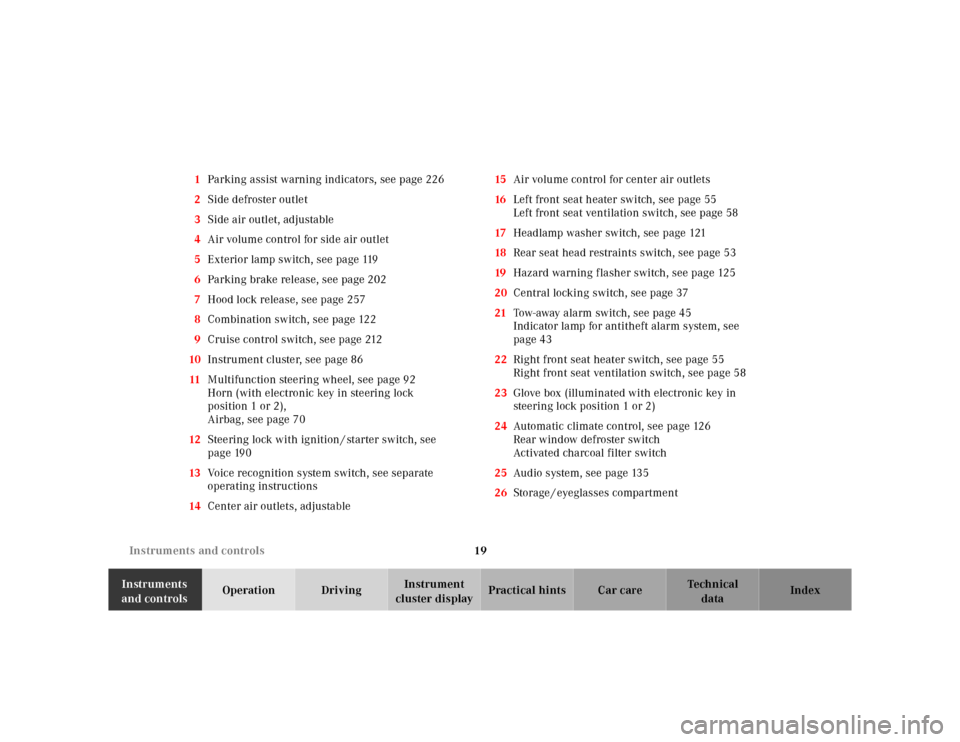
cluster displayPractical hints Car care Index 1Parking assist warning indicators, see page 226
2Side defroster outlet
3Side air outlet, adjustable
4Air volume control for side air outlet
5Exterior lamp switch, see page 119
6Parking brake release, see page 202
7Hood lock release, see page 257
8Combination switch, see page 122
9Cruise control switch, see page 212
10Instrument cluster, see page 86
11Multifunction steering wheel, see page 92
Horn (with electronic key in steering lock
position 1 or 2),
Airbag, see page 70
12Steering lock with ignition / starter switch, see
page 190
13Voice recognition system switch, see separate
operating instructions
14Center air outlets, adjustable15Air volume control for center air outlets
16Left front seat heater switch, see page 55
Left front seat ventilation switch, see page 58
17Headlamp washer switch, see page 121
18Rear seat head restraints switch, see page 53
19Hazard warning flasher switch, see page 125
20Central locking switch, see page 37
21Tow-away alarm switch, see page 45
Indicator lamp for antitheft alarm system, see
page 43
22Right front seat heater switch, see page 55
Right front seat ventilation switch, see page 58
23Glove box (illuminated with electronic key in
steering lock position 1 or 2)
24Automatic climate control, see page 126
Rear window defroster switch
Activated charcoal filter switch
25Audio system, see page 135
26Storage / eyeglasses compartment
Page 25 of 341
22 Contents - Operation
Te ch n ica l
data Instruments
and controlsOperationDrivingInstrument
cluster displayPractical hints Car care Index
OperationVehicle keys ...................................... 24
Start lock-out .................................... 27
General notes on the
central locking system ............... 28
Central locking system ................... 29
Radio frequency and
infrared remote control ............... 29
Opening the trunk ....................... 32
Opening and closing
windows and sliding/pop-up
roof from outside .......................... 33
Panic button .................................. 34
Mechanical keys ........................... 34
Doors .................................................. 35
Central locking switch .................... 37
Automatic central locking .............. 38
Emergency unlocking
in case of accident ...................... 38
Trunk ................................................. 39
Trunk lid release switch ................. 41
Trunk lid emergency release ......... 42
Antitheft alarm system ................... 43Tow-away alarm ............................... 45
Power seats front ............................. 46
Front seat head restraints .............. 52
Rear seat head restraints ............... 53
Multicontour seat ............................ 54
Seat heater ........................................ 55
Seat ventilation ................................ 58
Seat belts and integrated
restraint system .......................... 60
Seat belts .......................................... 60
Seat belt nonusage
warning system ........................... 61
BabySmart
TM airbag
deactivation system ................... 67
Self-test BabySmart
TM
without special child
seat installed ................................ 67
Supplemental restraint
system (SRS) ............................... 68
Emergency tensioning
retractor (ETR) ............................ 69
Airbags .............................................. 70Safety guidelines for the
seat belt, emergency
tensioning retractor
and airbag .................................... 76
Infant and child
restraint systems ......................... 78
Steering wheel adjustment ............ 81
Rear view mirrors ............................ 82
Instrument cluster ........................... 86
Multifunction steering wheel,
multifunction display ................. 92
Trip and main odometer,
FSS and engine oil
level display ................................. 96
Audio systems .................................. 97
Radio .............................................. 97
CD player ....................................... 98
Cassette player ............................. 99
Telephone ........................................ 100
Telephone book .......................... 100
Redialing ..................................... 102
Incoming call .............................. 104
Navigation system .......................... 105
Trip computer ................................. 106
Page 49 of 341
46 Seats
Te ch n ica l
data Instruments
and controlsOperationDrivingInstrument
cluster displayPractical hints Car care Index
Power seats front
To operate the front power seat adjustment switches,
turn electronic key in steering lock to position 1 or 2
(with the driver’s or front passenger’s door open, the
power seats can also be operated with the electronic key
removed or in steering lock position 0).
Wa r n i n g !
Do not adjust the driver’s seat while driving.
Adjusting the seat while driving could cause the
driver to lose control of the vehicle.Never ride in a moving vehicle with the backrest
reclined. Sitting in an excessively reclined position
can be dangerous. You could slide under the seat
belt in a collision. If you slide under it, the belt
would apply force at the abdomen or neck. That
could cause serious or even fatal injuries. The
backrest and seat belt provide the best restraint
when the wearer is in an upright position and the
belt properly positioned on the body.Never place hands under seat or near any moving
parts while a seat is being adjusted.
When leaving the vehicle always remove the
electronic key from the steering lock, and lock your
vehicle.The power seats can also be operated with the
driver’s or front passenger door open. Do not leave
children unattended in the vehicle or with access
to an unlocked vehicle. Unsupervised use of vehicle
equipment may cause serious personal injury.
Page 50 of 341
47 Seats
Te ch n ica l
data Instruments
and controlsOperationDrivingInstrument
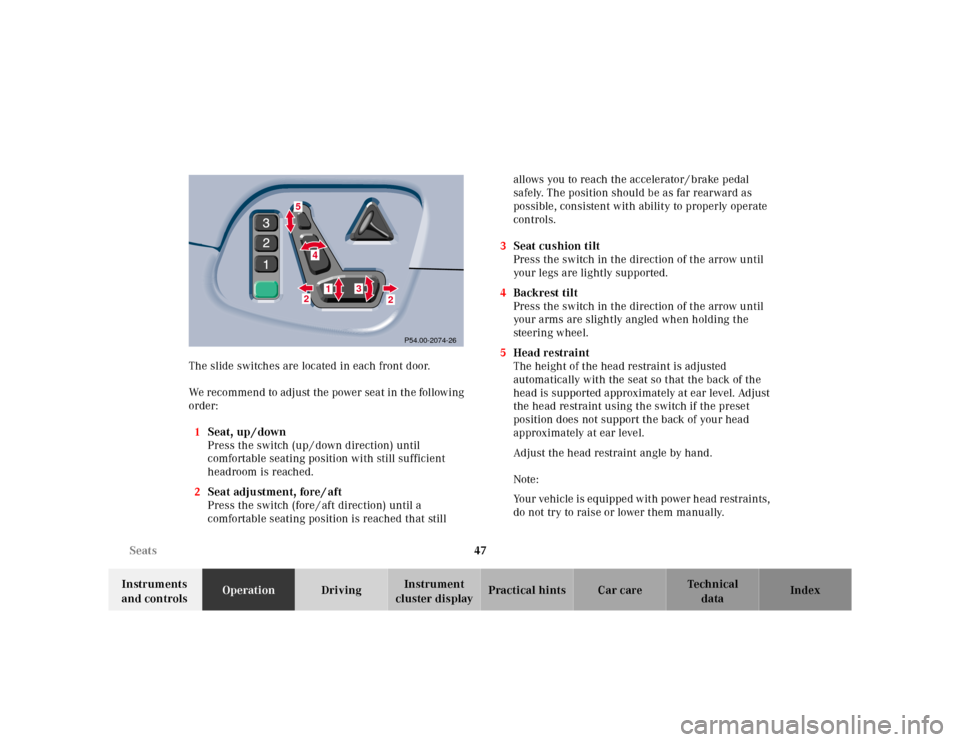
cluster displayPractical hints Car care Index The slide switches are located in each front door.
We recommend to adjust the power seat in the following
order:
1Seat, up / down
Press the switch (up / down direction) until
comfortable seating position with still sufficient
headroom is reached.
2Seat adjustment, fore / aft
Press the switch (fore / aft direction) until a
comfortable seating position is reached that still allows you to reach the accelerator / brake pedal
safely. The position should be as far rearward as
possible, consistent with ability to properly operate
controls.
3Seat cushion tilt
Press the switch in the direction of the arrow until
your legs are lightly supported.
4Backrest tilt
Press the switch in the direction of the arrow until
your arms are slightly angled when holding the
steering wheel.
5Head restraint
The height of the head restraint is adjusted
automatically with the seat so that the back of the
head is supported approximately at ear level. Adjust
the head restraint using the switch if the preset
position does not support the back of your head
approximately at ear level.
Adjust the head restraint angle by hand.
Note:
Your vehicle is equipped with power head restraints,
do not try to raise or lower them manually.
2
5
4
3
2
1
P54.00-2074-26
Page 51 of 341
48 Seats
Te ch n ica l
data Instruments
and controlsOperationDrivingInstrument
cluster displayPractical hints Car care Index
Synchronizing Head Restraints
If the power supply was interrupted (battery
disconnected or empty), the head restraints are no
longer adjusted automatically.
To resynchronize the adjustment feature, turn
electronic key in steering lock to position 2, move the
seat completely forward and the head restraint fully
down, and hold respective buttons for approximately
two seconds.Caution!
Do not remove head restraints except when mounting
seat covers. For removal refer to Front seat head
restraints, see page 52. Whenever restraints have been
removed be sure to reinstall them before driving.
Page 52 of 341
49 Seats
Te ch n ica l
data Instruments
and controlsOperationDrivingInstrument
cluster displayPractical hints Car care Index Memory function
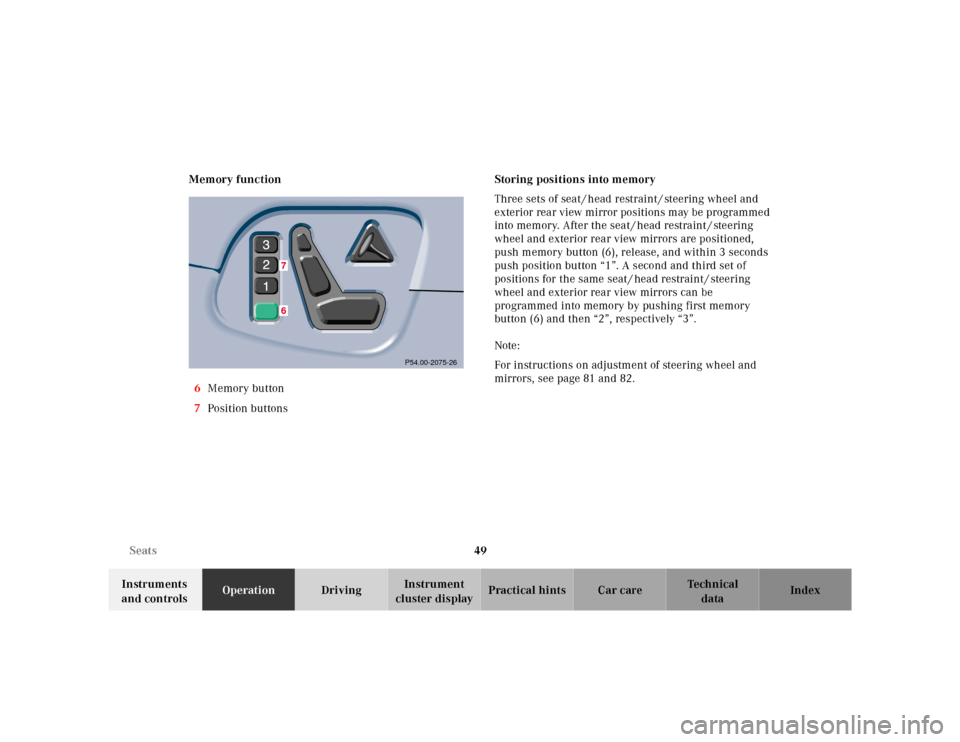
6Memory button
7Position buttonsStoring positions into memory
Three sets of seat / head restraint / steering wheel and
exterior rear view mirror positions may be programmed
into memory. After the seat / head restraint / steering
wheel and exterior rear view mirrors are positioned,
push memory button (6), release, and within 3 seconds
push position button “1”. A second and third set of
positions for the same seat / head restraint / steering
wheel and exterior rear view mirrors can be
programmed into memory by pushing first memory
button (6) and then “2”, respectively “3”.
Note:
For instructions on adjustment of steering wheel and
mirrors, see page 81 and 82.
76
P54.00-2075-26
Page 53 of 341
50 Seats
Te ch n ica l
data Instruments
and controlsOperationDrivingInstrument
cluster displayPractical hints Car care Index
Recalling positions from memory
To recall a seat / head restraint / steering wheel and
exterior rear view mirror position, push and hold
position button “1”, “2” or “3” until seat / head restraint /
steering wheel and exterior rear view mirror movement
has stopped. The seat / head restraint / steering wheel
and exterior rear view mirror movement stops when the
position button is released.
Caution!
Do not operate the power seats using the memory
button if the seat backrest is in an excessively reclined
position. Doing so could cause damage to front or rear
seats.
First move the backrest to an upright position.Important!
Prior to operating the vehicle, the driver should adjust
the seat height for proper vision as well as fore / aft
placement and backrest angle to ensure adequate
control, reach, operation, and comfort. The head
restraint should also be adjusted for proper height. See
also airbag section for proper seat positioning.
In addition, also adjust the steering wheel to ensure
adequate control, reach, operation, and comfort.
Both the inside and outside rear view mirrors should be
adjusted for adequate rearward vision.
Fasten seat belts. Infants and small children should be
seated in a properly secured restraint system that
complies with U.S. Federal Motor Vehicle Safety
Standard 213 and Canadian Motor Vehicle Safety
Stand ard 213.1.
All seat, head restraint, steering wheel, and rear view
mirror adjustments as well as fastening of seat belts
should be done before the vehicle is put into motion.
Page 57 of 341
54 Seats
Te ch n ica l
data Instruments
and controlsOperationDrivingInstrument
cluster displayPractical hints Car care Index
Multicontour seat (optional)
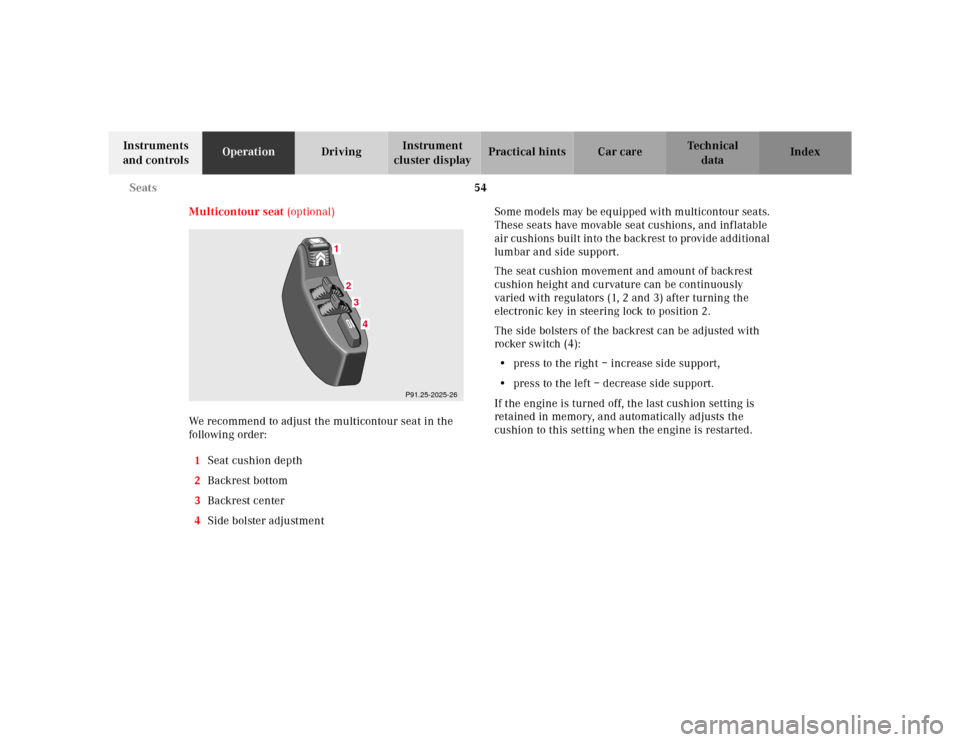
We recommend to adjust the multicontour seat in the
following order:
1Seat cushion depth
2Backrest bottom
3Backrest center
4Side bolster adjustmentSome m od els may be eq uipped with m ulticontour sea ts.
These seats have movable seat cushions, and inflatable
air cushions built into the backrest to provide additional
lumbar and side support.
The seat cushion movement and amount of backrest
cushion height and curvature can be continuously
varied with regulators (1, 2 and 3) after turning the
electronic key in steering lock to position 2.
The side bolsters of the backrest can be adjusted with
rocker switch (4):
•press to the right – increase side support,
•press to the left – decrease side support.
If the engine is turned off, the last cushion setting is
retained in memory, and automatically adjusts the
cushion to this setting when the engine is restarted.
1
234
P91.25-2025-26
Page 78 of 341
75 Restraint systems
Te ch n ica l
data Instruments
and controlsOperationDrivingInstrument
cluster displayPractical hints Car care Index
• Sit properly belted in an upright position with
your back against the backrest.• Adjust the driver’s seat as far as possible
rearward, still permitting proper operation of
vehicle controls. The distance from the center
of the driver’s breastbone to the center of the
airbag cover on the steering wheel must be at
least ten inches (25 cm) or more. You should be
able to accomplish this by a combination of
adjustments to the seat and steering wheel. If
you have any problems, please see your
authorized Mercedes-Benz Center.• Do not lean with your head or chest close to the
steering wheel or dashboard.• Keep hands on the outside of steering wheel
rim. Placing hands and arms inside the rim
can increase the risk and potential severity of
hand / arm injury when driver front airbag
inflates.• Adjust the front passenger seat as far as
possible rearward from the dashboard when
the seat is occupied.
• Occupants, especially children, should never
lean their heads in the area of the door where
the side airbag inflates. This could result in
serious injuries or death should the airbag be
triggered. Always sit upright, properly use the
seatbelts and appropriate size infant or child
restraint system• Children 12 years old and under must never
ride in the front seat, except in a Mercedes-
Benz authorized Baby Smart
TM compatible
child seat, which operates with the
BabySmart
TM system installed in the vehicle to
deactivate the passenger front airbag when it
is properly installed. Otherwise they will be
struck by the airbag when it inflates in a crash.
If this happens, serious or fatal injury can
result.
Failure to follow these instructions can result in
severe injuries to you or other occupants.