height MERCEDES-BENZ G-CLASS 2011 User Guide
[x] Cancel search | Manufacturer: MERCEDES-BENZ, Model Year: 2011, Model line: G-CLASS, Model: MERCEDES-BENZ G-CLASS 2011Pages: 288, PDF Size: 11.6 MB
Page 199 of 288
X To remove: make sure that cargo
compartment cover ; is rolled up.
XSlide catches : on the left-hand and right-
hand sides of cargo compartment
cover ; towards the center of the vehicle.
XSwing cargo compartment cover ; up and
out.
XTo install: slide catches : towards the
center of the vehicle.
XInsert cargo compartment cover ; into
the recesses in the side trim.
XPress the right and left sides of cargo
compartment cover ; downwards until
cargo compartment cover ; engages.
XSlide catches : in the direction of the side
trim.
Roof carrier
The roof is not suited for transporting loads.
Never use roof rails or other accessories
mounted on the roof.
GWarning!
Do not load items on the roof. It may cause
instability during some maneuvers which
could result in an accident.
Features
Cup holders
Important safety notes
GWarning
In order to help prevent spilling liquids on
vehicle occupants and/or vehicle equipment,
only use containers that fit into the cup
holder. Use lids on open containers and do
not fill containers to a height where the
contents, especially hot liquids, could spill
during braking, vehicle maneuvers, or in an
accident. Liquids spilled on vehicle occupants
may cause serious personal injury. Liquids
spilled on vehicle equipment may cause
damage not covered by the Mercedes-Benz
Limited Warranty.
When not in use, keep the cup holder closed.
An open cup holder may cause injury to you
or others when contacted during braking,
vehicle maneuvers, or in an accident.
Keep in mind that objects placed in the cup
holder may come loose during braking,
vehicle maneuvers, or in an accident and be
thrown around in the vehicle interior. Objects
thrown around in the vehicle interior may
cause an accident and/or serious personal
injury.
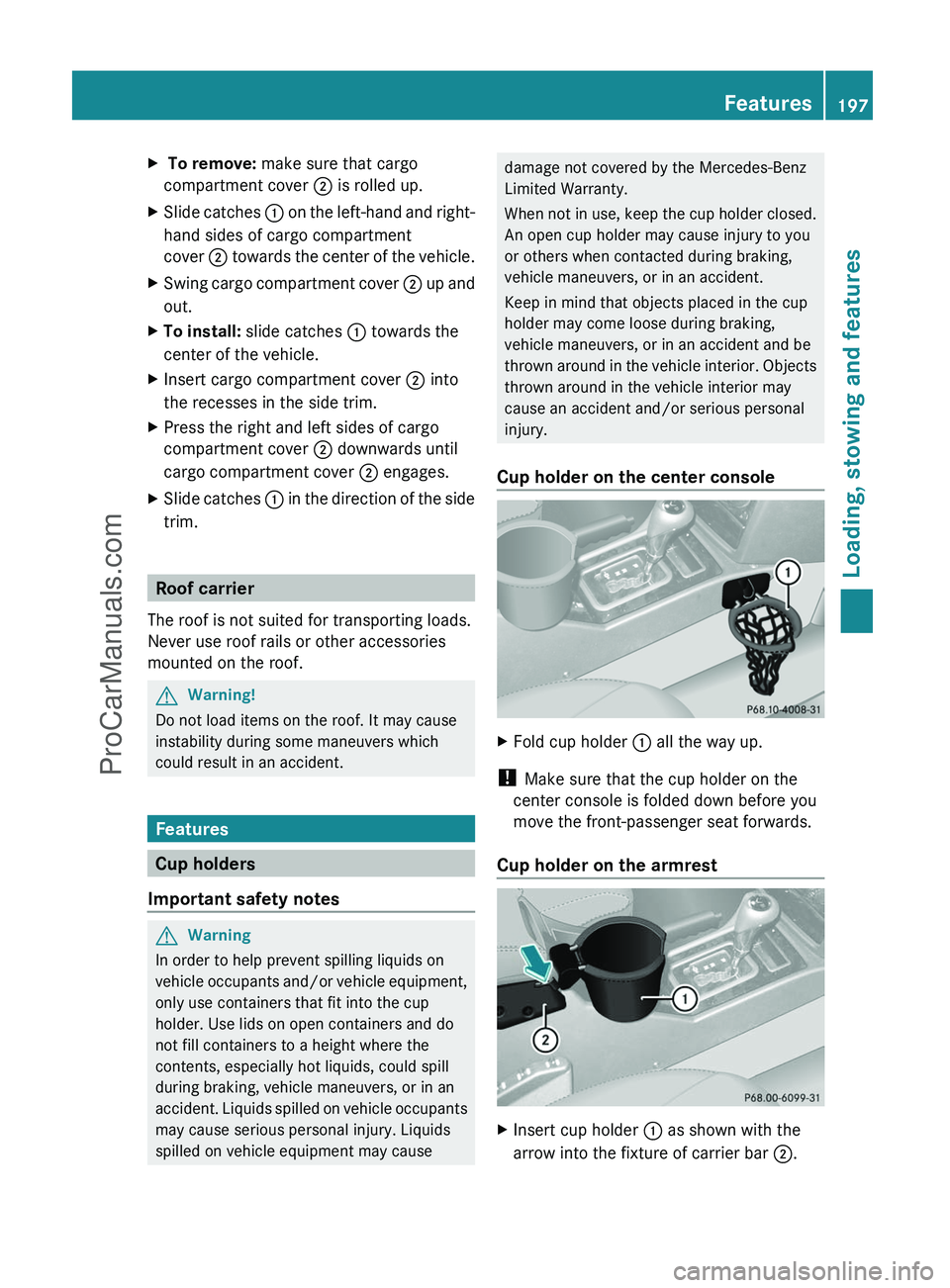
Cup holder on the center console
XFold cup holder : all the way up.
! Make sure that the cup holder on the
center console is folded down before you
move the front-passenger seat forwards.
Cup holder on the armrest
XInsert cup holder : as shown with the
arrow into the fixture of carrier bar ;.
Features197Loading, stowing and featuresZProCarManuals.com
Page 217 of 288
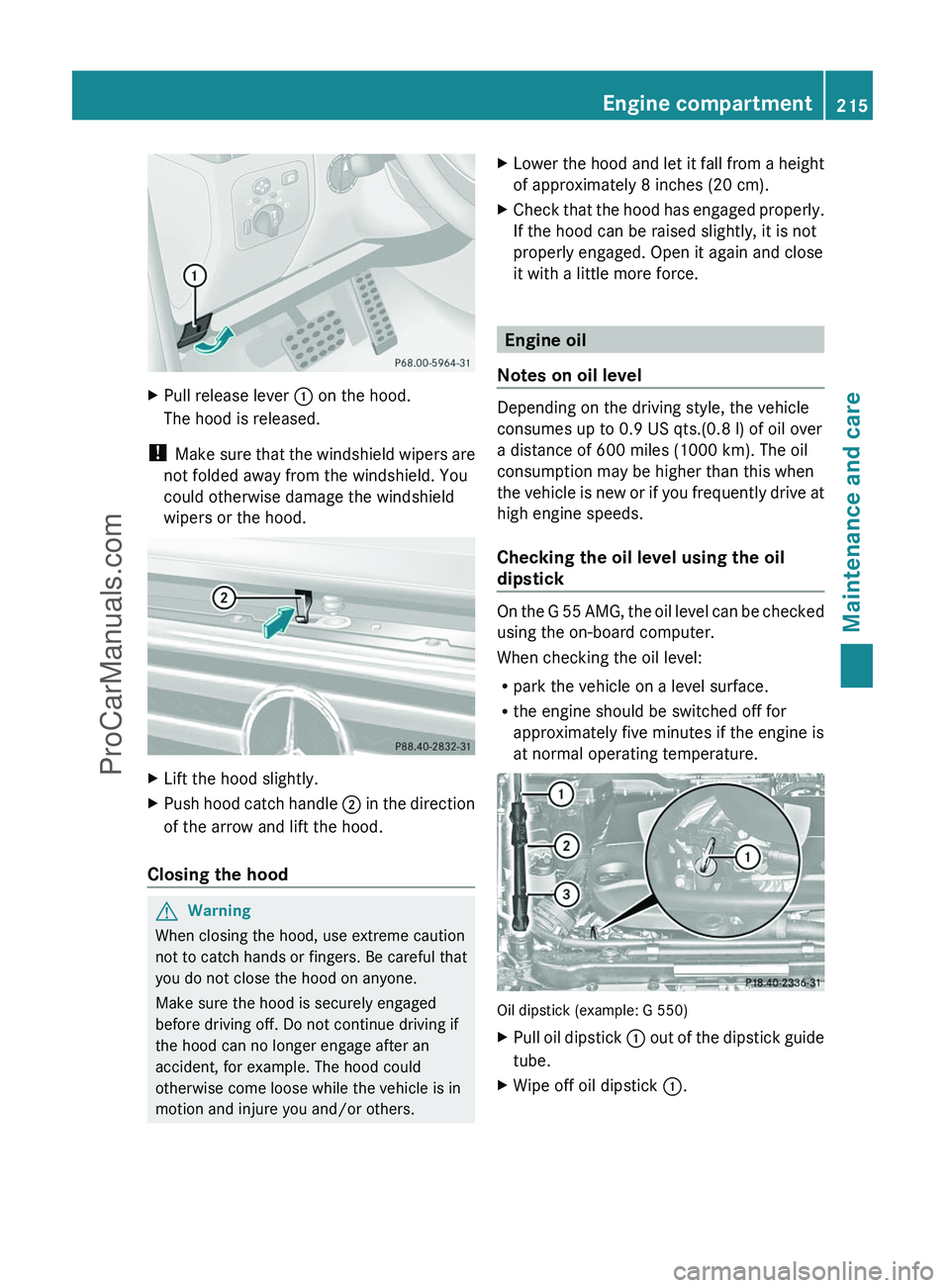
XPull release lever : on the hood.
The hood is released.
! Make sure that the windshield wipers are
not folded away from the windshield. You
could otherwise damage the windshield
wipers or the hood.
XLift the hood slightly.XPush hood catch handle ; in the direction
of the arrow and lift the hood.
Closing the hood
GWarning
When closing the hood, use extreme caution
not to catch hands or fingers. Be careful that
you do not close the hood on anyone.
Make sure the hood is securely engaged
before driving off. Do not continue driving if
the hood can no longer engage after an
accident, for example. The hood could
otherwise come loose while the vehicle is in
motion and injure you and/or others.
XLower the hood and let it fall from a height
of approximately 8 inches (20 cm).XCheck that the hood has engaged properly.
If the hood can be raised slightly, it is not
properly engaged. Open it again and close
it with a little more force.
Engine oil
Notes on oil level
Depending on the driving style, the vehicle
consumes up to 0.9 US qts.(0.8 l) of oil over
a distance of 600 miles (1000 km). The oil
consumption may be higher than this when
the vehicle is new or if you frequently drive at
high engine speeds.
Checking the oil level using the oil
dipstick
On the G 55 AMG, the oil level can be checked
using the on-board computer.
When checking the oil level:
R park the vehicle on a level surface.
R the engine should be switched off for
approximately five minutes if the engine is
at normal operating temperature.
Oil dipstick (example: G 550)
XPull oil dipstick : out of the dipstick guide
tube.XWipe off oil dipstick :.Engine compartment215Maintenance and careZProCarManuals.com
Page 235 of 288
Raising the vehicleGWarning!
When jacking up the vehicle, only use the jack
which has been specifically approved by
Mercedes-Benz for your vehicle.
The jack is designed exclusively for jacking up
the vehicle under the axle housing. Make sure
the jack is positioned correctly under the axle
housing. The jack must always be vertical
when in use, especially on inclines or
declines.
The jack is intended only for lifting the vehicle
briefly for wheel changes. It is not suited for
performing maintenance work under the
vehicle. To help avoid personal injury, use the
jack only to lift the vehicle during a wheel
change.
Never get beneath the vehicle while it is
supported by the jack. Keep hands and feet
away from the area under the lifted vehicle.
Always lower the vehicle onto sufficient
capacity jackstands before working under the
vehicle.
Always firmly engage the parking brake and
block the wheels with wheel chocks or other
sizeable objects before raising the vehicle
with the jack. Do not disengage the parking
brake while the vehicle is raised.
Make sure that the ground on which the
vehicle is standing and where you place the
jack is solid, level and not slippery. If
necessary, use a large underlay. On slippery
surfaces, such as tiled floors, you should use
a non-slip underlay, for example a rubber mat.
Do not use wooden blocks or similar objects
to support the jack. Otherwise the jack may
not be able to achieve its load-bearing
capacity if it is not at its full height.
Never start the engine when the vehicle is
raised.
Also observe the notes on the jack.
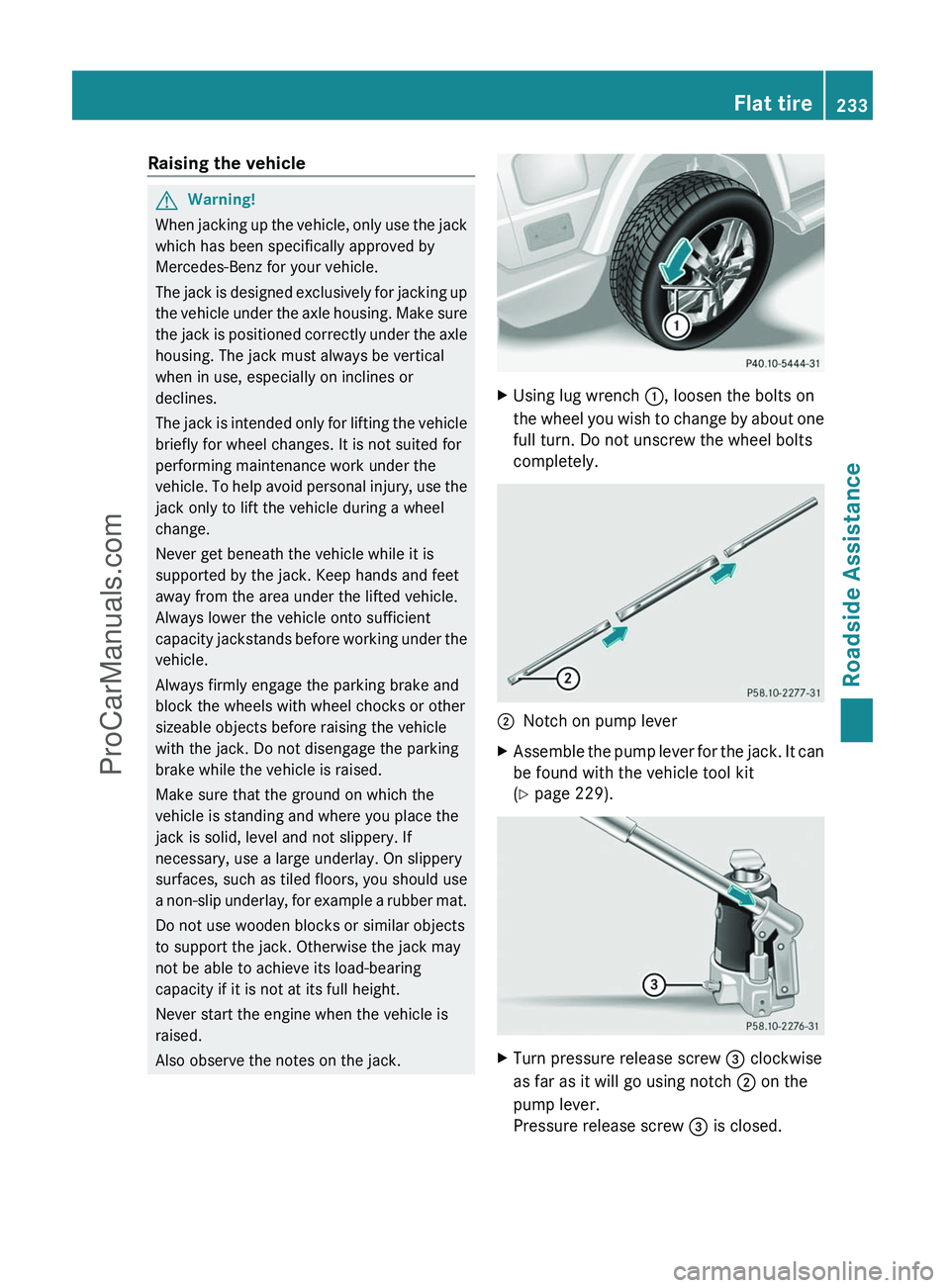
XUsing lug wrench :, loosen the bolts on
the wheel you wish to change by about one
full turn. Do not unscrew the wheel bolts
completely.;Notch on pump leverXAssemble the pump lever for the jack. It can
be found with the vehicle tool kit
( Y page 229).XTurn pressure release screw = clockwise
as far as it will go using notch ; on the
pump lever.
Pressure release screw = is closed.Flat tire233Roadside AssistanceZProCarManuals.com
Page 265 of 288
DLoad index (Y page 265)ETire name
i
Tire data is vehicle-specific and may
deviate from the data in the example.
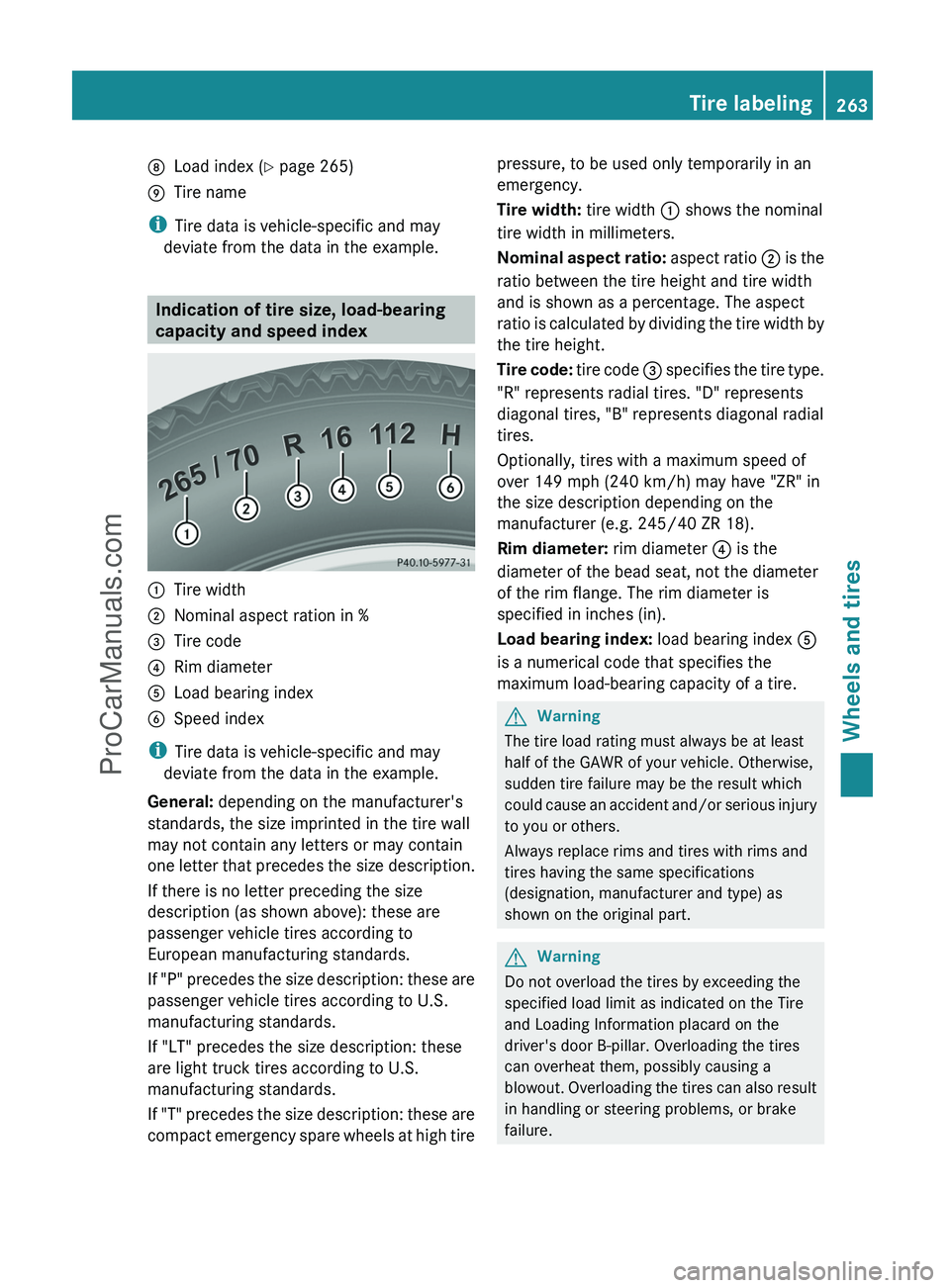
Indication of tire size, load-bearing
capacity and speed index
:Tire width;Nominal aspect ration in %=Tire code?Rim diameterALoad bearing indexBSpeed index
i Tire data is vehicle-specific and may
deviate from the data in the example.
General: depending on the manufacturer's
standards, the size imprinted in the tire wall
may not contain any letters or may contain
one letter that precedes the size description.
If there is no letter preceding the size
description (as shown above): these are
passenger vehicle tires according to
European manufacturing standards.
If "P" precedes the size description: these are
passenger vehicle tires according to U.S.
manufacturing standards.
If "LT" precedes the size description: these
are light truck tires according to U.S.
manufacturing standards.
If "T" precedes the size description: these are
compact emergency spare wheels at high tire
pressure, to be used only temporarily in an
emergency.
Tire width: tire width : shows the nominal
tire width in millimeters.
Nominal aspect ratio: aspect ratio ; is the
ratio between the tire height and tire width
and is shown as a percentage. The aspect
ratio is calculated by dividing the tire width by
the tire height.
Tire code: tire code = specifies the tire type.
"R" represents radial tires. "D" represents
diagonal tires, "B" represents diagonal radial
tires.
Optionally, tires with a maximum speed of
over 149 mph (240 km/h) may have "ZR" in
the size description depending on the
manufacturer (e.g. 245/40 ZR 18).
Rim diameter: rim diameter ? is the
diameter of the bead seat, not the diameter
of the rim flange. The rim diameter is
specified in inches (in).
Load bearing index: load bearing index A
is a numerical code that specifies the
maximum load-bearing capacity of a tire.GWarning
The tire load rating must always be at least
half of the GAWR of your vehicle. Otherwise,
sudden tire failure may be the result which
could cause an accident and/or serious injury
to you or others.
Always replace rims and tires with rims and
tires having the same specifications
(designation, manufacturer and type) as
shown on the original part.
GWarning
Do not overload the tires by exceeding the
specified load limit as indicated on the Tire
and Loading Information placard on the
driver's door B-pillar. Overloading the tires
can overheat them, possibly causing a
blowout. Overloading the tires can also result
in handling or steering problems, or brake
failure.
Tire labeling263Wheels and tiresZProCarManuals.com
Page 270 of 288
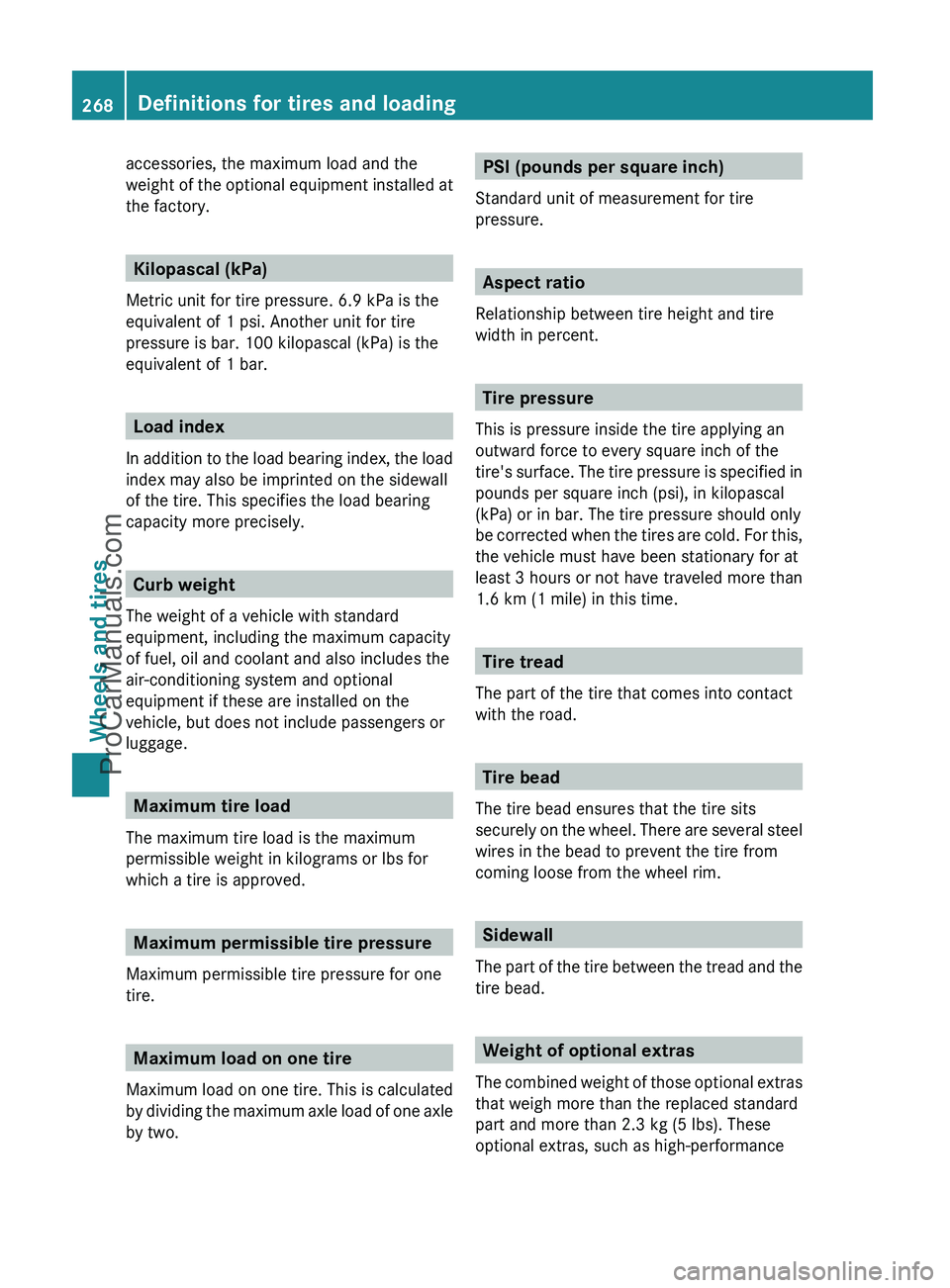
accessories, the maximum load and the
weight of the optional equipment installed at
the factory.
Kilopascal (kPa)
Metric unit for tire pressure. 6.9 kPa is the
equivalent of 1 psi. Another unit for tire
pressure is bar. 100 kilopascal (kPa) is the
equivalent of 1 bar.
Load index
In addition to the load bearing index, the load
index may also be imprinted on the sidewall
of the tire. This specifies the load bearing
capacity more precisely.
Curb weight
The weight of a vehicle with standard
equipment, including the maximum capacity
of fuel, oil and coolant and also includes the
air-conditioning system and optional
equipment if these are installed on the
vehicle, but does not include passengers or
luggage.
Maximum tire load
The maximum tire load is the maximum
permissible weight in kilograms or lbs for
which a tire is approved.
Maximum permissible tire pressure
Maximum permissible tire pressure for one
tire.
Maximum load on one tire
Maximum load on one tire. This is calculated
by dividing the maximum axle load of one axle
by two.
PSI (pounds per square inch)
Standard unit of measurement for tire
pressure.
Aspect ratio
Relationship between tire height and tire
width in percent.
Tire pressure
This is pressure inside the tire applying an
outward force to every square inch of the
tire's surface. The tire pressure is specified in
pounds per square inch (psi), in kilopascal
(kPa) or in bar. The tire pressure should only
be corrected when the tires are cold. For this,
the vehicle must have been stationary for at
least 3 hours or not have traveled more than
1.6 km (1 mile) in this time.
Tire tread
The part of the tire that comes into contact
with the road.
Tire bead
The tire bead ensures that the tire sits
securely on the wheel. There are several steel
wires in the bead to prevent the tire from
coming loose from the wheel rim.
Sidewall
The part of the tire between the tread and the
tire bead.
Weight of optional extras
The combined weight of those optional extras
that weigh more than the replaced standard
part and more than 2.3 kg (5 lbs). These
optional extras, such as high-performance
268Definitions for tires and loadingWheels and tires
ProCarManuals.com
Page 283 of 288
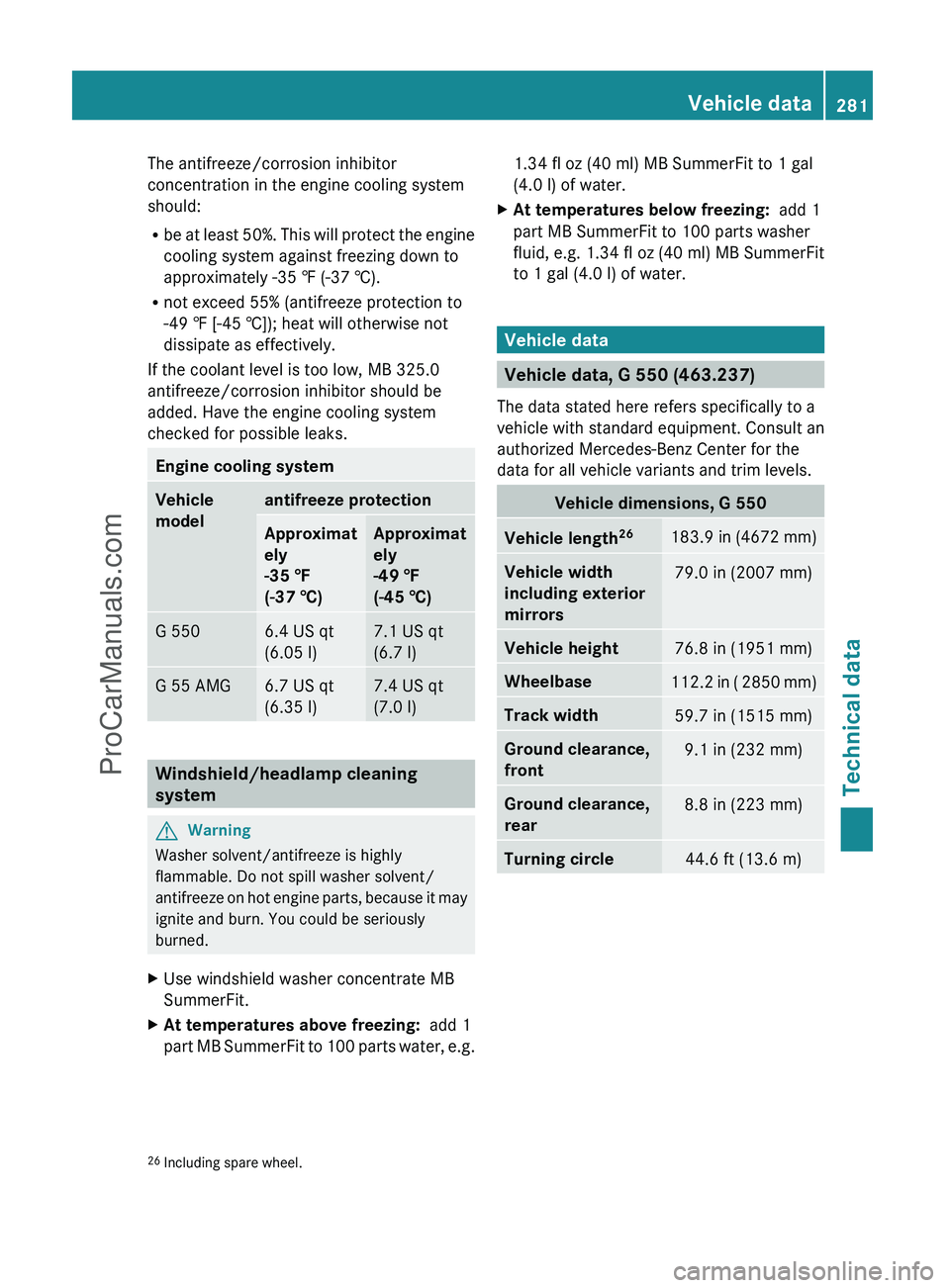
The antifreeze/corrosion inhibitor
concentration in the engine cooling system
should:
R be at least 50%. This will protect the engine
cooling system against freezing down to
approximately -35 ‡ (-37 †).
R not exceed 55% (antifreeze protection to
-49 ‡ [-45 †]); heat will otherwise not
dissipate as effectively.
If the coolant level is too low, MB 325.0
antifreeze/corrosion inhibitor should be
added. Have the engine cooling system
checked for possible leaks.Engine cooling systemVehicle
modelantifreeze protectionApproximat
ely
-35 ‡
(-37 †)Approximat
ely
-49 ‡
(-45 †)G 5506.4 US qt
(6.05 l)7.1 US qt
(6.7 l)G 55 AMG6.7 US qt
(6.35 l)7.4 US qt
(7.0 l)
Windshield/headlamp cleaning
system
GWarning
Washer solvent/antifreeze is highly
flammable. Do not spill washer solvent/
antifreeze on hot engine parts, because it may
ignite and burn. You could be seriously
burned.
XUse windshield washer concentrate MB
SummerFit.XAt temperatures above freezing: add 1
part MB SummerFit to 100 parts water, e.g.1.34 fl oz (40 ml) MB SummerFit to 1 gal
(4.0 l) of water.XAt temperatures below freezing: add 1
part MB SummerFit to 100 parts washer
fluid, e.g. 1.34 fl oz (40 ml) MB SummerFit
to 1 gal (4.0 l) of water.
Vehicle data
Vehicle data, G 550 (463.237)
The data stated here refers specifically to a
vehicle with standard equipment. Consult an
authorized Mercedes-Benz Center for the
data for all vehicle variants and trim levels.
Vehicle dimensions, G 550Vehicle length 26183.9 in
(4672 mm)Vehicle width
including exterior
mirrors79.0 in (2007 mm)Vehicle height76.8 in (1951 mm)Wheelbase112.2 in ( 2850 mm)Track width59.7 in (1515 mm)Ground clearance,
front9.1 in (232 mm)Ground clearance,
rear8.8 in (223 mm)Turning circle44.6 ft (13.6 m)26 Including spare wheel.Vehicle data281Technical dataZProCarManuals.com
Page 284 of 288
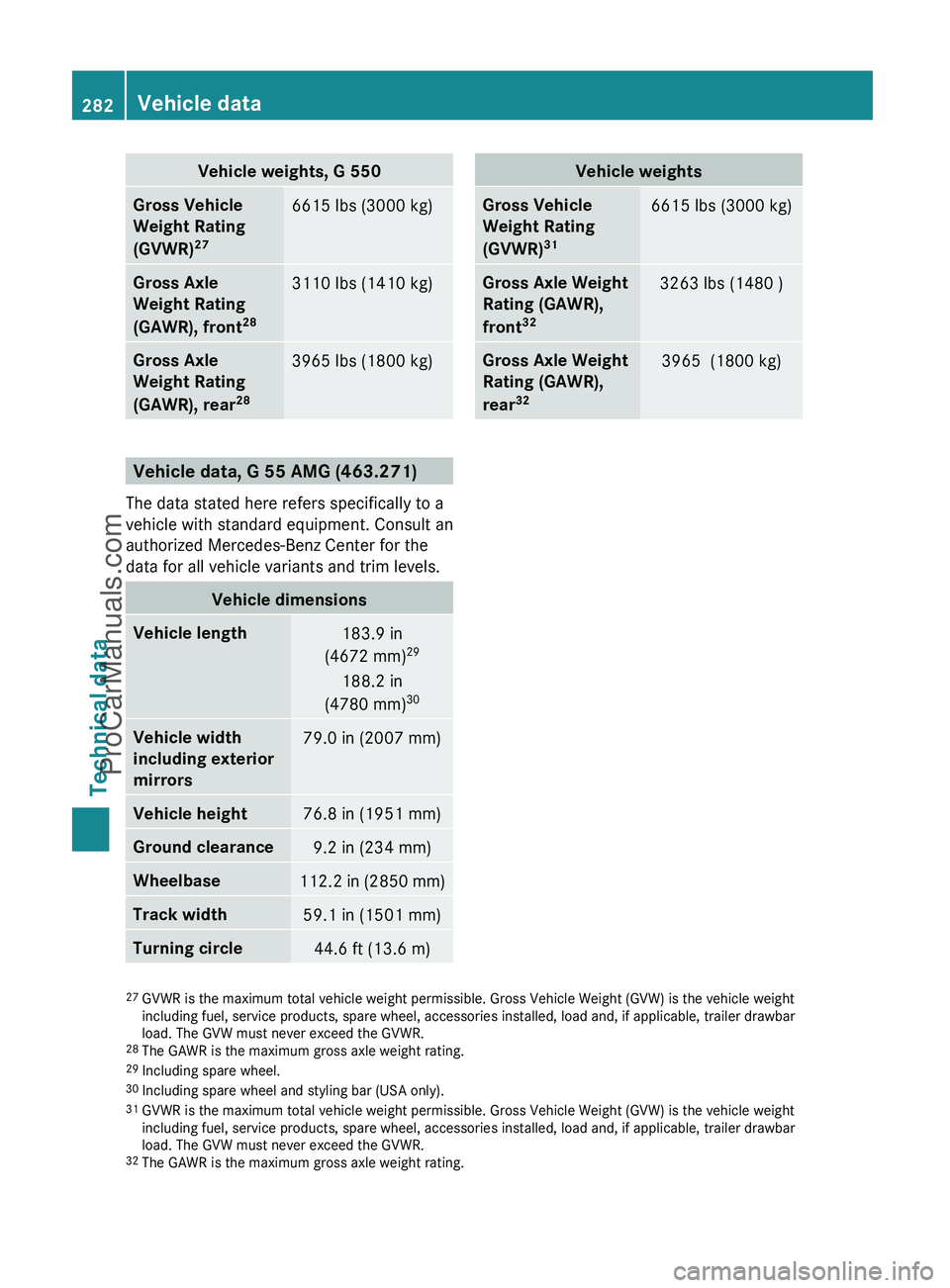
Vehicle weights, G 550Gross Vehicle
Weight Rating
(GVWR) 276615 lbs (3000 kg)Gross Axle
Weight Rating
(GAWR), front 283110 lbs (1410 kg)Gross Axle
Weight Rating
(GAWR), rear 283965 lbs (1800 kg)
Vehicle data, G 55 AMG (463.271)
The data stated here refers specifically to a
vehicle with standard equipment. Consult an
authorized Mercedes-Benz Center for the
data for all vehicle variants and trim levels.
Vehicle dimensionsVehicle length183.9 in
(4672 mm) 29
188.2 in
(4780 mm) 30Vehicle width
including exterior
mirrors79.0 in (2007 mm)Vehicle height76.8 in (1951 mm)Ground clearance9.2 in (234 mm)Wheelbase112.2 in (2850 mm)Track width59.1 in (1501 mm)Turning circle44.6 ft (13.6 m)Vehicle weightsGross Vehicle
Weight Rating
(GVWR) 316615 lbs (3000 kg)Gross Axle Weight
Rating (GAWR),
front 323263 lbs (1480 )Gross Axle Weight
Rating (GAWR),
rear 323965 (1800 kg)27
GVWR is the maximum total vehicle weight permissible. Gross Vehicle Weight (GVW) is the vehicle weight
including fuel, service products, spare wheel, accessories installed, load and, if applicable, trailer drawbar
load. The GVW must never exceed the GVWR.
28 The GAWR is the maximum gross axle weight rating.
29 Including spare wheel.
30 Including spare wheel and styling bar (USA only).
31 GVWR is the maximum total vehicle weight permissible. Gross Vehicle Weight (GVW) is the vehicle weight
including fuel, service products, spare wheel, accessories installed, load and, if applicable, trailer drawbar
load. The GVW must never exceed the GVWR.
32 The GAWR is the maximum gross axle weight rating.282Vehicle dataTechnical data
ProCarManuals.com