transmission MERCEDES-BENZ G-CLASS 2011 Owner's Manual
[x] Cancel search | Manufacturer: MERCEDES-BENZ, Model Year: 2011, Model line: G-CLASS, Model: MERCEDES-BENZ G-CLASS 2011Pages: 288, PDF Size: 11.6 MB
Page 130 of 288
Rthe automatic transmission is in selector
lever position N.
R you are driving no faster than 25 mph
(40 km/h).
You could otherwise damage the transfer
case.XPush the transfer case switch to LOW.
When the shift procedure is complete, the
L transfer case position appears in the
multifunction display.XShift the transmission to position D.
From LOW to HIGH
! Only carry out the gear selection if:
R the engine is running.
R the vehicle is rolling.
R the automatic transmission is in selector
lever position N.
R you are driving no faster than 43 mph
(70 km/h).
You could otherwise damage the transfer
case.
XPush the transfer case switch to HIGH.
When the shift procedure is complete, the
H transfer case position appears in the
multifunction display.
If the gear change is not completed, the
following messages could appear in the
display:
R TC Shift Conditions Not Fulfilled
You have not met one or more shift
conditions.
R TC In Neutral
The transfer case has canceled the gear
change process and is in N. The N transfer
case position appears in the multifunction
display.
GWarning!
If the transfer case is in Neutral, the park
position P of the automatic transmission will
not hold the vehicle. The parking brake must
be engaged to hold the vehicle in place.
R TC Shift Procedure Canceled
The transfer case has not performed the
gear change process.XCarry out the gear change process again.
Make sure to meet all conditions for
changing gears.
R Transfer Case Service Required
There is a malfunction in the transfer case.
XDo not shift the transfer case.XHave the vehicle checked at a qualified
specialist workshop as soon as possible,
e.g. at an authorized Mercedes-Benz
Center.
Shifting to neutral
GWarning!
If the transfer case is in Neutral, the park
position P of the automatic transmission will
not hold the vehicle. The parking brake must
be engaged to hold the vehicle in place.
XTurn the SmartKey to position 2 in the
ignition lock.XApply the parking brake.XDepress the brake pedal.XMove the selector lever to
position N (Y page 122).XPush the transfer case switch to LOW for
about 30 seconds.
When the shift procedure is complete, the
N transfer case position appears in the
multifunction display.
i If the transfer case is in N, the SmartKey
is in the ignition lock and you open the
driver's door, the TC In Neutral message
appears in the multifunction display. If you
then release the parking brake, a warning
tone will sound.
128Automatic transmissionDriving and parking
ProCarManuals.com
Page 131 of 288
Differential locks
General notes
Differential locks improve the traction of the
vehicle.
GWarning!
Never drive on firm road surfaces with
differential locks engaged. Never drive on
narrow bends with front-axle differential locks
engaged. With differential locks engaged, the
vehicle's ability to steer is severely restricted
and the danger of accidents is therefore
higher.
Do not engage or disengage differential locks
while driving on a bend. The vehicle may
otherwise make a jerking movement. You
could thus lose control of the vehicle and
cause an accident.
If you select a differential lock, ABS, 4ETS,
ESP ®
and BAS will be deactivated.
Your vehicle is equipped with a differential
lock for:
R the transfer case: this controls the balance
between the front and rear axles.
R the rear axle: this controls the balance
between the wheels on the rear axle.
R the front axle: this controls the balance
between the wheels on the front axle.
! In order to avoid damage to the transfer
case, you must operate the vehicle on a
dynamometer (1-axle dynamometer) only
if:
R the axle not driven on is jacked up
or
R the corresponding propeller shaft is
disconnected
and
R the differential lock of the transfer case
is engaged.
Otherwise, the transfer case could be
damaged.
Information about differentials and
differential locks
When the vehicle is driving through a bend,
the wheels on the outside of the bend must
travel a longer distance and must thus turn
more quickly than the wheels on the inside.
The differential, a transmission in the
drivetrain, balances out the different
rotational speeds and therefore enables
driving through bends.
The disadvantage of differentials: the wheels
with the least road grip are driven the hardest.
Example: a wheel on a driven axle stands on
snow-covered ground and thus has no
traction. This wheel receives the strongest
driving power from the differential, as the
force progression takes the path of least
resistance. The opposite wheel on this axle,
however, which stands on firm ground and
could therefore allow traction, receives no
driving power. 4ETS eliminates this
disadvantage and provides good steerability
by automatically braking the spinning wheel,
thus directing more driving power to the
wheel standing on firm ground, which is
therefore able to provide traction.
ESP® and 4ETS are traction systems that are
ideal for road driving and suitable for light off-
road driving. Off-road gear LOW likewise
improves off-road capabilities.
Moreover, the more difficult conditions in off-
road driving require further measures such as
locking one or several differentials. Your
vehicle is equipped with three differential
locks: a central differential lock for the
transfer case, a differential lock for the front
axle, and a differential lock for the rear axle.
Each differential lock can be engaged with the
respective switch on the center console.
When the central differential lock for the
transfer case is locked, the speed of the front
wheels is equal to that of the rear wheels.
When the differential for the rear axle is
locked, both rear wheels turn equally fast,
independent of their respective torques.
Keep in mind that by engaging the differential
Automatic transmission129Driving and parkingZProCarManuals.com
Page 132 of 288
locks, vehicle steerability is severely
restricted.
For your own safety, the safety of others, and
in order to avoid damage to the vehicle, the
differential locks must not be engaged when
driving on a firm road surface. Keep in mind
that when driving on firm road surfaces, the
unimpeded function of the differential is
necessary and must never be locked on firm
road surfaces. Vehicle steerability may
otherwise be lost and you may no longer be
able to steer the vehicle. For this reason, the
differential locks must be engaged
exclusively during off-road driving, and only
when activating the other driving systems
(4ETS, ESP ®
and off-road gear LOW) is no
longer sufficient.
Activating the differential lock
General notes
GWarning!
Never drive on firm road surfaces with
differential locks engaged. Never drive on
narrow bends with front-axle differential locks
engaged. With differential locks engaged, the
vehicle's ability to steer is severely restricted
and the danger of accidents is therefore
higher.
Do not engage or disengage differential locks
while driving on a bend. The vehicle may
otherwise make a jerking movement. You
could thus lose control of the vehicle and
cause an accident.
If you select a differential lock, ABS, 4ETS,
ESP ®
and BAS will be deactivated.
Activate the differential locks:
R off-road
R to deactivate ABS, 4ETS, ESP ®
and BAS
while off-road
R when fording
R on snow-covered, icy or dirty road surfaces
For further information on driving off-road,
see ( Y page 142).
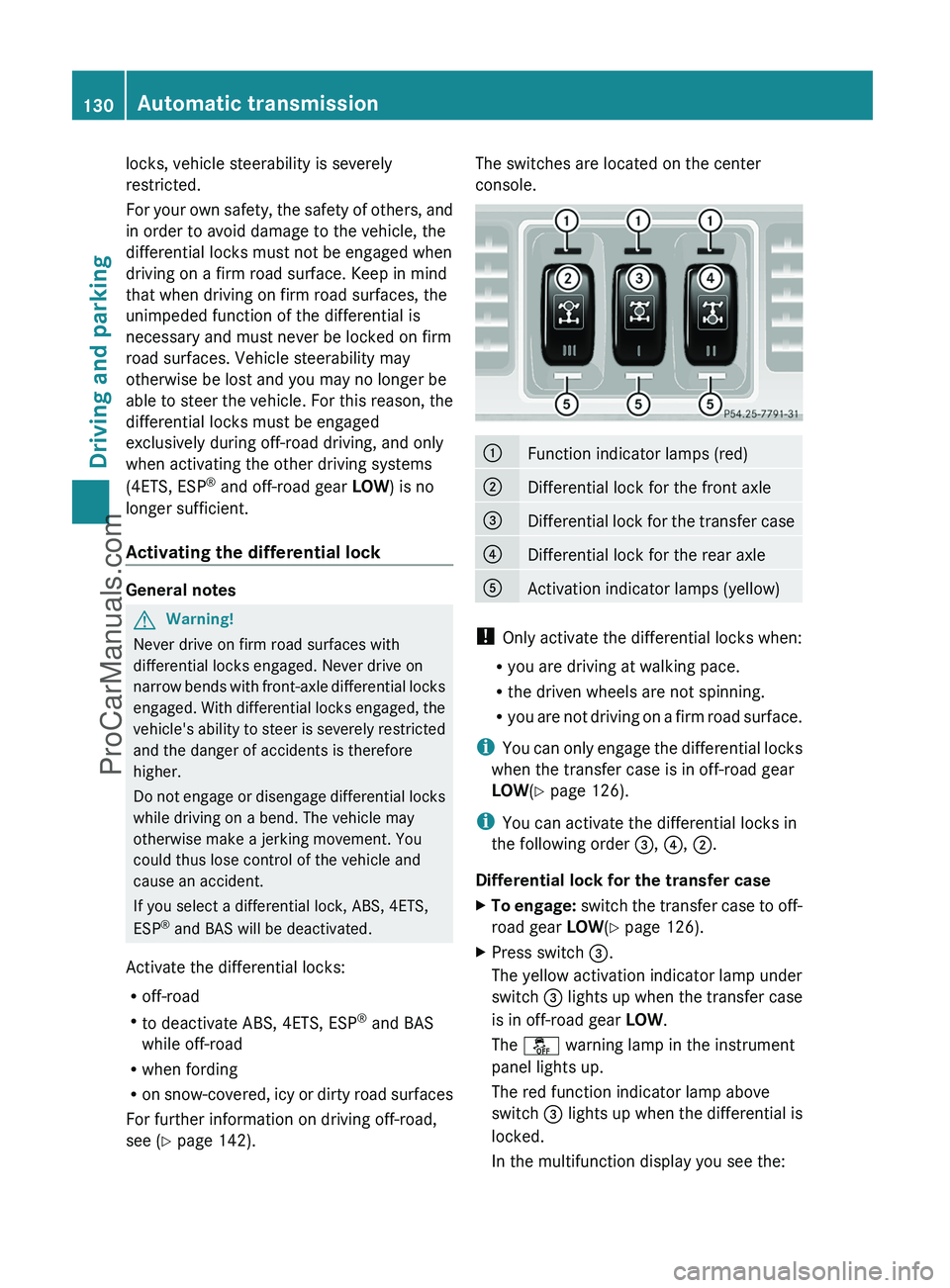
The switches are located on the center
console.:Function indicator lamps (red);Differential lock for the front axle=Differential lock for the transfer case?Differential lock for the rear axleAActivation indicator lamps (yellow)
! Only activate the differential locks when:
R you are driving at walking pace.
R the driven wheels are not spinning.
R you are not driving on a firm road surface.
i You can only engage the differential locks
when the transfer case is in off-road gear
LOW (Y page 126).
i You can activate the differential locks in
the following order =, ? , ; .
Differential lock for the transfer case
XTo engage: switch the transfer case to off-
road gear LOW(Y page 126).XPress switch =.
The yellow activation indicator lamp under
switch = lights up when the transfer case
is in off-road gear LOW.
The å warning lamp in the instrument
panel lights up.
The red function indicator lamp above
switch = lights up when the differential is
locked.
In the multifunction display you see the:130Automatic transmissionDriving and parking
ProCarManuals.com
Page 136 of 288
Problems with the fuel and fuel tankProblemPossible causes/consequences and M SolutionsFuel is leaking from the
vehicle.GRisk of explosion or fire
The fuel line or the fuel tank is defective.
XTurn the key to position 0 (Y page 117) in the ignition lock
immediately and remove it.XDo not restart the engine under any circumstances.XConsult a qualified specialist workshop.The fuel filler flap
cannot be opened.The fuel filler flap is not unlocked.
or
The key batteries are discharged.XUnlock the vehicle ( Y page 62).
or
XUnlock the vehicle using the mechanical key ( Y page 63).XOpen the rear door.XManually unlock the fuel filler flap using the emergency release
( Y page 133).The fuel filler flap is unlocked, but the opening mechanism is
jammed.XManually unlock the fuel filler flap using the emergency release
( Y page 133).XConsult a qualified specialist workshop.Parking
Important safety notes
GWarning
Do not park this vehicle in areas where
combustible materials can come into contact
with the hot exhaust system. Do not park the
vehicle on dry grassland or harvested grain
fields. Combustible materials, such as grass,
hay or leaves could be ignited by the hot
exhaust system and cause a vehicle fire.
Unintended vehicle movement can cause
serious personal injury or damage to the
vehicle or the vehicle drivetrain. To reduce
such risks, always do the following before
turning off the engine and leaving the vehicle:
R keep your right foot on the brake pedal.
R engage the parking brake.
R shift the automatic transmission into park
position P.
R slowly release the brake pedal.
R when parked on an incline, always turn the
front wheels towards the road curb.134ParkingDriving and parking
ProCarManuals.com
Page 137 of 288
Rturn the SmartKey in the ignition lock to
position 0 and remove the SmartKey from
the ignition lock.
R take the SmartKey with you and lock the
vehicle when leaving.
Switching off the engine
GWarning
Do not turn off the engine before the vehicle
has come to a complete stop. With the engine
not running, there is no power assistance for
the brake and steering systems. In this case,
it is important to keep in mind that a
considerably higher degree of effort is
necessary to brake and steer the vehicle.
GWarning!
Keep in mind that turning off the engine alone
only will shift AUTOTRONIC into neutral
position N automatically.
Always shift AUTOTRONIC into park position
P before turning off the engine.
Otherwise the vehicle could roll away which
could result in an accident and/or serious
personal injury.
XShift the transmission to position P.XTurn the SmartKey to position 0 in the
ignition lock and remove it.
The immobilizer is activated.XApply the parking brake firmly.
i The SmartKey can only be removed if the
automatic transmission is in position P.
Parking brake
GWarning
Engaging the parking brake while the vehicle
is in motion can cause the rear wheels to lock
up. You could lose control of the vehicle and
cause an accident. In addition, the vehicle's
brake lights do not light up when the parking
brake is engaged.
GWarning!
When leaving the vehicle, always remove the
SmartKey from the starter switch, take it with
you, and lock the vehicle. Do not leave
children unattended in the vehicle, or with
access to an unlocked vehicle. Children could
release the parking brake and/or shift the
automatic transmission out of park position
P , either of which could result in an accident
and/or serious personal injury.
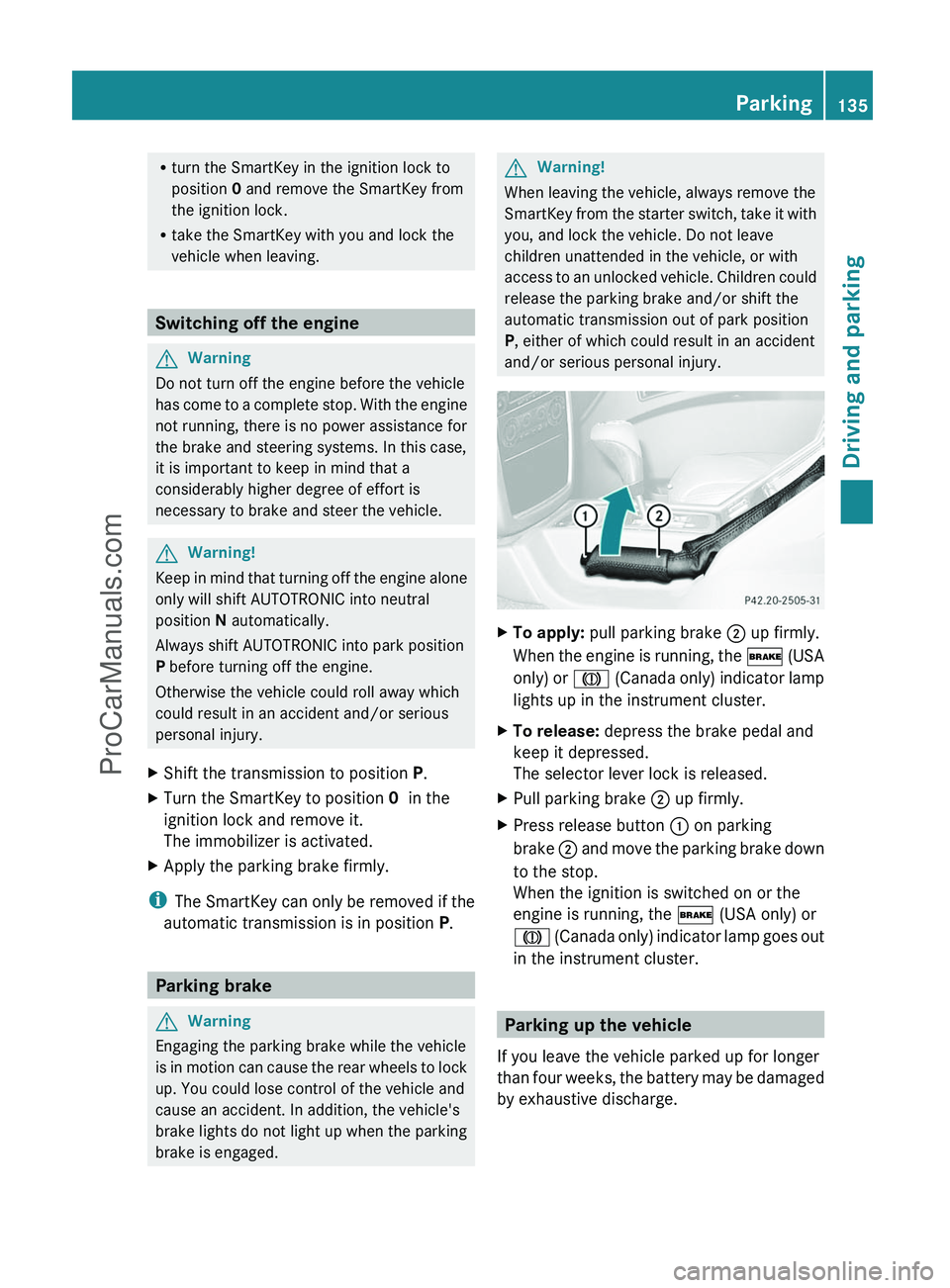
XTo apply: pull parking brake ; up firmly.
When the engine is running, the $ (USA
only) or J (Canada only) indicator lamp
lights up in the instrument cluster.XTo release: depress the brake pedal and
keep it depressed.
The selector lever lock is released.XPull parking brake ; up firmly.XPress release button : on parking
brake ; and move the parking brake down
to the stop.
When the ignition is switched on or the
engine is running, the $ (USA only) or
J (Canada only) indicator lamp goes out
in the instrument cluster.
Parking up the vehicle
If you leave the vehicle parked up for longer
than four weeks, the battery may be damaged
by exhaustive discharge.
Parking135Driving and parkingZProCarManuals.com
Page 143 of 288
RDrive slowly and at an even speed through
the water.
R Do not stop and do not switch off the
engine.
! Do not open any of the vehicle's doors
while fording. Otherwise, water could get
into the vehicle interior and damage the
vehicle's electronics and interior
equipment.
R Water offers a high degree of resistance,
and the ground is slippery and in some
cases unstable. Therefore, it is difficult and
dangerous to pull away in the water.
R Ensure that a bow wave does not form as
you drive.
R Clean any mud from the tire tread after
fording.
R Apply the brakes to dry them after fording.
Winter driving
General notes
GWarning
If the vehicle becomes trapped in snow,
ensure that snow is kept away from the
exhaust pipe and from around the vehicle as
long as the engine is running. Otherwise,
poisonous carbon monoxide (CO) may enter
the vehicle, resulting in loss of consciousness
and even death.
To assure sufficient fresh air ventilation, open
a window slightly on the side of the vehicle
not facing the wind.
Have your vehicle winterproofed at a qualified
specialist workshop, e.g. an authorized
Mercedes-Benz Center, at the onset of
winter.
Observe the notes in the "Winter operation"
section ( Y page 248).
Driving with summer tires
Observe the notes in the "Winter operation"
section ( Y page 248).
Slippery road surfaces
GWarning!
The outside temperature indicator is not
designed to serve as an ice-warning device
and is therefore unsuitable for that purpose.
Indicated temperatures just above the
freezing point do not guarantee that the road
surface is free of ice. The road may still be icy,
especially in wooded areas or on bridges.
GWarning!
On slippery road surfaces, never downshift in
order to obtain braking action. This could
result in drive wheel slip and reduced vehicle
control. Your vehicle’s ABS will not prevent
this type of control loss.
Do not engage the transfer case in position
LOW when driving on ice or packed snow. At
speeds below 18 mph (30 km/h) vehicle
steering is adversely affected by the Off-road
ABS.
Drive particularly carefully on slippery road
surfaces. Avoid sudden acceleration, steering
and braking maneuvers. Do not use cruise
control.
If the vehicle threatens to skid or cannot be
stopped when moving at low speed:
XShift the transmission to position N.XTry to bring the vehicle under control using
corrective steering.
i For more information on driving with
snow chains, see ( Y page 248).
GWarning
Make sure that you do not endanger other
road users when you apply the brakes.
Driving tips141Driving and parkingZProCarManuals.com
Page 145 of 288
RCheck the depth of water before fording
rivers and streams.
R When fording, do not stop and do not
switch off the engine.
R Look out for obstacles such as rocks, holes,
tree stumps and furrows.
R Always keep the doors, rear door, windows
and the sliding sunroof closed while the
vehicle is in motion.
R Switch off cruise control.
R Do not stray from marked routes or paths.
R Adapt your speed to the terrain. The
rougher, steeper or more ruts on the
terrain, the slower your speed should be.
R Drive slowly and at an even speed through
the water. Ensure that a bow wave does not
form as you drive.
R On sand, drive quickly to overcome the
rolling resistance. Otherwise, the vehicle
could dig itself into the sand.
R Do not jump with the vehicle as this will
interrupt the vehicle's propulsion.
R Avoid high engine speeds. Drive at
reasonable engine speeds (maximum
3000 rpm).
R Do not shift the automatic transmission to
transmission position N.
R Always check the vehicle for damage after
off-road driving.
i Information about retrofitting special all-
terrain tires is available from any
authorized Mercedes-Benz Center.HEnvironmental note
Protection of the environment is of primary
importance. Treat nature with respect.
Observe all prohibiting signs.
Checklist before driving off-road
XEngine oil level: check the engine oil and
top it up if necessary.
Only then does the engine receive enough
oil when the vehicle is standing on a steep
incline.! If the engine oil warning lamp lights up
while the vehicle is in motion, stop the
vehicle in a safe place as soon as possible.
Check the engine oil level. The engine oil
warning lamp warning must not be ignored.
Continuing the journey while the symbol is
displayed could lead to engine damage.XWheel-changing tool kit: check that the
jack is working and make sure you have the
wheelbrace, a robust tow cable and a
folding spade in the vehicle.XWheels and tires: check the tire tread
depth and tire pressure.XCheck for damage and remove any foreign
objects, e.g. small stones, from the
wheels/tires.XReplace any missing valve caps.XReplace dented or damaged wheels.XCarry a sound spare wheel.
Checklist after driving off-road
GWarning
If you feel a sudden significant vibration or
ride disturbance, or you suspect that possible
damage to your vehicle has occurred, you
should turn on the hazard warning flashers,
carefully slow down, and drive with caution to
an area which is a safe distance from the road.
Inspect the tires and the vehicle underbody
for possible damage. If the vehicle appears
unsafe, have the vehicle towed to the nearest
authorized Mercedes-Benz Center or tire
dealer for repairs.
Driving over rough terrain places greater
demands on your vehicle than driving on
normal roads. After driving off-road, check
the vehicle. This allows you to detect damage
promptly and reduce the risk of an accident
to yourself and other road users.
XShift the transfer case to HIGH
( Y page 126).XDisengage the differential locks
( Y page 129).Driving tips143Driving and parkingZProCarManuals.com
Page 146 of 288
XClean the headlamps and rear lights and
check for damage.XClean the front and rear license plates.XClean the wheels and tires with a water jet
and remove any foreign objects.XClean the wheels, tires, wheel arches and
the vehicle underside with a water jet;
check for any foreign objects and damage.XCheck whether twigs or other parts of
plants have become trapped. These
increase the risk of fire and can damage
fuel pipes, brake hoses or the rubber
bellows of the axle joints and propeller
shafts.XAfter the trip, examine without fail the
entire undercarriage, wheels, tires, brakes,
bodywork structure, steering, chassis and
exhaust system for damage.XAfter driving for extended periods across
sand, mud, gravel, water or in similarly dirty
conditions, have the brake discs, wheels,
brake pads/linings and axle joints checked
and cleaned.XIf you detect strong vibrations after off-road
driving, check for foreign objects in the
wheels and drivetrain and remove any that
you find. Foreign objects can disturb the
balance and cause vibrations.XTest the brakes.
Driving on sand
GWarning!
Do not reduce the tire inflation pressure
before driving through sand. However, if you
do so, remember to correct the tire inflation
pressure before continuing your trip. Driving
with reduced tire inflation pressure increases
the risk of losing control of the vehicle and
rolling over.
Observe the following rules when driving on
sand:
R shift the transfer case to
LOW (Y page 126).
R avoid high engine speeds.
R limit the shift range of the automatic
transmission according to the off-road
conditions.
R drive quickly to overcome the rolling
resistance. Otherwise, the vehicle could dig
itself into the sand.
R drive in the tracks of other vehicles if
possible. Make sure that the ruts are not
too deep, that the sand is firm enough and
that your vehicle has sufficient ground
clearance.
Tire ruts and gravel roads
Observe the following rules when driving
along ruts in off-road terrain or on roads with
loose gravel:
! Check that the ruts are not too deep and
that your vehicle has sufficient clearance.
Otherwise, your vehicle could be damaged
or bottom out and get stuck.
R shift the transfer case to
LOW (Y page 126).
R avoid high engine speeds.
R observe the safety notes (Y page 142) and
the general notes (Y page 142) on off-road
driving.
R restrict the shift range of the automatic
transmission to 1 (Y page 123).
R drive slowly.
R where ruts are too deep, drive with the
wheels of one side on the center grassy
area, if possible.
144Driving tipsDriving and parking
ProCarManuals.com
Page 148 of 288
RAvoid high engine speeds – drive at
appropriate engine speeds (no more than
3000 rpm).
R Use the braking power of the engine when
driving down a slope. Observe the engine
speed, do not overrev the engine.
i Further information on the maximum
engine speed can be found in the
"Tachometer" and "Technical Data"
sections.
R Select a shift range appropriate to the
gradient.
R Before tackling steep downhill gradients,
select shift range 1 (Y page 123).
R Check the brakes after driving off-road for
a long time.GWarning!
Never turn the vehicle around on steep
inclines. The vehicle might roll over. If the
vehicle cannot complete the attempted climb,
back it down in reverse gear.
i Hill start assist will aid you when pulling
away on a hill.
For more information, see "Hill start assist"
( Y page 118).
Maximum gradient-climbing capability
Do not drive at an angle on slopes, inclines or
gradients, but instead follow the direct line of
fall. The maximum gradient-climbing
capability of your vehicle is 80%, which
corresponds to an approach/departure angle
of 38°. Note that the vehicle's gradient-
climbing capability depends on the off-road
conditions.
Accelerate carefully and make sure that the
wheels do not spin when driving on steep
terrain.
i If the load on the front axle is reduced
when pulling away on a steep uphill slope,
the front wheels have a tendency to spin.
4ETS detects this and brakes the wheels
accordingly. The rear wheel torque is
increased, making it easier to drive off.
Brow of hill
When driving on an uphill gradient, reduce
pressure slightly on the accelerator
immediately before reaching the top of the hill
(do not shift the transmission to position N).
Use the vehicle's own impetus to drive over
the top of the hill.
This style of driving prevents:
R the vehicle from lifting off the ground on the
brow of a hill
R loss of traction
R the vehicle from traveling too quickly down
the other side
Driving downhill
R Before tackling steep downhill gradients,
select shift range 1 (Y page 123).
This way you use the engine's braking
effect to reduce the speed. If this is not
sufficient, brake gently. When doing so,
make sure that the vehicle is facing in the
direction of the line of fall.
R Observe the notes on driving in
mountainous terrain ( Y page 146).
R Drive slowly.
R Do not drive at an angle down steep
inclines. Steer into the line of fall and drive
with the front wheels aligned straight.
Otherwise, the vehicle could slip sideways,
tip and rollover.
R Check that the brakes are working normally
after a long downhill stretch.
i The special off-road ABS( Y page 56)
enables accurate, brief and repeated
locking of the front wheels, causing them
to dig into the loose ground. Note that when
the front wheels are fully braked, they slide
easily over the surface of the ground,
making it difficult to steer.
146Driving tipsDriving and parking
ProCarManuals.com
Page 150 of 288
XAccelerate the vehicle to the desired
speed.XBriefly press the cruise control lever
up : or down ;.XRemove your foot from the accelerator
pedal.
Cruise control is activated. The vehicle
automatically maintains the stored speed.
i Cruise control may be unable to maintain
the stored speed on uphill and downhill
gradients. The stored speed is resumed
when the gradient levels out.
Calling up the last speed stored
GWarning
The set speed stored in memory should only
be set again if prevailing road conditions and
legal speed limits permit. Possible
acceleration or deceleration differences
arising from returning to the preset speed
could cause an accident and/or serious injury
to you and others.
XBriefly pull the cruise control lever towards
you ?.XRemove your foot from the accelerator
pedal.
Cruise control is activated and adjusts the
vehicle's speed to the last speed stored.
i G 350 CDI: if no speed is stored, cruise
control stores the current speed and
maintains it.
Setting a speed
GWarning
Keep in mind that it may take a brief moment
until the vehicle has made the necessary
adjustments.
Increase or decrease the set vehicle speed to
a value that the prevailing road conditions and
legal speed limits permit. Otherwise, sudden
and unexpected acceleration or deceleration
of the vehicle could cause an accident and/
or serious injury to you and others.XPress the cruise control lever up : for a
higher speed or down ; for a lower speed.XKeep the cruise control lever pressed until
the desired speed is reached.XRelease the cruise control lever.
The new speed is stored.
i Cruise control is not deactivated if you
depress the accelerator pedal. For
example, if you accelerate briefly to
overtake, cruise control adjusts the
vehicle's speed to the last speed stored
after you have finished overtaking.
Setting in 1 mph (Canada: 1 km/h)
increments
XBriefly press the cruise control lever
up : for a higher speed or down ; for a
lower speed.
The last speed stored is increased or
reduced.
Deactivating cruise control
There are several ways to deactivate cruise
control:
XBriefly press the cruise control lever
forwards =.
or
XBrake.
Cruise control is automatically deactivated if:
R you apply the parking brake.
R you are driving below 20 mph (30 km/h).
R ESP ®
intervenes or you deactivate ESP ®
.
R you shift the transmission to position N
while driving.
R G 350 CDI: you engage a differential lock.
i The last speed stored is cleared when you
switch off the engine.
148Driving systemsDriving and parking
ProCarManuals.com