Approach/departure angle
G
WARNING
If you drive on a steep incline at an angle or
turn when driving on an incline, the vehicle
could slip sideways, tip and rollover. There is a risk of an accident.
Always drive on a steep incline in the line of
fall (straight up or down) and do not turn the
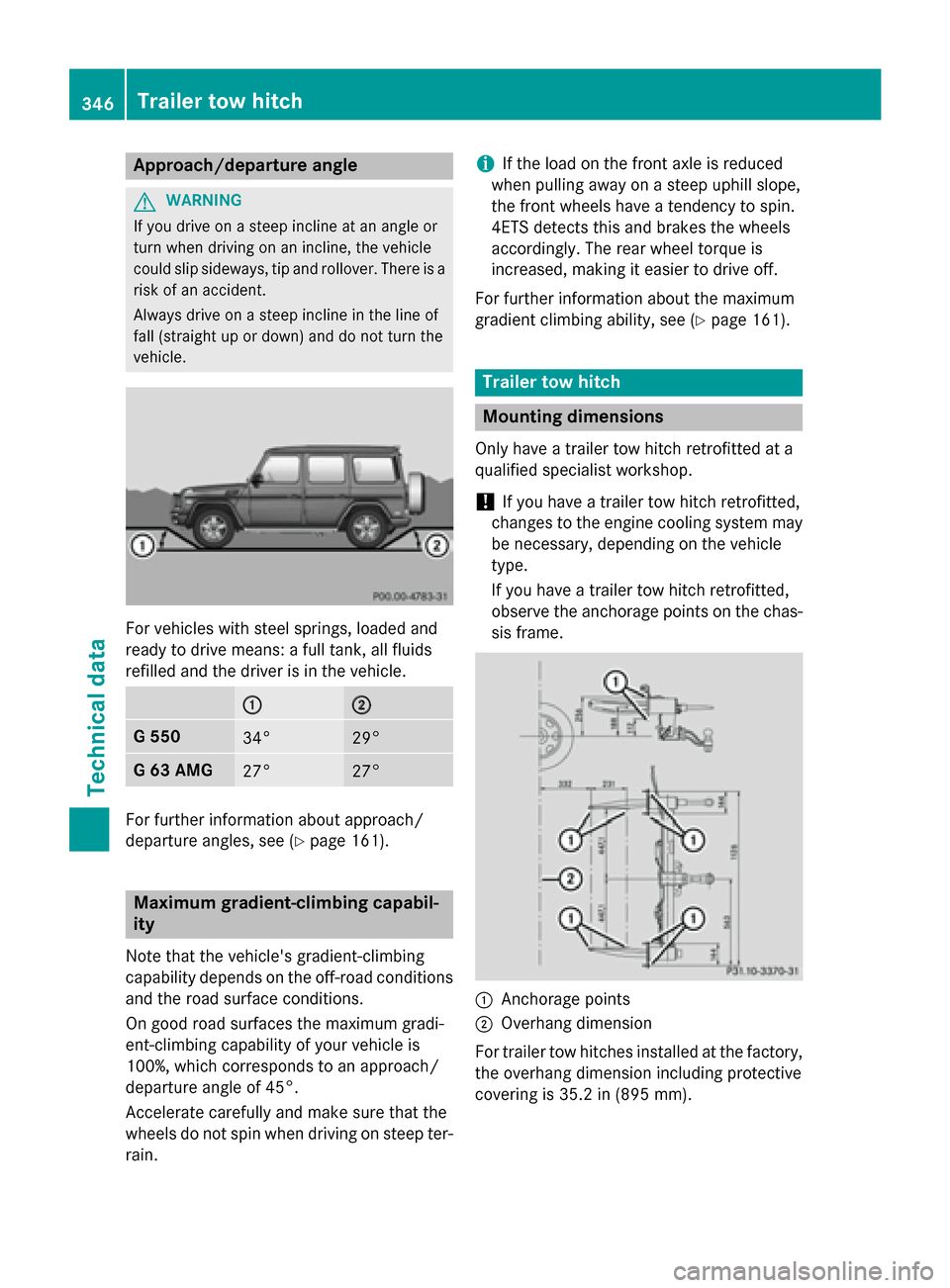
vehicle. For vehicles with steel springs, loaded and
ready to drive means: a full tank, all fluids
refilled and the driver is in the vehicle.
: : ;
;
G 550
34° 29°
G 63 AMG
27° 27°
For further information about approach/
departure angles, see (Y
page 161).Maximum gradient-climbing capabil-
ity
Note that the vehicle's gradient-climbing
capability depends on the off-road conditions and the road surface conditions.
On good road surfaces the maximum gradi-
ent-climbing capability of your vehicle is
100%, which corresponds to an approach/
departure angle of 45°.
Accelerate carefully and make sure that the
wheels do not spin when driving on steep ter-
rain. i
If the load on the front axle is reduced
when pulling away on a steep uphill slope,
the front wheels have a tendency to spin.
4ETS detects this and brakes the wheels
accordingly. The rear wheel torque is
increased, making it easier to drive off.
For further information about the maximum
gradient climbing ability, see (Y page 161). Trailer tow hitch
Mounting dimensions
Only have a trailer tow hitch retrofitted at a
qualified specialist workshop.
! If you have a trailer tow hitch retrofitted,
changes to the engine cooling system may
be necessary, depending on the vehicle
type.
If you have a trailer tow hitch retrofitted,
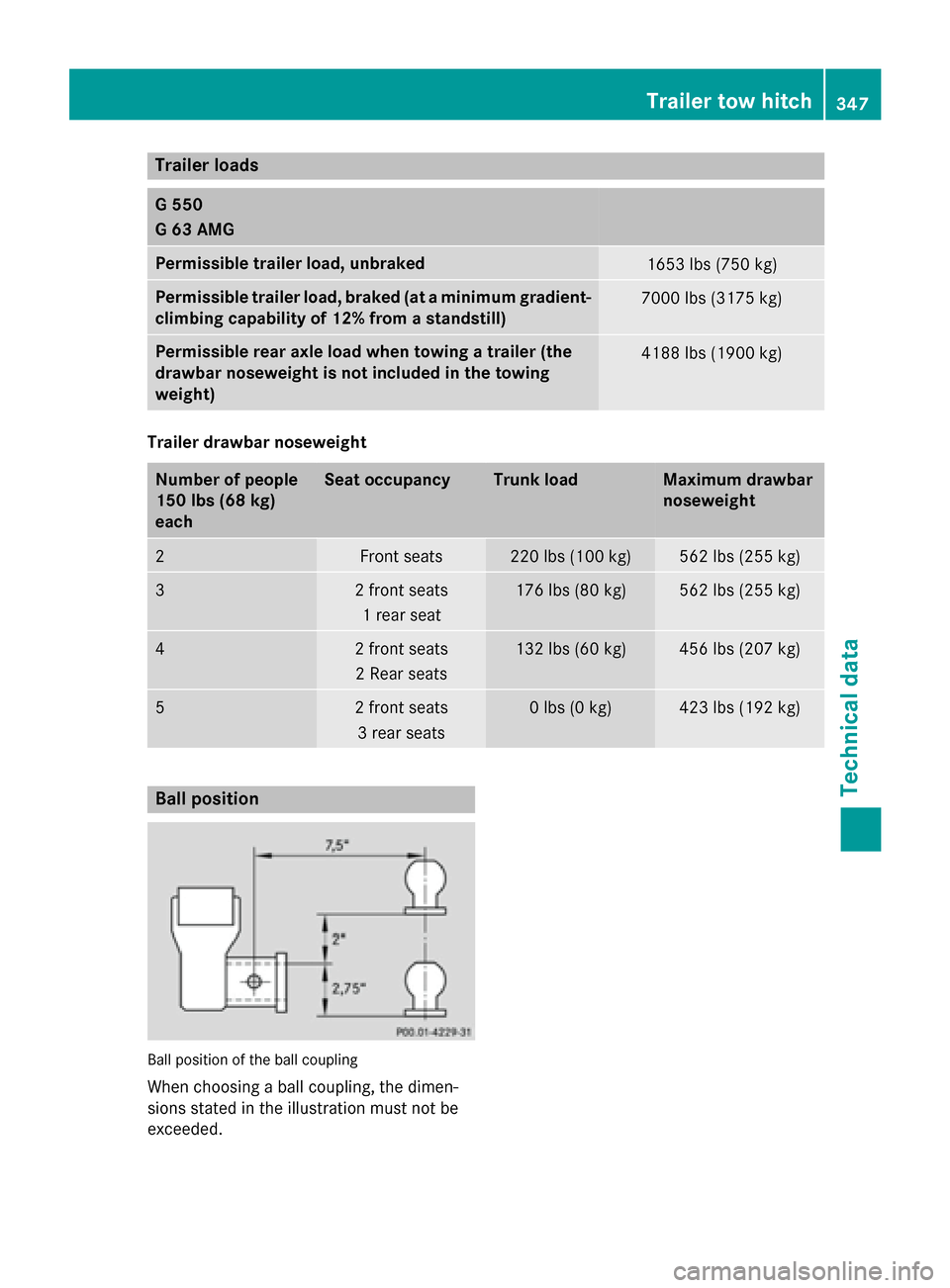
observe the anchorage points on the chas- sis frame. :
Anchorage points
; Overhang dimension
For trailer tow hitches installed at the factory, the overhang dimension including protective
covering is 35.2 in (895 mm). 346
Trailer tow hitchTechnical data
Trailer loads
G 550
G 63 AMG
Permissible trailer load, unbraked
1653 lbs (750 kg)
Permissible trailer load, braked (at a minimum gradient-
climbing capability of 12% from a standstill) 7000 lbs (3175 kg)
Permissible rear axle load when towing a trailer (the
drawbar noseweight is not included in the towing
weight) 4188 lbs (1900 kg)
Trailer drawbar noseweight
Number of people
150 lbs (68 kg)
each Seat occupancy Trunk load Maximum drawbar
noseweight
2 Front seats 220 lbs (100 kg) 562 lbs (255 kg)
3 2 front seats
1 rear seat 176 lbs (80 kg) 562 lbs (255 kg)
4 2 front seats
2 Rear seats 132 lbs (60 kg) 456 lbs (207 kg)
5 2 front seats
3 rear seats 0 lbs (0 kg) 423 lbs (192 kg)
Ball position
Ball position of the ball coupling
When choosing a ball coupling, the dimen-
sions stated in the illustration must not be
exceeded. Trailer tow hitch
347Technical data Z