check engine MERCEDES-BENZ G-Class 2015 W463 Owner's Guide
[x] Cancel search | Manufacturer: MERCEDES-BENZ, Model Year: 2015, Model line: G-Class, Model: MERCEDES-BENZ G-Class 2015 W463Pages: 350, PDF Size: 6.44 MB
Page 194 of 350
R
the permissible rear axle load of the towing
vehicle
R the maximum permissible gross vehicle
weight of both the towing vehicle and the
trailer
When towing a trailer, your vehicle's handling
characteristics will be different in comparison with when driving without a trailer.
The vehicle/trailer combination:
R is heavier
R is restricted in its acceleration and gradi-
ent-climbing capability
R has an increased braking distance
R is affected more by strong crosswinds
R demands more sensitive steering
R has a larger turning radius
This could impair the handling characteris-
tics.
When towing a trailer, always adjust your
speed to the current road and weather con-
ditions. Do not exceed the maximum permis-
sible speed for your vehicle/trailer combina-
tion.
General notes R
Do not exceed the legally prescribed max-
imum speed for vehicle/trailer combina-
tions in the relevant country.
This lowers the risk of an accident.
R Only install an approved trailer coupling on
your vehicle.
Further information on availability and on
installation is available from any authorized Mercedes-Benz Center.
R The bumpers of your vehicle are not suita-
ble for installing detachable trailer cou-
plings.
R Do not install hired trailer couplings or
other detachable trailer couplings on the
bumpers of your vehicle.
R If you do not need the ball coupling, remove
the ball coupling from the ball coupling
recess. This reduces the risk of damage to the ball coupling. i
When towing a trailer, set the tire pres-
sure on the rear axle of the towing vehicle
for a maximum load; see the tire pressure
table in the fuel filler flap (Y page 310).
You will find installation dimensions and loads
under "Technical data" (Y page 346).
The maximum noseweight of the trailer draw- bar on the ball coupling for up to 3 people is
562 lbs (255 kg). The maximum noseweight
of the trailer drawbar for more than 3 people and the maximum load for the trunk can be
found in the noseweight table (Y page 347).
However, the actual noseweight must not
exceed the value given on the trailer tow hitch or trailer identification plates. The lowest
weight applies.
Please note that when towing a trailer,
PARKTRONIC (Y page 182) and Blind Spot
Assist (Y page 178) are only available with
limitations, or not at all.
i On vehicles without level control, the
height of the ball coupling will alter accord- ing to the load placed on the vehicle. If nec-
essary, use a trailer with a height-adjusta-
ble drawbar.
Driving tips X
On long and steep downhill gradients,
select shift range 1,2or 3(Y page 145) in
good time.
i This also applies if you have activated
cruise control or SPEEDTRONIC.
X If necessary, shift the transfer case to LOW
RANGE (Ypage 186).
This will use the braking effect of the
engine, so that less braking will be required
to maintain the speed. This relieves the
load on the brake system and prevents the
brakes from overheating and wearing too
quickly. If you need additional braking,
depress the brake pedal repeatedly rather
than continuously.
The maximum permissible speed for vehicle/
trailer combinations depends on the type of
trailer. Before beginning the journey, check 192
Towing a trailerDriving an
d parking
Page 223 of 350
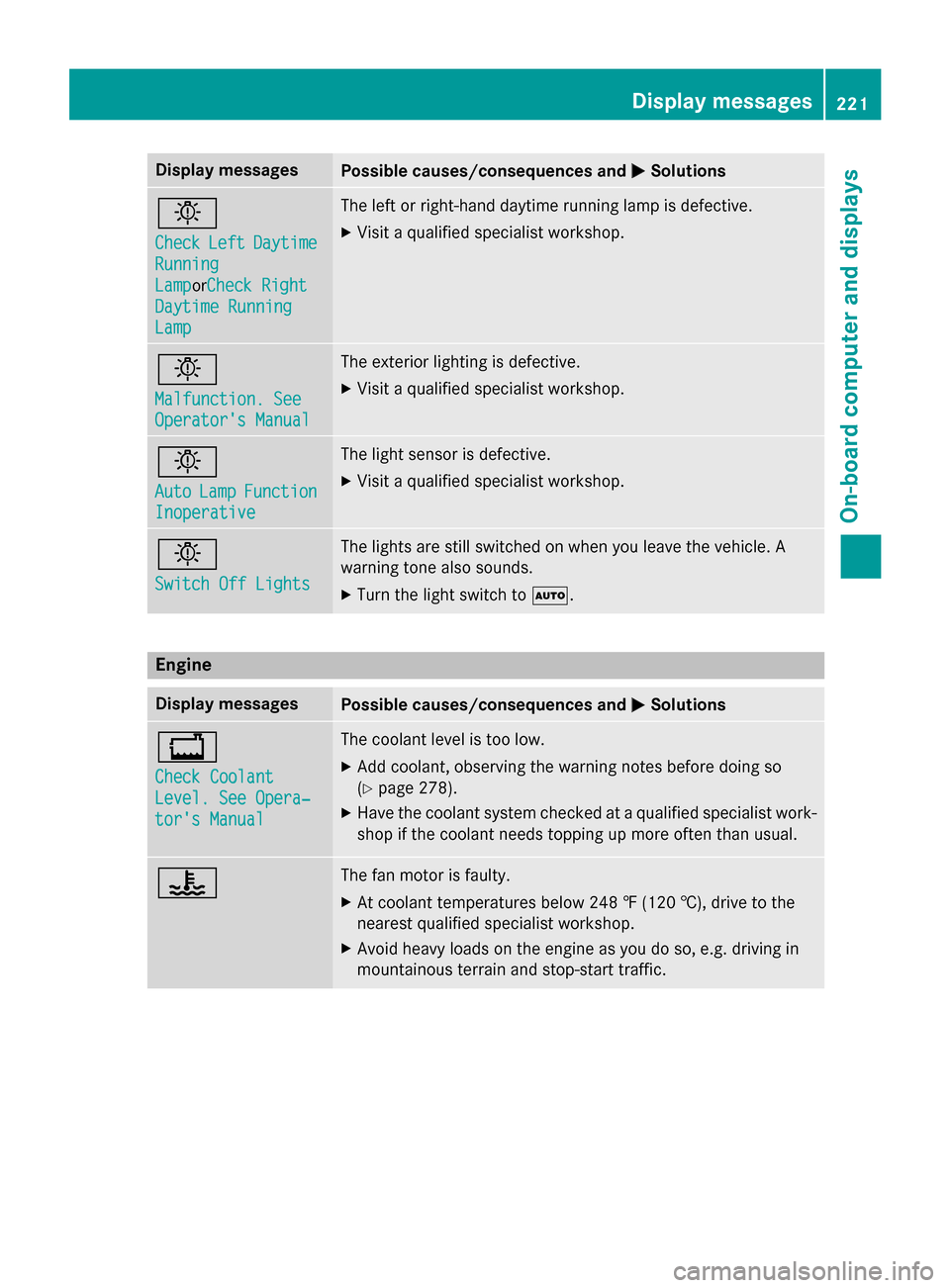
Display messages
Possible causes/consequences and
M
MSolutions b
Check Check
Left
LeftDaytime
Daytime
Running
Running
Lamp Lampor Check Right
Check Right
Daytime Running
Daytime Running
Lamp Lamp The left or right-hand daytime running lamp is defective.
X Visit a qualified specialist workshop. b
Malfunction. See Malfunction. See
Operator's Manual Operator's Manual The exterior lighting is defective.
X Visit a qualified specialist workshop. b
Auto Auto
Lamp
LampFunction
Function
Inoperative
Inoperative The light sensor is defective.
X Visit a qualified specialist workshop. b
Switch Off Lights Switch Off Lights The lights are still switched on when you leave the vehicle. A
warning tone also sounds.
X Turn the light switch to Ã.Engine
Display messages
Possible causes/consequences and
M MSolutions +
Check Coolant Check Coolant
Level. See Opera‐ Level. See Opera‐
tor's Manual tor's Manual The coolant level is too low.
X Add coolant, observing the warning notes before doing so
(Y page 278).
X Have the coolant system checked at a qualified specialist work-
shop if the coolant needs topping up more often than usual. ? The fan motor is faulty.
X At coolant temperatures below 248 ‡ (120 †), drive to the
nearest qualified specialist workshop.
X Avoid heavy loads on the engine as you do so, e.g. driving in
mountainous terrain and stop-start traffic. Display
messages
221On-board computer and displays Z
Page 224 of 350
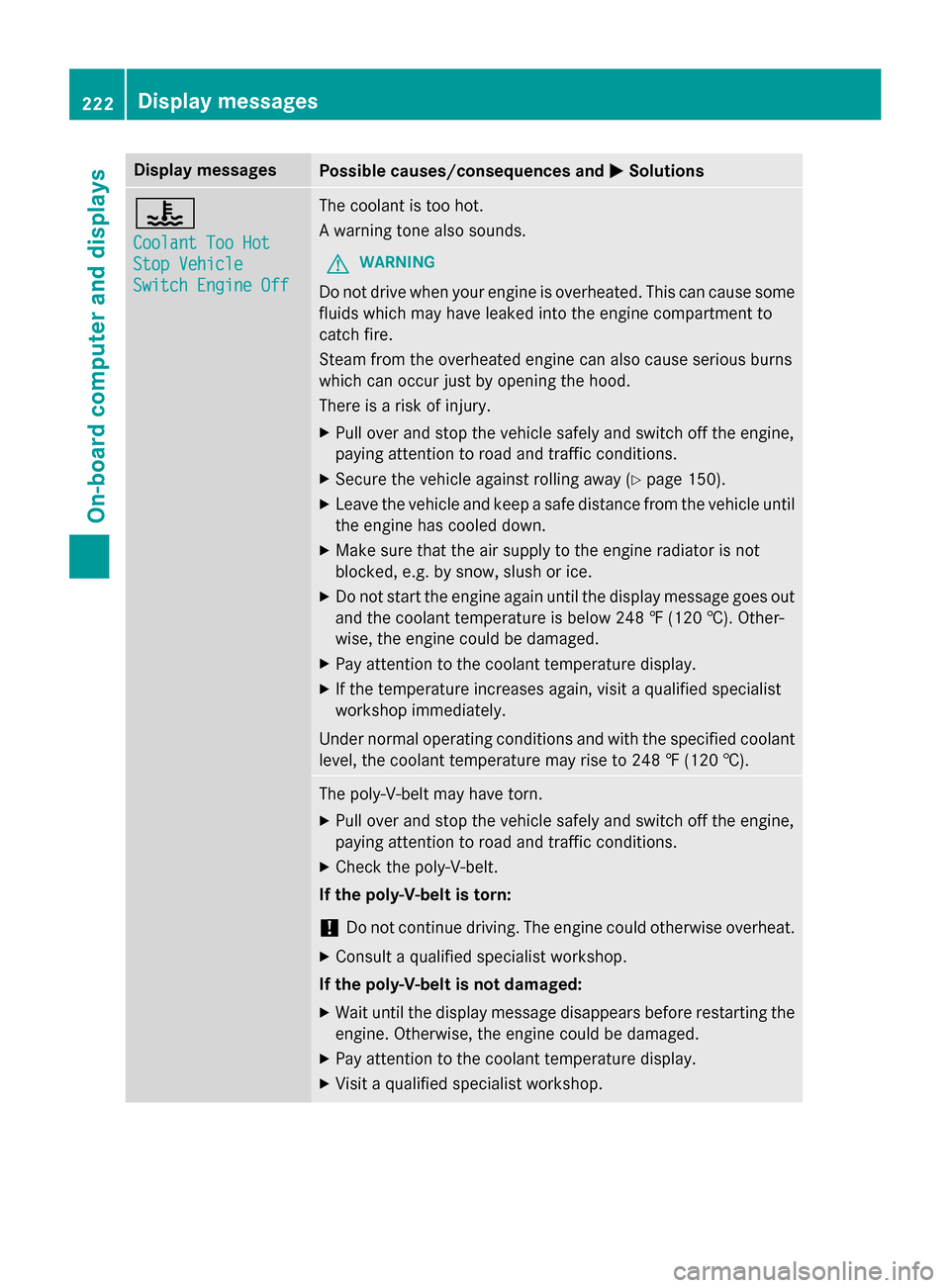
Display messages
Possible causes/consequences and
M
MSolutions ?
Coolant Too Hot Coolant Too Hot
Stop Vehicle Stop Vehicle
Switch Engine Off Switch Engine Off The coolant is too hot.
A warning tone also sounds.
G WARNING
Do not drive when your engine is overheated. This can cause some
fluids which may have leaked into the engine compartment to
catch fire.
Steam from the overheated engine can also cause serious burns
which can occur just by opening the hood.
There is a risk of injury.
X Pull over and stop the vehicle safely and switch off the engine,
paying attention to road and traffic conditions.
X Secure the vehicle against rolling away (Y page 150).
X Leave the vehicle and keep a safe distance from the vehicle until
the engine has cooled down.
X Make sure that the air supply to the engine radiator is not
blocked, e.g. by snow, slush or ice.
X Do not start the engine again until the display message goes out
and the coolant temperature is below 248 ‡ (120 †). Other-
wise, the engine could be damaged.
X Pay attention to the coolant temperature display.
X If the temperature increases again, visit a qualified specialist
workshop immediately.
Under normal operating conditions and with the specified coolant
level, the coolant temperature may rise to 248 ‡ (120 †). The poly-V-belt may have torn.
X Pull over and stop the vehicle safely and switch off the engine,
paying attention to road and traffic conditions.
X Check the poly-V-belt.
If the poly-V-belt is torn:
! Do not continue driving. The engine could otherwise overheat.
X Consult a qualified specialist workshop.
If the poly-V-belt is not damaged:
X Wait until the display message disappears before restarting the
engine. Otherwise, the engine could be damaged.
X Pay attention to the coolant temperature display.
X Visit a qualified specialist workshop. 222
Display
messagesOn-board computer and displays
Page 225 of 350
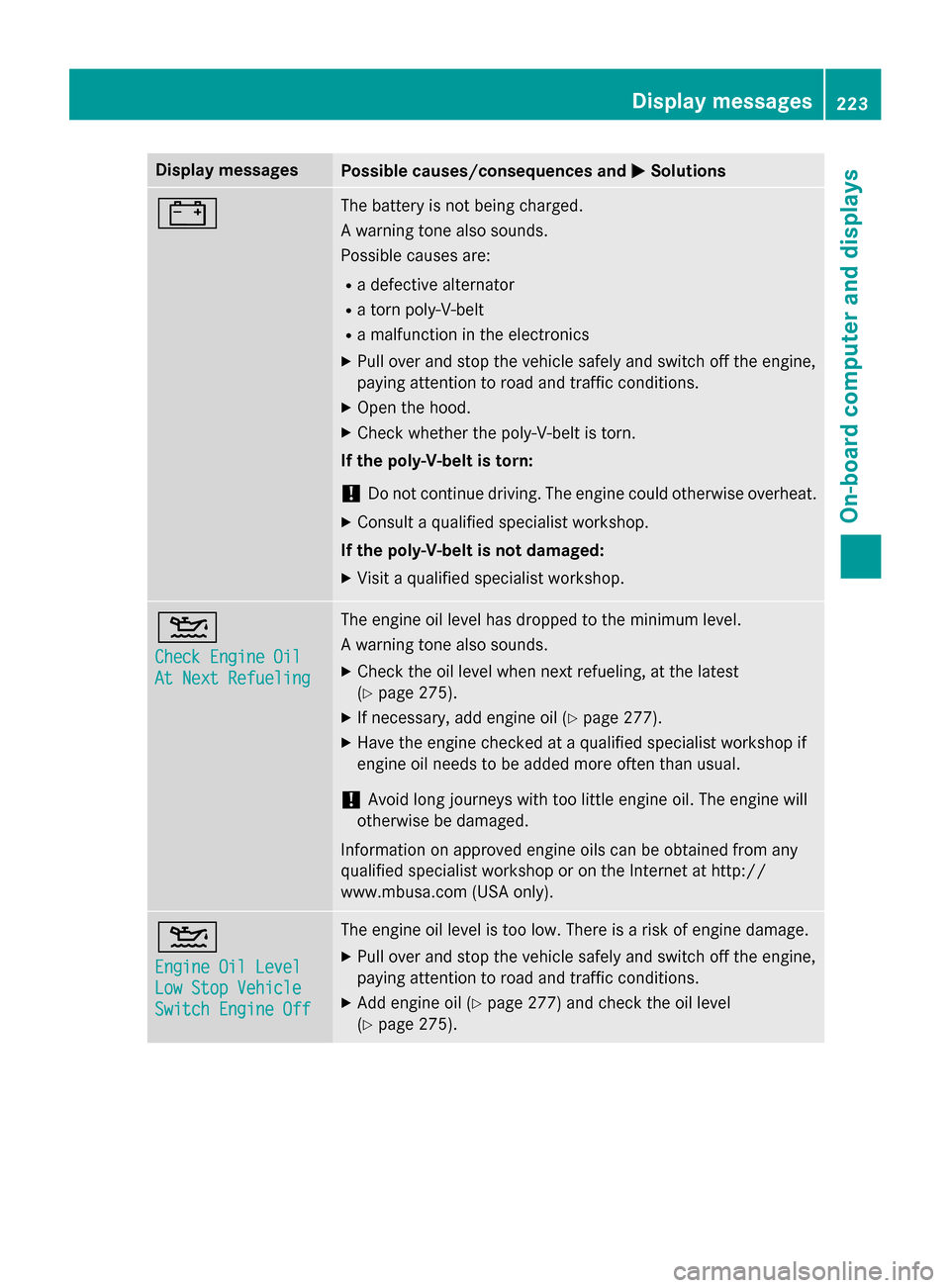
Display messages
Possible causes/consequences and
M
MSolutions # The battery is not being charged.
A warning tone also sounds.
Possible causes are:
R a defective alternator
R a torn poly-V-belt
R a malfunction in the electronics
X Pull over and stop the vehicle safely and switch off the engine,
paying attention to road and traffic conditions.
X Open the hood.
X Check whether the poly-V-belt is torn.
If the poly-V-belt is torn:
! Do not continue driving. The engine could otherwise overheat.
X Consult a qualified specialist workshop.
If the poly-V-belt is not damaged:
X Visit a qualified specialist workshop. 4
Check Engine Oil Check Engine Oil
At Next Refueling At Next Refueling The engine oil level has dropped to the minimum level.
A warning tone also sounds.
X Check the oil level when next refueling, at the latest
(Y page 275).
X If necessary, add engine oil (Y page 277).
X Have the engine checked at a qualified specialist workshop if
engine oil needs to be added more often than usual.
! Avoid long journeys with too little engine oil. The engine will
otherwise be damaged.
Information on approved engine oils can be obtained from any
qualified specialist workshop or on the Internet at http://
www.mbusa.com (USA only). 4
Engine Oil Level Engine Oil Level
Low Stop Vehicle Low Stop Vehicle
Switch Engine Off Switch Engine Off The engine oil level is too low. There is a risk of engine damage.
X Pull over and stop the vehicle safely and switch off the engine,
paying attention to road and traffic conditions.
X Add engine oil (Y page 277) and check the oil level
(Y page 275). Display
messages
223On-board computer and displays Z
Page 226 of 350
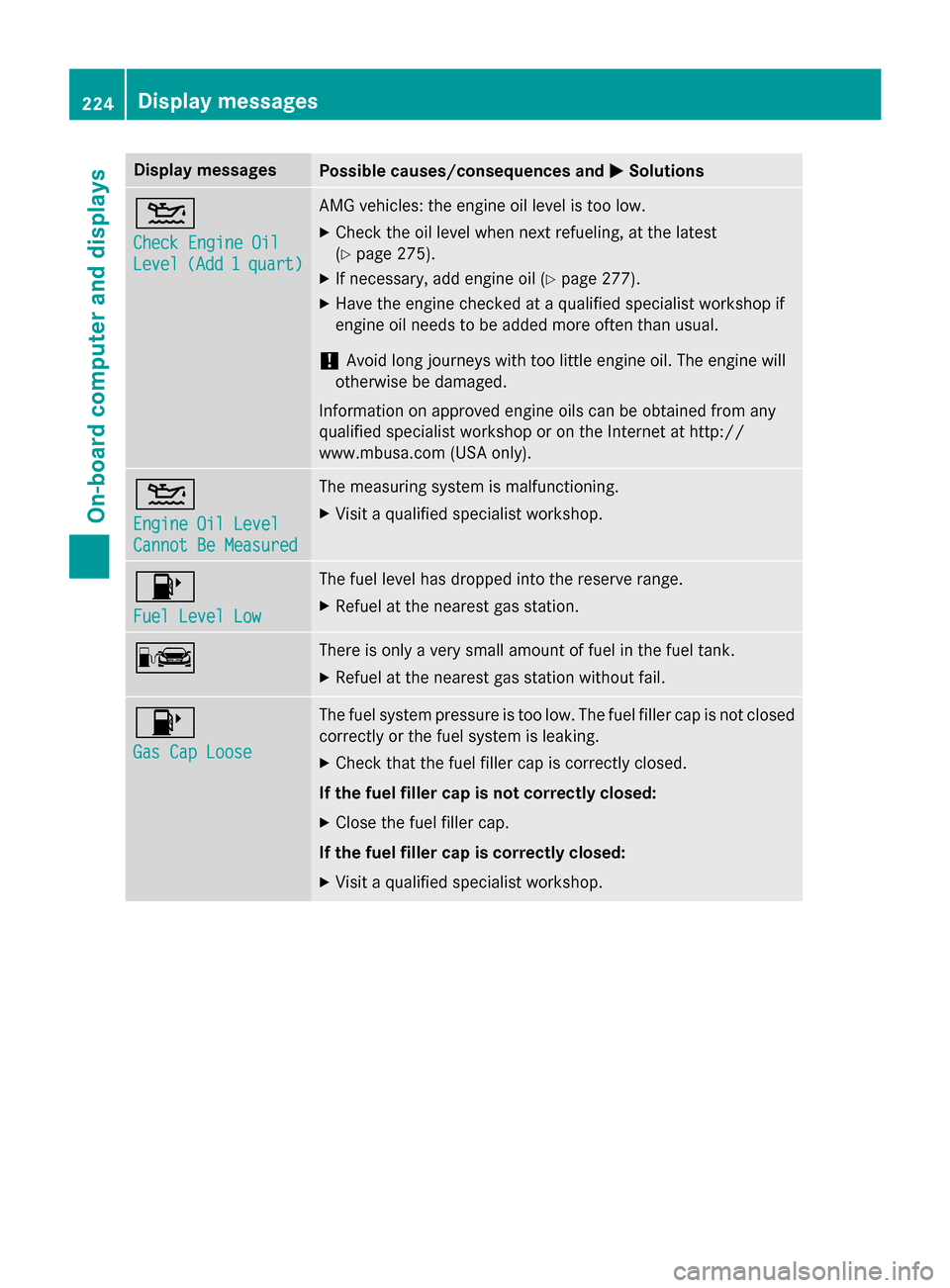
Display messages
Possible causes/consequences and
M
MSolutions 4
Check Engine Oil Check Engine Oil
Level Level
(Add
(Add1
1quart)
quart) AMG vehicles: the engine oil level is too low.
X Check the oil level when next refueling, at the latest
(Y page 275).
X If necessary, add engine oil (Y page 277).
X Have the engine checked at a qualified specialist workshop if
engine oil needs to be added more often than usual.
! Avoid long journeys with too little engine oil. The engine will
otherwise be damaged.
Information on approved engine oils can be obtained from any
qualified specialist workshop or on the Internet at http://
www.mbusa.com (USA only). 4
Engine Oil Level Engine Oil Level
Cannot Be Measured Cannot Be Measured The measuring system is malfunctioning.
X Visit a qualified specialist workshop. 8
Fuel Level Low Fuel Level Low The fuel level has dropped into the reserve range.
X Refuel at the nearest gas station. C There is only a very small amount of fuel in the fuel tank.
X Refuel at the nearest gas station without fail. 8
Gas Cap Loose Gas Cap Loose The fuel system pressure is too low. The fuel filler cap is not closed
correctly or the fuel system is leaking.
X Check that the fuel filler cap is correctly closed.
If the fuel filler cap is not correctly closed: X Close the fuel filler cap.
If the fuel filler cap is correctly closed: X Visit a qualified specialist workshop. 224
Display
messagesOn-board computer and displays
Page 227 of 350
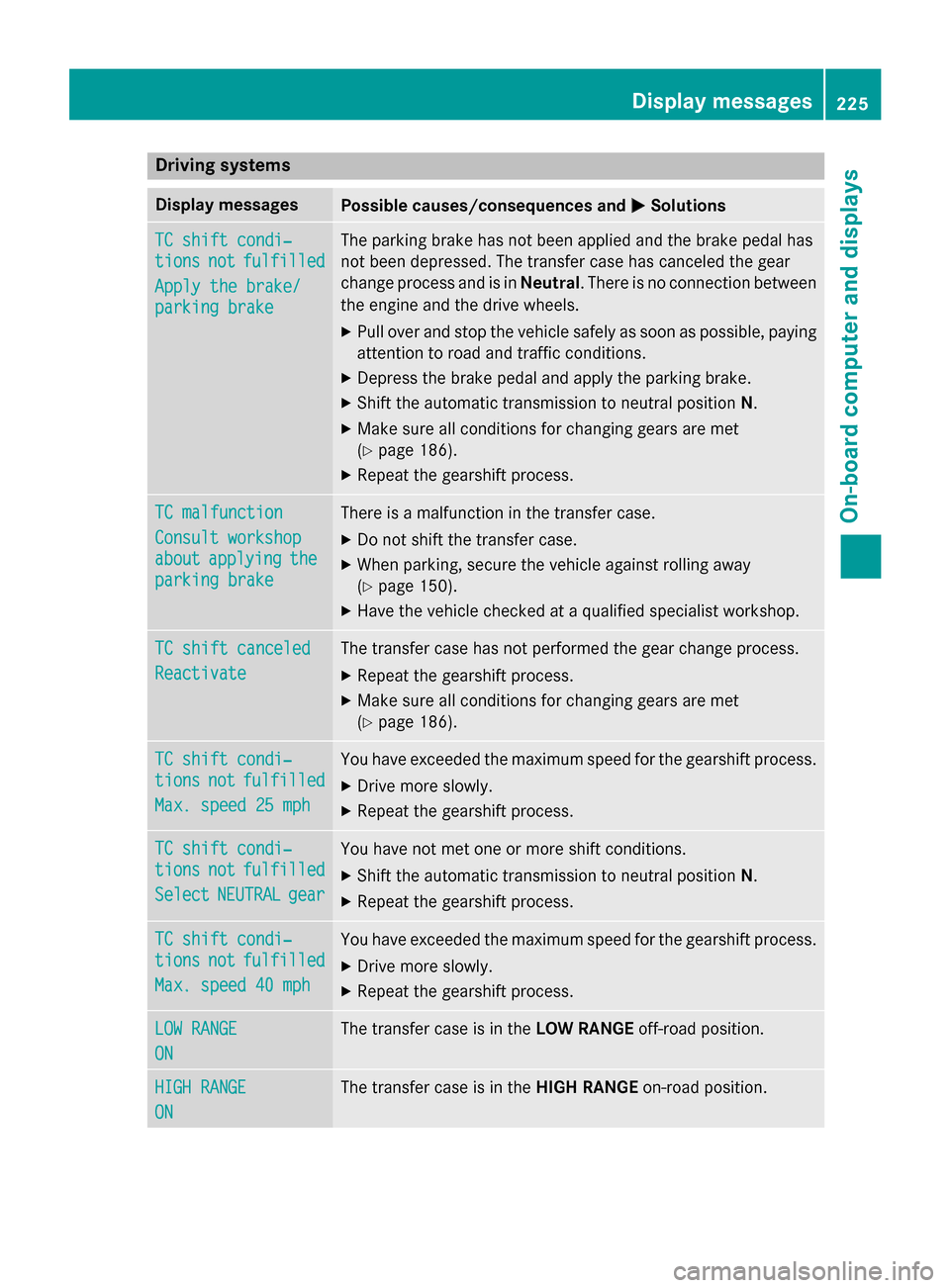
Driving systems
Display messages
Possible causes/consequences and
M
MSolutions TC shift condi‐
TC shift condi‐
tions tions
not
notfulfilled
fulfilled
Apply the brake/
Apply the brake/
parking brake parking brake The parking brake has not been applied and the brake pedal has
not been depressed. The transfer case has canceled the gear
change process and is in Neutral. There is no connection between
the engine and the drive wheels.
X Pull over and stop the vehicle safely as soon as possible, paying
attention to road and traffic conditions.
X Depress the brake pedal and apply the parking brake.
X Shift the automatic transmission to neutral position N.
X Make sure all conditions for changing gears are met
(Y page 186).
X Repeat the gearshift process. TC malfunction TC malfunction
Consult workshop Consult workshop
about about
applying
applying the
the
parking brake
parking brake There is a malfunction in the transfer case.
X Do not shift the transfer case.
X When parking, secure the vehicle against rolling away
(Y page 150).
X Have the vehicle checked at a qualified specialist workshop. TC shift canceled TC shift canceled
Reactivate Reactivate The transfer case has not performed the gear change process.
X Repeat the gearshift process.
X Make sure all conditions for changing gears are met
(Y page 186). TC shift condi‐ TC shift condi‐
tions tions
not
notfulfilled
fulfilled
Max. speed 25 mph
Max. speed 25 mph You have exceeded the maximum speed for the gearshift process.
X Drive more slowly.
X Repeat the gearshift process. TC shift condi‐
TC shift condi‐
tions tions
not
notfulfilled
fulfilled
Select
Select NEUTRAL
NEUTRAL gear
gear You have not met one or more shift conditions.
X Shift the automatic transmission to neutral position N.
X Repeat the gearshift process. TC shift condi‐
TC shift condi‐
tions tions
not
notfulfilled
fulfilled
Max. speed 40 mph
Max. speed 40 mph You have exceeded the maximum speed for the gearshift process.
X Drive more slowly.
X Repeat the gearshift process. LOW RANGE
LOW RANGE
ON ON The transfer case is in the
LOW RANGEoff-road position. HIGH RANGE
HIGH RANGE
ON ON The transfer case is in the
HIGH RANGEon-road position. Display
messages
225On-board computer and displays Z
Page 230 of 350
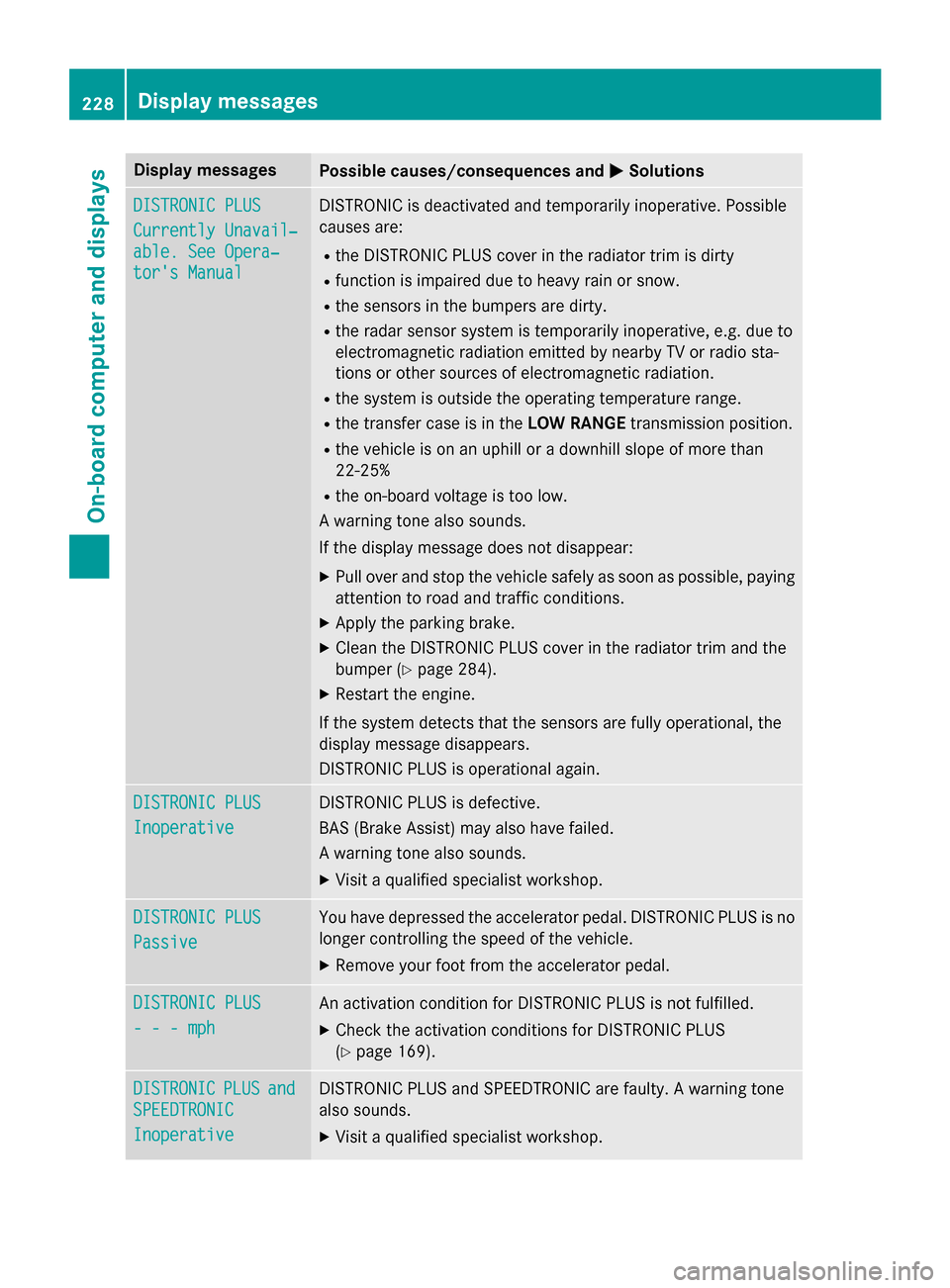
Display messages
Possible causes/consequences and
M
MSolutions DISTRONIC PLUS
DISTRONIC PLUS
Currently Unavail‐ Currently Unavail‐
able. See Opera‐ able. See Opera‐
tor's Manual tor's Manual DISTRONIC is deactivated and temporarily inoperative. Possible
causes are:
R the DISTRONIC PLUS cover in the radiator trim is dirty
R function is impaired due to heavy rain or snow.
R the sensors in the bumpers are dirty.
R the radar sensor system is temporarily inoperative, e.g. due to
electromagnetic radiation emitted by nearby TV or radio sta-
tions or other sources of electromagnetic radiation.
R the system is outside the operating temperature range.
R the transfer case is in the LOW RANGEtransmission position.
R the vehicle is on an uphill or a downhill slope of more than
22‑25%
R the on-board voltage is too low.
A warning tone also sounds.
If the display message does not disappear:
X Pull over and stop the vehicle safely as soon as possible, paying
attention to road and traffic conditions.
X Apply the parking brake.
X Clean the DISTRONIC PLUS cover in the radiator trim and the
bumper (Y page 284).
X Restart the engine.
If the system detects that the sensors are fully operational, the
display message disappears.
DISTRONIC PLUS is operational again. DISTRONIC PLUS DISTRONIC PLUS
Inoperative Inoperative DISTRONIC PLUS is defective.
BAS (Brake Assist) may also have failed.
A warning tone also sounds.
X Visit a qualified specialist workshop. DISTRONIC PLUS DISTRONIC PLUS
Passive Passive You have depressed the accelerator pedal. DISTRONIC PLUS is no
longer controlling the speed of the vehicle.
X Remove your foot from the accelerator pedal. DISTRONIC PLUS
DISTRONIC PLUS
- - - mph - - - mph An activation condition for DISTRONIC PLUS is not fulfilled.
X Check the activation conditions for DISTRONIC PLUS
(Y page 169). DISTRONIC
DISTRONIC
PLUS
PLUSand
and
SPEEDTRONIC
SPEEDTRONIC
Inoperative Inoperative DISTRONIC PLUS and SPEEDTRONIC are faulty. A warning tone
also sounds.
X Visit a qualified specialist workshop. 228
Display
messagesOn-board computer and displays
Page 234 of 350
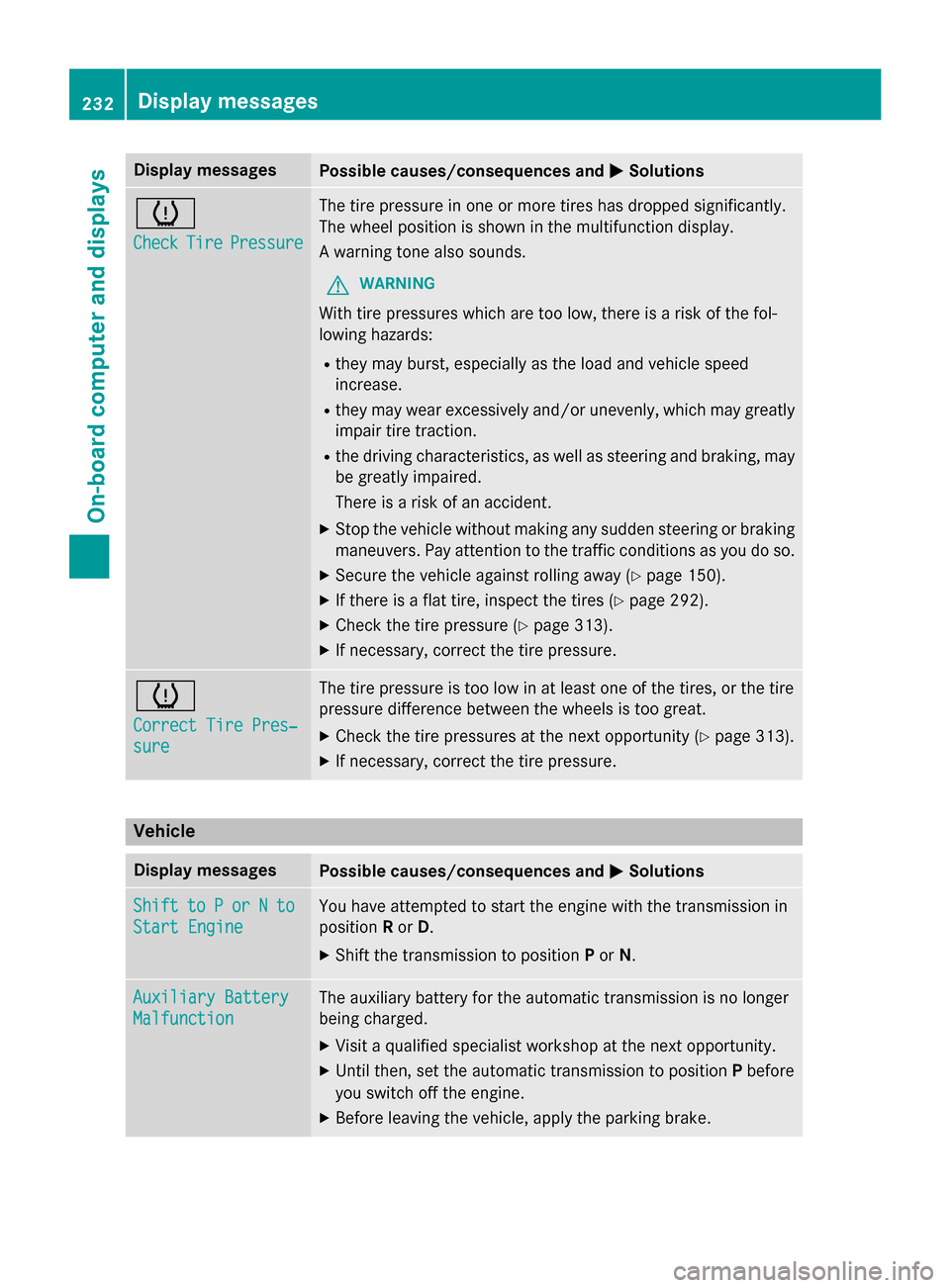
Display messages
Possible causes/consequences and
M
MSolutions h
Check Check
Tire
TirePressure
Pressure The tire pressure in one or more tires has dropped significantly.
The wheel position is shown in the multifunction display.
A warning tone also sounds.
G WARNING
With tire pressures which are too low, there is a risk of the fol-
lowing hazards:
R they may burst, especially as the load and vehicle speed
increase.
R they may wear excessively and/or unevenly, which may greatly
impair tire traction.
R the driving characteristics, as well as steering and braking, may
be greatly impaired.
There is a risk of an accident.
X Stop the vehicle without making any sudden steering or braking
maneuvers. Pay attention to the traffic conditions as you do so.
X Secure the vehicle against rolling away (Y page 150).
X If there is a flat tire, inspect the tires (Y page 292).
X Check the tire pressure (Y page 313).
X If necessary, correct the tire pressure. h
Correct Tire Pres‐ Correct Tire Pres‐
sure sure The tire pressure is too low in at least one of the tires, or the tire
pressure difference between the wheels is too great.
X Check the tire pressures at the next opportunity (Y page 313).
X If necessary, correct the tire pressure. Vehicle
Display messages
Possible causes/consequences and
M
MSolutions Shift
Shift
to
toP
Por
or N
Nto
to
Start Engine
Start Engine You have attempted to start the engine with the transmission in
position
Ror D.
X Shift the transmission to position Por N. Auxiliary Battery Auxiliary Battery
Malfunction Malfunction The auxiliary battery for the automatic transmission is no longer
being charged.
X Visit a qualified specialist workshop at the next opportunity.
X Until then, set the automatic transmission to position Pbefore
you switch off the engine.
X Before leaving the vehicle, apply the parking brake. 232
Display
messagesOn-board computer and displays
Page 235 of 350
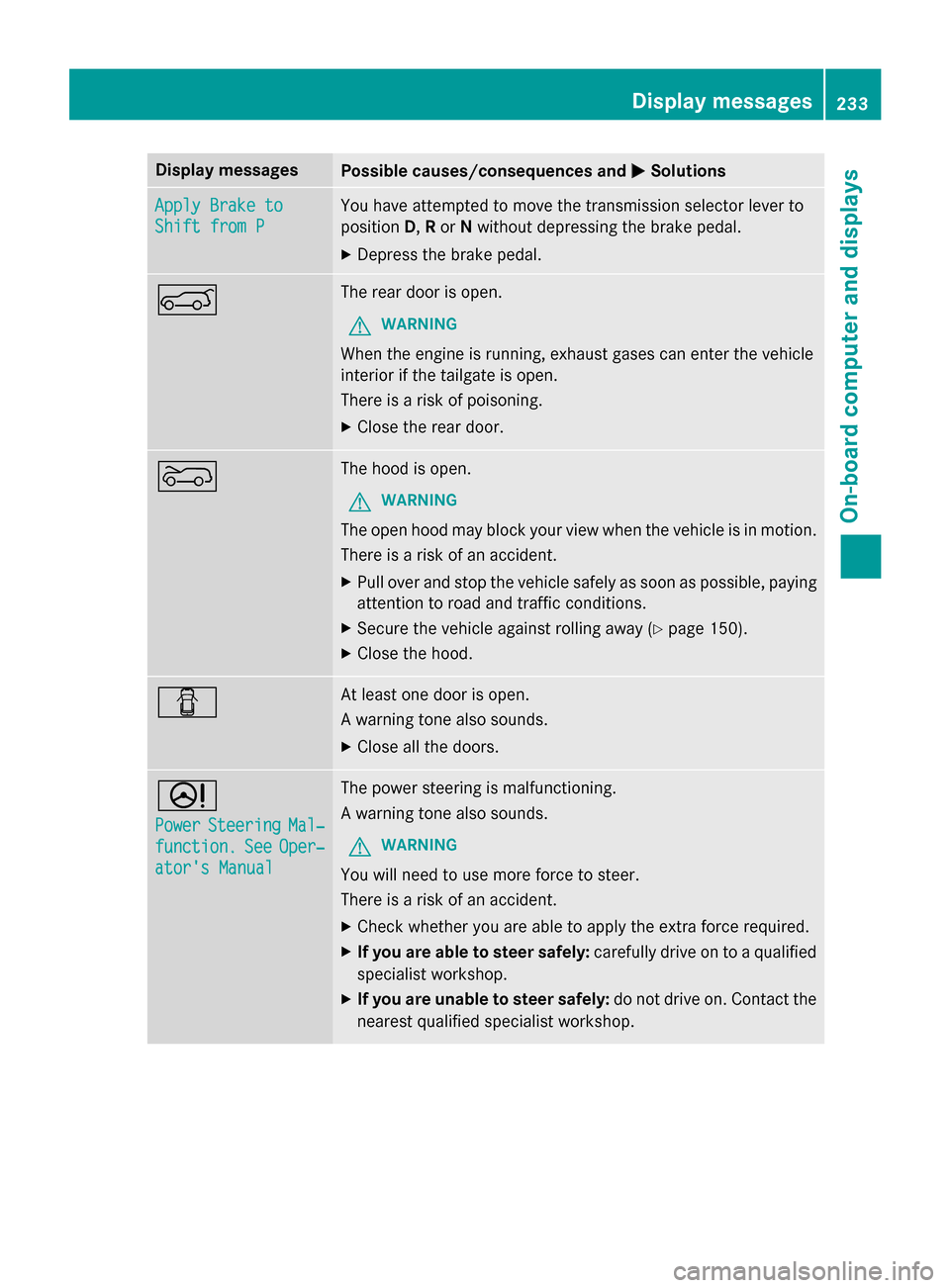
Display messages
Possible causes/consequences and
M
MSolutions Apply Brake to
Apply Brake to
Shift from P Shift from P You have attempted to move the transmission selector lever to
position
D,Ror Nwithout depressing the brake pedal.
X Depress the brake pedal. A The rear door is open.
G WARNING
When the engine is running, exhaust gases can enter the vehicle
interior if the tailgate is open.
There is a risk of poisoning.
X Close the rear door. ? The hood is open.
G WARNING
The open hood may block your view when the vehicle is in motion.
There is a risk of an accident.
X Pull over and stop the vehicle safely as soon as possible, paying
attention to road and traffic conditions.
X Secure the vehicle against rolling away (Y page 150).
X Close the hood. C At least one door is open.
A warning tone also sounds.
X Close all the doors. D
Power Power
Steering
Steering Mal‐
Mal‐
function.
function. See
SeeOper‐
Oper‐
ator's Manual
ator's Manual The power steering is malfunctioning.
A warning tone also sounds.
G WARNING
You will need to use more force to steer.
There is a risk of an accident. X Check whether you are able to apply the extra force required.
X If you are able to steer safely: carefully drive on to a qualified
specialist workshop.
X If you are unable to steer safely: do not drive on. Contact the
nearest qualified specialist workshop. Display
messages
233On-board computer and displays Z
Page 236 of 350
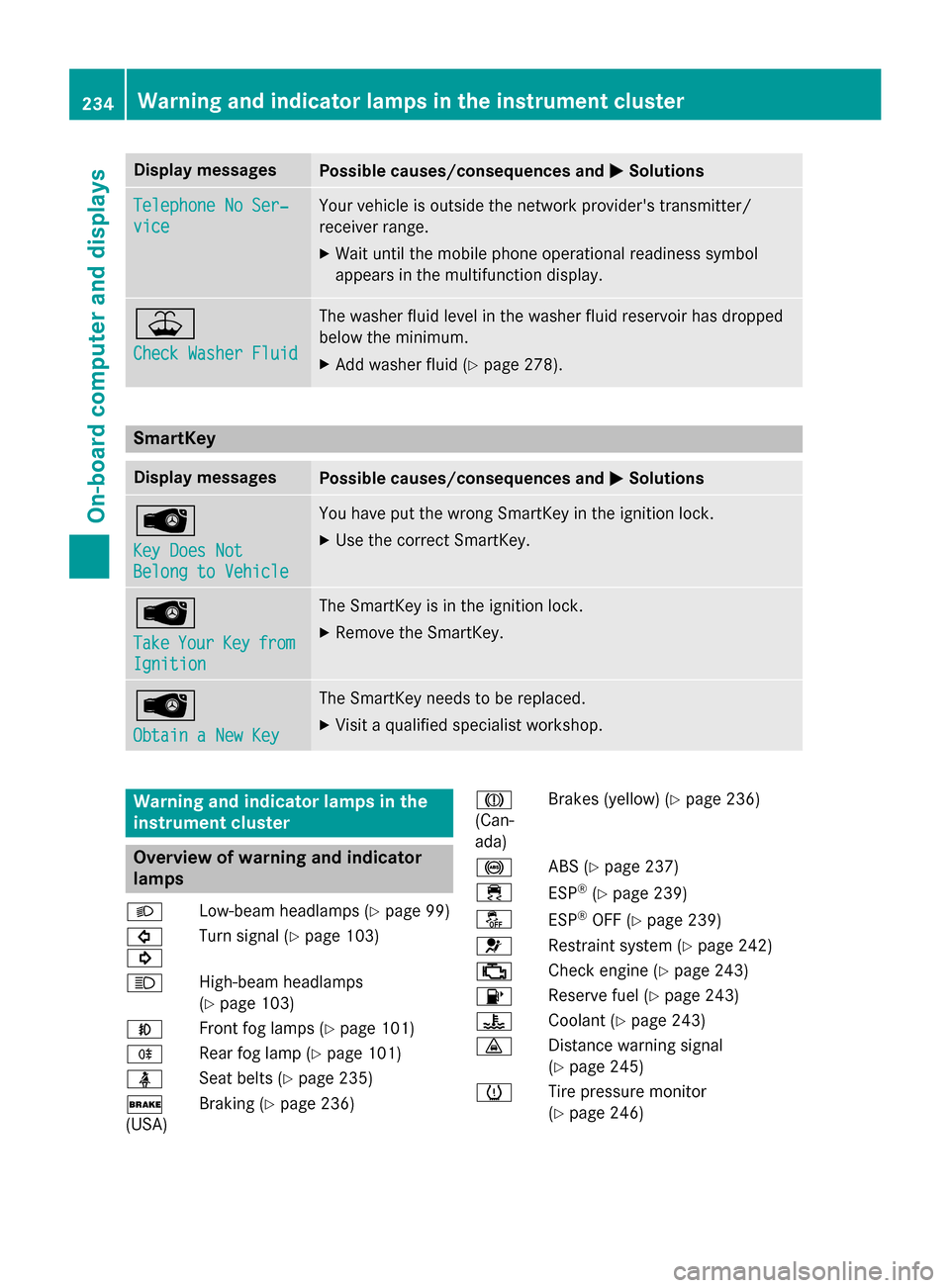
Display messages
Possible causes/consequences and
M
MSolutions Telephone No Ser‐
Telephone No Ser‐
vice vice Your vehicle is outside the network provider's transmitter/
receiver range.
X Wait until the mobile phone operational readiness symbol
appears in the multifunction display. ¥
Check Washer Fluid Check Washer Fluid The washer fluid level in the washer fluid reservoir has dropped
below the minimum.
X Add washer fluid (Y page 278).SmartKey
Display messages
Possible causes/consequences and
M MSolutions Â
Key Does Not Key Does Not
Belong to Vehicle Belong to Vehicle You have put the wrong SmartKey in the ignition lock.
X Use the correct SmartKey. Â
Take Take
Your
YourKey
Keyfrom
from
Ignition
Ignition The SmartKey is in the ignition lock.
X Remove the SmartKey. Â
Obtain a New Key Obtain a New Key The SmartKey needs to be replaced.
X Visit a qualified specialist workshop. Warning and indicator lamps in the
instrument cluster Overview of warning and indicator
lamps
L Low-beam headlamps (Y page 99)
#
! Turn signal (Y
page 103)
K High-beam headlamps
(Ypage 103)
N Front fog lamps (Y page 101)
R Rear fog lamp (Y page 101)
ü Seat belts (Y page 235)
$
(USA) Braking (Y
page 236) J
(Can-
ada)
Brakes (yellow) (Y
page 236)
! ABS (Ypage 237)
÷ ESP®
(Y page 239)
å ESP®
OFF (Y page 239)
6 Restraint system (Y page 242)
; Check engine (Y page 243)
8 Reserve fuel (Y page 243)
? Coolant (Y page 243)
· Distance warning signal
(Ypage 245)
h Tire pressure monitor
(Ypage 246) 234
Wa
rning and indi cator lamps in the instrument clusterOn-board computer and displays