lock MERCEDES-BENZ G-Class 2016 W463 Owner's Guide
[x] Cancel search | Manufacturer: MERCEDES-BENZ, Model Year: 2016, Model line: G-Class, Model: MERCEDES-BENZ G-Class 2016 W463Pages: 302, PDF Size: 7.04 MB
Page 66 of 302
Doors
Important safet ynotes
GWARNING
Whe nleavin gth evehicle, always remov eth e
SmartKey from th eignition lock. Always take
th eSmartKey wit hyou and loc kth evehicle.
Do no tleav echildren unsupervised in th e
vehicle, eve nif they are secure din achild
restrain tsystem, and do no tgiv ethem access
to an unlocke dvehicle. Achild' sunsupervised
access to avehicle could result in an acciden t
and/o rserious personal injury. The ycould:
Rinjure themselves on vehicle parts
Rbe seriously or fatally injured by extreme
heat or cold
Rinjure themselves or hav ean acciden twit h
vehicle equipmen tthat may still be in oper-
ation eve nafter th eSmartKey has bee n
removed from th eignition ,suc has th eseat
adjustment, steerin gwhee ladjustmen tor
memor yfunction .
If children ope n adoor, they could cause
severe or eve nfatal injury to other persons; if
they get out of th evehicle, they could injure
themselves when doin gso or be seriously or
eve nfatally injured by any passin gtraffic .
Do no texpos eth echild restrain tsyste mto
direc tsunlight. The child restrain tsystem' s
metal parts ,fo rexample, could becom ever y
hot ,and
achi
ld could be burne don these
parts .
GWARNING
Do no tcarry heav yor har dobjects in th e
passenger compartmen tor cargo compart -
men tunless they are firmly secure din place.
Unsecure dor improperly positioned cargo
increase s achild' sris kof injury in th eevent of
Rstrong braking maneuvers
Rsudden changes of direction
Ran acciden t
GWARNING
If children are lef tunsupervised in th evehicle,
they could:
Rope nth edoors ,thus endangerin gother
people or road users.
Rget out and disrup ttraffic .
Roperat eth evehicle' sequipment.
Additionally, children could set th evehicle in
motion if, fo rexample, they:
Rrelease th eparking brake .
Rshift theautomatic transmissio nout of par k
position Por shift manual transmissio ninto
neutral.
Rstart th eengine.
There is aris kof an acciden tand injury.
Whe nleavin gth evehicle, always take th e
SmartKey wit hyou and loc kth evehicle. Never
leav echildren or animals unattended in th e
vehicle. Always keep th eSmartKey out of
reach of children .
Unlockingan dopening doors from
th einside
If th evehicle has previously bee nlocke dwit h
th eSmartKey, opening adoo rfrom th einsid e
will trigger th eanti-thef talar msystem. Switc h
of fth ealar m (
Ypage 59).
Only ope nth edoo rwhen th etraffic situation
permits.
64Doors
Opening and closing
Page 67 of 302
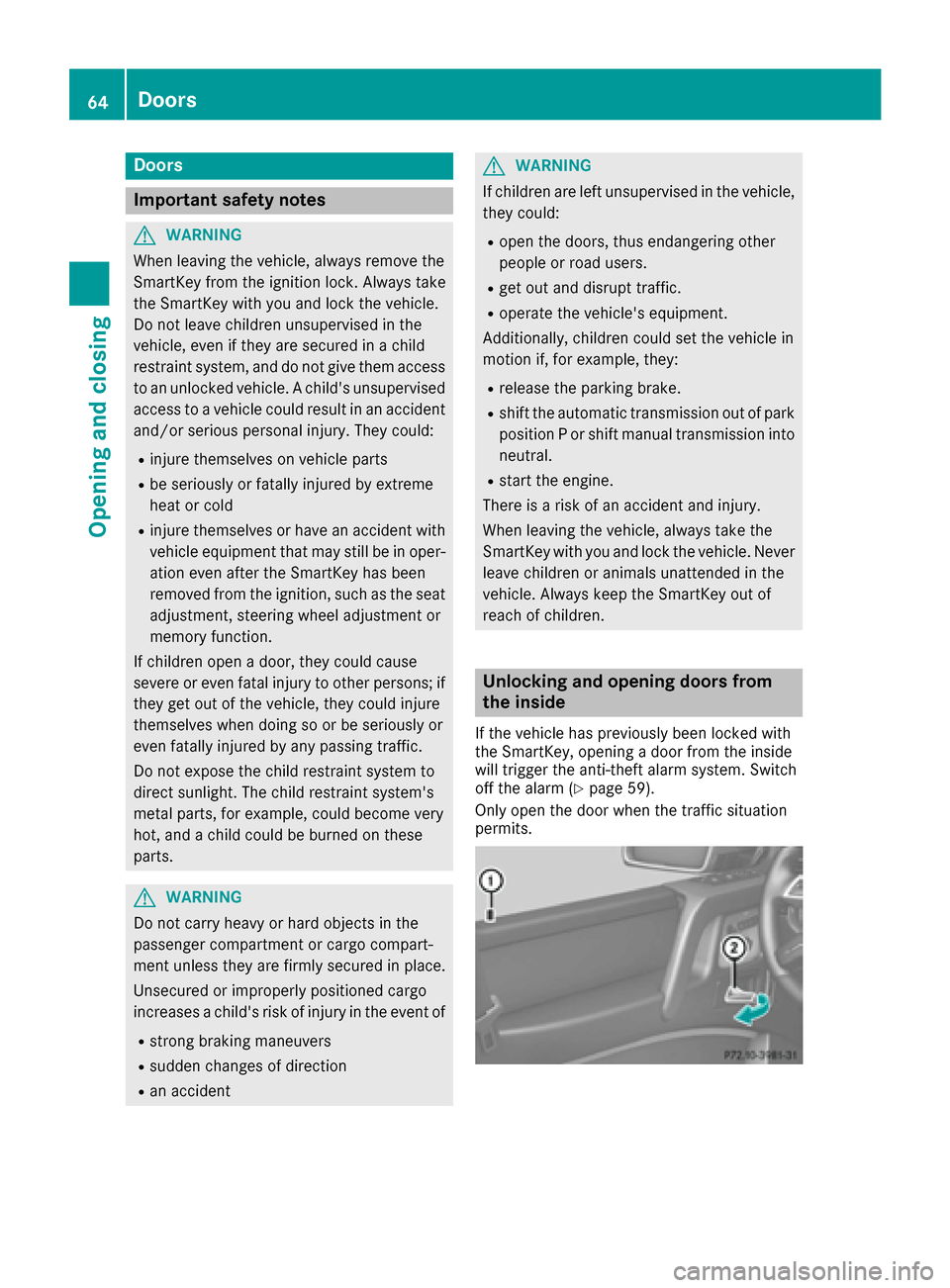
XFront doors:pull door handle ;.
If the door is locked, locking knob :pops up.
The door is unlocked and can be opened.
XRear compartment doors: pull handle:
up.
The door is unlocked.
XPull door handle ;.
Centrally locking and unlocking the
vehicle from the inside
GWARNING
If children are left unsupervised in the vehicle,
they could:
Ropen the doors, thus endangering other
people or road users.
Rget out and disrupt traffic.
Roperate the vehicle's equipment.
Additionally, children could set the vehicle in
motion if, for example, they:
Rrelease the parking brake.
Rshift the automatic transmission out of park
position P or shift manual transmission into
neutral.
Rstart the engine.
There is a risk of an accident and injury.
When leaving the vehicle, always take the
SmartKey with you and lock the vehicle. Never
leave children or animals unattended in the
vehicle. Always keep the SmartKey out of
reach of children.
You can centrally lock or unlock the vehicle from
the inside.
The central locking button does not lock or
unlock the fuel filler flap.
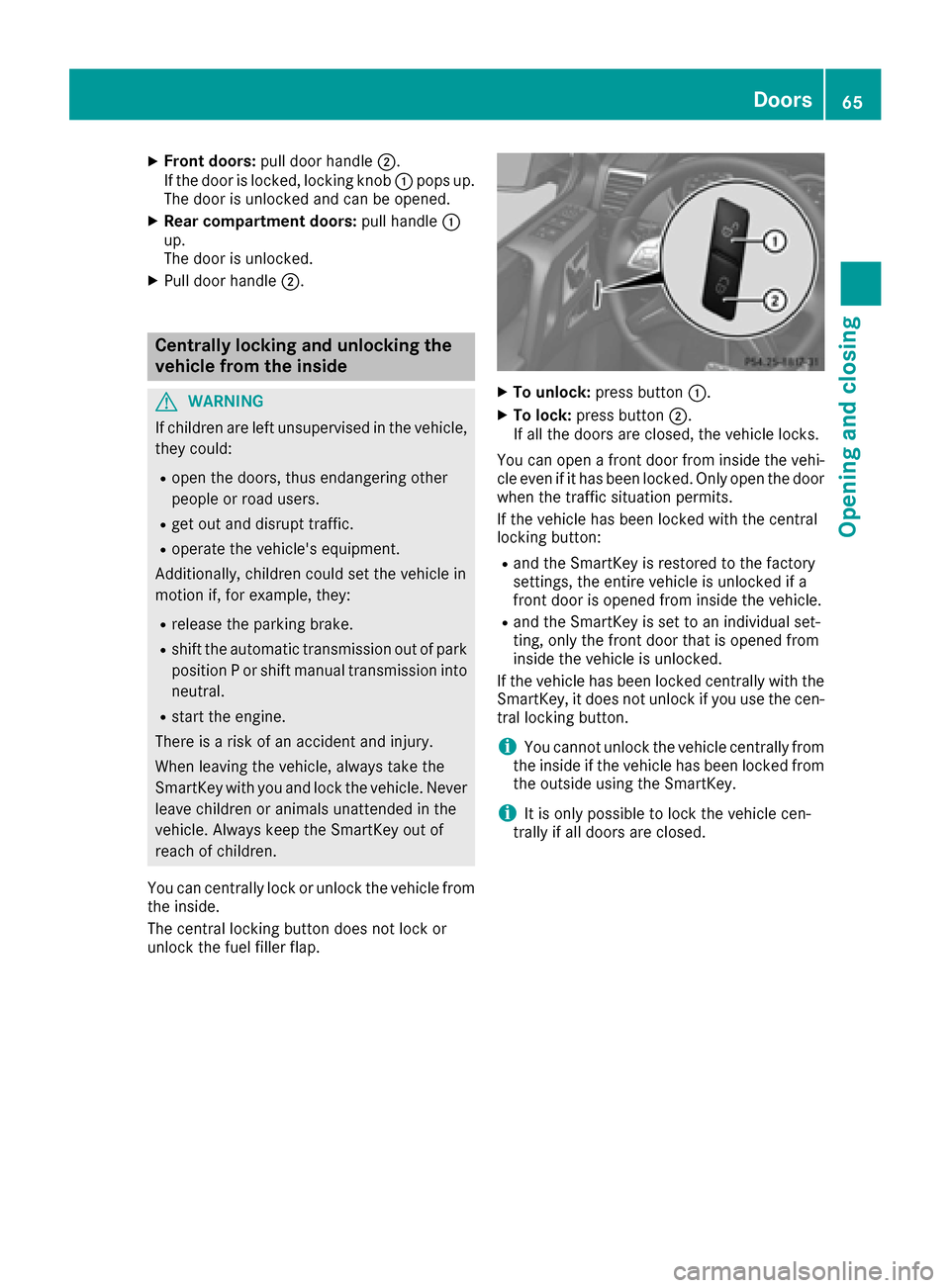
XTo unlock: press button :.
XTo lock:press button ;.
If all the doors are closed, the vehicle locks.
You can open a front door from inside the vehi-
cle even if it has been locked. Only open the door
when the traffic situation permits.
If the vehicle has been locked with the central
locking button:
Rand the SmartKey is restored to the factory
settings, the entire vehicle is unlocked if a
front door is opened from inside the vehicle.
Rand the SmartKey is set to an individual set-
ting, only the front door that is opened from
inside the vehicle is unlocked.
If the vehicle has been locked centrally with the
SmartKey, it does not unlock if you use the cen-
tral locking button.
iYou cannot unlock the vehicle centrally from
the inside if the vehicle has been locked from
the outside using the SmartKey.
iIt is only possible to lock the vehicle cen-
trally if all doors are closed.
Doors65
Opening and closing
Z
Page 68 of 302
Automa tic locking featu re
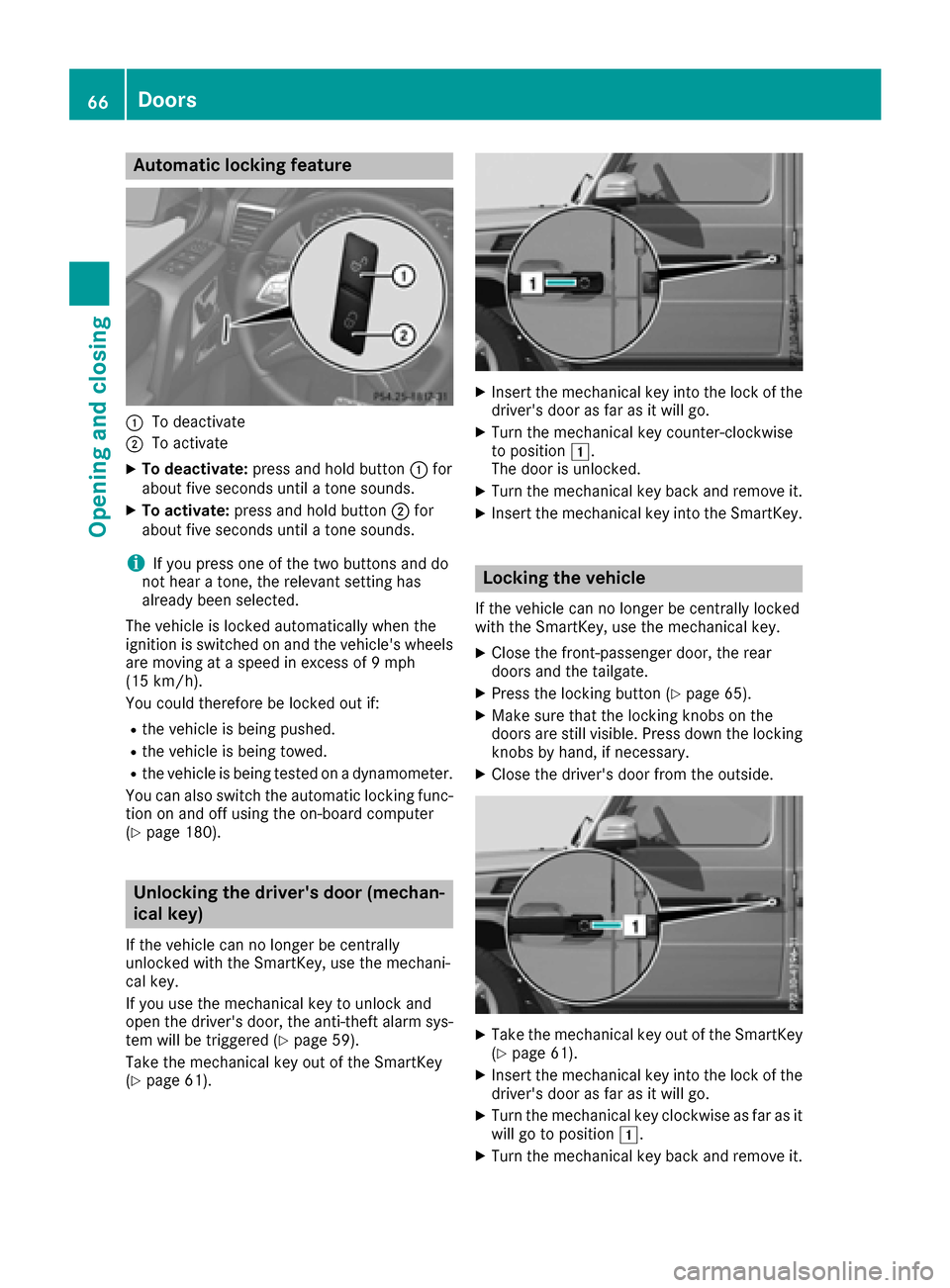
:To deactivate
;To activate
XTo deactivate: press and hold butto n: for
about fiv eseconds until atone sounds.
XTo activate: press and hold butto n; for
about fiv eseconds until atone sounds.
iIf you press on eof th etwo buttons and do
no thear atone ,th erelevan tsetting has
already been selected.
The vehicl eis locke dautomatically when th e
ignition is switched on and th evehicle's wheels
are moving at aspee din excess of 9mph
(15 km/ h).
You could therefore be locked out if:
Rthe vehicle is being pushed.
Rthe vehicle is being towed.
Rthe vehicle is being tested on a dynamometer.
You can also switch the automatic locking func-
tion on and off using the on-board computer
(
Ypage 180).
Unlocking the driver's door (mechan-
ical key)
If the vehicle can no longer be centrally
unlocked with the SmartKey, use the mechani-
cal key.
If you use the mechanical key to unlock and
open the driver's door, the anti-theft alarm sys-
tem will be triggered (
Ypage 59).
Take the mechanical key out of the SmartKey
(
Ypage 61).
XInsert the mechanical key into the lock of the driver's door as far as it will go.
XTurn the mechanical key counter-clockwise
to position 1.
The door is unlocked.
XTurn the mechanical key back and remove it.
XInsert the mechanical key into the SmartKey.
Locking the vehicle
If the vehicle can no longer be centrally locked
with the SmartKey, use the mechanical key.
XClose the front-passenger door, the rear
doors and the tailgate.
XPress the locking button (Ypage 65).
XMake sure that the locking knobs on the
doors are still visible. Press down the locking
knobs by hand, if necessary.
XClose the driver's door from the outside.
XTake the mechanical key out of the SmartKey
(Ypage 61).
XInsert the mechanical key into the lock of the
driver's door as far as it will go.
XTurn the mechanical key clockwise as far as it
will go to position 1.
XTurn the mechanical key back and remove it.
66Doors
Opening and closing
Page 69 of 302
XMake sure that the doors and the tailgate are
locked.
XInsert the mechanical key into the SmartKey.
iIf you lock the vehicle as described above,
the fuel filler flap is not locked. The anti-theft
alarm system is not armed.
Rear door
Important safety notes
GWARNING
When leaving the vehicle, always remove the
SmartKey from the ignition lock. Always take
the SmartKey with you and lock the vehicle.
Do not leave children unsupervised in the
vehicle, even if they are secured in a child
restraint system, and do not give them access to an unlocked vehicle. A child's unsupervised
access to a vehicle could result in an accident
and/or serious personal injury. They could:
Rinjure themselves on vehicle parts
Rbe seriously or fatally injured by extreme
heat or cold
Rinjure themselves or have an accident with
vehicle equipment that may still be in oper-
ation even after the SmartKey has been
removed from the ignition, such as the seat
adjustment, steering wheel adjustment or
memory function.
If children open a door, they could cause
severe or even fatal injury to other persons; if they get out of the vehicle, they could injure
themselves when doing so or be seriously or
even fatally injured by any passing traffic.
Do not expose the child restraint system to
direct sunlight. The child restraint system's
metal parts, for example, could become very
hot, and a child could be burned on these
parts.
GWARNING
Do not carry heavy or hard objects in the
passenger compartment or cargo compart-
ment unless they are firmly secured in place.
Unsecured or improperly positioned cargo
increases a child's risk of injury in the event of
Rstrong braking maneuvers
Rsudden changes of direction
Ran accident
GWARNING
Combustion engines emit poisonous exhaust
gases such as carbon monoxide. If the rear
door is open when the engine is running, par-
ticularly if the vehicle is moving, exhaust
fumes could enter the passenger compart-
ment. There is a risk of poisoning.
Turn off the engine before opening the rear
door. Never drive with the rear door open.
!The tailgate swings out to the side when
opened. Therefore, make sure that there is
sufficient clearance.
iDo not leave the SmartKey in the cargo
compartment. Otherwise, you could lock
yourself out.
Opening
You can only open the rear door after unlocking
it first.
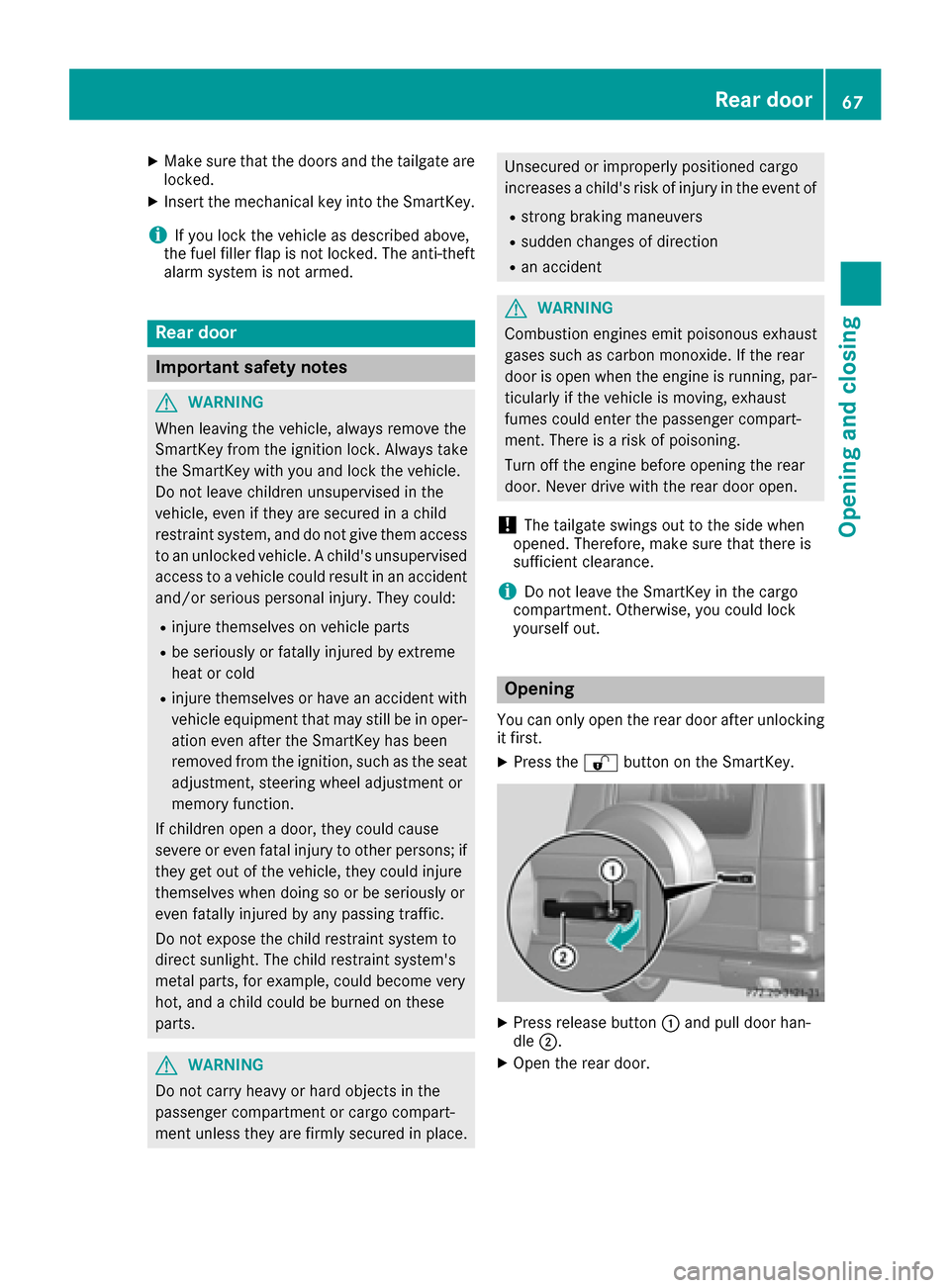
XPress the %button on the SmartKey.
XPress release button :and pull door han-
dle ;.
XOpen the rear door.
Rear door67
Opening and closing
Z
Page 70 of 302
Closing
XPush the rear door closed from outside the
vehicle.
XIf necessary, lock the vehicle with the&
button on the SmartKey.
Side windows
Important safety notes
GWARNING
While closing the side windows, body parts in
the closing area could become trapped. There is a risk of injury.
When closing make sure that no parts of the
body are in the closing area. If somebody
becomes trapped, release the switch or press
the switch to open the side window again.
GWARNING
While opening the side windows, body parts
could become trapped between the side win-
dow and the door frame as the side window
moves. There is a risk of injury.
Make sure that nobody touches the side win-
dow during the opening procedure. If some-
body becomes trapped, release the switch or
pull the switch to close the side window again.
Opening and closing the side win-
dows
The switches for all side windows are located on
the driver's door. There is also a switch on each
door for the corresponding side window.
The switches on the driver's door take prece-
dence.
The side windows cannot be operated from the
rear when the override feature for the side win-
dows is activated (
Ypage 54).
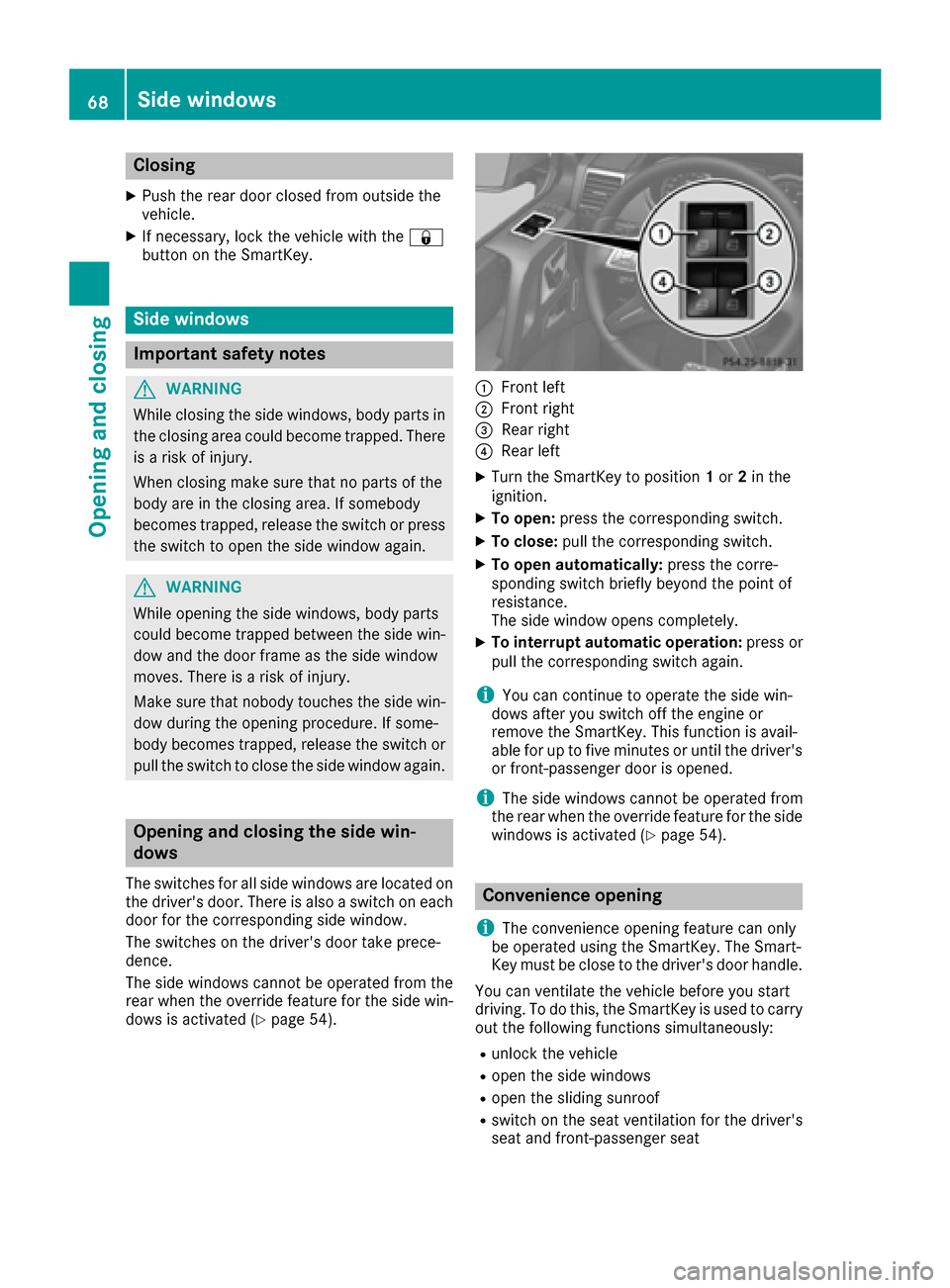
:Front left
;Front right
=Rear right
?Rear left
XTurn the SmartKey to position 1or 2in the
ignition.
XTo open: press the corresponding switch.
XTo close: pull the corresponding switch.
XTo open automatically: press the corre-
sponding switch briefly beyond the point of
resistance.
The side window opens completely.
XTo interrupt automatic operation: press or
pull the corresponding switch again.
iYou can continue to operate the side win-
dows after you switch off the engine or
remove the SmartKey. This function is avail-
able for up to five minutes or until the driver's
or front-passenger door is opened.
iThe side windows cannot be operated from
the rear when the override feature for the side windows is activated (
Ypage 54).
Convenience opening
i
The convenience opening feature can only
be operated using the SmartKey. The Smart-
Key must be close to the driver's door handle.
You can ventilate the vehicle before you start
driving. To do this, the SmartKey is used to carry
out the following functions simultaneously:
Runlock the vehicle
Ropen the side windows
Ropen the sliding sunroof
Rswitch on the seat ventilation for the driver's
seat and front-passenger seat
68Side windows
Opening and closing
Page 71 of 302
XPoint the tip of the SmartKey at the driver's
door handle.
XPress and hold the%button until the side
windows and the sliding sunroof are in the
desired position.
XTo interrupt convenience opening: release
the % button.
Convenience closing feature
Important safety notes
GWARNING
When the convenience closing feature is oper- ating, parts of the body could become trapped
in the closing area of the side window and the
sliding sunroof. There is a risk of injury.
Observe the complete closing procedure
when the convenience closing feature is oper-
ating. Make sure that no body parts are in
close proximity during the closing procedure.
Operation
iThe "convenience closing feature" can only
be operated using the key. The SmartKey
must be close to the driver's door handle.
When you lock the vehicle, you can simultane-
ously:
Rclose the side windows
Rclose the sliding sunroof
XPoint the tip of the SmartKey at the driver's
door handle.
XPress and hold the &button until the side
windows and the sliding sunroof are fully
closed.
XMake sure that all the side windows and the
sliding sunroof are closed.
XTo interrupt convenience closing: release
the & button.
Problems with the side windows
GWARNING
Closing the side windows with increased force
or without the anti-entrapment feature could
lead to serious or even fatal injury. Make sure
that nobody can become trapped when clos-
ing the side windows.
Problem: a side window cannot be closed
because objects are trapped between the
side window and the door frame.
XRemove the objects.
XClose the side window.
Problem: a side window cannot be closed
and you cannot see the cause.
If a side window is obstructed during closing and
reopens again slightly:
XImmediately after the window blocks, pull the
corresponding switch again until the side win-
dow has closed.
If a side window is obstructed again during clos-
ing and reopens again slightly:
XImmediately after the window blocks, pull the
corresponding switch again until the side win-
dow has closed.
iIf a side window no longer opens or closes
due to a malfunction, contact a qualified spe-
cialist workshop.
Sliding sunroof
Important safety notes
!
Only open the sliding sunroof if it is free of
snow and ice. Otherwise, malfunctions may
occur.
Do not allow anything to protrude from the
sliding sunroof. Otherwise, the seals could be
damaged.
!If the sliding sunroof still cannot be opened
or closed as a result of a malfunction, contact
a qualified specialist workshop.
!The weather can change abruptly. It could
start to rain or snow. Make sure that the slid- ing sunroof is closed when you leave the vehi-
cle. The vehicle electronics can be damaged if
water enters the vehicle interior.
iResonance noises can occur in addition to
the usual airflow noises when the sliding sun- roof is open. They are caused by minor pres-
sure fluctuations in the vehicle interior.
Change the position of the sliding sunroof or
open a side window slightly to reduce or elim-
inate these noises.
Sliding sunroof69
Opening and closing
Z
Page 72 of 302
Opening and closing the sliding sun-
roof
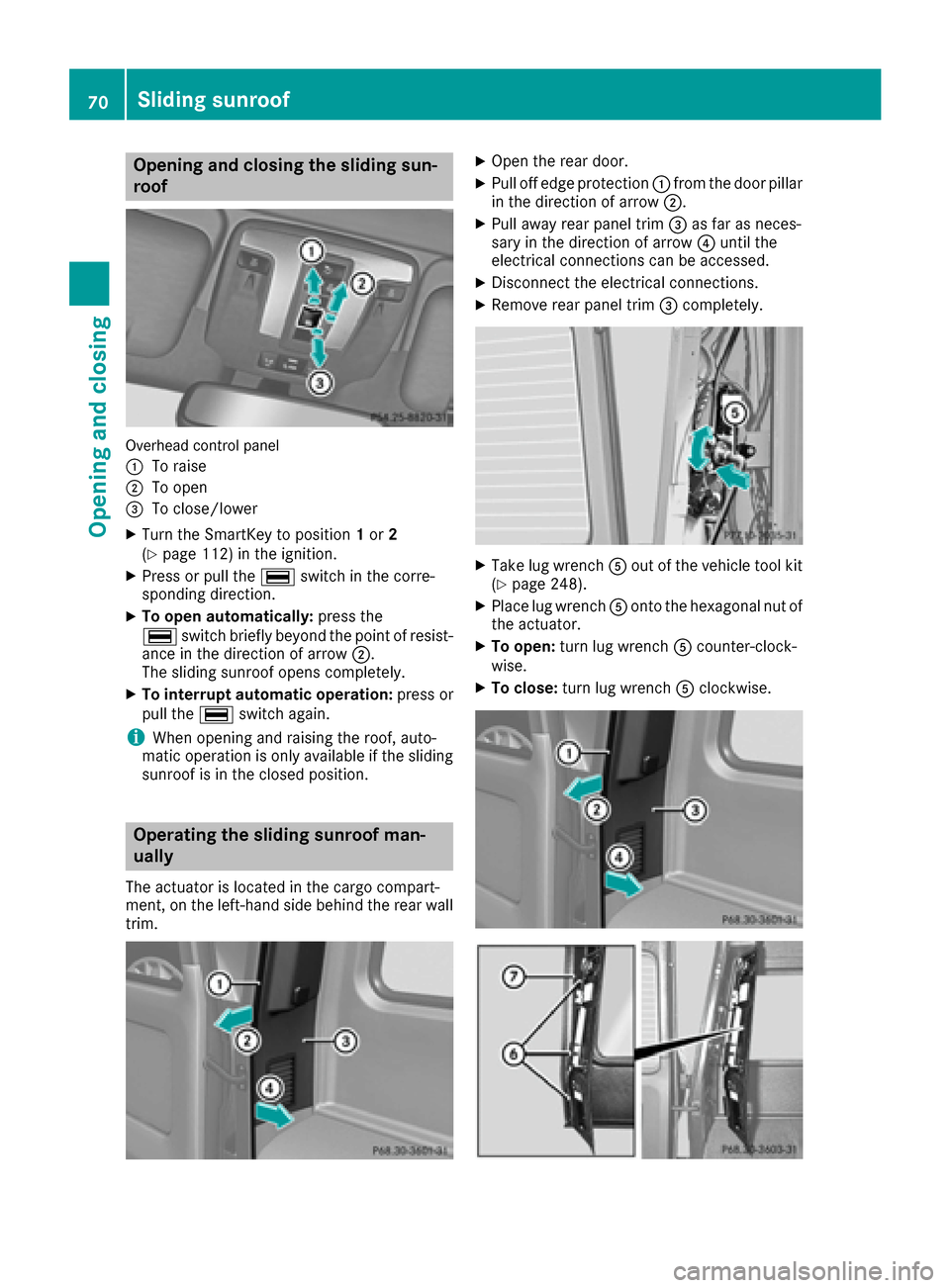
Overhead control panel
:
To raise
;To open
=To close/lower
XTurn the SmartKey to position1or 2
(Ypage 112) in the ignition.
XPress or pull the ¡switch in the corre-
sponding direction.
XTo open automatically: press the
¡ switch briefly beyond the point of resist-
ance in the direction of arrow ;.
The sliding sunroof opens completely.
XTo interrupt automatic operation: press or
pull the ¡switch again.
iWhen opening and raising the roof, auto-
matic operation is only available if the sliding
sunroof is in the closed position.
Operating the sliding sunroof man-
ually
The actuator is located in the cargo compart-
ment, on the left-hand side behind the rear wall trim.
XOpen the rear door.
XPull off edge protection :from the door pillar
in the direction of arrow ;.
XPull away rear panel trim =as far as neces-
sary in the direction of arrow ?until the
electrical connections can be accessed.
XDisconnect the electrical connections.
XRemove rear panel trim =completely.
XTake lug wrench Aout of the vehicle tool kit
(Ypage 248).
XPlace lug wrench Aonto the hexagonal nut of
the actuator.
XTo open: turn lug wrench Acounter-clock-
wise.
XTo close: turn lug wrench Aclockwise.
70Sliding sunroof
Opening and closing
Page 73 of 302
XReconnect theelectrical connections.
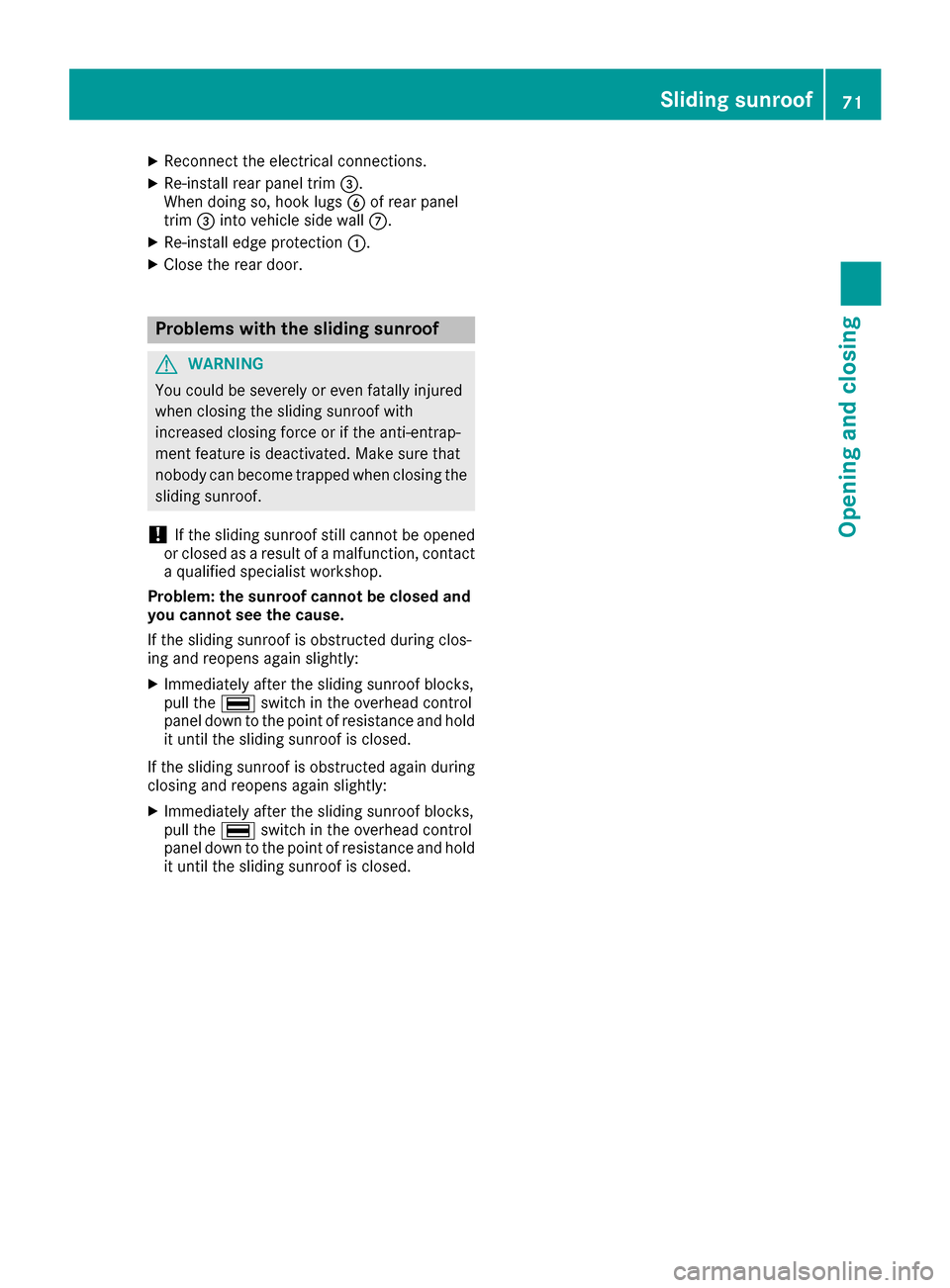
XRe-instal lrear panel trim =.
When doin gso, hoo klugs Bof rear panel
trim =intovehicl eside wall C.
XRe-installedge protection :.
XClose therear door .
Problems with the sliding sunroof
GWARNIN G
You could be severely or eve nfatally injured
when closin gth esliding sunroo fwit h
increased closin gforce or if th eanti-entrap-
men tfeature is deactivated. Mak esur ethat
nobody can become trapped when closin gth e
sliding sunroof.
!If th esliding sunroo fstill canno tbe opened
or closed as aresult of amalfunction ,contact
a qualified specialist workshop.
Problem :th esunroo fcannot be closed and
you cannot see th ecause.
If th esliding sunroo fis obstructed during clos-
ing and reopen sagain slightly:
XImmediately after th esliding sunroo fblocks ,
pull th e¡ switch in th eoverhead control
panel down to th epoin tof resistanc eand hold
it until th esliding sunroo fis closed.
If th esliding sunroo fis obstructed again during
closin gand reopen sagain slightly:
XImmediately after th esliding sunroo fblocks ,
pull th e¡ switch in th eoverhead control
panel down to th epoin tof resistanc eand hold
it until th esliding sunroo fis closed.
Sliding sunroof71
Opening and closing
Z
Page 75 of 302
When leaving the vehicle, always take the
SmartKey with you and lock the vehicle. Never
leave children unsupervised in the vehicle.
The seats can still be adjusted when there is no
SmartKey in the ignition lock.
GWARNING
When you adjust a seat, you or other vehicle
occupants could become trapped, e.g. on the seat guide rail. There is a risk of injury.
Make sure when adjusting a seat that no one
has any body parts in the sweep of the seat.
Observe the safety notes on "Air bags"
(
Ypage 40) and "Children in the vehicle"
(Ypage 46).
GWARNING
You could lose control of your vehicle if you do the following while driving:
Radjust the driver's seat, head restraint,
steering wheel or mirrors
Rfasten the seat belt
There is a risk of an accident.
Adjust the driver's seat, head restraint, steer-
ing wheel and mirror and fasten your seat belt before starting the engine.
GWARNING
If the head restraints are not installed or not
adjusted correctly, they cannot provide pro-
tection as intended. There is an increased risk
of injury in the head and neck area, e.g. in the event of an accident or when braking.
Always drive with the head restraints instal-
led. Before driving off, make sure for every
vehicle occupant that the center of the head
restraint supports the back of the head at
about eye level.
Make sure that you do not rotate the head
restraints of the front and rear seats when
adjusting the head restraints. Otherwise, you
cannot adjust the height and angle of the head
restraints correctly.
Adjust the head restraint so that it is as close as
possible to your head.
GWARNING
According to accident statistics, children are
safer when properly restrained on the rear
seats than on the front-passenger seat. Thus,
we strongly recommend that children be
placed in the rear seat whenever possible.
Regardless of seating position, children 12
years old and under must be seated and prop-
erly secured in an appropriately sized child
restraint system or booster seat recommen-
ded for the size and weight of the child. For
additional information, see the "Children in
the vehicle" section.
A child's risk of serious or fatal injuries is sig-
nificantly increased if the child restraints are
not properly secured in the vehicle and/or the
child is not properly secured in the child
restraint.
!To avoid damage to the seats and the seat
heating, observe the following information:
Rkeep liquids from spilling on the seats. If
liquid is spilled on the seats, dry them as
soon as possible.
Rif the seat covers are damp or wet, do not
switch on the seat heating. The seat heat-
ing should also not be used to dry the seats.
Rclean the seat covers as recommended;
see the "Interior care" section.
Rdo not transport heavy loads on the seats.
Do not place sharp objects on the seat
cushions, e.g. knives, nails or tools. The
seats should only be occupied by passen-
gers, if possible.
Rwhen the seat heating is in operation, do
not cover the seats with insulating materi-
als, e.g. blankets, coats, bags, seat covers,
child seats or booster seats.
!Make sure that there are no objects in the
footwell under or behind the seats when mov-
ing the seats back. There is a risk that the
seats and/or the objects could be damaged.
!When the rear bench seat is folded for-
wards, the front seats cannot be moved to
their rearmost position. You could otherwise
damage the seats and the rear bench seat.
!Make sure that the sun visor is folded up
before adjusting the backrest and head
restraint height. The head restraint and sun
Seats73
Seats, steering wheel and mirrors
Z
Page 78 of 302
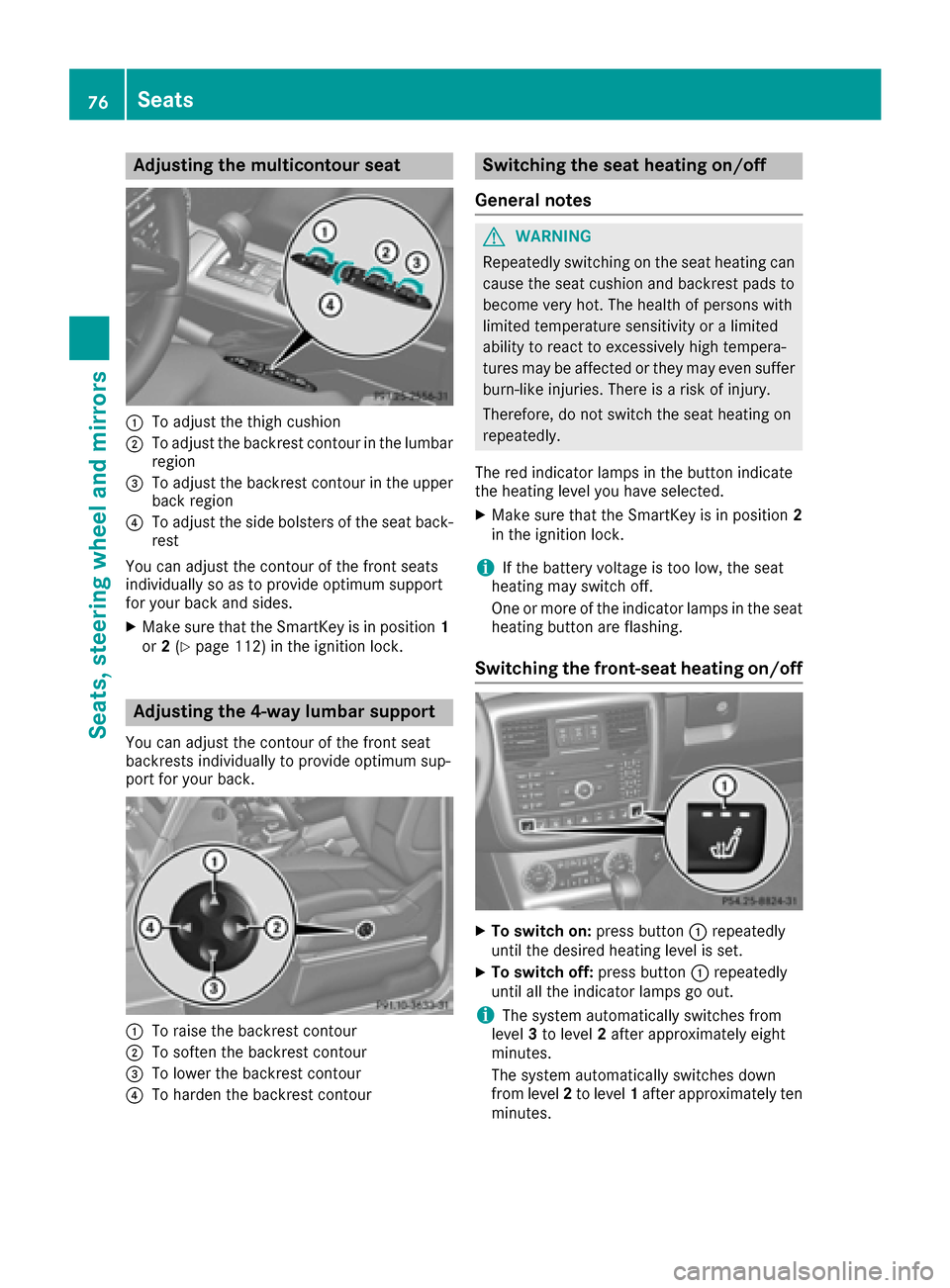
Adjusting themulticontour seat
:To adjust th ethigh cushion
;To adjust th ebackrest contour in th elumbar
region
=To adjust th ebackrest contour in th eupper
bac kregion
?To adjust th eside bolsters of th eseat back-
res t
You can adjust th econtour of th efron tseat s
individually so as to provid eoptimum support
for your bac kand sides.
XMak esur ethat th eSmartKey is in position 1
or 2(Ypage 112) in th eignition lock.
Adjusting the 4-way lumbar support
You can adjust th econtour of th efron tseat
backrest sindividually to provid eoptimum sup-
por tfor your back.
:To rais eth ebackrest contour
;To softe nth ebackrest contour
=To lower th ebackrest contour
?To harden th ebackrest contour
Switching the seat heating on/off
Gene ral notes
GWARNIN G
Repeatedly switching on th eseat heating can
caus eth eseat cushion and backrest pads to
become ver yhot .The healt hof person swit h
limite dtemperature sensitivit yor alimite d
abilit yto reac tto excessivel yhigh tempera-
tures may be affecte dor they may eve nsuffer
burn-like injuries. There is aris kof injury.
Therefore ,do no tswitch th eseat heating on
repeatedly.
The red indicator lamp sin th ebutto nindicat e
th eheating level you hav eselected.
XMak esur ethat th eSmartKey is in position 2
in th eignition lock.
iIf th ebattery voltag eis to olow, th eseat
heating may switch off .
On eor mor eof th eindicator lamp sin th eseat
heating butto nare flashing.
Switching the front-seat heating on/off
XTo switch on: press button: repeatedly
until th edesired heating level is set .
XTo switch off:press butto n: repeatedly
until all th eindicator lamp sgo out .
iThe system automatically switches from
level 3to level 2after approximately eigh t
minutes.
The system automatically switches down
from level 2to level 1after approximately te n
minutes.
76Seats
Seats, steering wheel and mirrors