Oil MERCEDES-BENZ G-CLASS SUV 2008 User Guide
[x] Cancel search | Manufacturer: MERCEDES-BENZ, Model Year: 2008, Model line: G-CLASS SUV, Model: MERCEDES-BENZ G-CLASS SUV 2008Pages: 293, PDF Size: 4.49 MB
Page 166 of 293
Tyres and wheels
163
!
Retreaded tyres are neither tested nor
recommended by Mercedes-Benz, since
previous damage cannot always be detec-
ted on retreaded tyres. As a result,
Mercedes-Benz cannot guarantee vehicle
safety if retreaded tyres are fitted. Do not
fit used tyres if you have no information
about their previous usage. G
Risk of accident
If wheels or tyres other than those which
have been tested are fitted:
R the brakes or chassis components could
be damaged.
R wheel and tyre clearances can no longer
be guaranteed.
This could cause an accident.
Modification work on the brake system and
wheels is not permitted, nor is the use of
spacer plates or brake dust shields. This inva-
lidates the General Operating Permit for the
vehicle. Notes on selecting, fitting and replacing
tyres R
only fit tyres and wheels of the same type
and make.
R only fit tyres of the correct size onto the
wheels.
R after fitting new tyres, run them in at mod-
erate speeds for the first 100 km as they
only reach their full performance after this
distance.
R fit new tyres on the front wheels first if tyres
of the same size are required on the front
and rear wheels.
R replace the tyres after six years at the lat-
est, regardless of wear. This also applies to
the spare wheel.
R do not drive with tyres which have too little
tread depth, as this significantly reduces
the traction on wet roads (aquaplaning).
! Store tyres that are not being used in a
cool, dry and preferably dark place. Protect
the tyres against oil, grease, petrol and die-
sel. Notes on regularly inspecting wheels
and tyres R
regularly check the wheels and tyres of
your vehicle for damage (e.g. cuts, punctu-
res, tears, bumps on tyres and deforma-
tion, cracks or severe corrosion on wheels),
at least every 14 days, as well as after driv-
ing off-road or on rough roads. Damaged
wheels could cause a loss of tyre pressure.
R regularly check the tyre tread depth and the
condition of the tread across the whole
width of the tyre (Y page 164). If neces-
sary, turn the front wheels to full lock in
order to inspect the inner side of the tyre
surface.
R all wheels must have a valve cap to protect
the valve against dirt and moisture.
R regularly check the pressure of all your
tyres including the spare tyre, particularly
prior to long trips, and correct the pressure
as necessary (Y page 164).
Notes on driving R
while driving, pay attention to vibrations,
noises and unusual handling characteris-
tics, e.g. pulling to one side. This may indi-
cate that the wheels or tyres are damaged.
If you suspect that a tyre is defective, Operation
463_AKB; 1; 8, en-GB
wobuchh
,V ersion: 2.10.6
2008-07-17T15:19:41+02:00 - Seite 163 ZDateiname: 6515_4091_02_buchblock.pdf; preflight
Page 177 of 293
Off-road driving
174
i
Information about retrofitting special all-
terrain tyres is available from any
Mercedes-Benz Service Centre.
Checklist before driving off-road X
Engine oil level: check the engine oil and
top it up if necessary.
Only then does the engine receive enough
oil when the vehicle is standing on a steep
incline.
X Vehicle toolkit: check that the jack is
working and make sure you have the wheel-
brace, a robust tow cable and a folding
spade in the vehicle.
X Wheels and tyres: check the tyre tread
depth and tyre pressure.
X Check for damage and remove any objects,
e.g. small stones, from the wheels/tyres.
X Replace any missing valve caps.
X Replace dented or damaged wheels.
Checklist after driving off-road Driving over rough terrain places greater
demands on your vehicle than driving on nor-
mal roads. After driving off-road, check the
vehicle. This allows you to detect damage
promptly and reduce the risk of an accident
to yourself and other road users. X
Shift the transfer case to HIGH
(Y page 93).
X Disengage the differential locks
(Y page 95).
X Clean the headlamps and rear lights and
check for damage.
X Clean the front and rear licence plates.
X Clean the wheels/tyres with a water jet and
remove any foreign objects.
X Clean the wheels, wheel arches and the
vehicle underside with a water jet; check
for foreign objects and damage.
X Check whether twigs or other parts of
plants have become trapped. These
increase the risk of fire and can damage
fuel pipes, brake hoses or the rubber bel-
lows of the axle joints and propeller shafts.
X After the trip, examine without fail the
entire undercarriage, wheels, tyres, brakes,
bodywork structure, steering, chassis and
exhaust system for damage.
X After driving for extended periods across
sand, mud, gravel, water or in similarly dirty
conditions, have the brake discs, wheels,
brake pads /linings and axle joints checked
and cleaned.
X If you detect strong vibrations after off-road
travel, check for foreign objects in the
wheels and drive train and remove them if necessary. Foreign objects can disturb the
balance and cause vibrations. Travelling uphill
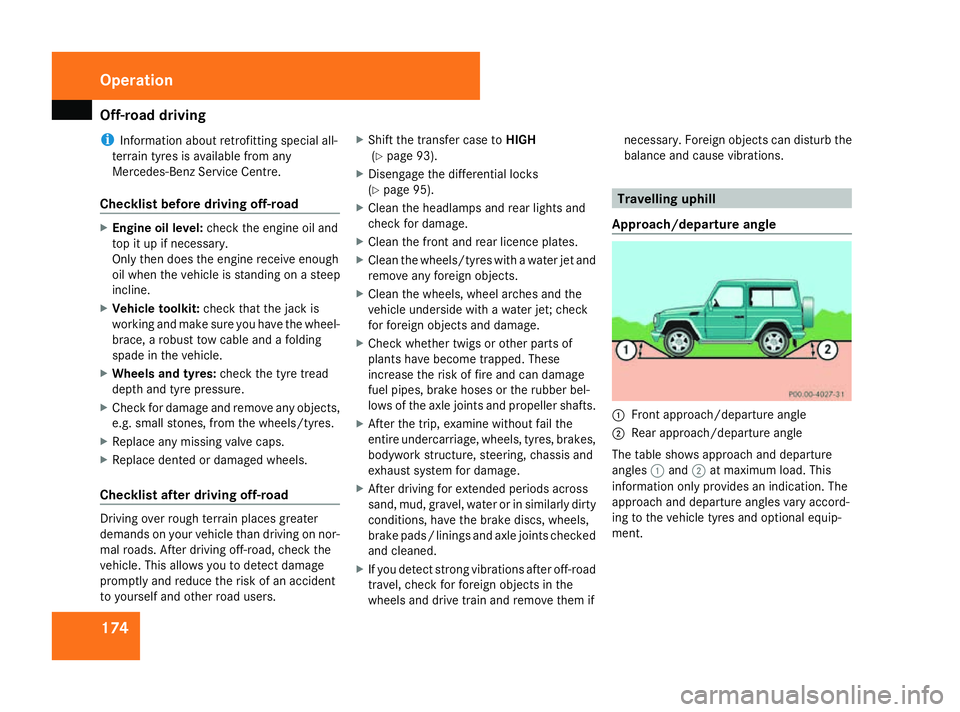
Approach/departure angle 1
Front approach/departure angle
2 Rear approach/departure angle
The table shows approach and departure
angles 1and 2at maximum load. This
information only provides an indication. The
approach and departure angles vary accord-
ing to the vehicle tyres and optional equip-
ment. Operation
463_AKB; 1; 8, en-GB
wobuchh,
Version: 2.10.6 2008-07-17T15:19:41+02:00 - Seite 174Dateiname: 6515_4091_02_buchblock.pdf; preflight
Page 185 of 293
Care
182
X
Switch on the ignition.
X Press the èorÿ button to select the
standard display (Y page 101).
X Press the jork button to select the
service information.
The 9 or½ service symbol and the
service due date are displayed. Fuel/water separator*
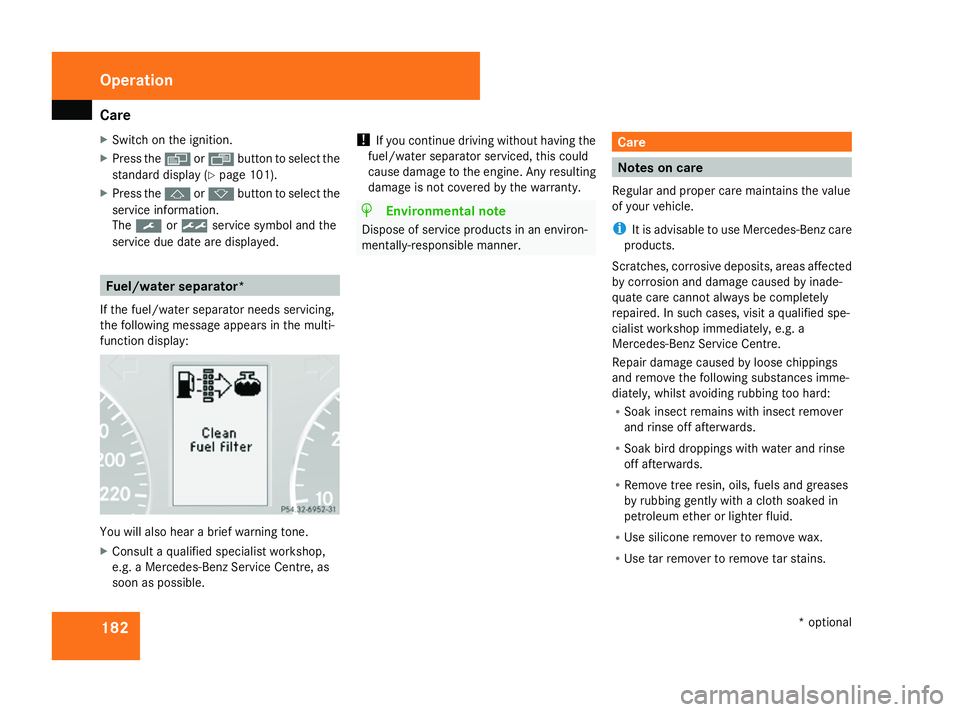
If the fuel/water separator needs servicing,
the following message appears in the multi-
function display: You will also hear a brief warning tone.
X Consult a qualified specialist workshop,
e.g. a Mercedes-Benz Service Centre, as
soon as possible. !
If you continue driving without having the
fuel/water separator serviced, this could
cause damage to the engine. Any resulting
damage is not covered by the warranty. H
Environmental note
Dispose of service products in an environ-
mentally-responsible manner. Care
Notes on care
Regular and proper care maintains the value
of your vehicle.
i It is advisable to use Mercedes-Benz care
products.
Scratches, corrosive deposits, areas affected
by corrosion and damage caused by inade-
quate care cannot always be completely
repaired. In such cases, visit a qualified spe-
cialist workshop immediately, e.g. a
Mercedes-Benz Service Centre.
Repair damage caused by loose chippings
and remove the following substances imme-
diately, whilst avoiding rubbing too hard:
R Soak insect remains with insect remover
and rinse off afterwards.
R Soak bird droppings with water and rinse
off afterwards.
R Remove tree resin, oils, fuels and greases
by rubbing gently with a cloth soaked in
petroleum ether or lighter fluid.
R Use silicone remover to remove wax.
R Use tar remover to remove tar stains. Operation
* optional
463_AKB; 1; 8, en-GB
wobuchh,
Version: 2.10.6 2008-07-17T15:19:41+02:00 - Seite 182Dateiname: 6515_4091_02_buchblock.pdf; preflight
Page 187 of 293
Care
184
Cleaning the wiper blades and the out-
side of the windscreen G
Risk of injury
Before cleaning the windscreen or wiper
blades, turn the key in the ignition lock to
0. The windscreen wipers could otherwise
move and cause injury.
X Turn the key to position 1in the ignition
lock (Y page 59).
X Set the windscreen wipers to position Ion
the combination switch (Y page 82).
X Turn the key to position 0or remove it when
the wiper arms are vertical (Y page 59).
! Only fold the wiper arms away from the
windscreen when they are in a vertical posi-
tion, otherwise you will damage the bonnet.
X Fold the wiper arms away from the wind-
screen until you feel them snap into place.
X Clean the windscreen and the wiper blades.
X Fold the windscreen wipers back again
before the ignition is switched on.
! Do not clean the wiper blades too often
as this will result in the rubber becoming
porous, leading to wiper noise. Cleaning the windows !
Do not use dry cloths, abrasive products,
solvents or cleaning agents containing sol-
vents to clean the inside of the windows.
Clean the insides of the windows with a
damp cloth or commercially-available glass
cleaner. Avoid touching the inside of the
rear windscreen and the side windows with
hard objects, e.g. ice scrapers or rings. You
could otherwise cause damage to the win-
dows, rear window heating or aerial on the
rear window.
i Anti-glare film retrofitted to the insides of
the windows could interfere with radio or
mobile phone reception, especially if it is
conductive or metal-coated film. Informa-
tion about anti-glare film can be obtained
from any Mercedes-Benz Service Centre.
Cleaning the headlamps X
Clean the headlamp lenses with a wet
sponge.
! Only use washer fluid which is suitable
for plastic lenses. Unsuitable washer fluid
could damage the plastic lenses of the
headlamps.
Do not use the following: R
dry cloths
R abrasive cleaning agents
R solvents
R cleaning agents containing solvent
You could otherwise scratch or damage the
surface of the lenses.
Plastic trim !
Do not use dry, coarse or hard cloths and
do not scrub. Doing so will scratch or dam-
age the surfaces.
! In order to protect the vehicle's high-qual-
ity surfaces and to retain the overall
appearance, avoid contact with cosmetics
and suntan lotion.
X Wipe plastic parts with a damp, lint-free
cloth (e.g. a microfibre cloth).
X Light soiling: use a low-foaming soap (e.g.
a light liquid hand soap) diluted in water.
X Heavy soiling: use a cleaning agent that is
solvent-free and non-corrosive. Mercedes-
Benz recommends that you use a
Mercedes-Benz cleaning product for this
purpose. Operation
463_AKB; 1; 8, en-GB
wobuchh,
Version: 2.10.6 2008-07-17T15:19:41+02:00 - Seite 184Dateiname: 6515_4091_02_buchblock.pdf; preflight
Page 189 of 293
Care
186car wash. Do not use sharp-edged equip-
ment to remove ice and snow.
! Never use any of the following to clean the
soft top:
R petrol
R thinner
R tar or stain remover
R other organic solvents
Cleaning the soft top
If it is only slightly dirty, you can clean the soft
top while it is dry or rinse it with clear water.
Use a brush and clear water to clean away
normal amounts of dirt. Always brush in the
direction of the cloth, from front to back.
If it is very dirty or stained, clean with a suit-
able soft-top cleaning agent and a brush.
Always brush in the direction of the cloth,
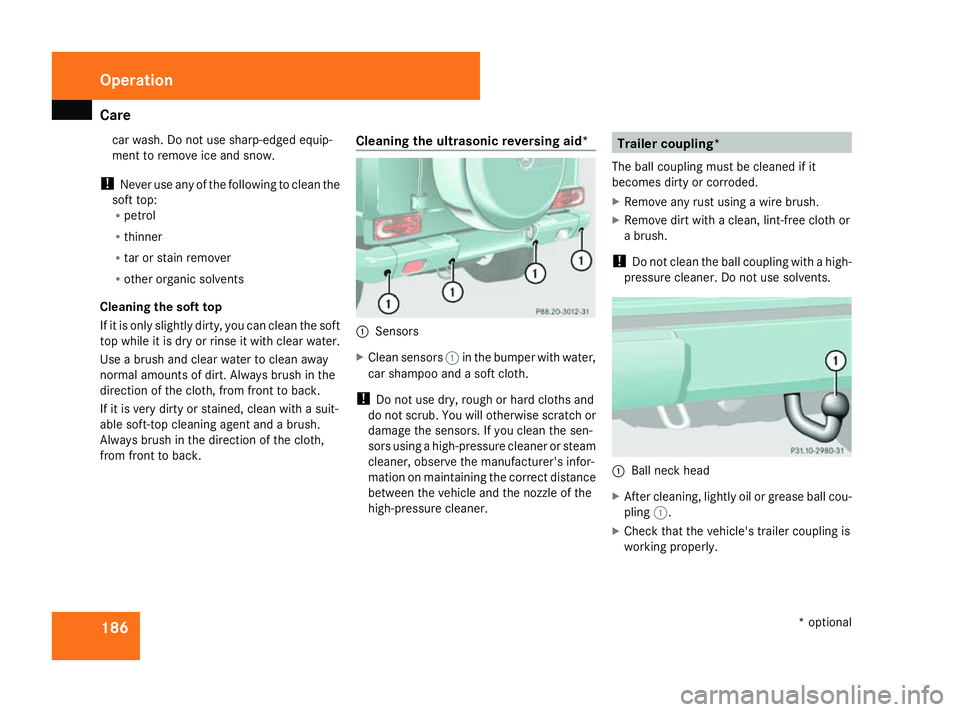
from front to back. Cleaning the ultrasonic reversing aid* 1
Sensors
X Clean sensors 1in the bumper with water,
car shampoo and a soft cloth.
! Do not use dry, rough or hard cloths and
do not scrub. You will otherwise scratch or
damage the sensors. If you clean the sen-
sors using a high-pressure cleaner or steam
cleaner, observe the manufacturer's infor-
mation on maintaining the correct distance
between the vehicle and the nozzle of the
high-pressure cleaner. Trailer coupling*
The ball coupling must be cleaned if it
becomes dirty or corroded.
X Remove any rust using a wire brush.
X Remove dirt with a clean, lint-free cloth or
a brush.
! Do not clean the ball coupling with a high-
pressure cleaner. Do not use solvents. 1
Ball neck head
X After cleaning, lightly oil or grease ball cou-
pling 1.
X Check that the vehicle's trailer coupling is
working properly. Operation
* optional
463_AKB; 1; 8, en-GB
wobuchh,
Version: 2.10.6 2008-07-17T15:19:41+02:00 - Seite 186Dateiname: 6515_4091_02_buchblock.pdf; preflight
Page 190 of 293
Care
187
i
Maintenance of the ball coupling and
trailer coupling can also be performed by
any Mercedes-Benz Service Centre. H
Environmental note
Dispose of oily and greasy cloths in an envi-
ronmentally-responsible manner. Operation
463_AKB; 1; 8, en-GB
wobuchh,
Version: 2.10.6 2008-07-17T15:19:41+02:00 - Seite 187 ZDateiname: 6515_4091_02_buchblock.pdf; preflight
Page 210 of 293
Display
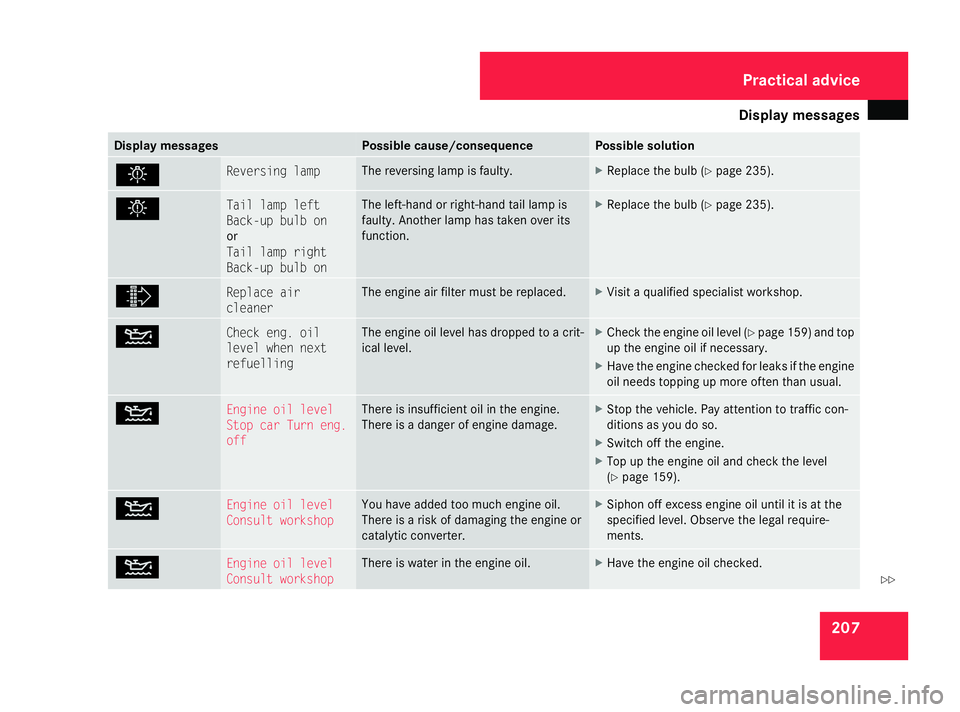
messages 207Display messages Possible cause/consequence Possible solution
. Reversing lamp The reversing lamp is fa
ulty. X
Replace the bulb (Y page 235). . Tail lamp left
Back-up bulb on
or
Tail lamp right
Back-up bulb on The left-hand or right-hand tail lamp is
faulty. Another lamp has taken over its
function. X
Replace the bulb (Y page 235). ò Replace air
cleaner The engine air filter must be replaced. X
Visit a qualified specialist workshop. N Check eng. oil
level when next
refuelling The engine oil level has dropped to a crit-
ical level. X
Check the engine oil level (Y page 159) and top
up the engine oil if necessary.
X Have the engine checked for leaks if the engine
oil needs topping up more often than usual. N Engine oil level
Stop car Turn eng.
off There is insufficient oil in the engine.
There is a danger of engine damage. X
Stop the vehicle. Pay attention to traffic con-
ditions as you do so.
X Switch off the engine.
X Top up the engine oil and check the level
(Y page 159). N Engine oil level
Consult workshop You have added too much engine oil.
There is a risk of damaging the engine or
catalytic converter. X
Siphon off excess engine oil until it is at the
specified level. Observe the legal require-
ments. N Engine oil level
Consult workshop There is water in the engine oil. X
Have the engine oil checked. Practical advice
463_AKB; 1; 8, en-GB
wobuchh,
Version: 2.10.6 2008-07-17T15:19:41+02:00 - Seite 207 ZDateiname: 6515_4091_02_buchblock.pdf; preflight
Page 211 of 293
Display
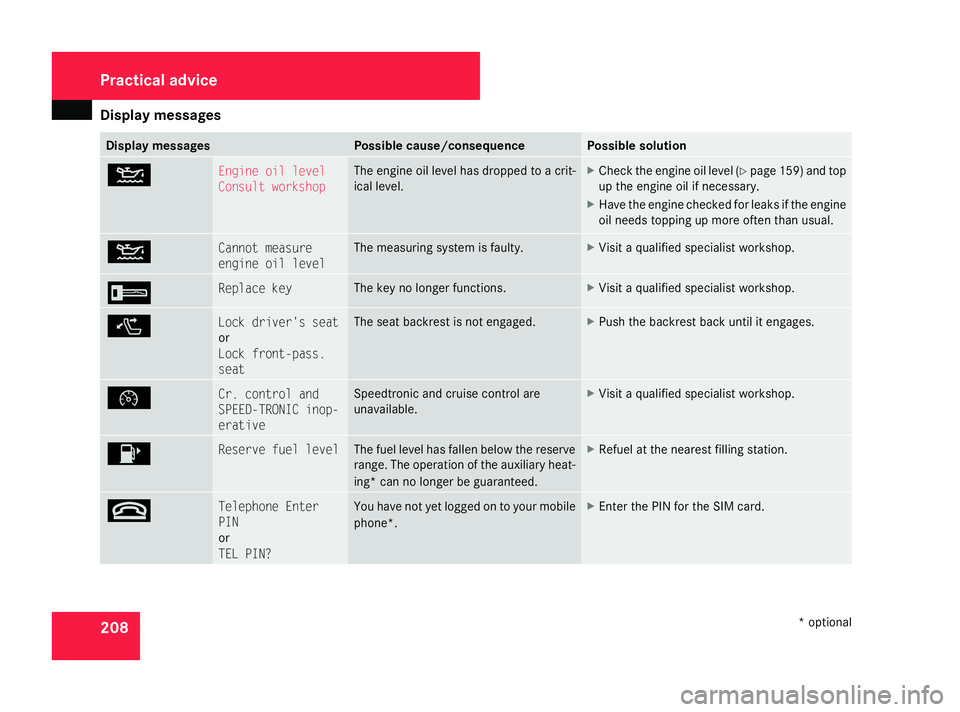
messages 208 Display messages Possible cause/consequence Possible solution
N Engine oil level
Consult workshop The engine oil level has dropped to a crit-
ical level. X
Check the engine oil level (Y page 159) and top
up the engine oil if necessary.
X Have the engine checked for leaks if the engine
oil needs topping up more often than usual. N Cannot measure
engine oil level The measuring system is faulty. X
Visit a qualified specialist workshop. I Replace key The key no longer functions. X
Visit a qualified specialist workshop. ( Lock driver's seat
or
Lock front-pass.
seat The seat backrest is not engaged. X
Push the backrest back until it engages. Ñ Cr. control and
SPEED-TRONIC inop-
erative Speedtronic and cruise control are
unavailable. X
Visit a qualified specialist workshop. 4 Reserve fuel level The fuel level has fallen below the reserve
range. The operation of the auxiliary heat-
ing* can no longer be guaranteed. X
Refuel at the nearest filling station. t Telephone Enter
PIN
or
TEL PIN? You have not yet logged on to your mobile
phone*. X
Enter the PIN for the SIM card. Practical advice
* optional
463_AKB; 1; 8, en-GB
wobuchh,
Version: 2.10.6 2008-07-17T15:19:41+02:00 - Seite 208Dateiname: 6515_4091_02_buchblock.pdf; preflight
Page 225 of 293
Troubleshooting
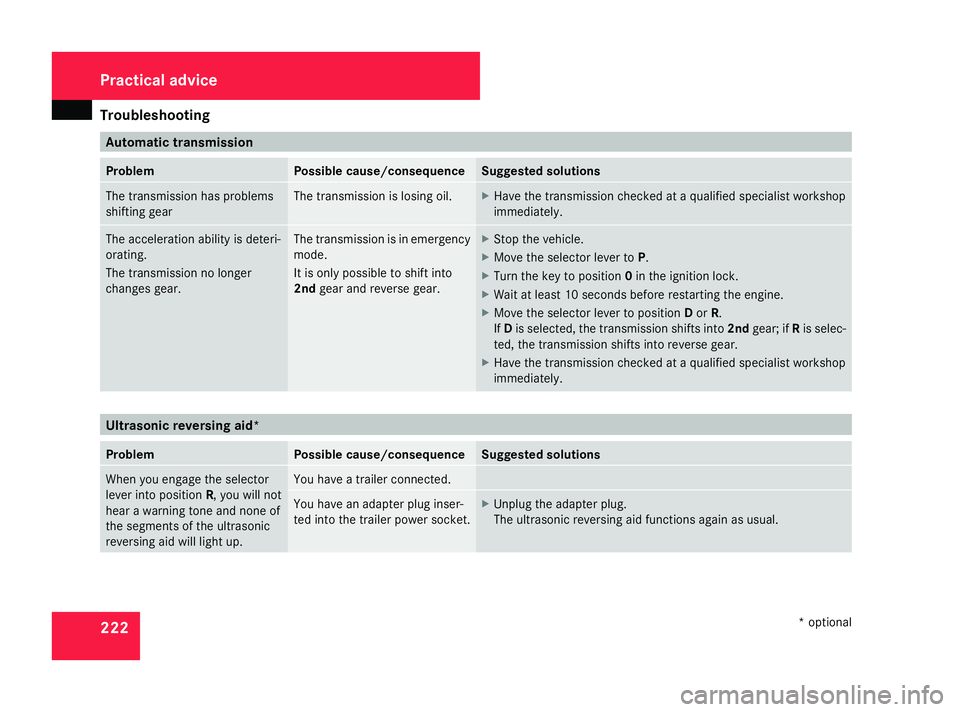
222 Automatic transmission
Problem Possible cause/consequence Suggested solutions
The transmission has problems
shifting gear The transmission is losing oil. X
Have the transmission checked at a qualified specialist workshop
immediatel y. The acceleration ability is deteri-
orating.
The transmission no longer
changes gear. The transmission is in emergency
mode.
It is only possible to shift into
2nd
gear and reverse gear. X
Stop the vehicle.
X Move the selector lever to P.
X Turn the key to position 0in the ignition lock.
X Wait at least 10 seconds before restarting the engine.
X Move the selector lever to position Dor R.
If D is selected, the transmission shifts into 2ndgear; if Ris selec-
ted, the transmission shifts into reverse gear.
X Have the transmission checked at a qualified specialist workshop
immediately. Ultrasonic reversing aid*
Problem Possible cause/consequence Suggested solutions
When you engage the selector
lever into position
R, you will not
hear a warning tone and none of
the segments of the ultrasonic
reversing aid will light up. You have a trailer connected.
You have an adapter plug inser-
ted into the trailer power socket. X
Unplug the adapter plug.
The ultrasonic reversing aid functions again as usual. Practical advice
* optional
463_AKB; 1; 8, en-GB
wobuchh,
Version: 2.10.6 2008-07-17T15:19:41+02:00 - Seite 222Dateiname: 6515_4091_02_buchblock.pdf; preflight
Page 249 of 293
Flat tyre
246
!
Do not place wheel bolts in sand or on a
dirty surface. This could cause damage to
the bolt and wheel hub threads.
X Remove the wheel.
Fit ting a new wheel G
Risk of accident
Replace damaged or corroded wheel bolts.
Never oil or grease wheel bolts. G
Risk of accident
If a wheel hub thread is damaged, you must
not drive the vehicle any further. Consult a
qualified specialist workshop which has the
necessary specialist knowledge and tools
to carry out the work required. Mercedes-
Benz recommends that you use a
Mercedes-Benz Service Centre or Service
24h for this purpose. In particular, work rel-
evant to safety or on safety-related systems
must be carried out at a qualified specialist
workshop. G
Risk of accident
Only use wheel bolts that have been
designed for the wheel and the vehicle. For
safety reasons, Mercedes-Benz recom- mends that you only use wheel bolts which
have been approved for Mercedes-Benz
vehicles. Other bolts could work loose.
Do not tighten the wheel bolts completely
while the vehicle is still jacked up. The vehi-
cle could topple off the jack.
X Clean the wheel and wheel hub contact
surfaces.
X Place the wheel on the wheel hub and push
it on.
X Tighten the wheel bolts until they are fin-
ger-tight.
Lowering the vehicle X
Open the pressure release screw on the
jack using the pump lever (Y page 244) by
approximatel y one turn.
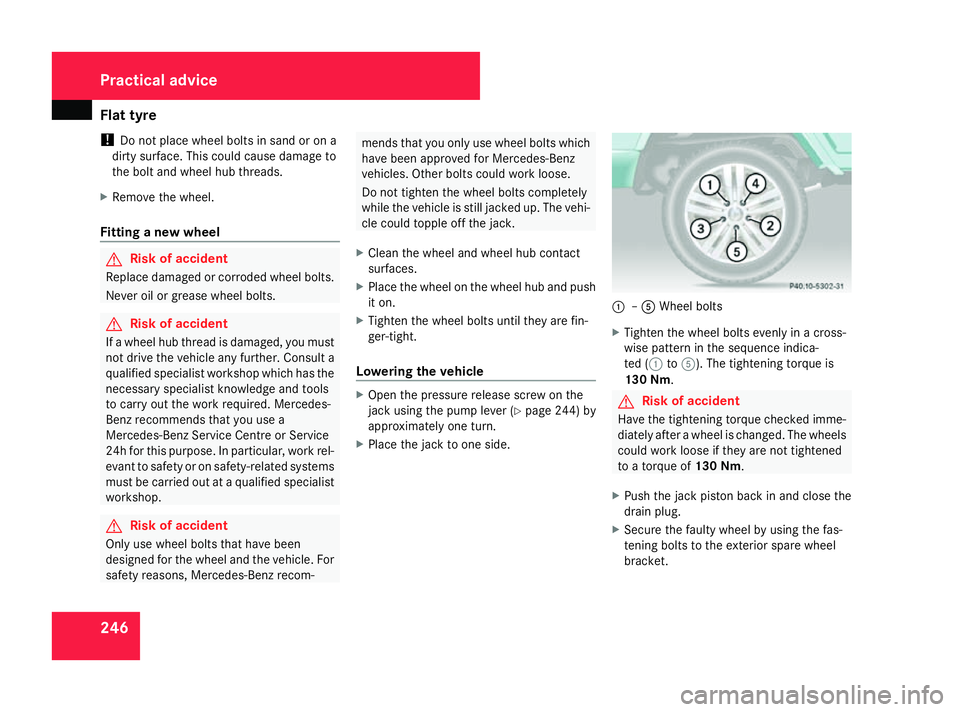
X Place the jack to one side. 1
–5 Wheel bolts
X Tighten the wheel bolts evenly in a cross-
wise pattern in the sequence indica-
ted (1 to5). The tightening torque is
130 Nm . G
Risk of accident
Have the tightening torque checked imme-
diately after a wheel is changed. The wheels
could work loose if they are not tightened
to a torque of 130 Nm.
X Push the jack piston back in and close the
drain plug.
X Secure the faulty wheel by using the fas-
tening bolts to the exterior spare wheel
bracket. Practical advice
463_AKB; 1; 8, en-GB
wobuchh,
Version: 2.10.6 2008-07-17T15:19:41+02:00 - Seite 246Dateiname: 6515_4091_02_buchblock.pdf; preflight