sensor MERCEDES-BENZ G-CLASS SUV 2008 User Guide
[x] Cancel search | Manufacturer: MERCEDES-BENZ, Model Year: 2008, Model line: G-CLASS SUV, Model: MERCEDES-BENZ G-CLASS SUV 2008Pages: 293, PDF Size: 4.49 MB
Page 71 of 293
Mirrors
68 Mirrors
Rear-view mirror
X Adjust the rear-view mirror by hand so you
have a good overview of the traffic condi-
tions. Exterior mirrors
G
Risk of accident
The exterior mirrors reduce the size of the
image. Objects are actually closer than
they appear. You could misjudge the dis-
tance from vehicles driving behind and
cause an accident, e.g. when changing
lane. For this reason, make sure of the
actual distance from the vehicle driving
behind by glancing over your shoulder.
The convex exterior mirrors provide a larger
field of vision.
At low outside temperatures the exterior mir-
rors are heated automatically.
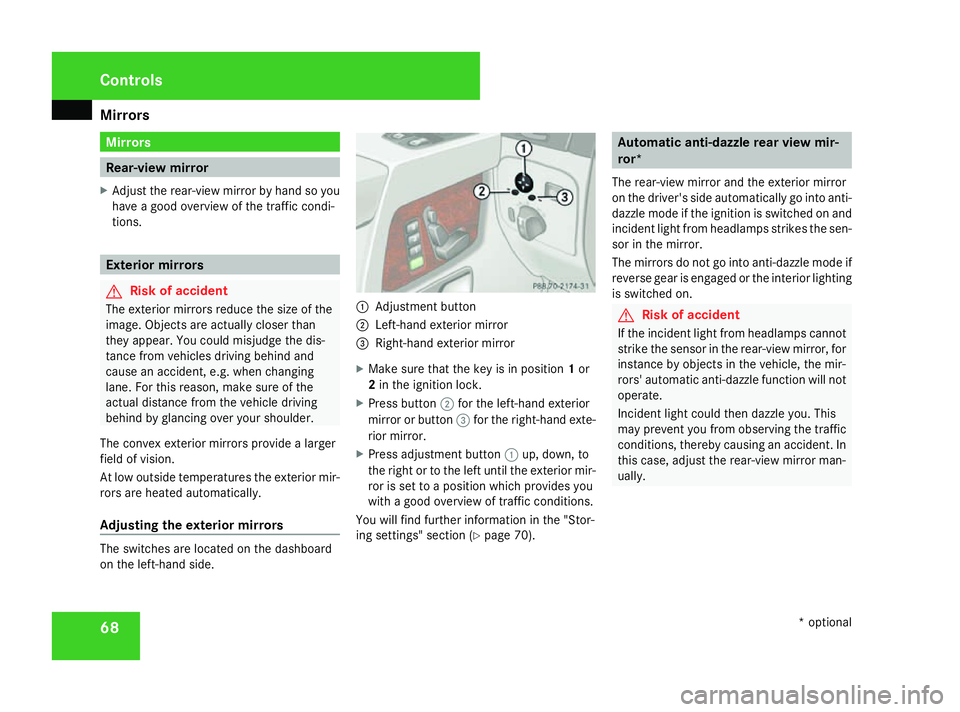
Adjusting the exterior mirrors The switches are located on the dashboard
on the left-hand side. 1
Adjustment button
2 Left-hand exterior mirror
3 Right-hand exterior mirror
X Make sure that the key is in position 1or
2 in the ignition lock.
X Press button 2for the left-hand exterior
mirror or button 3for the right-hand exte-
rior mirror.
X Press adjustment button 1up, down, to
the right or to the left until the exterior mir-
ror is set to a position which provides you
with a good overview of traffic conditions.
You will find further information in the "Stor-
ing settings" section (Y page 70). Automatic anti-dazzle rear view mir-
ror*
The rear-view mirror and the exterior mirror
on the driver's side automatically go into anti-
dazzle mode if the ignition is switched on and
incident light from headlamps strikes the sen-
sor in the mirror.
The mirrors do not go into anti-dazzle mode if
reverse gear is engaged or the interior lighting
is switched on. G
Risk of accident
If the incident light from headlamps cannot
strike the sensor in the rear-view mirror, for
instance by objects in the vehicle, the mir-
rors' automatic anti-dazzle function will not
operate.
Incident light could then dazzle you. This
may prevent you from observing the traffic
conditions, thereby causing an accident. In
this case, adjust the rear-view mirror man-
ually. Controls
* optional
463_AKB; 1; 8, en-GB
wobuchh,
Version: 2.10.6 2008-07-17T15:19:41+02:00 - Seite 68Dateiname: 6515_4091_02_buchblock.pdf; preflight
Page 86 of 293
Windscreen wipers
83
Wiping with washer fluid X
Press the combination switch beyond the
pressure point in the direction of arrow
2.
i Wipe the windscreen using washer fluid
even if it is raining. By doing so, you will
avoid smearing the windscreen.
Intermittent wipe/rain sensor X
Turn the combination switch in the direc-
tion of arrow 1to position I.
The rain sensor is activated. The appropri-
ate wiping frequency is set automatically
according to the intensity of the rain.
i If you have selected the intermittent wipe
setting, wiping is interrupted when the
vehicle is stationary and you open the driv-
er's or the front-passenger door. This pro-
tects people getting into and out of the
vehicle from being sprayed with water.
Intermittent wipe continues when:
R you close the doors again
R you turn the combination switch to posi-
tion IIor III
R you shift the selector lever to Dor R Continuous wipe X
Depending on the intensity of the rain, turn
the combination switch in the direction of
arrow 1to position IIor III.
i When the windscreen wiper is switched
on and you stop the vehicle, the windscreen
wiper wipes more slowly.
Switching off the windscreen wipers X
Turn the combination switch to position 0. Rear window wiper
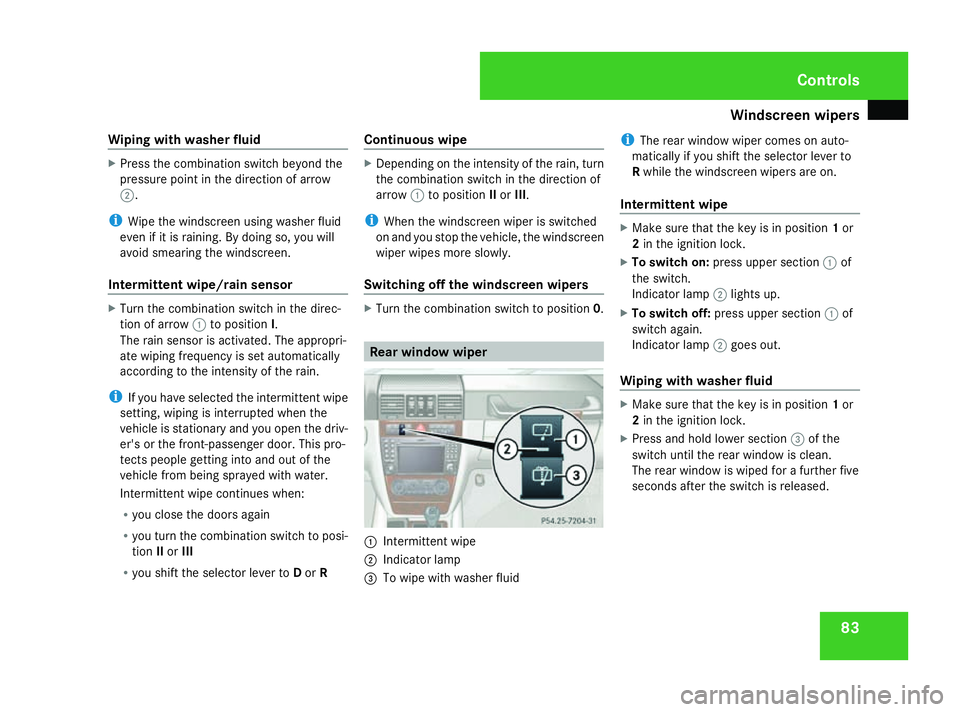
1
Intermittent wipe
2 Indicator lamp
3 To wipe with washer fluid i
The rear window wiper comes on auto-
matically if you shift the selector lever to
R while the windscreen wipers are on.
Intermittent wipe X
Make sure that the key is in position 1or
2 in the ignition lock.
X To switch on: press upper section 1of
the switch.
Indicator lamp 2lights up.
X To switch off: press upper section 1of
switch again.
Indicator lamp 2goes out.
Wiping with washer fluid X
Make sure that the key is in position 1or
2 in the ignition lock.
X Press and hold lower section 3of the
switch until the rear window is clean.
The rear window is wiped for a further five
seconds after the switch is released. Controls
463_AKB; 1; 8, en-GB
wobuchh
,V ersion: 2.10.6
2008-07-17T15:19:41+02:00 - Seite 83 ZDateiname: 6515_4091_02_buchblock.pdf; preflight
Page 121 of 293
Driving sys
tems 118 Ultrasonic reversing aid* (Station
wagon) G
Risk of accident
The ultrasonic reversing aid is only an aid
and may not detect all obstacles. It is not a
substitute for attentive driving.
You are always responsible for safety and
must continue to pay attention to your
immediate surroundings when parking and
manoeuvring. You could otherwise endan-
ger yourself and others. G
Risk of injury
Make sure that no persons or animals are
in the manoeuvring range. Otherwise, they
could be injured.
The ultrasonic reversing aid is an electronic
parking aid. It indicates visually and audibly
the distance between the rear area of your
vehicle and an object.
The ultrasonic reversing aid is activated auto-
matically when you switch on the ignition and
engage the reverse gear.
The ultrasonic reversing aid monitors the rear
bumper and rear area of your vehicle using
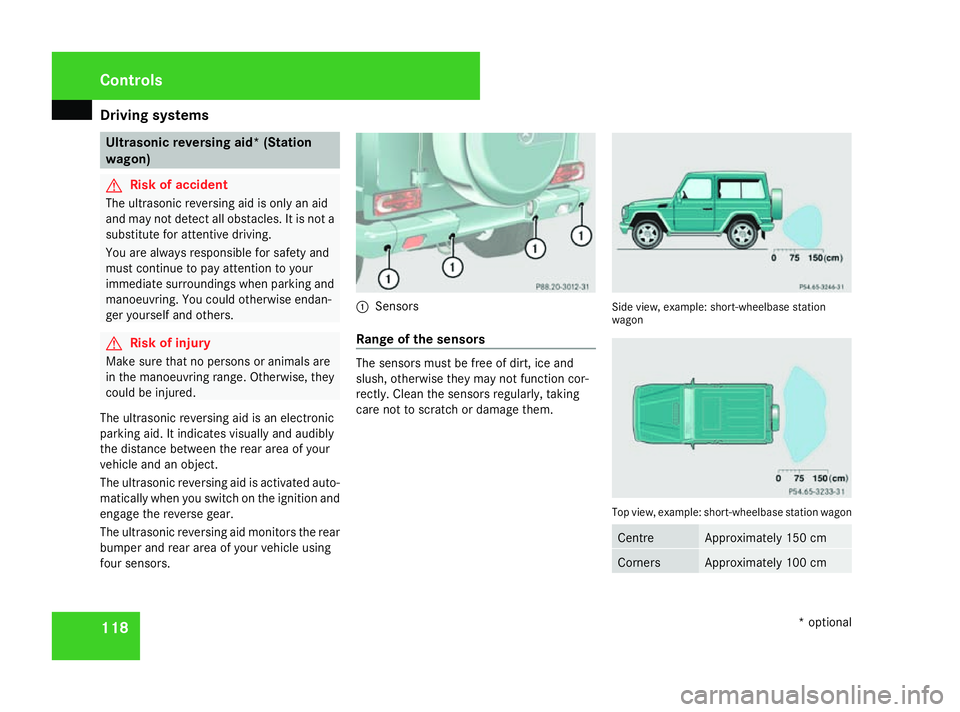
four sensors. 1
Sensors
Range of the sensors The sensors must be free of dirt, ice and
slush, otherwise they may not function cor-
rectly. Clean the sensors regularly, taking
care not to scratch or damage them. Side view, example: short-wheelbase station
wagon
Top view, example: short-wheelbase station wagon
Centre Approximately 150 cm
Corners Approximately 100 cmControls
* optional
463_AKB; 1; 8, en-GB
wobuchh
,V ersion: 2.10.6
2008-07-17T15:19:41+02:00 - Seite 118 Dateiname: 6515_4091_02_buchblock.pdf; preflight
Page 122 of 293
Driving sys
tems 119
!
When parking, pay particular attention to
objects above or below the sensors, such
as flower pots or trailer towbars. The ultra-
sonic reversing aid does not detect such
objects when they are in the immediate
vicinity of the vehicle. You could damage
the vehicle or the objects.
Ultrasonic sources such as an automatic
car wash, a lorry's compressed-air brakes
or a pneumatic drill could cause the ultra-
sonic reversing aid to malfunction.
Minimum distance Centre Approximately 30 cm
Corners Approximately 30 cm
If there is an obstacle within this range, all
warning displays flash and a warning tone
sounds. If the distance falls below the mini-
mum clearance, it may no longer be shown.
Warning displays
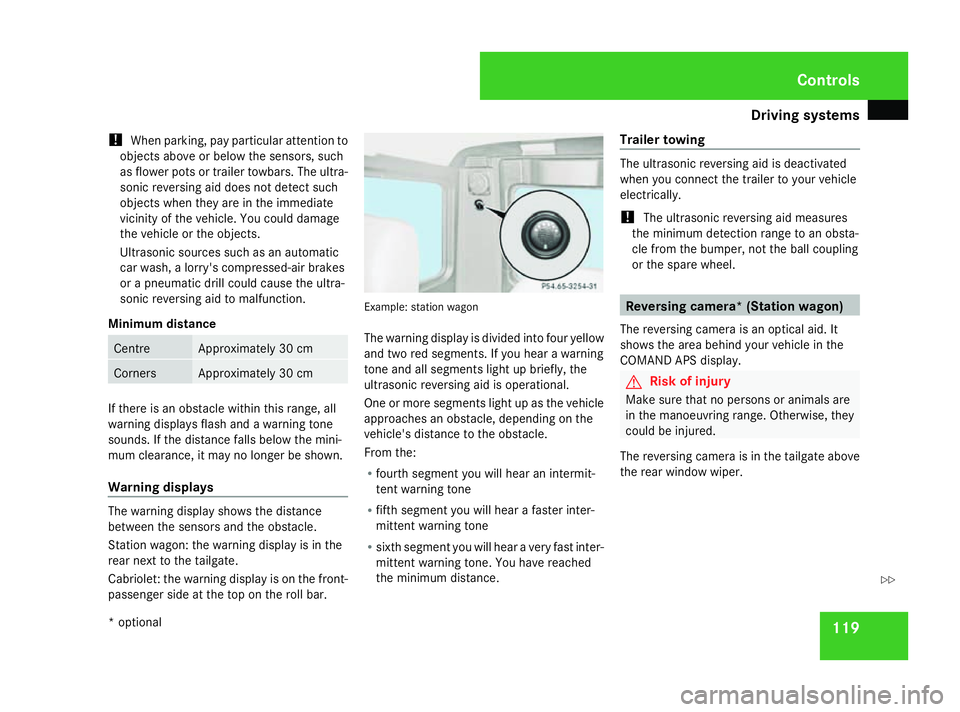
The warning display shows the distance
between the sensors and the obstacle.
Station wagon: the warning display is in the
rear next to the tailgate.
Cabriolet: the warning display is on the front-
passenger side at the top on the roll bar. Example: station wagon
The warning display is divided into four yellow
and two red segments. If you hear a warning
tone and all segments light up briefly, the
ultrasonic reversing aid is operational.
One or more segments light up as the vehicle
approaches an obstacle, depending on the
vehicle's distance to the obstacle.
From the:
R
fourth segment you will hear an intermit-
tent warning tone
R fifth segment you will hear a faster inter-
mittent warning tone
R sixth segment you will hear a very fast inter-
mittent warning tone. You have reached
the minimum distance. Trailer towing The ultrasonic reversing aid is deactivated
when you connect the trailer to your vehicle
electrically.
!
The ultrasonic reversing aid measures
the minimum detection range to an obsta-
cle from the bumper, not the ball coupling
or the spare wheel. Reversing camera* (Station wagon)
The reversing camera is an optical aid. It
shows the area behind your vehicle in the
COMAND APS display. G
Risk of injury
Make sure that no persons or animals are
in the manoeuvring range. Otherwise, they
could be injured.
The reversing camera is in the tailgate above
the rear window wiper. Controls
* optional
463_AKB; 1; 8, en-GB
wobuchh
,V ersion: 2.10.6
2008-07-17T15:19:41+02:00 - Seite 119 ZDateiname: 6515_4091_02_buchblock.pdf; preflight
Page 186 of 293
Care
183H
Environmental note
Dispose of empty packaging, cleaning
cloths and polishing wads in an environ-
mentally responsible manner.
! Do not affix:
R stickers
R films
R magnetic plates or similar items
to painted surfaces, otherwise you could
damage the paintwork. Vehicle care
! Do not park the vehicle for a long period
of time directly after cleaning, especially if
the wheels have just been cleaned with a
wheel cleaner. Wheel cleaners could cause
rapid corrosion of the brake discs and
brake pads/linings. After cleaning, park
the vehicle when it is at normal operating
temperature.
Automatic car wash You can wash the vehicle in an automatic car
wash from the beginning. !
Do not use a touch-free automatic car
wash that uses chemical agents to wash
the vehicle.
Preferably use automatic car washes without
brushes.
If the vehicle is very dirty, pre-wash it before
cleaning it in an automatic car wash.
! Make sure that the automatic car wash is
suitable for the size of the vehicle. Fold in
the exterior mirrors before the vehicle is
washed. There is otherwise a risk of dam-
age to the exterior mirrors.
! Make sure that the side windows are com-
pletely closed, that the ventilation/heater
blower is fully turned off and that the wind-
screen wiper switch is set to 0. The rain
sensor may otherwise be activated, trig-
gering unintended wiper movements. This
could cause damage to the vehicle.
After using an automatic car wash, wipe any
wax and drying agents off the windscreen and
the wiper blades. This will prevent smears and
reduce wiping noises caused by residue on
the windscreen. High-pressure cleaners G
Risk of accident
Do not use high-pressure cleaners with cir-
cular-jet nozzles (dirt grinders) to clean
your vehicle or ― especially ― the tyres.
Otherwise, you could damage the tyres and
cause an accident.
! Observe the instructions issued by the
equipment manufacturer concerning the
distance to be maintained between the
nozzle of the high-pressure cleaner and the
vehicle (at least 30 cm).
Move the high-pressure cleaner nozzle
around when cleaning your vehicle.
Do not aim directly at any of the following:
R tyres
R door joint
R electrical components
R battery
R connectors
R lights
R seals
Damaged seals or electrical components
can lead to failures or leaks. Operation
463_AKB; 1; 8, en-GB
wobuchh,
Version: 2.10.6 2008-07-17T15:19:41+02:00 - Seite 183 ZDateiname: 6515_4091_02_buchblock.pdf; preflight
Page 189 of 293
Care
186car wash. Do not use sharp-edged equip-
ment to remove ice and snow.
! Never use any of the following to clean the
soft top:
R petrol
R thinner
R tar or stain remover
R other organic solvents
Cleaning the soft top
If it is only slightly dirty, you can clean the soft
top while it is dry or rinse it with clear water.
Use a brush and clear water to clean away
normal amounts of dirt. Always brush in the
direction of the cloth, from front to back.
If it is very dirty or stained, clean with a suit-
able soft-top cleaning agent and a brush.
Always brush in the direction of the cloth,
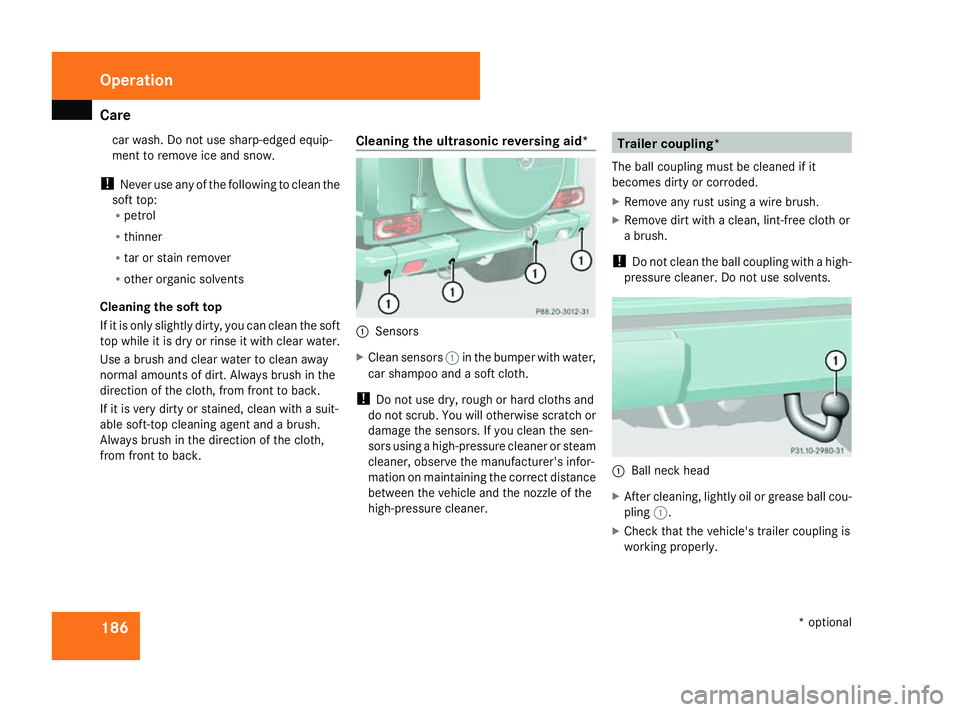
from front to back. Cleaning the ultrasonic reversing aid* 1
Sensors
X Clean sensors 1in the bumper with water,
car shampoo and a soft cloth.
! Do not use dry, rough or hard cloths and
do not scrub. You will otherwise scratch or
damage the sensors. If you clean the sen-
sors using a high-pressure cleaner or steam
cleaner, observe the manufacturer's infor-
mation on maintaining the correct distance
between the vehicle and the nozzle of the
high-pressure cleaner. Trailer coupling*
The ball coupling must be cleaned if it
becomes dirty or corroded.
X Remove any rust using a wire brush.
X Remove dirt with a clean, lint-free cloth or
a brush.
! Do not clean the ball coupling with a high-
pressure cleaner. Do not use solvents. 1
Ball neck head
X After cleaning, lightly oil or grease ball cou-
pling 1.
X Check that the vehicle's trailer coupling is
working properly. Operation
* optional
463_AKB; 1; 8, en-GB
wobuchh,
Version: 2.10.6 2008-07-17T15:19:41+02:00 - Seite 186Dateiname: 6515_4091_02_buchblock.pdf; preflight
Page 207 of 293
Display
messages 204 Display messages Possible cause/consequence Possible solution
. Dipped-beam, left
or
Dipped-beam, right The right-hand or left-hand dipped-beam
headlamp is fa
ulty. X
Visit a qualified specialist workshop. . AUTO lights inop-
erative The light sensor is faulty. Constant head-
lamp mode is switched on. X
Switch the lights to manual control in the on-
board computer (Y page 107).
X Switch the lights on and off using the light
switch. . Trailer turn sig-
nal left
or
Trailer turn sig-
nal right The left-hand or right-hand trailer turn sig-
nal is faulty. X
Replace the bulb. . Trailer brake lamp The left-hand or right-hand trailer brake
lamp is faulty. X
Replace the bulb. . Trailer tail lamp
left
or
Trailer tail lamp
right The left-hand or right-hand trailer tail lamp
is faulty. X
Replace the bulb. . Trailer reversing
lamp The left-hand or right-hand trailer revers-
ing lamp is faulty. X
Replace the bulb. Practical advice
463_AKB; 1; 8, en-GB
wobuchh,
Version: 2.10.6 2008-07-17T15:19:41+02:00 - Seite 204Dateiname: 6515_4091_02_buchblock.pdf; preflight
Page 226 of 293
Troubleshooting
223Problem Possible cause/consequence Suggested solutions
You hear a warning signal when
reversing. The ultrasonic reversing aid sen-
sors are dirty or there is interfer-
ence. X
Clean the ultrasonic reversing aid sensors (Y page 186).
X Switch the ignition back on. The problem ma
y be caused by an
external source of radio or ultra-
sound waves. The ultrasonic
reversing aid is switched off. X
See if ultrasonic reversing aid functions in a different location. You hear a warning tone when
reversing or you do not hear a
warning tone and none of the seg-
ments light up. The ultrasonic reversing aid has
malfunctioned and has switched
itself off. X
Have the ultrasonic reversing aid checked at a qualified specialist
workshop as soon as possible. Headlamps and turn signals
Problem Possible cause/consequence Suggested solutions
The headlamps or the turn signals
in the exterior mirrors are misted
up on the inside. Air humidity is very high. X
Drive with the headlamps switched on.
The headlamps are demisted after a short distance. The headlamp housing is not
sealed and moisture has been
able to enter. X
Have the headlamps checked at a qualified specialist workshop. Practical advice
463_AKB; 1; 8, en-GB
wobuchh,
Version: 2.10.6 2008-07-17T15:19:41+02:00 - Seite 223 ZDateiname: 6515_4091_02_buchblock.pdf; preflight
Page 263 of 293
Vehicle electronics
260 Vehicle electronics
Tampering
with the engine electron-
ics G
Risk of accident
Only have work on the engine electronics
and related components carried out at a
qualified specialist workshop which has the
necessary specialist knowledge and tools
to carry out the work required. Mercedes-
Benz recommends that you use a
Mercedes-Benz Service Centre for this pur-
pose. In particular, work relevant to safety
or on safety-related systems must be car-
ried out at a qualified specialist workshop.
The vehicle's roadworthiness could other-
wise be affected.
! Only have work done on the engine elec-
tronics and its associated parts, such as
control units, sensors and connector leads,
carried out at a qualified specialist work-
shop, e.g. a Mercedes-Benz Service
Centre. Otherwise, vehicle components
may wear more quickly and your vehicle's
warranty and operating permit may be inva-
lidated. Retrofitting electrical and electronic
equipment
Electrical and electronic equipment can jeop-
ardise the operating safety of your vehicle. If
equipment of this kind is retrofitted, it must
be type-approved and bear the emark. The
e mark may be obtained from the equipment
manufacturer or an authorised testing centre.
! Damage or consequential damage arising
from fitting equipment not approved by
Mercedes-Benz is not covered by the
Mercedes-Benz warranty.
If you wish to install two-way radios in the
vehicle, you must obtain formal approval.
Mercedes-Benz approves the installation of
two-way radios if such equipment is installed
professionally and a low-reflection exterior
aerial is used.
The transmission output of the two-way radio
must not exceed the maximum transmission
outputs listed. G
Risk of accident
Two-way radios may interfere with the vehi-
cle electronics and thereby jeopardise the
operational safety of the vehicle and your
own safety if: R
they do not have an exterior aerial
R the exterior aerial is not a low-reflection
aerial
R the exterior aerial has been fitted incor-
rectly G
Risk of injury
Excessive electromagnetic radiation may
also cause damage to your health and the
health of others. Using an exterior aerial
takes into account current scientific dis-
cussions relating to the possible health haz-
ards that may result from electromagnetic
fields.
For this reason, only have the exterior aerial
fitted at a qualified specialist workshop
which has the necessary specialist knowl-
edge and tools to carry out the work
required. Mercedes-Benz recommends
that you use a Mercedes-Benz Service
Centre for this purpose. In particular, work
relevant to safety or on safety-related sys-
tems must be carried out at a qualified spe-
cialist workshop.
i Mercedes-Benz recommends the use of
an approved exterior aerial. This ensures
optimal reception quality for mobile tele- Technical data
463_AKB; 1; 8, en-GB
wobuchh,
Version: 2.10.6 2008-07-17T15:19:41+02:00 - Seite 260Dateiname: 6515_4091_02_buchblock.pdf; preflight