light MERCEDES-BENZ G-CLASS SUV 2008 Manual Online
[x] Cancel search | Manufacturer: MERCEDES-BENZ, Model Year: 2008, Model line: G-CLASS SUV, Model: MERCEDES-BENZ G-CLASS SUV 2008Pages: 293, PDF Size: 4.49 MB
Page 84 of 293
Lights
81
X
To switch on with the rear door open:
press lock cylinder 2.
The luggage compartment lighting resumes
its normal function.
Rear interior lighting
X To switch on/off: press button1on the
front overhead control panel (Y page 79).
i If you open the rear door, the rear interior
lighting comes on. You can then not switch
it off using button 1on the front overhead
control panel.
Switch off the rear interior lighting if you
wish to leave the rear door open for a longer
period. This prevents the battery from dis-
charging.
To switch off the rear interior lighting with the
rear door open, see Switching off with rear
door open (Y page 80). Rear-compartment overhead control
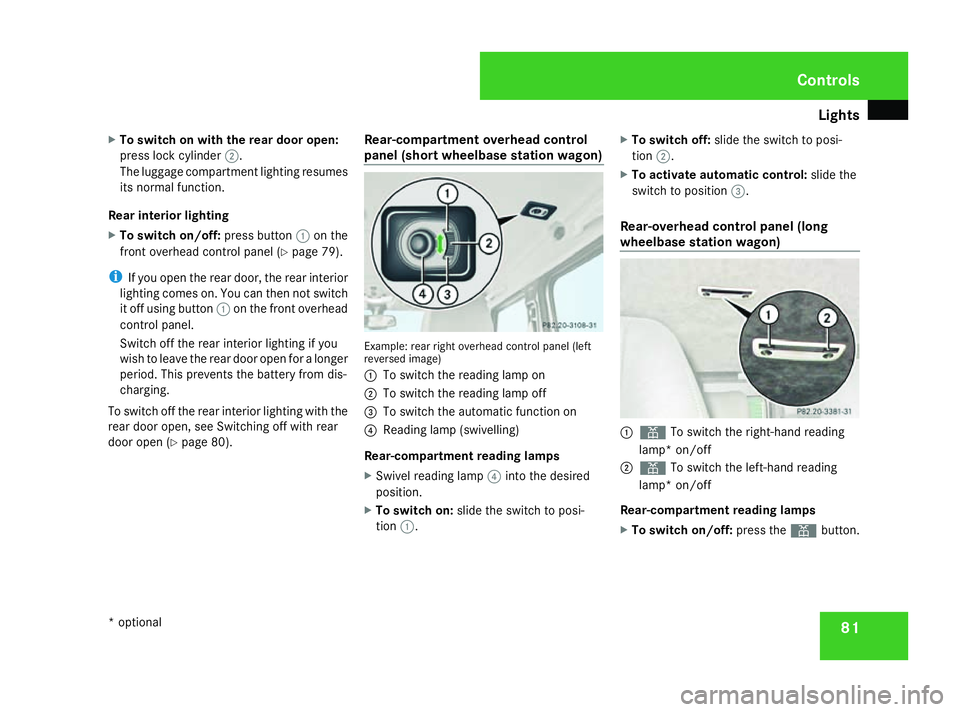
panel (short wheelbase station wagon) Example: rear right overhead control panel (left
reversed image)
1
To switch the reading lamp on
2 To switch the reading lamp off
3 To switch the automatic function on
4 Reading lamp (swivelling)
Rear-compartment reading lamps
X Swivel reading lamp 4into the desired
position.
X To switch on: slide the switch to posi-
tion 1. X
To switch off: slide the switch to posi-
tion 2.
X To activate automatic control: slide the
switch to position 3.
Rear-overhead control panel (long
wheelbase station wagon) 1
X To switch the right-hand reading
lamp* on/off
2 X To switch the left-hand reading
lamp* on/off
Rear-compartment reading lamps
X To switch on/off: press theXbutton. Controls
* optional
463_AKB; 1; 8, en-GB
wobuchh,
Version: 2.10.6
2008-07-17T15:19:41+02:00 - Seite 81 ZDateiname: 6515_4091_02_buchblock.pdf; preflight
Page 85 of 293
Windscreen wipers
82 Courtesy lighting in the front doors
To help you see better when it is dark, the
courtesy light is switched on when the
respective door is opened if you have activa-
ted the automatic control for the interior light.
The courtesy light is switched off when the
door is closed. Windscreen wipers
Switching the windscreen wipers on/
off
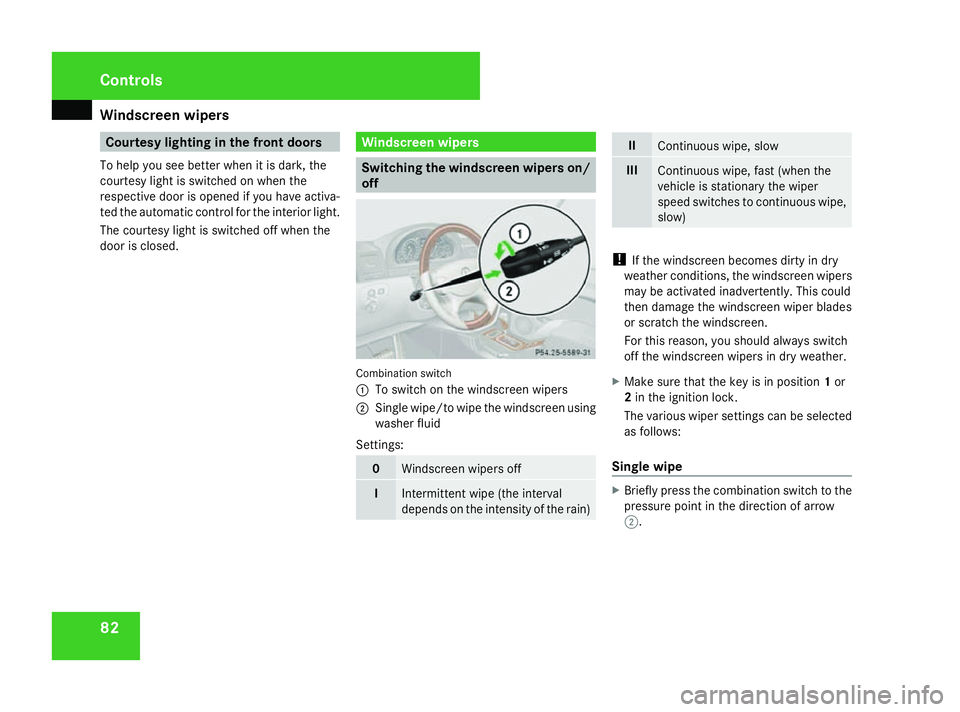
Combination switch
1
To switch on the windscreen wipers
2 Single wipe/to wipe the windscreen using
washer fluid
Settings: 0
Windscreen wipers off
I
Intermittent wipe (the interval
depends on the intensity of the rain) II
Continuous wipe, slow
III
Continuous wipe, fast (when the
vehicle is stationary the wiper
speed switches to continuous wipe,
slow)
!
If the windscreen becomes dirty in dry
weather conditions, the windscreen wipers
may be activated inadvertently. This could
then damage the windscreen wiper blades
or scratch the windscreen.
For this reason, you should always switch
off the windscreen wipers in dry weather.
X Make sure that the key is in position 1or
2 in the ignition lock.
The various wiper settings can be selected
as follows:
Single wipe X
Briefly press the combination switch to the
pressure point in the direction of arrow
2. Controls
463_AKB; 1; 8, en-GB
wobuchh
,V ersion: 2.10.6
2008-07-17T15:19:41+02:00 - Seite 82 Dateiname: 6515_4091_02_buchblock.pdf; preflight
Page 86 of 293
Windscreen wipers
83
Wiping with washer fluid X
Press the combination switch beyond the
pressure point in the direction of arrow
2.
i Wipe the windscreen using washer fluid
even if it is raining. By doing so, you will
avoid smearing the windscreen.
Intermittent wipe/rain sensor X
Turn the combination switch in the direc-
tion of arrow 1to position I.
The rain sensor is activated. The appropri-
ate wiping frequency is set automatically
according to the intensity of the rain.
i If you have selected the intermittent wipe
setting, wiping is interrupted when the
vehicle is stationary and you open the driv-
er's or the front-passenger door. This pro-
tects people getting into and out of the
vehicle from being sprayed with water.
Intermittent wipe continues when:
R you close the doors again
R you turn the combination switch to posi-
tion IIor III
R you shift the selector lever to Dor R Continuous wipe X
Depending on the intensity of the rain, turn
the combination switch in the direction of
arrow 1to position IIor III.
i When the windscreen wiper is switched
on and you stop the vehicle, the windscreen
wiper wipes more slowly.
Switching off the windscreen wipers X
Turn the combination switch to position 0. Rear window wiper
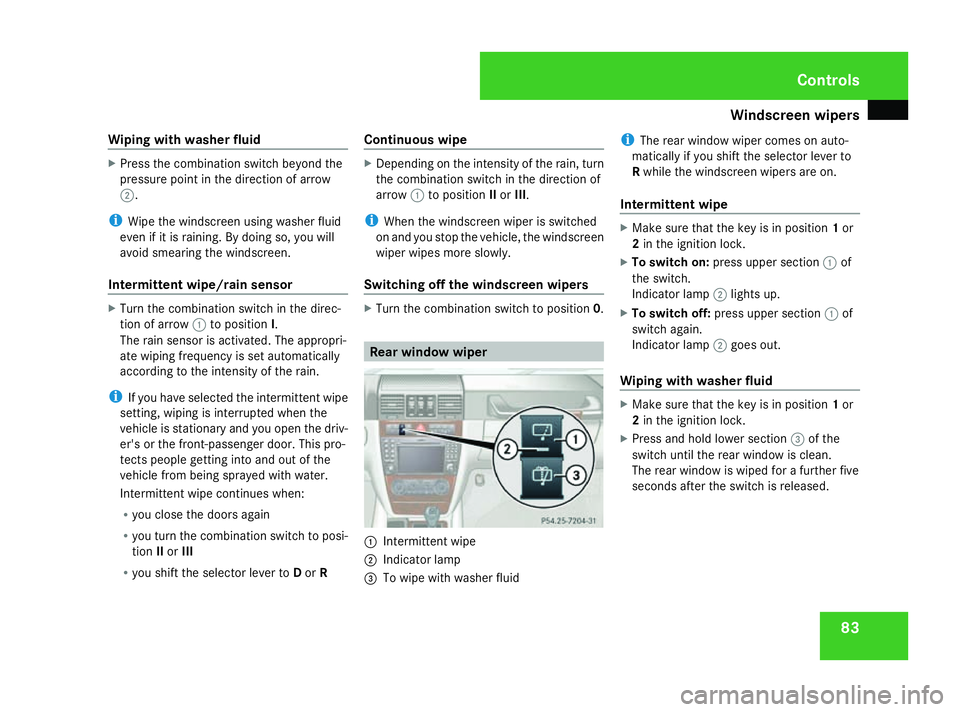
1
Intermittent wipe
2 Indicator lamp
3 To wipe with washer fluid i
The rear window wiper comes on auto-
matically if you shift the selector lever to
R while the windscreen wipers are on.
Intermittent wipe X
Make sure that the key is in position 1or
2 in the ignition lock.
X To switch on: press upper section 1of
the switch.
Indicator lamp 2lights up.
X To switch off: press upper section 1of
switch again.
Indicator lamp 2goes out.
Wiping with washer fluid X
Make sure that the key is in position 1or
2 in the ignition lock.
X Press and hold lower section 3of the
switch until the rear window is clean.
The rear window is wiped for a further five
seconds after the switch is released. Controls
463_AKB; 1; 8, en-GB
wobuchh
,V ersion: 2.10.6
2008-07-17T15:19:41+02:00 - Seite 83 ZDateiname: 6515_4091_02_buchblock.pdf; preflight
Page 87 of 293
Side windows
84 Side windows
Opening/closing the side windows
G
Risk of injury
Make sure that nobody can become trap-
ped between the side window and the door
frame as a side window is opened. Do not
touch or lean against the side window dur-
ing the opening procedure. You could
become trapped between the side window
and the door frame as the window moves
down. If danger threatens, release the
switch or pull the switch upwards to close
the side window again. G
Risk of injury
Make sure that nobody can become trap-
ped as you close a side window. If danger
threatens, release the switch or press the
switch a second time to open the side win-
dow again. G
Risk of injury
Do not leave children unsupervised in the
vehicle, even if they are secured in a child
restraint system. The children could: R
be seriously or even fatally injured on
parts of the vehicle
R be seriously or even fatally injured by
prolonged exposure to extremely high or
extremely low temperatures
R press the central unlocking switch and
thereby override the child-proof locks
and open the door
If children open a door, they could:
R seriously or even fatally injure other peo-
ple
R get out of the vehicle, thereby injuring
themselves or be seriously or even fatally
injured by a passing vehicle
Activate the child-proof locks if children are
travelling in the vehicle. They could other-
wise open doors or windows while the vehi-
cle is in motion and thereby injure them-
selves or others.
i It is also possible to open and close the
side windows from the outside using the
"Summer opening" (Y page 85) and "Con-
venience closing" (Y page 85) features
respectively. You can disable the controls for the rear
side windows from the driver's seat
(Y
page 46).
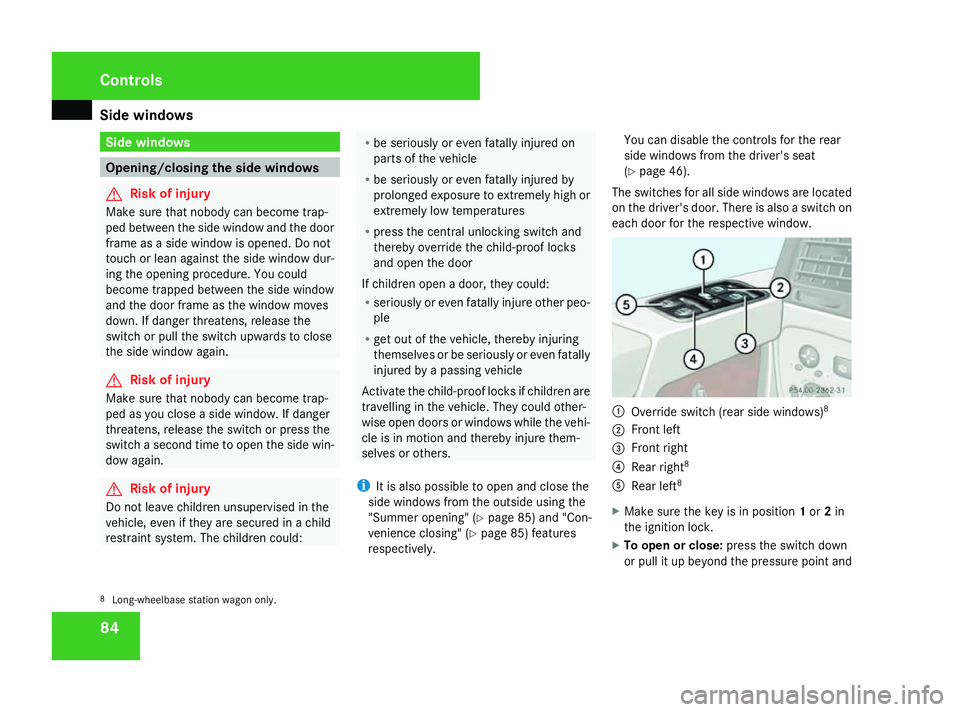
The switches for all side windows are located
on the driver's door. There is also a switch on
each door for the respective window. 1
Override switch (rear side windows) 8
2 Front left
3 Front right
4 Rear right 8
5 Rear left 8
X Make sure the key is in position 1or 2in
the ignition lock.
X To open or close: press the switch down
or pull it up beyond the pressure point and
8 Long-wheelbase station wagon only. Controls
463_AKB; 1; 8, en-GB
wobuchh,
Version: 2.10.6
2008-07-17T15:19:41+02:00 - Seite 84 Dateiname: 6515_4091_02_buchblock.pdf; preflight
Page 88 of 293
Side windows
85
hold it until the corresponding window is in
the desired position.
X To open fully: press the switch down
briefly beyond the pressure point and
release it.
X To stop: briefly press the switch down or
pull it up. Resetting the windows
Each side window must be reset if the battery
was disconnected or discharged.
X Make sure that the key is in position 2in
the ignition lock.
X Pull the corresponding switch upwards
until the side window is closed, and hold it
in this position for about another second. Summer opening
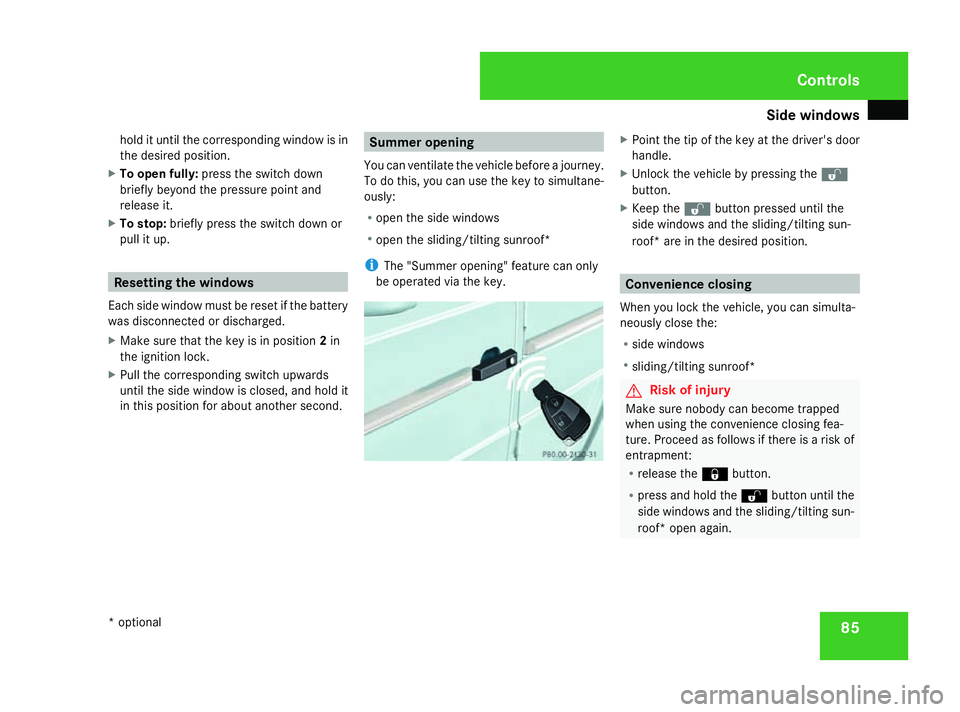
You can ventilate the vehicle before a journey.
To do this, you can use the key to simultane-
ously:
R open the side windows
R open the sliding/tilting sunroof*
i The "Summer opening" feature can only
be operated via the key. X
Point the tip of the key at the driver's door
handle.
X Unlock the vehicle by pressing the k
button.
X Keep the kbutton pressed until the
side windows and the sliding/tilting sun-
roof* are in the desired position. Convenience closing
When you lock the vehicle, you can simulta-
neously close the:
R side windows
R sliding/tilting sunroof* G
Risk of injury
Make sure nobody can become trapped
when using the convenience closing fea-
ture. Proceed as follows if there is a risk of
entrapment:
R release the jbutton.
R press and hold the kbutton until the
side windows and the sliding/tilting sun-
roof* open again. Controls
* optional
463_AKB; 1; 8, en-GB
wobuchh,
Version: 2.10.6 2008-07-17T15:19:41+02:00 - Seite 85 ZDateiname: 6515_4091_02_buchblock.pdf; preflight
Page 89 of 293
Driving and pa
rking 86X
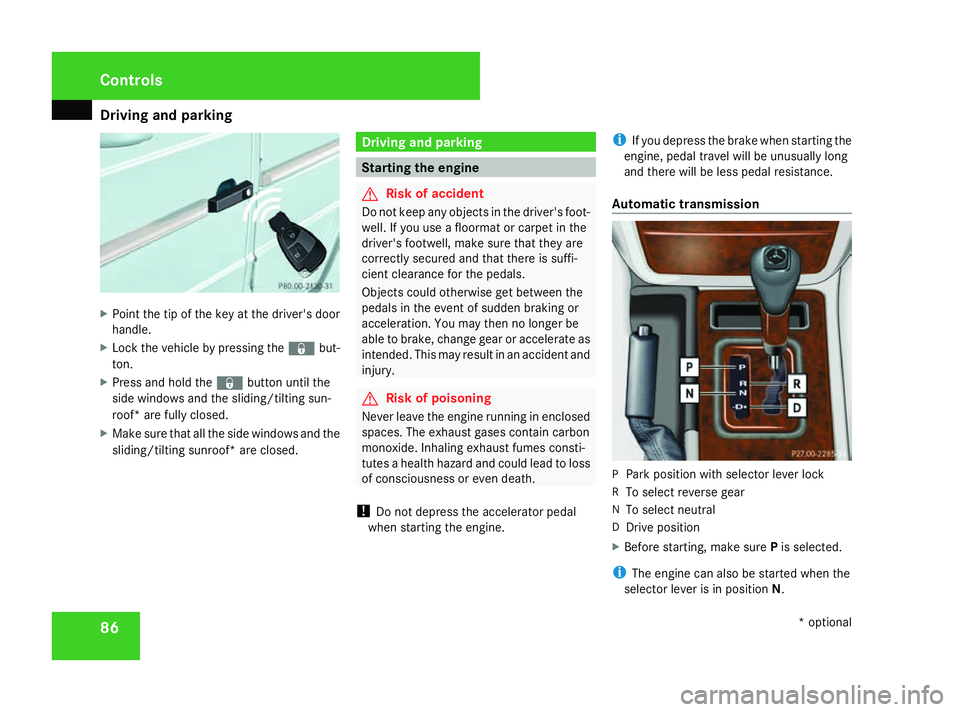
Point the tip of the key at the driver's door
handle.
X Lock the vehicle by pressing the jbut-
ton.
X Press and hold the jbutton until the
side windows and the sliding/tilting sun-
roof* are fully closed.
X Make sure that all the side windows and the
sliding/tilting sunroof* are closed. Driving and parking
Starting the engine
G
Risk of accident
Do not keep any objects in the driver's foot-
well. If you use a floormat or carpet in the
driver's footwell, make sure that they are
correctly secured and that there is suffi-
cient clearance for the pedals.
Objects could otherwise get between the
pedals in the event of sudden braking or
acceleration. You may then no longer be
able to brake, change gear or accelerate as
intended. This may result in an accident and
injury. G
Risk of poisoning
Never leave the engine running in enclosed
spaces. The exhaust gases contain carbon
monoxide. Inhaling exhaust fumes consti-
tutes a health hazard and could lead to loss
of consciousness or even death.
! Do not depress the accelerator pedal
when starting the engine. i
If you depress the brake when starting the
engine, pedal travel will be unusually long
and there will be less pedal resistance.
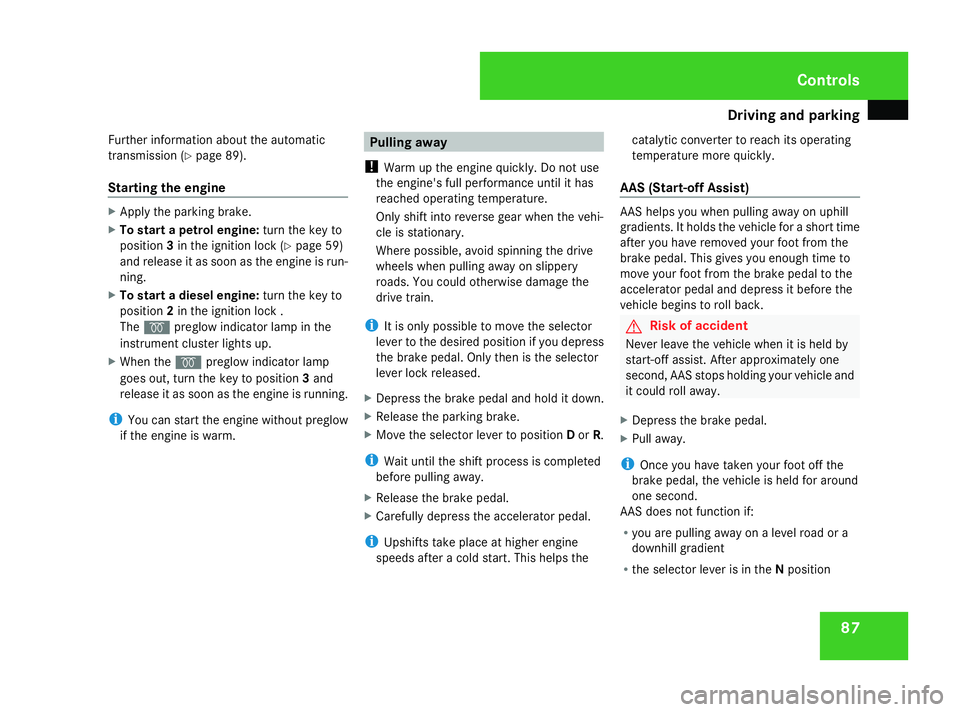
Automatic transmission P
Park position with selector lever lock
R To select reverse gear
N To select neutral
D Drive position
X Before starting, make sure Pis selected.
i The engine can also be started when the
selector lever is in position N.Cont
rols
* optional
463_AKB; 1; 8, en-GB
wobuchh,
Version: 2.10.6 2008-07-17T15:19:41+02:00 - Seite 86Dateiname: 6515_4091_02_buchblock.pdf; preflight
Page 90 of 293
Driving and pa
rking 87
Further information about the automatic
transmission (Y
page 89).
Starting the engine X
Apply the parking brake.
X To start a petrol engine: turn the key to
position 3in the ignition lock (Y page 59)
and release it as soon as the engine is run-
ning.
X To start a diesel engine: turn the key to
position 2in the ignition lock .
The q preglow indicator lamp in the
instrument cluster lights up.
X When the qpreglow indicator lamp
goes out, turn the key to position 3and
release it as soon as the engine is running.
i You can start the engine without preglow
if the engine is warm. Pulling away
! Warm up the engine quickly. Do not use
the engine's full performance until it has
reached operating temperature.
Only shift into reverse gear when the vehi-
cle is stationary.
Where possible, avoid spinning the drive
wheels when pulling away on slippery
roads. You could otherwise damage the
drive train.
i It is only possible to move the selector
lever to the desired position if you depress
the brake pedal. Only then is the selector
lever lock released.
X Depress the brake pedal and hold it down.
X Release the parking brake.
X Move the selector lever to position Dor R.
i Wait until the shift process is completed
before pulling away.
X Release the brake pedal.
X Carefully depress the accelerator pedal.
i Upshifts take place at higher engine
speeds after a cold start. This helps the catalytic converter to reach its operating
temperature more quickly.
AAS (Start-off Assist) AAS helps you when pulling away on uphill
gradients. It holds the vehicle for a short time
after you have removed your foot from the
brake pedal. This gives you enough time to
move your foot from the brake pedal to the
accelerator pedal and depress it before the
vehicle begins to roll back. G
Risk of accident
Never leave the vehicle when it is held by
start-off assist. After approximately one
second, AAS stops holding your vehicle and
it could roll away.
X Depress the brake pedal.
X Pull away.
i Once you have taken your foot off the
brake pedal, the vehicle is held for around
one second.
AAS does not function if:
R you are pulling away on a level road or a
downhill gradient
R the selector lever is in the Nposition Controls
463_AKB; 1; 8, en-GB
wobuchh
,V ersion: 2.10.6
2008-07-17T15:19:41+02:00 - Seite 87 ZDateiname: 6515_4091_02_buchblock.pdf; preflight
Page 91 of 293
Driving and pa
rking 88
R
the vehicle is secured with the parking
brake
R ESP ®
is malfunctioning Parking
G
Risk of accident
Only remove the key from the ignition lock
when the vehicle is stationary as you can-
not steer the vehicle with the key removed.
Never leave children unsupervised in the
vehicle. They could release the parking
brake. This could lead to a serious or fatal
accident. G
Risk of fire
Make sure that the exhaust system does
not under any circumstances come into
contact with easily ignitable material such
as dry grass or petrol. The material could
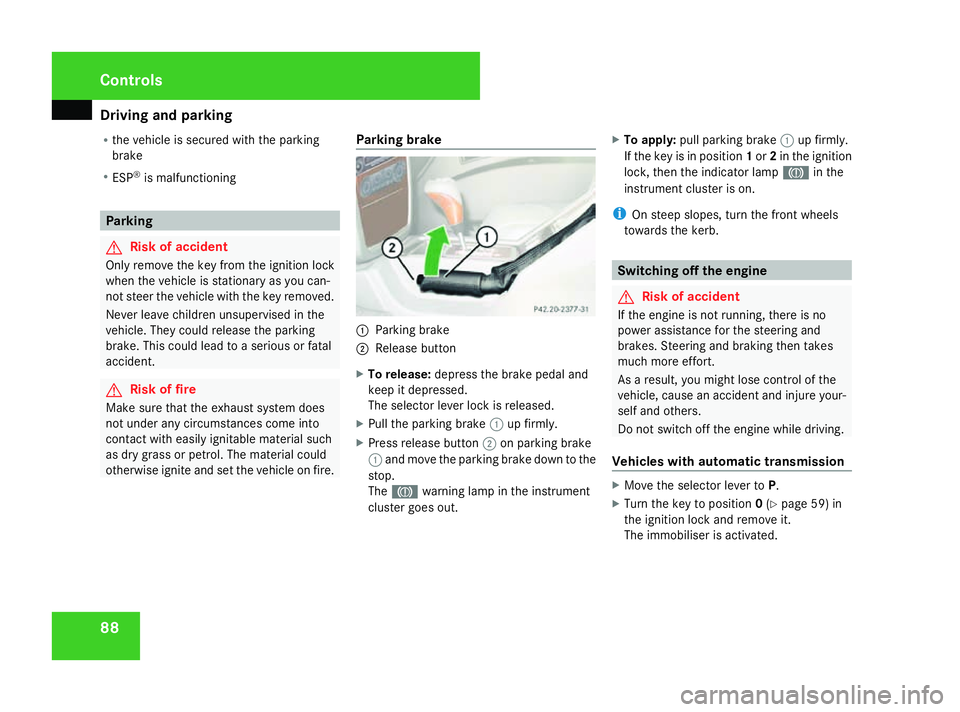
otherwise ignite and set the vehicle on fire. Parking brake 1
Parking brake
2 Release button
X To release: depress the brake pedal and
keep it depressed.
The selector lever lock is released.
X Pull the parking brake 1up firmly.
X Press release button 2on parking brake
1 and move the parking brake down to the
stop.
The 3 warning lamp in the instrument
cluster goes out. X
To apply: pull parking brake 1up firmly.
If the key is in position 1or 2in the ignition
lock, then the indicator lamp 3in the
instrument cluster is on.
i On steep slopes, turn the front wheels
towards the kerb. Switching off the engine
G
Risk of accident
If the engine is not running, there is no
power assistance for the steering and
brakes. Steering and braking then takes
much more effort.
As a result, you might lose control of the
vehicle, cause an accident and injure your-
self and others.
Do not switch off the engine while driving.
Vehicles with automatic transmission X
Move the selector lever to P.
X Turn the key to position 0(Y page 59) in
the ignition lock and remove it.
The immobiliser is activated. Controls
463_AKB; 1; 8, en-GB
wobuchh
,V ersion: 2.10.6
2008-07-17T15:19:41+02:00 - Seite 88 Dateiname: 6515_4091_02_buchblock.pdf; preflight
Page 92 of 293
Transmission
89Transmission
Notes on the transmission
G
Risk of accident
The movement of the pedals must not be
impaired in any way. Do not keep any
objects in the driver's footwell. Make sure
that floormats or carpets are correctly
secured and that there is sufficient clear-
ance for the pedals. G
Risk of accident
Do not change down for additional engine
braking on a slippery road surface. This
could cause the drive wheels to lose their
grip and the vehicle could skid. This could
cause you to lose control of your vehicle
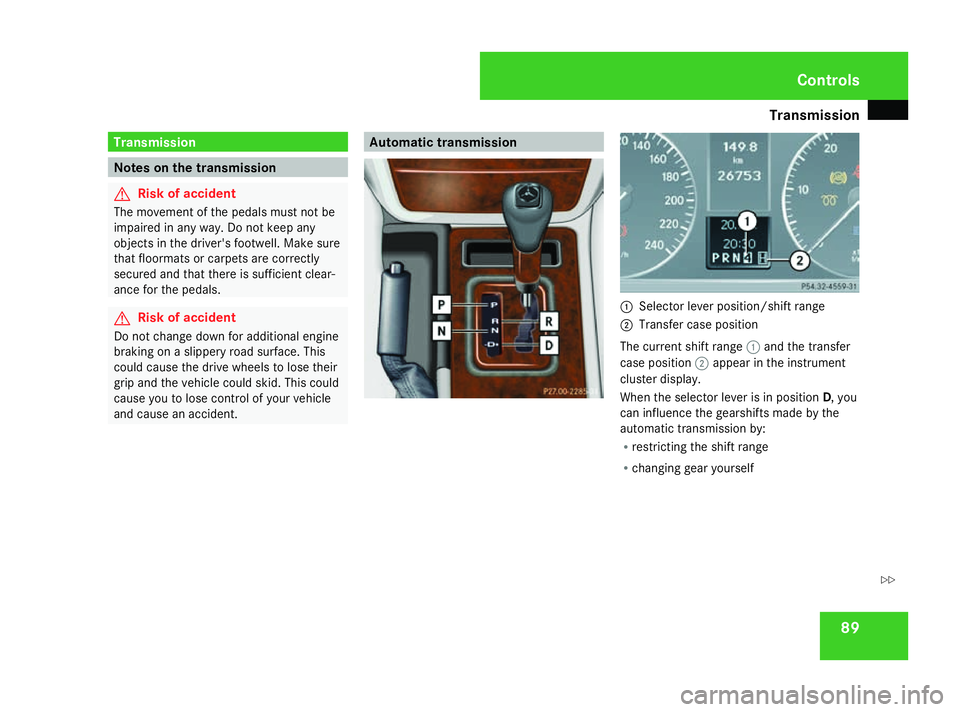
and cause an accident. Automatic transmission
1
Selector lever position/shift range
2 Transfer case position
The current shift range 1and the transfer
case position 2appear in the instrument
cluster display.
When the selector lever is in position D, you
can influence the gearshifts made by the
automatic transmission by:
R restricting the shift range
R changing gear yourself Controls
463_AKB; 1; 8, en-GB
wobuchh
,V ersion: 2.10.6
2008-07-17T15:19:41+02:00 - Seite 89 ZDateiname: 6515_4091_02_buchblock.pdf; preflight
Page 93 of 293
Transmission
90
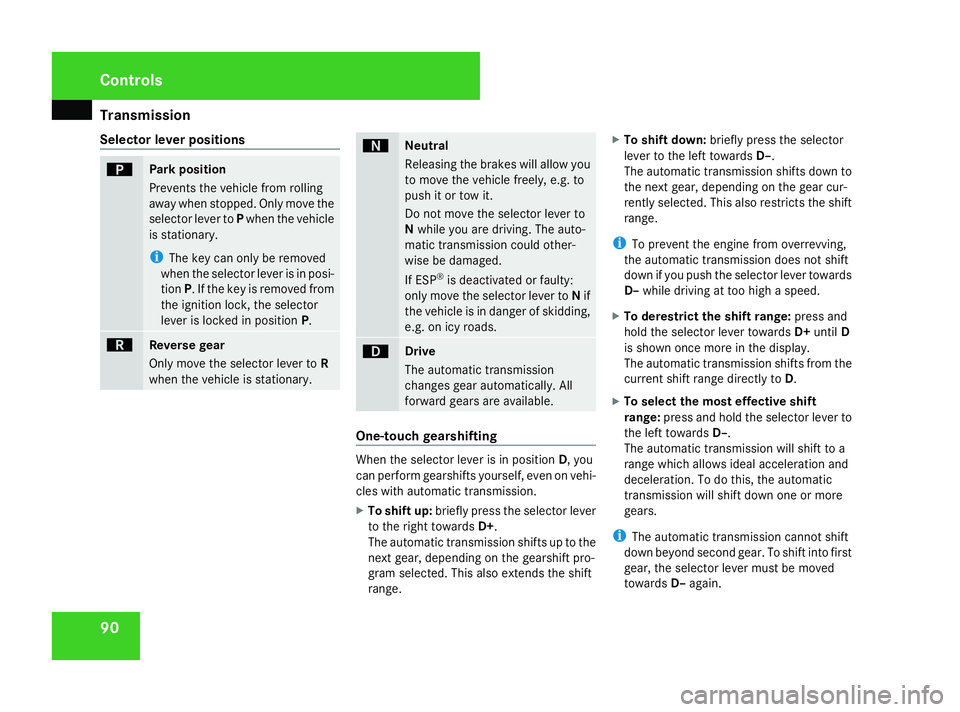
Selector lever positions ì
Park position
Prevents the vehicle from rolling
away when stopped. Only move the
selector lever to Pwhen the vehicle
is stationary.
i The key can only be removed
when the selector lever is in posi-
tion P. If the key is removed from
the ignition lock, the selector
lever is locked in position P.í
Reverse gear
Only move the selector lever to
R
when the vehicle is stationary. ë
Neutral
Releasing the brakes will allow you
to move the vehicle freely, e.g. to
push it or tow it.
Do not move the selector lever to
N
while you are driving. The auto-
matic transmission could other-
wise be damaged.
If ESP ®
is deactivated or faulty:
only move the selector lever to Nif
the vehicle is in danger of skidding,
e.g. on icy roads. ê
Drive
The automatic transmission
changes gear automatically. All
forward gears are available.
One-touch gearshifting
When the selector lever is in position
D, you
can perform gearshifts yourself, even on vehi-
cles with automatic transmission.
X To shift up: briefly press the selector lever
to the right towards D+.
The automatic transmission shifts up to the
next gear, depending on the gearshift pro-
gram selected. This also extends the shift
range. X
To shift down: briefly press the selector
lever to the left towards D–.
The automatic transmission shifts down to
the next gear, depending on the gear cur-
rently selected. This also restricts the shift
range.
i To prevent the engine from overrevving,
the automatic transmission does not shift
down if you push the selector lever towards
D– while driving at too high a speed.
X To derestrict the shift range: press and
hold the selector lever towards D+until D
is shown once more in the display.
The automatic transmission shifts from the
current shift range directly to D.
X To select the most effective shift
range: press and hold the selector lever to
the left towards D–.
The automatic transmission will shift to a
range which allows ideal acceleration and
deceleration. To do this, the automatic
transmission will shift down one or more
gears.
i The automatic transmission cannot shift
down beyond second gear. To shift into first
gear, the selector lever must be moved
towards D–again. Controls
463_AKB; 1; 8, en-GB
wobuchh
,V ersion: 2.10.6
2008-07-17T15:19:41+02:00 - Seite 90 Dateiname: 6515_4091_02_buchblock.pdf; preflight