belt MERCEDES-BENZ G-CLASS SUV 2013 User Guide
[x] Cancel search | Manufacturer: MERCEDES-BENZ, Model Year: 2013, Model line: G-CLASS SUV, Model: MERCEDES-BENZ G-CLASS SUV 2013Pages: 364, PDF Size: 9.62 MB
Page 44 of 364
child seat, which operates with the
BabySmart™ air bag deactivation system
installed in the vehicle to deactivate the
front passenger front air bag when it is
installed properly. Otherwise they will be
struck by the air bag when it inflates in a
crash. If this
happens,
serious or fatal injury
will result.
Failure to follow these instructions can result
in severe injuries to you or other occupants.
If you sell your vehicle, it is important that you
make the buyer aware of this safety
information. Be sure to give the buyer this
Operator's Manual. G
WARNING
Accident research shows that the safest place
for children in an
automobile is in a rear seat.
Should you choose to place a child 12 years
old or under in the front passenger seat of
your vehicle, you must properly use a
BabySmart TM
child restraint which will turn off
the front passenger front air bag.
To help avoid the possibility of injury, please
follow these guidelines:
(1) Always sit as upright as possible, wear the seat belt
properly, and for
children 12 years old and under,
use an appropriately sized infant
restraint, toddler restraint, or
booster seat recommended for the
size and weight of the child.
(2) Always wear seat belts properly.
If the air bags are deployed, you will hear a
bang, and a small
amount of powder may also
be released. Only in rare cases will the bang
affect your hearing. The powder that is
released generally does not constitute a
health hazard. The 0075 SRS warning lamp
lights up.
The air bags are deployed if the air bag control
unit detects the need for deployment. Only in
the event of such a situation will the air bags
provide their supplemental protection. If the driver and front passenger do not wear
their seat belts, it is not possible for the air
bags to provide their supplemental
protection.
In the event of other types of impacts and
impacts below air bag deployment
thresholds, the air bags will not deploy. The
driver and passengers will then be protected
to the extent
possible
by a properly fastened
seat belt. A properly fastened seat belt is also
needed to provide the best possible
protection if the vehicle rolls over.
Air bags provide additional protection; they
are not, however, a substitute for seat belts.
All vehicle occupants must fasten their seat
belts regardless of whether your vehicle is
equipped with air bags or not.
It is important for your safety and that of your
passengers to have deployed air bags
replaced and to have any malfunctioning air
bags repaired. This will help to make sure the
air bags continue to perform their protective
function for the vehicle occupants in the
event of an accident.
Front air bags G
WARNING
Observe "Important safety notes"
(Y page 41). G
WARNING
Your vehicle is equipped with air bag
technology which disables the front-
passenger air bag if the system recognizes
that the front-passenger seat is empty .
If the front-passenger seat is occupied by an
adult or young person and the 0073007C
indicator lamp is lit
up, the front-passenger air
bag is disabled. If the front-passenger seat is
recognized as empty, the air bag control unit
will not deploy the front-passenger air bag in
the event of a collision.
Ask your passenger to sit correctly on the
front-passenger seat in an upright position
until the 0073007C indicator lamp goes out. 42
Occupant safety
Safety
Page 45 of 364
If the
0073007C indicator lamp does not go
out, please consult an authorized Mercedes-
Benz Center. Driver's air bag
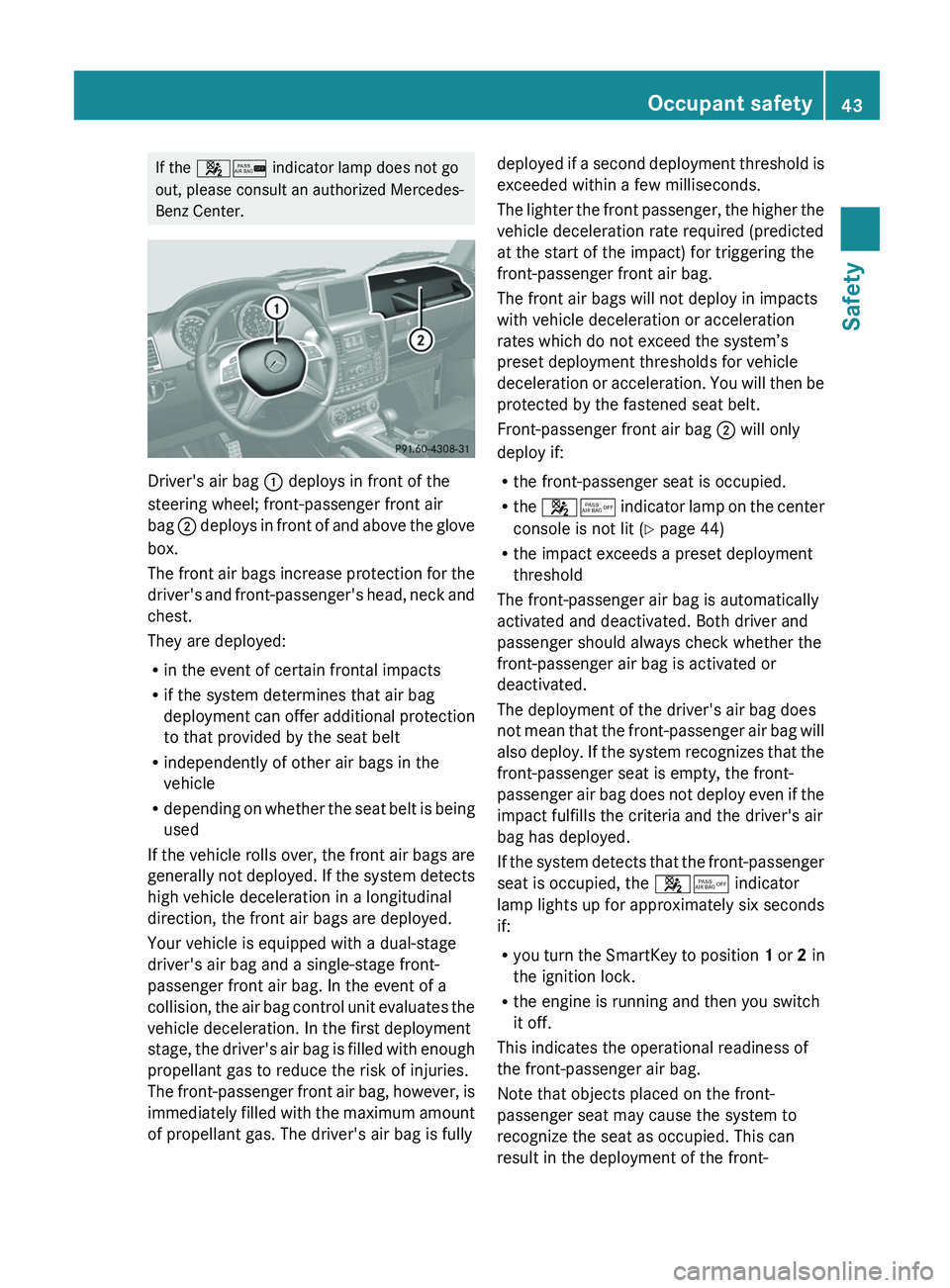
0043 deploys in front of the
steering wheel; front-passenger front air
bag 0044 deploys in front
of and above the glove
box.
The front air bags increase protection for the
driver's and front-passenger's head, neck and
chest.
They are deployed:
R in the event of certain frontal impacts
R if the system determines that air bag
deployment can offer additional protection
to that provided by the seat belt
R independently of other air bags in the
vehicle
R depending on whether the seat belt is being
used
If the vehicle rolls over, the front air bags are
generally not deployed. If the system detects
high vehicle deceleration in a longitudinal
direction, the front air bags are deployed.
Your vehicle is equipped with a dual-stage
driver's air bag and a single-stage front-
passenger front air bag. In the event of a
collision, the air bag control unit evaluates the
vehicle deceleration. In the first deployment
stage, the driver's air bag is filled with enough
propellant gas to reduce the risk of injuries.
The front-passenger front air bag, however, is
immediately filled with the maximum amount
of propellant gas. The driver's air bag is fully deployed if a second deployment threshold is
exceeded within a few milliseconds.
The
lighter the
front
passenger, the higher the
vehicle deceleration rate required (predicted
at the start of the impact) for triggering the
front-passenger front air bag.
The front air bags will not deploy in impacts
with vehicle deceleration or acceleration
rates which do not exceed the system’s
preset deployment thresholds for vehicle
deceleration or acceleration. You will then be
protected by the fastened seat belt.
Front-passenger front air bag 0044 will only
deploy if:
R the front-passenger seat is occupied.
R the 00730074 indicator lamp on the center
console is not lit (Y page 44)
R the impact exceeds a preset deployment
threshold
The front-passenger air bag is automatically
activated and deactivated. Both driver and
passenger should always check whether the
front-passenger air bag is activated or
deactivated.
The deployment of the driver's air bag does
not mean that the front-passenger air bag will
also deploy. If the system recognizes that the
front-passenger seat is empty, the front-
passenger air bag does not deploy even if the
impact fulfills the criteria and the driver's air
bag has deployed.
If the system detects that the front-passenger
seat is occupied, the 00730074 indicator
lamp lights up for approximately six seconds
if:
R you turn the SmartKey to position 1 or 2 in
the ignition lock.
R the engine is running and then you switch
it off.
This indicates the operational readiness of
the front-passenger air bag.
Note that objects placed on the front-
passenger seat may cause the system to
recognize the seat as occupied. This can
result in the deployment of the front- Occupant safety
43
Safety Z
Page 46 of 364
passenger air bag if the impact fulfills the
specified criteria. If the 00730074 indicator
lamp lights up, the front-passenger front air
bag is disabled and will not be deployed in
certain situations. If the
00730074 indicator
lamp does not light up, the front-passenger
front air bag is
enabled and can be deployed.
Window curtain air bags G
WARNING
Observe "Important safety notes"
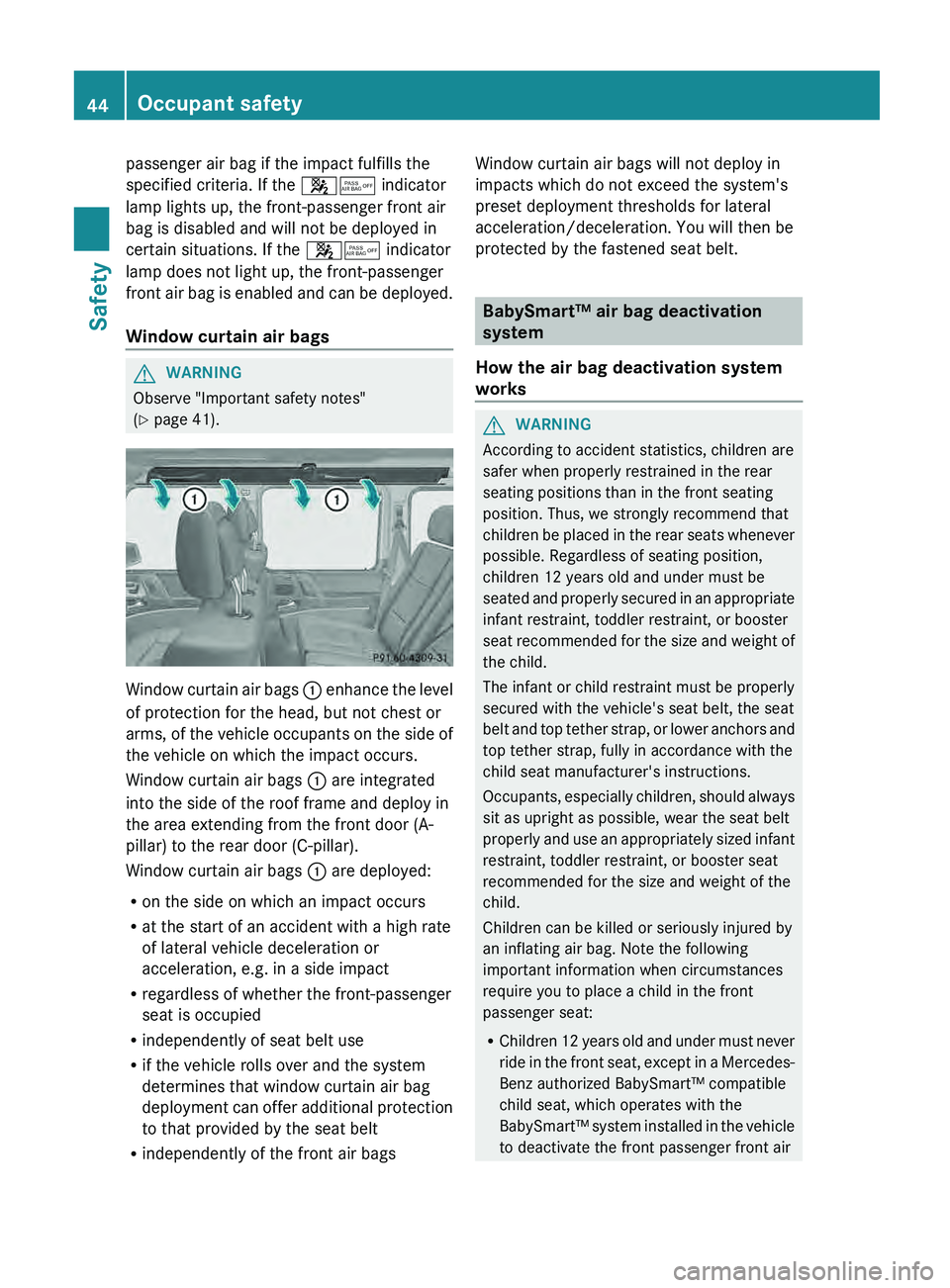
(Y page 41). Window curtain air bags
0043
enhance the
level
of protection for the head, but not chest or
arms,
of the vehicle occupants on the side of
the vehicle on which the impact occurs.
Window curtain air bags 0043 are integrated
into the side of the roof frame and deploy in
the area extending from the front door (A-
pillar) to the rear door (C-pillar).
Window curtain air bags 0043 are deployed:
R on the side on which an impact occurs
R at the start of an accident with a high rate
of lateral vehicle deceleration or
acceleration, e.g. in a side impact
R regardless of whether the front-passenger
seat is occupied
R independently of seat belt use
R if the vehicle rolls over and the system
determines that window curtain air bag
deployment can offer additional protection
to that provided by the seat belt
R independently of the front air bags Window curtain air bags will not deploy in
impacts which do not exceed the system's
preset deployment thresholds for lateral
acceleration/deceleration. You will then be
protected by the fastened seat belt.
BabySmart™ air bag deactivation
system
How the air bag deactivation system
works G
WARNING
According to accident statistics, children are
safer when properly restrained in the rear
seating positions than in the front seating
position. Thus, we strongly recommend that
children be placed in
the rear seats whenever
possible. Regardless of seating position,
children 12 years old and under must be
seated and properly secured in an appropriate
infant restraint, toddler restraint, or booster
seat recommended for the size and weight of
the child.
The infant or child restraint must be properly
secured with the vehicle's seat belt, the seat
belt and top tether strap, or lower anchors and
top tether strap, fully in accordance with the
child seat manufacturer's instructions.
Occupants, especially children, should always
sit as upright as possible, wear the seat belt
properly and use an appropriately sized infant
restraint, toddler restraint, or booster seat
recommended for the size and weight of the
child.
Children can be killed or seriously injured by
an inflating air bag. Note the following
important information when circumstances
require you to place a child in the front
passenger seat:
R Children 12 years old and under must never
ride in the front seat, except in a Mercedes-
Benz authorized BabySmart™ compatible
child seat, which operates with the
BabySmart™ system installed in the vehicle
to deactivate the front passenger front air44
Occupant safety
Safety
Page 47 of 364
bag when it is installed properly. Otherwise
they will be struck by the air bag when it
inflates in a crash. If this happens, serious
or fatal injury will result.
R A child in a
rear-facing child restraint on the
front passenger seat will be seriously
injured or even killed if the front passenger
front air bag inflates in a collision which
could occur under some circumstances,
even with the air bag technology installed
in your vehicle. The only means to
completely eliminate this risk is to never
place a child in a rear-facing child restraint
in the front seat. We therefore strongly
recommend that you always place a child
in a rear-facing child restraint in a backseat.
R If you must install a BabySmart™
compatible rear-facing child restraint on
the front passenger seat because
circumstances require you to do so, make
sure the 0073 007C indicator lamp is
illuminated, indicating that the front
passenger front air bag is deactivated.
Should the 0073 007C indicator lamp not
illuminate or go out while the restraint is
installed, please check installation.
Periodically check the 0073 007C indicator
lamp while driving to make sure the
0073 007C indicator lamp is illuminated. If
the 0073 007C indicator lamp goes out or
remains out, do not transport a child on the
front passenger seat until the system has
been repaired.
A child in a rear-facing child restraint on the
front passenger seat will be seriously
injured or even killed if the front passenger
front air bag inflates.
R If you have to place a child in a forward-
facing child restraint on the front passenger
seat, move the seat as far back as possible,
use the proper child restraint
recommended for the age, size and weight
of the child, and secure child restraint with
the vehicle's seat belt according to the
child seat manufacturer's instructions. G
WARNING
When using a BabySmart™ compatible child
seat on the front passenger seat, the front
passenger front air bag
will not deploy only if
the 0073 007C indicator lamp remains
illuminated.
Please be sure to check the 0073 007C
indicator lamp every time you use a
BabySmart™ compatible child seat on the
front passenger seat. Should the 0073 007C
indicator lamp go out while the restraint is
installed, please check installation. If the
0073 007C indicator lamp remains out, do not
use the BabySmart™ restraint to transport a
child on the front passenger seat until the
system has been repaired. G
WARNING
The BabySmart™ air bag disabling system
ONLY works with specially adapted child
restraint systems. It does
not work with child
restraint systems that are not compatible with
BabySmart™.
Never place anything between the seat
cushion and the child restraint system (e.g. a
cushion), as this reduces the effectiveness of
the BabySmart™ air bag deactivation system.
The underside of the child restraint system
must lie against the seat cushion of the front-
passenger seat. In the event of an accident,
an incorrectly installed child restraint system
could injure the child instead of offering
protection.
Observe the manufacturer's instructions
when installing special child restraint
systems. Occupant safety
45
Safety Z
Page 50 of 364
passenger seats are moved forwards and
upwards in the
event
of a rear-end collision of
a certain severity. This provides better head
support.
If the NECK-PRO head restraints have been
triggered in an accident, reset the NECK-PRO
head restraints on the driver’s and front-
passenger seat ( Y page 48). Otherwise, the
additional protection will not be available in
the event of another rear-end collision. You
can recognize if NECK-PRO head restraints
have been triggered by the fact that they have
moved forwards and can no longer be
adjusted.
Resetting triggered NECK-PRO head
restraints G
WARNING
For safety reasons, have the NECK-PRO head
restraints checked at a qualified specialist
workshop after a rear-end collision. G
WARNING
When pushing back the NECK-PRO head
restraint cushion, make sure your fingers do
not become caught between the head
restraint cushion and the cover. Failure to
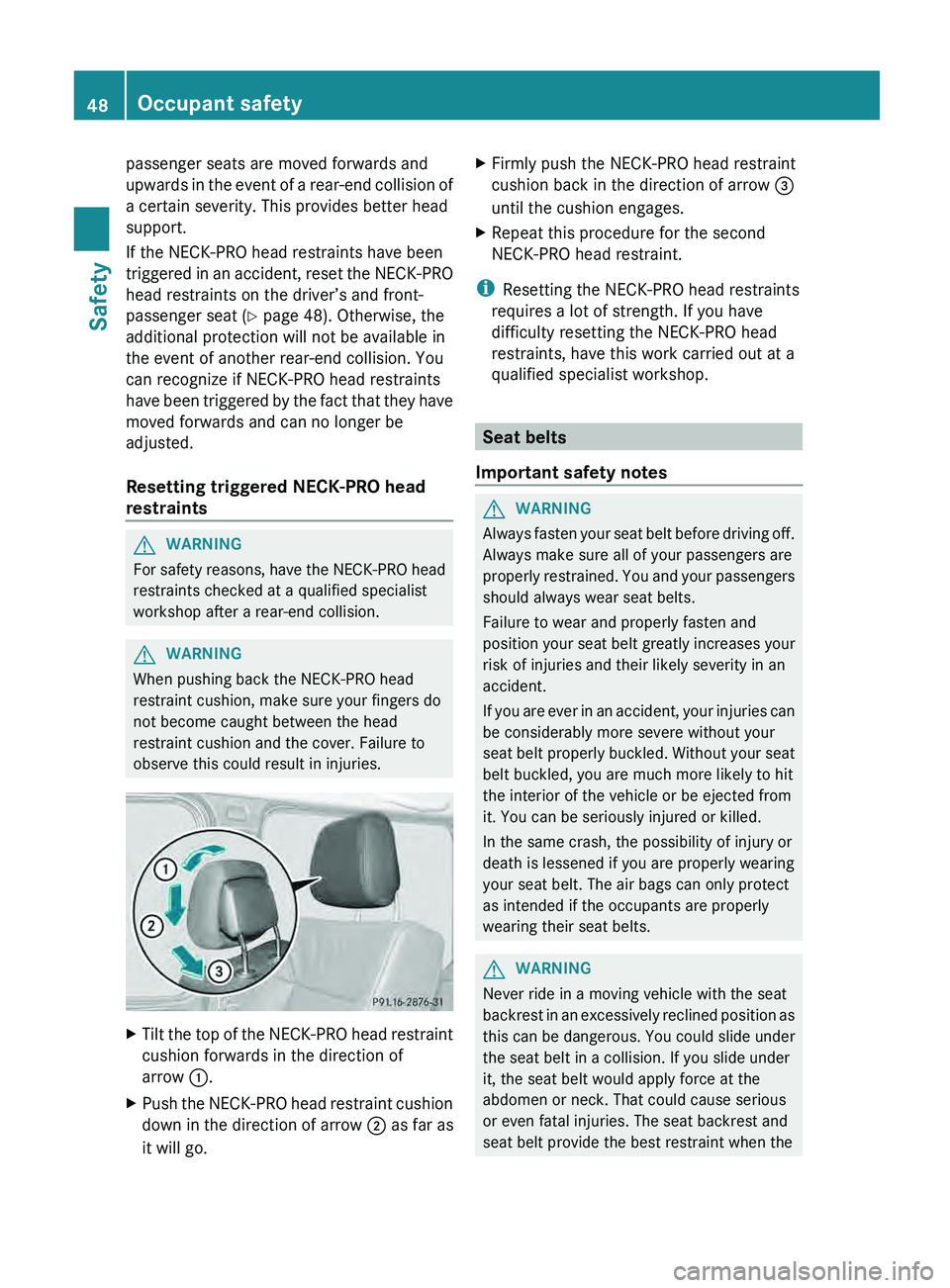
observe this could result in injuries. X
Tilt the top of the NECK-PRO head restraint
cushion forwards in the direction of
arrow 0043.
X Push the NECK-PRO head restraint cushion
down in the direction
of arrow 0044 as far as
it will go. X
Firmly push the NECK-PRO head restraint
cushion back in the direction of arrow 0087
until the cushion engages.
X Repeat this procedure for the second
NECK-PRO head restraint.
i Resetting the NECK-PRO head restraints
requires a lot of strength. If you have
difficulty resetting the NECK-PRO head
restraints, have this work carried out at a
qualified specialist workshop. Seat belts
Important safety notes G
WARNING
Always fasten your seat belt before driving off.
Always make sure all of your passengers are
properly restrained. You and
your passengers
should always wear seat belts.
Failure to wear and properly fasten and
position your seat belt greatly increases your
risk of injuries and their likely severity in an
accident.
If you are ever in an accident, your injuries can
be considerably more severe without your
seat belt properly buckled. Without your seat
belt buckled, you are much more likely to hit
the interior of the vehicle or be ejected from
it. You can be seriously injured or killed.
In the same crash, the possibility of injury or
death is lessened if you are properly wearing
your seat belt. The air bags can only protect
as intended if the occupants are properly
wearing their seat belts. G
WARNING
Never ride in a moving vehicle with the seat
backrest in an excessively
reclined position as
this can be dangerous. You could slide under
the seat belt in a collision. If you slide under
it, the seat belt would apply force at the
abdomen or neck. That could cause serious
or even fatal injuries. The seat backrest and
seat belt provide the best restraint when the 48
Occupant safety
Safety
Page 51 of 364
wearer is in a position that is as upright as
possible and the seat belt is properly
positioned on the body.
G
WARNING
Never let more people ride in the vehicle than
there are seat belts available. Make sure
everyone riding in the vehicle is correctly
restrained with a separate seat belt. Never
use a seat belt
for more than one person at a
time. G
WARNING
Always have damaged seat belts or seat belts
that have been subjected to a load in an
accident replaced and the anchorages
checked.
Only use seat belts that have been approved
by Mercedes-Benz.
Never tamper with seat belts. This can result
in the unintended deployment of the
Emergency Tensioning Devices or the failure
to deploy when necessary.
Do not bleach or dye seat belts, as this may
severely weaken them. In the event of a
collision, they may be unable to provide
adequate protection.
Have all work carried out only by qualified
technicians. Consult a qualified specialist
workshop.
The use of infant
or child restraints is required
by law in all 50 states, the District of
Columbia, all U.S. territories and all Canadian
provinces.
Even where this is not the case, all vehicle
occupants should have their seat belts
fastened when the vehicle is in motion.
i See "Children in the vehicle"
(Y page 54) for further information on
infants and children traveling in the vehicle,
as well as on child restraint systems. Correct use of the seat belts G
WARNING
CORRECT USE OF SEAT BELTS
R Seat belts only work properly if they are
fastened correctly. Never wear
seat belts in
any other way than as described in this
section, as that could result in serious
injuries in the event of an accident.
R All occupants should wear their seat belt at
all times, because seat belts help reduce
the likelihood of and potential severity of
injuries in accidents, even if the vehicle
overturns. The restraint system installed is
equipped with SRS (driver's air bag, front-
passenger air bag, window curtain air
bags), belt tensioners and belt force
limiters.
The system is designed to enhance the
protection offered to occupants who are
wearing their seat belts correctly, in certain
frontal impacts (front air bags and belt
tensioners) and side impacts (window
curtain air bags and belt tensioners) which
exceed preset deployment thresholds.
R Never route the shoulder section of the
seat belt under your arm, across your neck
or anywhere other than across your
shoulder. In the event of a frontal impact,
your body would be moved too far forward.
This would increase the risk of head and
neck injuries. The seat belt would then
apply excessive force to the ribs or
abdomen which could cause severe
internal injuries to organs such as the liver
or spleen.
Adjust the seat belt so that the upper part
of the belt is as close as possible to the
center of the shoulder. It should not touch
the neck. Never route the belt under the
shoulder. The height of the belt outlet can
be altered to ensure correct usage.
R The lap belt should be routed as low as
possible across the hips, not across the
abdomen. If the lap belt is routed across the Occupant safety
49
Safety
Z
Page 52 of 364
abdomen, it could cause serious injuries in
the event of an impact.
R Never route the seat belt over rigid or
fragile objects in or on your clothing, such
as eyeglasses, pens, keys
etc, as this could
cause injuries.
R Always ensure that the seat belt is routed
correctly. This is particularly important if
you are wearing loose clothing.
R Only one person should use each seat belt
at any one time. Never use a seat belt to
restrain more than one person or route the
belt around additional objects.
R Never wear seat belts when they are
twisted. Otherwise, in the event of an
impact, the full width of the seat belt is
unavailable to distribute the force of the
impact. The twisted seat belt routed across
your body could cause injuries.
R Pregnant women should also wear a three-
point seat belt. The lap belt must always
pass across your lap as low down as
possible, i.e. across your hips; not across
your abdomen.
R The seat backrest should be set as close to
vertical as possible.
R Check the seat belt during the journey in
order to make sure that it is correctly
positioned.
R Never rest your feet on the dashboard or
the seat. Always keep both feet on the floor
in front of the seat.
R When using a seat belt to secure an infant
restraint system, child restraint system or
a child on a booster seat, always follow the
child seat manufacturer's instructions. G
WARNING
Do not pass seat belts over sharp edges. They
could tear.
Do not allow the
seat belt to get caught in the
door or in the seat adjustment mechanism.
This could damage the seat belt. Never attempt to make modifications to seat
belts. This could impair the effectiveness of
the seat belts.
Fastening seat belts Important safety notes
G
WARNING
According to accident statistics, children are
safer when properly restrained on the rear
seats than on the
front-passenger seat. Thus,
we strongly recommend that children be
placed in the rear seat whenever possible.
Regardless of seating position, children 12
years old and under must be seated and
properly secured in an appropriately sized
child restraint system or booster seat
recommended for the size and weight of the
child. For additional information, see the
"Children in the vehicle" section.
A child's risk of serious or fatal injuries is
significantly increased if the child restraints
are not properly secured in the vehicle and/
or the child is not properly secured in the child
restraint. G
WARNING
Children 12 years old and under must never
ride in the front seat, except in a Mercedes-
Benz authorized BabySmart™ compatible
child seat, which operates with the
BabySmart™ system installed in the vehicle
to deactivate the
front
passenger front air bag
when it is installed properly. Otherwise they
will be struck by the air bag when it inflates in
a crash. If this happens, serious or fatal injury
will result. 50
Occupant safety
Safety
Page 53 of 364
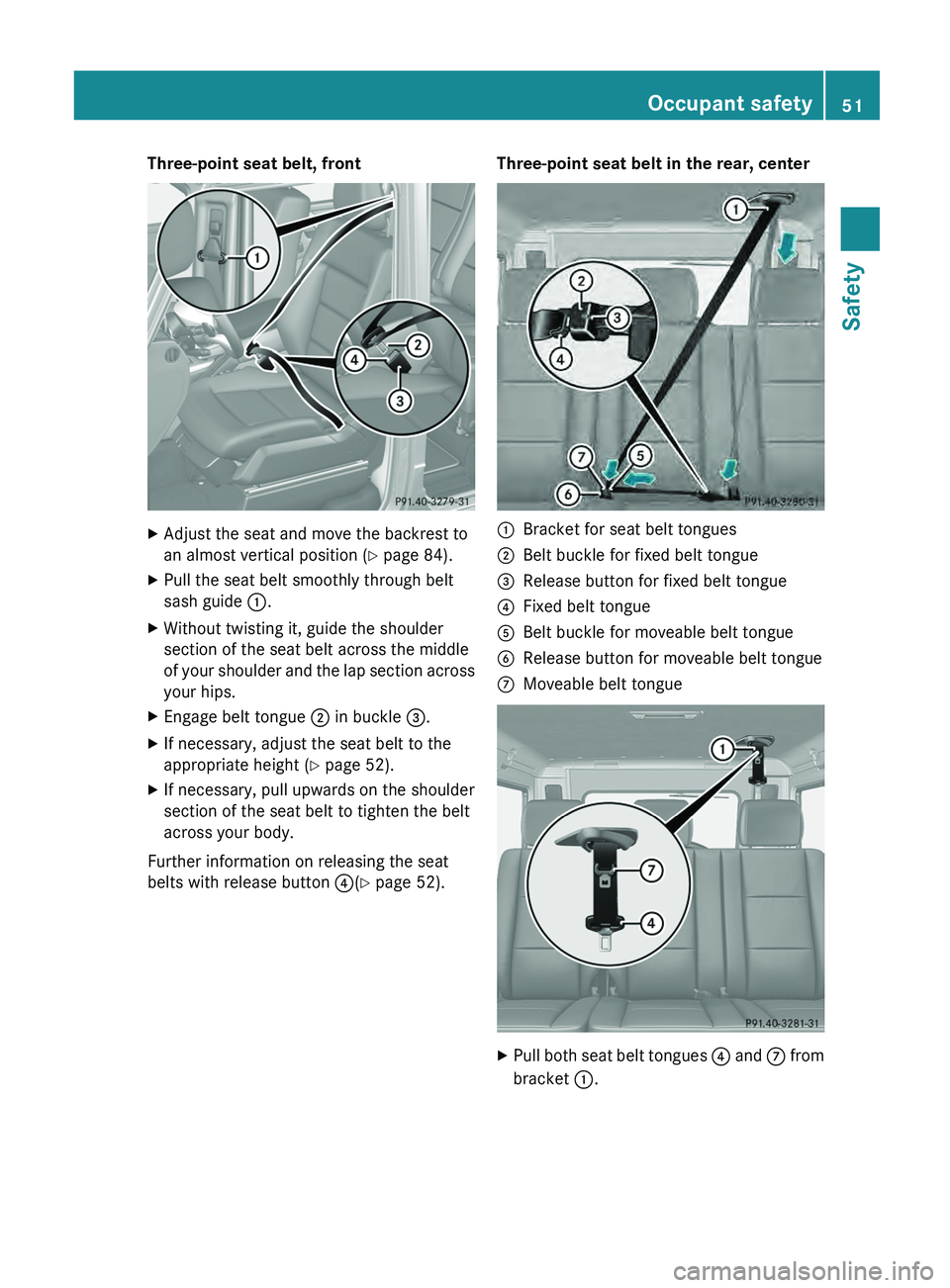
Three-point seat belt, front
X
Adjust the seat and move the backrest to
an almost vertical position ( Y page 84).
X Pull the seat belt smoothly through belt
sash guide 0043.
X Without twisting it, guide the shoulder
section of the seat belt across the middle
of your shoulder and
the lap section across
your hips.
X Engage belt tongue 0044 in buckle 0087.
X If necessary, adjust the seat belt to the
appropriate height (Y page 52).
X If necessary, pull upwards on the shoulder
section of the seat belt to tighten the belt
across your body.
Further information on releasing the seat
belts with release button 0085(
Y page 52).Three-point seat belt in the rear, center
0043
Bracket for seat belt tongues
0044 Belt buckle for fixed belt tongue
0087 Release button for fixed belt tongue
0085 Fixed belt tongue
0083 Belt buckle for moveable belt tongue
0084 Release button for moveable belt tongue
006B Moveable belt tongue X
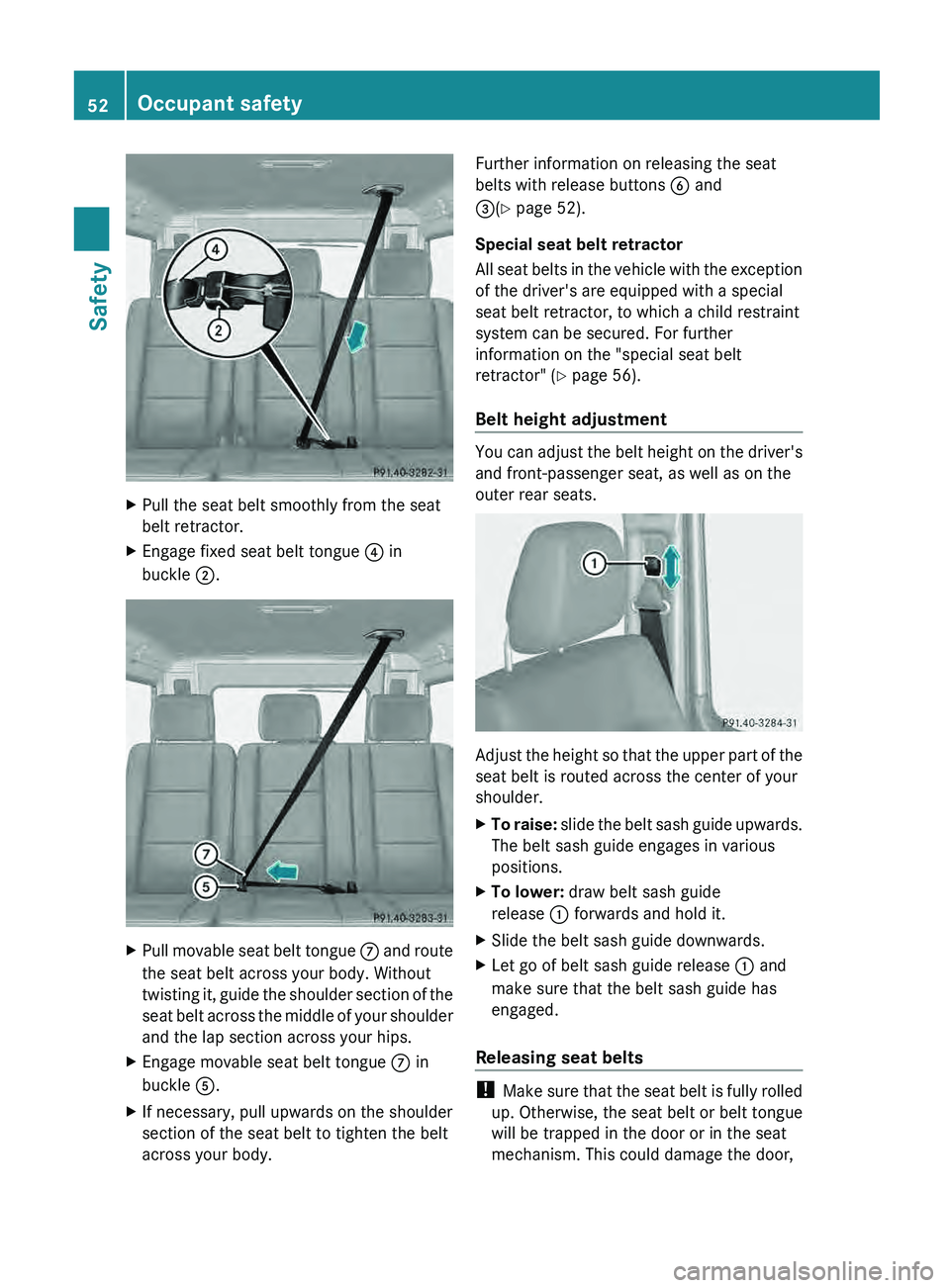
Pull both seat belt tongues 0085
and 006B
from
bracket 0043
. Occupant safety
51
Safety Z
Page 54 of 364
X
Pull the seat belt smoothly from the seat
belt retractor.
X Engage fixed seat belt tongue 0085 in
buckle 0044. X
Pull movable seat belt tongue 006B and route
the seat belt across your body. Without
twisting it,
guide the shoulder section of the
seat belt across the middle of your shoulder
and the lap section across your hips.
X Engage movable seat belt tongue 006B in
buckle 0083.
X If necessary, pull upwards on the shoulder
section of the seat belt to tighten the belt
across your body. Further information on releasing the seat
belts with release buttons
0084 and
0087(Y page 52).
Special seat belt retractor
All seat belts in
the vehicle with the exception
of the driver's are equipped with a special
seat belt retractor, to which a child restraint
system can be secured. For further
information on the "special seat belt
retractor" (Y page 56).
Belt height adjustment You can adjust the belt height on the driver's
and front-passenger seat, as well as on the
outer rear seats.
Adjust the height so that the upper part of the
seat belt is routed across the center of your
shoulder.
X
To raise: slide the belt sash guide upwards.
The belt sash guide engages in various
positions.
X To lower: draw belt sash guide
release 0043 forwards and hold it.
X Slide the belt sash guide downwards.
X Let go of belt sash guide release 0043
and
make sure that the belt sash guide has
engaged.
Releasing seat belts !
Make sure that the
seat belt is fully rolled
up. Otherwise, the seat belt or belt tongue
will be trapped in the door or in the seat
mechanism. This could damage the door, 52
Occupant safety
Safety
Page 55 of 364
the door trim panel and the seat belt.
Damaged seat belts can no longer fulfill
their protective function and must be
replaced. Visit a qualified specialist
workshop.
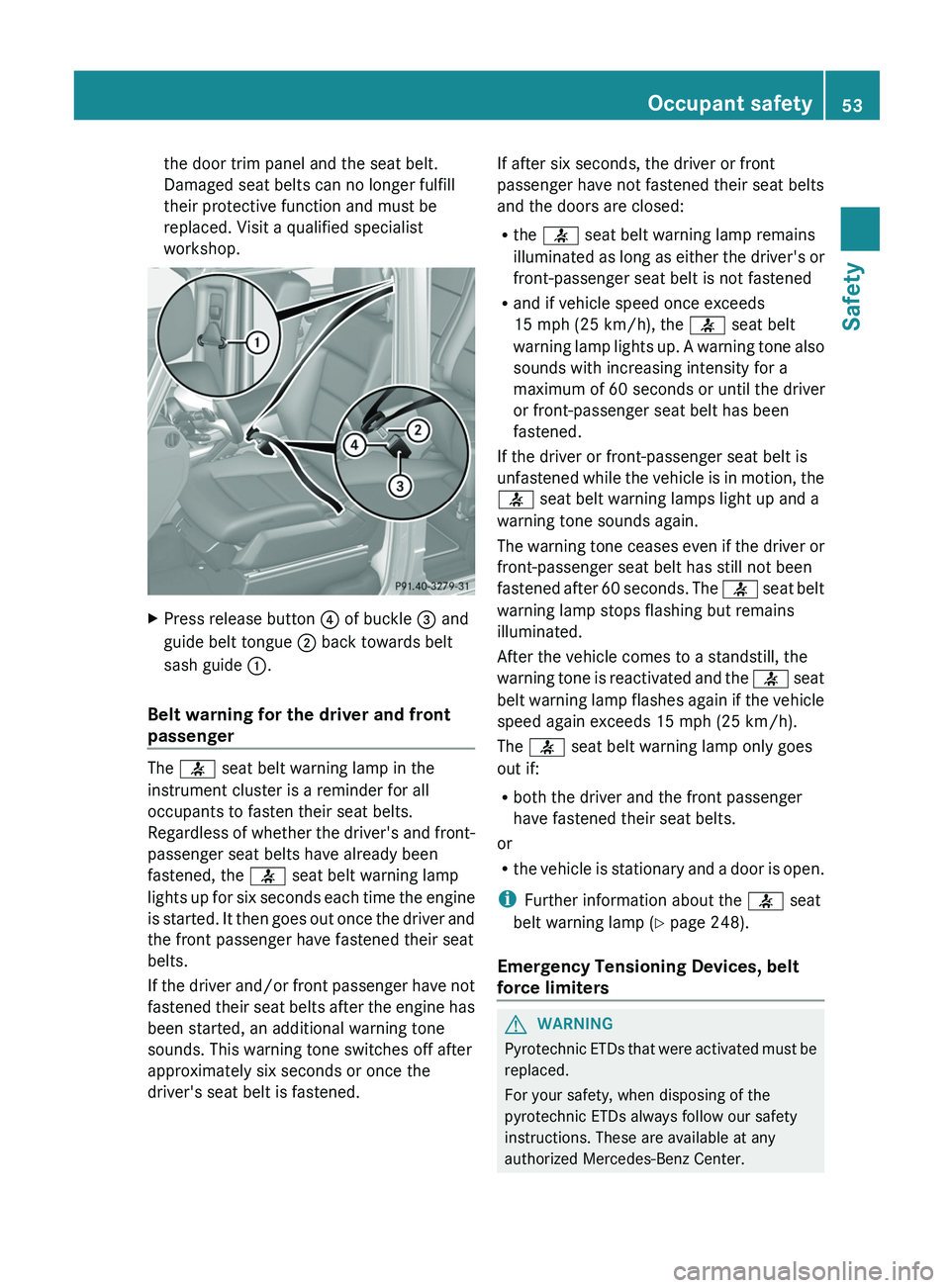
X
Press release button 0085 of buckle 0087 and
guide belt tongue 0044 back towards belt
sash guide 0043.
Belt warning for the driver and front
passenger The 0076 seat belt warning lamp in the
instrument cluster is a reminder for all
occupants to fasten their seat belts.
Regardless of whether
the
driver's and front-
passenger seat belts have already been
fastened, the 0076 seat belt warning lamp
lights up for six seconds each time the engine
is started. It then goes out once the driver and
the front passenger have fastened their seat
belts.
If the driver and/or front passenger have not
fastened their seat belts after the engine has
been started, an additional warning tone
sounds. This warning tone switches off after
approximately six seconds or once the
driver's seat belt is fastened. If after six seconds, the driver or front
passenger have not fastened their seat belts
and the doors are closed:
R
the 0076 seat belt warning lamp remains
illuminated as long as
either the driver's or
front-passenger seat belt is not fastened
R and if vehicle speed once exceeds
15 mph (25 km/h), the 0076 seat belt
warning lamp lights up. A warning tone also
sounds with increasing intensity for a
maximum of 60 seconds or until the driver
or front-passenger seat belt has been
fastened.
If the driver or front-passenger seat belt is
unfastened while the vehicle is in motion, the
0076 seat belt warning lamps light up and a
warning tone sounds again.
The warning tone ceases even if the driver or
front-passenger seat belt has still not been
fastened after 60 seconds. The 0076 seat belt
warning lamp stops flashing but remains
illuminated.
After the vehicle comes to a standstill, the
warning tone is reactivated and the 0076 seat
belt warning lamp flashes again if the vehicle
speed again exceeds 15 mph (25 km/h).
The 0076 seat belt warning lamp only goes
out if:
R both the driver and the front passenger
have fastened their seat belts.
or
R the vehicle is stationary and a door is open.
i Further information about the 0076 seat
belt warning lamp (Y page 248).
Emergency Tensioning Devices, belt
force limiters G
WARNING
Pyrotechnic ETDs that were activated must be
replaced.
For your safety, when disposing of the
pyrotechnic ETDs always follow our safety
instructions. These are available at any
authorized Mercedes-Benz Center. Occupant safety
53
Safety Z