light MERCEDES-BENZ G-CLASS SUV 2014 User Guide
[x] Cancel search | Manufacturer: MERCEDES-BENZ, Model Year: 2014, Model line: G-CLASS SUV, Model: MERCEDES-BENZ G-CLASS SUV 2014Pages: 272, PDF Size: 39.13 MB
Page 24 of 272
Manual is not supported by the
Manual is not supported by the
system. Ejecting disc...
system. Ejecting disc... Please
contact your authorized Mercedes-Benz
Center. X
When the installation has been
completed: confirm ejection of the
installation CD using the COMAND
controller.
i Canceling the installation: you can
cancel the installation of the Digital
Operator's Manual during the installation
process. The installation can be continued
at a later date. To do this, simply insert the
installation CD into the CD/DVD drive
again and follow the installation
instructions, as described above. Operation
Calling up the Digital Operator's
Manual
X Press the qcontrol knob on COMAND.
COMAND switches on. The previously
selected menu appears after a warning
message.
X Using the COMAND controller, select the
® symbol in the menu bar and confirm
with W.
X Choose the "Operator's Manual" selection
card and confirm with W.
The basic menu for the Digital Operator's
Manual opens. Visual search
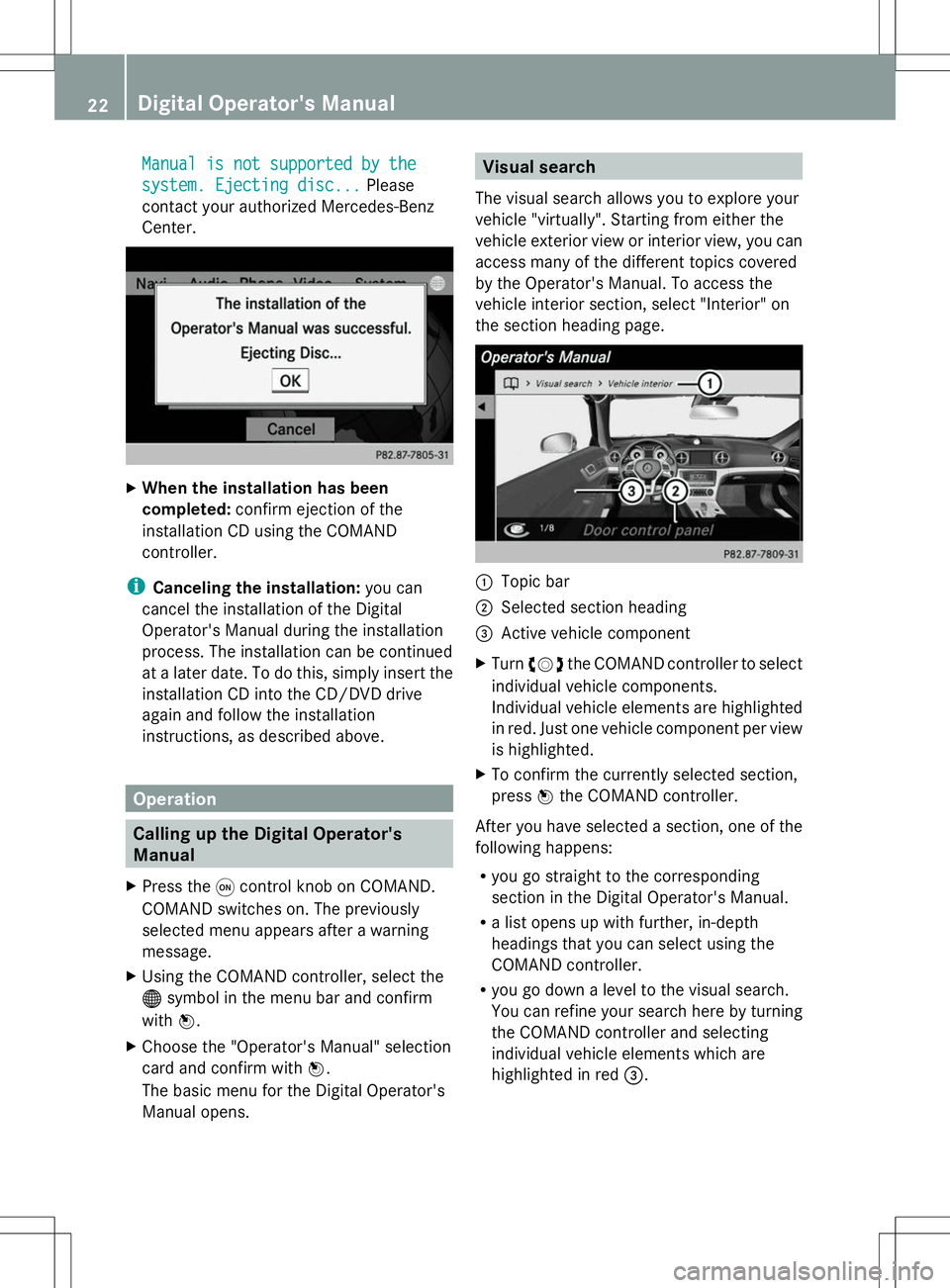
The visual search allows you to explore your
vehicle "virtually". Starting from either the
vehicle exterior view or interior view, you can
access many of the different topics covered
by the Operator's Manual. To access the
vehicle interior section, select "Interior" on
the section heading page. :
Topic bar
; Selected section heading
= Active vehicle component
X Turn cVd the COMAND controller to select
individual vehicle components.
Individual vehicle elements are highlighted
in red. Just one vehicle component per view
is highlighted.
X To confirm the currently selected section,
press Wthe COMAND controller.
After you have selected a section, one of the
following happens:
R you go straight to the corresponding
section in the Digital Operator's Manual.
R a list opens up with further, in-depth
headings that you can select using the
COMAND controller.
R you go down a level to the visual search.
You can refine your search here by turning
the COMAND controller and selecting
individual vehicle elements which are
highlighted in red =.22
Digital Operator's Manual
Page 32 of 272
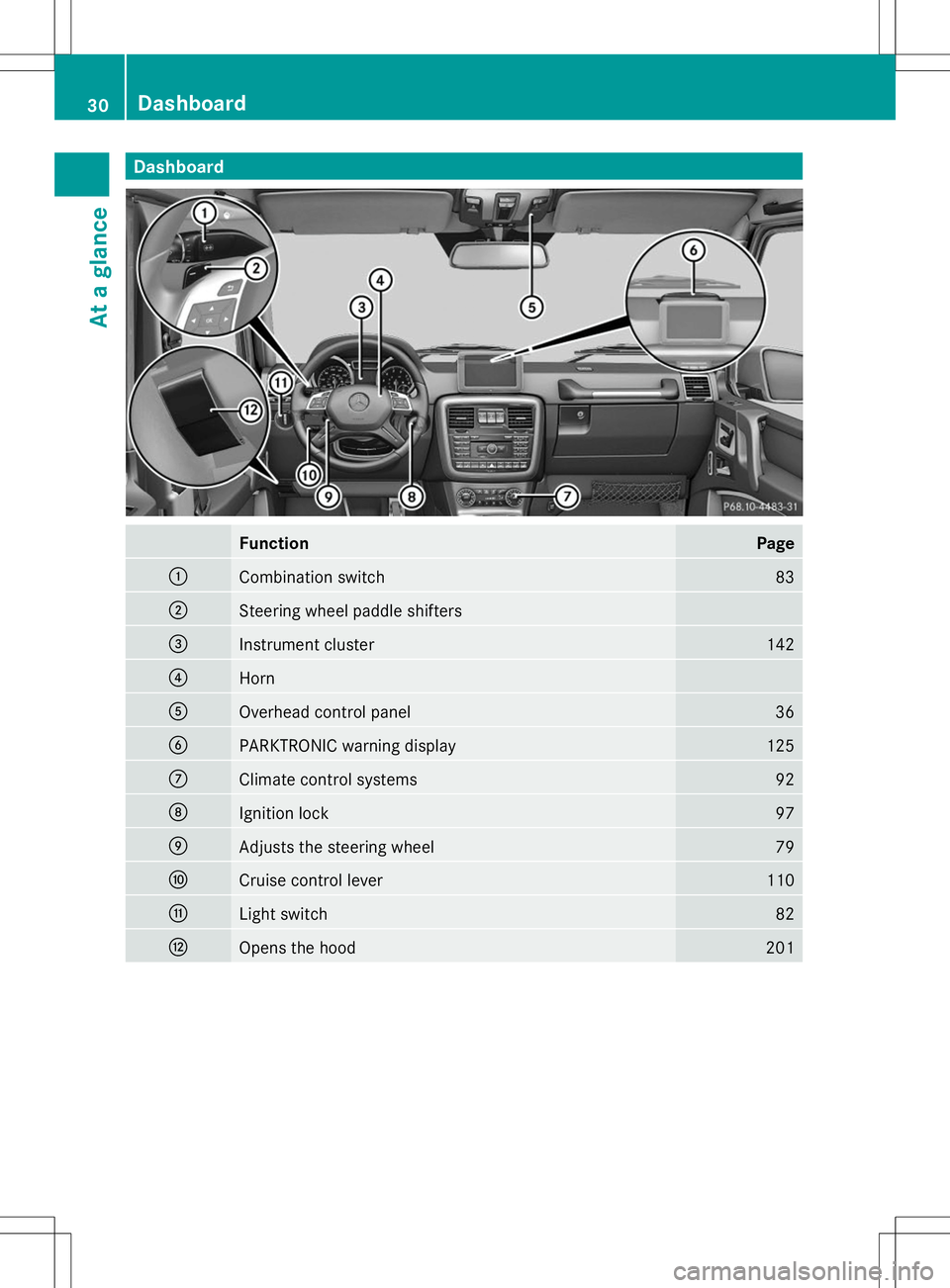
Dashboard
Function Page
:
Combination switch 83
;
Steering wheel paddle shifters
=
Instrument cluster 142
?
Horn
A
Overhead control panel 36
B
PARKTRONIC warning display 125
C
Climate control systems 92
D
Ignition lock 97
E
Adjusts the steering wheel 79
F
Cruise control lever 110
G
Light switch 82
H
Opens the hood 20130
Dashboa
rdAt a glance
Page 33 of 272
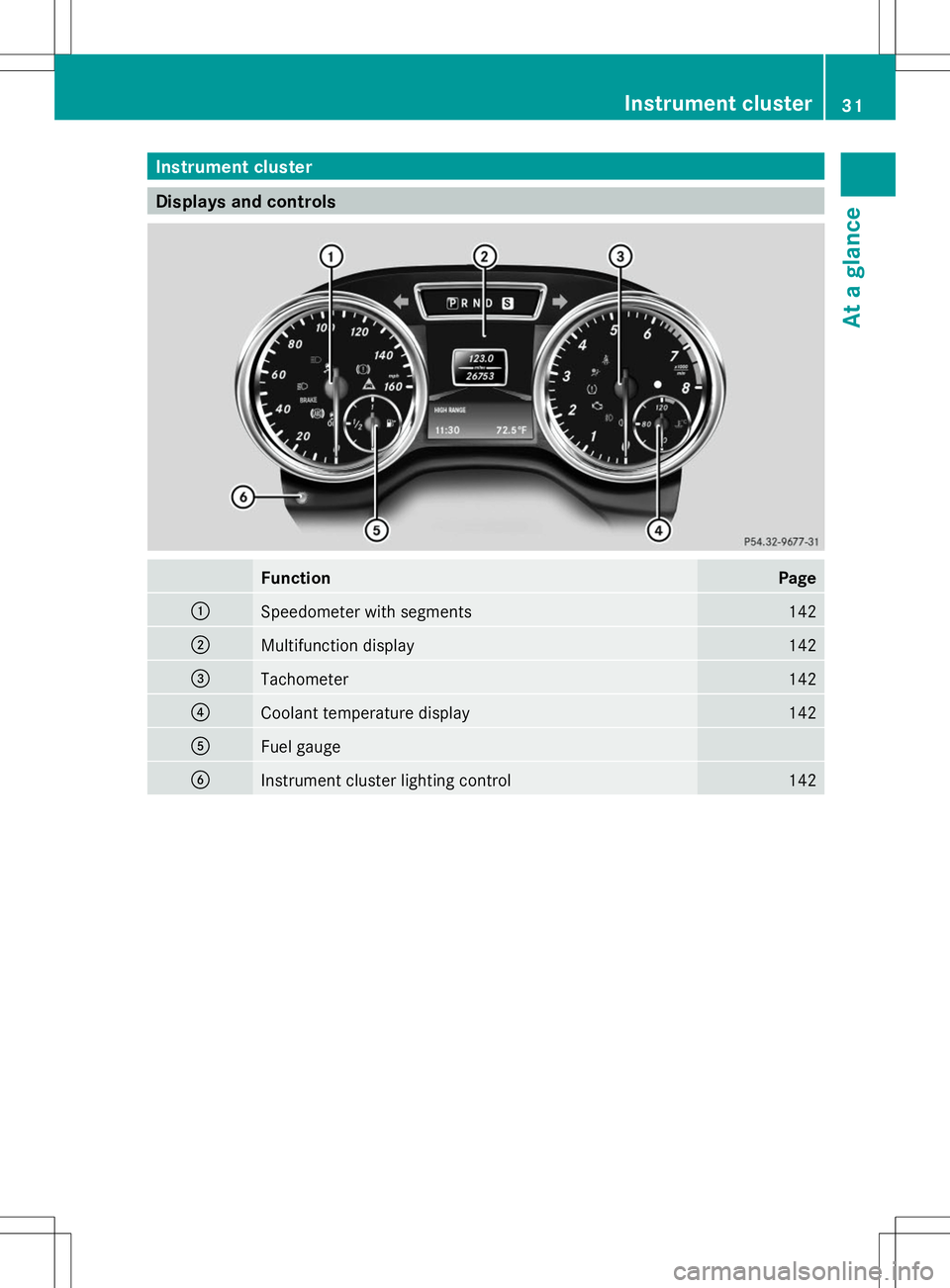
Instrument cluster
Displays and controls
Function Page
:
Speedometer with segments 142
;
Multifunction display 142
=
Tachometer 142
?
Coolant temperature display 142
A
Fuel gauge
B
Instrument cluster lighting control 142Instrument cluster
31At a glance
Page 37 of 272
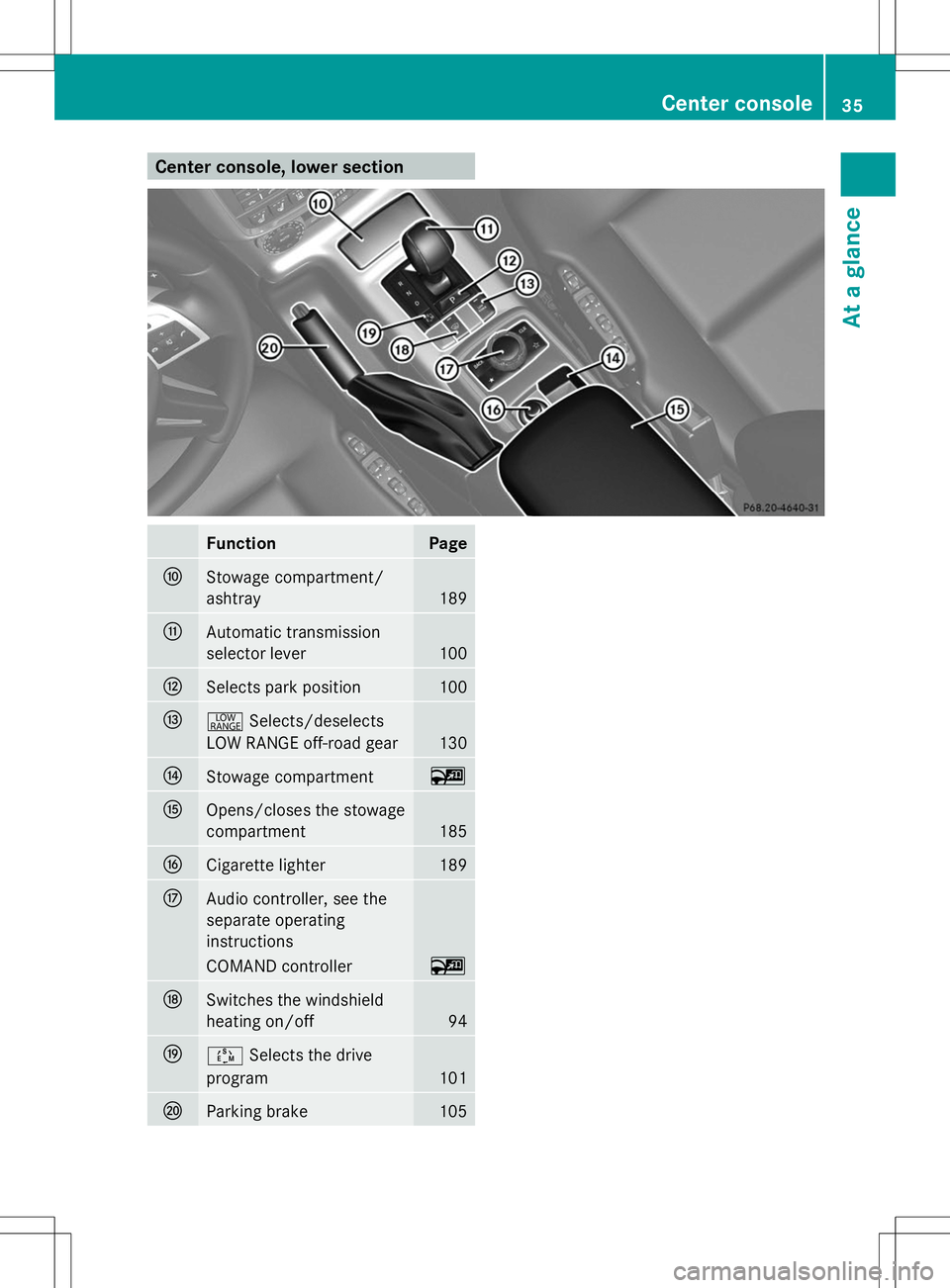
Center console, lower section
Function Page
F
Stowage compartment/
ashtray
189
G
Automatic transmission
selector lever 100
H
Selects park position 100
I
+
Selects/deselects
LOW RANGE off-road gear 130
J
Stowage compartment ~
K
Opens/closes the stowage
compartment 185
L
Cigarette lighter 189
M
Audio controller, see the
separate operating
instructions
COMAND controller ~
N
Switches the windshield
heating on/off
94
O
Ú
Selects the drive
program 101
P
Parking brake 105 Center console
35At a glance
Page 38 of 272
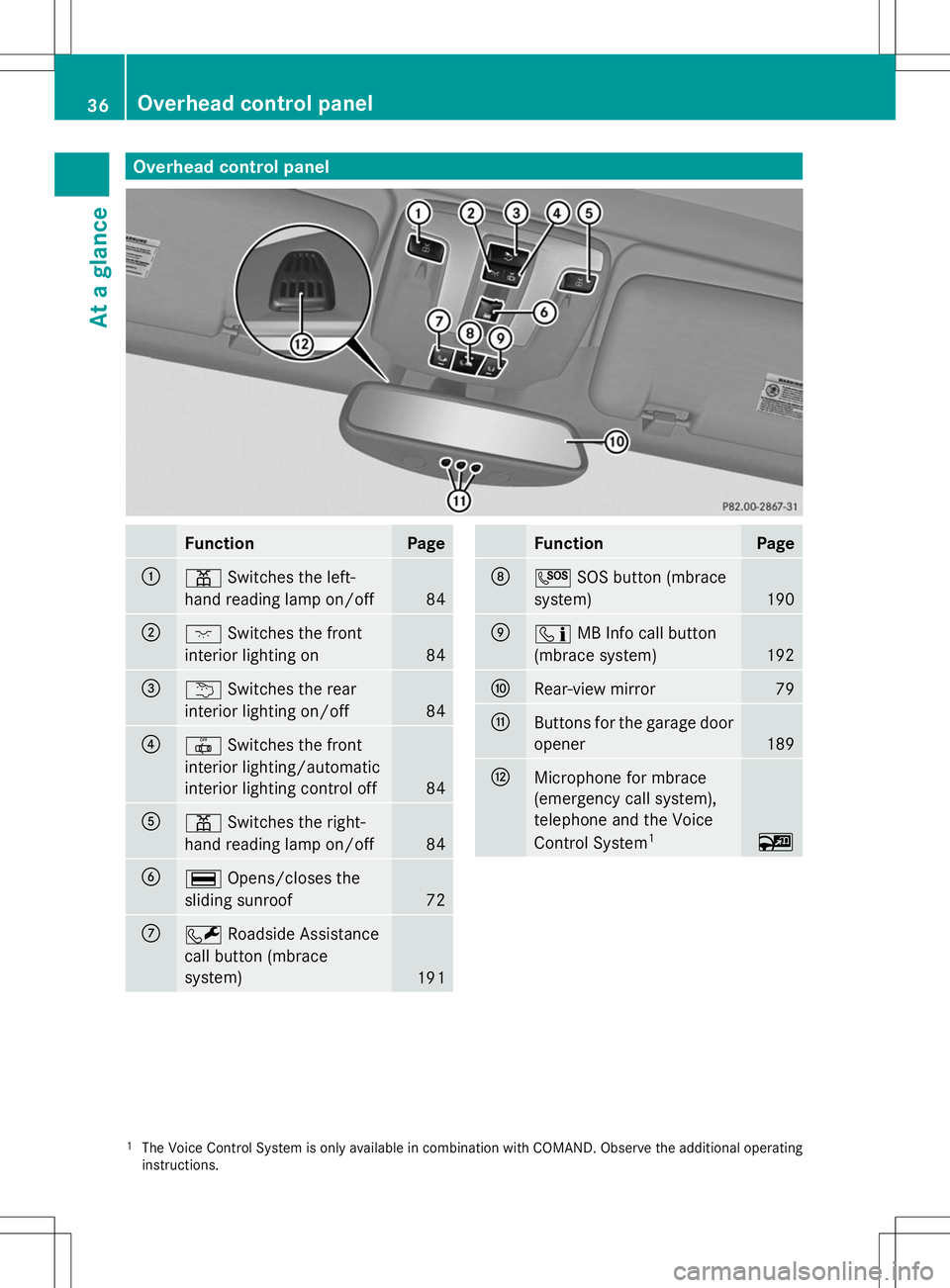
Overhead control panel
Function Page
:
p
Switches the left-
hand reading lamp on/off 84
;
c
Switches the front
interior lighting on 84
=
u
Switches the rear
interior lighting on/off 84
?
|
Switches the front
interior lighting/automatic
interior lighting control off 84
A
p
Switches the right-
hand reading lamp on/off 84
B
¡
Opens/closes the
sliding sunroof 72
C
F
Roadside Assistance
call button (mbrace
system) 191 Function Page
D
G
SOS button (mbrace
system) 190
E
ï
MB Info call button
(mbrace system) 192
F
Rear-view mirror 79
G
Buttons for the garage door
opener
189
H
Microphone for mbrace
(emergency call system),
telephone and the Voice
Control System
1 ~
1
The Voice Control System is only available in combination with COMAND. Observe the additional operating
instructions. 36
Overhead control panelAt a glance
Page 42 of 272
Useful information
i This Operator's Manual describes all
models and all standard and optional
equipment of your vehicle available at the
time of publication of the Operator's
Manual. Country-specific differences are
possible. Please note that your vehicle may
not be equipped with all features
described. This also applies to safety-
related systems and functions.
i Read the information on qualified
specialist workshops: (Y page 27).Occupant safety
Important safety notes
G
WARNING
Modifications to the restraint system, may
cause it to no longer work as intended. The
restraint system may then not perform its
intended protective function by failing in an
accident or triggering unexpectedly, for
example. There is an increased risk of injury.
Never modify parts of the restraint system.
Never tamper with the wiring as well as
electronic components or their software.
In this section, you will learn the most
important facts about the restraint system
components of the vehicle.
The restraint system consists of:
R Seat belts
R Child restraint systems
R LATCH-type (ISOFIX) child seat securing
system
Additional protection is provided by:
R SRS (Supplemental Restraint System)
R NECK-PRO head restraints
R Air bag system components with:
-The 45indicator lamp
- Front-passenger seat with BabySmart™
air bag deactivation system Although the systems are independent, their
protective functions work in conjunction with
each other. Not all air bags are always
deployed in an accident.
i Observe the additional information on
infants and children traveling with you in
the vehicle and restraint systems for
infants and children (Y page 53). SRS (Supplemental Restraint System)
Introduction SRS reduces the risk of occupants coming
into contact with the vehicle's interior in the
event of an accident. It can also reduce the
effect of the forces to which occupants are
subjected during an accident.
SRS consists of:
R SRS warning lamps 6
R Air bags
R Air bag control unit (with crash sensors)
R Emergency Tensioning Device (ETD) for
seat belts
R Seat belt force limiter
SRS warning lamp SRS functions are checked regularly when
you switch on the ignition and when the
engine is running. Therefore, malfunctions
can be detected in good time.
The
6 SRS warning lamp in the instrument
cluster lights up when the ignition is switched
on. It goes out no later than a few seconds
after the engine is started.
The SRS components are in operational
readiness when the 6SRS indicator lamp
goes out while the engine is running. 40
Occupant safetySafety
Page 45 of 272
bag is disabled. If the front-passenger seat is
recognized as empty, the air bag control unit
will not deploy the front-passenger air bag in
the event of a collision.
Ask your passenger to sit correctly on the
front-passenger seat in an upright position
until the 4/ indicator lamp goes out.
If the 4/ indicator lamp does not go
out, please consult an authorized Mercedes-
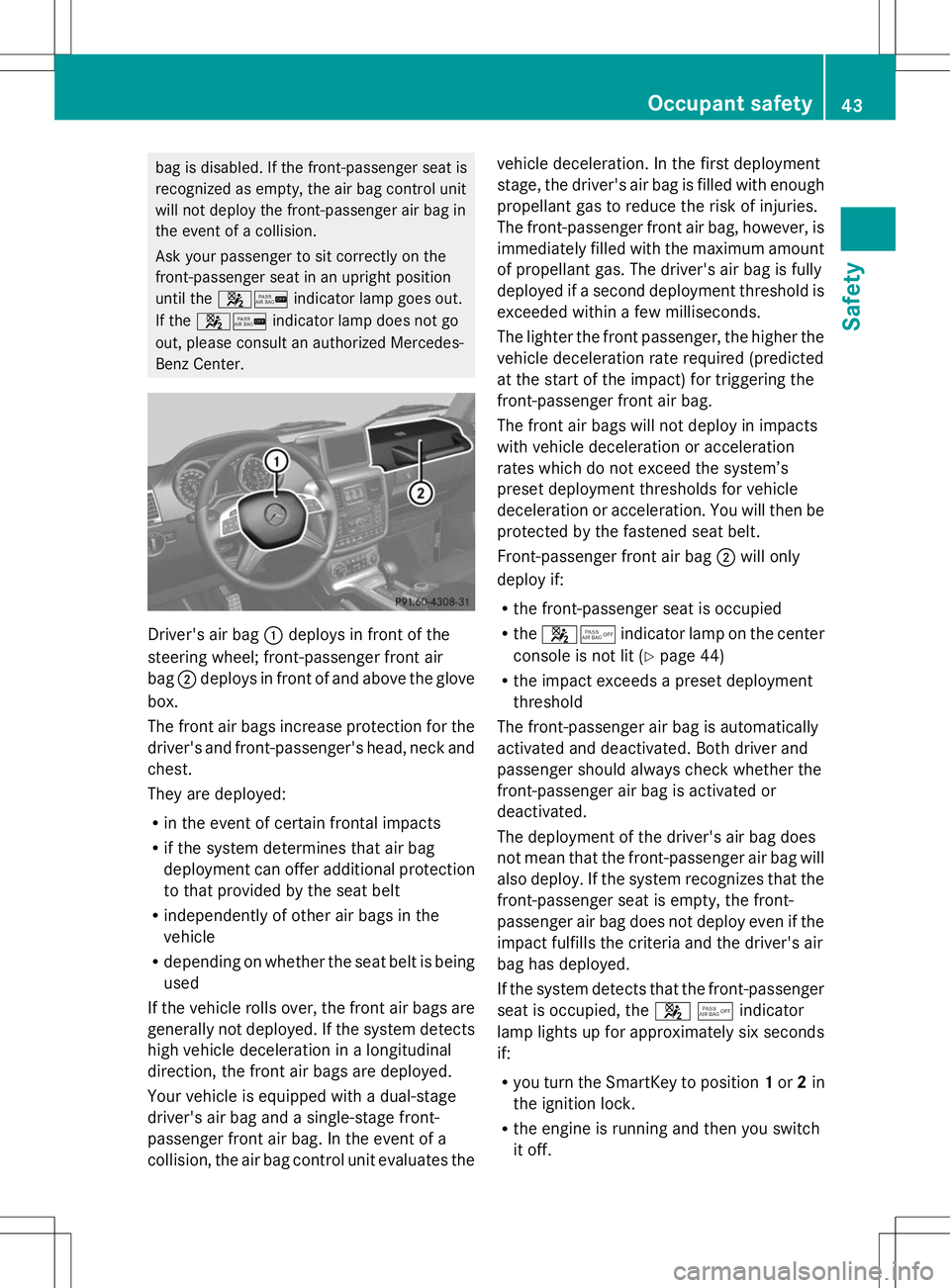
Benz Center. Driver's air bag
:deploys in front of the
steering wheel; front-passenger front air
bag ;deploys in front of and above the glove
box.
The front air bags increase protection for the
driver's and front-passenger's head, neck and
chest.
They are deployed:
R in the event of certain frontal impacts
R if the system determines that air bag
deployment can offer additional protection
to that provided by the seat belt
R independently of other air bags in the
vehicle
R depending on whether the seat belt is being
used
If the vehicle rolls over, the front air bags are
generally not deployed. If the system detects
high vehicle deceleration in a longitudinal
direction, the front air bags are deployed.
Your vehicle is equipped with a dual-stage
driver's air bag and a single-stage front-
passenger front air bag. In the event of a
collision, the air bag control unit evaluates the vehicle deceleration. In the first deployment
stage, the driver's air bag is filled with enough
propellant gas to reduce the risk of injuries.
The front-passenger front air bag, however, is
immediately filled with the maximum amount
of propellant gas. The driver's air bag is fully
deployed if a second deployment threshold is
exceeded within a few milliseconds.
The lighter the front passenger, the higher the
vehicle deceleration rate required (predicted
at the start of the impact) for triggering the
front-passenger front air bag.
The front air bags will not deploy in impacts
with vehicle deceleration or acceleration
rates which do not exceed the system’s
preset deployment thresholds for vehicle
deceleration or acceleration. You will then be
protected by the fastened seat belt.
Front-passenger front air bag ;will only
deploy if:
R the front-passenger seat is occupied
R the 45 indicator lamp on the center
console is not lit (Y page 44)
R the impact exceeds a preset deployment
threshold
The front-passenger air bag is automatically
activated and deactivated. Both driver and
passenger should always check whether the
front-passenger air bag is activated or
deactivated.
The deployment of the driver's air bag does
not mean that the front-passenger air bag will
also deploy. If the system recognizes that the
front-passenger seat is empty, the front-
passenger air bag does not deploy even if the
impact fulfills the criteria and the driver's air
bag has deployed.
If the system detects that the front-passenger
seat is occupied, the 45indicator
lamp lights up for approximately six seconds
if:
R you turn the SmartKey to position 1or 2in
the ignition lock.
R the engine is running and then you switch
it off. Occupant safety
43Safety Z
Page 46 of 272
This indicates the operational readiness of
the front-passenger air bag.
Note that objects placed on the front-
passenger seat may cause the system to
recognize the seat as occupied. This can
result in the deployment of the front-
passenger air bag if the impact fulfills the
specified criteria. If the 45indicator
lamp lights up, the front-passenger front air
bag is disabled and will not be deployed in
certain situations. If the 45indicator
lamp does not light up, the front-passenger
front air bag is enabled and can be deployed.
Window curtain air bags G
WARNING
Observe "Important safety notes"
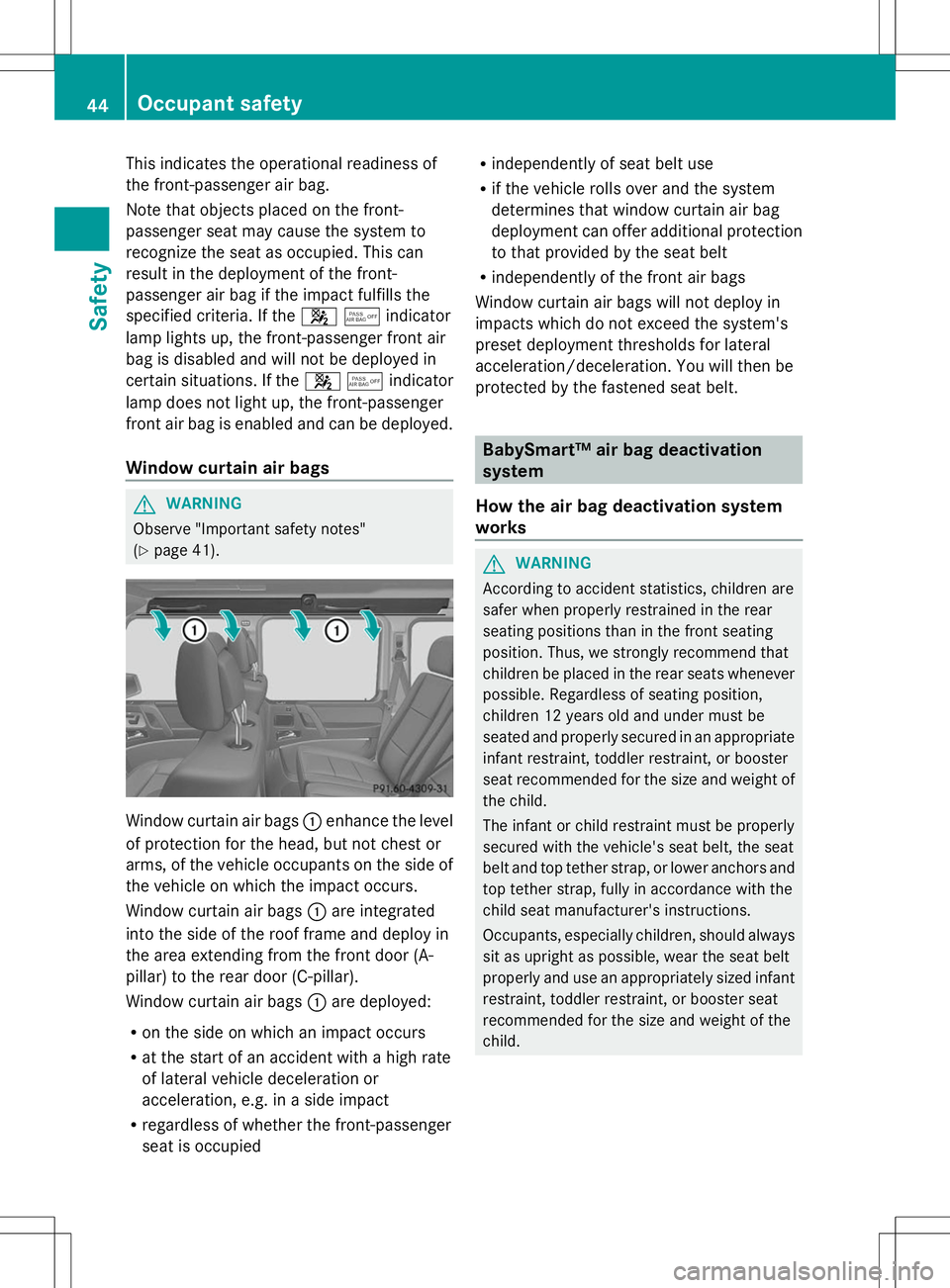
(Y page 41). Window curtain air bags
:enhance the level
of protection for the head, but not chest or
arms, of the vehicle occupants on the side of
the vehicle on which the impact occurs.
Window curtain air bags :are integrated
into the side of the roof frame and deploy in
the area extending from the front door (A-
pillar) to the rear door (C-pillar).
Window curtain air bags :are deployed:
R on the side on which an impact occurs
R at the start of an accident with a high rate
of lateral vehicle deceleration or
acceleration, e.g. in a side impact
R regardless of whether the front-passenger
seat is occupied R
independently of seat belt use
R if the vehicle rolls over and the system
determines that window curtain air bag
deployment can offer additional protection
to that provided by the seat belt
R independently of the front air bags
Window curtain air bags will not deploy in
impacts which do not exceed the system's
preset deployment thresholds for lateral
acceleration/deceleration. You will then be
protected by the fastened seat belt. BabySmart™ air bag deactivation
system
How the air bag deactivation system
works G
WARNING
According to accident statistics, children are
safer when properly restrained in the rear
seating positions than in the front seating
position. Thus, we strongly recommend that
children be placed in the rear seats whenever
possible. Regardless of seating position,
children 12 years old and under must be
seated and properly secured in an appropriate
infant restraint, toddler restraint, or booster
seat recommended for the size and weight of
the child.
The infant or child restraint must be properly
secured with the vehicle's seat belt, the seat
belt and top tether strap, or lower anchors and
top tether strap, fully in accordance with the
child seat manufacturer's instructions.
Occupants, especially children, should always
sit as upright as possible, wear the seat belt
properly and use an appropriately sized infant
restraint, toddler restraint, or booster seat
recommended for the size and weight of the
child. 44
Occupant safetySafety
Page 48 of 272
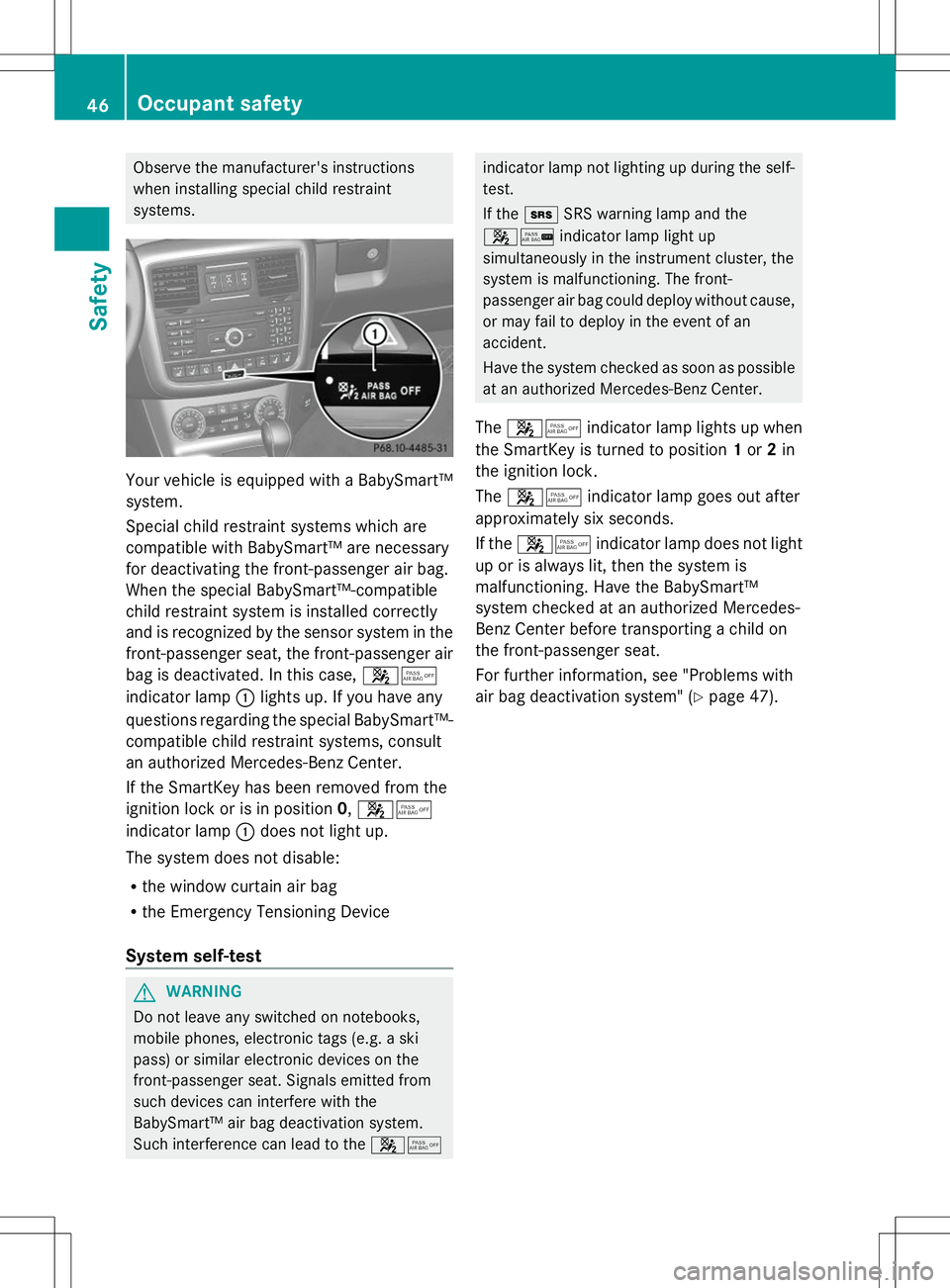
Observe the manufacturer's instructions
when installing special child restraint
systems. Your vehicle is equipped with a BabySmart™
system.
Special child restraint systems which are
compatible with BabySmart™ are necessary
for deactivating the front-passenger air bag.
When the special BabySmart™-compatible
child restraint system is installed correctly
and is recognized by the sensor system in the
front-passenger seat, the front-passenger air
bag is deactivated. In this case, 45
indicator lamp :lights up. If you have any
questions regarding the special BabySmart™-
compatible child restraint systems, consult
an authorized Mercedes-Benz Center.
If the SmartKey has been removed from the
ignition lock or is in position 0,45
indicator lamp :does not light up.
The system does not disable:
R the window curtain air bag
R the Emergency Tensioning Device
System self-test G
WARNING
Do not leave any switched on notebooks,
mobile phones, electronic tags (e.g. a ski
pass) or similar electronic devices on the
front-passenger seat. Signals emitted from
such devices can interfere with the
BabySmart™ air bag deactivation system.
Such interference can lead to the 45 indicator lamp not lighting up during the self-
test.
If the
+ SRS warning lamp and the
4/ indicator lamp light up
simultaneously in the instrument cluster, the
system is malfunctioning. The front-
passenger air bag could deploy without cause,
or may fail to deploy in the event of an
accident.
Have the system checked as soon as possible
at an authorized Mercedes-Benz Center.
The 45 indicator lamp lights up when
the SmartKey is turned to position 1or 2in
the ignition lock.
The 45 indicator lamp goes out after
approximately six seconds.
If the 45 indicator lamp does not light
up or is always lit, then the system is
malfunctioning. Have the BabySmart™
system checked at an authorized Mercedes-
Benz Center before transporting a child on
the front-passenger seat.
For further information, see "Problems with
air bag deactivation system" (Y page 47).46
Occupant safetySafety
Page 49 of 272
Problems with the air bag deactivation system
G
WARNING
If the 45 indicator lamp illuminates and remains illuminated when the weight of a typical
adult or someone larger than a small individual has been detected on the passenger seat, do not
allow any occupant to use the passenger seat until the system has been repaired. Problem Possible causes/consequences and
M MSolutions The
45
indicator lamp is
continuously lit. A special BabySmart™-compatible child restraint system is
mounted on the front-passenger seat.
The front-passenger air bag is therefore disabled.
There is no BabySmart™-compatible child restraint system
mounted on the front-passenger seat. The BabySmart™ system is
malfunctioning.
X
Have the BabySmart™ system checked as soon as possible at
an authorized Mercedes-Benz Center. The
45
indicator lamp does not
light up and/or remain
lit when a BabySmart™-
compatible child
restraint system is
installed on the front-
passenger seat. The BabySmart™ system is malfunctioning.
X
Make sure there is nothing between the seat cushion and the
child restraint system.
X Check that the child restraint system is installed correctly.
X If the 45 indicator lamp does not light up, have the
BabySmart™ system checked as soon as possible at an
authorized Mercedes-Benz Center.
Do not transport a child on the front-passenger seat until the
air bag deactivation system has been repaired. Seat belts
Important safety notes Mercedes-Benz recommends that you only
use seat belts which have been approved
specifically for your vehicle by Mercedes-
Benz. G
WARNING
Always fasten your seat belt before driving off.
Always make sure all of your passengers are
properly restrained. You and your passengers
should always wear seat belts.
Failure to wear and properly fasten and
position your seat belt greatly increases your risk of injuries and their likely severity in an
accident.
If you are ever in an accident, your injuries can
be considerably more severe without your
seat belt properly buckled. Without your seat
belt buckled, you are much more likely to hit
the interior of the vehicle or be ejected from
it. You can be seriously injured or killed.
In the same crash, the possibility of injury or
death is lessened if you are properly wearing
your seat belt. The air bags can only protect
as intended if the occupants are properly
wearing their seat belts. Occupant safety
47Safety Z