height MERCEDES-BENZ G-CLASS SUV 2014 Owners Manual
[x] Cancel search | Manufacturer: MERCEDES-BENZ, Model Year: 2014, Model line: G-CLASS SUV, Model: MERCEDES-BENZ G-CLASS SUV 2014Pages: 272, PDF Size: 39.13 MB
Page 16 of 272
Radio
Selecting a station .........................144
see separate operating instructions
Radio mode
see also Digital Operator's Manual 170
Radio-wave reception/
transmission in the vehicle
Declaration of conformity ................26
Reading lamp ....................................... 84
Rear bench seat Folding forward .............................. 187
Rear compartment
Setting the air vents ........................94
Rear door
Closing ............................................ .71
Display message ............................ 157
Important safety notes ....................70
Opening ........................................... 70
Rear fog lamp
Display message ............................ 144
Switching on/off .............................. 83
Rear lamps
see Lights
Rear seat bench
Folding into an upright position .....187
Rear seats
Display message ............................ 144
Rear view camera
Cleaning instructions .....................206
Function/notes ............................. 128
Rear view camera (cleaning
instructions) ...................................... 210
Rear-view mirror Anti-glare (manual) ..........................79
Dipping (automatic) .........................79
Rear window defroster .......................94
Problem (malfunction) .....................94
Switching on/off .............................. 94
Rear window wiper
Switching on/off .............................. 88
Refueling
Fuel gauge ..................................... 142
Important safety notes ..................101
Refueling proces s.......................... 102
see Fuel Remote control
Programming (garage door
opener) .................................. 189, 194
Replacing bulbs
Important safety notes ....................85
Overview of bulb type s.................... 86
Reserve (fuel tank)
see Fuel
Reserve fuel
Display message ............................ 144
Residual heat
Switching on/off .............................. 94
Restraint systems
see SRS (Supplemental Restraint
System)
Reversing lamps (display
message) ............................................ 144
Roof Display message ............................ 144
Roof lining and carpets (cleaning
guidelines) ......................................... 210
Route (navigation) see Route guidance (navigation)
Route guidance
see also Digital Operator's Manual 170
Route guidance (navigation) ............144 S
Safety Children in the vehicle .....................53
Child restraint systems ....................53
Safety system
see Driving safety systems
SD memory card
see also Digital Operator's Manual 170
Search & Send
see also Digital Operator's Manual 170
Seat
Folding the front seat backrests
forwards (EASY-ENTRY feature) .......78
Seat backrest
Folding back .................................. 186
Seat belts
Adjusting the height ......................... 51
Belt force limiters ............................ 52
Cleaning ......................................... 210
Correct usage .................................. 4814
Index
Page 51 of 272
center of the shoulder. It should not touch
the neck. Never route the belt under the
shoulder. The height of the belt outlet can
be altered to ensure correct usage.
R The lap belt should be routed as low as
possible across the hips, not across the
abdomen. If the lap belt is routed across the
abdomen, it could cause serious injuries in
the event of an impact.
R Never route the seat belt over rigid or
fragile objects in or on your clothing, such
as eyeglasses, pens, keys etc, as this could
cause injuries.
R Always ensure that the seat belt is routed
correctly. This is particularly important if
you are wearing loose clothing.
R Only one person should use each seat belt
at any one time. Never use a seat belt to
restrain more than one person or route the
belt around additional objects.
R Never wear seat belts when they are
twisted. Otherwise, in the event of an
impact, the full width of the seat belt is
unavailable to distribute the force of the
impact. The twisted seat belt routed across
your body could cause injuries.
R Pregnant women should also wear a three-
point seat belt. The lap belt must always
pass across your lap as low down as
possible, i.e. across your hips; not across
your abdomen.
R The seat backrest should be set as close to
vertical as possible.
R Check the seat belt during the journey in
order to make sure that it is correctly
positioned.
R Never rest your feet on the dashboard or
the seat. Always keep both feet on the floor
in front of the seat.
R When using a seat belt to secure an infant
restraint system, child restraint system or
a child on a booster seat, always follow the
child seat manufacturer's instructions. Fastening seat belts Important safety notes
G
WARNING
According to accident statistics, children are
safer when properly restrained on the rear
seats than on the front-passenger seat. Thus,
we strongly recommend that children be
placed in the rear seat whenever possible.
Regardless of seating position, children 12
years old and under must be seated and
properly secured in an appropriately sized
child restraint system or booster seat
recommended for the size and weight of the
child. For additional information, see the
"Children in the vehicle" section.
A child's risk of serious or fatal injuries is
significantly increased if the child restraints
are not properly secured in the vehicle and/
or the child is not properly secured in the child
restraint. G
WARNING
Children 12 years old and under must never
ride in the front seat, except in a Mercedes-
Benz authorized BabySmart™ compatible
child seat, which operates with the
BabySmart™ system installed in the vehicle
to deactivate the front passenger front air bag
when it is installed properly. Otherwise they
will be struck by the air bag when it inflates in
a crash. If this happens, serious or fatal injury
will result. Occupant safety
49Safety Z
Page 52 of 272
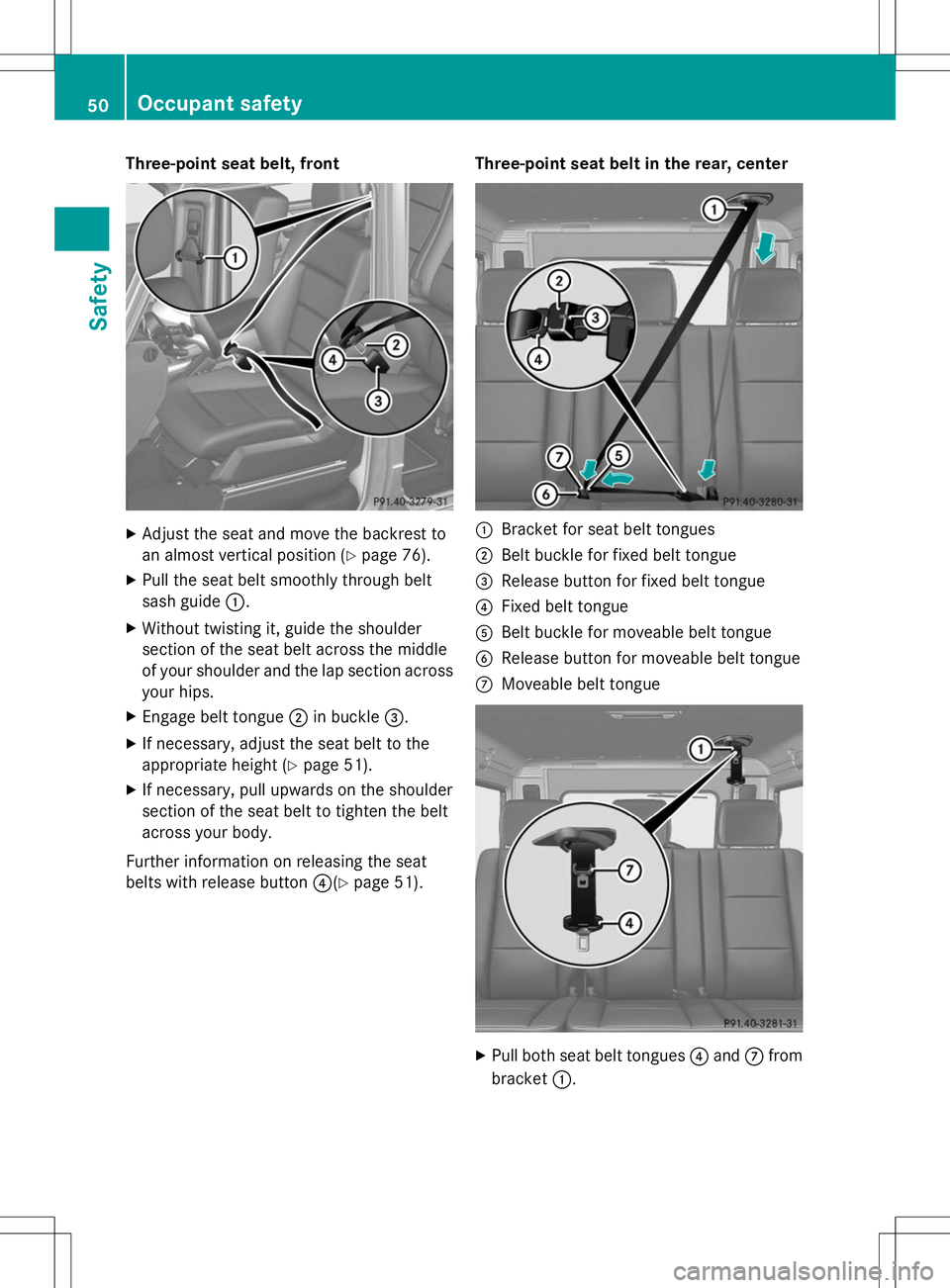
Three-point seat belt, front
X
Adjust the seat and move the backrest to
an almost vertical position (Y page 76).
X Pull the seat belt smoothly through belt
sash guide :.
X Without twisting it, guide the shoulder
section of the seat belt across the middle
of your shoulder and the lap section across
your hips.
X Engage belt tongue ;in buckle =.
X If necessary, adjust the seat belt to the
appropriate height (Y page 51).
X If necessary, pull upwards on the shoulder
section of the seat belt to tighten the belt
across your body.
Further information on releasing the seat
belts with release button ?(Ypage 51). Three-point seat belt in the rear, center :
Bracket for seat belt tongues
; Belt buckle for fixed belt tongue
= Release button for fixed belt tongue
? Fixed belt tongue
A Belt buckle for moveable belt tongue
B Release button for moveable belt tongue
C Moveable belt tongue X
Pull both seat belt tongues ?and Cfrom
bracket :. 50
Occupant safetySafety
Page 53 of 272
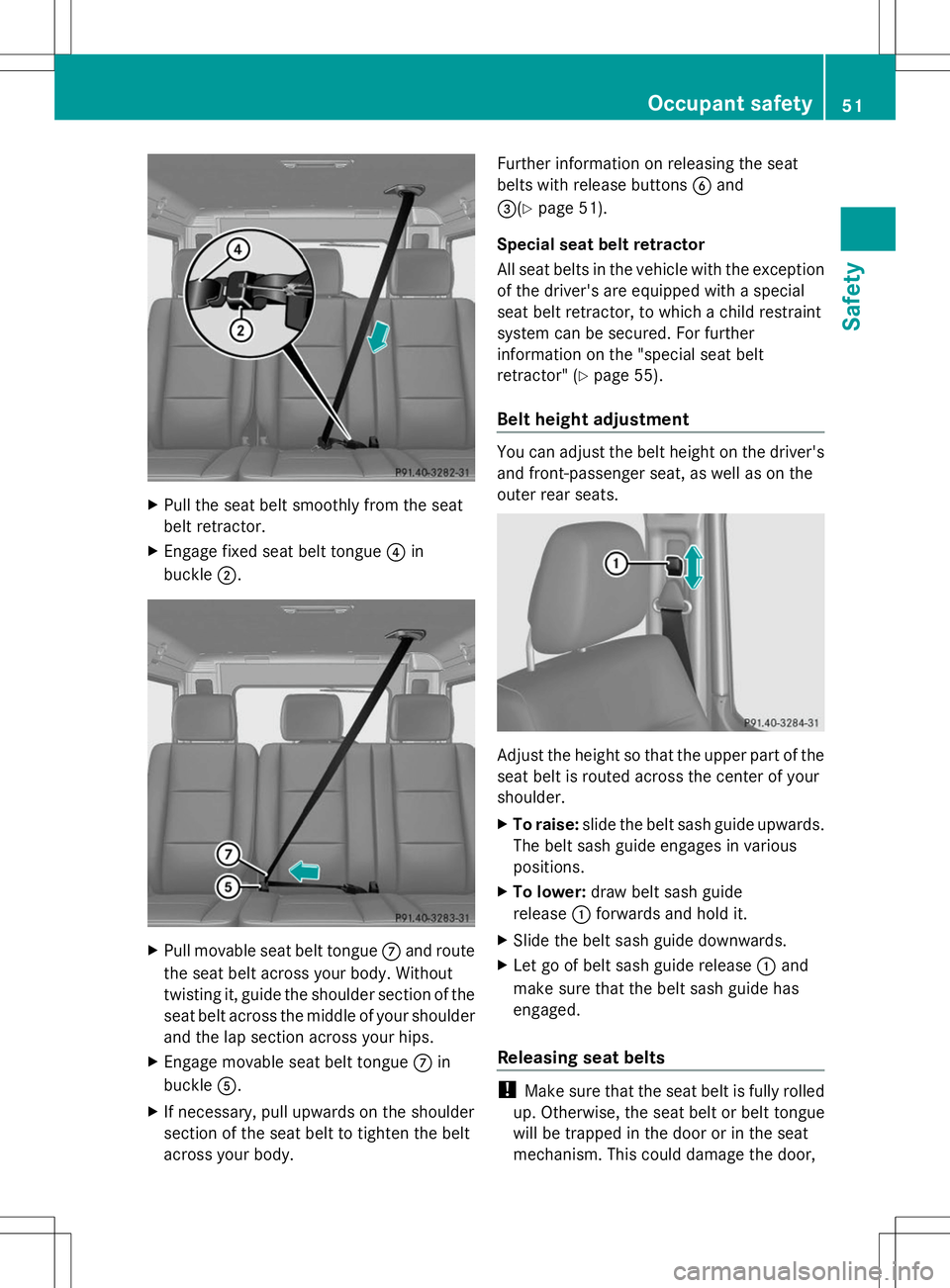
X
Pull the seat belt smoothly from the seat
belt retractor.
X Engage fixed seat belt tongue ?in
buckle ;. X
Pull movable seat belt tongue Cand route
the seat belt across your body. Without
twisting it, guide the shoulder section of the
seat belt across the middle of your shoulder
and the lap section across your hips.
X Engage movable seat belt tongue Cin
buckle A.
X If necessary, pull upwards on the shoulder
section of the seat belt to tighten the belt
across your body. Further information on releasing the seat
belts with release buttons
Band
=(Y page 51).
Special seat belt retractor
All seat belts in the vehicle with the exception
of the driver's are equipped with a special
seat belt retractor, to which a child restraint
system can be secured. For further
information on the "special seat belt
retractor" (Y page 55).
Belt height adjustment You can adjust the belt height on the driver's
and front-passenger seat, as well as on the
outer rear seats.
Adjust the height so that the upper part of the
seat belt is routed across the center of your
shoulder.
X
To raise: slide the belt sash guide upwards.
The belt sash guide engages in various
positions.
X To lower: draw belt sash guide
release :forwards and hold it.
X Slide the belt sash guide downwards.
X Let go of belt sash guide release :and
make sure that the belt sash guide has
engaged.
Releasing seat belts !
Make sure that the seat belt is fully rolled
up. Otherwise, the seat belt or belt tongue
will be trapped in the door or in the seat
mechanism. This could damage the door, Occupant safety
51Safety Z
Page 56 of 272
possible. Regardless of seating position,
children 12 years old and under must be
seated and properly secured in an appropriate
infant restraint, toddler restraint, or booster
seat recommended for the size and weight of
the child.
The infant or child restraint must be properly
secured with the vehicle's seat belt, the seat
belt and top tether strap, or lower anchors and
top tether strap, fully in accordance with the
child seat manufacturer's instructions.
Occupants, especially children, should always
sit as upright as possible, wear the seat belt
properly and use an appropriately sized infant
restraint, toddler restraint, or booster seat
recommended for the size and weight of the
child.
Children can be killed or seriously injured by
an inflating air bag. Note the following
important information when circumstances
require you to place a child in the front
passenger seat:
R Children 12 years old and under must never
ride in the front seat, except in a Mercedes-
Benz authorized BabySmart™ compatible
child seat, which operates with the
BabySmart™ system installed in the vehicle
to deactivate the front passenger front air
bag when it is installed properly. Otherwise
they will be struck by the air bag when it
inflates in a crash. If this happens, serious
or fatal injury will result.
R A child in a rear-facing child restraint on the
front passenger seat will be seriously
injured or even killed if the front passenger
front air bag inflates in a collision which
could occur under some circumstances,
even with the air bag technology installed
in your vehicle. The only means to
completely eliminate this risk is to never
place a child in a rear-facing child restraint
in the front seat. We therefore strongly
recommend that you always place a child
in a rear-facing child restraint in a backseat.
R If you must install a rear-facing child
restraint on the front passenger seat because circumstances require you to do
so, make sure the
4/indicator
lamp is illuminated, indicating that the front
passenger front air bag is deactivated.
Should the 4/indicator lamp not
illuminate or go out while the restraint is
installed, please check installation.
Periodically check the 4/indicator
lamp while driving to make sure the
4/indicator lamp is illuminated. If
the 4/indicator lamp goes out or
remains out, do not transport a child on the
front passenger seat until the system has
been repaired.
A child in a rear-facing child restraint on the
front passenger seat will be seriously
injured or even killed if the front passenger
front air bag inflates.
R If you have to place a child in a forward-
facing child restraint on the front passenger
seat, move the seat as far back as possible,
use the proper child restraint
recommended for the age, size and weight
of the child, and secure child restraint with
the vehicle's seat belt according to the
child seat manufacturer's instructions. G
WARNING
Infants and small children should never share
a seat belt with another occupant. In the event
of an accident, they could be crushed
between the occupant and seat belt.
A child's risk of serious or fatal injuries is
significantly increased if the child restraints
are not properly secured in the vehicle and/
or the child is not properly secured in the child
restraint.
Children that are too large for a child restraint
must travel in seats using normal seat belts.
Position the shoulder belt across the chest
and shoulder, not the face or neck. A booster
seat may be necessary to achieve proper seat
belt positioning for children over 41 lbs
(18 kg) until they reach a height where a lap/
shoulder belt fits properly without a booster
seat. 54
Children in the vehicleSafety
Page 58 of 272
G
WARNING
Never release the seat belt buckle while the
vehicle is in motion, since the special seat belt
retractor will be deactivated.
All seat belts except the driver's seat belt are
equipped with a special seat belt retractor.
When activated, the special seat belt
retractor ensures that the seat belt will not
slacken once the child restraint system has
been secured.
Installing a child restraint system:
X Always comply with the manufacturer's
installation instructions.
X Pull the seat belt smoothly from the seat
belt retractor.
X Engage the seat belt tongue in the belt
buckle.
Activating the special seat belt retractor:
X Pull the seat belt out fully and let the seat
belt retractor retract it again.
While the seat belt is retracting, you should
hear a ratcheting sound. The special seat
belt retractor is activated.
X Push down on the child restraint system to
take up any slack.
Removing a child restraint system/
deactivating the special seat belt retractor:
X Always comply with the manufacturer's
installation instructions.
X Press the release button on the seat belt
buckle.
X Guide the seat belt tongue into the belt
outlet.
The special seat belt retractor is
deactivated.
LATCH-type (ISOFIX) child seat anchors
in the rear G
WARNING
Observe "Important safety notes"
(Y page 53). G
WARNING
Children that are too large for a child restraint
must travel in seats using normal seat belts.
Position shoulder belt across the chest and
shoulder, not face or neck.
A booster seat may be necessary to achieve
proper seat belt positioning for children over
41 lb (18 kg) until they reach a height where
a lap/shoulder belt fits properly without a
booster.
Install the child restraint system in
accordance with the manufacturer's
instructions.
Attach the child restraint system to both
securing rings.
An incorrectly installed child restraint system
could come loose during an accident and
seriously or even fatally injure the child.
Child restraint systems or child seat securing
rings that are malfunctioning or damaged as
the result of a collision must be replaced.
! When installing the child restraint system,
make sure that the seat belt for the middle
seat does not get trapped. The seat belt
could otherwise be damaged.
LATCH-type (ISOFIX) is a standardized
securing system for specially designed child
restraint systems on the rear seats. Securing
rings for two LATCH-type (ISOFIX) child
restraint systems are installed on the left and
right of the rear seats.
Before every trip, make sure that the LATCH-
type (ISOFIX) child restraint system is
engaged correctly in both securing rings
Secure non-LATCH-type (ISOFIX) child
restraint systems using the vehicle's seat belt
system. Install the child seat according to the
manufacturer's instructions. 56
Children in the vehicleSafety
Page 79 of 272
accelerator/brake pedal safely. The
position should be as far back as possible
with the driver still able to operate the
controls properly.
R adjust the head restraint so that it is as
close to the head as possible and the center
of the head restraint supports the back of
the head at eye level.
R never place hands under the seat or near
any moving parts while a seat is being
adjusted.
Failure to do so could result in an accident
and/or serious personal injury. G
WARNING
According to accident statistics, children are
safer when properly restrained on the rear
seats than on the front-passenger seat. Thus,
we strongly recommend that children be
placed in the rear seat whenever possible.
Regardless of seating position, children 12
years old and under must be seated and
properly secured in an appropriately sized
child restraint system or booster seat
recommended for the size and weight of the
child. For additional information, see the
"Children in the vehicle" section.
A child's risk of serious or fatal injuries is
significantly increased if the child restraints
are not properly secured in the vehicle and/
or the child is not properly secured in the child
restraint. G
WARNING
For your protection, drive only with properly
positioned head restraints.
Adjust the head restraint so that it is as close
to the head as possible and the center of the
head restraint supports the back of the head
at eye level. This will reduce the potential for
injury to the head and neck in the event of an
accident or similar situation.
Do not drive the vehicle without the seat head
restraints. Head restraints are intended to
help reduce injuries during an accident. !
To avoid damage to the seats and the seat
heating, observe the following information:
R keep liquids from spilling on the seats. If
liquid is spilled on the seats, dry them as
soon as possible.
R if the seat covers are damp or wet, do not
switch on the seat heating. The seat
heating should also not be used to dry
the seats.
R clean the seat covers as recommended;
see the "Interior care" section.
R do not transport heavy loads on the
seats. Do not place sharp objects on the
seat cushions, e.g. knives, nails or tools.
The seats should only be occupied by
passengers, if possible.
R when the seat heating is in operation, do
not cover the seats with insulating
materials, e.g. blankets, coats, bags,
seat covers, child seats or booster seats.
! Make sure that there are no objects in the
footwell or behind the seats when resetting
the seats. There is a risk that the seats
and/or the objects could be damaged.
! When the rear bench seat is folded
forwards, the front seats cannot be moved
to their rearmost position. You could
otherwise damage the seats and the rear
bench seat.
! Make sure that the sun visor is folded up
before adjusting the backrest and head
restraint height. The head restraint and sun
visor could otherwise collide when the head
restraint is fully extended.
i If the front door is open, the seats can be
adjusted for up to 30 minutes after the
ignition has been switched off.
i The rear-compartment head restraints
can be removed (Y page 78).
For more information, contact a qualified
specialist workshop.
i You can find further information about
enlarging the cargo compartment (folding Seats
77Seats, steering wheel and mirrors Z
Page 139 of 272
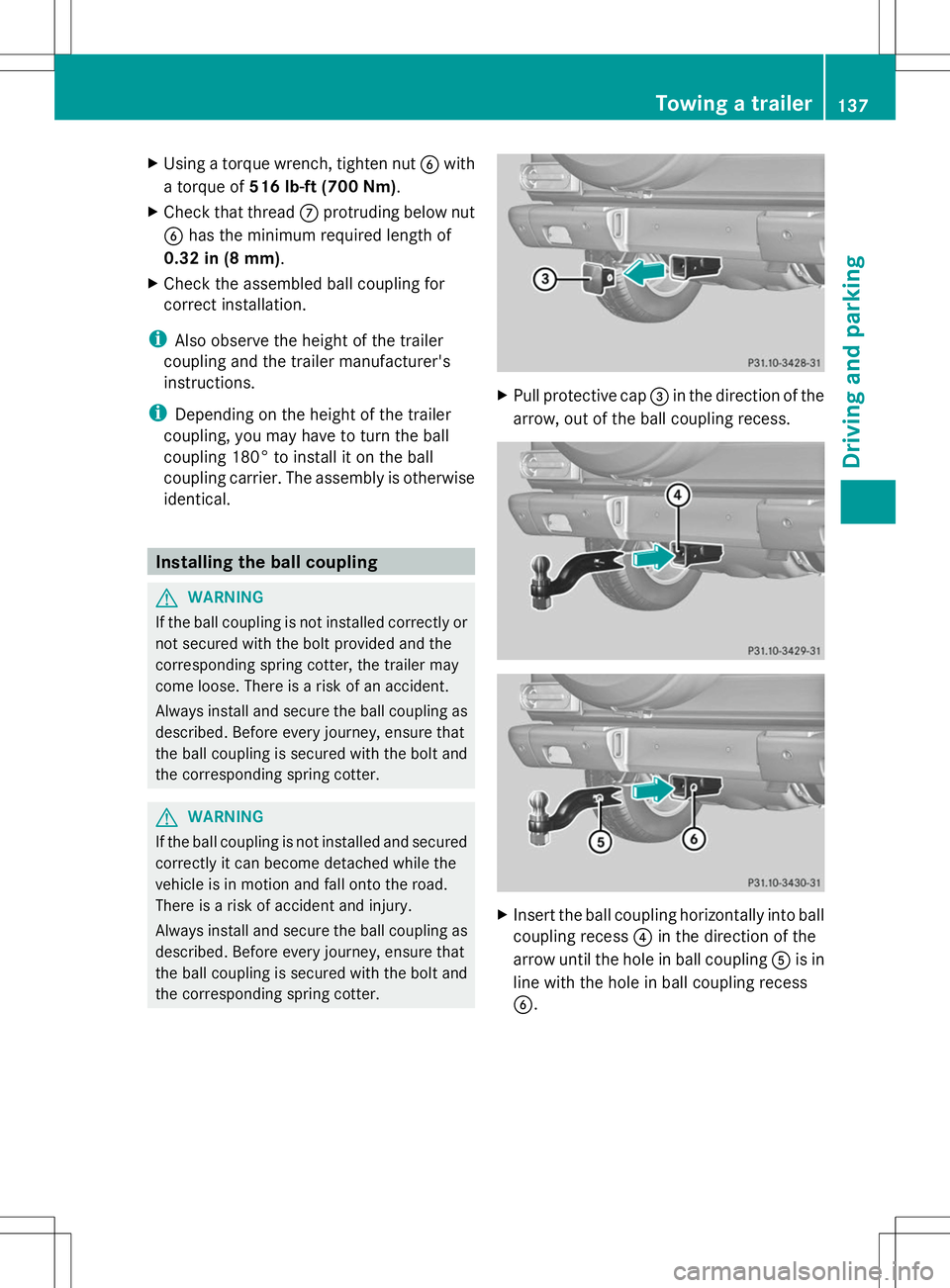
X
Using a torque wrench, tighten nut Bwith
a torque of 516 lb-ft (700 Nm).
X Check that thread Cprotruding below nut
B has the minimum required length of
0.32 in (8 mm).
X Check the assembled ball coupling for
correct installation.
i Also observe the height of the trailer
coupling and the trailer manufacturer's
instructions.
i Depending on the height of the trailer
coupling, you may have to turn the ball
coupling 180° to install it on the ball
coupling carrier. The assembly is otherwise
identical. Installing the ball coupling
G
WARNING
If the ball coupling is not installed correctly or
not secured with the bolt provided and the
corresponding spring cotter, the trailer may
come loose. There is a risk of an accident.
Always install and secure the ball coupling as
described. Before every journey, ensure that
the ball coupling is secured with the bolt and
the corresponding spring cotter. G
WARNING
If the ball coupling is not installed and secured
correctly it can become detached while the
vehicle is in motion and fall onto the road.
There is a risk of accident and injury.
Always install and secure the ball coupling as
described. Before every journey, ensure that
the ball coupling is secured with the bolt and
the corresponding spring cotter. X
Pull protective cap =in the direction of the
arrow, out of the ball coupling recess. X
Insert the ball coupling horizontally into ball
coupling recess ?in the direction of the
arrow until the hole in ball coupling Ais in
line with the hole in ball coupling recess
B. Towing a trailer
137Driving and parking Z
Page 203 of 272
Opening the hood
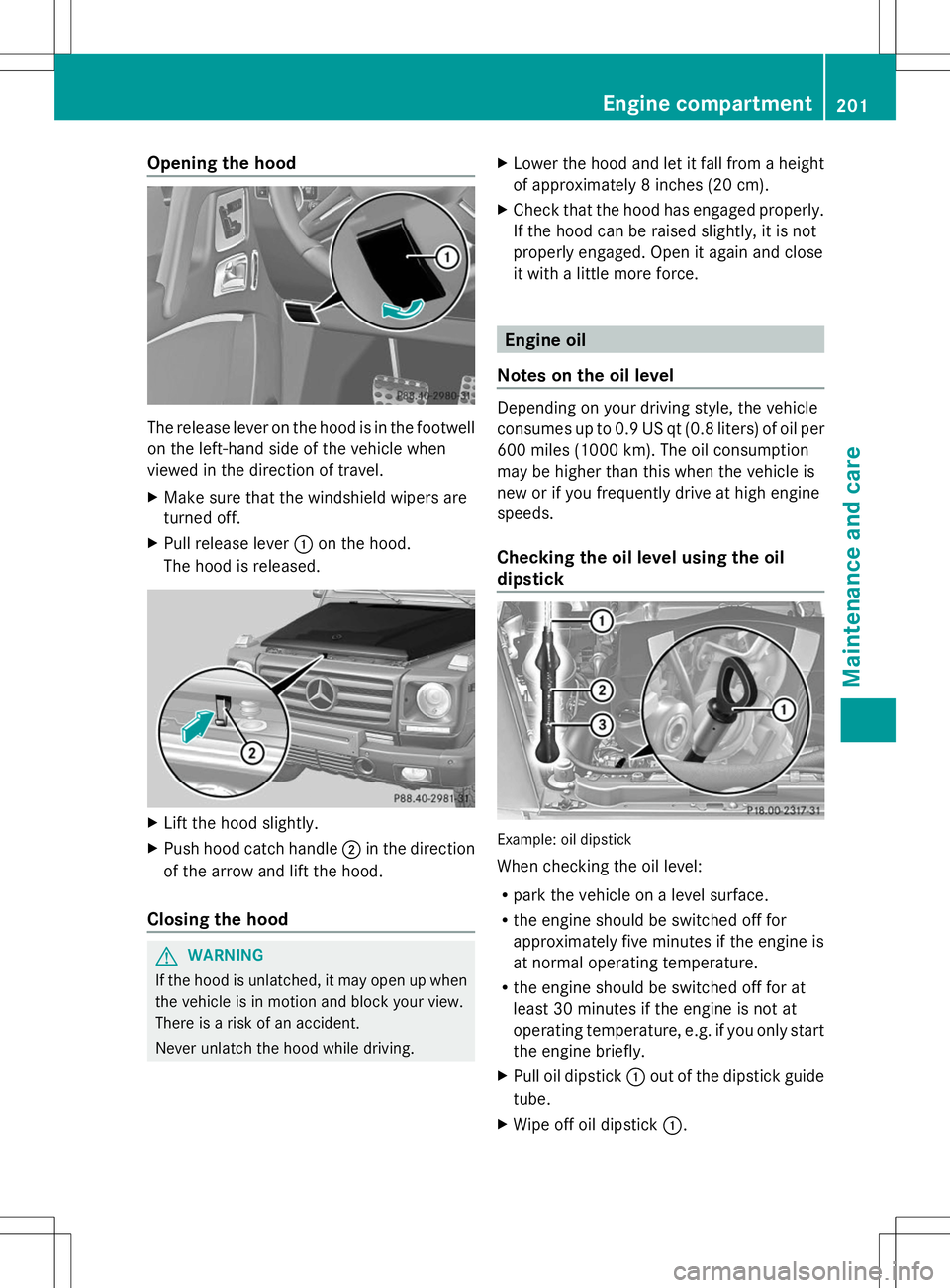
The release lever on the hood is in the footwell
on the left-hand side of the vehicle when
viewed in the direction of travel.
X Make sure that the windshield wipers are
turned off.
X Pull release lever :on the hood.
The hood is released. X
Lift the hood slightly.
X Push hood catch handle ;in the direction
of the arrow and lift the hood.
Closing the hood G
WARNING
If the hood is unlatched, it may open up when
the vehicle is in motion and block your view.
There is a risk of an accident.
Never unlatch the hood while driving. X
Lower the hood and let it fall from a height
of approximately 8 inches (20 cm).
X Check that the hood has engaged properly.
If the hood can be raised slightly, it is not
properly engaged. Open it again and close
it with a little more force. Engine oil
Notes on the oil level Depending on your driving style, the vehicle
consumes up to 0.9 US qt (0.8 liters) of oil per
600 miles (1000 km). The oil consumption
may be higher than this when the vehicle is
new or if you frequently drive at high engine
speeds.
Checking the oil level using the oil
dipstick
Example: oil dipstick
When checking the oil level:
R
park the vehicle on a level surface.
R the engine should be switched off for
approximately five minutes if the engine is
at normal operating temperature.
R the engine should be switched off for at
least 30 minutes if the engine is not at
operating temperature, e.g. if you only start
the engine briefly.
X Pull oil dipstick :out of the dipstick guide
tube.
X Wipe off oil dipstick :. Engine compartment
201Maintenance and care Z
Page 245 of 272
to degenerate and reduce tire life, and
excessive temperature can lead to sudden
tire failure. The grade C corresponds to a level
of performance which all passenger car tires
must meet under the Federal Motor Vehicle
Safety Standard No. 109. Grades B and A
represent higher levels of performance on the
laboratory test wheel than the minimum
required by law. Tire labeling
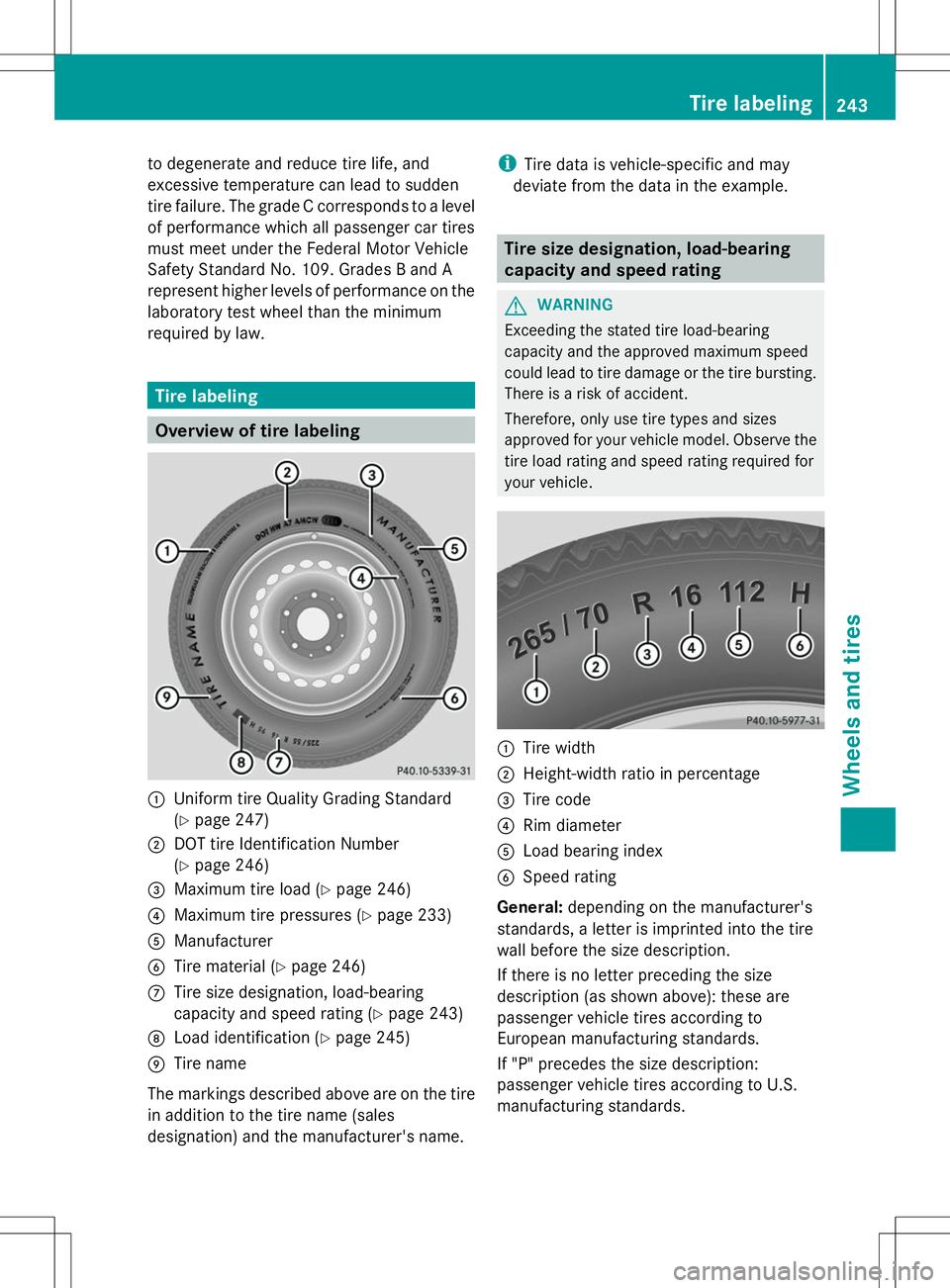
Overview of tire labeling
:
Uniform tire Quality Grading Standard
(Y page 247)
; DOT tire Identification Number
(Ypage 246)
= Maximum tire load (Y page 246)
? Maximum tire pressures (Y page 233)
A Manufacturer
B Tire material (Y page 246)
C Tire size designation, load-bearing
capacity and speed rating (Y page 243)
D Load identification (Y page 245)
E Tire name
The markings described above are on the tire
in addition to the tire name (sales
designation) and the manufacturer's name. i
Tire data is vehicle-specific and may
deviate from the data in the example. Tire size designation, load-bearing
capacity and speed rating
G
WARNING
Exceeding the stated tire load-bearing
capacity and the approved maximum speed
could lead to tire damage or the tire bursting.
There is a risk of accident.
Therefore, only use tire types and sizes
approved for your vehicle model. Observe the
tire load rating and speed rating required for
your vehicle. :
Tire width
; Height-width ratio in percentage
= Tire code
? Rim diameter
A Load bearing index
B Speed rating
General: depending on the manufacturer's
standards, a letter is imprinted into the tire
wall before the size description.
If there is no letter preceding the size
description (as shown above): these are
passenger vehicle tires according to
European manufacturing standards.
If "P" precedes the size description:
passenger vehicle tires according to U.S.
manufacturing standards. Tire labeling
243Wheels and tires Z