service MERCEDES-BENZ G-CLASS SUV 2016 User Guide
[x] Cancel search | Manufacturer: MERCEDES-BENZ, Model Year: 2016, Model line: G-CLASS SUV, Model: MERCEDES-BENZ G-CLASS SUV 2016Pages: 261, PDF Size: 6.01 MB
Page 23 of 261
Environmental protection
General notes
H
Environmenta
lnote
Daimler' sdeclared polic yisone of compre-
hensive environmental protection.
Our objectives are to use th enatural resour-
ces whic hformt hebasis of our existence on
this plane tsparingl yand in amanner which
takes th erequirements of bot hnature and
humanity int oconsideration.
You to ocan help to protect th eenvironment
by operatin gyour vehicle in an environmen-
tally-responsible manner.
Fuel consumption and th erateofe ngine,
transmission ,brak eand tyr ewear depen don
th ef ollowing factors:
R operatin gcondition sofyour vehicle
R your personal driving style
You can influenc ebothf actors. Therefore,
please bear th efollowing in mind:
Operatin gconditions:
R avoid shor ttrips, as these increase fuel
consumption.
R observe th ecorrec ttyrep ressure.
R do not carry any unnecessar yweight in the
vehicle.
R remove th eroof rac koncey ou no longer
nee dit.
R ar egularly serviced vehicle will contribute
to environmental protection .You should
therefore adher etotheservic eintervals.
R all maintenanc ework should be carried out
at aq ualifie dspecialist workshop.
Personal driving style:
R do not depress th eaccelerator pedal when
starting th eengine.
R do not warm up th eengine when th evehicle
is stationary.
R driv ecarefully and maintain asafe distance
fro mt hevehicle in front.
R avoid frequent, sudden acceleration and
braking. R
change gear in good time an duseeach gear
only up to Ôof its maximum engine speed.
R switch off the engine in stationar ytraffic.
R monitor the vehicle's fue lconsumption. Returnin
ganend-of-life vehicle
EU countrie sonly:
Mercedes-Benz will take back your end-of-life
vehicl efor environmentally friendl ydisposa lin
accordance with the Europea nUnion(EU) End-
Of-Life Vehicles Directive.
An etwork of return points and disassembly
plants ha sbeene stablished for yo utoreturn
your vehicle. Yo ucan leave it at any of these
points free of charge .Thism akesani mportant
contribution to closing the recycling circl eand
conserving resources.
For further information abou tthe recycling and
disposa lofend-of-life vehicles, and the take-
back conditions ,pleas evisit the national
Mercedes-Benz website for your country. Genuine Mercedes-Benz parts
H
Environmental note
Daimle rAGalso supplies reconditioned
assemblies and part swhicha re of th esame
qualit yasnew parts. For these, th esame war-
ranty applies as for new parts.
! Airbags and seat belt tensioners
,aswell as
control unit sand sensor sfor these restraint
systems, may be installe dinthefollowing
areas of your vehicle:
R doors
R door pillars
R door sills
R seats
R dashboard
R instrumen tcluster
R centr econsole
Do not install accessories such as audio sys-
tem sint hese areas. Do not carry out repairs
or welding. You could impair th eoperating
efficiency of th erestraint systems. 20
Introduction
Page 24 of 261
Have accessories retrofitted at
aqualified
specialist workshop.
You coul djeopardise the operating safety of
your vehicle if yo uuse parts, tyre sand wheels as
wel lasa ccessories relevant to safety that have
not bee napprove dbyM ercedes-Benz. This
coul dleadtom alfunctions in safety-relevant
systems, e.g. the brake system. Use only genu-
ine Mercedes-Benz parts or parts of equal qual- ity .U se only tyres, wheels and accessories that
hav ebeens pecifically approve dfor your vehi-
cle.
Mercedes-Benz tests genuine parts and conver-
sio np arts and accessories that hav ebeens pe-
cifically approve dfor your vehicle for thei rreli-
ability ,safety and suitability. Despite ongoing
marke tresearch, Mercedes-Benz is unable to
assess other parts. Mercedes-Benz therefore
accepts no responsibility for the use of such
parts in Mercedes-Benz vehicles ,even if they
hav ebeeno fficiall yapprove dori ndependently
approve dbyatesting centre.
In Germany ,certai nparts are officiall yapproved
for installatio normodification only if they com-
ply with legal requirements. Thi salsoa pplies to
some other countries. All genuine Mercedes-
Benz parts meet the approva lrequirements. The
use of non-approved parts may invalidate the
vehicle' sgeneral operating permit.
Thi sist he case:
R if they cause achang eofthe vehicle type from
that for which the vehicle' sgeneral operating
permit wa sgranted
R if other roa dusers coul dbeendangered
R if the emission or noise levels are adversely
affected
Always specify the vehicle identification number (VIN )(Ypage 249 )wheno rdering genuine
Mercedes-Benz parts. Owner'
sManual Vehicle equipment
i Th
isOwner' sManuald escribe sallmodels,
standard and optional equipment for your
vehicl etha tw erea vailable at the time of going
to press. Country-specifi cdifference sare
possible. Note tha tyou rv ehicl emaynot be
fitte dwitha llfeature sdescribed. Thi sisalso
the cas efor system sand functions relevant to
safety .Therefore, the equipment on your vehic
lemay differ from that in the descrip-
tions and illustrations.
The original purchase contract documentation
for yourv ehiclecontains alist of all of the sys-
tems in yourv ehicle.
Shoul dyou have any questions concerning
equipment and operation, please consult a
Mercedes-Benz Service Centre.
The Owner's Manua land Service Booklet are
important documents and should be kept in the vehicle. Operating safety
Im
portant safety notes G
WARNING
If yo udon ot have the prescribed service/
maintenance work or necessary repairs car-
ried out, this coul dresult in malfunctions or
system failures .There is arisk of an accident.
Always have the prescribed service/mainte-
nance work as wellasn ecessary repairs car-
ried out at aqualified specialist workshop. G
WARNING
Flammable materia lsuch as leaves, grass or
twigs may ignite if they come into contact with hot parts of the exhaust system. There is arisk
of fire.
When driving off road or on unpaved roads,
check the vehicle's underside regularly. In
particular, remove parts of plants or other
flammable materials which have become
trapped. In the case of damage, contact a
qualified specialist workshop. G
WARNING
Modifications to electronic components, their software as wellasw iring couldaffect their
function and/or the operation of other net-
worked components. This coul dinparticular
alsobet he case for systems relevant to
safety .They might not function properly any-
more and/or jeopardise the operational
safety of the vehicle. There is an increased
risk of an accident and injury. Introduction
21 Z
Page 25 of 261
Do not attempt to modify the wirin
gaswellas
electronic components or their software.
Alway shavew orkone lectrical and electronic
components carrie doutataq uali fied special-
is tw orkshop.
If yo umakea ny change stothe vehicl eelec-
tronics, the genera lope rating permi tisr en-
dered invalid.
! There is
ariskofd amagetothe vehicl eif:
R the vehicl ebecome sstuck, e.g .onahigh
kerb or an unpaved road
R youd rive too quickl yoverano bstacle ,e.g.
ak erb ,slowin gthreshold sorapothol ein
the road
R ah eavy object strikes the underbod yor
parts of the chassis
In situations like this, the body ,underbody,
chassi sparts, wheels or tyres could be dam-
aged withou tthe damage being visible .Com-
ponents damage dinthisw aycan unexpect-
edly fail or, in the cas eofanaccident, no lon-
ge rw ithstand the strain the yaredesigne dto
withstand.
If the underbod ypanelling is damaged, com-
bustibl ematerial ssuchasl eaves, grass or
twigs can gathe rbetween the underbod yand
the underbod ypanelling. If these materials
come into contact with hot parts of the
exhaust system ,the yc an catc hfire.
In such situations, have the vehicl echecked
and repaired immediatel yataqualified spe-
cialist workshop .If, on continuing your jour-
ney ,you notice tha tdrivin gsafety is impaired,
stop the vehicl eimmediately, paying atten-
tio ntor oada nd traffi cconditions. In such
cases, consul taqualified specialis twork-
shop. Declarations of conformity
Wireless vehicle components Th
ef ollowing information applies to all compo-
nentsoft he vehicle and the information sys-
tems and communication devices integrated in
the vehicle that receive and/or transmit radio
waves.
The components of this vehicle that receive
and/or transmit radio waves are compliant with
the basic requirement sand all other relevant condition
sofDirective 1999/5/EC .You can
obtain further information from any Mercedes-
Benz Service Centre.
Electromagneti ccom patibility The electromagnetic compatibilit
yofthe vehicle
components has been checked and certified
according to the currently valid version of Reg-
ulation ECE-R1 0.
Jack Copy and translation of the original declaration
of conformity:
EC declaration of conformity
2006/42/EC
We
WEBER-HYDRAULIK GMBH
Heilbronner Straße 30 —74363 Güglingen
declare that th eproduct "Weber hydraulic bottle
jack", types:
AADA DXAH AH XALATA TDATDX AT GATN
ATGX ATPX AT QAX
Capacity: 2,000 to 100,000 kg
Serial no.: from year of manufactur e01/2010
complie switht he relevan tessential healt hand
safety requirements of th eECDirective on
Machinery.
This EC declaration of conformity become sinva-
lid:
R in th eevent of modifications or repairs per-
formed by an unqualifie dperson
R if th eproduct sare used in suc haway that
does no tcom ply wit hintended applications
listed in th eoperatin ginstructions
R ther equired regular check sare no tper-
formed
Relevant EU Directives :ECDirective on Machi-
nery 2006/42/EC
Applicable standards :ISO 11530
Qualit yassurance: DI NENISO9001:2000
Güglingen ,01.07.2013 [signature] [signature]
Manager Representative of
Technical WEBER-HY
DRAULIK
GmbH Documentation
WEBER-HYDRAULIK GMBH22
Introduction
Page 26 of 261
Heilbronne
rStraße 30 —74363 Güglingen Diagnos
tics connection
The diagnostic sconnectio nisused fo rconnect-
in gd iagnostic equipmen tataqualified special-
ist workshop. G
WARNING
If yo uconnect equipment to adiagnostics
connection in the vehicle, it may affect the
operation of vehicl esystems .Asaresult, the
operating safety of the vehicl ecouldbea ffec-
ted. There is arisk of an accident.
Only connect equipment to adiagnostics con-
nection in the vehicle, which is approved for
yourv ehiclebyM ercedes-Benz. G
WARNING
Objects in the driver's footwel lcan impede
peda ltravel or block apeda lwhich is
depressed. This jeopardise ssafe operation of
the vehicle. There is arisk of an accident.
Stow all objects in the vehicl esafely, so that
they cannot reach the driver's footwell. Make sure the floormats and carpets are properly
secure dsothat they cannot slip and obstruct
the pedals. Do not lay severa lfloormats or
carpets on top of one another.
! If the engine is switched off and equipment
on the diagnostics connection is used ,the
starter battery may discharge.
Connecting equipment to the diagnostics con-
nection can leadtoe missions monitoring infor-
mation being reset, for example. This may lead
to the vehicl efailing to meet the requirements of
the next emissions test during the main inspec-
tion. Qualifieds
pecialist workshop
Aq ualified specialist workshop has the neces-
sary special skills, tools and qualifications to
correctly carry out any necessary work on your
vehicle. This particularly applies to work rele-
vant to safety. Alwaysh
avet he following work carrie doutat a
qualified specialist workshop:
R work relevant to safety
R service and maintenance work
R repai rwork
R modifications, installations and conversions
R work on electronic components
Mercedes-Benz recommends tha tyou usea
Mercedes-Benz Service Centre. Vehicl
eregistration
Mercedes-Benz ma yask its Service Centres to
carry ou ttechnical inspections on certain vehi-
cles. The quality or safety of the vehicl eis
improve dasaresultoft he inspection.
Mercedes-Benz can inform yo uabout vehicle
inspections onl yifithasyour registration data.
It is possibl ethaty ou rv ehicl ehasnot ye tbeen
registere dinyourn am eint he following cases:
R if your vehicl ewasnot purchased at an
authorised specialist dealer.
R if your vehicl ehasnot ye tbeeninspected at a
Mercedes-Benz Service Centre.
It is advisable to register your vehicl ewitha
Mercedes-Benz Service Centre.
Infor mMercedes-Benz as soo naspossible
abou tany change in address or vehicl eowner-
ship. Yo ucan do thi sataMercedes-Benz Ser-
vice Centre, for example. Correc
tuse
If you remove any warning stickers ,you or oth-
ers coul dfail to recognise certain dangers.
Leav ewarning stickers in position.
Observ ethe followin ginformatio nwhen driving
your vehicle:
R thes afety note sinthism anual
R technical dat afor th evehicle
R traffic rules and regulations
R laws and safety standards pertaining to motor
vehicles Implied warranty
! Follow th
einstruction sinthism anual about
th ep roper operation of your vehicl easwell as Introduction
23 Z
Page 27 of 261
about possible vehicle damage
.Damage to
your vehicle that arise sfromc ulpable contra-
ventions against these instruction sare not
covered either by Mercedes-Ben zimplied
warrant yorbyt heNew or Used-Vehicle War-
ranty. QR code for rescu
ecards
The QR code is secured in the fuel filler flap and
on the opposite side on the B-pillar. In the event of an accident ,rescue services can use the QR
code to quickly find the appropriate rescue card
for your vehicle. The curren trescue card con-
tains, in acompact form, the most important
information about your vehicle, e.g. the routing
of the electric cables.
You can find more information under
www.mercedes-benz.de/qr-code. Data stored in the vehicle
Many of the ele ctroniccom ponent sinyour vehi-
cl ec an stor edata.
These dat amemories temporarily or perma-
nently stor etechnic al information about:
R thev ehicle' soperatin gstate
R events
R faults
In general, this technical information docu-
ments th estate ofac om ponent ,amodule, a
syste mort hesurroundings.
These include, fo rexample:
R operatin gconditi onsofs ystemcomponent s–
fo re xample, flui dlevels
R status messages concernin gthe vehicle and
it si nd ividual component s–forexample,
whee lrotationa lspeed, vehicle speed, decel-
eration in movement, latera lacceleration,
accelerator peda lposition
R malfunction sand defects in important system
components, fo rexample, lights ,brakes
R vehicle reaction sand operatin gconditi onsin
special drivin gsituation s–forexample, air-
bag deployment, intervention of stability con-
trol systems
R ambien tconditi ons–f orexample, outside
temperature These dat
aare of an exclusively technical nature
and can be used to:
R assist in detecting and rectifying faults and
defects
R analyse vehicle functions, e.g. after an acci-
dent
R optimise vehicle functions
The data cannot be used to trace the vehicle's
movements.
When your vehicle is serviced, technical infor-
mation can be read from the event data memory
and fault data memory.
Services include, for example:
R repair services
R service processes
R warranty events
R quality assurance
The information is read out by employees of the service network (including the manufacturer)
using special diagnostic testers. You can obtain more information there, if required.
After afault has been rectified, the information
is deleted from the fault memory or is continu-
ally overwritten.
During vehicle operation, certain situations may
arise in which these technical data –inconjunc-
tion with other information and, if applicable,
after consultation with an approved assessor –
may be linked to an individual person.
Examples include:
R accident reports
R damage to the vehicle
R witness statements
Further additional functions that have been con-
tractually agreed upon with the customer allow
certain vehicle data to be conveyed by the vehi-
cle as well. The additional functions include, for example, vehicle location in the event of an
emergency. Copyright info
rmation
Information on licences for free and open-
source softwar eused in your vehicle can be
foun dont hedat acarrier in your vehicle docu-
men twallet and ,includin gupdates, on th efol-
lowin gwebsite:
http://www.mercedes-benz.com/opensource 24
Introduction
Page 34 of 261
Occupant safety
Introduction to the restraint system
The restraint system can reduce the risk of vehi- cle occupant scom ingi ntoc ontac twithp artsof
th ev ehicle's interio rintheevent of an accident.
The restrain tsystem can also reduce th eforces
to whic hvehicl eoccupant sare subjecte dduring
an accident.
The restrain tsystem includes the:
R seat belt system
R airbags
R child restrain tsystem
R child seat securin gsystem
The component softherestrain tsystem wor kin
conjunction wit heacho ther.T hey can only offer
protection if all vehicl eoccupant salways:
R have th eseat belt correctl yfastened
(Y page 33)
R have th eseat and head restrain tadjusted
properly (Y page 67)
As th edriver, you must also mak esuret hatthe
steering whee lisalso adjusted properly.
Observ ethe information on th ecorrect driver's
seat position (Y page 67).
In addition ,you must mak esuret ha tthe airbags
can inflat eproperly if they are deployed
(Y page 36).
An airbag supplement sacorrectly wornseat
belt .Asana dditional safet ydevice ,the airbag
increases th elevel of protection for vehicle
occupant sintheevent of an accident. The air-
bags are no tdeployed, for example, in th eevent
of an acciden tinwhichs ufficien tprotection is
offere dbytheseat belt .Inaddition ,onlyt ho se
airbags, whic hintheapplicable acciden tsitua-
tion soffer additional protection ,are deployed in
th ee vent of an accident. However, th eseat belt
and airbag generally do no tprotect against
objects penetrating th evehicl efromt heout-
side.
Information on how th erestrain tsystem oper-
ate scan be foun dunder "Deploymen tofbelt
tensioners and airbags" (Y page 37).
Se e" Children in th evehicle" for information on
children travellin gwithy ou in th evehicl easw ell
as on child restrain tsystems (Y page 38). Important safety notes
G
WARNING
If th erestraint system is modified, it may no
longer work as intended. The restraint system
may then not perform its intended protective function by failing in an accident or triggering
unexpectedly,f or example. There is an
increased risk of injury ,possibly even fatal.
Never modify parts of the restraint system. Do not attempt to modify the wiring as wellas
electronic components or their software.
If it is necessary to adjust the vehicl etoaccom-
modate aperso nwith disabilities, contact a
qualified specialist workshop. Mercedes-Benz
recommends that you use aMercedes-Benz
Service Centre for this. Restraint system warnin
glamp
The functions of the restraint system are
checke dafterthe ignition is switched on and at
regular interval swhile the engine is running.
Therefore, malfunctions can be detected in
goo dtime.
The 6 restraint system warning lamp on the
instrument cluster lights up when the ignition is switched on. It goe soutno later than afew sec-
onds afte rthe vehicl eisstarted. The compo-
nents of the restraint system are in operational
readiness.
Am alfunction ha soccurred if the 6restraint
system warning lamp:
R doe snot light up afte rthe ignition is switched
on
R doe snot go ou tafte raf ew seconds with the
engine running
R lights up agai nwhile the engine is running G
WARNING
If the restra ints ystem is malfunctioning,
restraint system components may be trig-
gered unintentionally or may not deploy as
intended during an accident. This may affect
the seat beltt ensioner or airbag, for example.
This poses an increased risk of injury or even
fatal injury. Occupant safety
31Safety
Z
Page 52 of 261
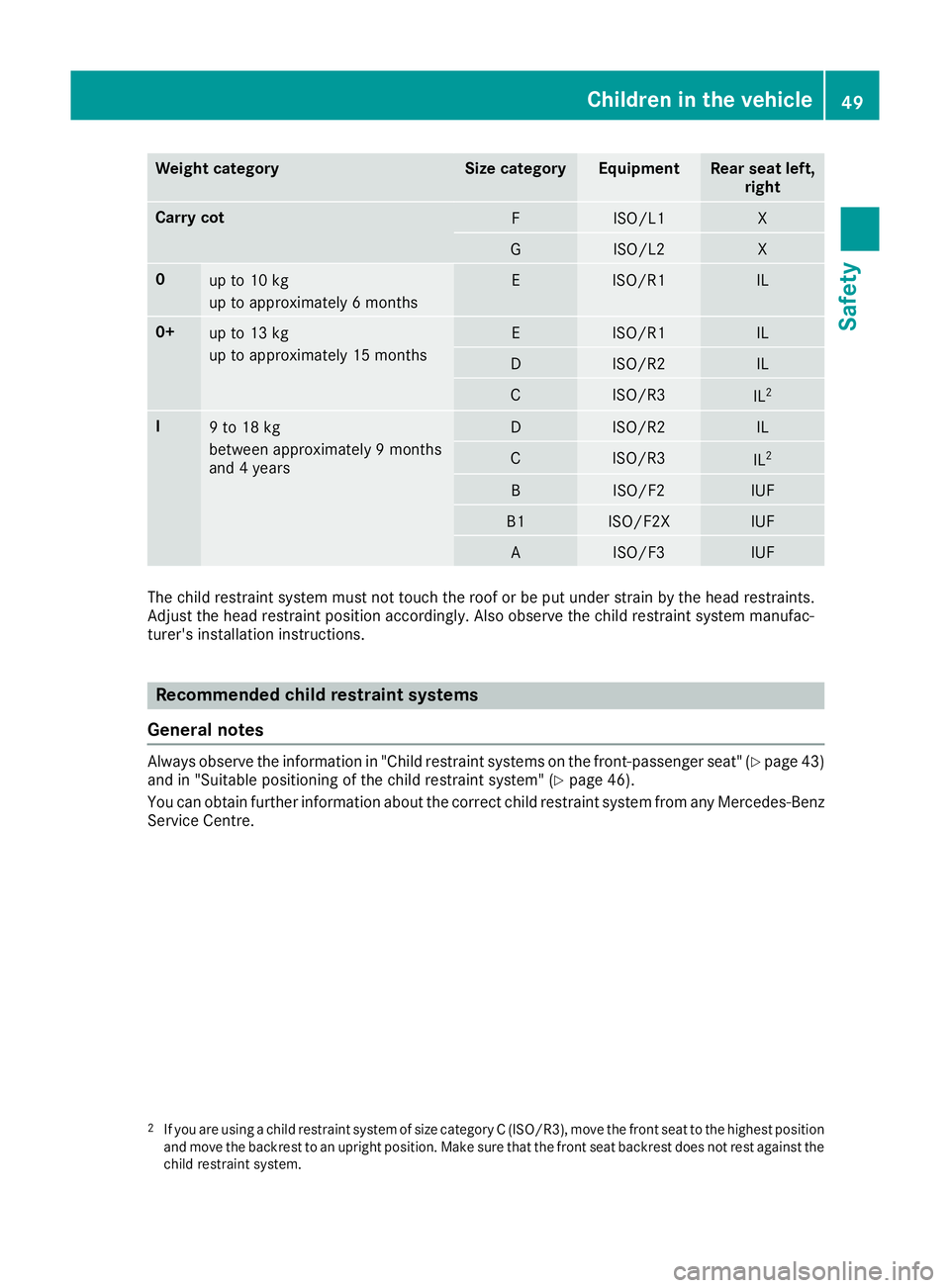
Weight category Size category Equip
ment Rear seat left,
right Carry cot
F ISO/L1 X
G ISO/L2 X
0
up to 10 kg
up to approximately
6months E ISO/R1 IL
0+
up to 13 kg
up to approximately 15 months E ISO/R1 IL
D ISO/R2 IL
C ISO/R3
IL
2 I
9to18kg
between approximately
9months
and 4years D ISO/R2 IL
C ISO/R3
IL
2 B ISO/F2 IUF
B1 ISO/F2X IUF
A ISO/F3 IUF
The chil
drestraint system must not touch the roof or be put under strain by the head restraints.
Adjust the head restraint position accordingly. Also observe the child restraint system manufac-
turer's installation instructions. Recommended child restrain
tsystems
General notes Alway
sobserve the informatio nin"Childrestraint system sonthe front-passenger seat" (Y page 43)
and in "Suitabl epositioni ng of the child restraint system "(Ypage 46).
Yo uc an obtai nfurthe rinformatio nabout the correct child restraint system from any Mercedes-Benz
Service Centre.
2 If you are usin gachild restraint system of size category C(ISO/R3), move the front seat to the highest position
and move the backrest to an upright position. Make sure that the front seat backrest does not rest against the child restraint system. Children in the vehicle
49Safety Z
Page 82 of 261
the xeno
nbulbs carrie doutataq uali fied spe-
cialist workshop. G
WARNING
Bulbs, lamp sand plugc onnectors can
become very hot during use. When replacing a bulb, you coul dburn yourself on these com-
ponents. There is arisk of injury.
Allow these components to cool downb efore
replacing the bulb.
Do not use abulbifith as been dropped or if its
glass has been scratched.
The bulbm ay explode if:
R you touch it
R it is hot
R you drop it
R you scratch it
Use bulbs only in closed lamp sthat have been
designed for this purpose. Fit only spar ebulbs of
the same type and the specified voltage.
Marks on the glass reduce the service life of the bulbs. Do not touch the glass tube with your
bare hands. If necessary, clea nthe glass tube
when cold with alcohol or spiri tand rub it off
with alint-free cloth.
Protect bulbs from moisture during operation.
Do not allow bulbs to come into contact with
liquids.
Xeno nbulbs and LED modules: you cannot
replace xenon bulbs or LED modules yourself.
Have the following bulbs replaced at aqualified
specialist workshop:
R third brake lamp
R side lamps/parking lamp s(front)
R main-beam/dipped-beam headlamps (xenon
headlamps)
R daytime driving lights
R licence plate lamp
i Individuals
egments of the licence plate
lamp LEDs may fail without adisplay message
appearing in the multifunction display.R egu-
larl ycheck the licence plate lighting. If nec-
essary, visit aqualified specialist workshop.
You can replace the following bulbs: R turn signa llamp (front)
R brake/tai llamp
R turn signa llamp (rear) R
tail lamp/parking lamp
R reversing light
R rear foglamp
Replace only the bulb sliste d( Ypage 79).
Hav ethe bulb stha tyou cannot change yourself
replaced at aquali fied specialis tworkshop.
If yo urequire assistance replacing bulbs, con-
sult aquali fied specialis tworkshop.
If the new bulb still does not light up ,consul ta
qualified specialis tworkshop.
Headlamps and lights ar eanimportant aspect of
vehicl esafety .You must therefore make sure
tha tthese functio ncorrectl yatalltimes .Have
the headlamp setting verified regularly. Overview of bulb types
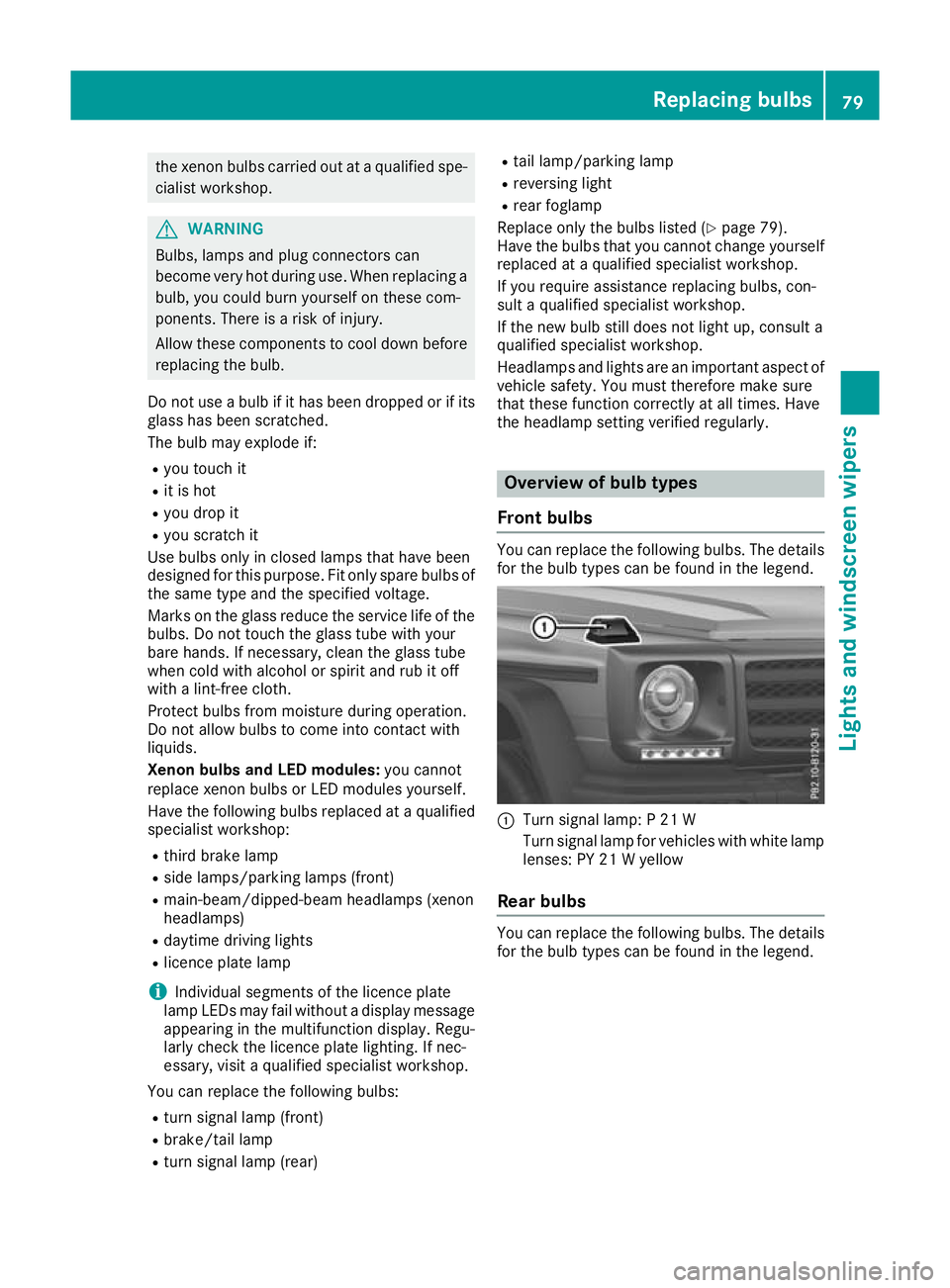
Fron tbulbs You can replace the following bulbs. The details
for the bulb types can be found in the legend. :
Turn signal lamp: P21W
Turn signal lamp for vehicles with white lamp lenses: PY 21 Wyellow
Rear bulbs You can replace the following
bulbs. The details
for the bulb types can be foun dinthe legend. Replacing bulbs
79Lights and windscreen wipers Z
Page 99 of 261
!
Avoid high engine speeds when the engine
is cold. The engine's service life could other-
wise be significantly shortened. Do not use
the engine's full performance until it has
reached operating temperature. Key positions
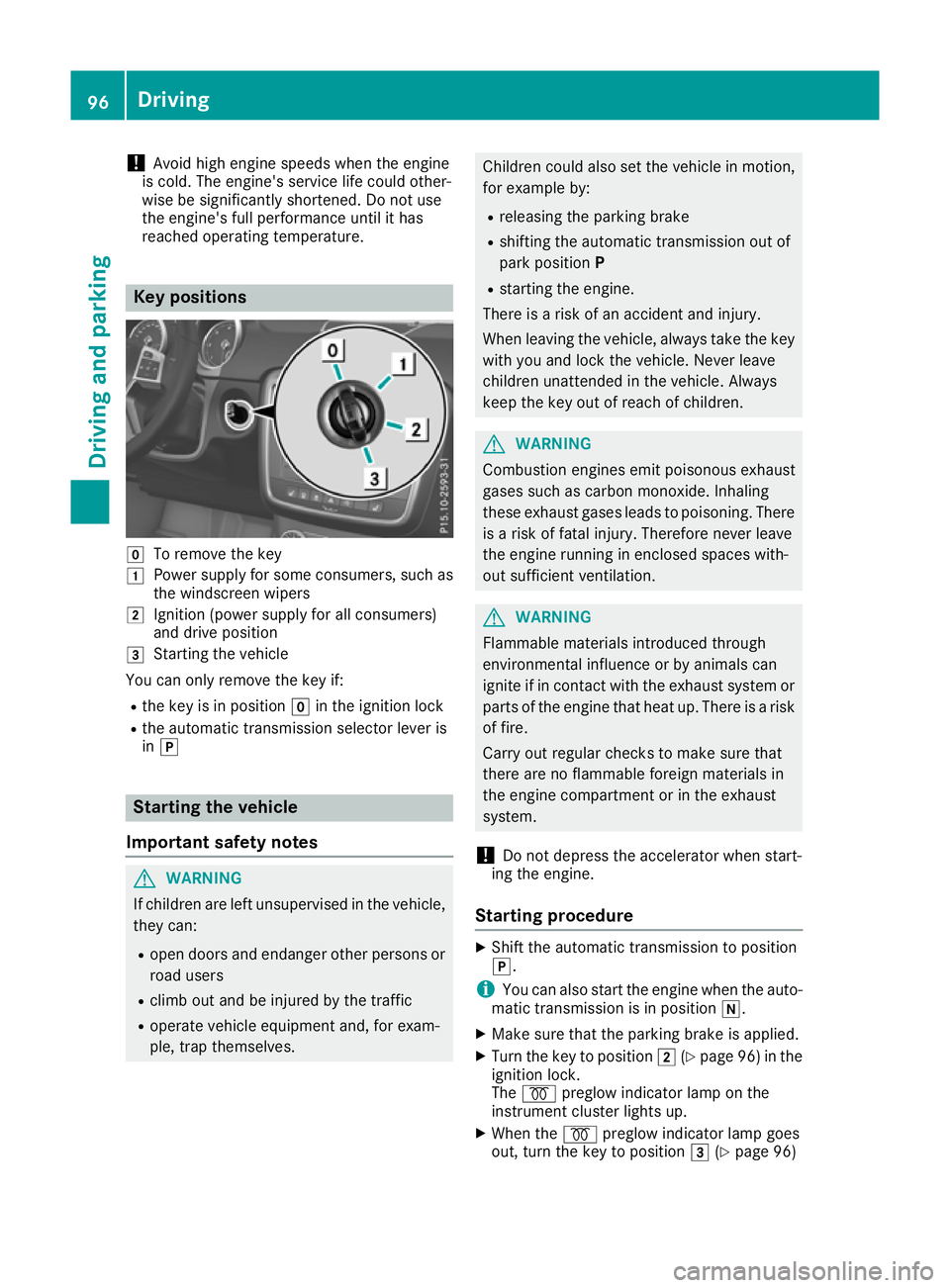
g
To remove the key
1 Power supply for some consumers, such as
the windscreen wipers
2 Ignition (power supply for all consumers)
and drive position
3 Starting the vehicle
You can only remove the key if: R the key is in position gin the ignition lock
R the automatic transmission selector lever is
in j Starting the vehicle
Important safety notes G
WARNING
If children are left unsupervised in the vehicle, they can:
R open doors and endanger other persons or
road users
R climb out and be injured by the traffic
R operate vehicle equipment and, for exam-
ple, trap themselves. Children could als
oset th evehicle in motion,
for example by:
R releasin gthe parking brake
R shiftin gthe automatic transmission out of
park position P
R starting th eengine.
Ther eisar iskofana ccidentand injury.
When leaving th evehicle ,always tak ethe key
wit hyou and loc kthe vehicle .Never leave
children unattende dinthevehicle .Always
keep th ekeyout of reac hofchildren. G
WARNING
Combustion engine semit poisonous exhaust
gase ssuch as carbon monoxide .Inhaling
these exhaust gase sleads to poisoning. There
is ar isk of fatal injury .Therefore never leave
the engine running in enclose dspace swith-
out sufficient ventilation. G
WARNING
Flammable materials introduced through
environmental influence or by animals can
ignite if in contact with the exhaust system or parts of the engine that heat up. There is arisk
of fire.
Carry out regular checks to make sure that
there are no flammable foreig nmaterials in
the engine compartment or in the exhaust
system.
! Do not depress the accelerator when start-
ing the engine.
Starting procedure X
Shift the automatic transmissio ntoposition
j.
i You can also star
tthe engine when the auto-
mati ctransmissio nisinpositioni.
X Make sure that the parking brake is applied.
X Turn the key to position 2(Ypage 96) in the
ignition lock.
The % preglow indicator lamp on the
instrument cluster lights up.
X Whe nthe % preglow indicator lamp goes
out, turn the key to position 3(Ypage 96) 96
DrivingDrivin
gand park ing
Page 114 of 261
AdBlue
®
Genera lnotes To function properly, BlueTE
Cexhaust gas after-
treatment must be operated with the reducing
agent AdBlue ®
.
When the supply of AdBlue ®
is almost used up,
the Refill AdBlue See Owner's Manual Refill AdBlue See Owner's Manual
message is shown in the multifunction display .A
warning tonea lso sounds.
If the Refill AdBlue No start in Xkm
Refill AdBlue No start in Xkm
message is shown in the multifunction display,
you can still drive the vehicle over the distance
shown. If AdBlue ®
is not topped up, you will
subsequently be unable to startt he engine.
When you see the warning message, it is rec-
ommended that you fill the AdBlue ®
reservoir
with 10 litres of AdBlue ®
.T his ensures that the
AdBlue ®
supply will last until the next regular
service due date.
Further information about BlueTEC exhaust gas
aftertreatmen tand about AdBlue ®
can
be obtained from any Mercedes-Benz Service
Centre.
i You can also have the AdBlue ®
tank refilled
at aq ualified specialist workshop.
If the outside temperature is lower than Ò11 †,
it may be difficult to top up. If AdBlue ®
is frozen
and there is an active warning indicator, topping up may not be possible. Park the vehicle in a
warm place, e.g. in agarage, until AdBlue ®
has
become liquid again. Topping up is then possible
again. Alternatively, have the AdBlue ®
tank refil-
led at aqualified specialist workshop.
Before driving your vehicle outside Europe, have the AdBlue ®
supply checked at aqualified spe-
cialist workshop.
Further information about BlueTEC exhaust gas
aftertreatmen tand about AdBlue ®
can
be obtained from any Mercedes-Benz Service
Centre.
Important safety notes AdBlue
®
is aw ater-soluble fluid for the exhaust
ga sa ftertreatment of diese lengines. It is:
R non-toxic
R colourless and odourless
R non-flammable If you open the AdBlue
®
tank ,small amounts of
ammonia vapourm ay be released.
Ammonia vapours have apungent odoura nd are
particularly irritating to the skin, mucous mem-
branes and eyes.Y ou may experience aburning
sensation in youre yes,nose and throat. You
may also experience coughing and watery eyes.
Do not inhalea ny ammonia vapours that may be
released. Fill the AdBlue ®
tank only in well-ven-
tilated areas.
Do not swallow AdBlue ®
or let it come into con-
tact with skin, eyes or clothing. Keep AdBlue ®
awayf rom children.
If you or others come into contact with AdBlue ®
,
observe the following:
R immediately rinse AdBlue ®
off yours kin with
soap and water.
R if AdBlue ®
comes into contact with youre yes,
immediately rinse them thoroughl ywith clean
water. Seek medica lattention immediately.
R if AdBlue ®
is swallowed, immediately rinse
yourm outh out thoroughly. Drink plenty of
water. Seek medica lattention immediately.
R change immediately out of clothing that has
come into contact with AdBlue ®
.
! Only use AdBlue ®
in accordance with
ISO 22241. Do not mix any additives with
AdBlue ®
,a nd do not dilute AdBlue ®
with
water. This may destroy the BlueTEC exhaust
gas aftertreatment system.
! In order to fill the AdBlue ®
tank, the vehicle
must be parked on alevel surface. The
AdBlue ®
tank can only be filledasi ntended
with the vehicle parked on alevel surface.
Fluctuations in capacity willt hus be avoided.
Filling avehicle standing on an uneven sur-
face is not permitted. There is adanger of
overfilling, which can cause damage to Blue-
TEC exhaust gas aftertreatment components.
! Surfaces which have come into contact with
AdBlue ®
whiler efilling shouldber insed
immediately with water, or remove AdBlue ®
with amoist cloth and cold water. If AdBlue ®
has already crystallised, use asponge and
cold water to clean the area.A dBlue®
residue
crystallises after acertain amount of time and
soils the affected surfaces.
! AdBlue ®
is not afuel additive and must not
be addedtot he fuel tank. If AdBlue ®
is added Refuelling
111Driving and parking Z