warning MERCEDES-BENZ G-CLASS SUV 2016 Repair Manual
[x] Cancel search | Manufacturer: MERCEDES-BENZ, Model Year: 2016, Model line: G-CLASS SUV, Model: MERCEDES-BENZ G-CLASS SUV 2016Pages: 261, PDF Size: 6.01 MB
Page 96 of 261
X
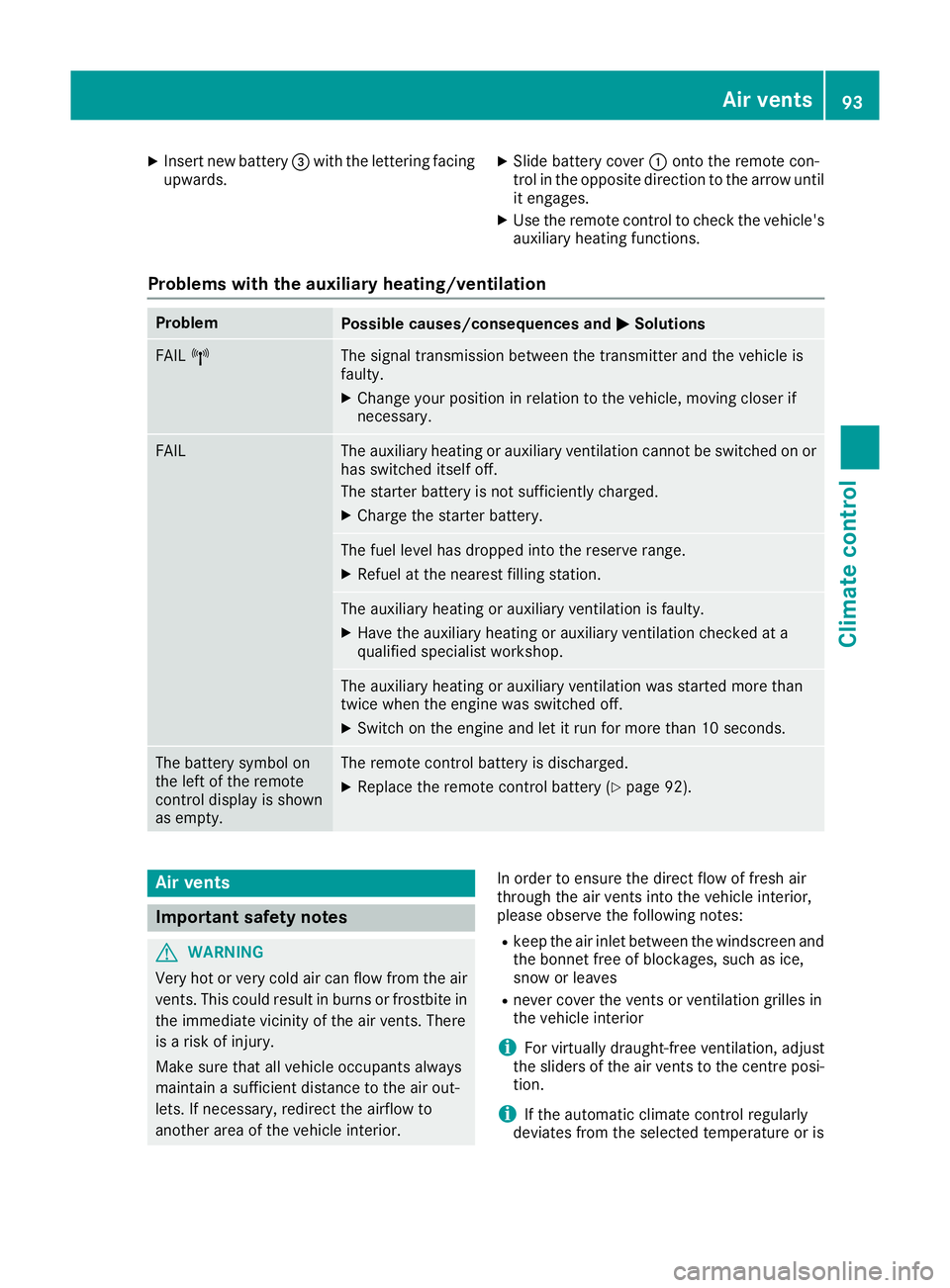
Insert new battery =with the lettering facing
upwards. X
Slide battery cover :onto the remote con-
trol in the opposite direction to the arrow until it engages.
X Use the remote control to check the vehicle's
auxiliary heating functions.
Problems with the auxiliary heating/ventilation Problem
Possible causes/con
sequences andM
MSolutions FAIL
¨ The signal transmission between the transmitter and the vehicle is
faulty.
X
Change your position in relation to the vehicle, moving closer if
necessary. FAIL The auxiliary heating or auxiliary ventilation cannot be switched on or
has switched itself off.
The starter battery is not sufficiently charged.
X Charge the starter battery. The fuel level has dropped into the reserve range.
X Refuel at the nearest filling station. The auxiliary heating or auxiliary ventilation is faulty.
X Have the auxiliary heating or auxiliary ventilation checked at a
qualified specialist workshop. The auxiliary heating or auxiliary ventilation was started more than
twice when the engine was switched off.
X Switch on the engine and let it run for more than 10 seconds. The battery symbol on
the left of the remote
control display is shown
as empty. The remote control battery is discharged.
X Replace the remote control battery (Y page 92).Air ven
ts Important safety notes
G
WARNING
Very ho torvery cold air can flow from the air
vents. This coul dresult in burns or frostbite in
the immediate vicinity of the air vents. There
is ar isk of injury.
Make sure that all vehicl eoccupants always
maintai nasufficient distance to the air out-
lets. If necessary, redirect the airflow to
another area of the vehicl einterior. In order to ensure the direct flow of fresh air
through the air vents into the vehicle interior,
please observe the following notes:
R keep the air inlet betwee nthe windscree nand
the bonnet free of blockages, such as ice,
snow or leaves
R never cover the vents or ventilation grilles in
the vehicle interior
i For virtually draught-free ventilation, adjust
the sliders of the air vents to the centre posi- tion.
i If the automatic climate control regularly
deviates from the selected temperature or is Airv
ents
93Climatecont rol Z
Page 98 of 261
Running-i
nnotes Importan
tsafety notes
In certain driving and driving safet ysystems ,the
sensor sadjust automatically while acertai ndis-
tance is bein gdriven after th evehicl ehas been
delivere dorafter repairs .Full system effective-
ness is no treached until th eend of this teach-in
process.
Brake pads/lining sand disc stha teither are new
or have been replace dachiev eoptimum braking
effec tonlya fter several hundre dkilometres of
driving .Compensat efor th ereduce dbraking
effec tbya pplyin ggreate rforce to th ebrake
pedal. Th
ef irs t1 500km
The mor eyou trea tthe engine with sufficient
car eatt he start, the mor esatisfie dyou will be
with the engine performance later on.
R Driv eatv aryingvehicl espeeds and engine
speeds for the first 1500 km
R Avoi doverstraining the vehicl eduringt his
period, e.g .drivin gatf ullt hrottle
R When shifting gear smanually, shift up in good
time ,befor et he rev counter needl ereaches
Ô of the wa ytothe red area of the rev counter
display
R Do not shift down agearm anuall yino rder to
brake
R Try to avoi ddepressing the accelerator pedal
beyond the pressure point (kickdown)
After 1500 km ,you maygradually bring the
vehicl euptof ullr oa da nd engine speeds.
Yo us houl dalsoo bserve these note sonrunning-
in if the engine or parts of the drive train on your vehicl ehaveb eenr eplaced.
Alway sobserve the maximum permissible
speed. Driving
Importan
tsafety notes G
WARNING
Objectsint he driver's footwel lcan impede
peda ltravel or block apeda lwhich is depressed. This jeopardises safe operatio
nof
the vehicle. There is arisk of an accident.
Stow all objects in the vehicle safely, so that
they cannot reach the driver' sfootwell. Make
sure the floormat sand carpet sare properly
secured so that they cannot slip and obstruct the pedals. Do not lay several floormat sor
carpet sontop of one another. G
WARNING
Unsuitable footwear can hinder correct usage of the pedals, e.g.:
R shoe swith thick soles
R shoes with high heels
R slippers
There is arisk of an accident.
Wears uitable footwea rtoensure correct
usage of the pedals. G
WARNING
If you switch off the ignitio nwhile driving,
safety-relevant functions are only available
with limitations, or not at all.T his couldaffect,
for example, the power steering and the brake
boosting effect. You willr equire considerably
more effort to steer and brake. There is arisk
of an accident.
Do not switch off the ignitio nwhile driving. G
WARNING
If the parking brake has not been fully
released when driving, the parking brake can:
R overheat and caus eafire
R lose its hold function.
There is arisk of fire and an accident. Release
the parking brake full ybefore driving off.
! Warm up the engine quickly. Do not use the
engine's full performance until it has reached operating temperature.
Only set the automatic transmission to the
respective drive positions when the vehicl eis
stationary.
Where possible,a voids pinning the drive
wheels when pulling awayons lippery roads.
Otherwise, you coul ddamage the drive train. Driving
95Drivingand parking Z
Page 99 of 261
!
Avoid high engine speeds when the engine
is cold. The engine's service life could other-
wise be significantly shortened. Do not use
the engine's full performance until it has
reached operating temperature. Key positions
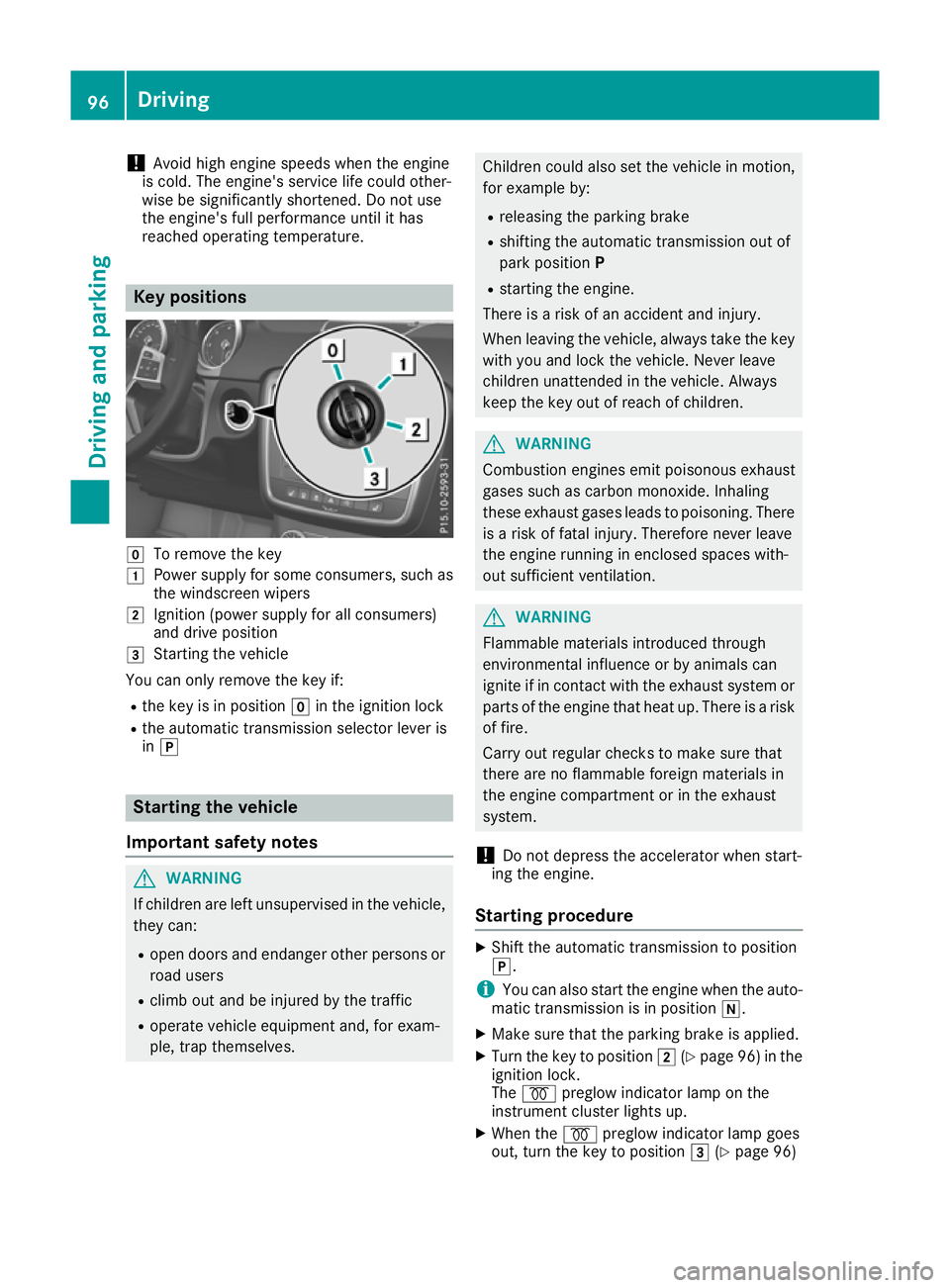
g
To remove the key
1 Power supply for some consumers, such as
the windscreen wipers
2 Ignition (power supply for all consumers)
and drive position
3 Starting the vehicle
You can only remove the key if: R the key is in position gin the ignition lock
R the automatic transmission selector lever is
in j Starting the vehicle
Important safety notes G
WARNING
If children are left unsupervised in the vehicle, they can:
R open doors and endanger other persons or
road users
R climb out and be injured by the traffic
R operate vehicle equipment and, for exam-
ple, trap themselves. Children could als
oset th evehicle in motion,
for example by:
R releasin gthe parking brake
R shiftin gthe automatic transmission out of
park position P
R starting th eengine.
Ther eisar iskofana ccidentand injury.
When leaving th evehicle ,always tak ethe key
wit hyou and loc kthe vehicle .Never leave
children unattende dinthevehicle .Always
keep th ekeyout of reac hofchildren. G
WARNING
Combustion engine semit poisonous exhaust
gase ssuch as carbon monoxide .Inhaling
these exhaust gase sleads to poisoning. There
is ar isk of fatal injury .Therefore never leave
the engine running in enclose dspace swith-
out sufficient ventilation. G
WARNING
Flammable materials introduced through
environmental influence or by animals can
ignite if in contact with the exhaust system or parts of the engine that heat up. There is arisk
of fire.
Carry out regular checks to make sure that
there are no flammable foreig nmaterials in
the engine compartment or in the exhaust
system.
! Do not depress the accelerator when start-
ing the engine.
Starting procedure X
Shift the automatic transmissio ntoposition
j.
i You can also star
tthe engine when the auto-
mati ctransmissio nisinpositioni.
X Make sure that the parking brake is applied.
X Turn the key to position 2(Ypage 96) in the
ignition lock.
The % preglow indicator lamp on the
instrument cluster lights up.
X Whe nthe % preglow indicator lamp goes
out, turn the key to position 3(Ypage 96) 96
DrivingDrivin
gand park ing
Page 100 of 261
and release it as soon as th
eengine is run-
ning.
You can start th eengine without preglow if the
engine is warm.
You can also use th etouch-start function .Todo
this, tur nthe keytop osition 3(Ypage 96) and
release it immediately. The engine then starts
automatically. Pulling away
General notes G
WARNING
If th eengine spee disabove the idling speed
and you engag etransmission position Dor R,
the vehicl ecouldp ulla wa ysuddenly .There is
ar isk of an accident.
When engaging transmission position Dor R,
alwaysf irmly depress the brake peda land do
not simultaneously accelerate.
! If
aw arning tone sound sand the Release Release
park. brake
park. brake message appears in the multi-
functio ndisplay, the parking brake is still
applied. Release the parking brake.
Depress the accelerator carefully when pulling
away.
You can open the doors from the inside at any
time.
You can also deactivate the automatic locking
feature (Y page 139).
It is possible to shift the transmission from posi-
tion jto the desired position only if you
depress the brake pedal.O nly then is the selec-
tor lever lock released.
i Upshifts take place at higher engine speeds
after acold start. This helps the catalytic con-
verter to reach its operating temperature
more quickly.
Pulling away with atrailer To ensure that you do not roll backwards when
pulling away on an uphill slope, apply the park-
ing brake. X
Depress the brake pedal and keep it
depressed.
X Shift the automatic transmission to position
h ork.
i Alwaysw
aitu ntilthe shifting proces sis
complete befor edrivin goff.
X Releas ethe parkin gbrake (Y page 114).
X Releas ethe brake pedal.
X Carefully depress the accelerator pedal. EC
Os tart/st op function
Important safety notes G
WARNING
If th eengine is switched off automatically and
you exit the vehicle, the engine is restarted
automatically.T he vehiclemay begi nmoving.
There is arisk of accident and injury.
If you wishtoe xit the vehicle, alwayst urn off
the ignitio nand secure the vehicl eagainst
rolling away.
General notes The ECO start/stop function switches the
engin
eoff automatically if the vehicle stops
moving.
When the vehicle pulls away again, the engine
start sautomatically. The ECO start/stopf unc-
tion thereby helps you to reduce the fuel con-
sumption and emissions of your vehicle.
The ECO start/stopf unction is activated each
time the engine is switched on.
The ECO start/stopf unction is only available in
drive program E.
The system is operational if all conditions for
automatic engine switch-off have been fulfilled
(Y page 98) and the èECO symbol is
shown in green in the multifunction display.
If the conditions for automatic engine switch-off
(Y page 98) are not all fulfilled, the èECO
symbol is shown in yellow in the multifunction
display.
If the ECO start/stopf unction has been man-
ually deactivated (Y page 98) oramalfunction
has caused the system to be deactivated, the
è ECO symbol is not displayed. Driving
97Driving and parking Z
Page 103 of 261
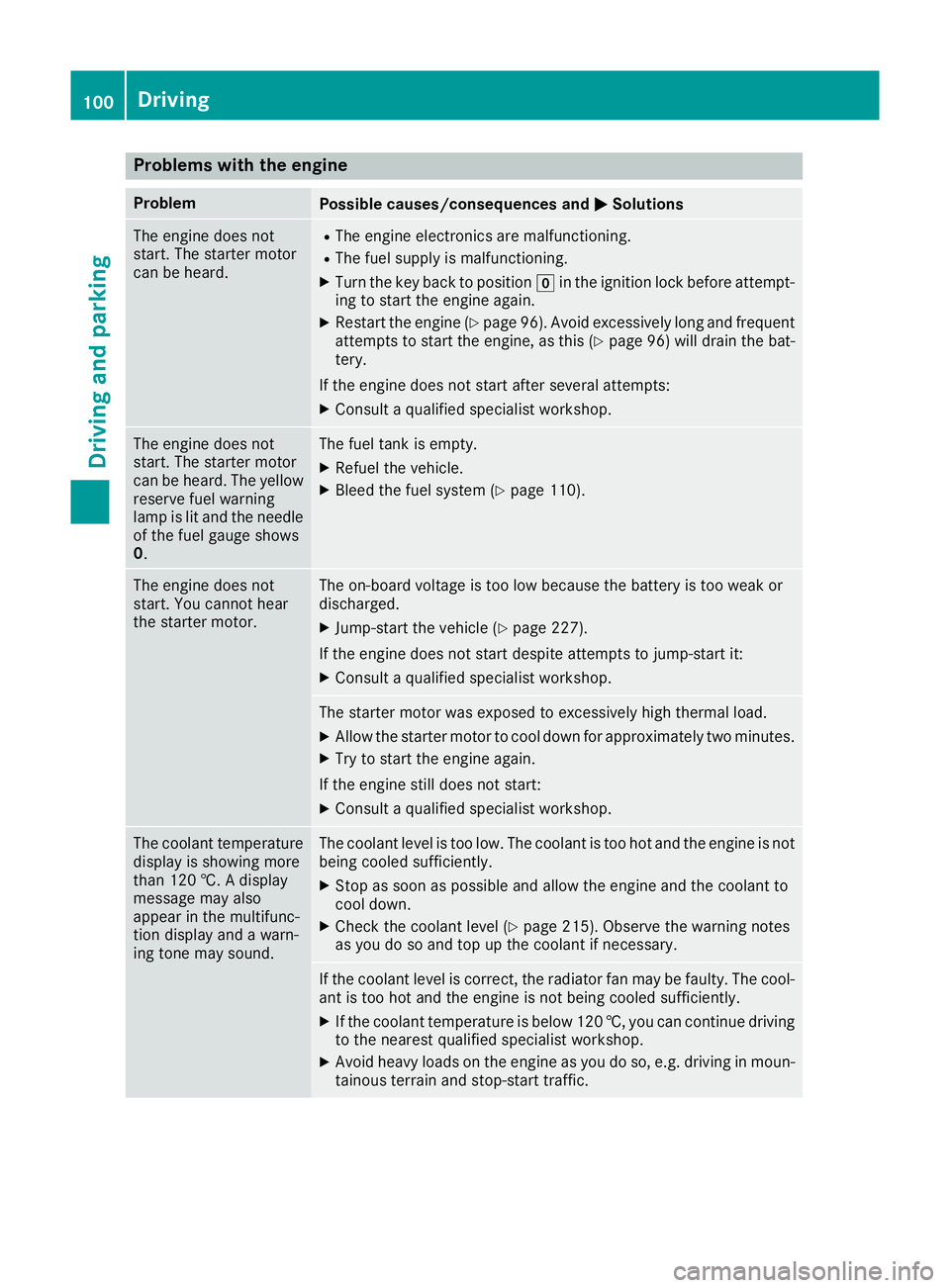
Problems with the engine
Problem
Possible causes/consequences and
M
MSolutions The engine does not
start. The starter motor
can be heard. R
The engine electronics are malfunctioning.
R The fuel supply is malfunctioning.
X Turn the key back to position gin the ignition lock before attempt-
ing to start the engine again.
X Restart the engine (Y page 96). Avoid excessively long and frequent
attemptstos tart the engine, as this (Y page 96) will drain the bat-
tery.
If the engine does not start after several attempts:
X Consult aqualified specialist workshop. The engine does not
start
.The starter motor
can be heard. The yellow reserve fuel warning
lamp is lit and the needle
of the fuel gauge shows
0. The fuel tank is empty.
X Refuel the vehicle.
X Bleed the fuel system (Y page 110).The engine does not
start
.You cannot hear
the starter motor. The on-board voltage is too low because the battery is too weak or
discharged.
X Jump-start the vehicle (Y page 227).
If the engine does not start despite attempt stojump-start it:
X Consult aqualified specialist workshop. The starter motor was exposed to excessively high thermal load.
X Allow the starter motor to cool down for approximately two minutes.
X Try to start the engine again.
If the engine still does not start:
X Consult aqualified specialist workshop. The coolant temperature
display is showing more
than 120 †. Adisplay
message may also
appear in the multifunc-
tion display and awarn-
ing tonem ay sound. The coolant level is too low. The coolant is too hot and the engine is not
being cooled sufficiently.
X Stop as soon as possible and allow the engine and the coolant to
cool down.
X Check the coolant level (Y page 215). Observe the warning notes
as you do so and top up the coolant if necessary. If the coolan
tlevel is correct, the radiator fan may be faulty. The cool-
ant is too hot and the engine is not being cooled sufficiently.
X If the coolant temperature is below1 20 †, you can continue driving
to the nearest qualifieds pecialist workshop.
X Avoid heavy loadsont he engine as you do so, e.g. driving in moun-
tainous terrain and stop-start traffic. 100
DrivingDriving and parking
Page 104 of 261
Automati
ctransmission Important safety notes
G
WARNING
If th eengine spee disabove the idling speed
and you engag etransmission position Dor R,
the vehicl ecouldp ulla wa ysuddenly .There is
ar isk of an accident.
When engaging transmission position Dor R,
alwaysf irmly depress the brake peda land do
not simultaneously accelerate. G
WARNING
The automatic transmission switches to neu-
tral position Nwhen you switch off the engine.
The vehicl emay roll away. There is arisk of an
accident.
After switching off the engine, alwayss witch
to parking position P.Prevent the parked vehi-
cle from rolling awaybya pplying the parking
brake.
i Bear in mind that power transmission
between the engine and the transmission is
interrupted when the engine is switched off.
For this reason, shift the automatic transmis-
sion to Pwhen the engine is switched off and
the vehicl eisstationary. Apply the parking
brake to prevent the vehicl efrom rolling
away. Selector lever
Overview of transmission positions !
If the engine speed is too high or if the vehi-
cle is rolling ,donot shift the transmission
directly from Dto R,f rom Rto Dor directly to
P.
Do not open the driver's door while the vehi-
cle is in motion. At low speeds in transmission position Dor R,p ark position Pis otherwise
engaged automatically.
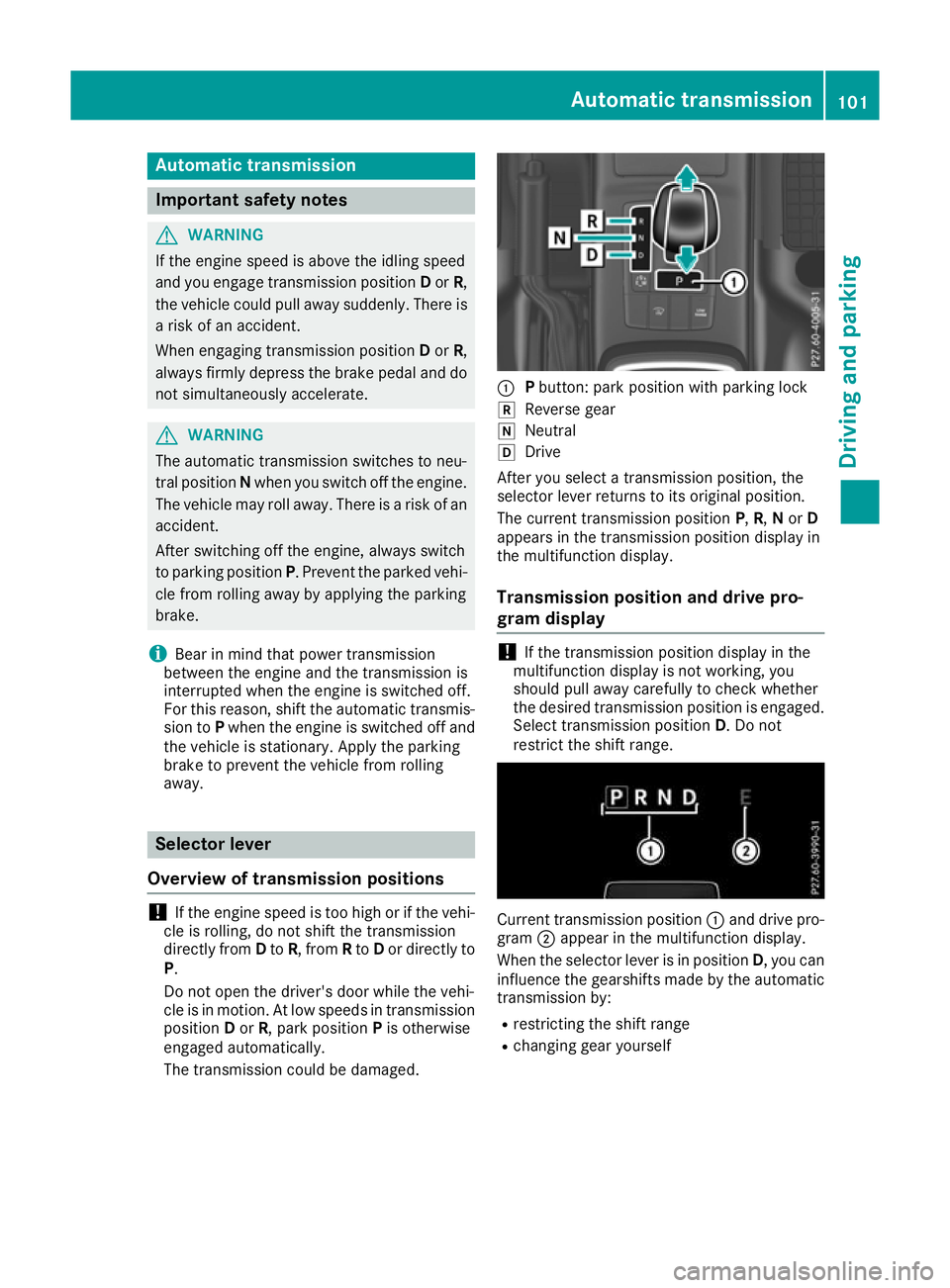
The transmission could be damaged. :
Pbutton: park position with parking lock
k Revers egear
i Neutral
h Drive
After you select atransmission position ,the
selector lever return stoits original position.
The curren ttransmission position P,R, Nor D
appears in the transmission position display in
the multifunction display.
Transmission position and drive pro-
gram display !
If the transmission position display in the
multifunctio ndisplayisn ot working, you
should pull awayc arefully to check whether
the desired transmission position is engaged.
Select transmission position D.Donot
restrict the shift range. Current transmission position
:and dri vepro-
gram ;appear in th emultifunction display.
When th eselector leve risinposition D,you can
influence th egearshifts made by th eautomatic
transmission by:
R restricting th eshiftrange
R changing gear yourself Automatic transmission
101Driving and parking Z
Page 105 of 261
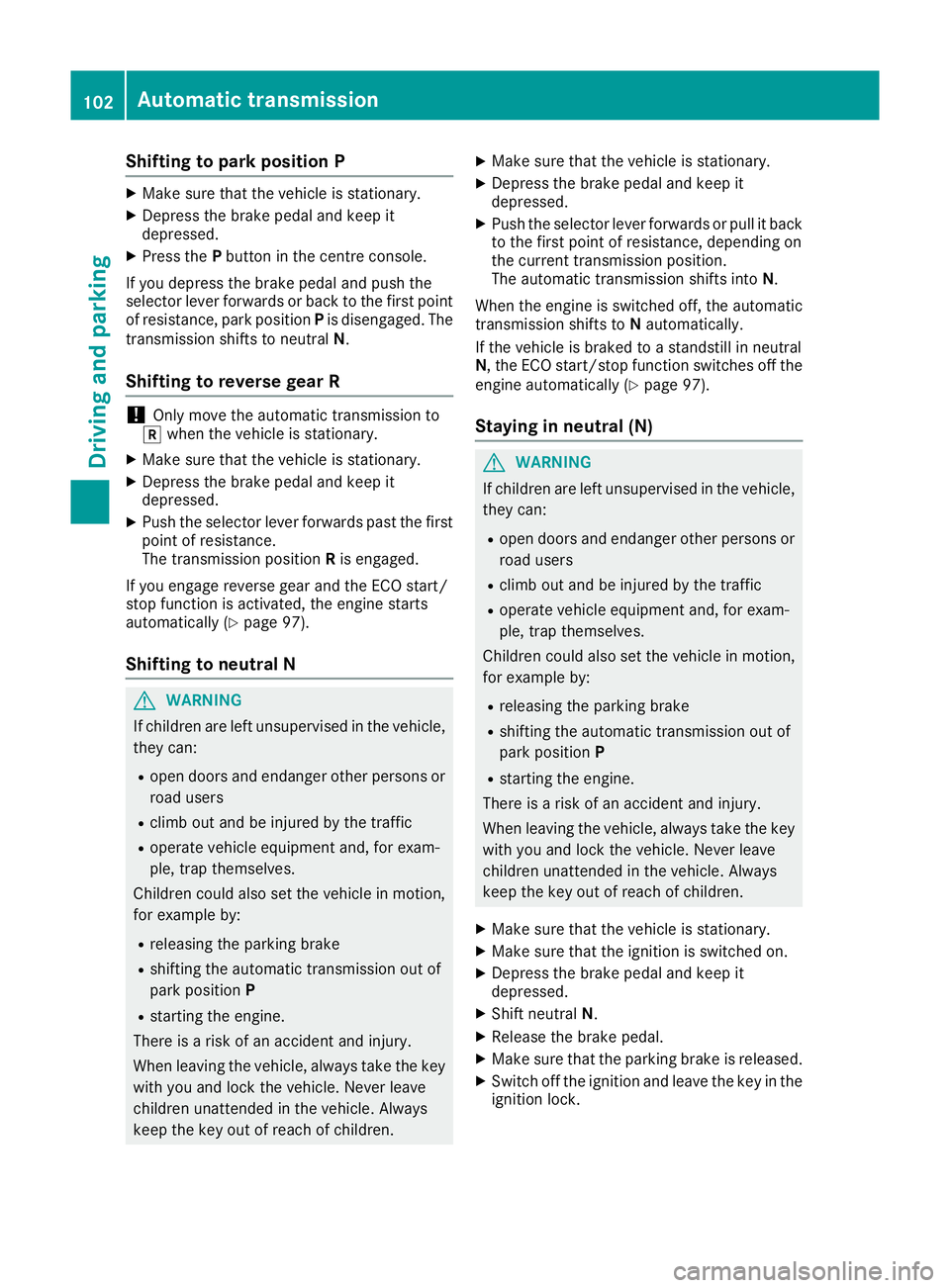
Shifting to parkp
osition PX
Make sure that the vehicle is stationary.
X Depress the brake pedal and keep it
depressed.
X Press the Pbutton in the centre console.
If you depress the brake pedal and push the
selector lever forwards or back to the first point of resistance, park position Pis disengaged. The
transmission shifts to neutral N.
Shifting to reverse gear R !
Only move the automatic transmission to
k when the vehicle is stationary.
X Make sure that the vehicle is stationary.
X Depress the brake pedal and keep it
depressed.
X Push the selector lever forwards past the first
point of resistance.
The transmission position Ris engaged.
If you engage reverse gear and the ECO start/
stop function is activated, the engine starts
automatically (Y page 97).
Shifting to neutral N G
WARNING
If children are left unsupervised in the vehicle, they can:
R open doors and endanger other persons or
road users
R climb out and be injured by the traffic
R operate vehicle equipment and, for exam-
ple, trap themselves.
Children could also set the vehicle in motion, for examp leby:
R releasing the parking brake
R shifting the automatic transmission out of
park position P
R starting the engine.
There is arisk of an accident and injury.
When leaving the vehicle, alwayst ake the key
with you and lock the vehicle. Never leave
children unattended in the vehicle. Always
keep the key out of reach of children. X
Make sure that the vehicl eisstationary.
X Depress the brake pedal and keep it
depressed.
X Push the selector lever forwards or pull it back
to the first point of resistance, depending on
the current transmission position.
The automatic transmission shifts into N.
When the engine is switched off, the automatic
transmission shifts to Nautomatically.
If the vehicle is braked to astandstill in neutral
N,t he ECO start/stop function switches off the
engine automatically (Y page 97).
Staying in neutral( N) G
WARNING
If children are left unsupervised in the vehicle, they can:
R open doors and endanger other persons or
road users
R climb out and be injure dbythe traffic
R operate vehicl eequipment and, for exam-
ple,t rap themselves.
Childre ncoulda lsos et the vehicl einmotion,
for exampl eby:
R releasing the parking brake
R shifting the automatic transmission out of
park position P
R starting the engine.
There is arisk of an accident and injury.
When leaving the vehicle, alwayst ake the key
with you and lock the vehicle. Never leave
children unattended in the vehicle. Always
keep the key out of reach of children.
X Make sure that the vehicl eisstationary.
X Make sure that the ignitio nisswitched on.
X Depress the brake peda land keep it
depressed.
X Shift neutral N.
X Release the brake pedal.
X Make sure that the parking brake is released.
X Switch off the ignitio nand leave the key in the
ignitio nlock. 102
Automatic transmissionDrivinga
nd parking
Page 111 of 261
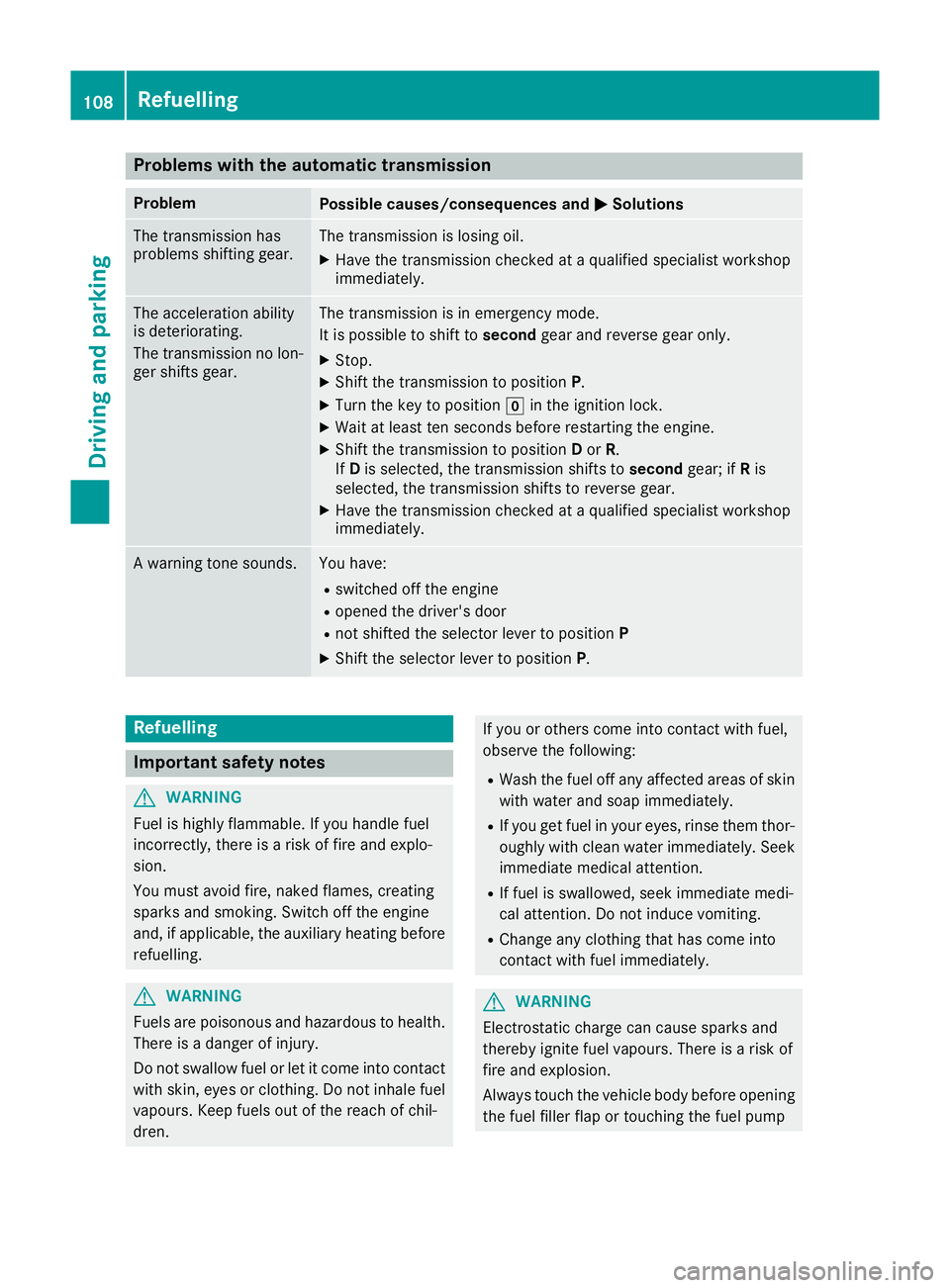
Problems with the automatic transmission
Problem
Possible causes/consequences and
M
MSolutions The transmission has
problems shifting gear. The transmission is losing oil.
X Have the transmission checked at aqualified specialist workshop
immediately. The acceleration ability
is deteriorating.
The transmission no lon-
ger shifts gear. The transmission is in emergenc
ymode.
It is possible to shift to secondgear and reverse gear only.
X Stop.
X Shift the transmission to position P.
X Turn the key to position gin the ignition lock.
X Wait at least ten seconds before restarting the engine.
X Shift the transmission to position Dor R.
If D is selected, the transmission shifts to secondgear; ifRis
selected, the transmission shifts to reverse gear.
X Have the transmission checked at aqualified specialist workshop
immediately. Aw
arning tone sounds. Yo
uh ave:
R switched off the engine
R opene dthe driver's door
R not shifted the selector lever to position P
X Shif tthe selector lever to position P.Refuelling
Important safety notes
G
WARNING
Fue lish ighly flammable.Ify ou handlefuel
incorrectly ,there is arisk of fire and explo-
sion.
You must avoi dfire, naked flames, creating
sparks and smoking. Switch off the engine
and, if applicable,t he auxiliary heating before
refuelling. G
WARNING
Fuel sare poisonous and hazardous to health.
There is adange rofinjury.
Do not swallowf uel or let it come into contact
with skin, eyesorc lothing. Do not inhal efuel
vapours. Keep fuel sout of the reach of chil-
dren. If you or others come into contact with fuel,
observe the following:
R Wash the fuel off any affected area sofskin
with water and soap immediately.
R If you get fuel in youre yes,rinse them thor-
oughlyw ith clean water immediately.S eek
immediate medica lattention.
R If fuel is swallowed, seek immediate medi-
cal attention. Do not induce vomiting.
R Change any clothing that has come into
contact with fuel immediately. G
WARNING
Electrostatic charge can cause sparks and
thereby ignite fuel vapours. There is arisk of
fire and explosion.
Always touch the vehicl ebody before opening
the fuel filler flap or touching the fuel pump 108
RefuellingDrivinga
nd parking
Page 112 of 261
nozzle. Thi
sdischarge sany electrostatic
charge tha tmayhave buil tup.
Do not get back into the vehicl eduring the refu-
elling process ;otherwise, electrostatic charge
could buil dupagain. G
WARNING
If yo umix diesel fuel with petrol, the flash
point of this fuel mixture is lower than that of pure diesel fuel .When the engine is running,
components in the exhaust system may over-
heatu nnoticed. There is arisk of fire.
Never refue lwith petrol. Never add petrol to
diesel fuel.
! Do not use petrol to refue
lvehicles with a
diesel engine. Do not switch on the ignitio nif
you accidentally refue lwith the wrong fuel.
Otherwise, fuel can enter the fuel system.
Even smal lamounts of the wrong fuel could
result in damage to the fuel system and the
engine. The repair costs are high .Notify a
qualified specialist worksho pand have the
fuel tank and fuel lines drained completely.
! Overfilling the fuel tank coul
ddamage the
fuel system.
! Take care not to spil
lany fuel on painted
surfaces. You coul dotherwise damage the
paintwork.
! Use
afilter when adding fuel from afuel can.
The fuel lines and/or the fuel injection system coul dotherwise be blocked by particles from
the fuel can.
If you overfil lthe fuel tank, some fuel may spray
out when you remove the fuel pump nozzle.
Further information on fuel and fuel quality
(Y page2 50). Refuelling
General information Observe the important safety notes
(Y
page 108).
If you unlock/lock the vehicle from the outside, the fuel filler flap also unlocks/locks.
The positio nofthe8 fuel filler cap is dis-
played on the instrument cluster. The arrow next to the filling pump indicates the side of the vehi-
cle.
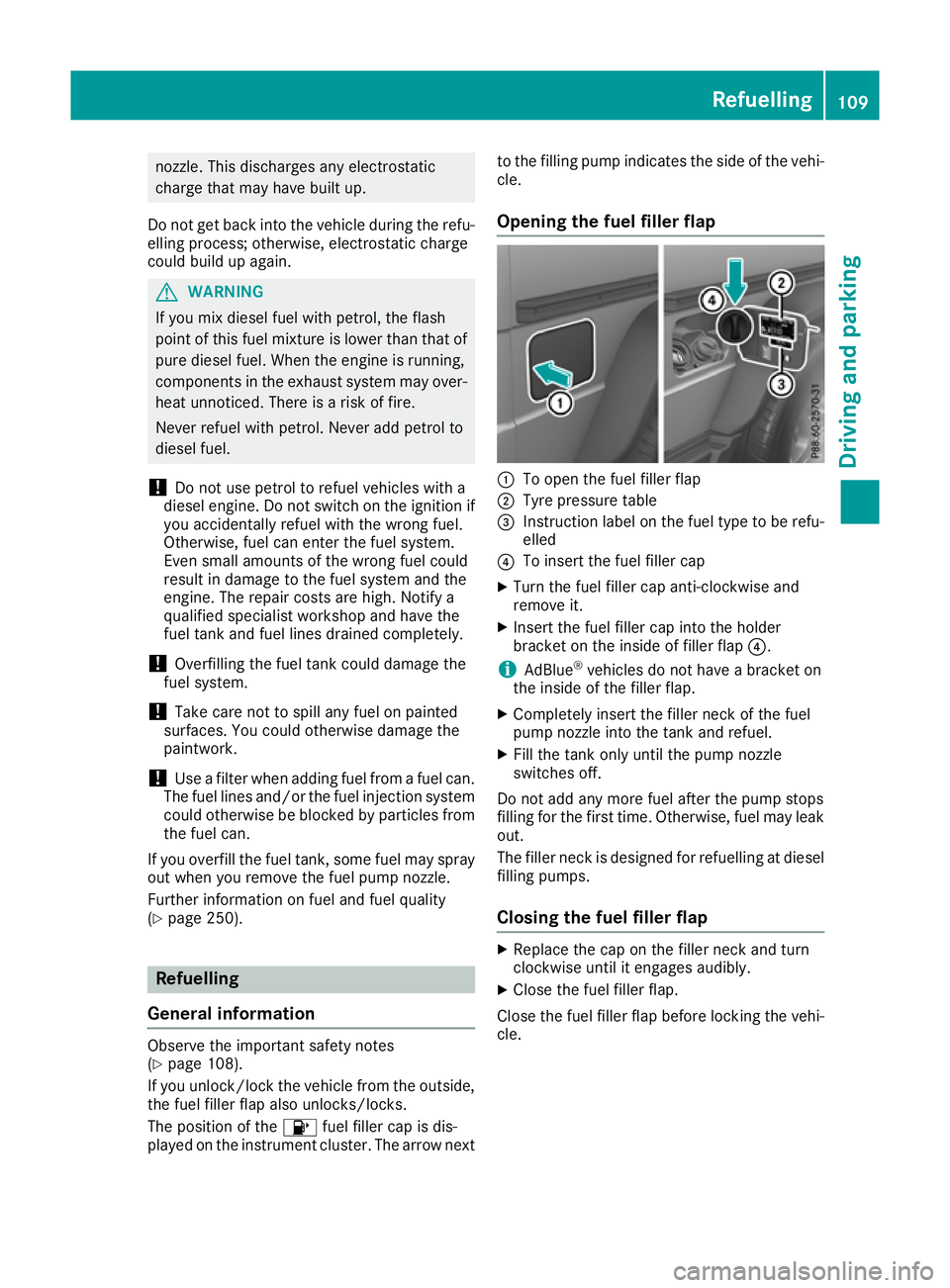
Opening the fuel filler flap :
To open the fuel filler flap
; Tyre pressure table
= Instruction label on the fuel type to be refu-
elled
? To insert the fuel filler cap
X Turn the fuel filler cap anti-clockwise and
remove it.
X Insert the fuel filler cap into the holder
bracket on the inside of filler flap ?.
i AdBlue ®
vehicles do not have abracket on
the inside of the filler flap.
X Completely insert the filler neck of the fuel
pump nozzle into the tank and refuel.
X Fill the tank only until the pump nozzle
switches off.
Do not add any more fuel after the pump stops
filling for the first time. Otherwise, fuel may leak out.
The filler neck is designed for refuelling at diesel
filling pumps.
Closing the fuel filler flap X
Replace the cap on the filler neck and turn
clockwise until it engages audibly.
X Clos ethe fuel filler flap.
Close th efuel filler flap before lockin gthe vehi-
cle. Refuelling
109Driving and parking Z
Page 113 of 261
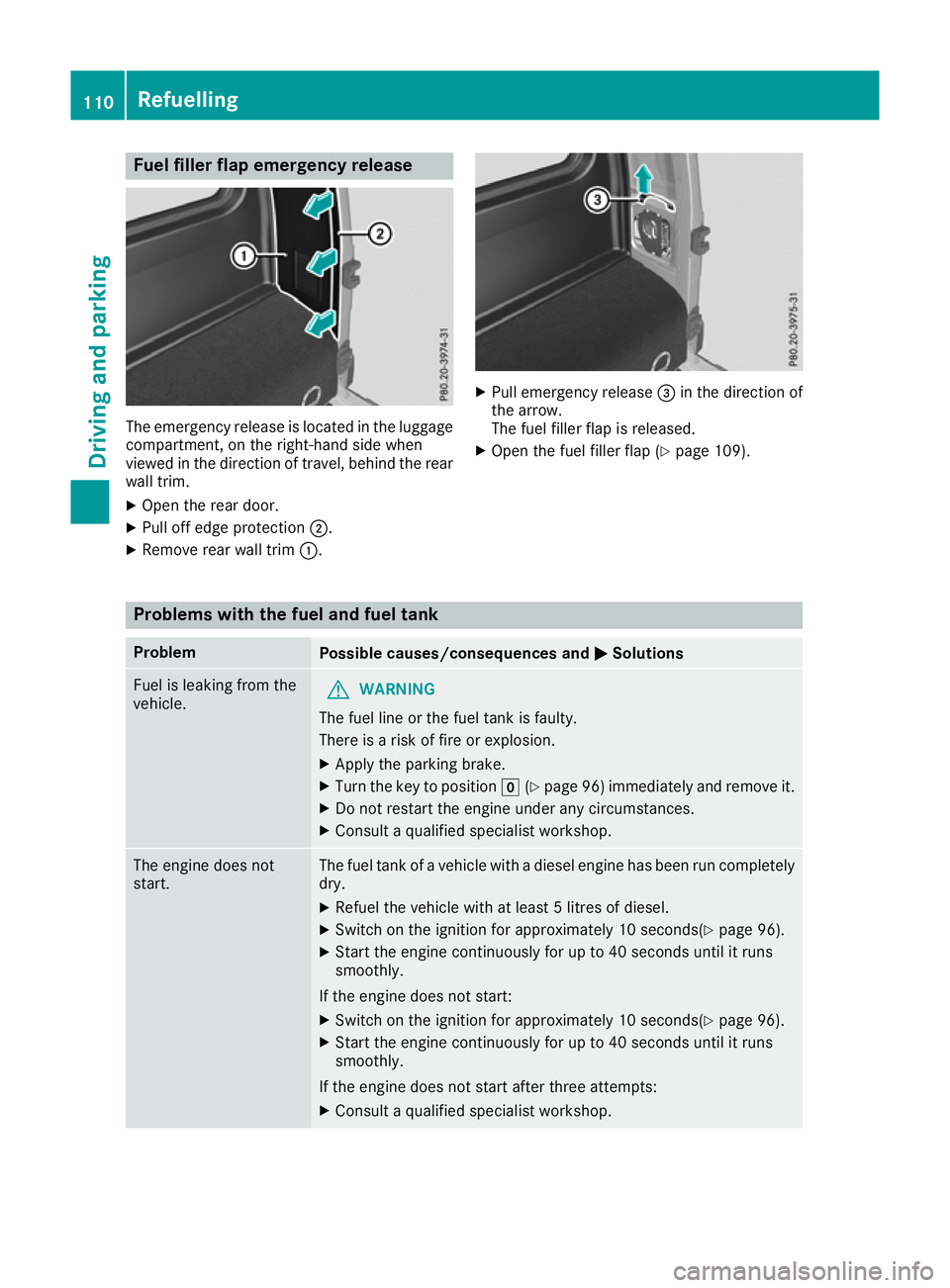
Fuel filler fla
pemergency release The emergenc
yrelease is located in the luggage
compartment,ont he right-hand side when
viewed in the direction of travel, behind the rear
wall trim.
X Open the rear door.
X Pull off edge protection ;.
X Remove rear wall trim :. X
Pull emergenc yrelease =in the direction of
the arrow.
The fuel filler flap is released.
X Open the fuel filler flap (Y page 109).Problems with the fuel and fuel tank
Problem
Possible causes/consequences and
M MSolutions Fuel is leaking fro
mthe
vehicle. G
WARNING
The fuel line or the fuel tank is faulty.
There is arisk of fire or explosion.
X Apply the parking brake.
X Turn the key to position g(Ypage9 6) immediatel yand remove it.
X Do not restart the engine under any circumstances.
X Consult aqualified specialist workshop. The engin
edoes not
start. The fuel tank of
avehicle with adiesel engine has been run completely
dry.
X Refuel the vehicle with at least 5litres of diesel.
X Switch on the ignition for approximately 10 seconds(Y page 96).
X Start the engine continuously for up to 40 seconds until it runs
smoothly.
If the engine does not start:
X Switch on the ignition for approximately 10 seconds(Y page 96).
X Start the engine continuously for up to 40 seconds until it runs
smoothly.
If the engine does not start after three attempts: X Consult aqualified specialist workshop. 110
RefuellingDriving and parking