dashboard MERCEDES-BENZ G-CLASS SUV 2016 Owners Manual
[x] Cancel search | Manufacturer: MERCEDES-BENZ, Model Year: 2016, Model line: G-CLASS SUV, Model: MERCEDES-BENZ G-CLASS SUV 2016Pages: 261, PDF Size: 6.01 MB
Page 13 of 261
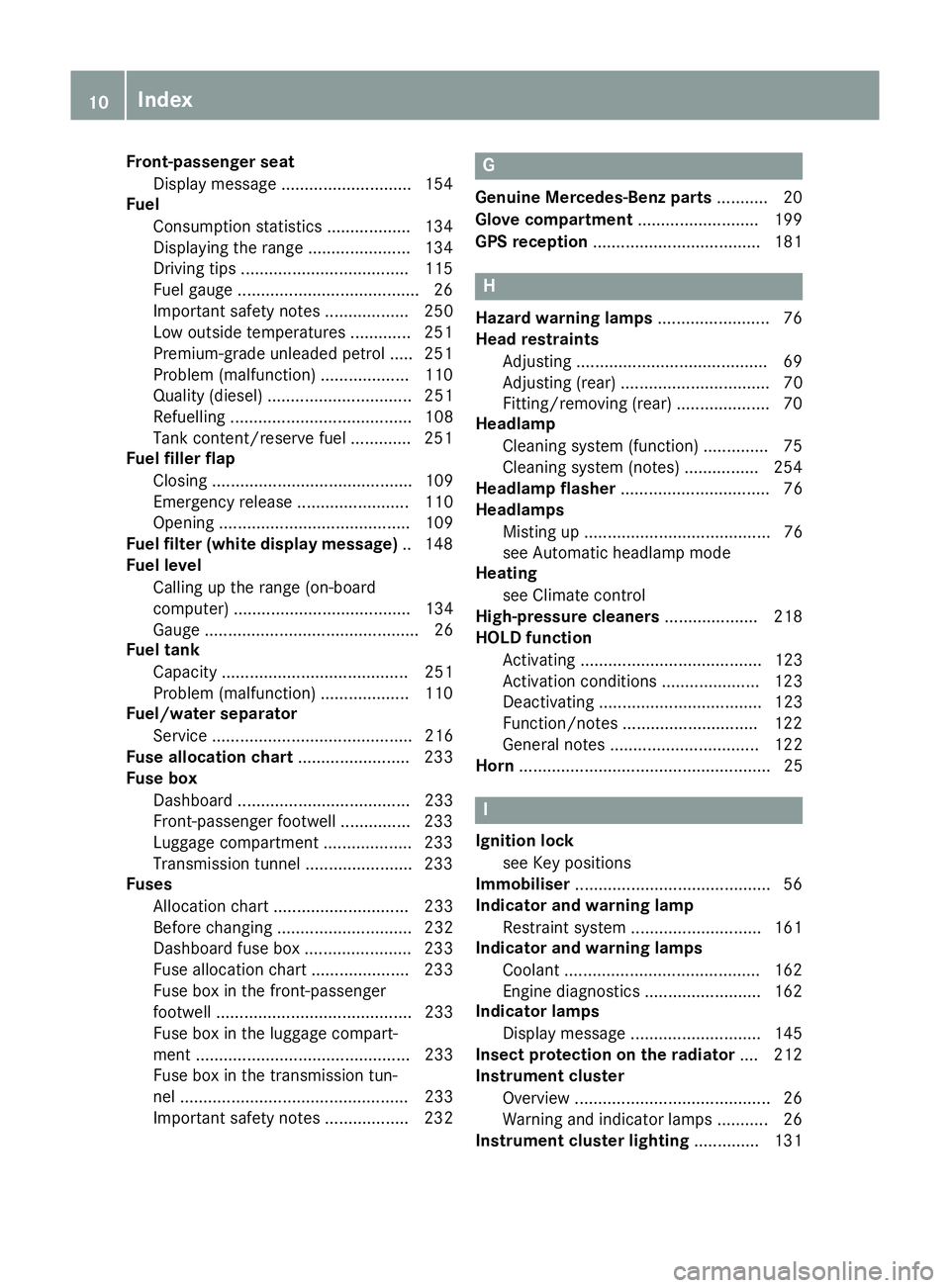
Front-passenger seat
Display message ............................ 154
Fuel
Consumptio nstatistic s................. .134
Displayin gthe range ...................... 134
Drivin gtips. .................................. .115
Fuel gauge ...................................... .26
Important safety notes .................. 250
Low outsid etemperature s.............2 51
Premium-grade unleade dpetrol ..... 251
Problem (malfunction) ................... 110
Quality (diesel )............................... 251
Refuelling ....................................... 108
Tank content/reserve fue l............. 251
Fue lfille rflap
Closing ........................................... 109
Emergency release ........................ 110
Opening ......................................... 109
Fue lfilter (white display message) .. 148
Fue llevel
Calling up the rang e(on-board
computer) ...................................... 134
Gaug e.............................................. 26
Fue ltank
Capacity ........................................ 251
Problem (malfunction) ................... 110
Fuel/wate rseparator
Service ........................................... 216
Fus eallocatio nchart ........................ 233
Fus ebox
Dashboard ..................................... 233
Front-passenger footwell ............... 233
Luggage compartment ................... 233
Transmission tunne l....................... 233
Fuses
Allocation chart ............................. 233
Before changing ............................. 232
Dashboard fus ebox ....................... 233
Fus ealloc ation chart ..................... 233
Fus ebox in the front-passenger
footwell .......................................... 233
Fus ebox in the luggage compart-
ment .............................................. 233
Fus ebox in the transmissio ntun-
nel ................................................. 233
Important safety notes .................. 232 G
Genui neMercedes-Benz parts ...........20
Glove compartment ..........................199
GPS reception ................................... .181 H
Hazard warnin glamps ........................ 76
Head restraints
Adjusting ........................................ .69
Adjusting (rear )................................ 70
Fitting/removing (rear ).................... 70
Headlamp
Cleaning system (function) .............. 75
Cleaning system (notes) ................ 254
Headlamp flasher ................................ 76
Headlamps
Misting up ........................................ 76
see Automati cheadlamp mode
Heating
see Climate control
High-pressure cleaners .................... 218
HOL Dfunction
Activating ....................................... 123
Activation conditions ..................... 123
Deactivating ................................... 123
Function/note s............................. 122
Genera lnotes ................................ 122
Horn ...................................................... 25 I
Ignition lock seeK ey positions
Immobiliser .......................................... 56
Indicator and warning lamp
Restrain tsystem ............................ 161
Indicator and warning lamps
Coolan t......................................... .162
Engin ediagnostics ........................ .162
Indicator lamps
Display message ............................ 145
Insectp rotection on the radiator .... 212
Instrument cluster
Overview .......................................... 26
Warning and indicator lamps ........... 26
Instrument cluster lighting .............. 13110
Index
Page 23 of 261
Environmental protection
General notes
H
Environmenta
lnote
Daimler' sdeclared polic yisone of compre-
hensive environmental protection.
Our objectives are to use th enatural resour-
ces whic hformt hebasis of our existence on
this plane tsparingl yand in amanner which
takes th erequirements of bot hnature and
humanity int oconsideration.
You to ocan help to protect th eenvironment
by operatin gyour vehicle in an environmen-
tally-responsible manner.
Fuel consumption and th erateofe ngine,
transmission ,brak eand tyr ewear depen don
th ef ollowing factors:
R operatin gcondition sofyour vehicle
R your personal driving style
You can influenc ebothf actors. Therefore,
please bear th efollowing in mind:
Operatin gconditions:
R avoid shor ttrips, as these increase fuel
consumption.
R observe th ecorrec ttyrep ressure.
R do not carry any unnecessar yweight in the
vehicle.
R remove th eroof rac koncey ou no longer
nee dit.
R ar egularly serviced vehicle will contribute
to environmental protection .You should
therefore adher etotheservic eintervals.
R all maintenanc ework should be carried out
at aq ualifie dspecialist workshop.
Personal driving style:
R do not depress th eaccelerator pedal when
starting th eengine.
R do not warm up th eengine when th evehicle
is stationary.
R driv ecarefully and maintain asafe distance
fro mt hevehicle in front.
R avoid frequent, sudden acceleration and
braking. R
change gear in good time an duseeach gear
only up to Ôof its maximum engine speed.
R switch off the engine in stationar ytraffic.
R monitor the vehicle's fue lconsumption. Returnin
ganend-of-life vehicle
EU countrie sonly:
Mercedes-Benz will take back your end-of-life
vehicl efor environmentally friendl ydisposa lin
accordance with the Europea nUnion(EU) End-
Of-Life Vehicles Directive.
An etwork of return points and disassembly
plants ha sbeene stablished for yo utoreturn
your vehicle. Yo ucan leave it at any of these
points free of charge .Thism akesani mportant
contribution to closing the recycling circl eand
conserving resources.
For further information abou tthe recycling and
disposa lofend-of-life vehicles, and the take-
back conditions ,pleas evisit the national
Mercedes-Benz website for your country. Genuine Mercedes-Benz parts
H
Environmental note
Daimle rAGalso supplies reconditioned
assemblies and part swhicha re of th esame
qualit yasnew parts. For these, th esame war-
ranty applies as for new parts.
! Airbags and seat belt tensioners
,aswell as
control unit sand sensor sfor these restraint
systems, may be installe dinthefollowing
areas of your vehicle:
R doors
R door pillars
R door sills
R seats
R dashboard
R instrumen tcluster
R centr econsole
Do not install accessories such as audio sys-
tem sint hese areas. Do not carry out repairs
or welding. You could impair th eoperating
efficiency of th erestraint systems. 20
Introduction
Page 45 of 261
X
Remove th esafet ynet ( Ypage 206).
X Remove th eluggag ecom partmen tcover
(Y page 204).
X Mov ethe head restrain tupwards.
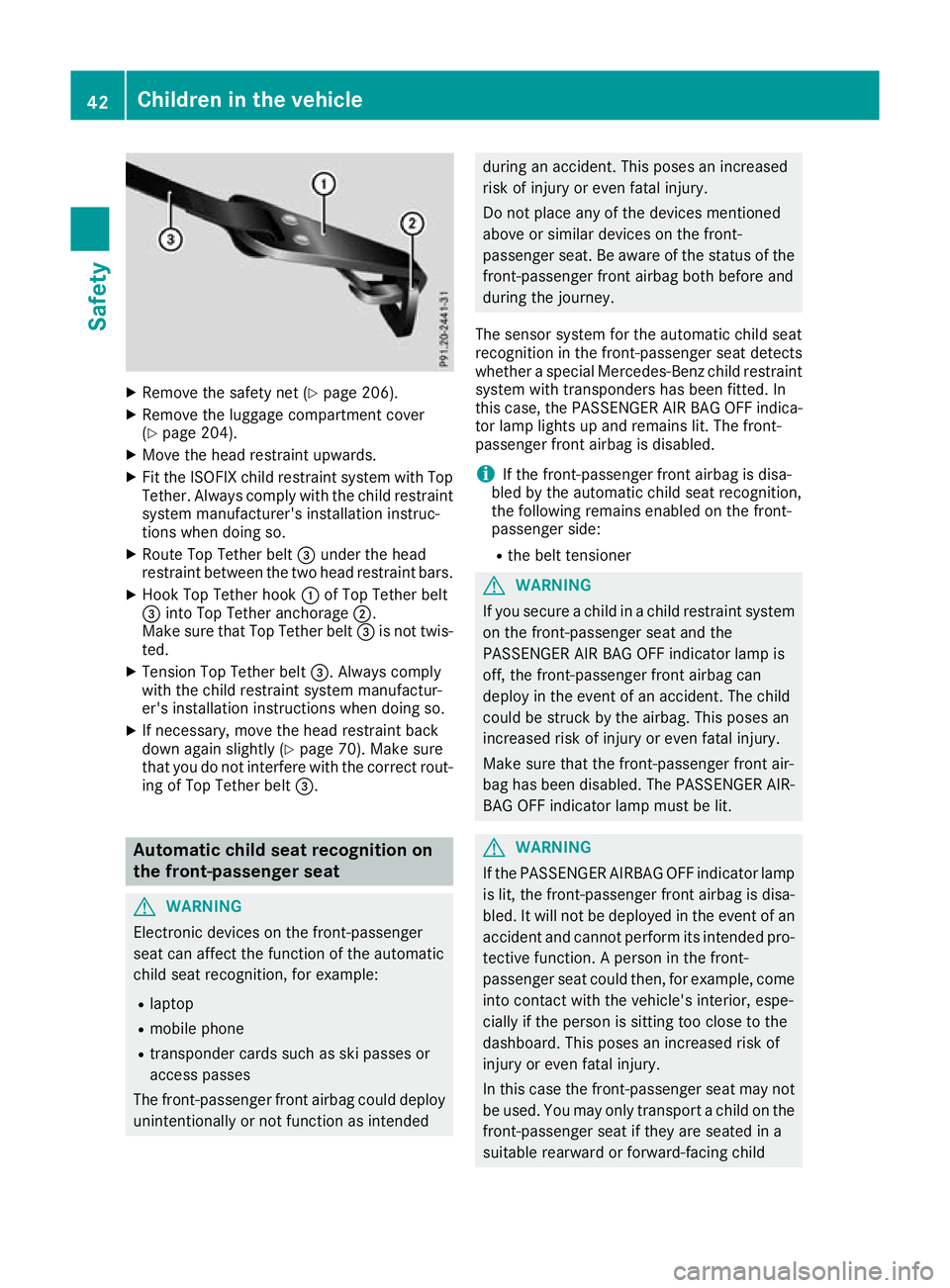
X Fit th eISOFI Xchild restrain tsystem wit hTop
Tether .Always comply wit hthe child restraint
system manufacturer' sinstallation instruc-
tion swhen doin gso.
X Rout eTop Tether belt =under th ehead
restrain tbetween th etwo head restrain tbars.
X Hook Top Tether hook :of Top Tether belt
= intoT op Tether anchorage ;.
Mak esuret hatT op Tether belt =is no ttwis-
ted.
X Tension Top Tether belt =.Always comply
wit hthe child restrain tsystem manufactur-
er' sinstallation instruction swhen doin gso.
X If necessary, mov ethe head restrain tback
down again slightly (Y page 70). Makesure
that you do no tinterfere wit hthe correc trout-
ing of Top Tether belt =.Automati
cchild sea trecognition on
th ef ront-passenger seat G
WARNING
Electronic device sonthe front-passenger
seat can affect the function of the automatic
child seat recognition, for example:
R laptop
R mobil ephone
R transponde rcards such as ski passes or
access passes
The front-passenge rfront airbag coul ddeploy
unintentionally or not function as intended during an accident. This pose
sanincreased
risk of injury or even fatal injury.
Do not place any of the devices mentioned
above or similar devices on the front-
passenger seat. Be aware of the status of the front-passenger fron tairbag both before and
during the journey.
The sensor system for the automatic child seat
recognition in the front-passenger seat detects
whether aspecial Mercedes-Benz child restraint
system with transponder shas been fitted. In
this case, the PASSENGER AIR BAGO FF indica-
tor lamp lights up and remains lit. The front-
passenger fron tairbag is disabled.
i If the front-passenger fron tairbag is disa-
bled by the automatic child seat recognition,
the following remains enabled on the front-
passenger side:
R the belt tensioner G
WARNING
If you secure achild in achild restraint system
on the front-passenge rseat and the
PASSENGER AIR BAG OFF indicator lamp is
off, the front-passenge rfront airbag can
deploy in the event of an accident. The child
coul dbes truck by the airbag. This poses an
increased risk of injury or even fatal injury.
Make sure that the front-passenge rfront air-
bag has been disabled. The PASSENGER AIR- BAG OFF indicator lamp must be lit. G
WARNING
If the PASSENGER AIRBAG OFF indicator lamp is lit, the front-passenge rfront airbag is disa-
bled. It willn ot be deployedint he event of an
accident and cannot perform its intended pro-
tective function. Aperso nint he front-
passenger seat coul dthen, for example, come
into contact with the vehicle's interior, espe-
cially if the perso nissitting too close to the
dashboard. This poses an increased risk of
injury or even fatal injury.
In this case the front-passenge rseat may not
be used .You may only transport achild on the
front-passenge rseat if they are seated in a
suitable rearward or forward-facing child 42
Children in the vehicleSafety
Page 46 of 261
restraint system. Always observe the infor-
mation about suitable positioning of the child restraint system in this Owner's Manua las
wellast he child restraint system manufac-
turer's installation instructions. G
WARNING
If you secure achild in aforward-facing child
restraint system on the front-passenge rseat
and you position the front-passenge rseat too
close to the dashboard, in the event of an
accident, the child could:
R come into contact with the vehicle's inte-
rior if the PASSENGER AIR BAG OFF indi-
cator lamp is lit, for example
R be struck by the airbag if the PASSENGER
AIR BAG OFF indicator lamp is off
This poses an increased risk of injury or even fatal injury.
Move the front-passenge rseat as far back as
possible.A lways make sure that the shoulder
belts trap is correctly routed from the vehicle
belts ash guide to the shoulderb eltg uide on
the child restraint system. The shoulderb elt
strap must be routed forwards and down-
wards from the belts ash guide. If necessary,
adjust the belts ash guide and the front-
passenger seat accordingly .Always observe
the information about suitable positioning of
the child restraint system in this Owner's
Manual as wellast he child restraint system
manufacturer's installation instructions.
i Ensure that yourv
ehicleise quipped with
automatic child seat recognitio nfor the front-
passenger seat (Y page43).Ift his is not the
case, alwaysi nstallachild restraint system on
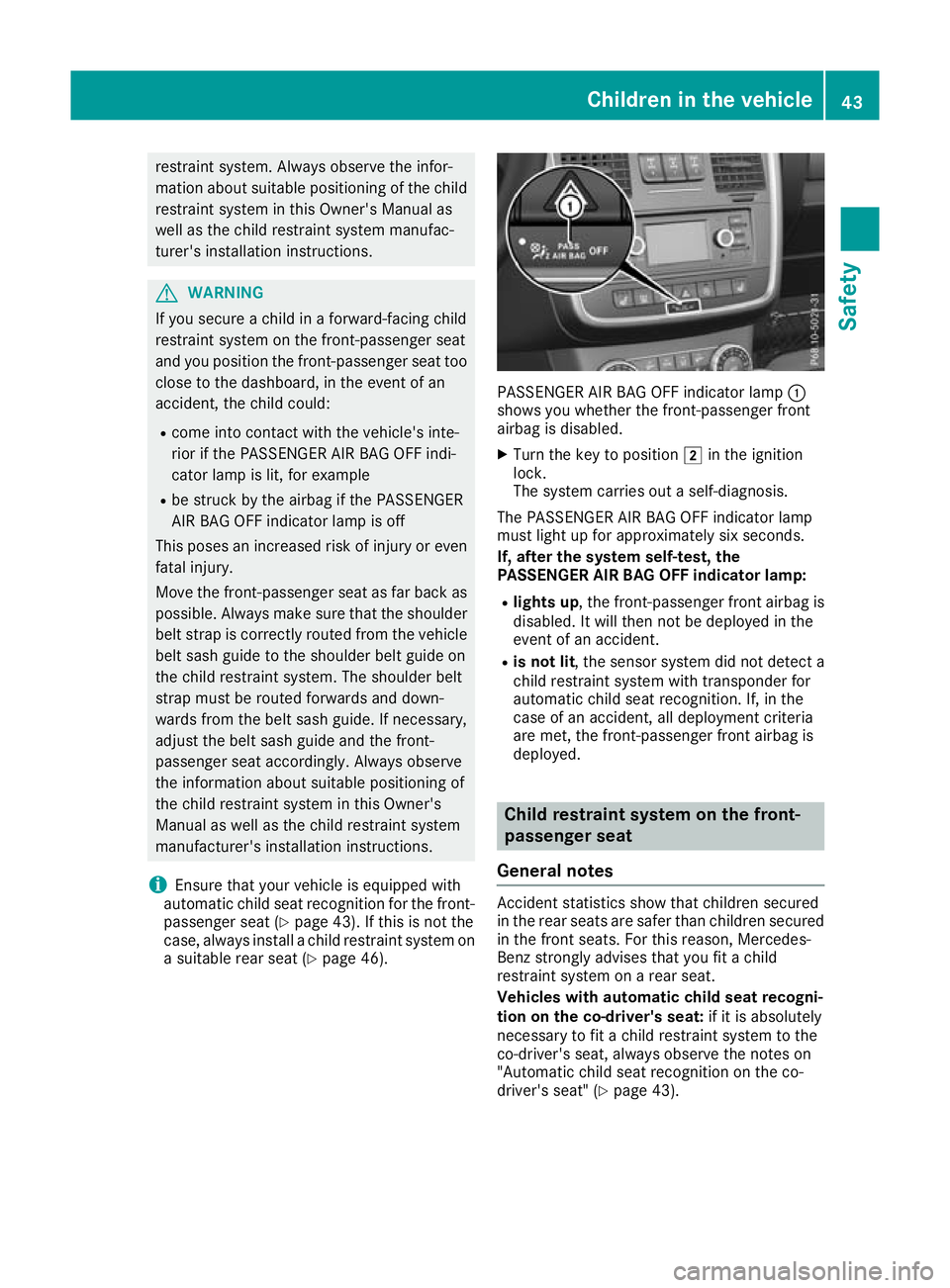
as uitable rear seat (Y page46). PASSENGER AIR BAG OFF indicato
rlamp :
shows you whether the front-passenger front
airbag is disabled.
X Turn the key to position 2in the ignition
lock.
The system carries out aself-diagnosis.
The PASSENGER AIR BAG OFF indicator lamp
must light up for approximately six seconds.
If, after the system self-test, the
PASSENGER AIR BAG OFF indicator lamp:
R lights up ,the front-passenger fronta irbag is
disabled. It will then not be deployed in the
event of an accident.
R is not lit ,the sensor system did not detect a
child restraint system with transponder for
automatic child seat recognition. If, in the
case of an accident ,all deployment criteria
are met, the front-passenger fronta irbag is
deployed. Childr
estraint system on th efront-
passenge rseat
General notes Accident statistics show that childre
nsecured
in the rea rseats ar esafer tha nchildren secured
in the front seats. For thi sreason, Mercedes-
Benz strongl yadvises tha tyou fitac hild
restraint system on arears eat.
Vehicles with automatic child seat recogni-
tio nont he co-driver' sseat:if it is absolutely
necessary to fit achild restraint system to the
co-driver' sseat, always observe the notes on
"Automatic child sea trecognitio nonthe co-
driver's seat" (Y page 43). Child
renint hevehicle
43Safety Z
Page 47 of 261
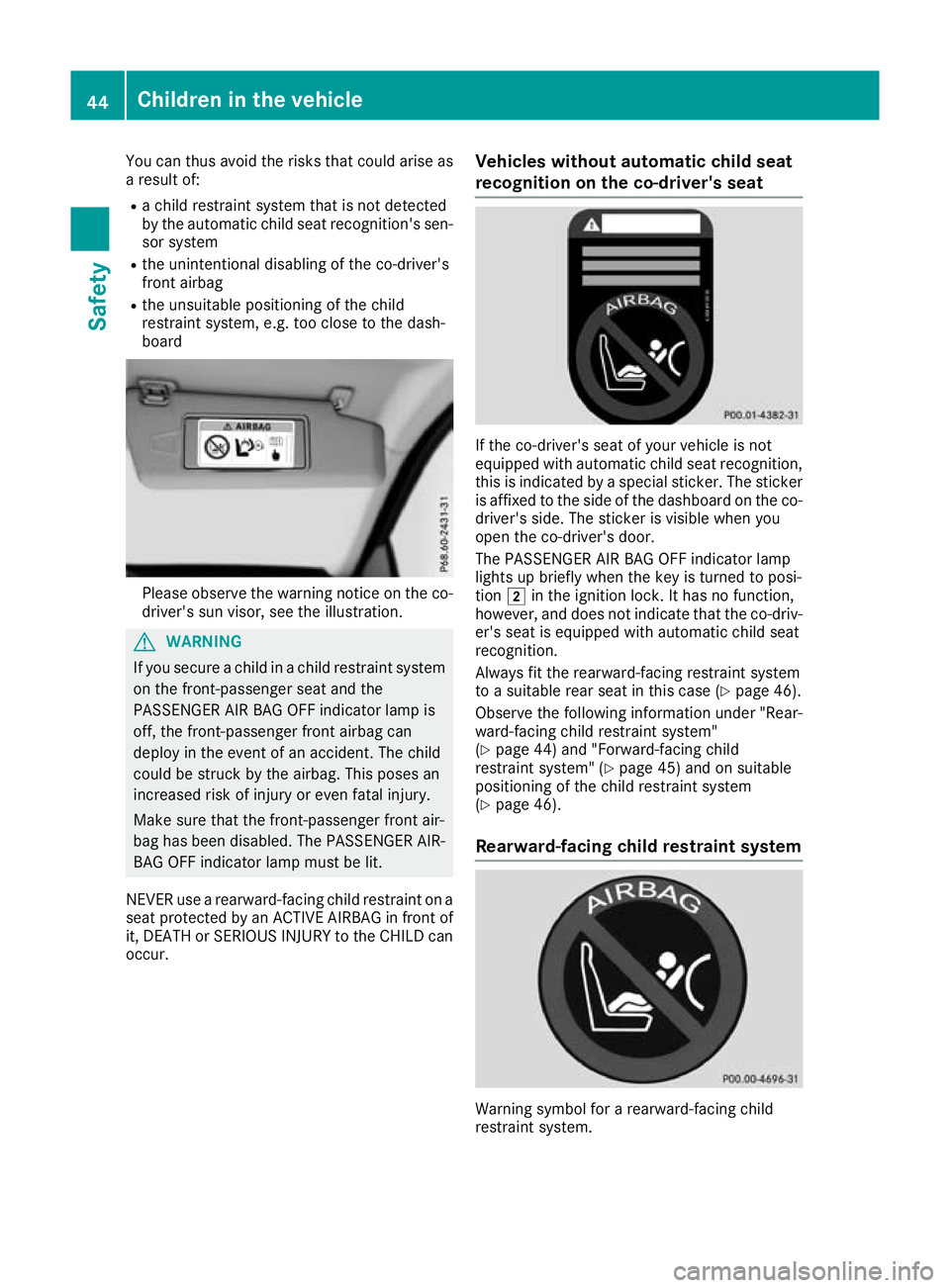
You can thus avoid the risk
sthat could arise as
ar esult of:
R ac hild restraint syste mthat is not detected
by the automatic child seat recognition' ssen-
sor system
R the unintentional disabling of the co-driver's
fron tairbag
R the unsuitable positionin gofthe child
restraint system, e.g. too close to the dash-
board Please observe the warning notice on the co-
driver' ssun visor, see the illustration. G
WARNING
If you secure achild in achild restraint system
on the front-passenge rseat and the
PASSENGER AIR BAG OFF indicator lamp is
off, the front-passenge rfront airbag can
deploy in the event of an accident. The child
coul dbes truck by the airbag. This poses an
increased risk of injury or even fatal injury.
Make sure that the front-passenge rfront air-
bag has been disabled. The PASSENGER AIR- BAG OFF indicator lamp must be lit.
NEVER use arearward-facing child restraint on a
seat protected by an ACTIVE AIRBAG in front of
it, DEATH or SERIOUS INJUR Ytothe CHILD can
occur. Vehicles without automatic child seat
recognitio nonthe co-driver' sseat If th
eco-driver's seat of yourv ehicle is not
equipped with automatic child seat recognition,
this is indicated by aspecia lsticker. The sticker
is affixed to the side of the dashboard on the co-
driver's side. The sticker is visible when you
open the co-driver's door.
The PASSENGER AIR BAG OFF indicator lamp
lights up briefl ywhen the key is turned to posi-
tion 2in the ignition lock. It has no function,
however, and does not indicate that the co-driv-
er's seat is equipped with automatic child seat
recognition.
Alwaysf it the rearward-facing restraint system
to as uitable rear seat in this case (Y page 46).
Observe the following information under "Rear-
ward-facing child restraint system"
(Y page 44) and "Forward-facing child
restraint system" (Y page 45) and on suitable
positioning of the child restraint system
(Y page 46).
Rearward-facing childr estraint system Warning symbo
lfor arearward-facing child
restraint system. 44
Children in the vehicleSafety
Page 75 of 261
When leaving the vehicle, alway
stake the key
with you and lock the vehicle. Never leave
children unattended in the vehicle.
The electrically adjustable steerin gwheel can
still be adjusted when there is no key in the igni-
tion lock. Adjust
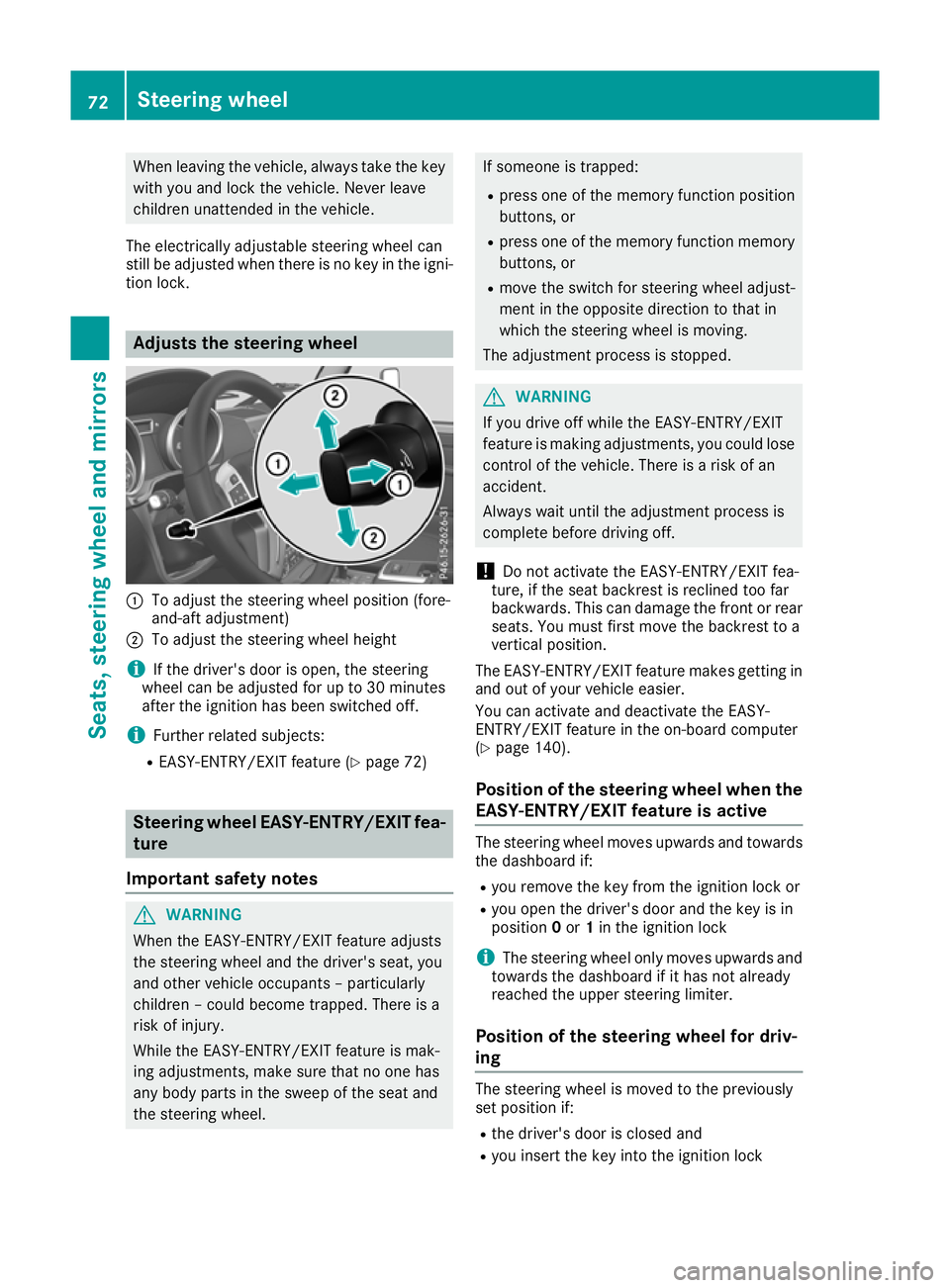
sthe steering wheel :
To adjust the steeri ngwheel position (fore-
and-aft adjustment)
; To adjust the steerin gwheel height
i If the driver's door is open, the steering
wheel can be adjusted for up to 30 minutes
after the ignition has been switched off.
i Further related subjects:
R EASY-ENTRY/EXIT feature (Y page 72)Steering wheel EASY-ENTRY/EXIT fea-
ture
Important safety notes G
WARNING
When the EASY-ENTRY/EXIT feature adjusts
the steering wheel and the driver's seat, you
and other vehicle occup ants –p articularly
children –couldb ecome trapped. There is a
risk of injury.
Whil ethe EASY-ENTRY/EXIT feature is mak-
ing adjustments, make sure that no one has
any body parts in the swee pofthe seat and
the steering wheel. If someone is trapped:
R press one of the memory function position
buttons, or
R press one of the memory function memory
buttons, or
R move the switch for steering wheel adjust-
ment in the opposite direction to that in
which the steering wheel is moving.
The adjustment process is stopped. G
WARNING
If you drive off while the EASY-ENTRY/EXIT
feature is making adjustments, you coul dlose
control of the vehicle. There is arisk of an
accident.
Always waitu ntil the adjustment process is
complete before driving off.
! Do not activate the EASY-ENTRY/EXIT fea-
ture, if the seat backrest is recline dtoo far
backwards. This can damage the front or rear seats. You must first move the backrest to a
vertical position.
The EASY-ENTRY/EXIT feature makes getting in
and out of yourv ehicleeasier.
You can activate and deactivate the EASY-
ENTRY/EXIT feature in the on-board computer
(Y page1 40).
Position of the steering wheel whent he
EASY-ENTRY/EXIT feature is active The steering wheel moves upwards and towards
the dashboard if:
R you remov ethe key from the ignition lock or
R you open the driver's door and the key is in
position 0or 1in the ignition lock
i The steerin
gwheel only moves upwards and
towards the dashboard if it has not already
reached the upper steerin glimiter.
Position of the steering wheel for driv-
ing The steerin
gwheel is moved to the previously
set position if:
R the driver's door is closed and
R you insert the key into the ignition lock 72
Steering wheelSeats, steering wheel and mirrors
Page 97 of 261
uncomfortable due to drafts
,procee dasfol-
lows:
XOpen th eside air vents.
X Open th ecentr eair vents.
X Open th erear air vents.
X Set th etem perature to 22 †.
The automatic climate control adjust sto
th es et temperature. Adjusting th
eair vents
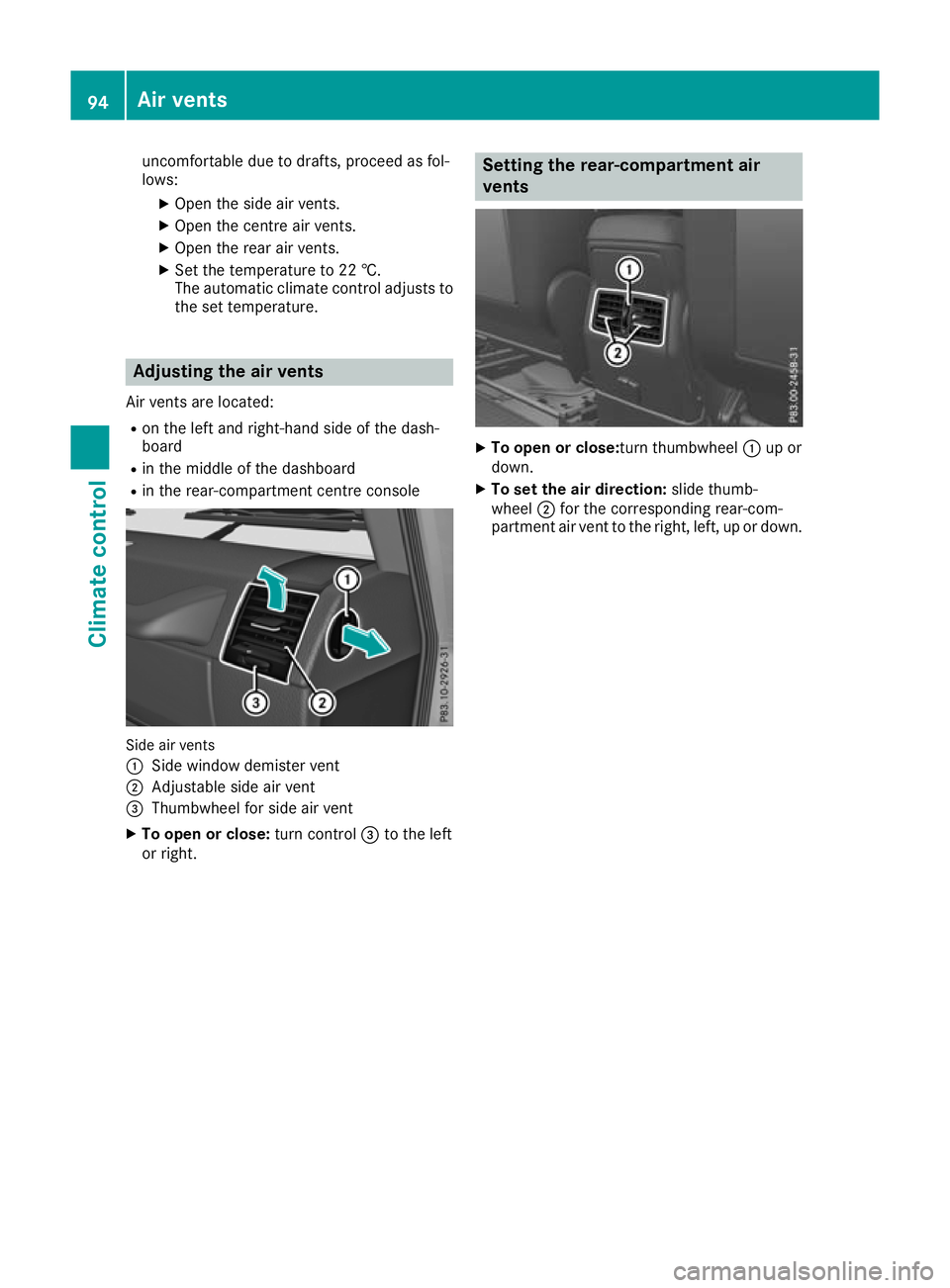
Air vents are located: R on th elefta nd right-hand side of th edash-
board
R in th emiddle of th edashboard
R in th erear-compartmen tcentre console Side air vents
:
Side windo wdemiste rvent
; Adjustable sid eairvent
= Thumbwhee lfor sid eairvent
X To ope norclose:turn control =to the left
or right. Settin
gthe rear-compartment air
vents X
To open or close:tur nthumbwheel :up or
down.
X To se tthe air direction: slidethumb-
wheel ;for the corresponding rear-com-
partment ai rvent to the right, left, up or down. 94
Airv
entsClimat econt rol
Page 235 of 261

In th
eevent of damage to th eengine,
transmission or electrical system X
Shift th etransfer cas etoneutral position
Neutral (Ypage 125).
X Shif tthe automatic transmissio ntoposition
N.
In the even tofdamage to the transfer
case Have the propeller shafts between the axles and
the transfe rcase removed.
In the event of damage to the front axle Have the propeller shaft between the rea
raxle
and the transfe rcase removed.
The nhavet he vehicle towe dawayw itht he front
axl eraised.
In the event of damage to the rear axle Have the propeller shaft between the front axle
and the transfe rcase removed.
The nhavet he vehicle towe dwitht he rea raxle
raised and wheel rollers unde rthe front axle. Tow-start
ing( em ergency engine
starting)
! Do not tow-start vehicles with automatic
transmission. Yo ucould otherwis edamage
the automatic transmission.
Yo uc an find informatio non"Jump-starting"
under (Y page 227). Fuses
Importan
tsafety notes G
WARNING
If yo umanipulate, bridge or replace afaulty
fuse with afuse of ahigher amperage ,the
electric cables coul dbeoverloaded. This may
result in afire. There is arisk of an accident
and injury.
Always replace faulty fuses with specified new fuses of the correct amperage. The fuses in your vehicle disconnect fault
ycir-
cuits. If afuse blows, all the components in the
circuit and their functions will fail.
Blown fuses must be replaced with fuses of the same rating, which you can recognise by the
colour and fuse rating. The fuse ratings are listed
in the fuse allocation chart (Y page 233).
If the newly inserted fuse also blows, have the
cause traced and rectified at aqualified special-
ist workshop, e.g. aMercedes-Benz Service
Centre.
! Only use fuses that have been approved for
Mercedes-Benz vehicles and which have the
correc tfuse rating for the system concerned.
Otherwise, components or systems could be
damaged.
! Make sure that no moisture can enter the
fuse box when the cover is open.
! When closing the cover, make sure that it is
lying correctly on the fuse box. Moisture seep-
ing in or dirt could otherwise impair the oper-
ation of the fuses. Bef
orer eplacing afuse
Observ ethe important safety notes
(Y page 232).
X Switch off the engine.
X Switch off al lelectrical consumers.
X Remove the key from the ignition lock.
All indicator lamps on the instrument cluster
must be off.
X Secure the vehicl eagain st rolling away
(Y page 113).
The fuses are locate dinvarious fus eboxes:
R Main fus eboxon the front-passenger side of
the dashboard
R Fus eboxin the front-passenger footwell
R Fus eboxin the transmission tunnel
R Fus eboxin the luggage compartment
The fus ealloc ation chart and the spare fuses are
in the fus eboxon the dashboard on the front-
passenger side (Y page 233).
The fus eextractor is in the vehicl etool kit
(Y page 223). 232
FusesBreakdo
wn assis tance
Page 236 of 261
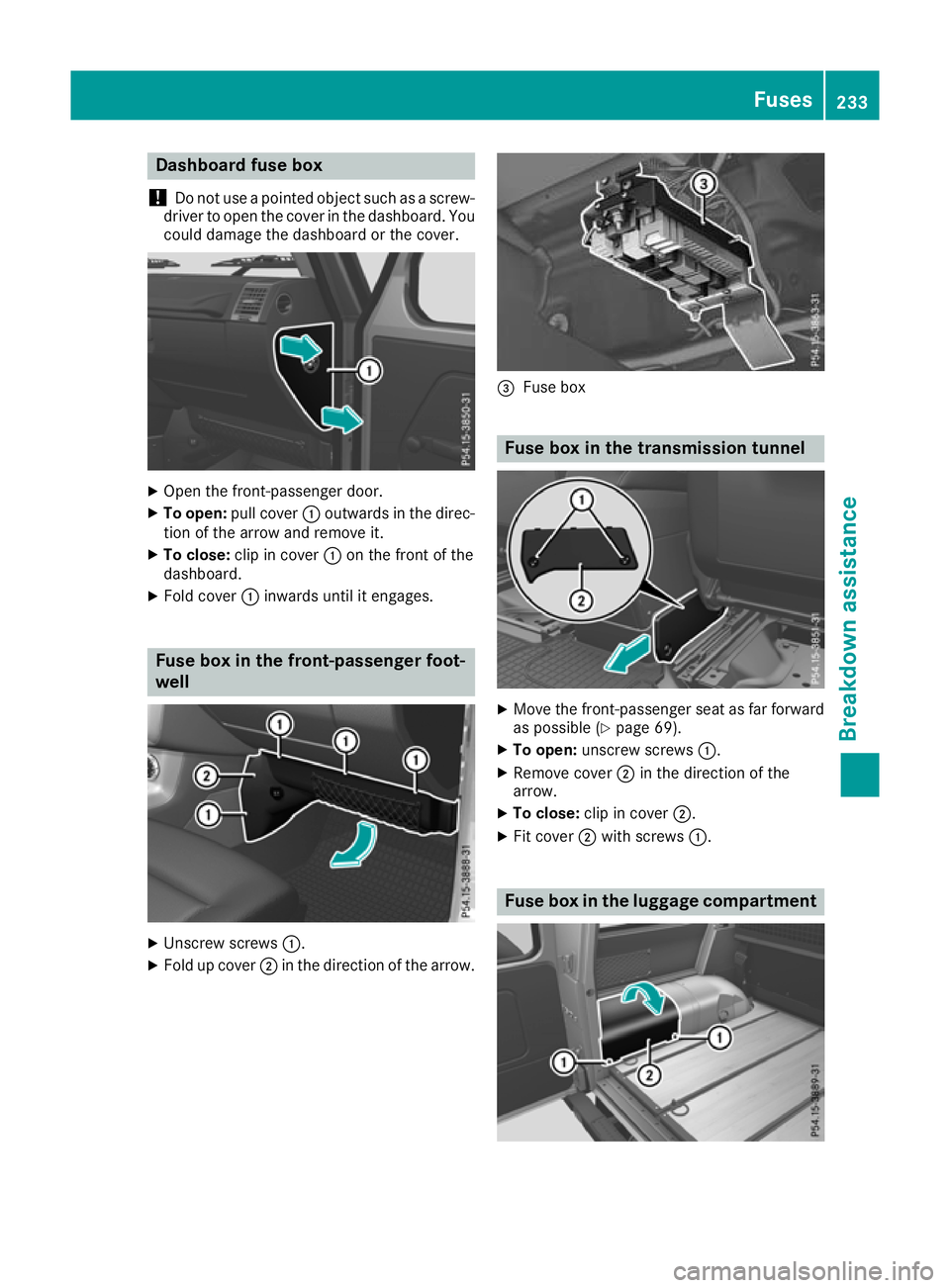
Dashboar
dfuseb ox
! Do no
tuse ap ointe dobjec tsuc hasas crew-
driver to ope nthe cover in th edashboard. You
could damage th edashboar dorthecover. X
Ope nthe front-passenger door.
X To open: pull cover :outwards in the direc-
tion of the arrow and remove it.
X To close: clip in cover :on the front of the
dashboard.
X Fold cover :inwards until it engages. Fus
ebox in th efront-passenger foot-
well X
Unscre wscrews :.
X Fold up cover ;in the direction of the arrow. =
Fuse box Fus
ebox in th etransmission tunnel X
Mov ethe front-passenger seat as far forward
as possible (Y page 69).
X To open: unscrew screws :.
X Remove cover ;in the direction of the
arrow.
X To close: clip in cover ;.
X Fit cover ;with screws :. Fus
ebox in th eluggage compartment Fuses
233Breakdown assistance Z