engine MERCEDES-BENZ G-CLASS SUV 2018 Owners Manual
[x] Cancel search | Manufacturer: MERCEDES-BENZ, Model Year: 2018, Model line: G-CLASS SUV, Model: MERCEDES-BENZ G-CLASS SUV 2018Pages: 549, PDF Size: 10.22 MB
Page 6 of 549
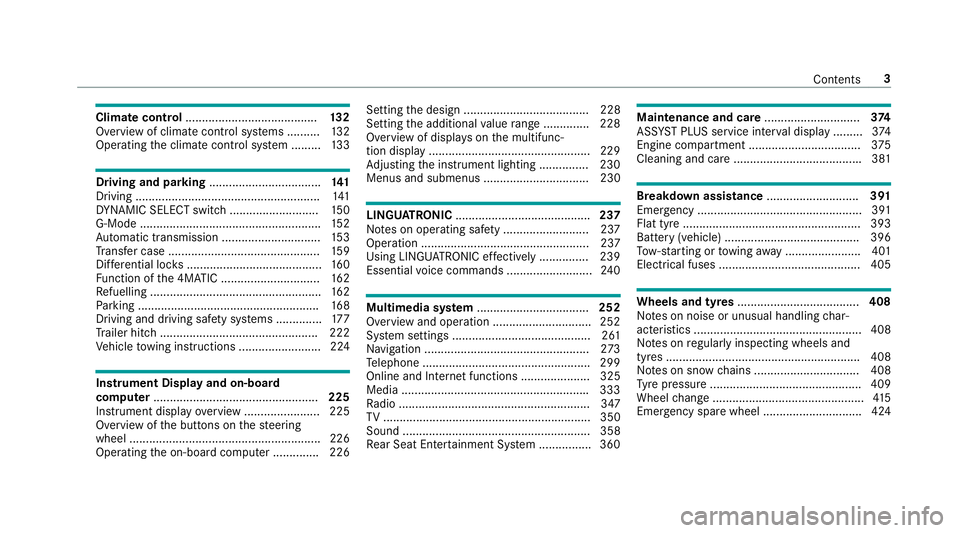
Climate control
........................................ 13 2
Overview of climate contro l systems ..........1 32
Operating the climate control sy stem ......... 13 3 Driving and pa
rking .................................. 141
Driving ........................................................ 141
DY NA MIC SELECT switch ........................... 15 0
G-Mode ...................................................... .152
Au tomatic transmission .............................. 15 3
Tr ans fer case .............................................. 15 9
Dif fere ntial lo cks ......................................... 16 0
Fu nction of the 4MATIC .............................. 16 2
Re fuelling .................................................... 16 2
Pa rking ...................................................... .168
Driving and driving saf ety sy stems .............. 17 7
Tr ailer hit ch................................................ 222
Ve hicle towing instructions ........................ .224 Instrument Display and on-board
compu ter.................................................. 225
Instrument display overview ...................... .225
Overview of the buttons on thesteering
wheel ..........................................................2 26
Operating the on-board computer .............. 226 Setting
the design ...................................... 228
Setting the additional value range .............. 228
Overview of displ ays on the multifunc‐
tion display .................................................2 29
Ad justing the instrument lighting ............... 230
Menus and submenus ................................ 230 LINGU
ATRO NIC ......................................... 237
No tes on operating saf ety .......................... 237
Ope ration ................................................... 237
Using LINGU ATRO NIC ef fectively ............... 239
Essential voice commands .......................... 24 0 Multimedia sy
stem .................................. 252
Overview and operation .............................. 252
Sy stem settings .......................................... 261
Na vigation .................................................. 273
Te lephone .................................................. .299
Online and Internet functions ..................... 325
Media ........................................................ .333
Ra dio .......................................................... 347
TV ............................................................... 350
Sound ......................................................... 358
Re ar Seat En tertainment Sy stem ................3 60 Maintenance and care
.............................374
ASS YST PLUS service inter val display ........ .374
Engine compartment .................................. 375
Cleaning and care ...................................... .381 Breakdown assistance
............................391
Emergency .................................................. 391
Flat tyre ...................................................... 393
Battery (vehicle) ......................................... 396
To w- starting or towing away ....................... 401
Electrical fuses ........................................... 405 Wheels and tyres
..................................... 408
No tes on noise or unusual handling char‐
acteristics .................................................. .408
No tes on regular lyinspecting wheels and
tyres .......................................................... .408
No tes on snow chains ................................ 408
Ty re pressure .............................................. 409
Wheel change .............................................. 41 5
Emergency spare wheel .............................. 424 Contents
3
Page 7 of 549
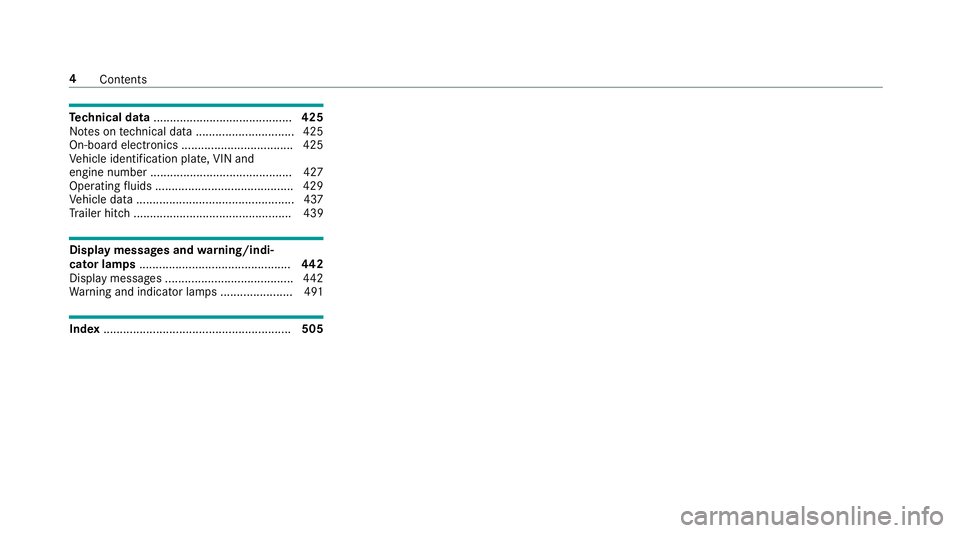
Te
ch nical data .......................................... 425
No tes on tech nical da ta.............................. 425
On-board electronics .................................. 425
Ve hicle identification plate, VIN and
engine number ...........................................4 27
Operating fluids .......................................... 429
Ve hicle data ................................................ 437
Tr ailer hit ch................................................ 439 Displ
aymessages and warning/indi‐
cator lamps .............................................. 442
Displ aymessa ges ....................................... 442
Wa rning and indicator lamps ...................... 491 Index
......................................................... 5054
Contents
Page 12 of 549
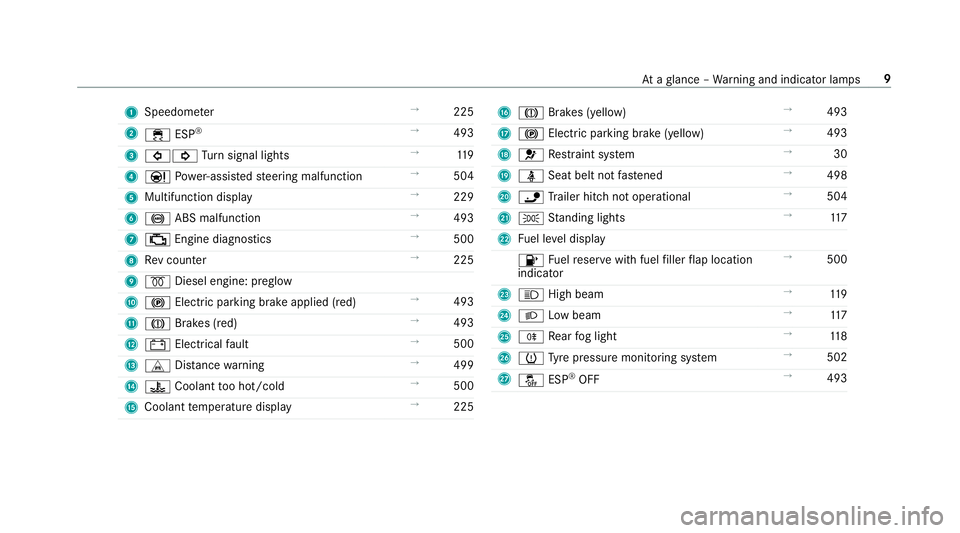
1
Speedom eter →
225
2 ÷ ESP®
→
493
3 #! Turn signal lights →
11 9
4 Ð Powe r-assis tedsteering malfunction →
504
5 Multifunction display →
229
6 ! ABS malfunction →
493
7 ; Engine diagnostics →
500
8 Rev counter →
225
9 % Diesel engine: preglow
A ! Electric parking brake applied (red) →
493
B J Brakes (red) →
493
C # Electrical fault →
500
D L Distance warning →
499
E ? Coolant too hot/cold →
500
F Coolant temp erature display →
225 G
J Brakes (yellow) →
493
H ! Electric pa rking brake (yellow) →
493
I 6 Restra int sy stem →
30
J ü Seat belt not fastened →
498
K ï Trailer hit chnot operational →
504
L T Standing lights →
11 7
M Fuel le vel display
8 Fuelreser vewith fuel filler flap location
indicator →
500
N K High beam →
11 9
O L Low beam →
11 7
P R Rear fog light →
11 8
Q h Tyre pressure monitoring sy stem →
502
R å ESP®
OFF →
493 At
aglance – Warning and indicator lamps 9
Page 14 of 549
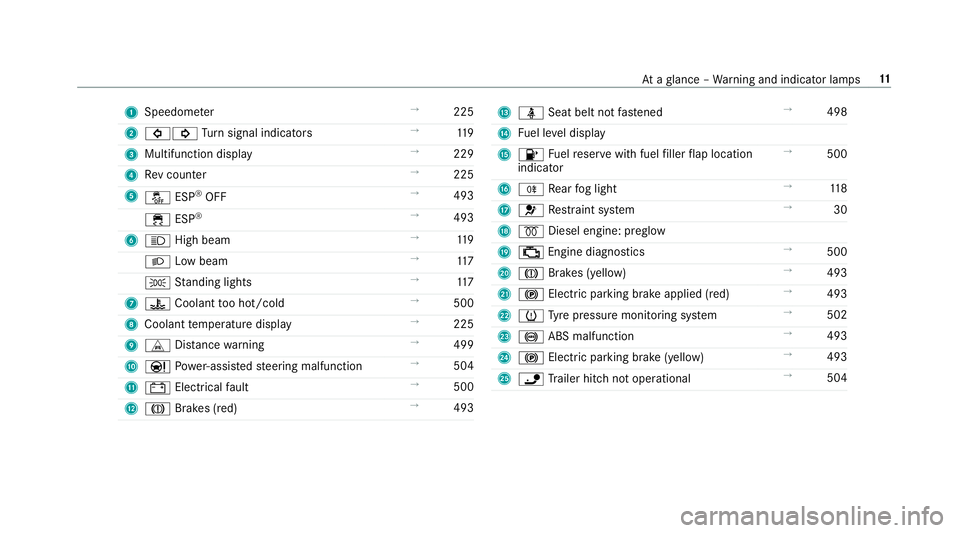
1
Speedom eter →
225
2 #! Turn signal indicators →
11 9
3 Multifunction display →
229
4 Rev counter →
225
5 å ESP®
OFF →
493
÷ ESP®
→
493
6 K High beam →
11 9
L Low beam →
11 7
T Standing lights →
11 7
7 ? Coolant too hot/cold →
500
8 Coolant temp erature display →
225
9 L Distance warning →
499
A Ð Powe r-assis tedsteering malfunction →
504
B # Electrical fault →
500
C J Brakes (red) →
493 D
ü Seat belt not fastened →
498
E Fuel le vel display
F 8 Fuelreser vewith fuel filler flap location
indicator →
500
G R Rear fog light →
11 8
H 6 Restra int sy stem →
30
I % Diesel engine: preglow
J ; Engine diagnostics →
500
K J Brakes (yellow) →
493
L ! Electric pa rking brake applied (red) →
493
M h Tyre pressure monitoring sy stem →
502
N ! ABS malfunction →
493
O ! Electric pa rking brake (yellow) →
493
P ï Trailer hit chnot operational →
504 At
aglance – Warning and indicator lamps 11
Page 22 of 549
Pr
otection of the environment
+ ENVIRONMENTAL
NOTEEnvironmental
dama gedue tooperating conditions and
personal driving style The pollutant emission of
your vehicle is
directly related tothewa yyo u operate your
ve hicle.
Help toprotect the environment byoperating
yo ur vehicle in an environmentally responsi‐
ble manner. Please obser vethefo llowing rec‐
ommendations on ope rating conditions and
pe rsonal driving style.
Operating conditions: #
Make sure that the tyre pressure is cor‐
re ct. #
Do not car ryany unnecessary weight
(e.g. roof luggage rack s once you no
lon ger need them). #
Adhere tothe service inter vals.
A regularly serviced vehicle will contri b‐
ute toenvironmen tal pr otection. #
Alw ays ha vemaintenance workcar ried
out at a qualified specialist workshop.
Pe rsonal driving style: #
Do not depress the accelera tor pedal
when starting the engine. #
Do not warm upthe engine while the
ve hicle is stationar y. #
Drive carefully and maintain a suitable
di st ance from theve hicle in front. #
Avoid frequent, sudden acceleration
and braking. #
Change gear in good time and use each
ge ar on lyup toÔ of its maximum
engine speed. #
Switch off the engine in stationary traf‐
fi c, e.g. byusing the ECO start/ stop
function. #
Drive fuel-ef ficiently. Obser vethe ECO
display for a fuel-ef ficient driving style. Ta
ke -back of end-of-life vehicles
EU countries onl y:
Mercedes-Benz will take back your end-of-life
ve hicle for environment-friendly disposal in
accordance with the European Union(EU) End-
of-Life Vehicles Directive.
A network of vehicle take -ba ckpoints and dis‐
mantlers has been es tablished foryo uto return
yo ur vehicle. You can lea veit at any of these
points free of charge . This makes an impor tant
contribution toclosing there cycling circle and
conse rving resources.
Fo r fur ther information about there cycling and
disposal of end-of-li fevehicles, and theta ke-
back conditions, please visit the national
Mercedes-Benz website foryo ur count ry. Gene
ral no tes 19
Page 50 of 549
Only use
child restra int sy stems which are in
proper working condition &
WARNING Risk of inju ryor death caused
by the use of damaged child restra int
sy stems
Child restra int sy stems or their retaining sys‐
te ms that ha vebeen subjec tedto a load in
an accident may then not be able toper form
th eir intended pr otective function.
The child cannot be restra ined in theeve nt of
an accident, heavy braking or a sudden
ch ange of direction. #
Alw aysre place child restra int sy stems
immediately that ha vebeen damaged or
in vo lved in an accident. #
Have the securing sy stems forth ech ild
re stra int sy stems checked at a qualified
specialist workshop before ins talling a
ch ild restra int sy stem again. Av
oiding direct sunlight &
WARNING Risk of bu rns when thech ild
seat is exposed todirect sunlight
If th ech ild restra int sy stem is exposed to
direct sunlight or heat, parts could heat up.
Children could suf fer burns on these parts,
particularly on me tallic parts of thech ild
re stra int sy stem. #
Alw ays make sure that thech ild
re stra int sy stem is not exposed to
direct sunlight. #
Protect it with a blank et,fo rex ample. #
Ifth ech ild restra int sy stem has been
ex posed todirect sunlight, allow it to
cool before secu ring a child into it. #
Never lea vechildren unat tended in the
ve hicle. Obser
vewhen stopping or parking &
WARNING Risk of accident and inju ry
due tochildren and animals left unat ten‐
ded in theve hicle
If yo u lea vechildren and animals unat tended
in theve hicle, they may be able toset the
ve hicle in motion, forex ample by:
R releasing the parking brake
R shifting the automatic transmission out of
park position j.
R starting the engine.
In addition, they may operate vehicle equip‐
ment and become trapped. #
Never lea vechildren and animals unat‐
te nded in theve hicle. #
When leaving theve hicle, alw aysta ke
th eke y with you and lock theve hicle. Occupant saf
ety47
Page 71 of 549

outlet of
theve hicle tothe shoulder belt
guide on thech ild restra int sy stem.
The shoulder belt stra p must be routed for‐
wa rds and down wards from the seat belt out‐
let. #
If necessar y,adjust the seat belt outlet and
th e front passenger seat according ly.Child saf
ety loc ks Ac
tivating/deactivating the child saf ety lock
fo r the rear doors &
WARNING Risk of accident and inju ry
due tochildren and animals left unat ten‐
ded in theve hicle
If yo u lea vechildren and animals unat tended
in theve hicle, they may be able toset the
ve hicle in motion, forex ample by:
R releasing the parking brake
R shifting the automatic transmission out of
park position j.
R starting the engine. In addition,
they may operate vehicle equip‐
ment and become trapped. #
Never lea vechildren and animals unat‐
te nded in theve hicle. #
When leaving theve hicle, alw aysta ke
th eke y with you and lock theve hicle. &
WARNING Risk offata l injury due to
ex posure toextreme heat or cold in the
ve hicle
If people –particularly children – are exposed
to extreme temp eratures over an extended
pe riod of time, there is a risk of serious or
ev en fata l injury! #
Never lea veanyone – pa rticularly chil‐
dren – unat tended in theve hicle. #
Never lea veanimals in theve hicle unat‐
te nded. &
WARNING Risk of accident and inju ry
due tochildren left unat tended in the
ve hicle
When children are tra velling in theve hicle,
th ey could:
R open doo rs,th ereby endangering other
people or road users
R get out of theve hicle and be hit bytraf fic
R operate vehicle equipment and become
trapped, forex ample #
When children are tra velling in theve hi‐
cle, alw ays activate theav ailable child
saf ety loc ks. #
Never lea vechildren unat tended in the
ve hicle. #
When leaving theve hicle, alw aysta ke
th eke y with you and lock theve hicle. Child saf
ety loc ksforth ere ar doors and there ar
side wind owsareavailable.
The child saf ety lock on there ar doors secures
each door separatel y.The doors can no longer
be opened from the inside. 68
Occupant saf ety
Page 74 of 549
Key
Overview of
key functions &
WARNING Risk of accident and inju ry
due tochildren left unat tended in the
ve hicle
If ch ildren are left unat tended in theve hicle,
th ey could:
R open doo rs,th ereby endangering other
persons or road users.
R get out of theve hicle and be hit by
oncoming traf fic.
R ope rate ve hicle equipment and become
trapped, forex ample.
In addition, children could also set theve hi‐
cle in motion, forex ample, by:
R releasing the parking brake.
R shifting the automatic transmission out of
park position jor shifting manual trans‐
mission into neutral.
R starting the engine. #
When leaving theve hicle, alw aysta ke
th eke y with you and lock theve hicle. #
Never lea vechildren and animals unat‐
te nded in theve hicle. #
Keep theve hicle key out of reach of
ch ildren. *
NO
TEDama getotheke y caused by
magnetic fields #
Keep theke yaw ay from strong mag‐
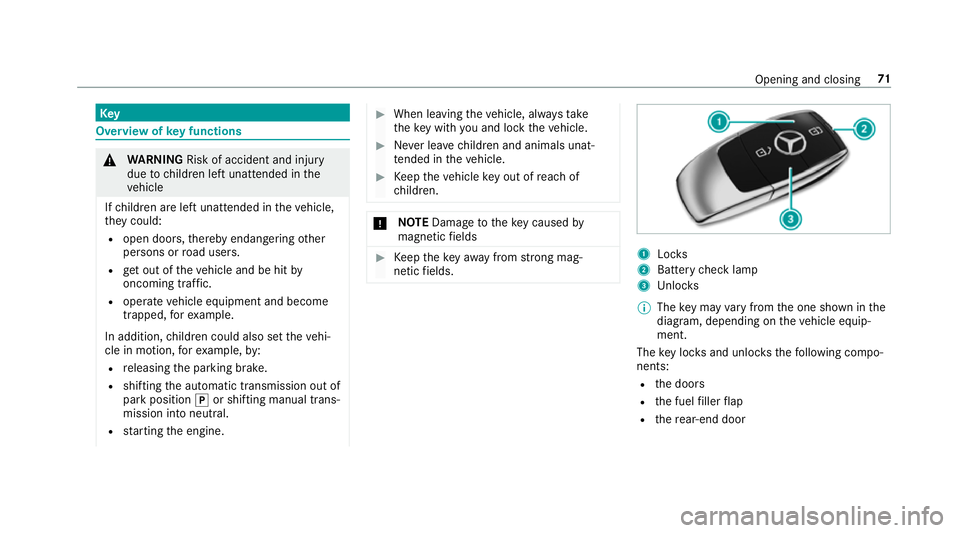
netic fields. 1
Locks
2 Battery check lamp
3 Unloc ks
% The key may vary from the one shown in the
diagram, depending on theve hicle equip‐
ment.
The key loc ksand unlo cksth efo llowing compo‐
nents:
R the doors
R the fuel filler flap
R there ar-end door Opening and closing
71
Page 80 of 549
#
Tounlo ck:turn the emer gency key anti-
clo ckwise as far as it will go toposition 1. #
Tolock: turnthe emer gency key clo ckwise
as far as it will go toposition 2. Re
ar-end door Opening and closing
there ar-end door &
DANG ER Risk of poisoning from exhaust
ga ses
Combustion engines emit poisonous exhaust
ga ses, such as carbon monoxide. Exhaust
ga ses can enter theve hicle interior if the
re ar-end door is open when the engine is
ru nning, especial lyifth eve hicle is in motion. #
Alw ays switch off the engine before
opening there ar-end door. #
Never drive with there ar-end door
open. &
WARNING Risk of inju ryfrom unsecu red
items in theve hicle
If objects, luggage or loads are not secured
or not secured suf ficientl y,they could slip,
tip ove r or be throw n around and thereby hit
ve hicle occupants.
There is a risk of injur y,particularly in the
ev ent of sudden braking or a sudden change
in direction. #
Alw aysstow objects in such a wayth at
th ey cannot be thro wn around. #
Before the journe y,secure objects, lug‐
ga ge or loads against slipping or tipping
ove r. *
NO
TEDama gewhen opening there ar-
end door The
rear-end door swings out tothe side
when it is opened. #
Ensure that there is suf ficient clear‐
ance. #
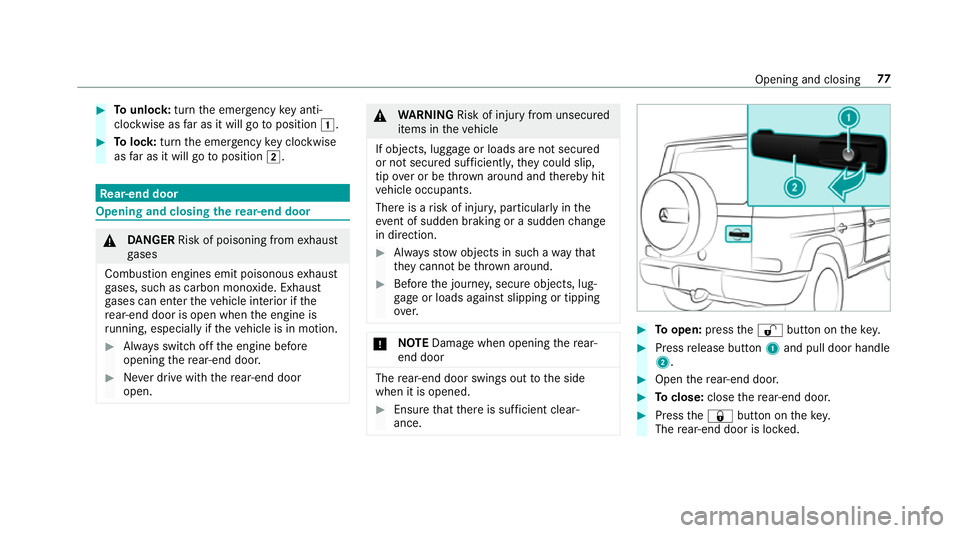
Toopen: pressthe% button on thekey. #
Press release button 1and pull door handle
2. #
Open there ar-end door. #
Toclose: closethere ar-end door. #
Press the& button on thekey.
The rear-end door is loc ked. Opening and closing
77
Page 90 of 549

Note
s onthe cor rect driver's seat position &
WARNING Risk of inju rythro ugh adjust‐
ing vehicle settings while theve hicle is in
motion
Yo u could lose cont rol of theve hicle in the
fo llowing situations:
R ifyo u adjust the driver's seat, the head
re stra ints, thesteering wheel or the mir‐
ro r while theve hicle is in motion
R ifyo ufast enyour seat belt while theve hi‐
cle is in motion #
Before starting the engine: adjust the
driver's seat, the head restra ints, the
st eering wheel or the mir ror and fasten
yo ur seat belt. Ensure
thefo llowing when adjusting thesteering
wheel 1, seat belt 2and driver's seat 3:
R you are as faraw ay from the driver's airbag
as possible
R you are sitting in an upright position
R your thighs are slight lysuppor tedby the seat
cushion R
your legs are not fully extended and you can
depress the pedals properly
R the back of your head is suppo rted at eye
le ve lby the cent reofthe head restra int
R you can hold thesteering wheel with your
arms slightly bent
R you can mo veyour legs freely
R you can see all the displa yson the instru‐
ment clus ter clea rly
R you ha vea good overview of the traf fic con‐
ditions
R your seat belt is pulled snug lyagainst your
body and is routed across the cent reofyour
shoulder and across your hips in the pelvic
area Seats and
stowing 87