tires MERCEDES-BENZ G500 2002 W463 Owner's Manual
[x] Cancel search | Manufacturer: MERCEDES-BENZ, Model Year: 2002, Model line: G500, Model: MERCEDES-BENZ G500 2002 W463Pages: 385, PDF Size: 30.37 MB
Page 6 of 385

3 Contents
DrivingControl and operation of
radio transmitters ..................... 190
The first 1 000 miles
(1 500 km) ................................. 191
Maintenance ................................... 191
Tele Aid ........................................... 192
Catalytic converter ........................202
Emission control ............................203
Starter switch .................................204
Starting and turning off
the engine ..................................206
Automatic transmission ...............207
Parking brake ................................. 215Driving instructions ....................... 216
Drive sensibly – save fuel ......... 216
Drinking and driving ................. 216
Pedals ........................................... 216
Power assistance .........................217
Brakes ...........................................217
Driving off ....................................218
Parking ......................................... 219
Tires .............................................. 219
Snow chains ............................... 222
Winter driving instructions ..... 222
Deep water .................................. 224
Passenger compartment ........... 225
Traveling abroad ........................ 225
Off-Road driving ............................ 226
Cruise control ................................ 234
Brake assist system
(BAS) .......................................... 237Antilock brake system
(ABS) ...........................................239
Four-wheel electronic traction system
(4-ETS) ........................................ 241
Electronic Brake Booster
(EBB) ...........................................242
Electronic stability program
(ESP) ...........................................243
Transfer case ..................................247
Switching transfer case .............248
A few words about differentials
and differential locks ............... 251
Differential locks ............................253
What you should know
at the gas station .......................258
Check regularly and before a long
trip ............................................... 261
J_G463.book Seite 3 Mittwoch, 19. September 2001 8:06 08
Page 192 of 385
189 Contents - Driving
Te ch n i c a l
data Instruments
and controlsOperationDrivingInstrument
cluster displayPractical hints Car care Index
DrivingControl and operation of radio
transmitters ............................... 190
The first 1 000 miles
(1 500 km) ................................. 191
Maintenance ................................... 191
Tele Aid ........................................... 192
Catalytic converter ........................202
Emission control ............................203
Starter switch .................................204
Starting and turning off
the engine ..................................206
Automatic transmission ...............207
Parking brake ................................. 215Driving instructions ....................... 216
Drive sensibly – save fuel ......... 216
Drinking and driving ................. 216
Pedals ........................................... 216
Power assistance .........................217
Brakes ...........................................217
Driving off ....................................218
Parking ......................................... 219
Tires .............................................. 219
Snow chains ............................... 222
Winter driving instructions ..... 222
Deep water .................................. 224
Passenger compartment ........... 225
Traveling abroad ........................ 225
Off-Road driving ............................ 226
Cruise control ................................ 234Brake assist system
(BAS) ...........................................237
Antilock brake system
(ABS) ...........................................239
Four-wheel electronic
traction system (4-ETS) ............ 241
Electronic Brake Booster
(EBB) ...........................................242
Electronic stability program
(ESP) ...........................................243
Transfer case ..................................247
Switching transfer case .............248
A few words about differentials
and differential locks ............... 251
Differential locks ............................253
What you should know at
the gas station ...........................258
Check regularly and before a long
trip ............................................... 261
J_G463.book Seite 189 Mittwoch, 19. September 2001 8:06 08
Page 219 of 385
216 Driving instructions
Te ch n i c a l
data Instruments
and controlsOperationDrivingInstrument
cluster displayPractical hints Car care Index
Driving instructions
Drive sensibly – save fuel
Fuel consumption, to a great extent, depends on driving
habits and operating conditions.
To save fuel you should:
•keep tires at the recommended inflation pressures,
•remove unnecessary loads,
•allow engine to warm up under low load use,
•avoid frequent acceleration and deceleration,
•have all maintenance work performed at regular
intervals by an authorized Mercedes-Benz Light
Truck Center.
Fuel consumption is also increased by driving in cold
weat her, in stop -and -go traf f ic, on short trip s an d in hilly
country.Drinking and driving
Ped al s
Wa r n i n g !
Drinking or taking drugs and driving can be a very
dangerous combination. Even a small amount of
alcohol or drugs can affect your reflexes,
perceptions and judgement.The possibility of a serious or even fatal accident is
sharply increased when you drink or take drugs
and drive.Please do not drink or take drugs and drive or allow
anyone to drive after drinking or taking drugs.Wa r n i n g !
Keep driver’s foot area clear at all times. Objects
stored in this area may impair pedal movement.
J_G463.book Seite 216 Mittwoch, 19. September 2001 8:06 08
Page 222 of 385
219 Driving instructions
Te ch n i c a l
data Instruments
and controlsOperationDrivingInstrument
cluster displayPractical hints Car care Index Parking
Important!
It is advisable to set the parking brake whenever
parking or leaving the vehicle. In addition, move
selector lever to position “P”.
When parking on hills, always set the parking brake.Tires
Tread wear indicators (TWI) are required by law. These
indicators are located in six places on the tread
circumference and become visible at a tread depth of
approximately
1/16in (1.5 mm), at which point the tire is
considered worn and should be replaced.
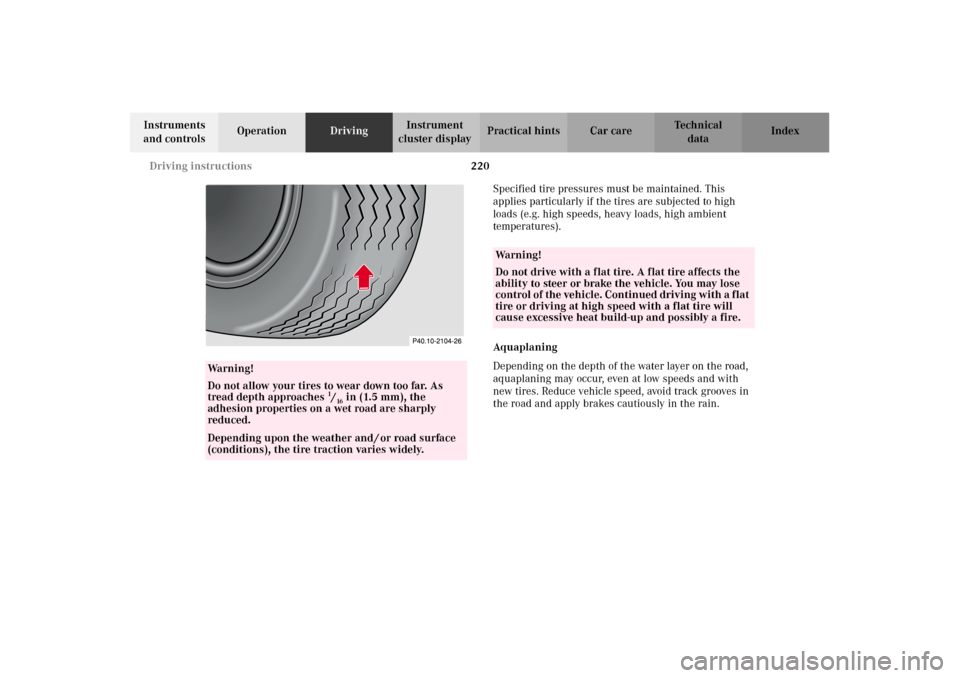
The tread wear indicator appears as a solid band across
the tread.
Note:
For instructions on towing the vehicle, see page 324.
Wa r n i n g !
To reduce the risk of personal injury as a result of
vehicle movement, before
turning off the engine
and leaving the vehicle, always:
1. Keep right foot on the service brake pedal.
2. Pull the parking brake lever up as many
notches as possible.
3. Move the selector lever to position “P”.
4. Slowly release the service brake pedal.
5. Turn front wheels towards the road curb.
6. Turn the electronic key to starter switch
position 0 and remove.
7. Take the key and lock vehicle when leaving.
Wa r n i n g !
If you feel a sudden significant vibration or ride
disturbance, or you suspect that possible damage to
your vehicle has occurred, you should turn on the
hazard warning flashers, carefully slow down, and
drive with caution to an area which is a safe
distance from the roadway.Inspect the tires and under the vehicle for possible
damage. If the vehicle or tires appear unsafe, have
it towed to the nearest Mercedes-Benz Light Truck
Center or tire dealer for repairs.
J_G463.book Seite 219 Mittwoch, 19. September 2001 8:06 08
Page 223 of 385
220 Driving instructions
Te ch n i c a l
data Instruments
and controlsOperationDrivingInstrument
cluster displayPractical hints Car care Index
Specified tire pressures must be maintained. This
applies particularly if the tires are subjected to high
loads (e.g. high speeds, heavy loads, high ambient
temperatures).
Aquaplaning
Depending on the depth of the water layer on the road,
aquaplaning may occur, even at low speeds and with
new tires. Reduce vehicle speed, avoid track grooves in
the road and apply brakes cautiously in the rain.
Wa r n i n g !
Do not allow your tires to wear down too far. As
tread depth approaches
1/16in (1.5 mm), the
adhesion properties on a wet road are sharply
reduced.
Depending upon the weather and / or road surface
(conditions), the tire traction varies widely.
Wa r n i n g !
Do not drive with a flat tire. A flat tire affects the
ability to steer or brake the vehicle. You may lose
control of the vehicle. Continued driving with a flat
tire or driving at high speed with a flat tire will
cause excessive heat build-up and possibly a fire.
J_G463.book Seite 220 Mittwoch, 19. September 2001 8:06 08
Page 224 of 385
221 Driving instructions
Te ch n i c a l
data Instruments
and controlsOperationDrivingInstrument
cluster displayPractical hints Car care Index Tire traction
The safe speed on a wet, snow covered or icy road is
always lower than on a dry road.
You should pay particular attention to the condition of
the road whenever the outside temperatures are close to
the freezing point.
We recommend M+S rated radial-ply tires with a
minimum tread depth of approximately 1/8 in (4 mm)
for the winter season for all four wheels to insure
normal balanced handling characteristics. On packed
snow, they can reduce your stopping distance as
compared with summer tires. Stopping distance,
however, is still considerably greater than when the
road is not snow or ice covered.Tire speed rating
Your vehicle is factory equipped with “V”-rated tires,
which have a speed rating of 150 mph (240 km / h).
An electronic speed limiter prevents your vehicle from
exceeding the tire speed rating.
Despite the tire rating, local speed limits should be
obeyed. Use prudent driving speeds appropriate to
prevailing conditions.
Wa r n i n g !
If ice has formed on the road, tire traction will be
substantially reduced. Under such weather
conditions, drive, steer and brake with extreme
caution.
Wa r n i n g !
Even when permitted by law, never operate a
vehicle at speeds greater than the maximum speed
rating of the tires.Exceeding the maximum speed for which tires are
rated can lead to sudden tire failure causing loss of
vehicle control and resulting in personal injury
and possible death.
J_G463.book Seite 221 Mittwoch, 19. September 2001 8:06 08
Page 226 of 385
223 Driving instructions
Te ch n i c a l
data Instruments
and controlsOperationDrivingInstrument
cluster displayPractical hints Car care Index Road salts and chemicals can adversely affect braking
efficiency. Increased pedal force may become necessary
to produce the normal brake effect. We therefore
recommend depressing the brake pedal periodically
when traveling at length on salt-strewn roads. This can
bring road salt impaired braking efficiency back to
normal. A prerequisite is, however, that this be done
without endangering other drivers on the road.
If the vehicle is parked after being driven on salt treated
roads, the braking ef ficiency should be tested as soon as
possible after driving is resumed while observing the
safety rules in the previous paragraph.Winter driving
Have your vehicle winterized at your authorized
Mercedes-Benz Light Truck Center before the onset of
winter.
•Check the engine oil. Change the engine oil if the
engine contains an oil which is not approved for
winter operation. For viscosity (SAE / CCMC class)
and filling quantity, see page 361.
•Check engine coolant anticorrosion / antifreeze
concentration.
•Additive for the windshield washer and headlamp
cleaning system: Add MB Concentrate “S” to a
premixed windshield washer solvent / antifreeze
which is form ulated for b elow f r eezin g temperatures
see page 307.
•Test battery: Battery capacity drops with decreasing
ambient temperature. A well charged battery helps
to ensure that the engine can be started, even at low
ambient temperatures.
•Tires: We recommend M+S rated radial-ply tires on
all four wheels for the winter season. Observe
permissible maximum speed for M+S rated
radial-ply tires and the legal speed limit.
Wa r n i n g !
If the vehicle becomes stuck in snow, make sure
that snow is kept clear of the exhaust pipe and
from around the vehicle with engine running.
Otherwise, deadly carbon monoxide (CO) gases may
enter vehicle interior resulting in unconsciousness
and death.To assure sufficient fresh air ventilation, open a
window slightly on the side of the vehicle not
facing the wind.
J_G463.book Seite 223 Mittwoch, 19. September 2001 8:06 08
Page 227 of 385
224 Driving instructions
Te ch n i c a l
data Instruments
and controlsOperationDrivingInstrument
cluster displayPractical hints Car care Index
In winter operation, the maximum effectiveness of the
antilock brake system (ABS), the four wheel electronic
traction system (4-ETS), the electronic stability program
(ESP), and electronic brake booster (EBB) can only be
achieved with M+S rated radial-ply tires and / or snow
chains recommended by Mercedes-Benz. Snow chains
maximize performance.
For driving instructions using snow chains see
page 222.Deep water
Caution!
Do not drive through flooded areas or water of unknown
depth. Before driving through water, determine its
depth. It should not be deeper than approximately
20 inches (50 cm).
If you must drive through deep water, drive slowly to
prevent water from entering the engine compartment or
passenger compartment, being ingested by the air
intake, possibly causing damage to electrical
components or wiring, to engine or transmission that is
not covered by the Mercedes-Benz Limited Warranty.
J_G463.book Seite 224 Mittwoch, 19. September 2001 8:06 08
Page 230 of 385
227 Driving instructions
Te ch n i c a l
data Instruments
and controlsOperationDrivingInstrument
cluster displayPractical hints Car care Index Be especially careful when driving in unknown
territory. It is good practice to get out of the vehicle and
scout the path you intend to take.
Continuous and speedy driving in sandy soil overcomes
the vehicle rolling resistance, and helps to prevent the
vehicle from sinking into the ground. Switch on the
differential locks, see page 253.
Do not initiate jumps with the vehicle. It interrupts the
forward momentum of the vehicle.
Always drive on slopes with the engine running and the
vehicle in gear.
Sand, dirt, mud and other material having friction
property, can cause exceptional wear and tear as well as
failure of the brakes.
In this case the brakes may be less effective or even fail
when you most need them. Always clean and check the
brakes following each off-road trip.Checklist before off-road driving
• Engine oil level: Check the engine oil level, see
page 127 and page 304. The display “ENGINE OIL
LEVEL – O.K.” must appear in the multifunction
display.
Only then is a trouble free oil supply obtained even
on steep gradients with the vehicle.
•Tires: Check t he tr ead de pt h an d main tain s pec if ied
tire pressure (see tire pressure label inside the fuel
filler flap). Check tires for possible damage and
remove foreign objects. The valve caps must be
mounted.
•Rims: Dented or bent rims can cause tire pressure
loss and damage the tire beads. For this reason,
check and, if necessary, change rims before driving
off-road.
• Vehicle tool kit: Check if the vehicle jack is
functional. In all cases take the vehicle tool kit, a
strong tow rope, a shovel and a small plank (to put
under the vehicle jack on sandy soil) with you.
J_G463.book Seite 227 Mittwoch, 19. September 2001 8:06 08
Page 236 of 385
233 Driving instructions
Te ch n i c a l
data Instruments
and controlsOperationDrivingInstrument
cluster displayPractical hints Car care Index Returning from off-road driving
Off-road driving increases strain on the vehicle.
We recommend that you inspect the vehicle for possible
damage after each off-road trip. Recognizing any
damage and a subsequent timely repair reduces the
chance of a possible breakdown or accident later on.
Proceed as follows:
•Disengage the differential locks, see page 253.
•Engage the transfer case in position HIGH, see
page 247.
•Remove excessive dirt from tires, wheels, wheel
housings, and underbody. For instance, after driving
in mud, clean the radiator, chassis, engine, brakes,
and wheels from extreme dirt, using a strong jet of
water.
•Inspect frame, oil pan, brake hoses, etc., as well as
vehicle underbody for possible damage.
•Check tires for possible damage, clean all exterior
lamps, and conduct a brake test.•Check for brush or branches caught in the
undercarriage. They could increase the possibility of
a fire, as well as cut fuel and / or brake lines,
puncture rubber bellows of the axles or drive shafts.
Wa r n i n g !
Never drive on pavement with activated differential
locks. Engaged front axle differential locks limits
ability to move around curves. If you feel a sudden significant vibration or ride
disturbance, or you suspect that possible damage to
your vehicle has occurred, you should turn on the
hazard warning flashers, carefully slow down, and
drive with caution to an area which is a safe
distance from the roadway.Inspect the tires and under the vehicle for possible
damage. If the vehicle or tires appear unsafe, have
it towed to the nearest Mercedes-Benz Light Truck
Center or tire dealer for repairs.
J_G463.book Seite 233 Mittwoch, 19. September 2001 8:06 08