winter tires MERCEDES-BENZ G550 2010 W463 Owner's Manual
[x] Cancel search | Manufacturer: MERCEDES-BENZ, Model Year: 2010, Model line: G550, Model: MERCEDES-BENZ G550 2010 W463Pages: 272, PDF Size: 7.04 MB
Page 15 of 272
Rear view camera .............................. 120
Cleaning the camera lens ..............195
Rear window defroster ..................... 127
Rear window wiper/washer ............... 83
Recommended tire inflation
pressure ..................................... 159, 178
Refrigerant, air conditioning ............ 262
Refueling ............................................ 150
Regular checks .................................. 152
Reminder, Seat belt see Seat belts, Telltale
Remote control
see Key, SmartKey
Remote door unlock (Tele Aid) ......... 142
Replacing
Key .................................................. 62
Replacing bulbs ................................. 233
Reporting safety defects .................... 22
Research Octane Number see RON
Reserve fuel
Messages in the multifunction
display ........................................... 214
Warning lamp ................................... 26
Reset button .................................. 27, 98
Restraint systems see Occupant safety
Rims ........................................... 179, 258
Roadside Assistance ................... 19, 140
RON (Research Octane Number) ..... 263
Roof rack ............................................ 130
Rubber parts, cleaning ...................... 196
S
Safety
Driving safety systems .....................52
Occupant safety ............................... 32
Reporting defects ............................ 22
Safety belts
see Seat belts
Seat belt force limiter ......................... 45
Seat belts ............................................. 39
Children in the vehicle .....................46
Cleaning ......................................... 196
Fastening ......................................... 41
Height adjustment ...........................43
Proper use of ................................... 40
Safety guidelines ............................. 34
Safety notes ..................................... 39
Telltale ..................................... 44, 222
Seat heating ......................................... 69
Seating capacity ................................ 166
Seats ..................................................... 65
Adjustment ...................................... 65
Easy-entry/exit feature ....................71
Folding (expanding cargo volume) . 130
Heating ............................................ 69
Memory function .............................. 73
Multicontour seat ............................ 68
Ventilation ....................................... 69
Securing cargo
Cargo tie-down rings ...................... 130
Selective setting
see Key, SmartKey
Selector lever
see Gear selector lever
Self-test
BabySmart™ .................................... 38
Tele Aid .......................................... 139
Service
see Maintenance
Service, parts .................................... 254
Service and warranty information ..... 18
Service intervals see Maintenance System, Service
indicator message
Service life (tires) .............................. 170
Settings
Factory setting (SmartKey) ..............61
Memory function .............................. 73
Menu ............................................. 106
Selective setting (SmartKey) ............61
Side marker lamps
Cleaning lenses ............................. 194
Messages in the multifunction
display ........................................... 215
Sidewall (tires) .................................. 179
SmartKey see Key, SmartKey
Snow chains ...................................... 180
Snow tires see Winter tires Index13463_AKB; 3; 35, en-USd2ureepe,Version: 2.11.8.12009-07-16T20:59:56+02:00 - Seite 13
Page 17 of 272
Temperature
Coolant ............................................ 98
Interior temperature ......................124
Outside .................................. 103, 108
Tether anchorage points
see Children in the vehicle
Tie-down rings ................................... 130
Tightening torque
Wheels ........................................... 242
TIN (Tire Identification Number) ...... 179
Tire and Loading Information
placard ............................................... 165
Tire and loading terminology ........... 177
Tire Identification Number see TIN
Tire inflation pressure
Checking ........................................ 161
Important notes on ........................160
Label on the inside of fuel filler
flap ................................................ 160
Placard on driver’s door B-pillar .....165
Tire labeling ....................................... 173
Tire load rating .................................. 178
Tire ply composition and material
used .................................................... 179
Tires ........................................... 158, 258
Advanced Tire Pressure
Monitoring System (Advanced
TPMS) ............................................ 162
Air pressure ................................... 159
Care and maintenance ...................170
Cleaning ......................................... 171
Direction of rotation, spinning .......169
Important notes on tire inflation
pressure ........................................ 160
Inflation pressure ........................... 161
Information placard .......................165
Inspection ...................................... 170
Labeling ......................................... 173
Load index ............................. 173, 178
Load rating .................................... 178
Messages in the multifunction
display ................................... 206, 218
Ply composition and material
used ............................................... 179
Problems under-/overinflation ......161
Retreads ........................................ 158
Rims and tires (technical data) ......258Rotation ......................................... 172
Service life ..................................... 170
Sizes .............................................. 258
Snow chains .................................. 180
Speed rating .......................... 174, 179
Storing ........................................... 171
Temperature .......................... 160, 172
Terminology ................................... 177
Tire Identification Number .............179
TPMS low tire pressure/
malfunction telltale ........................226
Traction ................................. 171, 179
Tread ............................................. 179
Tread depth ........................... 170, 179
Treadwear ...................................... 171
Treadwear indicators .............170, 179
Vehicle maximum load on ..............179
Wear pattern .................................. 172
Winter tires ............................ 179, 258
Tire speed rating ....................... 174, 179
Tongue Weight Rating see TWR
Top tether
see Children in the vehicle
Total load limit ................................... 179
Tow-away alarm .................................. 56
Towing
Vehicle ........................................... 246
Traction ...................................... 171, 179
Transfer case ....................................... 93
Gear ranges ..................................... 93
Messages in the multifunction
display ........................................... 209
Switching ......................................... 94
Transmission
see Automatic transmission
Transmission fluid level .................... 157
Transmission gear selector lever see Gear selector lever
Transmission positions ....................... 90
Traveling abroad ............................... 189
Tread (tires) ....................................... 179
Tread depth (tires) .................... 170, 179
Treadwear .......................................... 171
Treadwear indicators (tires) .... 170, 179
Trip computer menu ......................... 112
Trip odometer, resetting ..................... 99Index15463_AKB; 3; 35, en-USd2ureepe,Version: 2.11.8.12009-07-16T20:59:56+02:00 - Seite 15
Page 19 of 272
Windshield defroster ........................ 127
Windshield wipers
Replacing wiper blades ..................238
Winter driving
Instructions .................................... 180
Snow chains .................................. 180
Tires ............................................... 179
Winter tires ................................ 179, 258
Wood trims, cleaning ........................ 197Index17463_AKB; 3; 35, en-USd2ureepe,Version: 2.11.8.12009-07-16T20:59:56+02:00 - Seite 17
Page 54 of 272
Any unauthorized modification to this
device could void the user’s authority to
operate the equipment.
Driving safety systems
Introduction
This section contains information about the
following driving safety systems:
R ABS (
Antilock Brake System)
R BAS (
Brake Assist System)
R EBB (
Electronic Brake Booster)
R ESP ®
(
Electronic Stability Program)
i In winter operation, the maximum
effectiveness of most of the driving
systems described in this section is only
achieved with winter tires, or snow chains
as required.
Safety notes
GWarning!
The following factors increase the risk of
accidents:
R Excessive speed, especially in turns
R Wet and slippery road surfaces
R Following another vehicle too closely
The driving safety systems described in this
section cannot reduce these risks or prevent
the natural laws of physics from acting on the
vehicle. They cannot increase braking or
steering efficiency beyond that afforded by
the condition of the vehicle brakes and tires
or the traction afforded.
Only a safe, attentive, and skillful driver can
prevent accidents.
The capabilities of a vehicle equipped with the
driving safety systems described in this
section must never be exploited in a reckless
or dangerous manner which could jeopardize
the user’s safety or the safety of others.
Always adjust your driving style to the
prevailing road and weather conditions and
keep a safe distance to other road users and
objects on the street.
If a driving system malfunctions, other driving
safety systems may also switch off. Observe
indicator and warning lamps that may come
on as well as messages in the multifunction
display that may appear.GWarning!
The ABS, the BAS, and the ESP ®
switch off
when the differential locks are switched on.
When the ABS, the BAS, and the ESP ®
are
switched off
R wheels may lock during hard braking
R steering capabilities are reduced
R braking distance is increased
R vehicle stability in standard driving
maneuvers is increased
Make sure the differential locks are switched
on at all times except when driving off-road
for example. Switch on the differential locks
immediately when returning from off-road
driving.
ABS
GObserve Safety notes, see page 52.GWarning!
Do not pump the brake pedal. Use firm, steady
brake pedal pressure instead. Pumping the
brake pedal defeats the purpose of the ABS
and significantly reduces braking
effectiveness.
The Antilock Brake System (ABS) regulates
the brake pressure so that the wheels do not
lock during braking. This allows you to
maintain the ability to steer your vehicle.
The ABS is functional above a speed of
approximately 5 mph (8 km/h) independent
of road surface conditions, provided the
differential locks are not engaged.
52Driving safety systemsSafety and security
463_AKB; 3; 35, en-USd2ureepe,Version: 2.11.8.12009-07-16T20:59:56+02:00 - Seite 52
Page 120 of 272
Failure to observe these guidelines could
cause the vehicle to skid.
The 4MATIC cannot prevent accidents
resulting from excessive speed.
! When towing the vehicle with all wheels
on the ground, the gear selector lever must
be in neutral position N and the SmartKey
must be in starter switch position 2.
When towing the vehicle with all wheels on
the ground, the vehicle may be towed only
for distances up to 30 miles (50 km) and at
a speed not to exceed 30 mph (50 km/h).
If the vehicle is towed with one axle raised
(observe instructions regarding flexible
drive shaft and propeller shafts), the engine
must be shut off and the SmartKey must be
in starter switch position 1. Otherwise, the
4-ETS may become engaged which may
cause loss of towing control.
! Only conduct operational or performance
tests on a two-axle dynamometer. If such
tests are necessary, contact an authorized
Mercedes-Benz Center. You could
otherwise seriously damage the brake
system and/or the transfer case which is
not covered by the Mercedes-Benz Limited
Warranty.
iIn winter operation, the maximum
effectiveness of the 4MATIC is only
achieved with winter tires (Y page 179) or
snow chains as required.
Rear Parking Assist system
The Rear Parking Assist system is an
electronic parking aid with ultrasonic sensors
designed to assist the driver during parking
maneuvers. It indicates the relative distance
between the rear of the vehicle and an
obstacle visually and audibly.
The Rear Parking Assist system is activated
automatically when you switch on the ignition
and the automatic transmission is in reverse
gear R.
The Rear Parking Assist system monitors the
rear surroundings of your vehicle with four
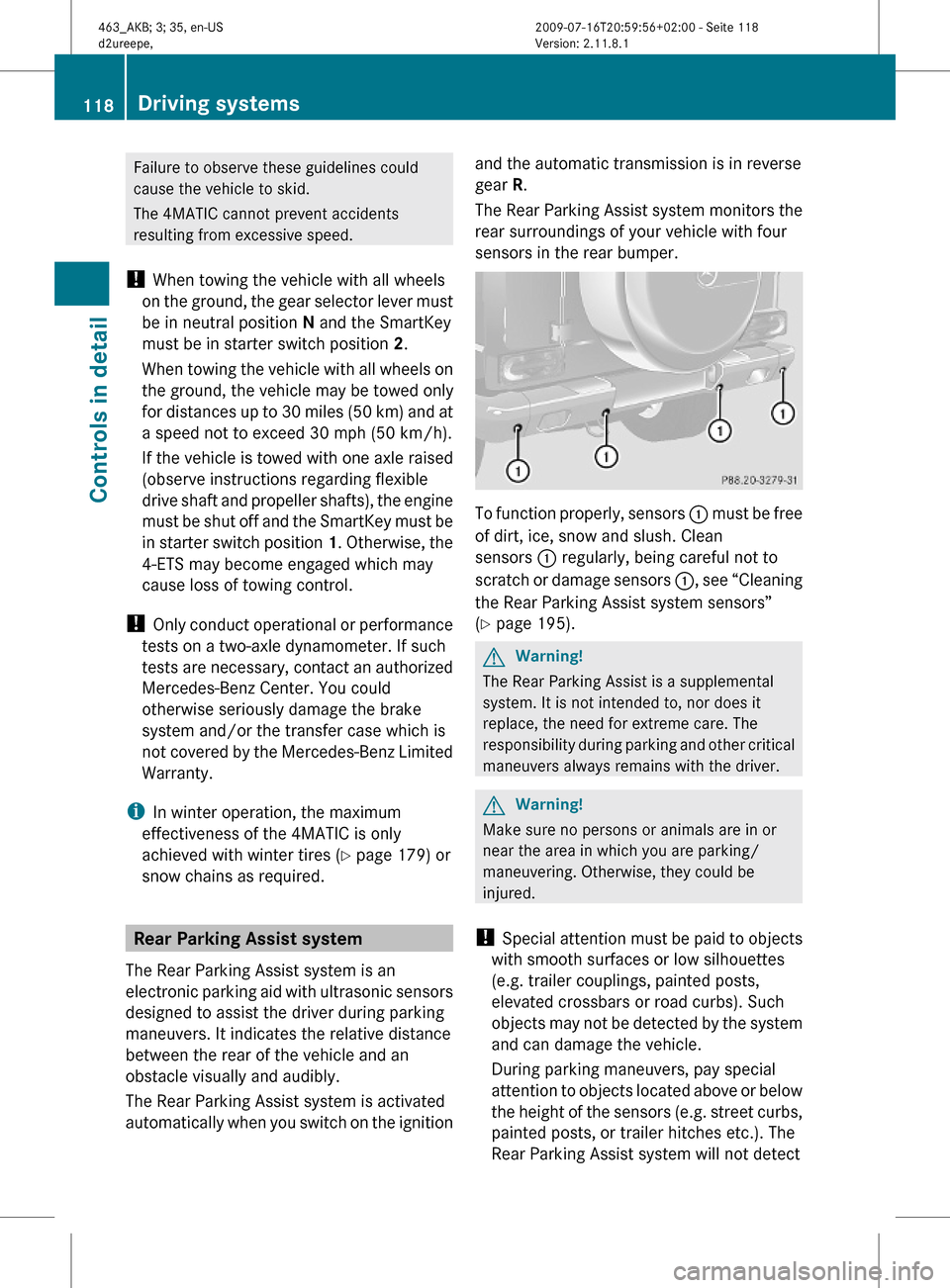
sensors in the rear bumper.
To function properly, sensors : must be free
of dirt, ice, snow and slush. Clean
sensors : regularly, being careful not to
scratch or damage sensors :, see “Cleaning
the Rear Parking Assist system sensors”
(Y page 195).
GWarning!
The Rear Parking Assist is a supplemental
system. It is not intended to, nor does it
replace, the need for extreme care. The
responsibility during parking and other critical
maneuvers always remains with the driver.
GWarning!
Make sure no persons or animals are in or
near the area in which you are parking/
maneuvering. Otherwise, they could be
injured.
! Special attention must be paid to objects
with smooth surfaces or low silhouettes
(e.g. trailer couplings, painted posts,
elevated crossbars or road curbs). Such
objects may not be detected by the system
and can damage the vehicle.
During parking maneuvers, pay special
attention to objects located above or below
the height of the sensors (e.g. street curbs,
painted posts, or trailer hitches etc.). The
Rear Parking Assist system will not detect
118Driving systemsControls in detail
463_AKB; 3; 35, en-USd2ureepe,Version: 2.11.8.12009-07-16T20:59:56+02:00 - Seite 118
Page 151 of 272
Vehicle equipment ............................150
The first 1000 miles (1500 km) .......150
At the gas station .............................150
Engine compartment ........................152
Tires and wheels ...............................158
Winter driving ...................................179
Driving instructions ..........................181
Maintenance ......................................190
Vehicle care .......................................192
149Operation463_AKB; 3; 35, en-USd2ureepe,Version: 2.11.8.12009-07-16T20:59:56+02:00 - Seite 149
Page 160 of 272
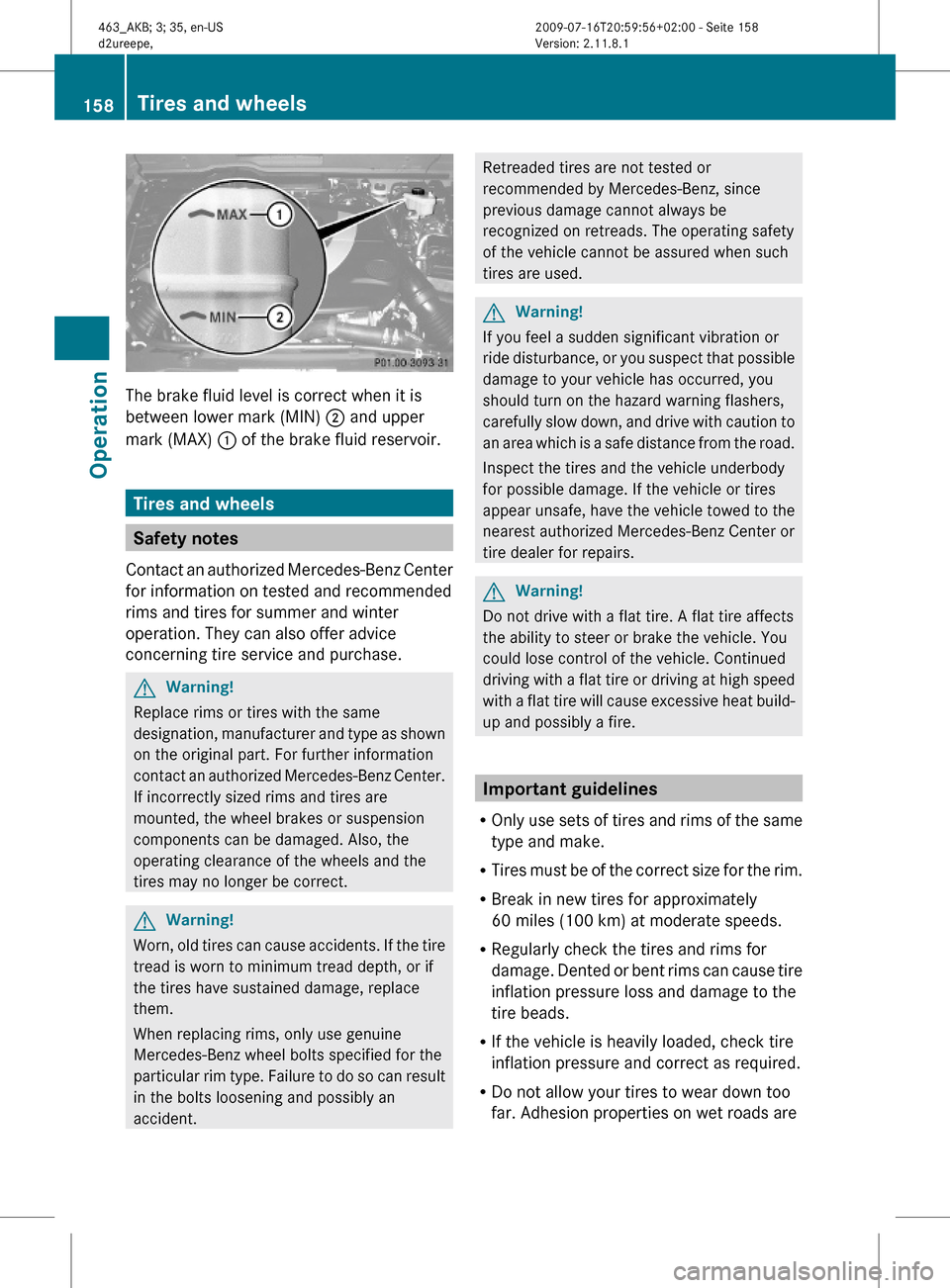
The brake fluid level is correct when it is
between lower mark (MIN) ; and upper
mark (MAX) : of the brake fluid reservoir.
Tires and wheels
Safety notes
Contact an authorized Mercedes-Benz Center
for information on tested and recommended
rims and tires for summer and winter
operation. They can also offer advice
concerning tire service and purchase.
GWarning!
Replace rims or tires with the same
designation, manufacturer and type as shown
on the original part. For further information
contact an authorized Mercedes-Benz Center.
If incorrectly sized rims and tires are
mounted, the wheel brakes or suspension
components can be damaged. Also, the
operating clearance of the wheels and the
tires may no longer be correct.
GWarning!
Worn, old tires can cause accidents. If the tire
tread is worn to minimum tread depth, or if
the tires have sustained damage, replace
them.
When replacing rims, only use genuine
Mercedes-Benz wheel bolts specified for the
particular rim type. Failure to do so can result
in the bolts loosening and possibly an
accident.
Retreaded tires are not tested or
recommended by Mercedes-Benz, since
previous damage cannot always be
recognized on retreads. The operating safety
of the vehicle cannot be assured when such
tires are used.
GWarning!
If you feel a sudden significant vibration or
ride disturbance, or you suspect that possible
damage to your vehicle has occurred, you
should turn on the hazard warning flashers,
carefully slow down, and drive with caution to
an area which is a safe distance from the road.
Inspect the tires and the vehicle underbody
for possible damage. If the vehicle or tires
appear unsafe, have the vehicle towed to the
nearest authorized Mercedes-Benz Center or
tire dealer for repairs.
GWarning!
Do not drive with a flat tire. A flat tire affects
the ability to steer or brake the vehicle. You
could lose control of the vehicle. Continued
driving with a flat tire or driving at high speed
with a flat tire will cause excessive heat build-
up and possibly a fire.
Important guidelines
ROnly use sets of tires and rims of the same
type and make.
RTires must be of the correct size for the rim.
RBreak in new tires for approximately
60 miles (100 km) at moderate speeds.
RRegularly check the tires and rims for
damage. Dented or bent rims can cause tire
inflation pressure loss and damage to the
tire beads.
RIf the vehicle is heavily loaded, check tire
inflation pressure and correct as required.
RDo not allow your tires to wear down too
far. Adhesion properties on wet roads are
158Tires and wheelsOperation
463_AKB; 3; 35, en-USd2ureepe,Version: 2.11.8.12009-07-16T20:59:56+02:00 - Seite 158
Page 172 of 272
Tire care and maintenanceGWarning!
Regularly check the tires for damage.
Damaged tires can cause tire inflation
pressure loss. As a result, you could lose
control of your vehicle.
Worn, old tires can cause accidents. If the tire
tread is worn to minimum tread depth, or if
the tires have sustained damage, replace
them.
Check the tire inflation pressure at least once
a month. For more information on checking
tire inflation pressure, see “Recommended
tire inflation pressure” (Y page 159).
Tire inspection
Every time you check the tire inflation
pressure, you should also inspect your tires
for the following:
Rexcessive treadwear (Y page 170)
Rcord or fabric showing through the tire’s
rubber
Rbumps, bulges, cuts, cracks or splits in the
tread or side of the tire
Replace the tire if you find any of the above
conditions.
Make sure you also inspect the spare tire
periodically for condition and inflation. Spare
tires will age and become worn over time even
if never used, and thus should be inspected
and replaced when necessary.
Life of tire
GWarning!
Tires and spare tire should be replaced after
6 years, regardless of the remaining tread.
The service life of a tire is dependent upon
varying factors including but not limited to:
RDriving style
RTire inflation pressure
RDistance driven
Tread depth GWarning!
Although the applicable federal motor vehicle
safety laws consider a tire to be worn when
the treadwear indicators (TWI) become visible
at approximately 1/16 in (1.6 mm), we
recommend that you do not allow your tires
to wear down to that level. As tread depth
approaches 1/8 in (3 mm), the adhesion
properties on a wet road are sharply reduced.
Depending upon the weather and/or road
surface (conditions), the tire traction varies
widely.
Do not allow your tires to wear down too far.
Adhesion properties on wet roads are sharply
reduced at tread depths of less than 1/8 in
(3 mm).
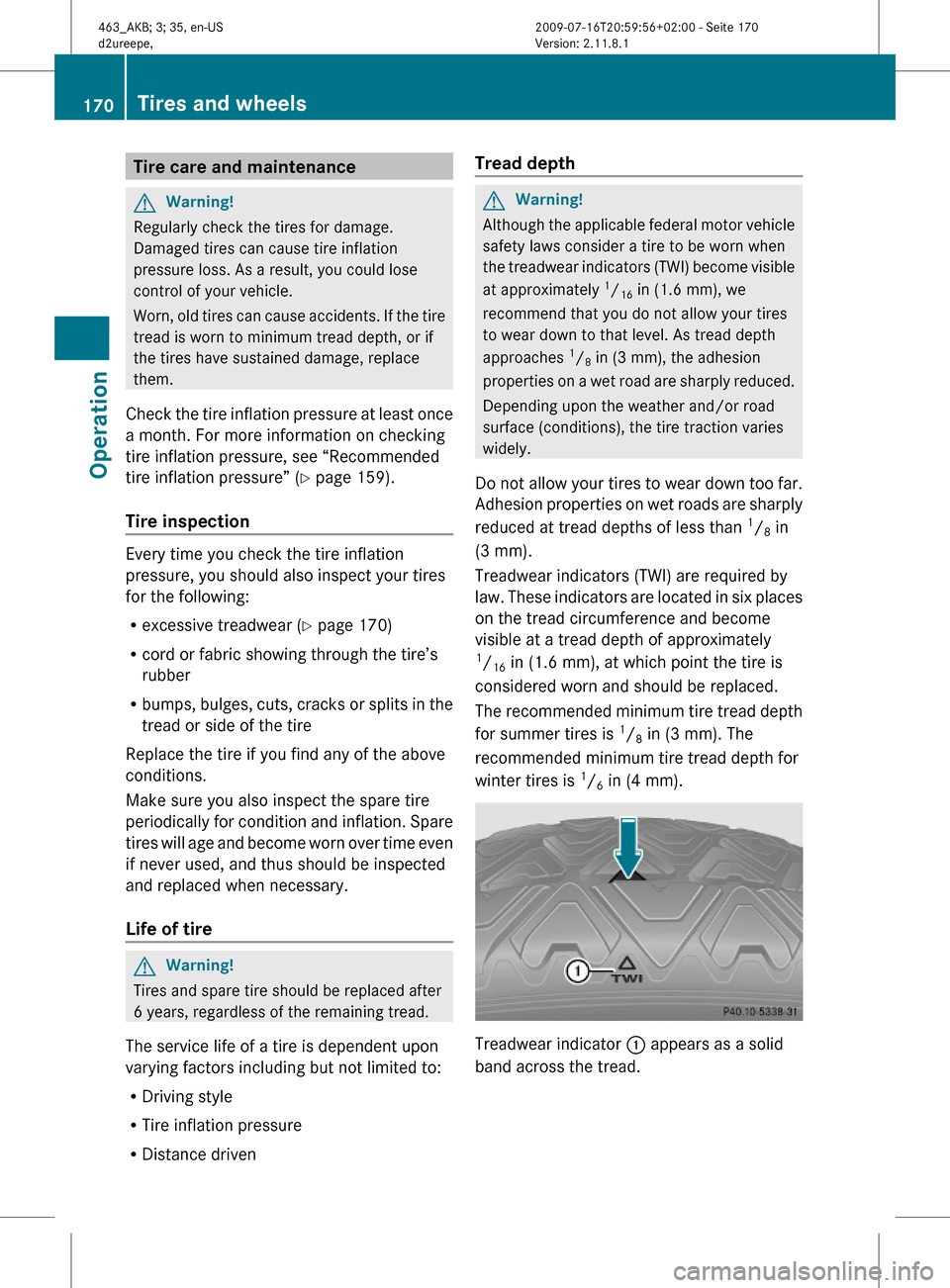
Treadwear indicators (TWI) are required by
law. These indicators are located in six places
on the tread circumference and become
visible at a tread depth of approximately1/16 in (1.6 mm), at which point the tire is
considered worn and should be replaced.
The recommended minimum tire tread depth
for summer tires is 1/8 in (3 mm). The
recommended minimum tire tread depth for
winter tires is 1/6 in (4 mm).
Treadwear indicator : appears as a solid
band across the tread.
170Tires and wheelsOperation
463_AKB; 3; 35, en-USd2ureepe,Version: 2.11.8.12009-07-16T20:59:56+02:00 - Seite 170
Page 174 of 272
The safe speed on a wet, snow covered or icy
road is always lower than on a dry road.
You should pay particular attention to the
condition of the road whenever the outside
temperature is close to the freezing point.
Mercedes-Benz recommends winter tires
( Y page 179) with a minimum tread depth of
approximately 1
/ 6 in (4 mm) on all four wheels
for the winter season to ensure normal
balanced handling characteristics. On
packed snow, they can reduce your stopping
distance compared to summer tires.
Stopping distance, however, is still
considerably greater than when the road is
not covered with snow or ice. Exercise
appropriate caution.
! Avoid spinning of a drive wheel. This may
cause serious damage to the drivetrain
which is not covered by the Mercedes-Benz
Limited Warranty.
Temperature GWarning!
The temperature grade for this tire is
established for a tire that is properly inflated
and not overloaded. Excessive speed,
underinflation, or excessive loading, either
separately or in combination, can cause
excessive heat build-up and possible tire
failure.
The temperature grades are A (the highest),
B, and C, representing the tire’s resistance to
the generation of heat and its ability to
dissipate heat when tested under controlled
conditions on a specified indoor laboratory
test wheel. Sustained high temperature can
cause the material of the tire to degenerate
and reduce tire life, and excessive
temperature can lead to sudden tire failure.
The grade C corresponds to a level of
performance which all passenger car tires
must meet under the Federal Motor Vehicle
Safety Standard No. 109. Grades B and A
represent higher levels of performance on the
laboratory test wheel than the minimum
required by law.
Rotating tires
GWarning!
Rotate front and rear wheels only if the tires
are of the same dimension.
If your vehicle is equipped with mixed-size
tires (different tire dimensions front vs. rear),
tire rotation is not possible.
GWarning!
Have the tightening torque checked after
changing a wheel. Wheels could become
loose if not tightened with a torque of
96 lb-ft (130 Nm).
Only use genuine Mercedes-Benz wheel bolts
specified for your vehicle’s rims.
Tire rotation can be performed on vehicles
with tires of the same dimension all around.
If your vehicle is equipped with tires of the
same dimension all around, tires can be
rotated, observing a front-to-rear rotation
pattern that will maintain the intended
rotation (spinning) direction of the tire
( Y page 169).
In some cases, such as when your vehicle is
equipped with mixed-size tires (different tire
dimension front vs. rear), tire rotation is not
possible.
If applicable to your vehicle’s tire
configuration, tires can be rotated according
to the tire manufacturer’s recommended
intervals in the tire manufacturer’s warranty
pamphlet located in your vehicle literature
portfolio. If none is available, tires should be
rotated every 3 000 to 6 000 miles (5 000 to
10 000 km), or sooner if necessary, according
to the degree of tire wear. The same rotation
(spinning) direction must be maintained.
Rotate tires before the characteristic tire
wear pattern becomes visible (shoulder wear
on front tires and tread center wear on rear
tires).
172Tires and wheelsOperation
463_AKB; 3; 35, en-USd2ureepe,Version: 2.11.8.12009-07-16T20:59:56+02:00 - Seite 172
Page 177 of 272
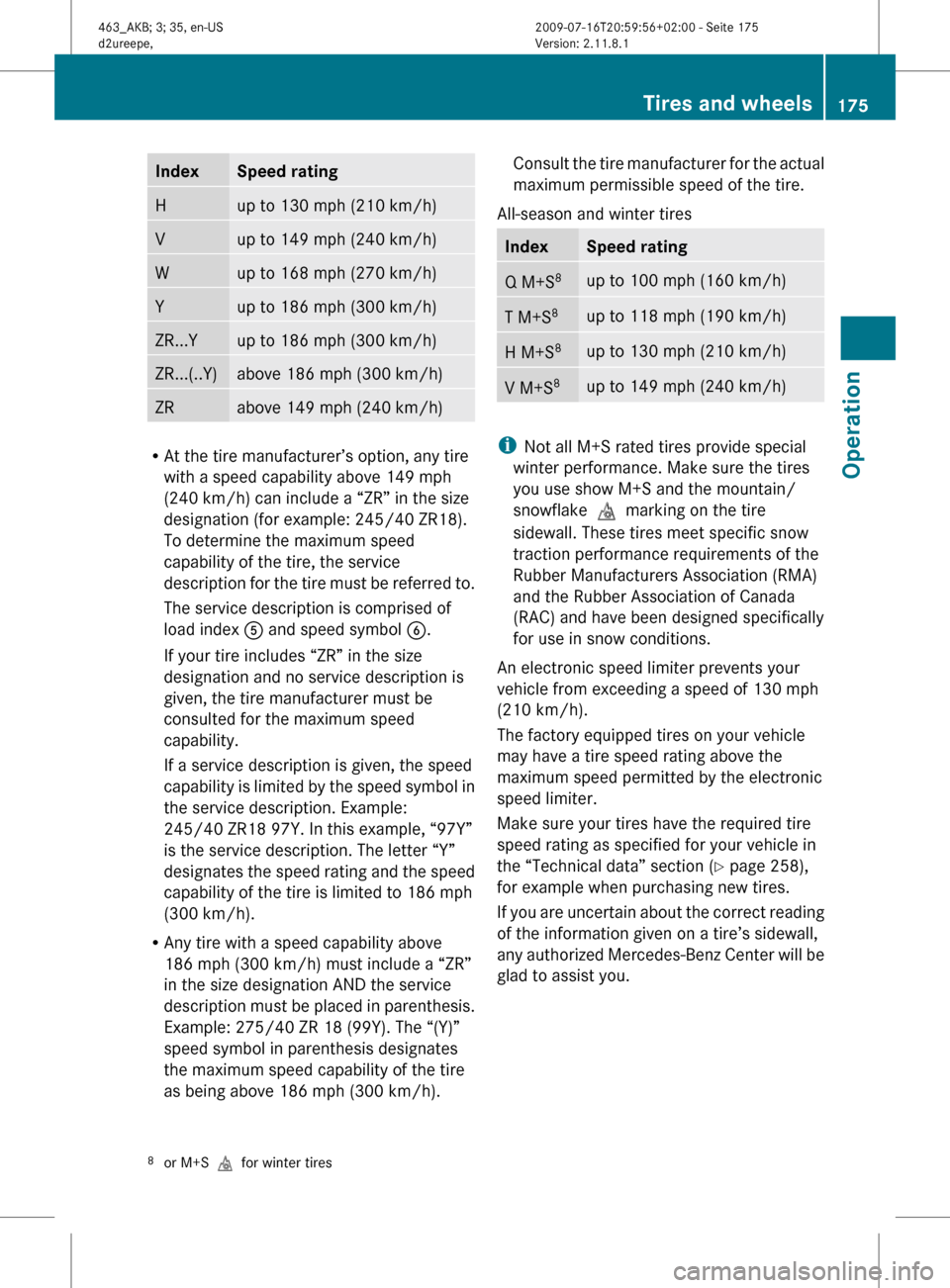
IndexSpeed ratingHup to 130 mph (210 km/h)Vup to 149 mph (240 km/h)Wup to 168 mph (270 km/h)Yup to 186 mph (300 km/h)ZR...Yup to 186 mph (300 km/h)ZR...(..Y)above 186 mph (300 km/h)ZRabove 149 mph (240 km/h)
RAt the tire manufacturer’s option, any tire
with a speed capability above 149 mph
(240 km/h) can include a “ZR” in the size
designation (for example: 245/40 ZR18).
To determine the maximum speed
capability of the tire, the service
description for the tire must be referred to.
The service description is comprised of
load index A and speed symbol B.
If your tire includes “ZR” in the size
designation and no service description is
given, the tire manufacturer must be
consulted for the maximum speed
capability.
If a service description is given, the speed
capability is limited by the speed symbol in
the service description. Example:
245/40 ZR18 97Y. In this example, “97Y”
is the service description. The letter “Y”
designates the speed rating and the speed
capability of the tire is limited to 186 mph
(300 km/h).
R Any tire with a speed capability above
186 mph (300 km/h) must include a “ZR”
in the size designation AND the service
description must be placed in parenthesis.
Example: 275/40 ZR 18 (99Y). The “(Y)”
speed symbol in parenthesis designates
the maximum speed capability of the tire
as being above 186 mph (300 km/h).
Consult the tire manufacturer for the actual
maximum permissible speed of the tire.
All-season and winter tiresIndexSpeed ratingQ M+S 8up to 100 mph (160 km/h)T M+S8up to 118 mph (190 km/h)H M+S 8up to 130 mph (210 km/h)V M+S8up to 149 mph (240 km/h)
i
Not all M+S rated tires provide special
winter performance. Make sure the tires
you use show M+S and the mountain/
snowflake imarking on the tire
sidewall. These tires meet specific snow
traction performance requirements of the
Rubber Manufacturers Association (RMA)
and the Rubber Association of Canada
(RAC) and have been designed specifically
for use in snow conditions.
An electronic speed limiter prevents your
vehicle from exceeding a speed of 130 mph
(210 km/h).
The factory equipped tires on your vehicle
may have a tire speed rating above the
maximum speed permitted by the electronic
speed limiter.
Make sure your tires have the required tire
speed rating as specified for your vehicle in
the “Technical data” section ( Y page 258),
for example when purchasing new tires.
If you are uncertain about the correct reading
of the information given on a tire’s sidewall,
any authorized Mercedes-Benz Center will be
glad to assist you.
8 or M+S ifor winter tiresTires and wheels175Operation463_AKB; 3; 35, en-USd2ureepe,Version: 2.11.8.12009-07-16T20:59:56+02:00 - Seite 175Z