oil pressure MERCEDES-BENZ G55AMG 2010 W463 Owner's Manual
[x] Cancel search | Manufacturer: MERCEDES-BENZ, Model Year: 2010, Model line: G55AMG, Model: MERCEDES-BENZ G55AMG 2010 W463Pages: 272, PDF Size: 7.04 MB
Page 6 of 272
1, 2, 3 ...
115V AC Socket ................................. 137
4-ETS (Electronic Traction System) ... 54
4MATIC see All-wheel drive (4MATIC)
A
ABS (Antilock Brake System) ............. 52
Indicator lamp ................................ 220
Messages in the multifunction
display ........................................... 204
Accessory weight .............................. 177
Accidents ............................................. 88
Air bags ........................................... 33
Emergency calls (Tele Aid) .............139
Additives
Engine oil ....................................... 262
Gasoline ......................................... 263
Address change ................................... 20
Advanced Tire Pressure
Monitoring System (Advanced
TPMS) ................................................. 162
Messages in the multifunction
display ................................... 206, 218
Air bags ................................................ 33
Emergency call upon deployment ..139
Front, driver and passenger .............35
Front passenger front air bag off
indicator lamp .......................... 37, 227
Safety guidelines ............................. 34
Window curtain ................................ 37
Air conditioning refrigerant and
lubricant ............................................. 262
Air distribution .................................. 125
Air pressure see Tire inflation pressure
Air pressure (tires) ............................ 177
Air recirculation mode ...................... 126
Air volume .......................................... 125
Alarm system see Anti-theft systems
All-wheel drive (4MATIC) .................. 117
Alternator
Messages in the multifunction
display ........................................... 212
Alternator (Technical data)
see Vehicle specification
Anticorrosion/antifreeze .................. 264
Antilock Brake System see ABS
Anti-theft systems ............................... 55
Anti-theft alarm system ...................56
Immobilizer ...................................... 55
Tow-away alarm ............................... 56
Aquaplaning
see Hydroplaning
Armrest, front
Storage compartment ....................133
Telephone tray ............................... 133
Ashtrays ............................................. 135
Aspect ratio (tires) ............................ 177
Audio/DVD menu .............................. 103
Auto-dimming rear view mirrors ........ 73
Automatic central locking .......... 62, 111
Automatic headlamp mode ................ 75
Automatic interior lighting control .... 79
Automatic locking when driving ...... 111
Automatic transmission ..................... 89
Gear range indicator ........................92
Gear ranges ..................................... 92
Gear selector lever ........................... 89
Hill-start assist system ..................117
Kickdown ......................................... 91
One-touch gearshifting ....................92
Shifting procedure ...........................90
Transmission position indicator .......90
Transmission positions ....................90
Axle oils .............................................. 260
B
BabySmart™
Air bag deactivation system .............37
Self-test ........................................... 38
Backrest
see Seats
Backup lamps
Messages in the multifunction
display ........................................... 215
Bar (air pressure unit) ....................... 177
BAS (Brake Assist System) ................. 53
4Index463_AKB; 3; 35, en-USd2ureepe,Version: 2.11.8.12009-07-16T20:59:56+02:00 - Seite 4
Page 13 of 272
Memory function ................................. 73
Menus see Control system menus
Mirrors .................................................. 72
Auto-dimming rear view mirrors ....... 73
Exterior rear view mirror parking
position ............................................ 73
Exterior rear view mirrors ................72
Interior rear view mirror ...................72
Memory function .............................. 73
Vanity mirror .................................. 135
MON (Motor Octane Number) .......... 263
Motor Octane Number see MON
Multicontour seat ................................ 68
Multifunction display ........................ 101
Symbol messages ..........................208
Text messages ............................... 204
Vehicle status messages ...............203
Multifunction display messages
ABS ................................................ 204
Advanced TPMS ..................... 206, 218
Alternator ...................................... 212
Battery ........................................... 212
Brake fluid ..................................... 208
Brake pads ..................................... 208
Coolant .......................................... 210
Cruise control ................................ 205
Doors ............................................. 210
Engine oil ....................................... 213
ESP ®
.............................................. 204
Fog lamps .............................. 215, 217
Gas cap .......................................... 214
High-beam lamps ........................... 216
Hood .............................................. 210
License plate lamps .......................216
Light sensor ................................... 216
Low-beam lamps ............................ 216
Parking brake ................................ 208
Parking lamps ................................ 216
Reserve fuel ................................... 214
Reverse lamp ................................. 215
Side marker lamps .........................215
SmartKey ....................................... 210
SRS ................................................ 205
Tailgate .......................................... 210
Tail lamps ...................................... 217
Tele Aid .......................................... 209Tire inflation pressure ............206, 218
Tire pressure monitor ....................206
Tires ...................................... 206, 218
Transfer case ................................. 209
Turn signals ................................... 218
Washer fluid ................................... 210
Multifunction steering wheel
Adjustment ...................................... 70
Buttons ............................................ 99
Cleaning ......................................... 196
Easy-entry/exit feature ...........71, 112
Heating ............................................ 72
Memory function .............................. 73
Overview .......................................... 27
N
Navigation menu ............................... 105
Navigation system see Separate operating instructions
Net, parcel ......................................... 130
Night security illumination .............. 110
Normal occupant weight .................. 178
Number, vehicle identification
(VIN) ................................................... 255
O
Occupant distribution ....................... 178
Occupant safety
Air bags ........................................... 33
BabySmart™ .................................... 37
Children and air bags .......................33
Children in the vehicle .....................46
Child seat anchors – LATCH-type
(ISOFIX) ........................................... 49
Fastening the seat belts ................... 41
Front passenger front air bag off
indicator lamp .......................... 37, 227
Infant and child restraint systems .... 47
Introduction ..................................... 32
ISOFIX (Child seat anchors –
LATCH-type) ..................................... 49
Seat belts .................................. 34, 39
Odometer ........................................... 101
Off-road driving ................................. 184
Checklist ............................... 185, 189
Crossing obstacles ........................188
Index11463_AKB; 3; 35, en-USd2ureepe,Version: 2.11.8.12009-07-16T20:59:56+02:00 - Seite 11
Page 14 of 272
Driving instructions ........................ 184
Driving on sand .............................. 188
Driving through water ....................187
Returning ....................................... 189
Ruts ............................................... 188
Steep terrain .................................. 186
Oil, oil level
see Engine oil
On-board computer
see Control system
One-touch gearshifting ....................... 92
Operating safety .................................. 21
Ornamental moldings, cleaning ....... 194
Outside temperature see Displays
Overhead control panel ...................... 30
P
Paintwork, cleaning .......................... 193
Paintwork code ................................. 255
Panic alarm .......................................... 51
Parcel net ........................................... 130
Parking ................................................. 88
Rear Parking Assist system ...........118
Parking Assist
see Rear Parking Assist system
Parking brake ...................................... 88
Messages in the multifunction
display ........................................... 208
Parking position
Exterior rear view mirrors ................73
Transmission position ......................90
Parts service ...................................... 254
PASS AIR BAG OFF indicator lamp see Front passenger front air bag
off indicator lamp
Passenger safety
see Occupant safety
Pedals ................................................. 182
Phone see Telephone
Plastic parts, cleaning ...................... 196
Power assistance .............................. 182
Power outlets .................................... 136
Power seats see Seats
Power tilt/sliding sunroof
Opening/closing in an emergency . 231
Operation ....................................... 128
Power washer .................................... 193
Power windows ................................... 84
Cleaning ......................................... 195
Operation ......................................... 84
Rear door window, override
switch .............................................. 50
Practical hints ................................... 200
Problems
While driving .................................... 87
With vehicle ..................................... 21
With wipers ...................................... 83
Product information ............................ 18
Production options weight ............... 178
Proximity key see Key, SmartKey
PSI (air pressure unit) ....................... 178
R
Radio
Selecting stations ..........................103
Radio transmitters ............................ 189
Rain sensor see Intermittent wiping
Rear axle oil ....................................... 260
Rear door ashtray see Ashtrays
Rear doors
Child safety locks ............................ 50
Rear door window
Override switch ................................ 50
Rear fog lamp
Replacing bulb ............................... 234
see Fog lamps
Rear lamps
see Tail lamps
Rear Parking Assist system ............. 118
Cleaning system sensors ...............195
Malfunctions .................................. 120
Minimum distance .........................119
Range ............................................ 119
Sensors ......................................... 118
Warning indicators .........................119
Rear seat head restraints
see Head restraints
12Index463_AKB; 3; 35, en-USd2ureepe,Version: 2.11.8.12009-07-16T20:59:56+02:00 - Seite 12
Page 105 of 272
The following functions are available:
RChecking tire inflation pressure with the
Advanced TPMS (Y page 162)
RCalling up digital speedometer or outside
temperature (Y page 103)
RCalling up maintenance service indicator
display (Y page 191)
RChecking engine oil level (Y page 154)
Calling up digital speedometer or
outside temperature
You can select whether the digital
speedometer or the outside temperature
appears in the multifunction display
(Y page 108).
GWarning!
The outside temperature indicator is not
designed to serve as an ice-warning device
and is therefore unsuitable for that purpose.
Indicated temperatures just above the
freezing point do not guarantee that the road
surface is free of ice. The road may still be icy,
especially in wooded areas or on bridges.
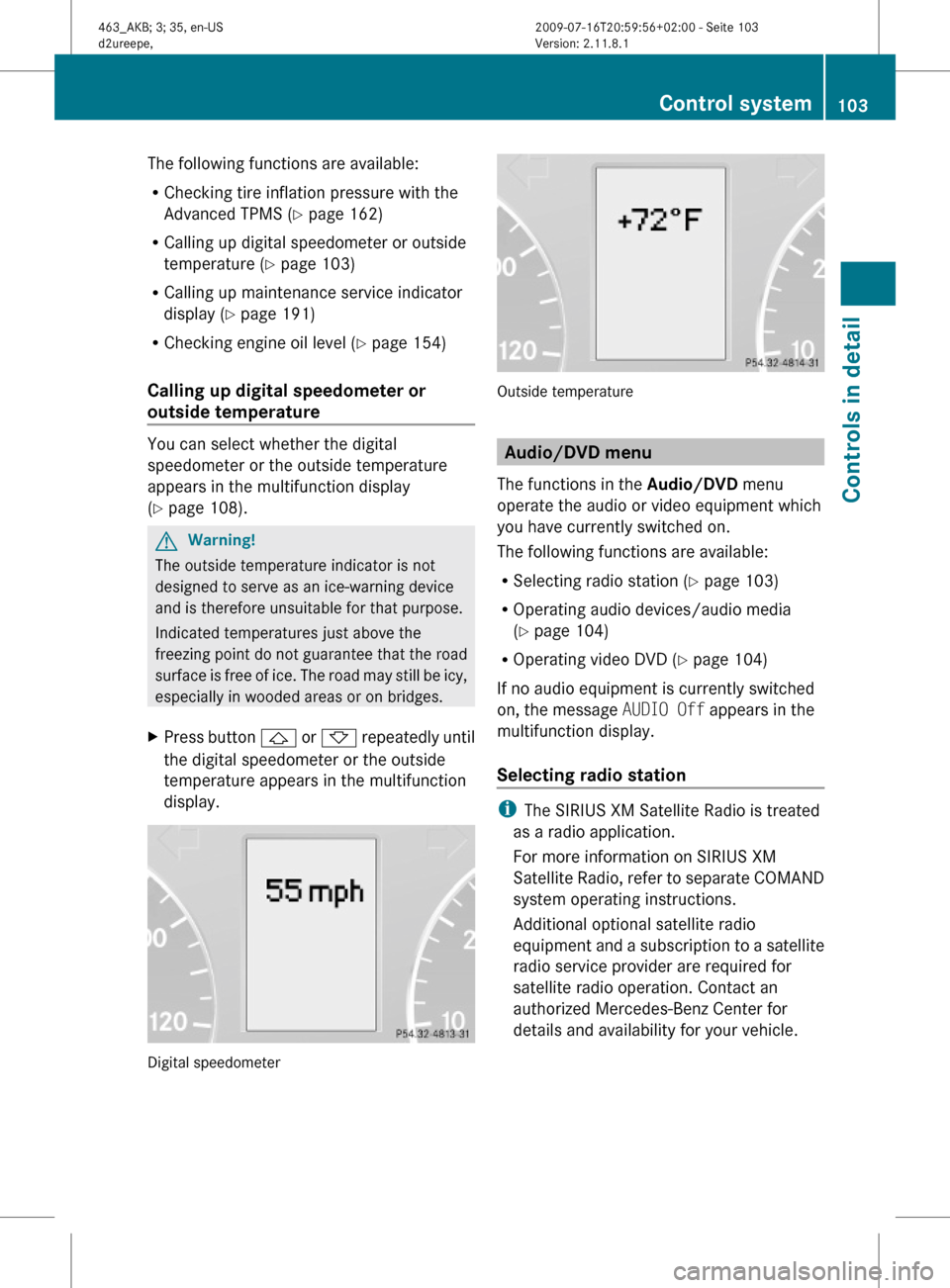
XPress button & or * repeatedly until
the digital speedometer or the outside
temperature appears in the multifunction
display.
Digital speedometer
Outside temperature
Audio/DVD menu
The functions in the Audio/DVD menu
operate the audio or video equipment which
you have currently switched on.
The following functions are available:
RSelecting radio station (Y page 103)
ROperating audio devices/audio media
(Y page 104)
ROperating video DVD (Y page 104)
If no audio equipment is currently switched
on, the message AUDIO Off appears in the
multifunction display.
Selecting radio station
iThe SIRIUS XM Satellite Radio is treated
as a radio application.
For more information on SIRIUS XM
Satellite Radio, refer to separate COMAND
system operating instructions.
Additional optional satellite radio
equipment and a subscription to a satellite
radio service provider are required for
satellite radio operation. Contact an
authorized Mercedes-Benz Center for
details and availability for your vehicle.
Control system103Controls in detail463_AKB; 3; 35, en-USd2ureepe,Version: 2.11.8.12009-07-16T20:59:56+02:00 - Seite 103Z
Page 152 of 272
Vehicle equipment
i This Operator’s Manual describes all
features, standard or optional, potentially
available for your vehicle at the time of
purchase. Please be aware that your
vehicle might not be equipped with all
features described in this manual.
The first 1000 miles (1500 km)
The more cautiously you treat your vehicle
during the break-in period, the more satisfied
you will be with its performance later on.
R Drive your vehicle during the first
1 000 miles (1 500 km) at varying but
moderate vehicle and engine speeds.
R During this period, avoid heavy loads (full
throttle driving) and excessive engine
speeds (no more than 2
/ 3 of maximum rpm
in each gear).
R Shift gears in a timely manner.
R Avoid accelerating by kickdown.
R Do not attempt to slow the vehicle down by
shifting to a lower gear using the gear
selector lever.
R Select gear ranges 3, 2 or 1 (Y page 92)
only when driving at moderate speeds (for
hill driving).
After 1 000 miles (1 500 km) you may
gradually increase vehicle and engine speeds
to the permissible maximum.
! Additional instructions for AMG vehicles:
R During the first 1 000 miles (1 500 km),
do not exceed a speed of 85 mph
(140 km/h).
R During this period, avoid engine speeds
above 4 500 rpm in each gear.
R Shift gears in a timely manner.
R Avoid off-road driving during the break-in
period until the oil change in the front
and rear axle at 2 000 miles (3 000 km)
has been performed. Please refer to
Maintenance Booklet.
All of the above instructions, as may apply to
your vehicle type, also apply when driving the
first 1 000 miles (1 500 km) after the engine,
the transfer case, the front differential or the
rear differential have been replaced.
i Always obey applicable speed limits.
At the gas station
Refueling
GWarning!
Gasoline is highly flammable and poisonous.
It burns violently and can cause serious
personal injury.
Never allow sparks, flames or smoking
materials near gasoline!
Turn off the engine before refueling.
Whenever you are around gasoline, avoid
inhaling fumes and any skin or clothing
contact. Extinguish all smoking materials.
Direct skin contact with fuels and the
inhalation of fuel vapors are damaging your
health.
GWarning!
Overfilling of the fuel tank may create
pressure in the system which could cause a
gas discharge. This could cause the gas to
spray back out when removing the fuel pump
nozzle, which could cause personal injury.
! Never refuel vehicles with gasoline engine
with diesel fuel. Even small amounts of
diesel fuel will damage the fuel system and
engine. Damage resulting from the use of
non-approved fuels or fuel additives or
resulting from mixing gasoline with diesel
fuel is not covered by the Mercedes-Benz
Limited Warranty.
! If you have accidentally filled the tank
with incorrect or non-approved fuel, do not
150At the gas stationOperation
463_AKB; 3; 35, en-USd2ureepe,Version: 2.11.8.12009-07-16T20:59:56+02:00 - Seite 150
Page 154 of 272
XClosing: Turn fuel filler cap ; clockwise
until it audibly engages.
iClose the fuel filler flap before locking the
vehicle. Otherwise the flap locking pin will
prevent closing the fuel filler flap.
XClose fuel filler flap :.
Check regularly and before a long trip
For information on quantities and
requirements of operating agents, see “Fuels,
coolants, lubricants, etc.” (Y page 260).
Check the following:
REngine oil level (Y page 153)
RTire inflation pressure (Y page 161)
RCoolant level (Y page 156)
RVehicle lighting (Y page 233)
RWasher system and headlamp cleaning
system (Y page 157)
RBrake fluid (Y page 157)
Engine compartment
Hood
GWarning!
Do not pull the release lever while the vehicle
is in motion. Otherwise the hood could be
forced open by passing air flow.
This could cause the hood to come loose and
injure you and/or others.
Opening
GWarning!
Do not open the hood when the engine is
overheated. You could be seriously injured.
Observe the coolant temperature gauge to
determine whether the engine may be
overheated. If you see flames or smoke
coming from the engine compartment, move
away from the vehicle. Wait until the engine
has cooled. If necessary, call the fire
department.
GWarning!
You could be injured when the hood is open –
even when the engine is turned off.
Parts of the engine can become very hot. To
prevent burns, let the engine cool completely
before touching any components on the
vehicle. Comply with all relevant safety
precautions.
GWarning!
To help prevent personal injury, stay clear of
moving parts when the hood is open and the
engine is running.
The radiator fan may continue to run for
approximately 30 seconds or may even
restart after the engine has been turned off.
Stay clear of fan blades.
GWarning!
The engine is equipped with a transistorized
ignition system. Because of the high voltage
it is dangerous to touch any components
(ignition coils, spark plug sockets, diagnostic
socket) of the ignition system
Rwith the engine running
Rwhile starting the engine
Rwhen the ignition is switched on and the
engine is turned manually
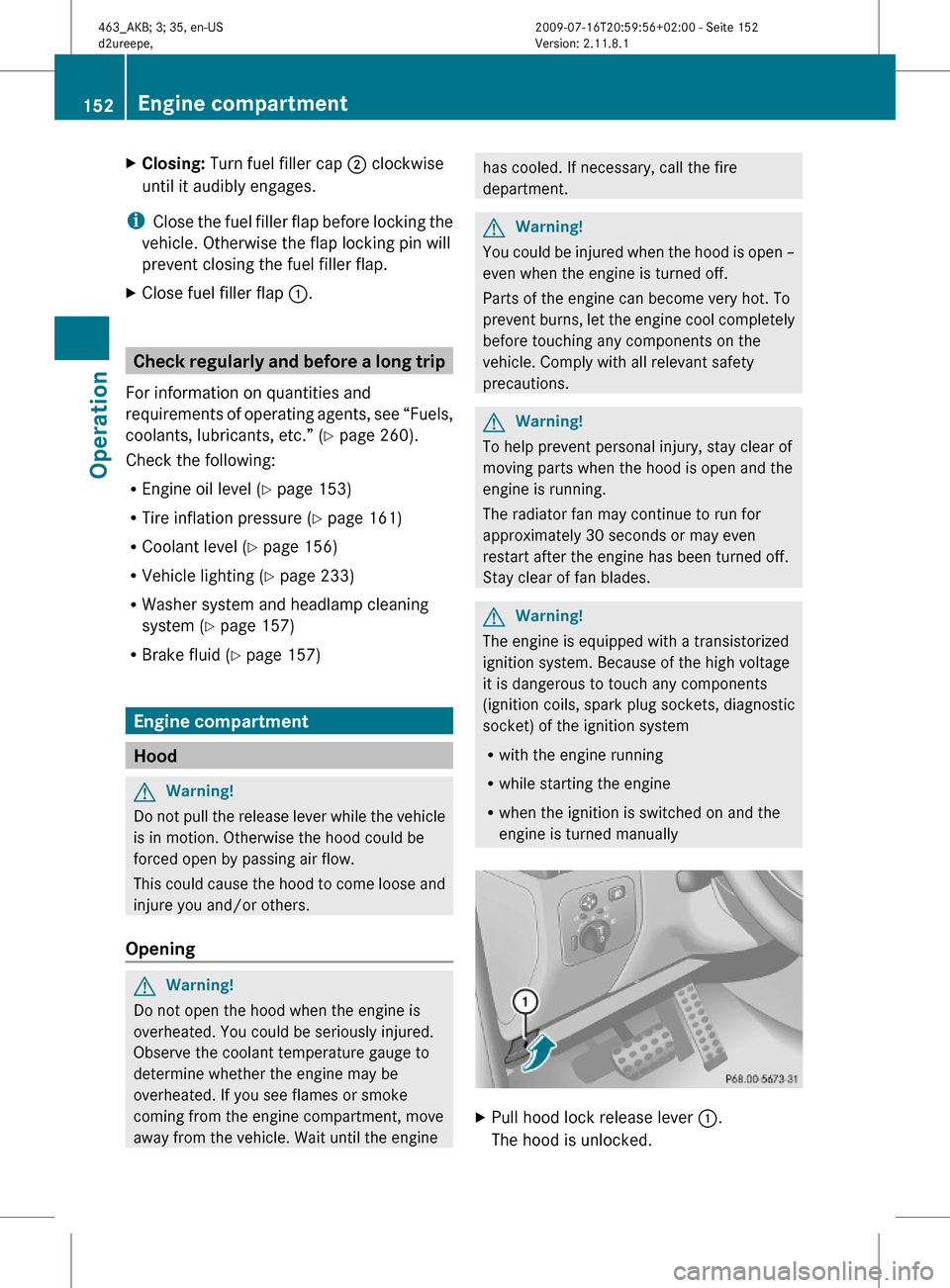
XPull hood lock release lever :.
The hood is unlocked.
152Engine compartmentOperation
463_AKB; 3; 35, en-USd2ureepe,Version: 2.11.8.12009-07-16T20:59:56+02:00 - Seite 152
Page 158 of 272
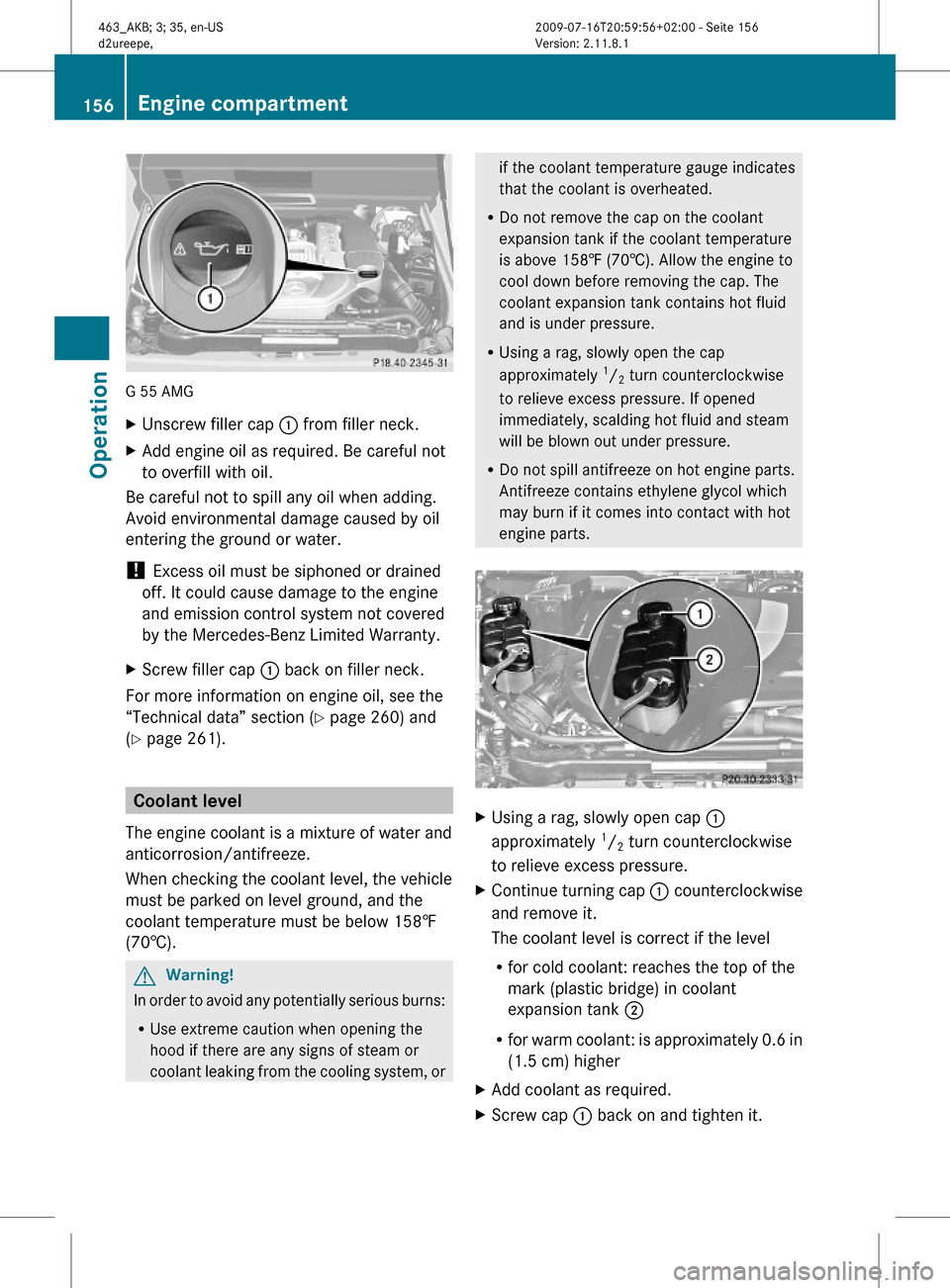
G 55 AMG
XUnscrew filler cap : from filler neck.XAdd engine oil as required. Be careful not
to overfill with oil.
Be careful not to spill any oil when adding.
Avoid environmental damage caused by oil
entering the ground or water.
! Excess oil must be siphoned or drained
off. It could cause damage to the engine
and emission control system not covered
by the Mercedes-Benz Limited Warranty.
XScrew filler cap : back on filler neck.
For more information on engine oil, see the
“Technical data” section (Y page 260) and
(Y page 261).
Coolant level
The engine coolant is a mixture of water and
anticorrosion/antifreeze.
When checking the coolant level, the vehicle
must be parked on level ground, and the
coolant temperature must be below 158‡
(70†).
GWarning!
In order to avoid any potentially serious burns:
RUse extreme caution when opening the
hood if there are any signs of steam or
coolant leaking from the cooling system, or
if the coolant temperature gauge indicates
that the coolant is overheated.
RDo not remove the cap on the coolant
expansion tank if the coolant temperature
is above 158‡ (70†). Allow the engine to
cool down before removing the cap. The
coolant expansion tank contains hot fluid
and is under pressure.
RUsing a rag, slowly open the cap
approximately 1/2 turn counterclockwise
to relieve excess pressure. If opened
immediately, scalding hot fluid and steam
will be blown out under pressure.
RDo not spill antifreeze on hot engine parts.
Antifreeze contains ethylene glycol which
may burn if it comes into contact with hot
engine parts.
XUsing a rag, slowly open cap :
approximately 1/2 turn counterclockwise
to relieve excess pressure.
XContinue turning cap : counterclockwise
and remove it.
The coolant level is correct if the level
Rfor cold coolant: reaches the top of the
mark (plastic bridge) in coolant
expansion tank ;
Rfor warm coolant: is approximately 0.6 in
(1.5 cm) higher
XAdd coolant as required.XScrew cap : back on and tighten it.156Engine compartmentOperation
463_AKB; 3; 35, en-USd2ureepe,Version: 2.11.8.12009-07-16T20:59:56+02:00 - Seite 156
Page 179 of 272
Tire type code
Tire type code ? may, at the option of the
manufacturer, be used as a descriptive code
for identifying significant characteristics of
the tire.
Date of manufacture
The date of manufacture A identifies the
week and year of manufacture.
The first two figures identify the week,
starting with “01” to represent the first full
week of the calendar year. The second two
figures represent the year.
For example, “3208” represents the 32nd
week of 2008.
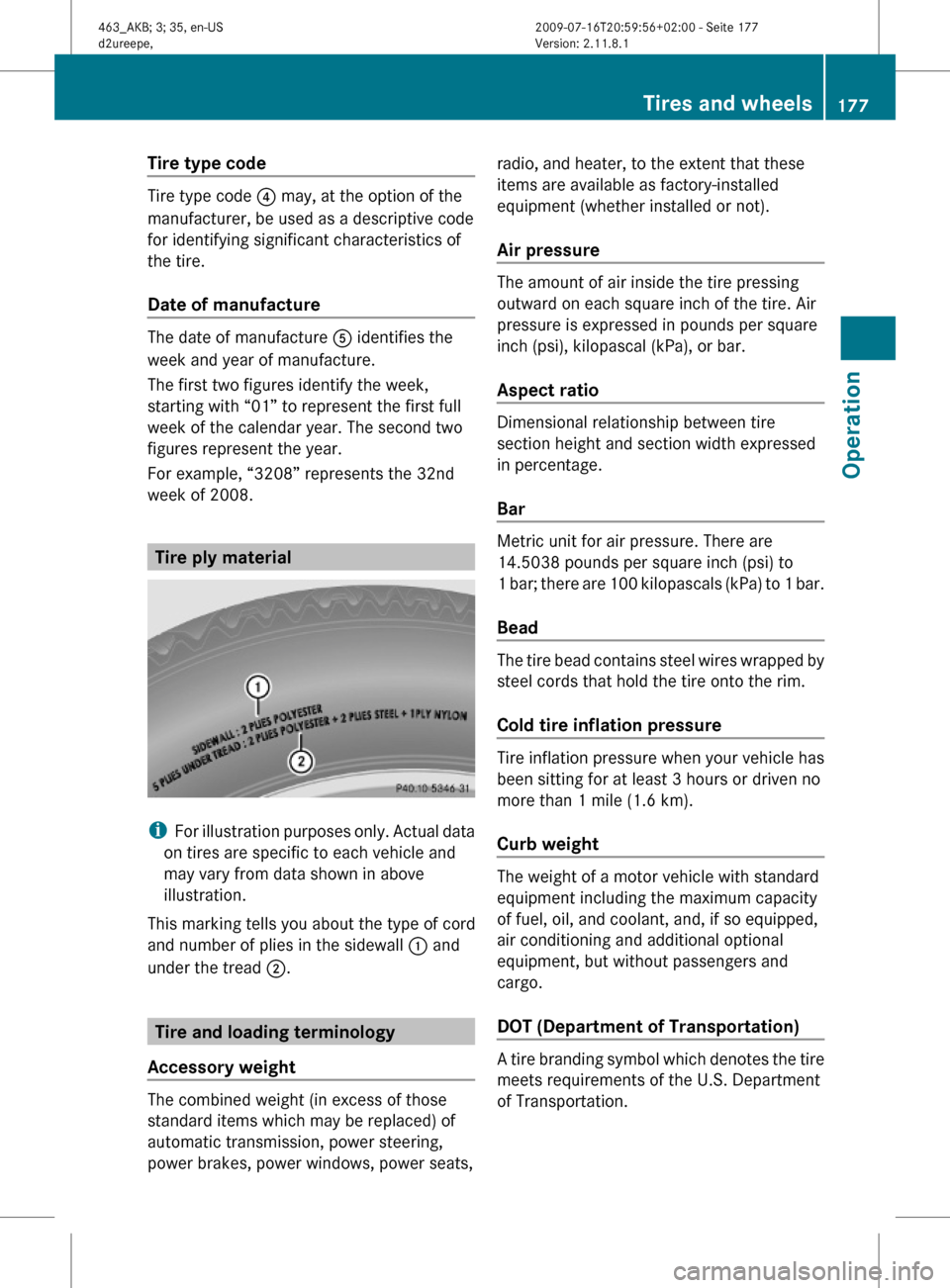
Tire ply material
iFor illustration purposes only. Actual data
on tires are specific to each vehicle and
may vary from data shown in above
illustration.
This marking tells you about the type of cord
and number of plies in the sidewall : and
under the tread ;.
Tire and loading terminology
Accessory weight
The combined weight (in excess of those
standard items which may be replaced) of
automatic transmission, power steering,
power brakes, power windows, power seats,
radio, and heater, to the extent that these
items are available as factory-installed
equipment (whether installed or not).
Air pressure
The amount of air inside the tire pressing
outward on each square inch of the tire. Air
pressure is expressed in pounds per square
inch (psi), kilopascal (kPa), or bar.
Aspect ratio
Dimensional relationship between tire
section height and section width expressed
in percentage.
Bar
Metric unit for air pressure. There are
14.5038 pounds per square inch (psi) to
1 bar; there are 100 kilopascals (kPa) to 1 bar.
Bead
The tire bead contains steel wires wrapped by
steel cords that hold the tire onto the rim.
Cold tire inflation pressure
Tire inflation pressure when your vehicle has
been sitting for at least 3 hours or driven no
more than 1 mile (1.6 km).
Curb weight
The weight of a motor vehicle with standard
equipment including the maximum capacity
of fuel, oil, and coolant, and, if so equipped,
air conditioning and additional optional
equipment, but without passengers and
cargo.
DOT (Department of Transportation)
A tire branding symbol which denotes the tire
meets requirements of the U.S. Department
of Transportation.
Tires and wheels177Operation463_AKB; 3; 35, en-USd2ureepe,Version: 2.11.8.12009-07-16T20:59:56+02:00 - Seite 177Z
Page 187 of 272
Off-road driving rules
REngage the transfer case in position LOW
before driving under off-road conditions
( Y page 93).
R If necessary, activate differential locks
( Y page 95).
The ABS, BAS and ESP ®
are switched off
automatically when the differential locks
are activated.
R Fasten items being carried as securely as
possible ( Y page 129).
! Observe the following during off-road
driving:
R Keep doors, tailgate, windows, and tilt/
sliding sunroof closed whenever driving
off-road.
R Switch the cruise control off.
R Adjust vehicle speed to condition of
terrain. The more uneven, rutty and
steeper the terrain, the lower the speed
should be. Drive through water slowly at
an even speed, avoiding a bow wave.
R Be especially careful when driving in
unknown territory. It may be necessary
to get out of the vehicle and scout the
path you intend to take.
R Watch out for obstacles, such as rocks,
holes, tree stumps and ruts.
R Avoid excessive engine speeds – drive at
moderate engine speeds (max. 3 000
rpm).
R Before driving through water, determine
its depth.
R Do not stop vehicle while immersed in
water, and do not shut off the engine.
R In sandy soil, drive at a steady speed as
allowed by conditions. This helps
overcome the vehicle rolling resistance
and reduces the likelihood of the vehicle
sinking into the ground.
R Do not initiate jumps with the vehicle. It
interrupts the forward momentum of the
vehicle.
R Always drive onto slopes with the engine
running and the vehicle in gear.
R Do not shift automatic transmission into
neutral position N.
R Inspect the vehicle for possible damage
after each off-road trip.GWarning!
Do not reduce the tire inflation pressure
before driving through sand. However, if you
do so, remember to correct the tire inflation
pressure before continuing your trip. Driving
with reduced tire inflation pressure increases
the risk of losing control of the vehicle and
rolling over.
Checklist before off-road driving
Engine oil level
R Check the engine oil level ( Y page 153).
Only with a proper oil level can the vehicle
obtain a trouble-free oil supply, even on
steep gradients.
! If an engine oil level warning message
appears in the multifunction display while
driving, stop the vehicle in a safe location
or as soon at is safe to do so. Check the
engine oil level.
The engine oil level warning messages
should not be ignored. Extended driving
with the message displayed could result in
serious engine damage that is not covered
by the Mercedes-Benz Limited Warranty.
Tires
R Check the tread depth and maintain
specified tire inflation pressure. A placard
with the recommended tire inflation
Driving instructions185Operation463_AKB; 3; 35, en-USd2ureepe,Version: 2.11.8.12009-07-16T20:59:56+02:00 - Seite 185Z
Page 188 of 272
pressures is located on the driver’s door B-
pillar (Y page 166).
RCheck tires for possible damage and
remove foreign objects.
RReplace missing valve caps.
Rims
RDented or bent rims can cause tire inflation
pressure loss and damage the tire beads.
For this reason, check and, if necessary,
change rims before driving off-road.
Vehicle tool kit
RCheck if the jack (Y page 201) is
functional.
RAlways take the vehicle tool kit, a strong
tow rope, a shovel and a small plank (to put
under the jack on sandy soil) with you.
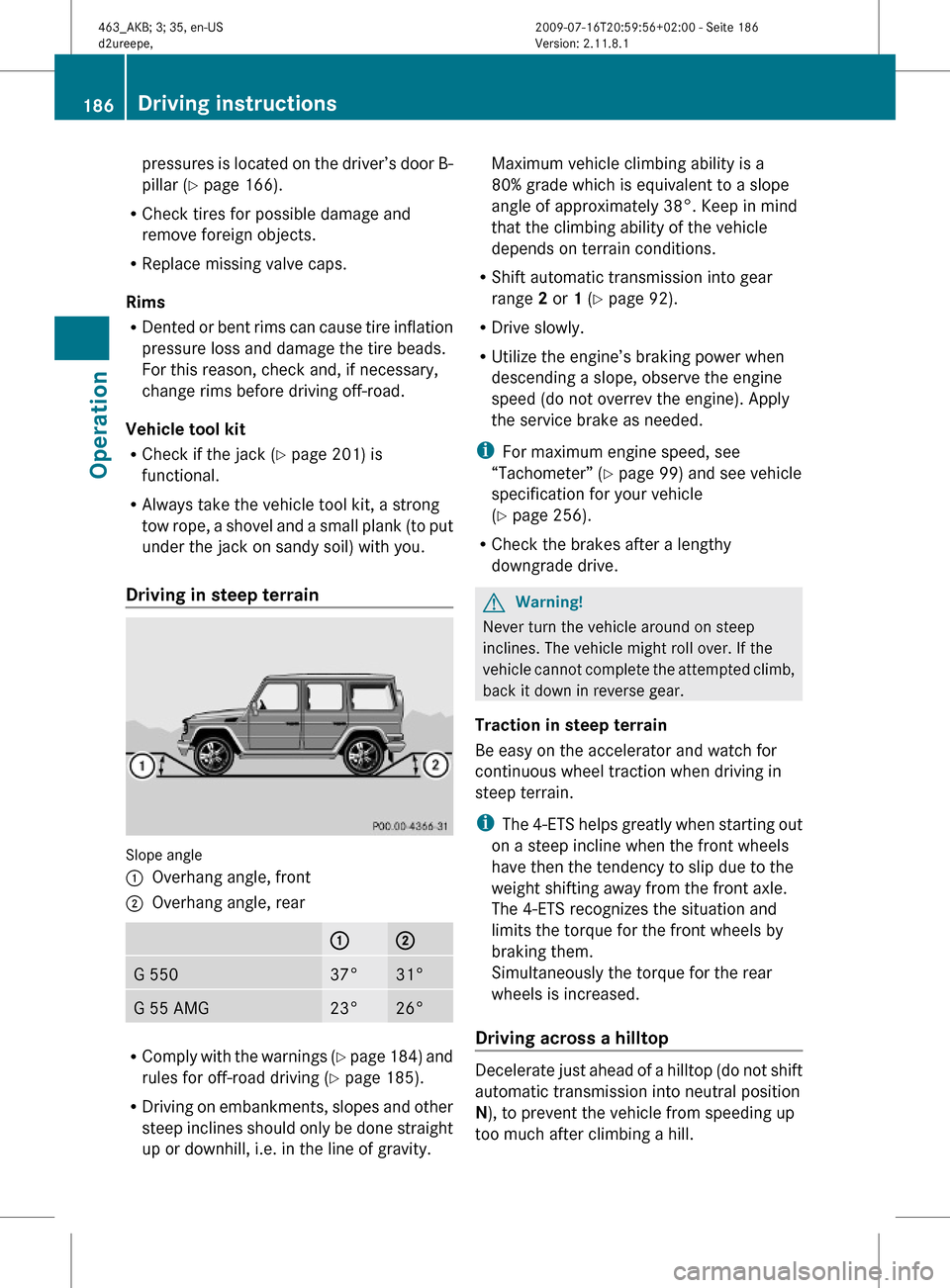
Driving in steep terrain
Slope angle
:Overhang angle, front;Overhang angle, rear:;G 55037°31°G 55 AMG23°26°
RComply with the warnings (Y page 184) and
rules for off-road driving (Y page 185).
RDriving on embankments, slopes and other
steep inclines should only be done straight
up or downhill, i.e. in the line of gravity.
Maximum vehicle climbing ability is a
80% grade which is equivalent to a slope
angle of approximately 38°. Keep in mind
that the climbing ability of the vehicle
depends on terrain conditions.
RShift automatic transmission into gear
range 2 or 1 (Y page 92).
RDrive slowly.
RUtilize the engine’s braking power when
descending a slope, observe the engine
speed (do not overrev the engine). Apply
the service brake as needed.
iFor maximum engine speed, see
“Tachometer” (Y page 99) and see vehicle
specification for your vehicle
(Y page 256).
RCheck the brakes after a lengthy
downgrade drive.
GWarning!
Never turn the vehicle around on steep
inclines. The vehicle might roll over. If the
vehicle cannot complete the attempted climb,
back it down in reverse gear.
Traction in steep terrain
Be easy on the accelerator and watch for
continuous wheel traction when driving in
steep terrain.
iThe 4-ETS helps greatly when starting out
on a steep incline when the front wheels
have then the tendency to slip due to the
weight shifting away from the front axle.
The 4-ETS recognizes the situation and
limits the torque for the front wheels by
braking them.
Simultaneously the torque for the rear
wheels is increased.
Driving across a hilltop
Decelerate just ahead of a hilltop (do not shift
automatic transmission into neutral position
N), to prevent the vehicle from speeding up
too much after climbing a hill.
186Driving instructionsOperation
463_AKB; 3; 35, en-USd2ureepe,Version: 2.11.8.12009-07-16T20:59:56+02:00 - Seite 186