Heat MERCEDES-BENZ GL 2010 Workshop Manual
[x] Cancel search | Manufacturer: MERCEDES-BENZ, Model Year: 2010, Model line: GL, Model: MERCEDES-BENZ GL 2010Pages: 380, PDF Size: 9.81 MB
Page 301 of 380
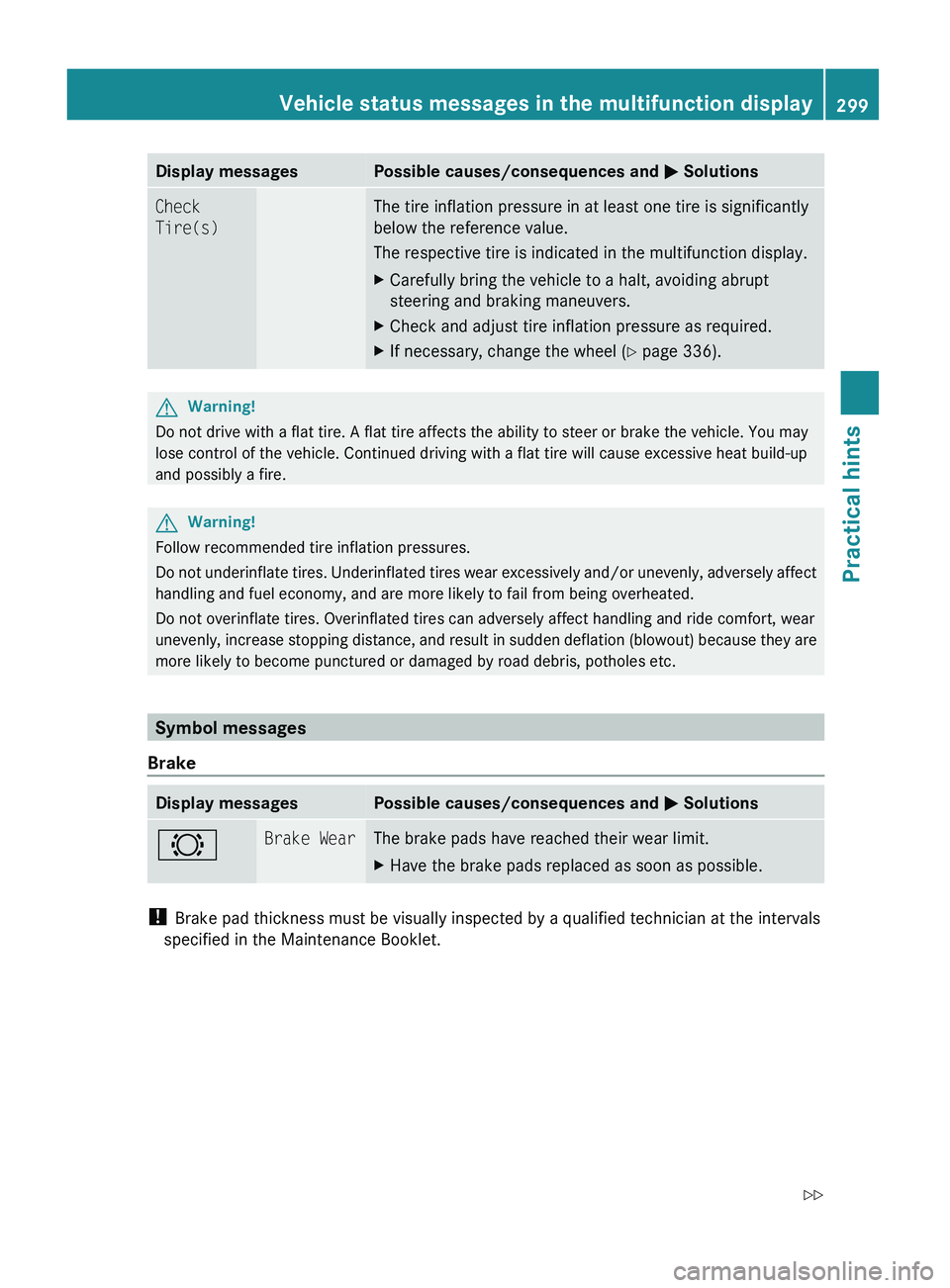
Display messagesPossible causes/consequences and M SolutionsCheck
Tire(s)The tire inflation pressure in at least one tire is significantly
below the reference value.
The respective tire is indicated in the multifunction display.XCarefully bring the vehicle to a halt, avoiding abrupt
steering and braking maneuvers.XCheck and adjust tire inflation pressure as required.XIf necessary, change the wheel ( Y page 336).GWarning!
Do not drive with a flat tire. A flat tire affects the ability to steer or brake the vehicle. You may
lose control of the vehicle. Continued driving with a flat tire will cause excessive heat build-up
and possibly a fire.
GWarning!
Follow recommended tire inflation pressures.
Do not underinflate tires. Underinflated tires wear excessively and/or unevenly, adversely affect
handling and fuel economy, and are more likely to fail from being overheated.
Do not overinflate tires. Overinflated tires can adversely affect handling and ride comfort, wear
unevenly, increase stopping distance, and result in sudden deflation (blowout) because they are
more likely to become punctured or damaged by road debris, potholes etc.
Symbol messages
Brake
Display messagesPossible causes/consequences and M Solutions#Brake WearThe brake pads have reached their wear limit.XHave the brake pads replaced as soon as possible.
!
Brake pad thickness must be visually inspected by a qualified technician at the intervals
specified in the Maintenance Booklet.
Vehicle status messages in the multifunction display299Practical hintsX164_AKB; 5; 31, en-USd2ureepe,Version: 2.11.8.12009-09-11T12:30:16+02:00 - Seite 299Z
Page 305 of 380
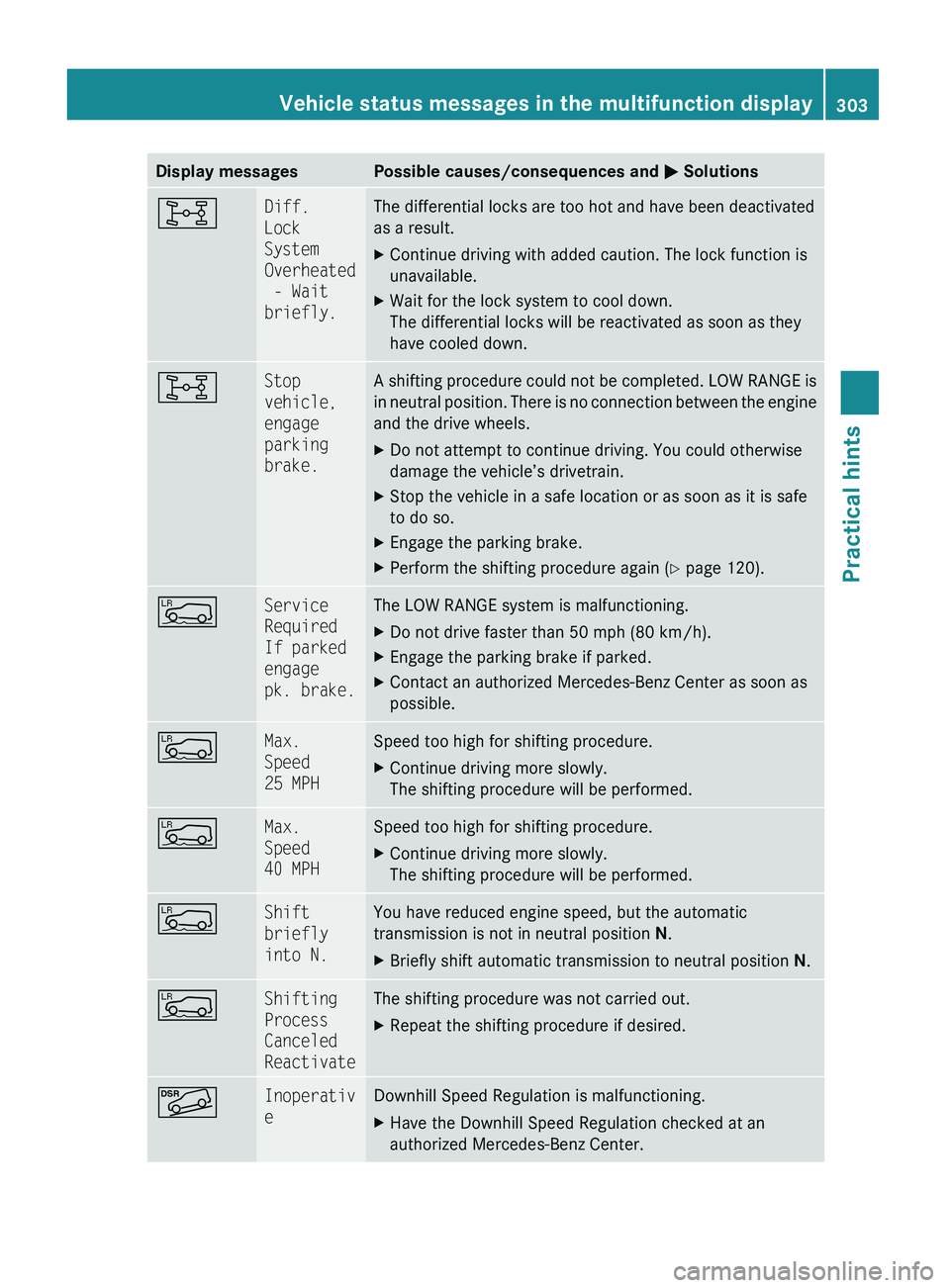
Display messagesPossible causes/consequences and M Solutions8Diff.
Lock
System
Overheated
- Wait
briefly.The differential locks are too hot and have been deactivated
as a result.XContinue driving with added caution. The lock function is
unavailable.XWait for the lock system to cool down.
The differential locks will be reactivated as soon as they
have cooled down.8Stop
vehicle,
engage
parking
brake.A shifting procedure could not be completed. LOW RANGE is
in neutral position. There is no connection between the engine
and the drive wheels.XDo not attempt to continue driving. You could otherwise
damage the vehicle’s drivetrain.XStop the vehicle in a safe location or as soon as it is safe
to do so.XEngage the parking brake.XPerform the shifting procedure again ( Y page 120).ÅService
Required
If parked
engage
pk. brake.The LOW RANGE system is malfunctioning.XDo not drive faster than 50 mph (80 km/h).XEngage the parking brake if parked.XContact an authorized Mercedes-Benz Center as soon as
possible.ÅMax.
Speed
25 MPHSpeed too high for shifting procedure.XContinue driving more slowly.
The shifting procedure will be performed.ÅMax.
Speed
40 MPHSpeed too high for shifting procedure.XContinue driving more slowly.
The shifting procedure will be performed.ÅShift
briefly
into N.You have reduced engine speed, but the automatic
transmission is not in neutral position N.XBriefly shift automatic transmission to neutral position N.ÅShifting
Process
Canceled
ReactivateThe shifting procedure was not carried out.XRepeat the shifting procedure if desired.ÃInoperativ
eDownhill Speed Regulation is malfunctioning.XHave the Downhill Speed Regulation checked at an
authorized Mercedes-Benz Center.Vehicle status messages in the multifunction display303Practical hintsX164_AKB; 5; 31, en-USd2ureepe,Version: 2.11.8.12009-09-11T12:30:16+02:00 - Seite 303Z
Page 308 of 380
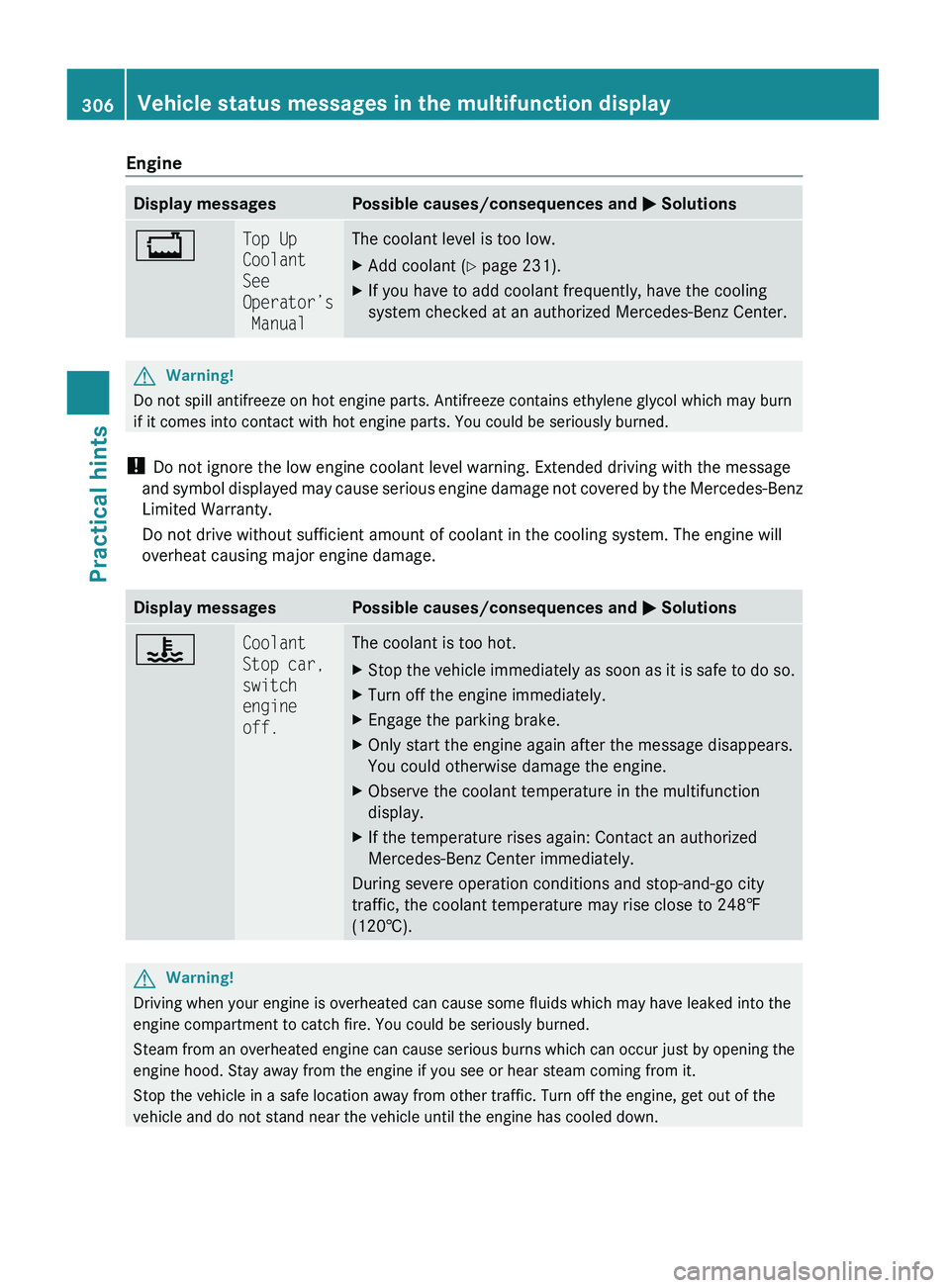
EngineDisplay messagesPossible causes/consequences and M Solutions+Top Up
Coolant
See
Operator’s
ManualThe coolant level is too low.XAdd coolant ( Y page 231).XIf you have to add coolant frequently, have the cooling
system checked at an authorized Mercedes-Benz Center.GWarning!
Do not spill antifreeze on hot engine parts. Antifreeze contains ethylene glycol which may burn
if it comes into contact with hot engine parts. You could be seriously burned.
! Do not ignore the low engine coolant level warning. Extended driving with the message
and symbol displayed may cause serious engine damage not covered by the Mercedes-Benz
Limited Warranty.
Do not drive without sufficient amount of coolant in the cooling system. The engine will
overheat causing major engine damage.
Display messagesPossible causes/consequences and M Solutions?Coolant
Stop car,
switch
engine
off.The coolant is too hot.XStop the vehicle immediately as soon as it is safe to do so.XTurn off the engine immediately.XEngage the parking brake.XOnly start the engine again after the message disappears.
You could otherwise damage the engine.XObserve the coolant temperature in the multifunction
display.XIf the temperature rises again: Contact an authorized
Mercedes-Benz Center immediately.
During severe operation conditions and stop-and-go city
traffic, the coolant temperature may rise close to 248‡
(120†).
GWarning!
Driving when your engine is overheated can cause some fluids which may have leaked into the
engine compartment to catch fire. You could be seriously burned.
Steam from an overheated engine can cause serious burns which can occur just by opening the
engine hood. Stay away from the engine if you see or hear steam coming from it.
Stop the vehicle in a safe location away from other traffic. Turn off the engine, get out of the
vehicle and do not stand near the vehicle until the engine has cooled down.
306Vehicle status messages in the multifunction displayPractical hints
X164_AKB; 5; 31, en-USd2ureepe,Version: 2.11.8.12009-09-11T12:30:16+02:00 - Seite 306
Page 309 of 380
! The engine should not be operated with the coolant temperature above 248‡ (120†).
Doing so may cause serious damage which is not covered by the Mercedes-Benz Limited
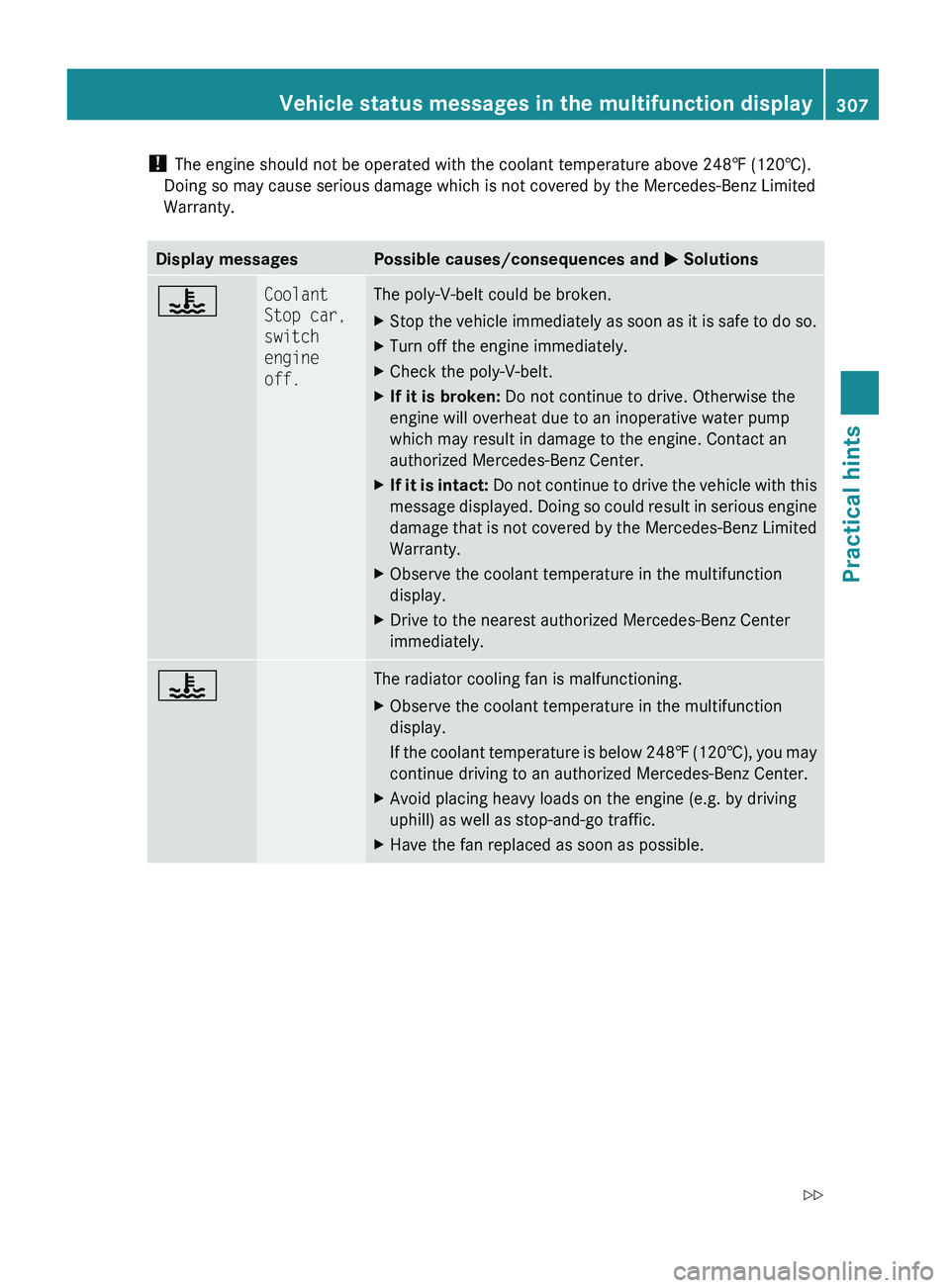
Warranty.Display messagesPossible causes/consequences and M Solutions?Coolant
Stop car,
switch
engine
off.The poly-V-belt could be broken.XStop the vehicle immediately as soon as it is safe to do so.XTurn off the engine immediately.XCheck the poly-V-belt.XIf it is broken: Do not continue to drive. Otherwise the
engine will overheat due to an inoperative water pump
which may result in damage to the engine. Contact an
authorized Mercedes-Benz Center.XIf it is intact: Do not continue to drive the vehicle with this
message displayed. Doing so could result in serious engine
damage that is not covered by the Mercedes-Benz Limited
Warranty.XObserve the coolant temperature in the multifunction
display.XDrive to the nearest authorized Mercedes-Benz Center
immediately.?The radiator cooling fan is malfunctioning.XObserve the coolant temperature in the multifunction
display.
If the coolant temperature is below 248‡ (120†), you may
continue driving to an authorized Mercedes-Benz Center.XAvoid placing heavy loads on the engine (e.g. by driving
uphill) as well as stop-and-go traffic.XHave the fan replaced as soon as possible.Vehicle status messages in the multifunction display307Practical hintsX164_AKB; 5; 31, en-USd2ureepe,Version: 2.11.8.12009-09-11T12:30:16+02:00 - Seite 307Z
Page 310 of 380
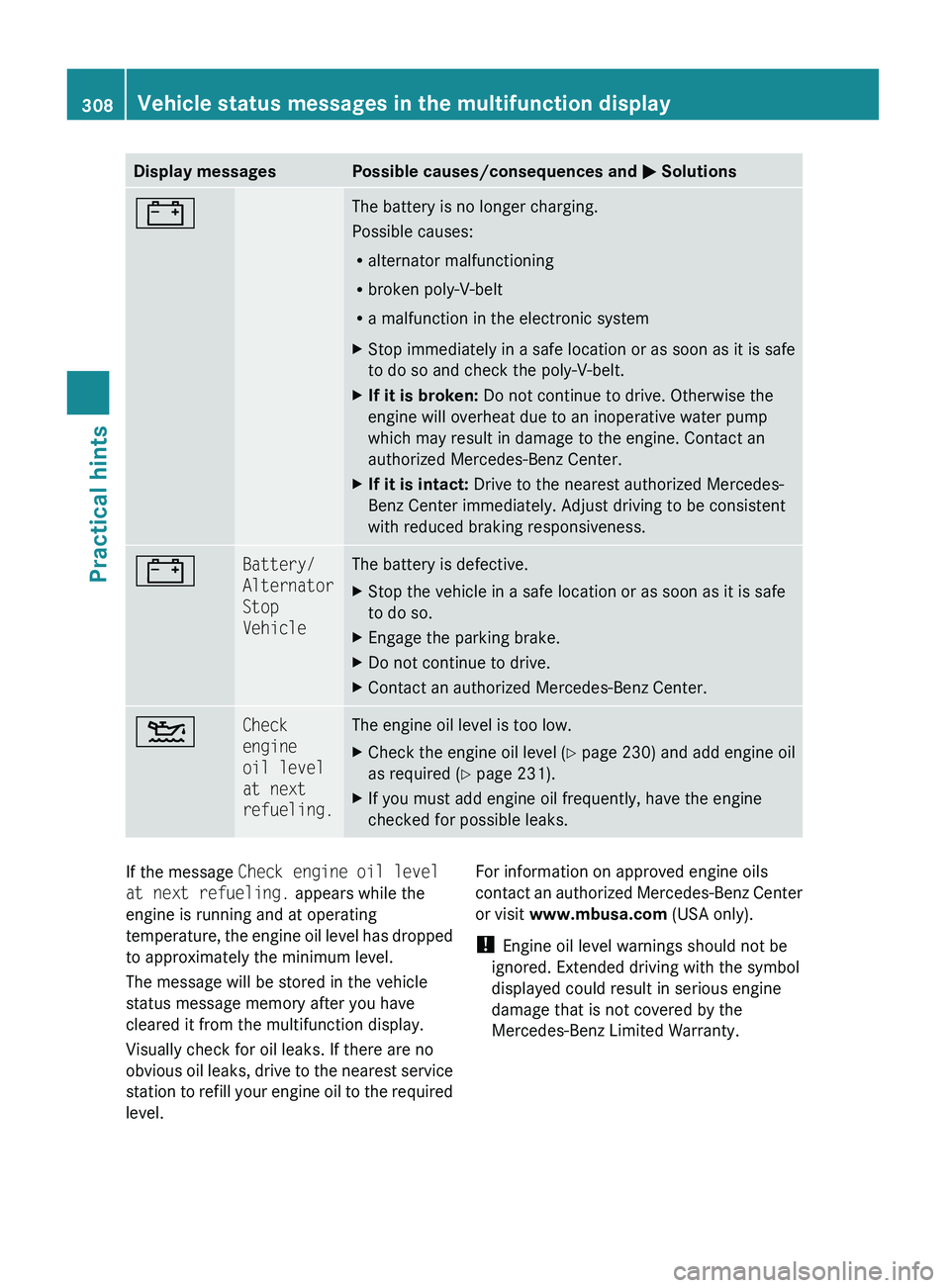
Display messagesPossible causes/consequences and M Solutions#The battery is no longer charging.
Possible causes:
R alternator malfunctioning
R broken poly-V-belt
R a malfunction in the electronic systemXStop immediately in a safe location or as soon as it is safe
to do so and check the poly-V-belt.XIf it is broken: Do not continue to drive. Otherwise the
engine will overheat due to an inoperative water pump
which may result in damage to the engine. Contact an
authorized Mercedes-Benz Center.XIf it is intact: Drive to the nearest authorized Mercedes-
Benz Center immediately. Adjust driving to be consistent
with reduced braking responsiveness.#Battery/
Alternator
Stop
VehicleThe battery is defective.XStop the vehicle in a safe location or as soon as it is safe
to do so.XEngage the parking brake.XDo not continue to drive.XContact an authorized Mercedes-Benz Center.4Check
engine
oil level
at next
refueling.The engine oil level is too low.XCheck the engine oil level ( Y page 230) and add engine oil
as required ( Y page 231).XIf you must add engine oil frequently, have the engine
checked for possible leaks.If the message Check engine oil level
at next refueling. appears while the
engine is running and at operating
temperature, the engine oil level has dropped
to approximately the minimum level.
The message will be stored in the vehicle
status message memory after you have
cleared it from the multifunction display.
Visually check for oil leaks. If there are no
obvious oil leaks, drive to the nearest service
station to refill your engine oil to the required
level.For information on approved engine oils
contact an authorized Mercedes-Benz Center
or visit www.mbusa.com (USA only).
! Engine oil level warnings should not be
ignored. Extended driving with the symbol
displayed could result in serious engine
damage that is not covered by the
Mercedes-Benz Limited Warranty.308Vehicle status messages in the multifunction displayPractical hints
X164_AKB; 5; 31, en-USd2ureepe,Version: 2.11.8.12009-09-11T12:30:16+02:00 - Seite 308
Page 316 of 380
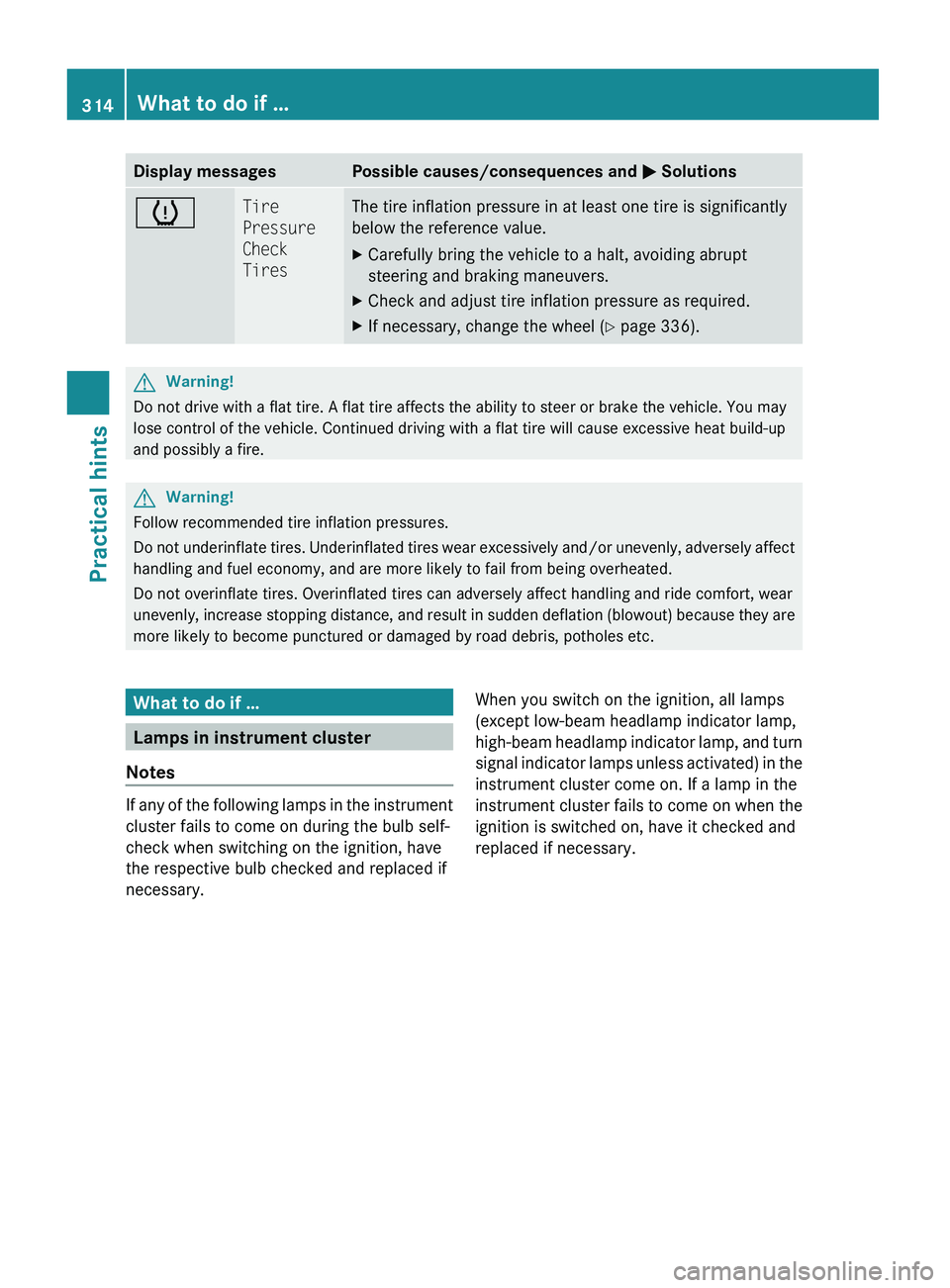
Display messagesPossible causes/consequences and M SolutionshTire
Pressure
Check
TiresThe tire inflation pressure in at least one tire is significantly
below the reference value.XCarefully bring the vehicle to a halt, avoiding abrupt
steering and braking maneuvers.XCheck and adjust tire inflation pressure as required.XIf necessary, change the wheel ( Y page 336).GWarning!
Do not drive with a flat tire. A flat tire affects the ability to steer or brake the vehicle. You may
lose control of the vehicle. Continued driving with a flat tire will cause excessive heat build-up
and possibly a fire.
GWarning!
Follow recommended tire inflation pressures.
Do not underinflate tires. Underinflated tires wear excessively and/or unevenly, adversely affect
handling and fuel economy, and are more likely to fail from being overheated.
Do not overinflate tires. Overinflated tires can adversely affect handling and ride comfort, wear
unevenly, increase stopping distance, and result in sudden deflation (blowout) because they are
more likely to become punctured or damaged by road debris, potholes etc.
What to do if …
Lamps in instrument cluster
Notes
If any of the following lamps in the instrument
cluster fails to come on during the bulb self-
check when switching on the ignition, have
the respective bulb checked and replaced if
necessary.
When you switch on the ignition, all lamps
(except low-beam headlamp indicator lamp,
high-beam headlamp indicator lamp, and turn
signal indicator lamps unless activated) in the
instrument cluster come on. If a lamp in the
instrument cluster fails to come on when the
ignition is switched on, have it checked and
replaced if necessary.314What to do if …Practical hints
X164_AKB; 5; 31, en-USd2ureepe,Version: 2.11.8.12009-09-11T12:30:16+02:00 - Seite 314
Page 321 of 380
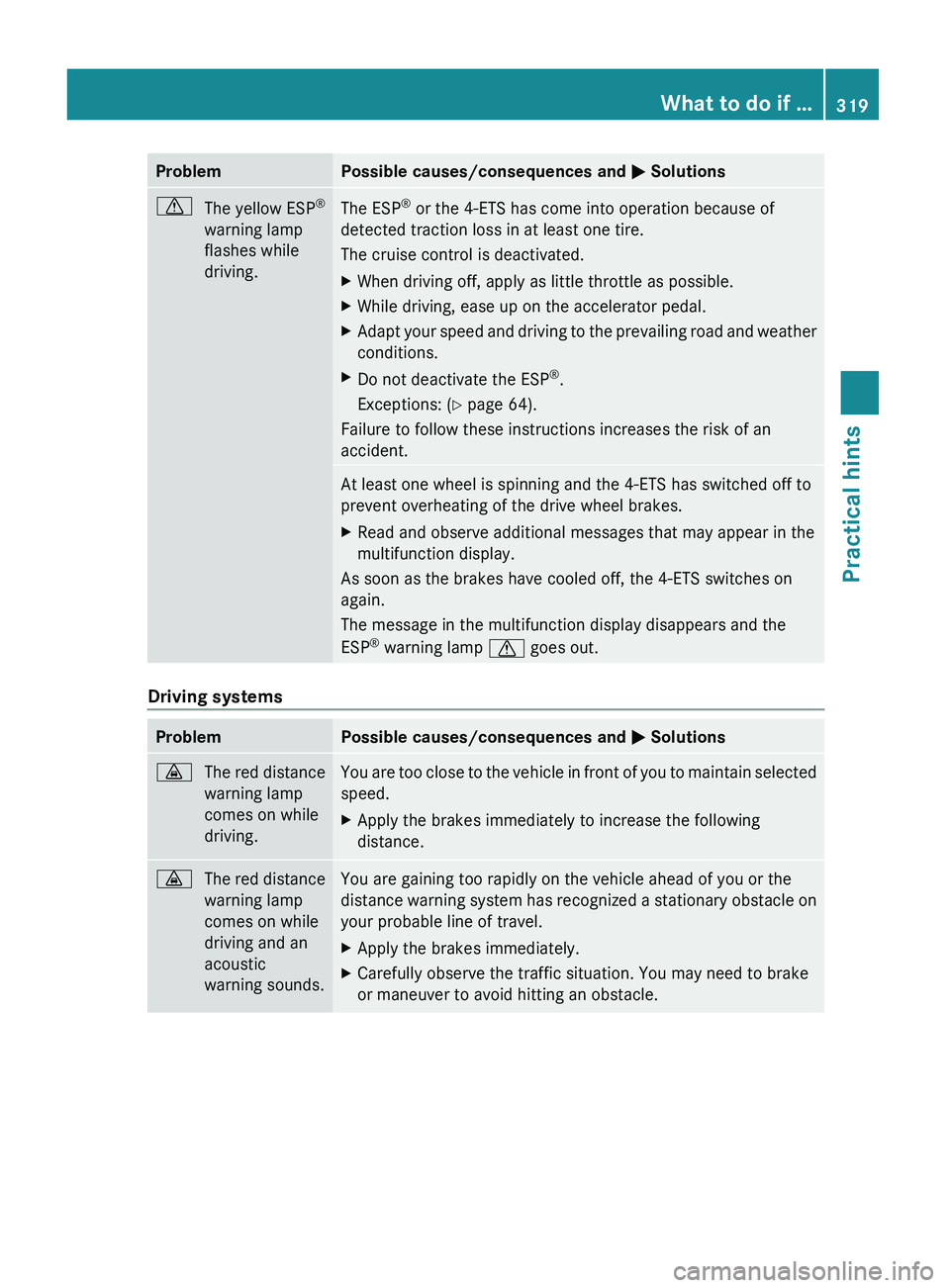
ProblemPossible causes/consequences and M SolutionsdThe yellow ESP ®
warning lamp
flashes while
driving.The ESP ®
or the 4-ETS has come into operation because of
detected traction loss in at least one tire.
The cruise control is deactivated.XWhen driving off, apply as little throttle as possible.XWhile driving, ease up on the accelerator pedal.XAdapt your speed and driving to the prevailing road and weather
conditions.XDo not deactivate the ESP ®
.
Exceptions: ( Y page 64).
Failure to follow these instructions increases the risk of an
accident.
At least one wheel is spinning and the 4-ETS has switched off to
prevent overheating of the drive wheel brakes.XRead and observe additional messages that may appear in the
multifunction display.
As soon as the brakes have cooled off, the 4-ETS switches on
again.
The message in the multifunction display disappears and the
ESP ®
warning lamp d goes out.
Driving systems
ProblemPossible causes/consequences and M Solutions·The red distance
warning lamp
comes on while
driving.You are too close to the vehicle in front of you to maintain selected
speed.XApply the brakes immediately to increase the following
distance.·The red distance
warning lamp
comes on while
driving and an
acoustic
warning sounds.You are gaining too rapidly on the vehicle ahead of you or the
distance warning system has recognized a stationary obstacle on
your probable line of travel.XApply the brakes immediately.XCarefully observe the traffic situation. You may need to brake
or maneuver to avoid hitting an obstacle.What to do if …319Practical hintsX164_AKB; 5; 31, en-USd2ureepe,Version: 2.11.8.12009-09-11T12:30:16+02:00 - Seite 319Z
Page 323 of 380
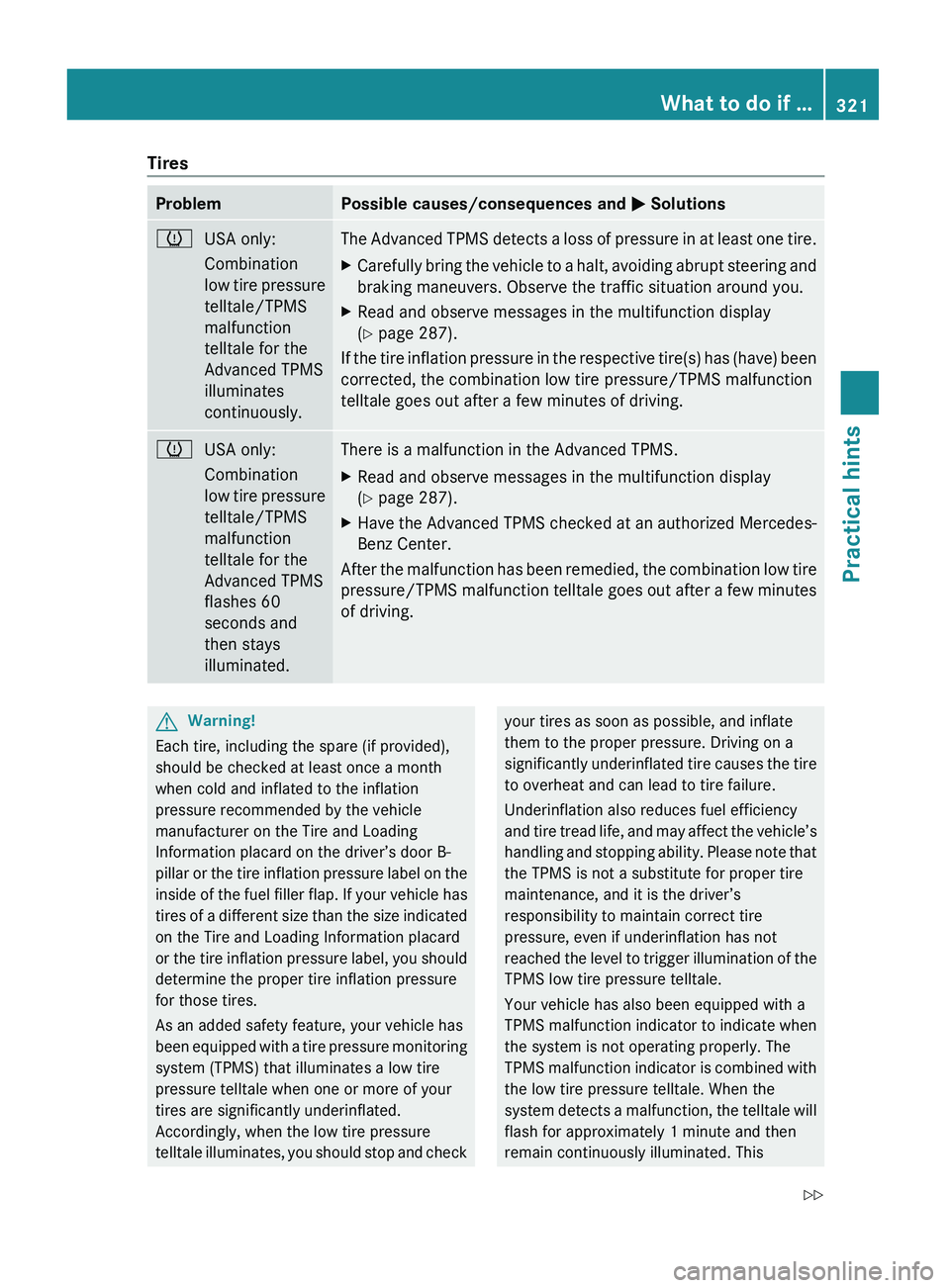
TiresProblemPossible causes/consequences and M SolutionshUSA only:
Combination
low tire pressure
telltale/TPMS
malfunction
telltale for the
Advanced TPMS
illuminates
continuously.The Advanced TPMS detects a loss of pressure in at least one tire.XCarefully bring the vehicle to a halt, avoiding abrupt steering and
braking maneuvers. Observe the traffic situation around you.XRead and observe messages in the multifunction display
( Y page 287).
If the tire inflation pressure in the respective tire(s) has (have) been
corrected, the combination low tire pressure/TPMS malfunction
telltale goes out after a few minutes of driving.
hUSA only:
Combination
low tire pressure
telltale/TPMS
malfunction
telltale for the
Advanced TPMS
flashes 60
seconds and
then stays
illuminated.There is a malfunction in the Advanced TPMS.XRead and observe messages in the multifunction display
( Y page 287).XHave the Advanced TPMS checked at an authorized Mercedes-
Benz Center.
After the malfunction has been remedied, the combination low tire
pressure/TPMS malfunction telltale goes out after a few minutes
of driving.
GWarning!
Each tire, including the spare (if provided),
should be checked at least once a month
when cold and inflated to the inflation
pressure recommended by the vehicle
manufacturer on the Tire and Loading
Information placard on the driver’s door B-
pillar or the tire inflation pressure label on the
inside of the fuel filler flap. If your vehicle has
tires of a different size than the size indicated
on the Tire and Loading Information placard
or the tire inflation pressure label, you should
determine the proper tire inflation pressure
for those tires.
As an added safety feature, your vehicle has
been equipped with a tire pressure monitoring
system (TPMS) that illuminates a low tire
pressure telltale when one or more of your
tires are significantly underinflated.
Accordingly, when the low tire pressure
telltale illuminates, you should stop and check
your tires as soon as possible, and inflate
them to the proper pressure. Driving on a
significantly underinflated tire causes the tire
to overheat and can lead to tire failure.
Underinflation also reduces fuel efficiency
and tire tread life, and may affect the vehicle’s
handling and stopping ability. Please note that
the TPMS is not a substitute for proper tire
maintenance, and it is the driver’s
responsibility to maintain correct tire
pressure, even if underinflation has not
reached the level to trigger illumination of the
TPMS low tire pressure telltale.
Your vehicle has also been equipped with a
TPMS malfunction indicator to indicate when
the system is not operating properly. The
TPMS malfunction indicator is combined with
the low tire pressure telltale. When the
system detects a malfunction, the telltale will
flash for approximately 1 minute and then
remain continuously illuminated. ThisWhat to do if …321Practical hintsX164_AKB; 5; 31, en-USd2ureepe,Version: 2.11.8.12009-09-11T12:30:16+02:00 - Seite 321Z
Page 341 of 380
in the second-row footwell for electric air
pump operation.XTurn the SmartKey in the starter switch to
position 1.
or
XVehicles with KEYLESS-GO: Press the
KEYLESS-GO start/stop button once. Do
not depress the brake pedal.XPress I on electric air pump switch =.
The electric air pump is switched on and
inflates the tire.
i First, the sealing is pumped into the tire.
The pressure may briefly rise to up to 73 psi
(5 bar). This is normal and not an indication
of a malfunction. Do not switch off the
electric air pump.
XLet the electric air pump inflate the tire for
approximately 5 minutes.
The pressure gauge must display at least
26 psi (1.8 bar).GWarning!
The air hose can become hot during inflation.
Please exercise appropriate caution.
! Do not operate the electric air pump
longer than 8 minutes without interruption.
Otherwise it may overheat.
You may operate the air pump again after
it has cooled off.
If the tire inflation pressure of at least
26 psi (1.8 bar) is not attained:
XTurn off the electric air pump by pressing
0 on electric air pump switch =.XDetach filler hose D from tire valve E.XDrive vehicle back or forth very slowly
approximately 30 ft (10 m).
This serves to better distribute the TIREFIT
sealant material inside the tire.XInflate the tire again.GWarning!
If a tire inflation pressure of 26 psi (1.8 bar)
is not attained, the tire is too severely
damaged for TIREFIT to provide a reliable tire
repair.
In this case, TIREFIT cannot properly seal the
tire.
Do not drive the vehicle.
Contact the nearest Mercedes-Benz Center or
call Roadside Assistance.
After attaining a tire inflation pressure of
at least 26 psi (1.8 bar):
XPress 0 on electric air pump switch =.
The electric air pump is switched off.XDetach the TIREFIT kit from the tire valve.GWarning!
The air hose may still be hot. Exercise proper
caution to avoid burning yourself when
detaching the electric air pump.
! Remaining TIREFIT sealant could escape
from the filler hose after it has been
detached from the tire valve. TIREFIT
sealant may cause stains.
Therefore, cover the filler hose, e.g. by
inserting it into the plastic bag the TIREFIT
kit was packed in.
XDrive off immediately.GWarning!
Do not exceed a vehicle speed of 50 mph
( 80 km/h). A TIREFIT repair is not designed to
operate at higher speeds.
The sticker must be attached on the
instrument cluster where it will be easily seen
by the driver.
Vehicle handling characteristics of a TIREFIT
repaired tire may change. Adapt your driving
accordingly.
Flat tire339Practical hintsX164_AKB; 5; 31, en-USd2ureepe,Version: 2.11.8.12009-09-11T12:30:16+02:00 - Seite 339Z
Page 375 of 380
vehicles are not covered by the Mercedes-
Benz Limited Warranty or by any pre-owned
or Extended Limited Warranties.
AdBlue ®
AdBlue ®
is a non-flammable, non-toxic,
colorless and odorless, water-soluble liquid.
! Only use AdBlue ®
complying with
ISO 22241. Do not blend with additives.
! Rinse surfaces that have come into
contact with AdBlue ®
, or remove AdBlue ®
with a moist cloth and cold water
immediately. If AdBlue ®
has crystallized
already, use cold water and a sponge.
AdBlue ®
residues will crystallize and soil
the affected surfaces.
High ambient temperatures
If AdBlue ®
in the reservoir heats up to above
122‡ (50†) for a long period of time, for
example due to direct sunlight, ammonia gas
vapors may escape when opening the
AdBlue ®
tank.
GWarning!
When opening the filler cap of the AdBlue ®
tank ammonia gas vapors may escape. Refill
AdBlue ®
in a well ventilated area only.
Ammonia gas vapors have a pungent odor and
are particularly irritating for your skin,
mucous membranes, and eyes. Inhaling
ammonia gas vapors will cause burning eyes,
nose, and throat, as well as coughing and
watering eyes.
Low ambient temperatures
AdBlue ®
freezes at a temperature of
approximately 12‡ (-11†). Your vehicle is
factory equipped with an AdBlue ®
preheating
system. The vehicle can thus be operated at
temperatures below 12‡ (-11†).
Special additives
! Only use AdBlue ®
complying with
ISO 22241. Do not add additives to
AdBlue ®
and do not dilute AdBlue ®
with
water. Otherwise, the BlueTEC exhaust gas
aftertreatment system could be damaged.
Damage caused by using additives or
diluting with water are not covered by the
Mercedes-Benz Limited Warranty.
Purity
The purity of AdBlue ®
is of particular
importance for avoiding malfunctions in the
exhaust gas aftertreatment.
If AdBlue ®
is pumped out of the tank, e.g.
during repair work, the same liquid must not
be used to refill the tank as its purity is no
longer guaranteed.
! Impurities caused for example by other
service products, cleaning agents, and dust
result in increased emissions,
malfunctions, catalyst damage, or engine
damage.
Coolants
The engine coolant is a mixture of water and
anticorrosion/antifreeze, which provides:
R Corrosion protection
R Freeze protection
R Boiling protection (by increasing the boiling
point)
The cooling system was filled at the factory
with a coolant providing freeze protection to
approximately -35‡ (-37†) and corrosion
protection.
! Add premixed coolant solution only.
Adding water and MB 325.0 Anticorrosion/
Antifreeze separately from each other,
could cause engine damage not covered by
the Mercedes-Benz Limited Warranty.
Fuels, coolants, lubricants, etc.373Technical dataX164_AKB; 5; 31, en-USd2ureepe,Version: 2.11.8.12009-09-11T12:30:16+02:00 - Seite 373Z