service MERCEDES-BENZ GL 2011 Service Manual
[x] Cancel search | Manufacturer: MERCEDES-BENZ, Model Year: 2011, Model line: GL, Model: MERCEDES-BENZ GL 2011Pages: 376, PDF Size: 17.39 MB
Page 351 of 376
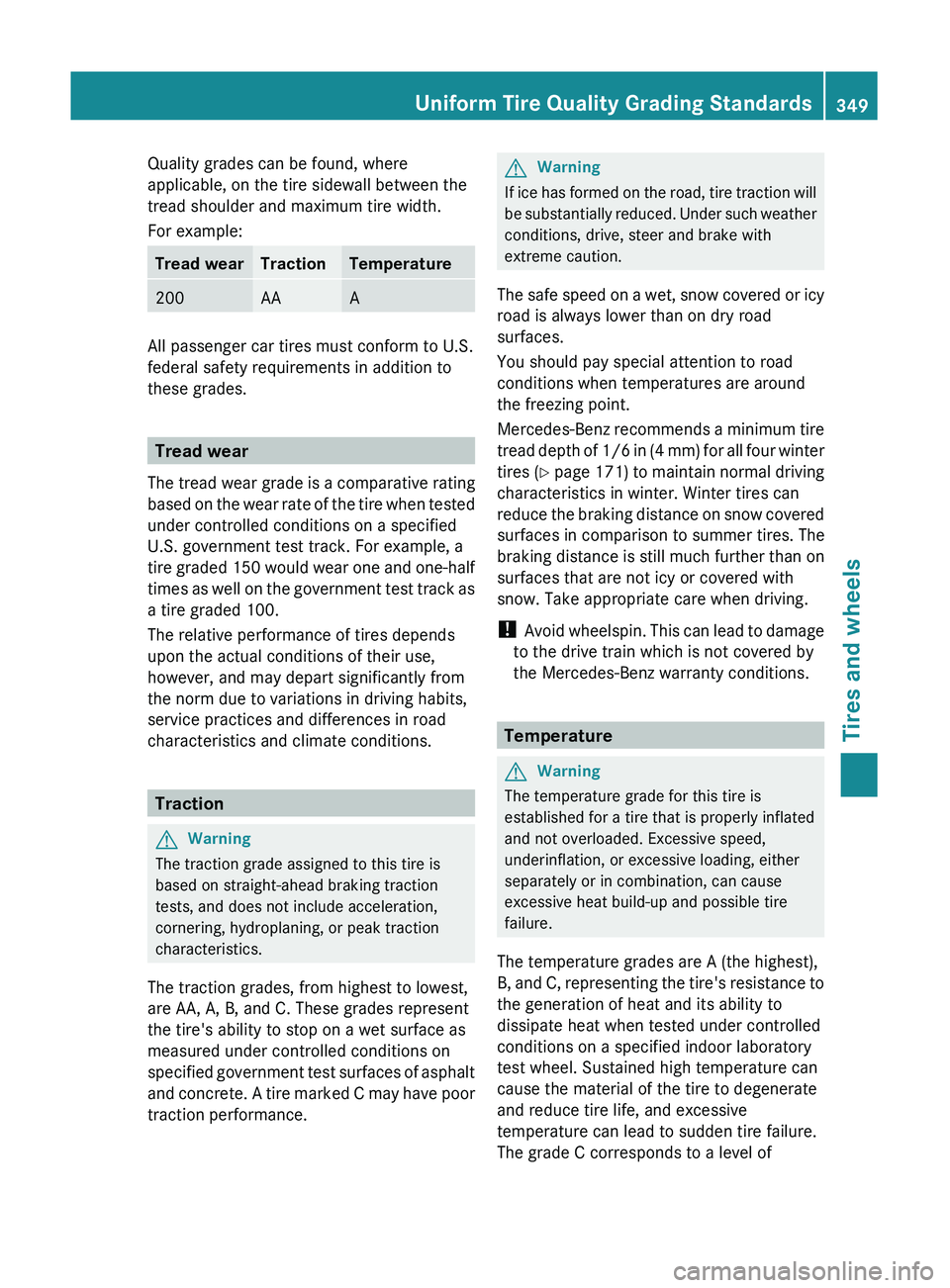
Quality grades can be found, where
applicable, on the tire sidewall between the
tread shoulder and maximum tire width.
For example:Tread wearTractionTemperature200AAA
All passenger car tires must conform to U.S.
federal safety requirements in addition to
these grades.
Tread wear
The tread wear grade is a comparative rating
based on the wear rate of the tire when tested
under controlled conditions on a specified
U.S. government test track. For example, a
tire graded 150 would wear one and one-half
times as well on the government test track as
a tire graded 100.
The relative performance of tires depends
upon the actual conditions of their use,
however, and may depart significantly from
the norm due to variations in driving habits,
service practices and differences in road
characteristics and climate conditions.
Traction
GWarning
The traction grade assigned to this tire is
based on straight-ahead braking traction
tests, and does not include acceleration,
cornering, hydroplaning, or peak traction
characteristics.
The traction grades, from highest to lowest,
are AA, A, B, and C. These grades represent
the tire's ability to stop on a wet surface as
measured under controlled conditions on
specified government test surfaces of asphalt
and concrete. A tire marked C may have poor
traction performance.
GWarning
If ice has formed on the road, tire traction will
be substantially reduced. Under such weather
conditions, drive, steer and brake with
extreme caution.
The safe speed on a wet, snow covered or icy
road is always lower than on dry road
surfaces.
You should pay special attention to road
conditions when temperatures are around
the freezing point.
Mercedes-Benz recommends a minimum tire
tread depth of 1/6 in (4 mm) for all four winter
tires ( Y page 171) to maintain normal driving
characteristics in winter. Winter tires can
reduce the braking distance on snow covered
surfaces in comparison to summer tires. The
braking distance is still much further than on
surfaces that are not icy or covered with
snow. Take appropriate care when driving.
! Avoid wheelspin. This can lead to damage
to the drive train which is not covered by
the Mercedes-Benz warranty conditions.
Temperature
GWarning
The temperature grade for this tire is
established for a tire that is properly inflated
and not overloaded. Excessive speed,
underinflation, or excessive loading, either
separately or in combination, can cause
excessive heat build-up and possible tire
failure.
The temperature grades are A (the highest),
B, and C, representing the tire's resistance to
the generation of heat and its ability to
dissipate heat when tested under controlled
conditions on a specified indoor laboratory
test wheel. Sustained high temperature can
cause the material of the tire to degenerate
and reduce tire life, and excessive
temperature can lead to sudden tire failure.
The grade C corresponds to a level of
Uniform Tire Quality Grading Standards349Tires and wheelsBA 164.8 USA, CA Edition B 2011; 1; 2, en-USd2sboikeVersion: 3.0.3.52010-04-21T15:08:44+02:00 - Seite 349Z
Page 354 of 376
For further information on the load bearing
index, see load index ( Y page 353).
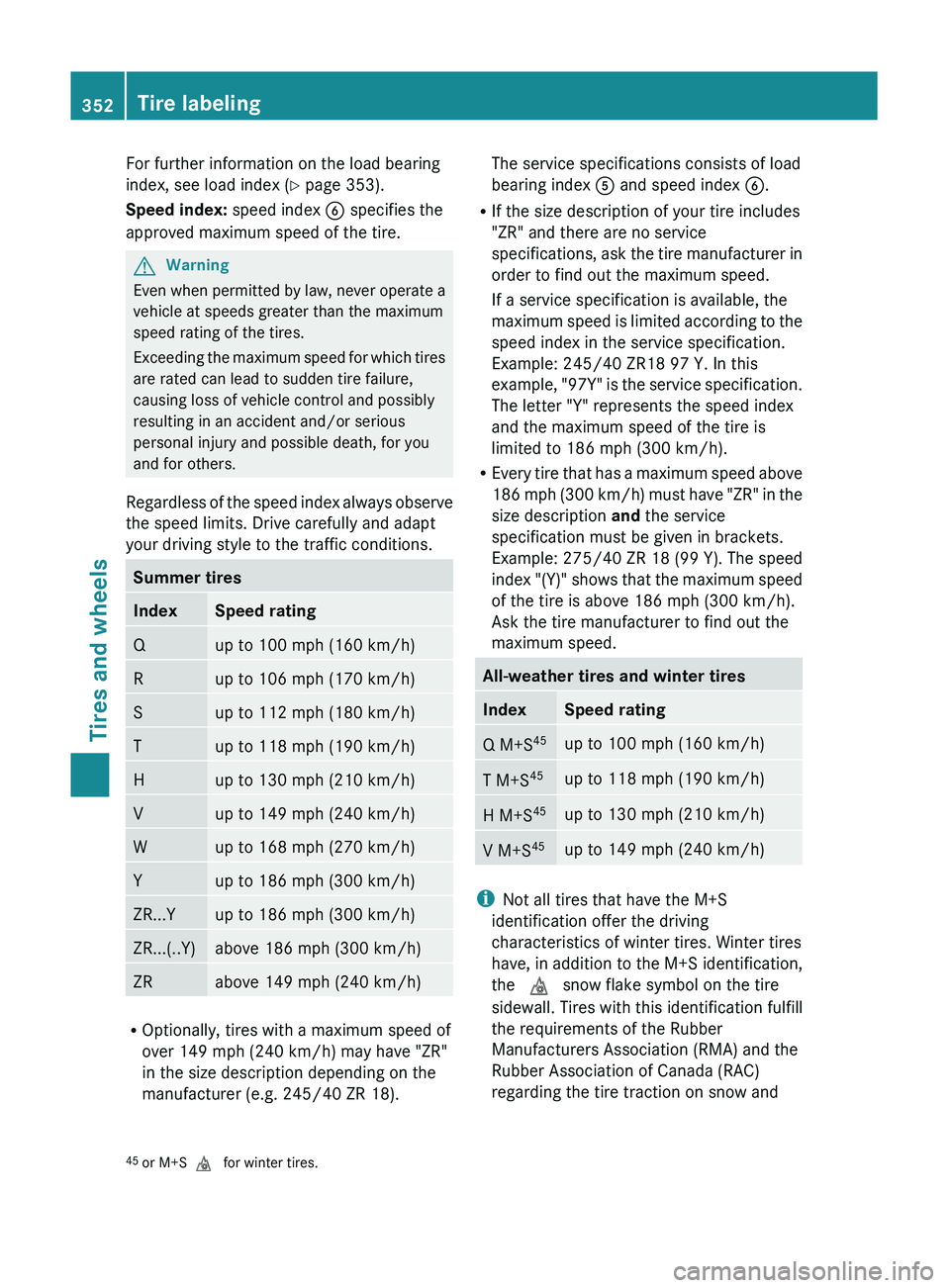
Speed index: speed index B specifies the
approved maximum speed of the tire.GWarning
Even when permitted by law, never operate a
vehicle at speeds greater than the maximum
speed rating of the tires.
Exceeding the maximum speed for which tires
are rated can lead to sudden tire failure,
causing loss of vehicle control and possibly
resulting in an accident and/or serious
personal injury and possible death, for you
and for others.
Regardless of the speed index always observe
the speed limits. Drive carefully and adapt
your driving style to the traffic conditions.
Summer tiresIndexSpeed ratingQup to 100 mph (160 km/h)Rup to 106 mph (170 km/h)Sup to 112 mph (180 km/h)Tup to 118 mph (190 km/h)Hup to 130 mph (210 km/h)Vup to 149 mph (240 km/h)Wup to 168 mph (270 km/h)Yup to 186 mph (300 km/h)ZR...Yup to 186 mph (300 km/h)ZR...(..Y)above 186 mph (300 km/h)ZRabove 149 mph (240 km/h)
R Optionally, tires with a maximum speed of
over 149 mph (240 km/h) may have "ZR"
in the size description depending on the
manufacturer (e.g. 245/40 ZR 18).
The service specifications consists of load
bearing index A and speed index B.
R If the size description of your tire includes
"ZR" and there are no service
specifications, ask the tire manufacturer in
order to find out the maximum speed.
If a service specification is available, the
maximum speed is limited according to the
speed index in the service specification.
Example: 245/40 ZR18 97 Y. In this
example, "97Y" is the service specification.
The letter "Y" represents the speed index
and the maximum speed of the tire is
limited to 186 mph (300 km/h).
R Every tire that has a maximum speed above
186 mph (300 km/h) must have "ZR" in the
size description and the service
specification must be given in brackets.
Example: 275/40 ZR 18 (99 Y). The speed
index "(Y)" shows that the maximum speed
of the tire is above 186 mph (300 km/h).
Ask the tire manufacturer to find out the
maximum speed.All-weather tires and winter tiresIndexSpeed ratingQ M+S 45up to 100 mph (160 km/h)T M+S45up to 118 mph (190 km/h)H M+S 45up to 130 mph (210 km/h)V M+S45up to 149 mph (240 km/h)
i
Not all tires that have the M+S
identification offer the driving
characteristics of winter tires. Winter tires
have, in addition to the M+S identification,
the i snow flake symbol on the tire
sidewall. Tires with this identification fulfill
the requirements of the Rubber
Manufacturers Association (RMA) and the
Rubber Association of Canada (RAC)
regarding the tire traction on snow and
45 or M+S i for winter tires.352Tire labelingTires and wheels
BA 164.8 USA, CA Edition B 2011; 1; 2, en-USd2sboikeVersion: 3.0.3.52010-04-21T15:08:44+02:00 - Seite 352
Page 363 of 376
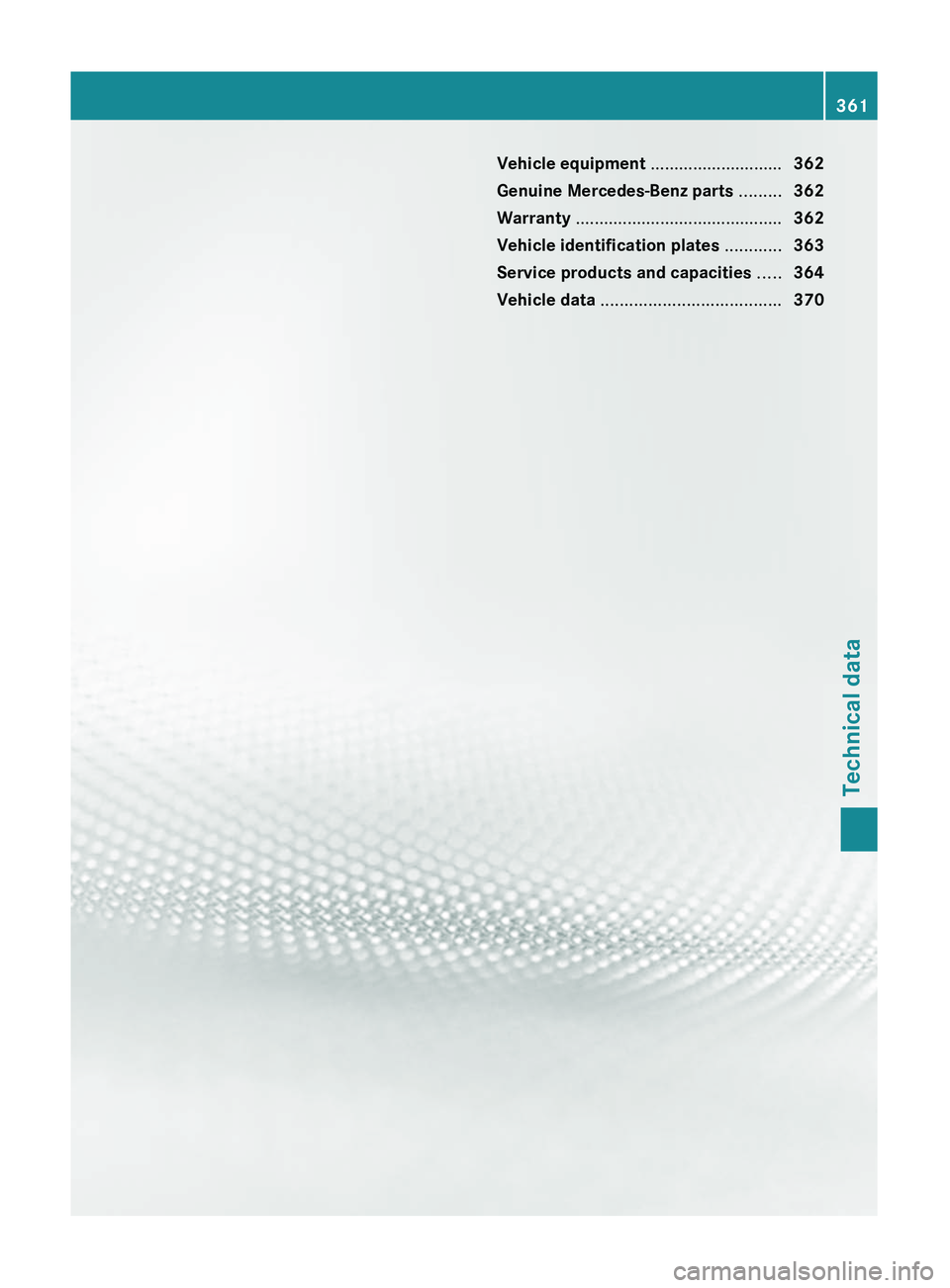
Vehicle equipment ............................362
Genuine Mercedes-Benz parts .........362
Warranty ............................................ 362
Vehicle identification plates ............363
Service products and capacities .....364
Vehicle data ...................................... 370361Technical dataBA 164.8 USA, CA Edition B 2011; 1; 2, en-USd2sboikeVersion: 3.0.3.52010-04-21T15:08:44+02:00 - Seite 361
Page 364 of 376
Vehicle equipment
i This manual describes all the standard
and optional equipment of your vehicle
which was available at the time of
purchase. Country-specific differences are
possible. Bear in mind that your vehicle
may not feature all functions described
here. This also refers to safety-related
systems and functions.
Genuine Mercedes-Benz parts
All Mercedes-Benz Centers maintain a supply
of genuine Mercedes-Benz parts for
necessary service and repair work. In
addition, strategically located parts delivery
centers provide for quick and reliable parts
service.
More than 300,000 different parts are
available for Mercedes-Benz models.
Genuine Mercedes-Benz parts are subjected
to stringent quality inspections. Every part
has been specifically developed,
manufactured or selected for and adapted to
Mercedes-Benz vehicles.
Only genuine Mercedes-Benz parts should
therefore be used.
! The use of non-approved parts could
impair the vehicle's safety. For this reason,
Mercedes-Benz recommends genuine
Mercedes-Benz parts and approved
conversion parts and accessories for your
vehicle model.
HEnvironmental note
Daimler AG also supplies reconditioned major
assemblies and parts which are of the same
quality as new parts. They are covered by the
same Limited Warranty entitlements as new
parts.
Always specify the vehicle identification
number and engine number when ordering
genuine Mercedes-Benz parts. You will find
these numbers on your vehicle's
identification plates, for example
( Y page 363).
Warranty
Your vehicle is covered under the terms of the
warranties printed in the Service and
Warranty Information booklet.
Your authorized Mercedes-Benz Center will
exchange or repair any defective parts
originally installed in the vehicle in
accordance with the terms of the following
warranties:
R New Vehicle Limited Warranty
R Emission System Warranty
R Emission Performance Warranty
R California, Connecticut, Maine,
Massachusetts, New York, Pennsylvania,
Rhode Island and Vermont Emission
Control Systems Warranty 52
R State Warranty Enforcement Laws ("Lemon
Laws")
Replacement parts and accessories are
subject to the Mercedes-Benz Replacement
Part and Accessory Warranties. You can
obtain these at any Mercedes-Benz Center.
i Should you lose your Service and
Warranty Information booklet, have an
authorized Mercedes-Benz Center arrange
for a replacement. It will be mailed to you.
52 Only vehicles with a gasoline engine.362WarrantyTechnical data
BA 164.8 USA, CA Edition B 2011; 1; 2, en-USd2sboikeVersion: 3.0.3.52010-04-21T15:08:44+02:00 - Seite 362
Page 366 of 376
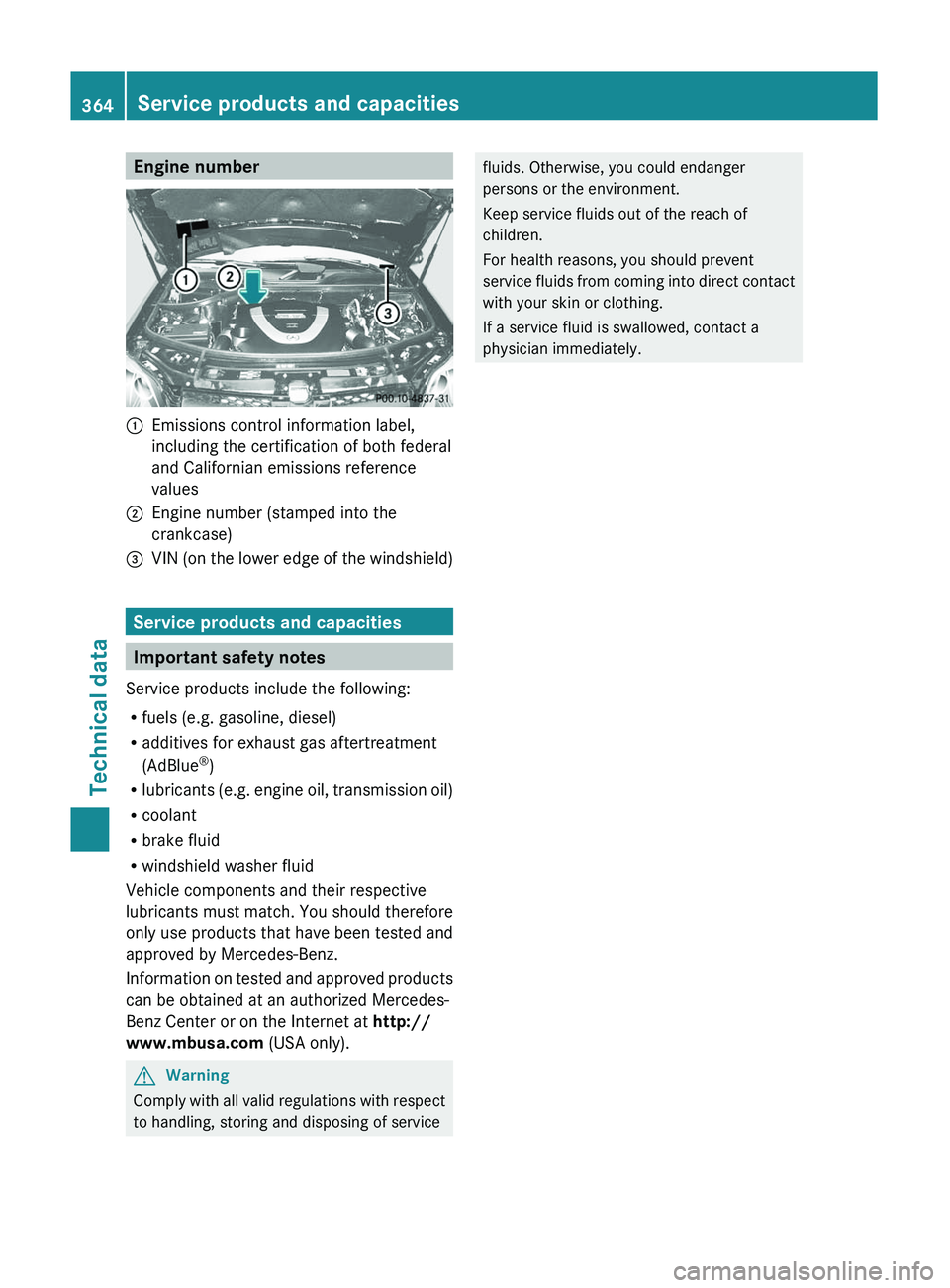
Engine number:Emissions control information label,
including the certification of both federal
and Californian emissions reference
values;Engine number (stamped into the
crankcase)=VIN (on the lower edge of the windshield)
Service products and capacities
Important safety notes
Service products include the following:
R fuels (e.g. gasoline, diesel)
R additives for exhaust gas aftertreatment
(AdBlue ®
)
R lubricants (e.g. engine oil, transmission oil)
R coolant
R brake fluid
R windshield washer fluid
Vehicle components and their respective
lubricants must match. You should therefore
only use products that have been tested and
approved by Mercedes-Benz.
Information on tested and approved products
can be obtained at an authorized Mercedes-
Benz Center or on the Internet at http://
www.mbusa.com (USA only).
GWarning
Comply with all valid regulations with respect
to handling, storing and disposing of service
fluids. Otherwise, you could endanger
persons or the environment.
Keep service fluids out of the reach of
children.
For health reasons, you should prevent
service fluids from coming into direct contact
with your skin or clothing.
If a service fluid is swallowed, contact a
physician immediately.364Service products and capacitiesTechnical data
BA 164.8 USA, CA Edition B 2011; 1; 2, en-USd2sboikeVersion: 3.0.3.52010-04-21T15:08:44+02:00 - Seite 364
Page 367 of 376
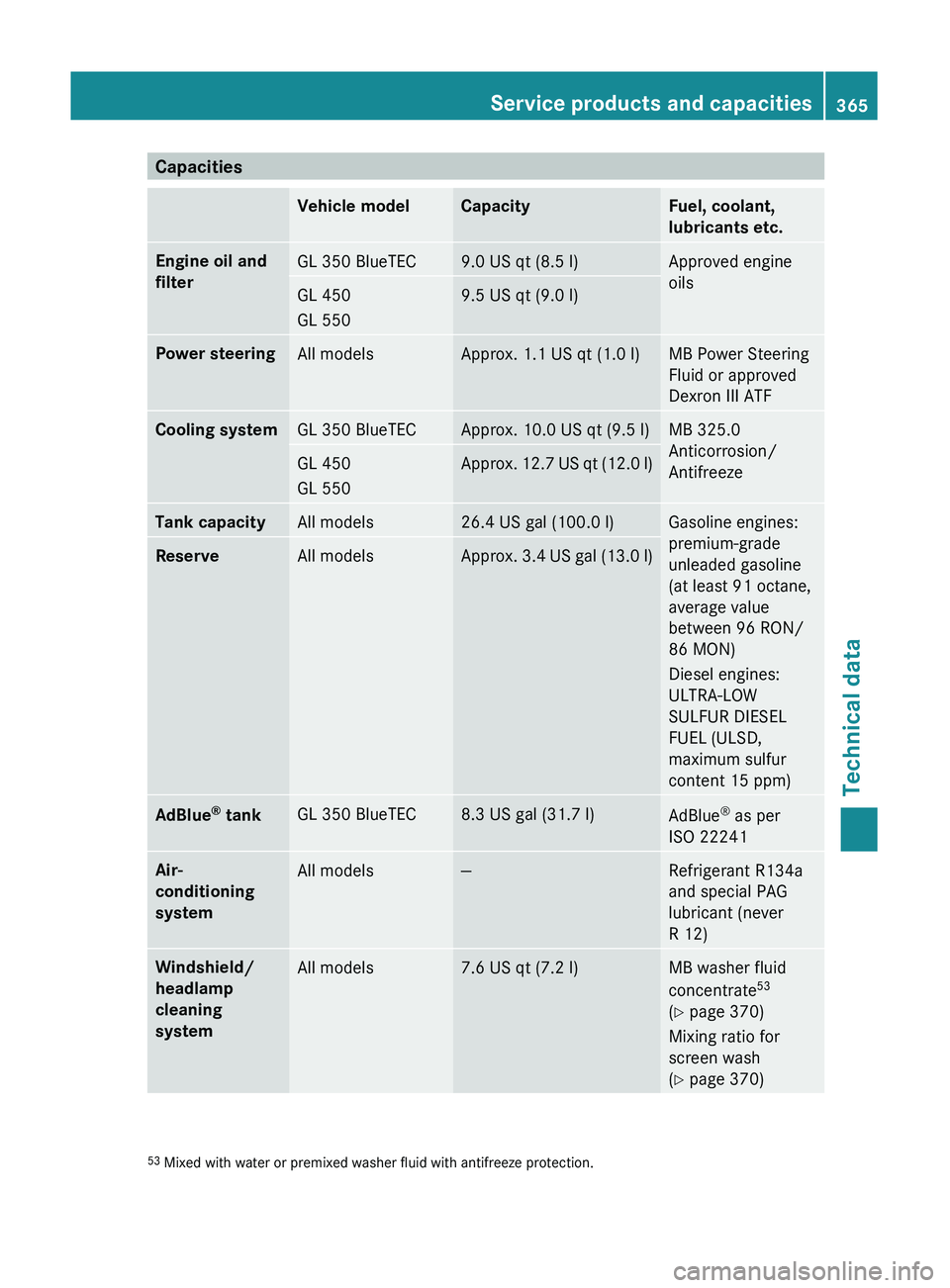
CapacitiesVehicle modelCapacityFuel, coolant,
lubricants etc.Engine oil and
filterGL 350 BlueTEC9.0 US qt (8.5 l)Approved engine
oilsGL 450
GL 5509.5 US qt (9.0 l)Power steeringAll modelsApprox. 1.1 US qt (1.0 l)MB Power Steering
Fluid or approved
Dexron III ATFCooling systemGL 350 BlueTECApprox. 10.0 US qt (9.5 l)MB 325.0
Anticorrosion/
AntifreezeGL 450
GL 550Approx. 12.7 US qt (12.0 l)Tank capacityAll models26.4 US gal (100.0 l)Gasoline engines:
premium-grade
unleaded gasoline
(at least 91 octane,
average value
between 96 RON/
86 MON)
Diesel engines:
ULTRA-LOW
SULFUR DIESEL
FUEL (ULSD,
maximum sulfur
content 15 ppm)ReserveAll modelsApprox. 3.4 US gal (13.0 l)AdBlue ®
tankGL 350 BlueTEC8.3 US gal (31.7 l)AdBlue ®
as per
ISO 22241Air-
conditioning
systemAll models—Refrigerant R134a
and special PAG
lubricant (never
R 12)Windshield/
headlamp
cleaning
systemAll models7.6 US qt (7.2 l)MB washer fluid
concentrate 53
( Y page 370)
Mixing ratio for
screen wash
( Y page 370)53
Mixed with water or premixed washer fluid with antifreeze protection.Service products and capacities365Technical dataBA 164.8 USA, CA Edition B 2011; 1; 2, en-USd2sboikeVersion: 3.0.3.52010-04-21T15:08:44+02:00 - Seite 365Z
Page 368 of 376
Fuel
Important safety notesGWarning!
Gasoline and diesel fuels are highly flammable
and poisonous. They burn violently and can
cause serious injury.
Never allow sparks, flames or smoking
materials near gasoline or diesel fuel!
Turn off the engine before refueling.
Whenever you are around gasoline or diesel
fuel, avoid inhaling fumes and any skin or
clothing contact. Extinguish all smoking
materials.
Direct skin contact with fuels and the
inhalation of fuel vapors are damaging your
health.
Premium-grade unleaded gasoline
! To ensure the longevity and full
performance of the engine, only premium-
grade unleaded gasoline must be used.
If premium-grade unleaded gasoline is
unavailable and regular gasoline is used,
observe the following precautions:
R only fill the fuel tank to half full with
regular unleaded gasoline and add the
rest as soon as possible with premium-
grade unleaded gasoline.
R do not drive at the maximum speed.
R avoid sudden acceleration.
R when the vehicle is carrying a light cargo,
e.g. two passengers without luggage, do
not allow the engine to rev above
3000 rpm.
R when the vehicle is fully loaded or being
operated in mountainous terrain, do not
depress the accelerator pedal further
than 2
/ 3 of the pedal travel.
Fuel requirements
Gasoline engines
Use only premium-grade unleaded gasoline.
The octane number should be at least 91.
Details can be found on the gas pump. The
octane number is the average value of the
Research Octane Number (RON) and Motor
Octane Number (MON): (RON + MON) / 2,
also known as knock resistance.
Reformulated Gasoline (RFG) and/or
unleaded gasoline with additives can be used
if the concentration of the additives in the fuel
does not exceed 10%, e.g.:
R Ethanol
R TAME
R ETBE
R IPA
R TBA
For MTBE, the concentration should not
exceed 15%.
The concentration of methanol in gasoline
including other additives must not exceed 3%.
Using mixtures of methanol and ethanol is not
permitted. Gasohol, a mixture of 10% ethanol
and 90% unleaded petrol can be used.
All of these mix fuels must fulfill the fuel
requirements, e.g.:
R knock resistance
R boiling point
R vapor pressure
Diesel engines – important safety
information
! Only use commercially available ULTRA-
LOW SULFUR DIESEL FUEL (ULSD, 15 ppm
MAXIMUM SULFUR) that meets the
ASTM D975 standard. Failure to use
ULTRA-LOW SULFUR DIESEL FUEL (ULSD)
can severely damage the vehicle's exhaust
gas aftertreatment system.
! Do not fill the tank with gasoline. Do not
blend diesel fuel with gasoline or kerosene.
Otherwise, the fuel system and the engine
will be damaged. Damage resulting from
366Service products and capacitiesTechnical data
BA 164.8 USA, CA Edition B 2011; 1; 2, en-USd2sboikeVersion: 3.0.3.52010-04-21T15:08:44+02:00 - Seite 366
Page 369 of 376
the use of gasoline or kerosene is not
covered by the Mercedes-Benz Limited
Warranty.
To prevent malfunctions, diesel fuel with
improved flow characteristics is available in
the winter months. Check with your fuel
retailer.
Information on the fuel grade can usually be
found on the gas pump. If the information
cannot be found on the gas pump, ask service
station personnel. For further information,
contact an authorized Mercedes-Benz Center
or visit http://www.mbusa.com (USA
only).
Diesel engines – Fuels containing bio-
diesel (FAME [fatty acid methyl ester])
Mercedes-Benz USA approves the use of B5
(ULSD with a maximum of up to five percent
by volume biodiesel) for all diesel engines
with common rail direct injection (CDI) and
BlueTEC.
Pure biodiesel and diesel fuels that contain a
higher percentage of biodiesel, e.g. B20, may
cause damage to the fuel system/engine and
are, therefore, not approved.
For further information, please ask the
service station personnel. The label on the
gas pump must indicate clearly that the B5
biodiesel blend meets the ULSD standard. If
the label is not clear, do not refuel the vehicle.
The Mercedes-Benz Limited Warranty does
not cover damages caused by the use of fuels
not meeting Mercedes-Benz approved fuel
standards.
Additives in gasoline
One of the major problems in engine design
is the creation of carbon deposits during the
process of burning fuel. Mercedes-Benz
recommends that you use fuel brands that
have the additives which prevent the build up
of carbon deposits.
If you use fuels without these additives for a
longer period of time, there may be a build up
of carbon deposits, especially on the inlet
valves and in the combustion chamber.
This could lead to engine running problems,
e.g.:
R warm-up hesitation
R unstable idle
R knocking/pinging
R misfire
R power loss
In areas where carbon deposits may be
encountered due to lack of availability of
gasoline which contains these additives,
Mercedes-Benz recommends the use of
additives approved for use in Mercedes-Benz
vehicles.
Consult an authorized Mercedes-Benz Center
or visit http://www.mbusa.com (USA only)
to view a list of approved products. Observe
the instructions for use on the product label.
Do not mix other fuel additives with fuel. This
causes unnecessary costs and could damage
the engine.
! Do not refuel with low-grade fuel and do
not use fuel additives that are not tested
and approved for Mercedes-Benz vehicles.
Damage or malfunctions can result that are
not covered:
R by the Mercedes-Benz Limited Warranty
R by an existing Limited Warranty
R by an extended Limited Warranty
AdBlue ®
Important safety guidelines
i For BlueTEC vehicles only.
AdBlue ®
is a non-flammable, non-toxic,
colorless, odorless and water-soluble fluid.
! Only use AdBlue ®
that complies with
ISO 22241. Do not add any special
additives to AdBlue ®
and do not thin
AdBlue ®
with water. This could destroy the
BlueTEC exhaust gas aftertreatment.
Service products and capacities367Technical dataBA 164.8 USA, CA Edition B 2011; 1; 2, en-USd2sboikeVersion: 3.0.3.52010-04-21T15:08:44+02:00 - Seite 367Z
Page 370 of 376
! Rinse surfaces that have come into
contact with AdBlue ®
immediately with
water or remove AdBlue ®
using a damp
cloth and cold water. If the AdBlue ®
has
already crystallized, use a sponge and cold
water to clean it. AdBlue ®
residues
crystallize after time and contaminate the
affected surfaces.
High outside temperatures
If AdBlue ®
is heated to above 122 ‡ (50 †)
for an extended period of time, e.g. due to
direct sunlight on the AdBlue ®
tank,
AdBlue ®
may start to decompose. Ammonia
vapors develop as a result.
GWarning!
When opening the filler cap of the AdBlue ®
tank ammonia gas vapors may escape. Refill
AdBlue ®
in a well ventilated area only.
Ammonia gas vapors have a pungent odor and
are particularly irritating for your skin,
mucous membranes, and eyes. Inhaling
ammonia gas vapors will cause burning eyes,
nose, and throat, as well as coughing and
watering eyes.
Low outside temperatures
AdBlue ®
freezes at a temperature of
approximately 12 ‡(11 †). The vehicle is
equipped with an AdBlue ®
preheating system
at the factory. Winter operation can thus be
guaranteed even at temperatures below
12 ‡(–11 †).
Additives
! Use only AdBlue ®
complying with ISO
22241. Do not use any additives with
AdBlue ®
and do not thin AdBlue ®
with
water. This may destroy the BlueTEC
exhaust gas aftertreatment system.
Damage resulting from the use of additives
or water is not covered by the Mercedes-
Benz Limited Warranty.
Purity
Assuring the purity of AdBlue ®
is particularly
important with respect to avoiding
malfunctions in the exhaust gas
aftertreatment system.
If AdBlue ®
is pumped out of the AdBlue ®
tank,
e.g. during repair work, it must not be
returned to the tank. The purity of the fluid
can no longer be guaranteed.
! Impurities in AdBlue ®
, e.g. due to other
service products, cleaning agents or dust,
lead to increased emission values, system
malfunctions, catalytic converter damage
or damage to the BlueTEC system.
Engine oil
Points to remember
The engine oils are matched to the
performance of Mercedes-Benz engines and
service intervals. For this reason, only use
engine oils and oil filters that are approved for
vehicles with a service system.
Contact an authorized Mercedes-Benz Center
or visit http://www.mbusa.com (USA only)
for a list of approved engine oils and oil filters.
! Never use engine oil or an oil filter of a
specification other than is necessary to
fulfill the prescribed service intervals. Do
not change the engine oil or oil filter in
order to achieve longer replacement
intervals than those prescribed. Otherwise,
you may cause damage to the engine or
exhaust gas aftertreatment; this is not
covered by the Mercedes-Benz Limited
Warranty.
Follow the instructions in the service
interval display regarding the oil change.
Otherwise, you may damage the engine and
the exhaust gas aftertreatment.
Mercedes-Benz recommends MOBIL OIL.
The table shows which engines oil have been
approved for your vehicle.
368Service products and capacitiesTechnical data
BA 164.8 USA, CA Edition B 2011; 1; 2, en-USd2sboikeVersion: 3.0.3.52010-04-21T15:08:44+02:00 - Seite 368
Page 371 of 376
ModelEngine
modelMB
ApprovalGL 350 BlueTEC642229.51GL 450273229.5GL 550273229.5
i MB Approval is stated on the containers.
Lubricant additives
! Do not mix any lubricant additives with
the engine oil. This could damage the
engine. Damage resulting from the use of
such lubricant additives in the engine oil is
not covered by the Mercedes-Benz Limited
Warranty.
Engine oil viscosity
Viscosity describes the flow characteristics
of a fluid. If an engine oil has a high viscosity,
this means that it is thick; a low viscosity
means that it is thin.
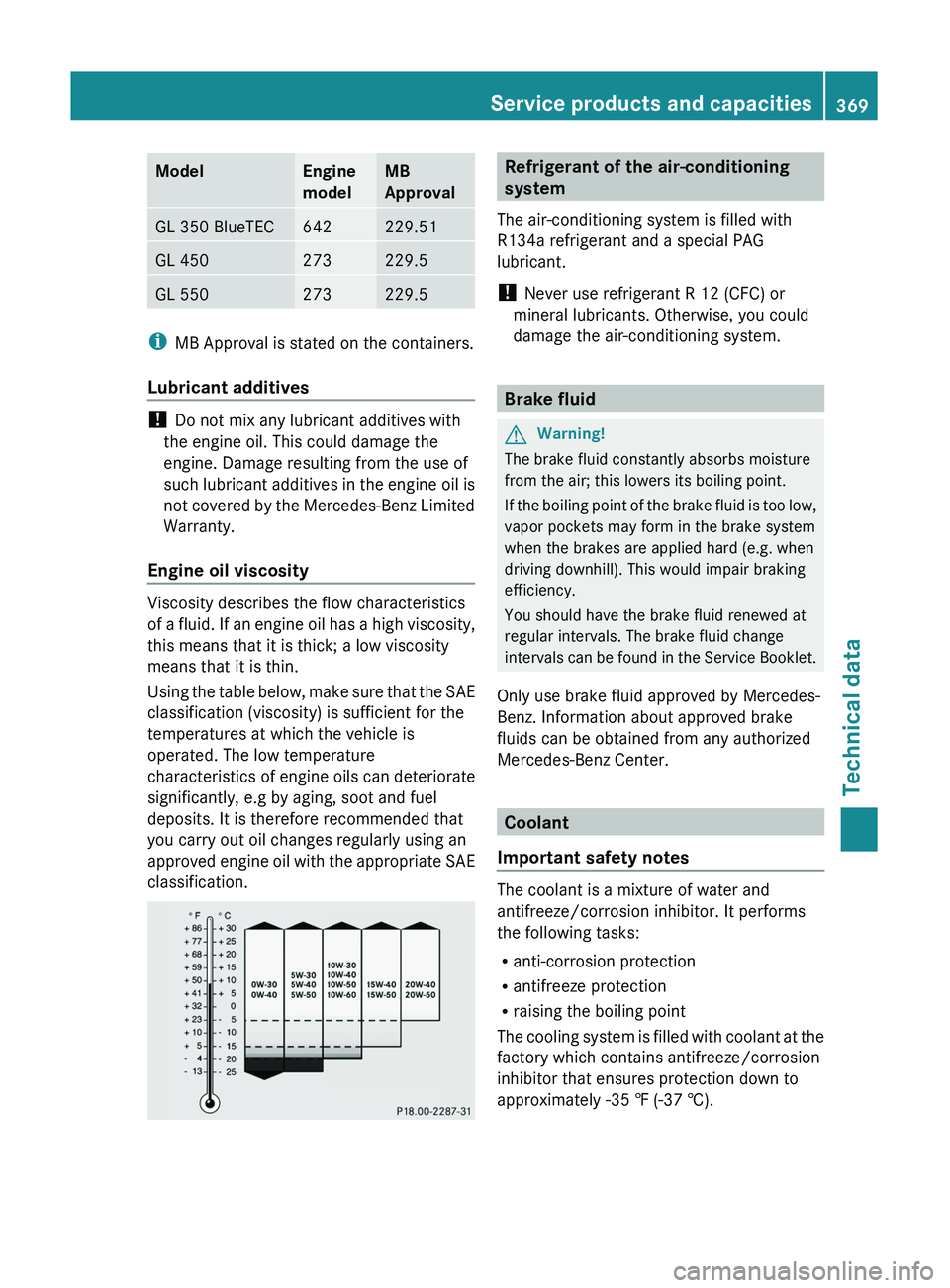
Using the table below, make sure that the SAE
classification (viscosity) is sufficient for the
temperatures at which the vehicle is
operated. The low temperature
characteristics of engine oils can deteriorate
significantly, e.g by aging, soot and fuel
deposits. It is therefore recommended that
you carry out oil changes regularly using an
approved engine oil with the appropriate SAE
classification.
Refrigerant of the air-conditioning
system
The air-conditioning system is filled with
R134a refrigerant and a special PAG
lubricant.
! Never use refrigerant R 12 (CFC) or
mineral lubricants. Otherwise, you could
damage the air-conditioning system.
Brake fluid
GWarning!
The brake fluid constantly absorbs moisture
from the air; this lowers its boiling point.
If the boiling point of the brake fluid is too low,
vapor pockets may form in the brake system
when the brakes are applied hard (e.g. when
driving downhill). This would impair braking
efficiency.
You should have the brake fluid renewed at
regular intervals. The brake fluid change
intervals can be found in the Service Booklet.
Only use brake fluid approved by Mercedes-
Benz. Information about approved brake
fluids can be obtained from any authorized
Mercedes-Benz Center.
Coolant
Important safety notes
The coolant is a mixture of water and
antifreeze/corrosion inhibitor. It performs
the following tasks:
R anti-corrosion protection
R antifreeze protection
R raising the boiling point
The cooling system is filled with coolant at the
factory which contains antifreeze/corrosion
inhibitor that ensures protection down to
approximately -35 ‡ (-37 †).
Service products and capacities369Technical dataBA 164.8 USA, CA Edition B 2011; 1; 2, en-USd2sboikeVersion: 3.0.3.52010-04-21T15:08:44+02:00 - Seite 369Z