reset MERCEDES-BENZ GL 2011 Owners Manual
[x] Cancel search | Manufacturer: MERCEDES-BENZ, Model Year: 2011, Model line: GL, Model: MERCEDES-BENZ GL 2011Pages: 376, PDF Size: 17.39 MB
Page 13 of 376
Loading guidelines ............................ 264
Locking Automatic ........................................ 79
Emergency locking ........................... 80
From inside the vehicle (central
locking button) ................................. 79
Low-beam headlamp (display
message) ............................................ 237
LOW RANGE Display message ............................ 245
Off-road gear ......................... 157, 205
LOW RANGE off-road gear ........ 157, 205
Luggage net ....................................... 266
Lumbar support 4-way lumbar support ....................104
Luxury head restraints ....................... 97
M
Main-beam headlamps (display
message) ............................................ 238
Malfunction message see Display messages
Malfunctions relevant to safety
Reporting ......................................... 23
mbrace
Call priority .................................... 287
Display message ............................ 231
Downloading destinations
(COMAND) ..................................... 287
Emergency call .............................. 284
Important safety notes ..................283
Locating a stolen vehicle ...............288
MB info call button ........................286
Roadside Assistance button ..........285
Self-test ......................................... 283
System .......................................... 283
Vehicle remote unlocking ..............287
Mechanical key
Function/notes ................................ 75
Memory card (on-board computer) . 219
Memory function ............................... 110
Menu (on-board computer) Additional functions .......................226
Audio ............................................. 219
DISTRONIC .................................... 186
DVD ............................................... 220
Message memory .......................... 229
Navigation ..................................... 220
Off-road ......................................... 220
Overview of menus ........................217
Resetting to factory settings ..........221
Settings ......................................... 221
Standard display ............................ 218
Telephone ...................................... 227
Trip computer ................................ 227
Messages
see Display messages
Mirrors
Sun visor ........................................ 278
see Exterior mirrors or Rear-view mirror
MOExtended run-flat system ........... 321
MP3 Operating (on-board computer) .....219
see separate operating instructions
Multicontour seat .............................. 103
Multifunction display ........................ 215
Multifunction steering wheel Operating the on-board computer . 215
Overview .......................................... 30
N
Navigation On-board computer .......................220
see separate operating instructions
NECK-PRO head restraints
Operation ......................................... 52
Resetting triggered ..........................52
NECK-PRO luxury head restraints
Resetting triggered ..........................52
Notes on breaking-in a new
vehicle ................................................ 146
O
Occupant Classification System
(OCS) Faults ............................................... 47
Operation ......................................... 42
System self-test ............................... 46
Occupant safety
Children in the vehicle .....................59
System overview .............................. 36
Index11BA 164.8 USA, CA Edition B 2011; 1; 2, en-USd2sboikeVersion: 3.0.3.52010-04-21T15:08:44+02:00 - Seite 11
Page 15 of 376
Power windowssee Side windows
Pre-emptive occupant safety
system
see PRE-SAFE ®
system
PRE-SAFE ®
system
Display message ............................ 231
Operation ......................................... 51
Product information ............................ 19
Pulling away Automatic transmission .................149
R
Radar sensor system (on-board
computer) .......................................... 224
Radiator cover ................................... 295
Radio Changing a station (on-board
computer) ...................................... 219
see separate operating instructions
Radio-controlled equipment
Assembly ....................................... 292
Range (on-board computer) ............. 227
Rear bench seat Folding forwards/back ..................267
Rear compartment
Activating/deactivating climate
control ........................................... 137
Setting the air vents ..............143, 144
Setting the temperature ................139
Rear-compartment seat
see Rear seat
Rear fog lamp (display message) ..... 239
Rear seat Adjusting ....................................... 100
Rear view camera
Function/notes ............................. 198
Rear view camera (cleaning
instructions) ...................................... 303
Rear-view mirror Anti-glare (manual) ........................108
Dipping (automatic) .......................109
Rear window heating
Malfunction .................................... 141
Switching on/off ........................... 141
Rear window wiper ........................... 126
Replacing the wiper blade .............. 127
Refueling ............................................ 159
Remote control Programming (garage door
opener) .......................................... 289
Reporting
Malfunctions relevant to safety ........ 23
Reserve fuel
Display message ............................ 243
Warning lamp ................................. 259
Reset button ........................................ 28
Residual heat Switching on/off ........................... 142
Restraint systems
see SRS
Reversing lamp (display message) .. 239
Roadside Assistance (breakdown) .... 20
Roller sunblind Rear panorama roof .......................279
Roof carrier ........................................ 273
Roof lining and carpets (Cleaning
guidelines) ......................................... 305
Route see Route guidance (on-board
computer)
Route guidance (on-board
computer) .......................................... 220
S
Safety Children in the vehicle .....................59
Child restraint systems ....................59
Occupant Classification System
(OCS) ............................................... 42
Overview of occupant safety
systems ........................................... 36
Safety systems
see Driving safety systems
Seat
Folding down/up (third row of
seats) ............................................. 100
Seat belts
Adjusting the driver's and front-
passenger seat belt .........................56
Adjusting the height ......................... 56
Belt force limiters ............................ 57
Cleaning ......................................... 305
Correct usage .................................. 54
Index13BA 164.8 USA, CA Edition B 2011; 1; 2, en-USd2sboikeVersion: 3.0.3.52010-04-21T15:08:44+02:00 - Seite 13
Page 16 of 376
Emergency Tensioning Devices ........ 57
Fastening ......................................... 55
Important safety guidelines .............53
Releasing ......................................... 57
Safety guidelines ............................. 37
Switching belt adjustment on/off
(on-board computer) ......................225
Warning lamp ................................. 255
Warning lamp (function) ................... 57
Seat heating
Indicator lamp (Malfunction) ..........105
Seats
Adjusting (electrically) .....................96
Adjusting (second and third rows) . 100
Adjusting the 4-way lumbar
support .......................................... 104
Adjusting the head restraint ............97
Cleaning the cover .........................304
Correct driver's seat position ........... 94
Important safety instructions ...........95
Multicontour seat .......................... 103
Storing settings (memory
function) ........................................ 110
Switching seat heating on/off .......104
Switching the seat ventilation on/
off .................................................. 105
Seat ventilation
Indicator lamp (Malfunction) ..........105
Securing hooks .................................. 268
Sensors (cleaning instructions) ....... 303
Service indicator see Service interval display
Service interval display .................... 298
Displaying a service message (on-
board computer) ............................ 299
Service products
AdBlue ®
special additives ..............367
Brake fluid ..................................... 369
Coolant (engine) ............................ 369
Engine oil ....................................... 368
Filling capacity ............................... 365
Fuel ................................................ 366
Important safety notes ..................364
Notes ............................................. 364
Refrigerant (air-conditioning
system) .......................................... 369
Washer fluid ................................... 370Settings
Factory (on-board computer) .........221
On-board computer .......................221
Shift ranges ....................................... 155
Side impact air bag ............................. 41
Side marker lamp (display
message) ............................................ 239
Side windows Convenience closing feature ............87
Convenience opening feature ..........86
Hinged side windows .......................86
Important safety information ...........84
Opening/closing .............................. 85
Resetting ......................................... 87
Troubleshooting ............................... 88
Sliding sunroof
Important safety information ...........88
Troubleshooting ............................... 90
see Tilt/sliding sunroof
SmartKey
Changing the battery .......................76
Changing the programming .............75
Checking the battery .......................76
Important safety notes ....................72
Malfunction ...................................... 77
Snow chains ...................................... 172
Socket ................................................ 281
Dashboard ..................................... 281
Front-passenger footwell ...............281
Luggage compartment ...................281
Rear compartment .........................281
SOS
see mbrace
Spare wheel
Notes/data .................................... 359
Storage location ............................ 311
see Emergency spare wheel
Speedometer
Additional speedometer (on-
board computer) ............................ 218
Segments ...................................... 215
Setting the unit (on-board
computer) ...................................... 221
SRS (Supplemental Restraint
System) Display message ............................ 231
Introduction ..................................... 3614IndexBA 164.8 USA, CA Edition B 2011; 1; 2, en-USd2sboikeVersion: 3.0.3.52010-04-21T15:08:44+02:00 - Seite 14
Page 18 of 376
Outside temperature ...................... 214
Setting ........................................... 139
Theft deterrent locking system
Immobilizer ...................................... 69
Tilt/sliding sunroof
Opening/closing .............................. 89
Resetting ......................................... 90
Time (on-board computer) ................ 222
TIREFIT kit .......................................... 312
Tire pressure Calling up (on-board computer) .....341
Checking manually ........................339
Display message ............................ 248
Maximum ....................................... 344
Notes ............................................. 337
Not reached (TIREFIT) ....................315
Pressure loss warning ....................339
Reached (TIREFIT) ..........................315
Recommended ............................... 336
Tire pressure monitor
Warning lamp ................................. 260
Tire pressure monitoring system
Function/notes ............................. 341
Restarting ...................................... 343
Tires
Aspect ratio (definition) .................356
Average weight of the vehicle
occupants (definition) ....................354
Bar (definition) ............................... 354
Characteristics .............................. 354
Checking ........................................ 335
Cleaning ......................................... 336
Definition of terms .........................354
Direction of rotation ......................348
Distribution of the vehicle
occupants (definition) ....................357
DOT, Tire Identification Number
(TIN) ............................................... 353
DOT (Department of
Transportation) (definition) ............354
Flat tire .......................................... 311
GAWR (Gross Axle Weight Rating)
(definition) ..................................... 355
GTW (Gross Trailer Weight)
(definition) ..................................... 355
Guidelines to be observed .............335
GVW (Gross Vehicle Weight)
(definition) ..................................... 355GVWR (Gross Vehicle Weight
Rating) (definition) .........................355
Increased vehicle weight due to
optional equipment (definition) ......354
Kilopascal (kPa) (definition) ...........355
Labeling (overview) ........................350
Load bearing index (definition) ......356
Load index ..................................... 353
Load index (definition) ...................355
Maximum loaded vehicle weight
(definition) ..................................... 355
Maximum load on a tire
(definition) ..................................... 356
Maximum permissible tire
pressure (definition) ....................... 355
Maximum tire load .........................348
Maximum tire loading (definition) ..355
Optional equipment weight
(definition) ..................................... 356
PSI (pounds per square inch)
(definition) ..................................... 356
Replacing ....................................... 350
Service life ..................................... 335
Sidewall (definition) .......................356
Speed index (definition) .................355
Storing ........................................... 336
Structure and characteristics
(definition) ..................................... 354
Temperature .................................. 349
TIN (Tire Identification Number)
(definition) ..................................... 356
Tire bead (definition) ......................356
Tire pressure (definition) ................356
Tire pressures (recommended) ......354
Tire quality classes ........................348
Tire size (data) ............................... 357
Tire size designation, load-bearing
capacity, speed index ....................351
Tire tread ....................................... 335
Tire tread (definition) .....................356
Total load limit (definition) .............357
Traction ......................................... 349
Traction (definition) .......................356
Tread wear ..................................... 349
TWR (permissible trailer drawbar
noseweight) (definition) .................356
Uniform tire quality classification
standards (definition) .....................35416IndexBA 164.8 USA, CA Edition B 2011; 1; 2, en-USd2sboikeVersion: 3.0.3.52010-04-21T15:08:44+02:00 - Seite 16
Page 19 of 376
Unladen weight (definition) ............355
Wear indicator (definition) .............356
Wheel rim (definition) ....................355
Tires and wheels (important safety
information) ....................................... 334
Top Tether ............................................ 62
Towing Important safety guidelines ...........327
Towing a trailer
Driving tips .................................... 209
Towing away
Installing the towing eye ................327
Removing the towing eye ...............328
Trailer
Coupling up ................................... 209
Decoupling ..................................... 211
Display message ............................ 237
Power supply ................................. 212
Towing ........................................... 210
Trailer loads and drawbar
noseweights ...................................... 211
Trailer towing .................................... 155
Blind Spot Assist ............................ 202
ESP ®
................................................ 68
PARKTRONIC ................................. 197
Transfer case ..................................... 157
Shift ranges ................................... 158
Transmission position display ......... 153
Transmission positions .................... 154
Traveling uphill Brow of hill ..................................... 178
Driving downhill ............................. 178
Maximum gradient-climbing
capability ....................................... 178
Trip computer (on-board
computer) .......................................... 227
Trip odometer Calling up ....................................... 218
Resetting (on-board computer) ......227
Trunk
Automatic opening ..................... 82, 83
Turn signal (display message) ......... 237
Turn signals ....................................... 117
TWR (permissible trailer drawbar
noseweight) (definition) ................... 356
Type plate
see Vehicle identification plate U
Unlocking Emergency unlocking .......................80
From inside the vehicle (central
unlocking button) ............................. 79
V
Vanity mirror Sun visor ........................................ 278
Vehicle
Data acquisition ............................... 23
Emergency release ..........................80
Equipment ....................................... 19
Exterior view .................................... 26
Individual settings (on-board
computer) ...................................... 221
Loading .......................................... 344
Lowering ........................................ 320
Maintenance .................................... 20
Parking up ..................................... 166
Raising ........................................... 318
Reporting problems .........................22
Towing away .................................. 327
Tow-starting ................................... 327
Transporting .................................. 329
Vehicle data
see Technical data
Vehicle identification number
see VIN
Vehicle identification plate .............. 363
Vehicle tool kit .................................. 310
Video (DVD) ........................................ 220
Video DVD (on-board computer) ...... 220
VIN ...................................................... 363
W
Warning and indicator lamps Overview .......................................... 29
PASSENGER AIRBAG OFF
indicator lamp (only Canada) ...........48
PASSENGER AIRBAG OFF
indicator lamp (only USA) ................42
Warranty ............................................ 362
Wheel bolt tightening torque ........... 320
Wheel chock ...................................... 317
Index17BA 164.8 USA, CA Edition B 2011; 1; 2, en-USd2sboikeVersion: 3.0.3.52010-04-21T15:08:44+02:00 - Seite 17
Page 30 of 376
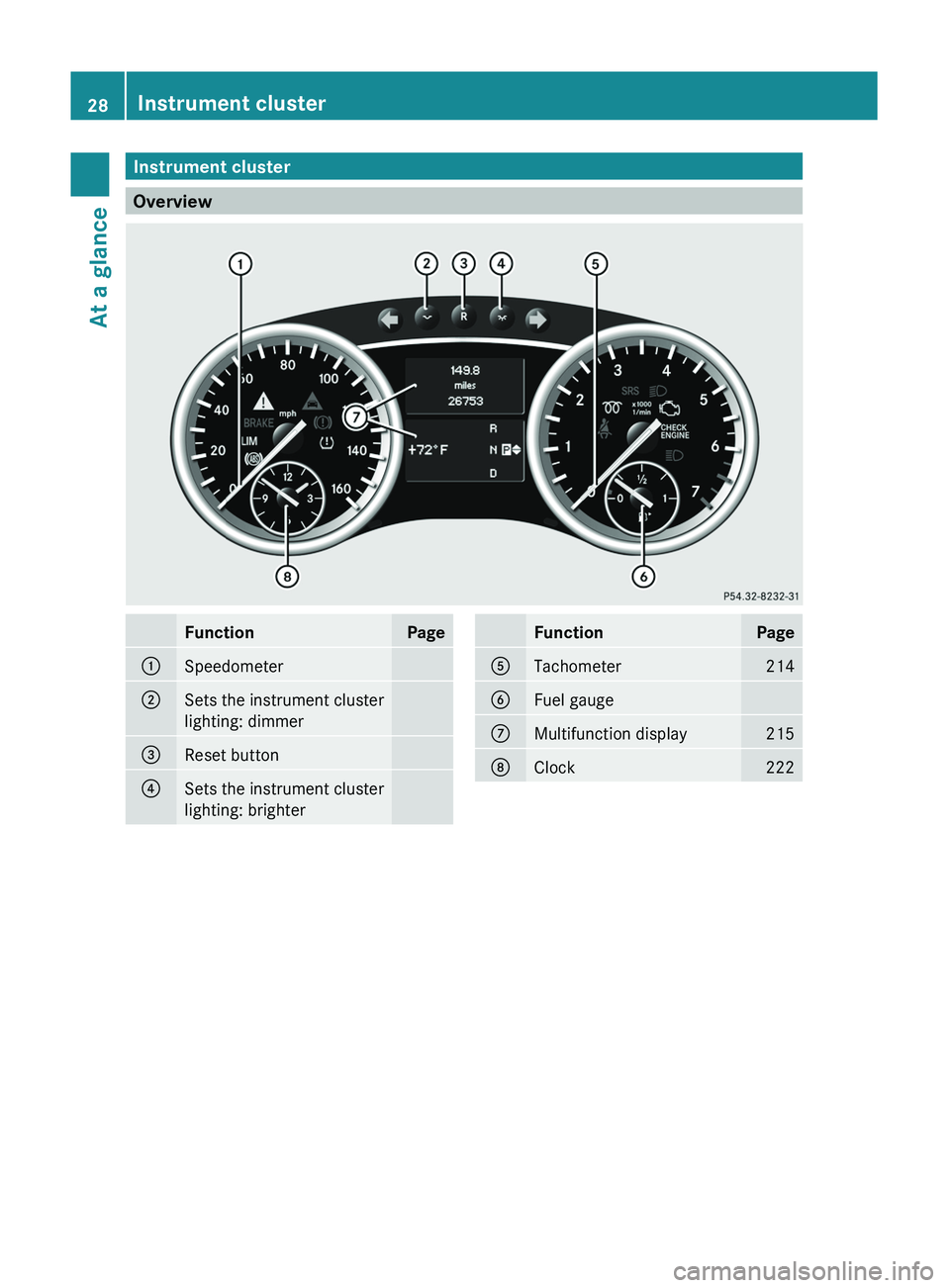
Instrument cluster
Overview
FunctionPage:Speedometer;Sets the instrument cluster
lighting: dimmer=Reset button?Sets the instrument cluster
lighting: brighterFunctionPageATachometer214BFuel gaugeCMultifunction display215DClock22228Instrument clusterAt a glance
BA 164.8 USA, CA Edition B 2011; 1; 2, en-USd2sboikeVersion: 3.0.3.52010-04-21T15:08:44+02:00 - Seite 28
Page 42 of 376
The front air bags increase protection for the
driver's and front-passenger's head and
chest.
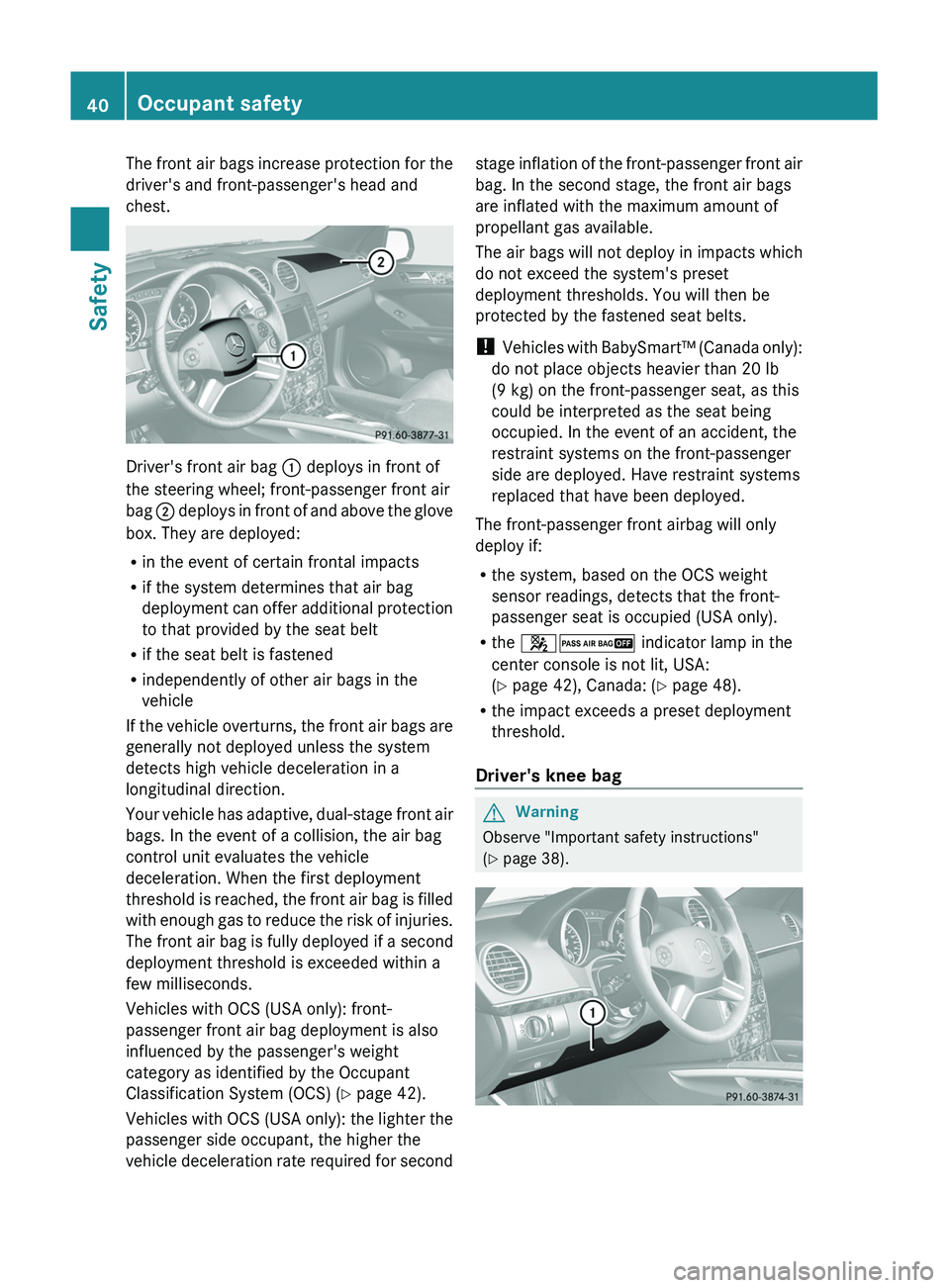
Driver's front air bag : deploys in front of
the steering wheel; front-passenger front air
bag ; deploys in front of and above the glove
box. They are deployed:
R in the event of certain frontal impacts
R if the system determines that air bag
deployment can offer additional protection
to that provided by the seat belt
R if the seat belt is fastened
R independently of other air bags in the
vehicle
If the vehicle overturns, the front air bags are
generally not deployed unless the system
detects high vehicle deceleration in a
longitudinal direction.
Your vehicle has adaptive, dual-stage front air
bags. In the event of a collision, the air bag
control unit evaluates the vehicle
deceleration. When the first deployment
threshold is reached, the front air bag is filled
with enough gas to reduce the risk of injuries.
The front air bag is fully deployed if a second
deployment threshold is exceeded within a
few milliseconds.
Vehicles with OCS (USA only): front-
passenger front air bag deployment is also
influenced by the passenger's weight
category as identified by the Occupant
Classification System (OCS) ( Y page 42).
Vehicles with OCS (USA only): the lighter the
passenger side occupant, the higher the
vehicle deceleration rate required for second
stage inflation of the front-passenger front air
bag. In the second stage, the front air bags
are inflated with the maximum amount of
propellant gas available.
The air bags will not deploy in impacts which
do not exceed the system's preset
deployment thresholds. You will then be
protected by the fastened seat belts.
! Vehicles with BabySmart™ (Canada only):
do not place objects heavier than 20 lb
(9 kg) on the front-passenger seat, as this
could be interpreted as the seat being
occupied. In the event of an accident, the
restraint systems on the front-passenger
side are deployed. Have restraint systems
replaced that have been deployed.
The front-passenger front airbag will only
deploy if:
R the system, based on the OCS weight
sensor readings, detects that the front-
passenger seat is occupied (USA only).
R the 42 indicator lamp in the
center console is not lit, USA:
( Y page 42), Canada: ( Y page 48).
R the impact exceeds a preset deployment
threshold.
Driver's knee bagGWarning
Observe "Important safety instructions"
( Y page 38).
40Occupant safetySafety
BA 164.8 USA, CA Edition B 2011; 1; 2, en-USd2sboikeVersion: 3.0.3.52010-04-21T15:08:44+02:00 - Seite 40
Page 44 of 376
bag on the front-passenger side will not
deploy. The side impact air bag on the front-
passenger side will deploy if the front
passenger seat belt is fastened, regardless of
whether the front-passenger seat is occupied
or not.
! Vehicles with BabySmart™ (Canada only):
do not place objects heavier than 20 lb
(9 kg) on the front-passenger seat, as this
could be interpreted as the seat being
occupied. In the event of an accident, the
restraint systems on the front-passenger
side are deployed. Have restraint systems
replaced that have been deployed.
Window curtain air bagsGWarning
Observe "Important safety instructions"
( Y page 38).
The window curtain air bags enhance the level
of protection for the head (but not chest or
arms) of the vehicle occupants on the side of
the vehicle on which the impact occurs.
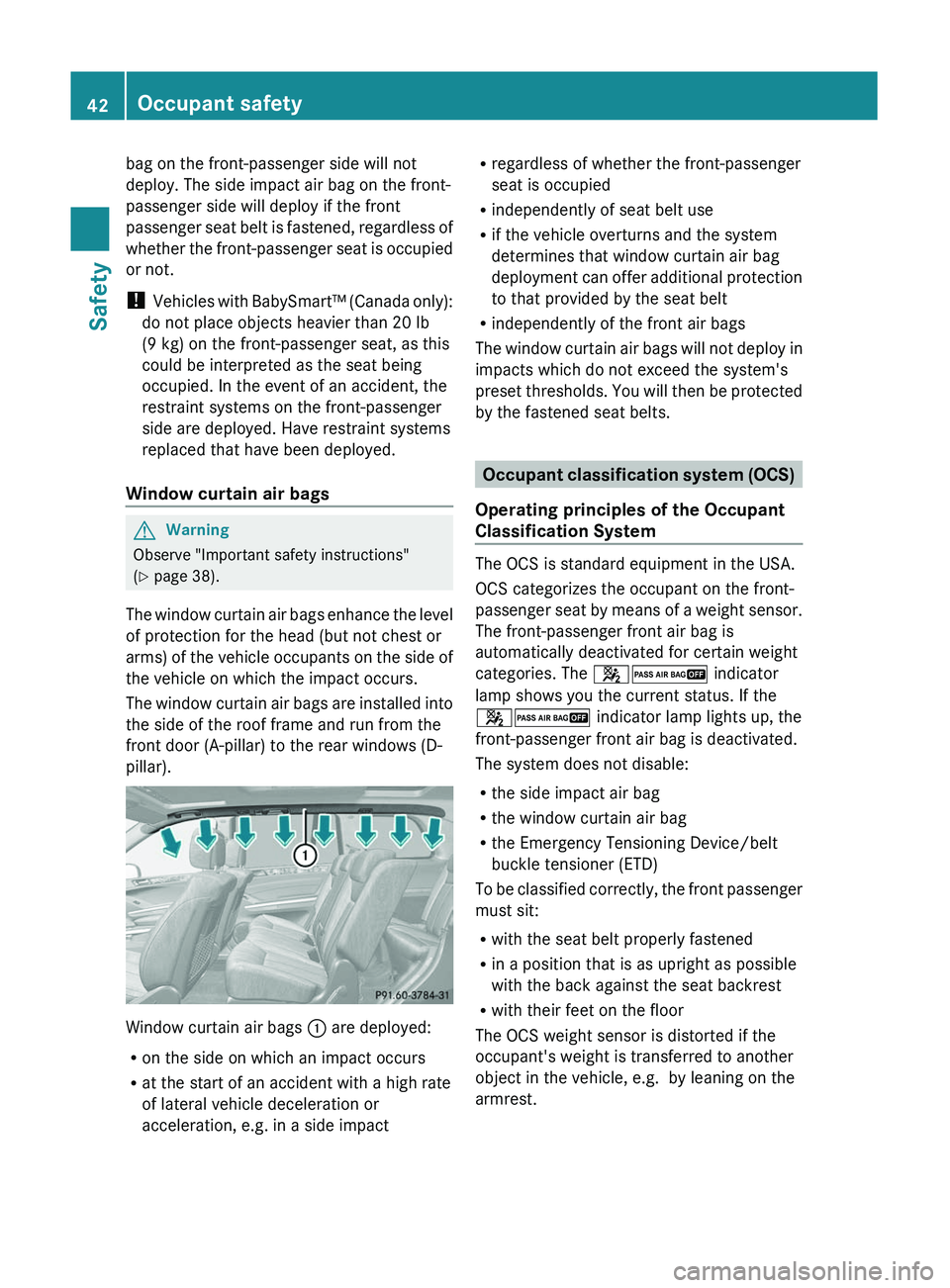
The window curtain air bags are installed into
the side of the roof frame and run from the
front door (A-pillar) to the rear windows (D-
pillar).
Window curtain air bags : are deployed:
R on the side on which an impact occurs
R at the start of an accident with a high rate
of lateral vehicle deceleration or
acceleration, e.g. in a side impact
R regardless of whether the front-passenger
seat is occupied
R independently of seat belt use
R if the vehicle overturns and the system
determines that window curtain air bag
deployment can offer additional protection
to that provided by the seat belt
R independently of the front air bags
The window curtain air bags will not deploy in
impacts which do not exceed the system's
preset thresholds. You will then be protected
by the fastened seat belts.
Occupant classification system (OCS)
Operating principles of the Occupant
Classification System
The OCS is standard equipment in the USA.
OCS categorizes the occupant on the front-
passenger seat by means of a weight sensor.
The front-passenger front air bag is
automatically deactivated for certain weight
categories. The 42 indicator
lamp shows you the current status. If the
42 indicator lamp lights up, the
front-passenger front air bag is deactivated.
The system does not disable:
R the side impact air bag
R the window curtain air bag
R the Emergency Tensioning Device/belt
buckle tensioner (ETD)
To be classified correctly, the front passenger
must sit:
R with the seat belt properly fastened
R in a position that is as upright as possible
with the back against the seat backrest
R with their feet on the floor
The OCS weight sensor is distorted if the
occupant's weight is transferred to another
object in the vehicle, e.g. by leaning on the
armrest.
42Occupant safetySafety
BA 164.8 USA, CA Edition B 2011; 1; 2, en-USd2sboikeVersion: 3.0.3.52010-04-21T15:08:44+02:00 - Seite 42
Page 46 of 376
If the 4 2 indicator lamp is not
illuminated, the front passenger front air bag
is activated and will be deployed
R in the event of certain frontal impacts
R if impact exceeds a preset deployment
threshold
R independently of the side impact air bags
If the front passenger front air bag is
deployed, the rate of inflation will be
influenced by
R the rate of relevant vehicle deceleration as
assessed by the air bag control unit
R the front passenger’s weight category as
identified by the OCS
For further information, see "Air bag display
messages" ( Y page 231).GWarning
Accident statistics show that children
secured in the rear seats are safer than
children secured in the front-passenger seat.
For this reason, we strongly advise that you
always secure children in the rear seats.
Regardless of the seat position, children
under 12 years must be secured correctly in
a suitable infant or child restraint system or
booster seat suitable for the size and weight
of the child.
The infant or child restraint system must be
correctly secured using the vehicle's seat
belt, the seat belt and Top Tether belt or the
lower anchorages and the Top Tether belt in
complete accordance with the child seat
manufacturer's instructions.
Occupants, in particular children, must sit as
upright as possible, fasten the seat belt
correctly and use a suitable infant restraint
system, child restraint system or booster seat
suitable for the size and weight of the child.
Children can be killed or seriously injured by
an inflating air bag. Observe the following
important information if it is absolutely
necessary to carry a child on the front-
passenger seat:
R your vehicle is equipped with air bag
technology designed to deactivate the
passenger front air bag in your vehicle
when the system senses the weight of a
typical 12-month-old child or less along
with the weight of a standard appropriate
child restraint on the passenger seat.
R a child in a rear-facing child restraint on the
passenger seat will be seriously injured or
even killed if the passenger front air bag
inflates in a collision which could occur
under some circumstances, even with the
air bag technology installed in your vehicle.
The only way to completely rule out this risk
is by making sure you never place a child in
a rearward-facing child restraint system on
the front-passenger seat. For this reason,
we strongly advise that you always carry
children in a rearward-facing child restraint
system on a rear seat.
R if it is absolutely necessary to install a
rearward-facing child restraint system on
the front-passenger seat, make sure the
42 indicator lamp is
illuminated, indicating that the front-
passenger front air bag is disabled. If the
42 indicator lamp does not
light up or goes out when the child restraint
system is installed, check the anchorages
of the restraint system. Check the
42 indicator lamp regularly
while driving to ensure that the
42 indicator lamp is
illuminated. If the 42 indicator
lamp lights up or remains out, you may only
carry a child on the front-passenger seat
once the system has been repaired.
A child in a rear-facing child restraint on the
passenger seat will be seriously injured or
even killed if the passenger front air bag
inflates.44Occupant safetySafety
BA 164.8 USA, CA Edition B 2011; 1; 2, en-USd2sboikeVersion: 3.0.3.52010-04-21T15:08:44+02:00 - Seite 44
Page 54 of 376
of having to swerve to avoid an obstacle at
a speed above 85 mph (140 km/h).
PRE-SAFE ®
takes the following measures
depending on the hazardous situation
detected:
R the front seat belts are pre-tensioned.
R on vehicles with memory functions: the
front-passenger seat is adjusted if it is in an
unfavorable position under accident
conditions.
R if the vehicle skids, the side windows are
closed so that only a small gap remains.
R on vehicles with sliding sunroof: if the
vehicle skids, the sliding sunroof closes so
that only a small gap remains.
If the hazardous situation passes without
resulting in an accident, PRE-SAFE ®
slackens
the belt pretensioning. All settings made by
PRE-SAFE ®
can then be reversed.
If the seat belts are not released:XMove the backrest or the seat back slightly
until the belt pretensioning is reduced.
The locking mechanism releases.GWarning
Make sure that nobody can become trapped
as you adjust the seat.
! Make sure that there are no objects in the
footwell or behind the seats when resetting
the seats. There is a risk that the seats
and/or the objects could be damaged.
More information about belt adjustment, a
convenience function integrated into PRE-
SAFE ®
, can be found in the "Belt adjustment"
section ( Y page 56).
NECK-PRO head restraints
The NECK-PRO head restraints increase
protection to the driver's and front-
passenger's head and neck. To this end, the
head restraints on the driver's and front-
passenger seats are moved forwards and
upwards in the event of a rear-end collision of
a certain severity. This provides better head
support.GWarning
Do not secure any objects (e.g. coat hangers)
on the NECK-PRO head restraints. Otherwise,
the NECK-PRO head restraints may not
function properly, or in the event of a rear-end
collision may not be able offer the level of
protection they are designed to provide.
If the NECK-PRO head restraints have been
triggered in an accident, you must reset the
NECK-PRO head restraints on the driver’s and
front-passenger seat ( Y page 52).
Otherwise, the additional protection will not
be available in the event of another rear-end
collision. You can recognize when NECK-PRO
head restraints have been triggered by the
fact that they have moved forwards and can
no longer be adjusted.
Resetting triggered NECK-PRO head
restraints
Important safety information
GWarning
For reasons of safety, have the NECK-PRO
head restraints/NECK-PRO luxury head
restraints checked at a Mercedes-Benz
Service Center after a rear-end collision.
GWarning
If you press the NECK-PRO head restraint
cushion backwards, make sure that your
fingers are not trapped between the cushion
and the cover. Failure to observe could result
in injuries.
NECK-PRO head restraints
i Resetting the NECK-PRO head restraints
requires a certain amount of strength. If
you have difficulty resetting the NECK-PRO
head restraints, have this work carried out
at a qualified specialist workshop, e.g. an
authorized Mercedes-Benz Center.
52Occupant safetySafety
BA 164.8 USA, CA Edition B 2011; 1; 2, en-USd2sboikeVersion: 3.0.3.52010-04-21T15:08:44+02:00 - Seite 52