ECU MERCEDES-BENZ GL 2012 Owners Manual
[x] Cancel search | Manufacturer: MERCEDES-BENZ, Model Year: 2012, Model line: GL, Model: MERCEDES-BENZ GL 2012Pages: 384, PDF Size: 15.71 MB
Page 2 of 384
Symbols
Registered trademarks:
R BabySmart™ is a registered trademark of
the Siemens Automotive Corp.
R Bluetooth ®
is a registered trademark of the
Bluetooth SIG Inc.
R DTS is a registered trademark of DTS, Inc.
R Dolby and MLP are registered trademarks
of Dolby Laboratories.
R ESP ®
and PRE-SAFE ®
are registered
trademarks of Daimler AG.
R HomeLink ®
is a registered trademark of
Prince, a Johnson Controls Company.
R iPod ®
and iTunes ®
are registered
trademarks of Apple Inc., registered in the
USA and in other countries.
R Logic 7 ®
is a registered trademark of
Harman International Industries,
Incorporated.
R Microsoft ®
is a registered trademark of the
Microsoft Corporation in the USA and in
other countries.
R SIRIUS and associated brands are
registered trademarks of SIRIUS XM Radio
Inc.
R HD Radio and associated brands are
registered trademarks of the iBiquity
Digital Corporation.
R Windows Media ®
is a registered trademark
of the Microsoft Corporation in the USA and
in other countries.
R Gracenote ®
is a registered trademark of
Gracenote, Inc.
R ZagatSurvey ®
and associated brands are
registered trademarks of Zagat.
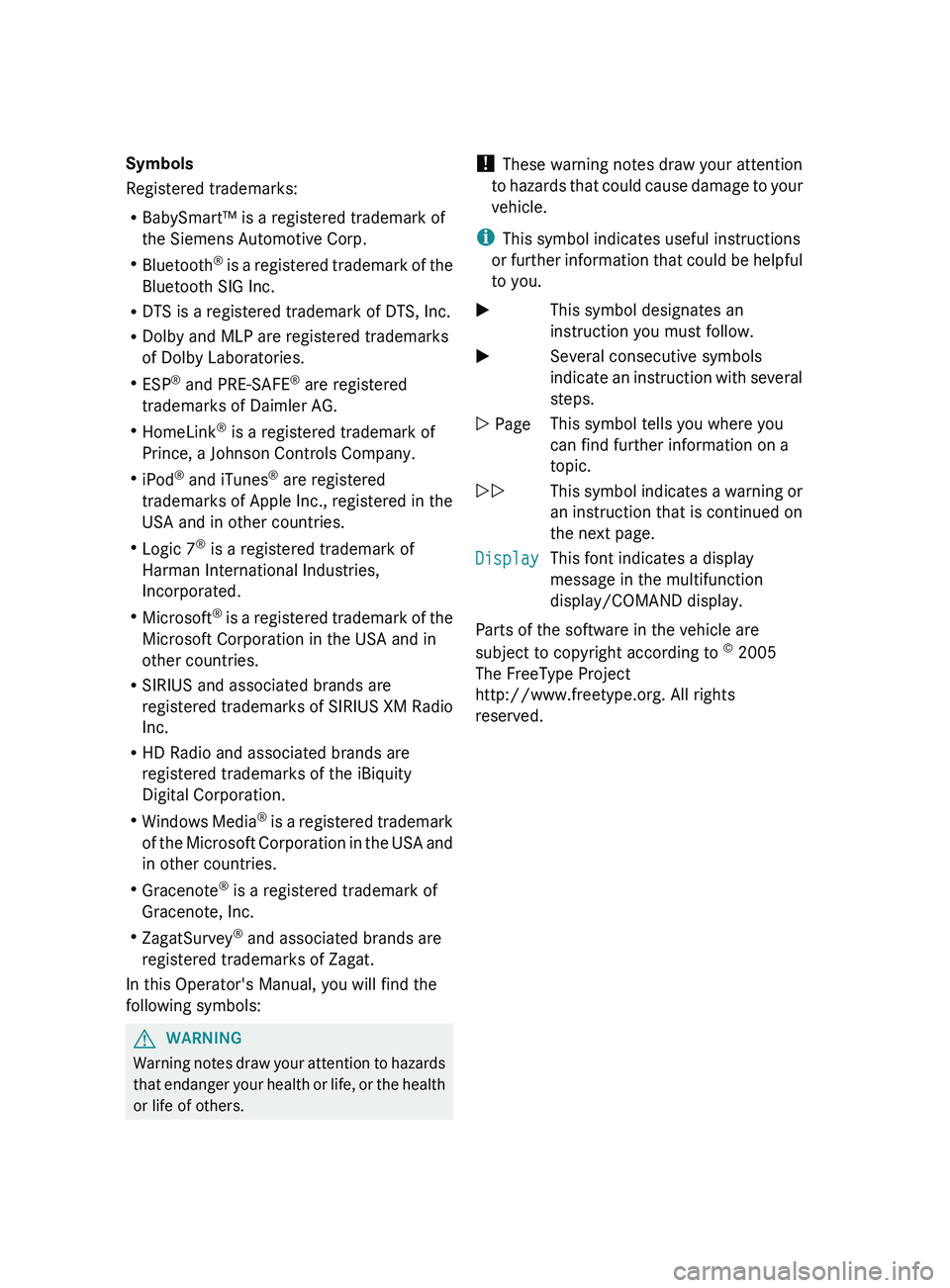
In this Operator's Manual, you will find the
following symbols:GWARNING
Warning notes draw your attention to hazards
that endanger your health or life, or the health
or life of others.
! These warning notes draw your attention
to hazards that could cause damage to your
vehicle.
i This symbol indicates useful instructions
or further information that could be helpful
to you.XThis symbol designates an
instruction you must follow.XSeveral consecutive symbols
indicate an instruction with several
steps.Y PageThis symbol tells you where you
can find further information on a
topic.YYThis symbol indicates a warning or
an instruction that is continued on
the next page.DisplayThis font indicates a display
message in the multifunction
display/COMAND display.
Parts of the software in the vehicle are
subject to copyright according to ©
2005
The FreeType Project
http://www.freetype.org. All rights
reserved.
Page 11 of 384
EASY-PACK load-securing kit ........... 275
EBD (electronic brake force
distribution) Display message ............................ 235
Function/notes ................................ 71
Electrical fuses
see Fuses
Electronic Brake force Distribution
see EBD (Electronic Brake force
Distribution)
Electronic Stability Program
see ESP ®
(Electronic Stability Program)
Electronic Traction System
see 4ETS (Electronic Traction System)
Emergency release
Driver's door .................................... 85
Fuel filler flap ................................. 161
Vehicle ............................................. 85
Emergency spare wheel
Storage location ............................ 315
Emergency Tensioning Devices
Function ........................................... 59
Safety guidelines ............................. 39
Emissions purification
Service and warranty information ....21
Engine
Check Engine warning lamp ........... 264
Display message ............................ 244
Emergency starting ........................333
Engine number ............................... 370
Irregular running ............................ 153
Starting problems ..........................153
Starting the engine with the
SmartKey ....................................... 150
Starting with KEYLESS-GO .............151
Switching off .................................. 166
Engine electronics
Problem (malfunction) ...................153
Engine emergency stop .................... 335
Engine oil Adding ........................................... 302
Additives ........................................ 375
Checking the oil level ..................... 301
Display message ............................ 246
Filling capacity ............................... 371
Notes about oil grades ................... 375Notes on oil level/consumption ....301
Viscosity ........................................ 375
ESP ®
(Electronic Stability
Program) 4ETS ................................................ 70
Deactivating/activating ...................70
Display message ............................ 233
Function/notes ................................ 69
Important safety information ...........69
Trailer stabilization ........................... 71
Warning lamp ................................. 261
Exhaust check ................................... 169
Exhaust tail pipe (cleaning
instructions) ...................................... 310
Exterior lighting see Lights
Exterior mirrors
Adjusting ....................................... 112
Dipping (automatic) .......................113
Folding in/out (automatically) .......113
Folding in/out (electrically) ...........112
Folding in when locking (on-board
computer) ...................................... 228
Out of position (troubleshooting) ...113
Setting ........................................... 113
Storing settings (memory
function) ........................................ 114
Storing the parking position ..........113
F
Filler cap see Fuel filler flap
First-aid kit ......................................... 314
Flat tire Changing a wheel/mounting the
spare wheel ................................... 321
MOExtended run-flat system .........325
Preparing the vehicle .....................316
Raising the vehicle .........................322
TIREFIT kit ...................................... 317
Floormat ............................................. 297
Fording Off-road ......................................... 171
On flooded roads ........................... 171
Front fog lamp
Switching on/off ........................... 120
Index9
Page 17 of 384
Rear window heatingSwitching on/off ........................... 143
Rear window wiper
Replacing the wiper blade .............. 130
Switching on/off ........................... 129
Refueling
Fuel gauge ....................................... 29
Important safety notes ..................159
Refueling process ..........................161
see Fuel
Remote control
Garage door opener .......................293
Reporting
Malfunctions relevant to safety ........ 25
Reserve (fuel tank)
see Fuel
Reserve fuel
Display message ............................ 247
Warning lamp ................................. 264
see Fuel
Reset button ........................................ 29
Residual heat (climate control) ........ 144
Restraint system see SRS (Supplemental Restraint
System)
Roadside Assistance (breakdown) .... 22
Roller sunblind Rear panorama roof .......................283
Roof carrier ........................................ 277
Roof lining and carpets (cleaning
guidelines) ......................................... 312
Roof load (maximum) see Technical data
Route
see Route guidance (navigation)
Route guidance (navigation) ............ 222
S
Safety Children in the vehicle .....................61
Child restraint systems ....................61
Occupant Classification System
(OCS) ............................................... 45
Overview of occupant safety
systems ........................................... 38
Safety systems
see Driving safety systems
Seat
Folding down/up (third row of
seats) ............................................. 104
Important safety notes ....................99
Seat belts
Adjusting the driver's and front-
passenger seat belt .........................58
Adjusting the height ......................... 58
Belt force limiters ............................ 59
Cleaning ......................................... 311
Correct usage .................................. 56
Emergency Tensioning Devices ........ 59
Fastening ......................................... 57
Important safety guidelines .............55
Releasing ......................................... 59
Safety guidelines ............................. 39
Special seat belt retractor ...............63
Switching belt adjustment on/off
(on-board computer) ......................228
Warning lamp ................................. 258
Warning lamp (function) ................... 59
Seats
Adjusting (electrically) ...................100
Adjusting (second and third rows) . 104
Adjusting the 4-way lumbar
support .......................................... 108
Adjusting the head restraint ..........101
Cleaning the cover .........................311
Correct driver's seat position ........... 98
Folding the rear bench seat
forwards/back ............................... 270
Multicontour seat .......................... 107
Seat heating problem ....................109
Seat ventilation problem ................109
Storing settings (memory
function) ........................................ 114
Switching seat heating on/off .......108
Switching the seat ventilation on/
off .................................................. 109
Securing hooks .................................. 273
Sensors (cleaning instructions) ....... 309
Service see ASSYST PLUS service interval
display
Service interval display
Displaying service messages .........305
Hiding service messages ...............305Index15
Page 19 of 384
Steering wheel heating ..................110
Storing settings (memory
function) ........................................ 114
Steering wheel (cleaning
instructions) ...................................... 311
Steering wheel heating Indicator lamp (malfunction) ..........111
Switching on/off ........................... 110
Steering wheel paddle shifters ........ 157
Stowage compartments Armrest (under) ............................. 269
Glove box ....................................... 269
Parcel net ...................................... 270
Stowage space
Center console .............................. 269
Center console (rear) .....................270
Cup holders ................................... 282
Important safety information .........268
Summer opening
see Convenience opening feature
Summer tires ..................................... 340
Sun visor ............................................ 283
Supplement Restraint System see SRS (Supplemental Restraint
System)
Surround lighting (on-board
computer) .......................................... 225
SUV (Sport Utility Vehicle) .......................23
Switching air-recirculation mode
on/off ................................................. 144
Switching off the alarm (ATA) ............ 72
T
Tachometer ........................................ 216
Tailgate Display message ............................ 255
Important safety notes ....................85
Limiting the opening angle ...............89
Opening/closing (automatically
from inside) ...................................... 88
Opening/closing (automatically
from outside) ................................... 87
Opening/closing (from outside) .......86
Tail lamps
Display message ............................ 243
see Lights
Tank
see Fuel tank
Tank content
Fuel gauge ....................................... 29
Technical data
GL 350 BlueTEC ............................. 377
GL 450 ........................................... 377
GL 550 ........................................... 378
Tires/wheels ................................. 363
TELEAID
Call priority .................................... 291
Display message ............................ 236
Downloading destinations
(COMAND) ..................................... 292
Emergency call .............................. 288
Important safety notes ..................287
Locating a stolen vehicle ...............293
MB info call button ........................290
Roadside Assistance button ..........290
Search & Send ............................... 292
Self-test ......................................... 288
System .......................................... 288
Vehicle remote unlocking ..............292
Telephone
Accepting a call ............................. 230
Display message ............................ 256
Menu (on-board computer) ............230
Number from the phone book ........ 230
Redialing ........................................ 230
Rejecting/ending a call .................230
Telescopic rod (EASY-PACK load-
securing kit) ....................................... 277
Temperature Coolant (on-board computer) ......... 220
Displaying the outside
temperature ................................... 220
Outside temperature ...................... 216
Setting (climate control) ................141
Theft deterrent locking system
Immobilizer ...................................... 72
Tilt/sliding sunroof
see Sliding sunroof
Time (on-board computer) ................ 224
TIREFIT kit .......................................... 317
Tire pressure Calling up (on-board computer) .....347
Checking manually ........................345
Display message ............................ 252Index17
Page 27 of 384
In Canada
Customer Relations Department
Mercedes-Benz Canada, Inc.
98 Vanderhoof Avenue
Toronto, Ontario M4G 4C9
Reporting malfunctions relevant to
safety
For the USA only:
The following text is reproduced as required
of all manufacturers according to Title 49,
Code of U.S. Federal Regulations, Part 575
pursuant to the National Traffic and Motor
Vehicle Safety Act of 1966.
Reporting safety defects
If you believe that your vehicle has a defect
which could cause a crash or could cause
injury or death, you should immediately
inform the National Highway Traffic Safety
Administration (NHTSA) in addition to
notifying Mercedes-Benz USA, LLC.
If NHTSA receives similar complaints, it may
open an investigation, and if it finds that a
safety defect exists in a group of vehicles, it
may order a recall and remedy campaign.
However, NHTSA cannot become involved in
individual problems between you, your
dealer, or Mercedes-Benz USA, LLC.
To contact NHTSA, you may call the Vehicle
Safety Hotline toll-free at
1-888-327-4236 (TTY: 1-800-424-9153); go
to: http://www.safercar.gov ; or write to:
Administrator, NHTSA Headquarters,
1200 New Jersey Avenue, SE, West Building,
Washington, DC 20590.
You can also obtain additional information
about vehicle safety from:
http://www.safercar.gov .
Limited Warranty
! Follow the instructions in this manual
about the proper operation of your vehicle
as well as about possible vehicle damage.
Damage to your vehicle that arises from
culpable contraventions against these
instructions are not covered either by
Mercedes-Benz Limited Warranty or by the
New or Used-Vehicle Warranty of
Daimler AG.
Data stored in the vehicle
Information about electronic data
acquisition in the vehicle
( Including notice pursuant to California Code
§ 9951)
Your vehicle records electronic data. If your
vehicle is equipped with mbrace 3
, data is
transmitted in the event of an accident.
This information helps, for example, to test
vehicle systems after an accident and to
continually improve vehicle safety.
Daimler AG can access this data and submit
it:
R for safety research or vehicle diagnosis
purposes
R with the consent of the vehicle owner
R on the instruction of prosecuting
authorities
R for use in arbitration of disputes that
involve Daimler AG, its affiliates or its sales
and service organizations
R as otherwise required or permitted by law.
Please observe the mbrace 3
purchase
agreement for further details on the recording
and transfer of data by this system.
3 The system is called TELE AID in Canada.Introduction25Z
Page 48 of 384
When the OCS senses that the front
passenger seat occupant is classified as
being heavier than the weight of a typical 12-
month-old child seated in a standard child
restraint or as being a small individual (such
as a young teenager or a small adult), the
42 indicator lamp will illuminate
for approximately 6 seconds when the engine
is started. Depending on occupant weight
sensor readings from the seat, it will then
remain illuminated or go out. With the
42 indicator lamp illuminated,
the front passenger front air bag is
deactivated. With the 42
indicator lamp out, the front passenger front
air bag is activated.
When the OCS senses that the front
passenger seat occupant is classified as an
adult or someone larger than a small
individual, the 42 indicator lamp
will illuminate for approximately six seconds
when the engine is started and then go out.
This indicates that the front passenger front
air bag is activated.
If the 42 indicator lamp is
illuminated, the front passenger front air bag
is deactivated and will not be deployed.
If the 24 indicator lamp is not
illuminated, the front passenger front air bag
is activated and will be deployed
R in the event of certain frontal impacts
R if the impact exceeds a predetermined
triggering threshold
R independently of the side impact air bags
If the front passenger front air bag is
deployed, the rate of inflation will be
influenced by
R the rate of vehicle deceleration as assessed
by the air bag control unit
R the front passenger's weight category as
identified by the OCS
For further information, see "air bag display
messages" ( Y page 239).GWARNING
According to accident statistics, children are
safer when properly restrained on the rear
seats than on the front-passenger seat. Thus,
we strongly recommend that children be
placed in the rear seats whenever possible.
Regardless of seating position, children 12
years old and under must be seated and
properly secured in an appropriately sized
child restraint system or booster seat
recommended for the size and weight of the
child.
The infant or child restraint system must be
properly secured with the vehicle's seat belt,
the seat belt and Top Tether strap, or lower
anchors and Top Tether strap, fully in
accordance with the child seat
manufacturer's instructions.
Occupants, especially children, should always
sit as upright as possible, wear the seat belt
properly and use an appropriate sized infant
restraint, toddler restraint, or booster seat
recommended for the size and weight of the
child.
Children can be killed or seriously injured by
an inflating air bag. Note the following
important information when circumstances
require you to place a child in the front-
passenger seat:
R Your vehicle is equipped with air bag
technology designed to deactivate the
front-passenger front air bag in your vehicle
when the system senses the weight of a
typical 12-month-old child or less along
with the weight of a standard appropriate
child restraint on the front-passenger seat.
R A child in a rear-facing child restraint on the
front-passenger seat will be seriously
injured or even killed if the front-passenger
front air bag inflates in a collision which
could occur under some circumstances,
even with the air bag technology installed
in your vehicle. The only means to eliminate
this risk completely is never to place a child
in a rear-facing child restraint in the front-
passenger seat. We therefore strongly
46Occupant safetySafety
Page 49 of 384
recommend that you always place a child
in a rear-facing child restraint on the rear
seat.
R If you install a rear-facing child restraint on
the front-passenger seat, make sure the
42 indicator lamp is
illuminated, indicating that the front-
passenger front air bag is deactivated.
Should the 42 indicator lamp
not illuminate or go out while the restraint
is installed, please check installation.
Periodically check the 42
indicator lamp while driving to make sure
the 42 indicator lamp is
illuminated. If the 42 indicator
lamp goes out or remains out, do not
transport a child on the front-passenger
seat until the system has been repaired.
A child in a rear-facing child restraint on the
front-passenger seat will be seriously
injured or even killed if the front-passenger
front air bag inflates.
R If you place a child in a forward-facing child
restraint on the front-passenger seat:
- move the seat as far back as possible
- use the proper child restraint
recommended for the age, size and
weight of the child
- secure child restraint with the vehicle's
seat belt according to the child seat
manufacturer's instructions
R For children larger than a typical 12-month-
old child, the front-passenger front air bag
can be activated or deactivated.
If the driver's air bag deploys, this does not
mean that the front-passenger front air bag
also has to deploy.
The OCS may have detected that the seat:
R was empty or occupied by a person with a
weight of up to or less than that of a typical12-month-old child seated in a standard
child restraint
R was occupied by a small individual, such as
a young teenager or a small adult
R was occupied by a child in a child restraint
system, whose weight is greater than that
of a typical 12-month-old child.
These are examples of when the OCS
deactivates the front-passenger front air bag.
Deactivation takes place although the
collision fulfills the criteria for deploying the
driver's air bag.
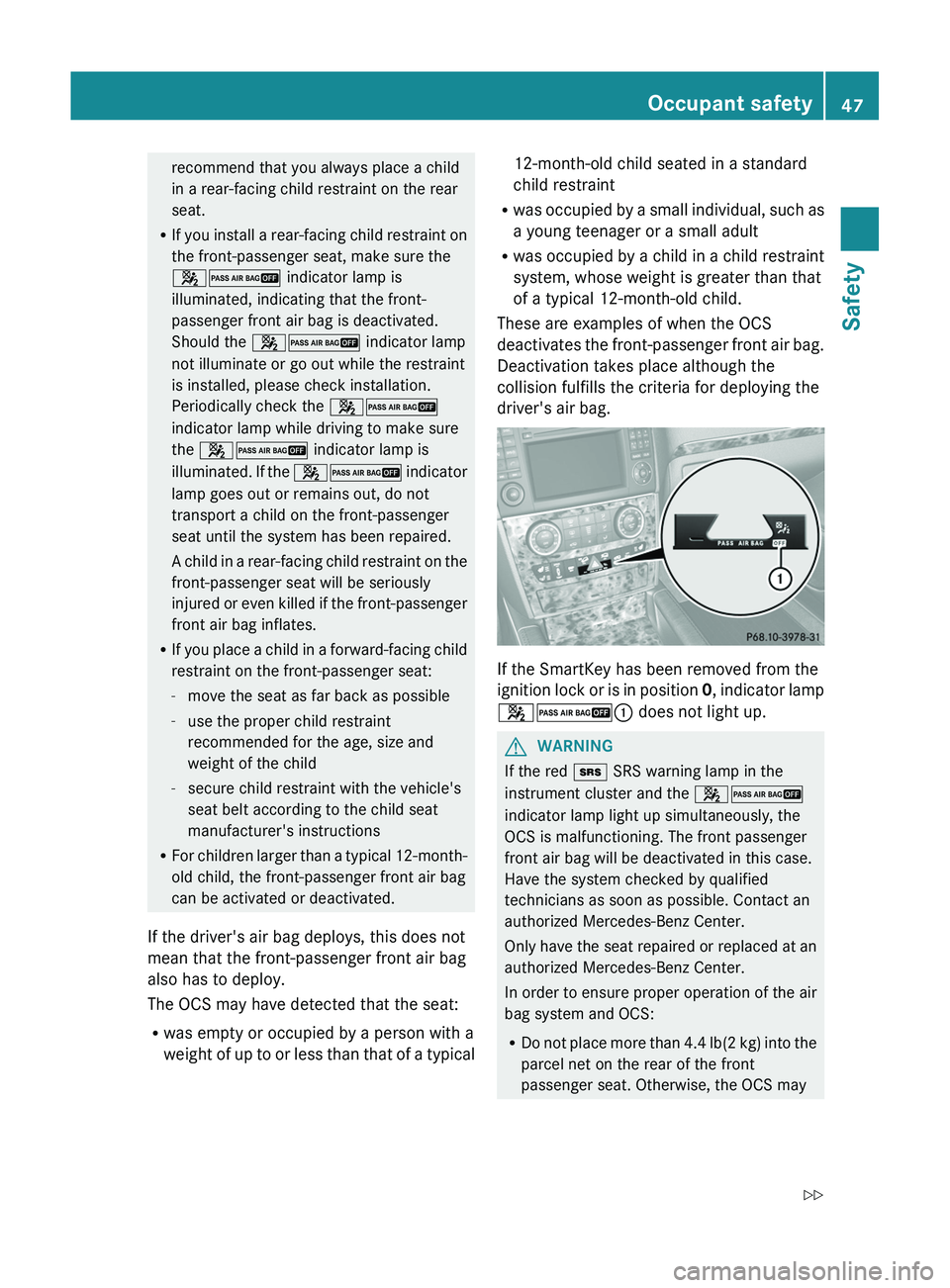
If the SmartKey has been removed from the
ignition lock or is in position 0, indicator lamp
42 : does not light up.
GWARNING
If the red + SRS warning lamp in the
instrument cluster and the 42
indicator lamp light up simultaneously, the
OCS is malfunctioning. The front passenger
front air bag will be deactivated in this case.
Have the system checked by qualified
technicians as soon as possible. Contact an
authorized Mercedes-Benz Center.
Only have the seat repaired or replaced at an
authorized Mercedes-Benz Center.
In order to ensure proper operation of the air
bag system and OCS:
R Do not place more than 4.4 lb (2 kg) into the
parcel net on the rear of the front
passenger seat. Otherwise, the OCS may
Occupant safety47SafetyZ
Page 52 of 384
GWARNING
If the 42 indicator lamp does not illuminate or remains out with the weight of a
typical 12-month-old child in a standard child restraint or less, or is unoccupied, on the front-
passenger seat, do not transport a child on the front-passenger seat until the system has been
repaired.
BabySmart™ air bag deactivation
system
How the air bag deactivation system
works
The BabySmart™ system is standard
equipment in Canada.
GWARNING
Accident statistics show that children
secured in the rear seats are safer than
children secured in the front-passenger seat.
For this reason, Mercedes-Benz strongly
advises that you always secure children in the
rear seats. Regardless of the seat position,
children under 12 years must be secured
correctly in a suitable infant or child restraint
system or booster seat suitable for the size
and weight of the child.
Secure the infant restraint system or child
restraint system using:
R the seat belt of the vehicle
R the seat belt and a Top Tether belt
R the LATCH-type (ISOFIX) child seat mount
and a Top Tether belt
The child restraint system must be installed
and secured correctly, observing the
manufacturer's installation instructions.
Occupants, in particular children, must sit as
upright as possible, fasten the seat belt
correctly and use a suitable infant restraint
system, child restraint system or booster seat
suitable for the size and weight of the child.
Children can be seriously or even fatally
injured by an air bag deploying. Observe the
following important information if it is
necessary to carry a child on the front-
passenger seat:
R Canada only: children under 12 years of age
may only sit in the front-passenger seat if
they are seated in a child restraint system
which is compatible with BabySmart™ and
approved by Mercedes-Benz. When the
child restraint system is installed correctly,
the front-passenger front air bag is disabled
in conjunction with the BabySmart™
system installed in the vehicle. If the front-
passenger front air bag is deployed in the
event of a collision, it could hit the child.
This could lead to serious or fatal injuries.
R A child in a rearward-facing child restraint
system on the front-passenger seat could
be seriously injured or even killed if the
front-passenger front air bag inflates in a
collision despite the air bag technology
installed in your vehicle, which could occur
under some circumstances. The only way
to completely rule out this risk is by making
sure you never place a child in a rearward-
facing child restraint system on the front-
passenger seat. For this reason, we
strongly advise that you always carry
children in a rearward-facing child restraint
system on a rear seat.
R If it is necessary to install a BabySmart™-
compatible rear-facing child restraint
system on the front-passenger seat, make
sure the 42 indicator lamp is
illuminated. This indicates that the front-
passenger front air bag is deactivated. If the
42 indicator lamp does not
light up or goes out when the child restraint50Occupant safetySafety
Page 53 of 384
system is installed, check the anchorages
of the restraint system. Periodically check
the 42 indicator lamp while
driving to make sure the 42
indicator lamp is illuminated. If the
42 indicator lamp goes out or
remains out, you may only carry a child on
the front-passenger seat once the system
has been repaired.
A child in a rearward-facing child restraint
system on the front-passenger seat can be
seriously injured or even killed if the front-
passenger front air bag is deployed.
R When securing a child in a front-facing child
restraint system on the front-passenger
seat, you must:
- move the front-passenger seat as far
back as possible
- use a child restraint system that is
suitable for the age, size and weight of
the child
- observe the manufacturer's installation
instructions in order to install and secure
the child restraint system correctly.GWARNING
When using a BabySmart™-compatible child
restraint system on the front-passenger seat,
the front-passenger front air bag is only
disabled if the 42 indicator lamp
is illuminated.
Check the 42 indicator lamp
repeatedly, every time you use a
BabySmart™-compatible child restraint
system on the front-passenger seat. Should
the 42 indicator lamp not
illuminate or go out while the restraint is
installed, please check installation. If the
42 indicator lamp remains out,
do not use the BabySmart™ child restraint
system to carry a child on the front-passenger
seat until the system has been repaired.
GWARNING
The BabySmart™ air bag disabling system
ONLY works with specially adapted child
restraint systems. It does not work with child
restraint systems that are not compatible with
BabySmart™.
Never place anything between the seat
cushion and the child restraint system (e.g. a
cushion), as this reduces the effectiveness of
the BabySmart™ air bag deactivation system.
The underside of the child restraint system
must lie against the seat cushion of the front-
passenger seat. In the event of an accident,
an incorrectly installed child restraint system
could injure the child instead of offering
protection.
Observe the manufacturer's instructions
when installing special child restraint
systems.
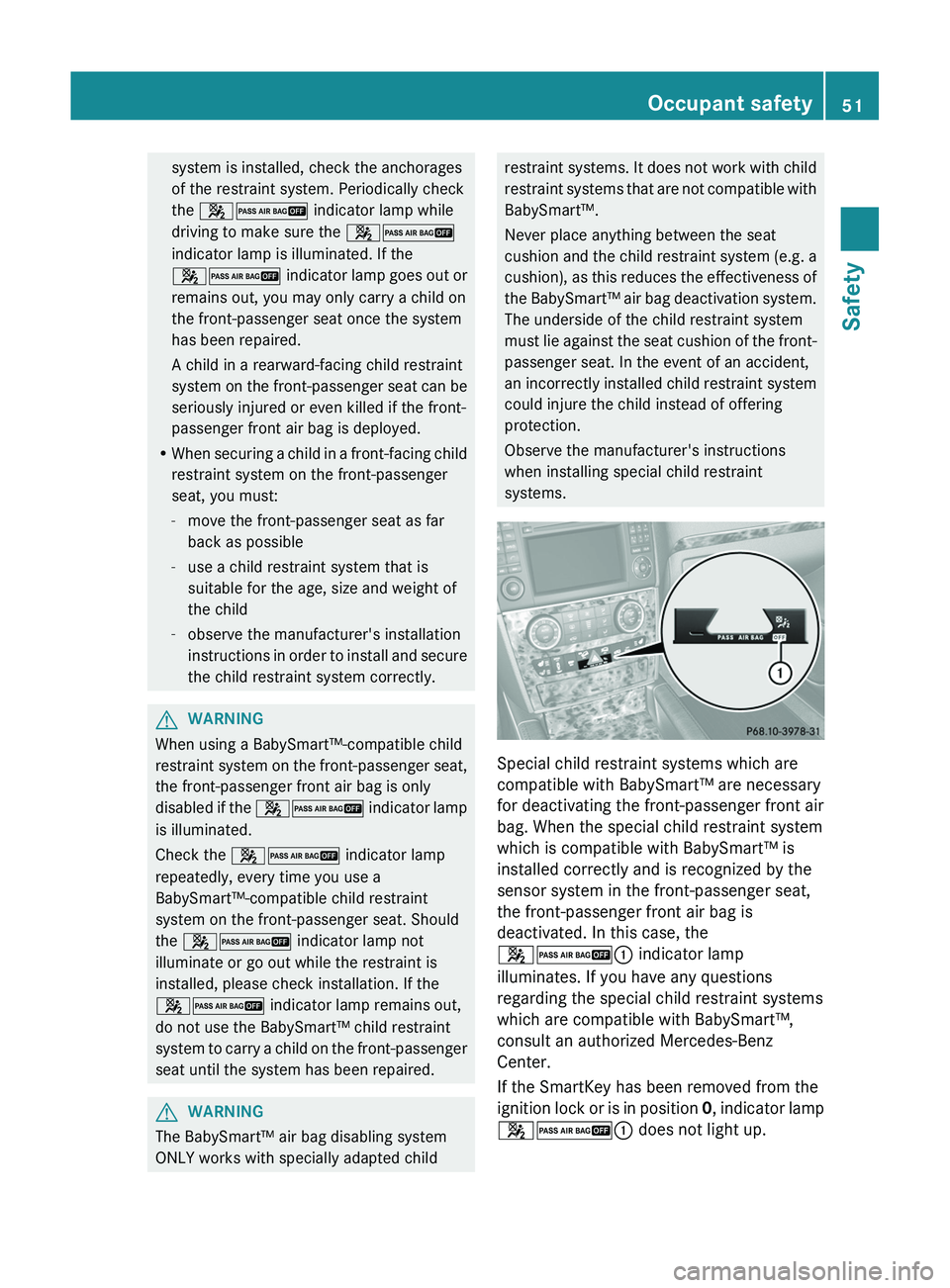
Special child restraint systems which are
compatible with BabySmart™ are necessary
for deactivating the front-passenger front air
bag. When the special child restraint system
which is compatible with BabySmart™ is
installed correctly and is recognized by the
sensor system in the front-passenger seat,
the front-passenger front air bag is
deactivated. In this case, the
42 : indicator lamp
illuminates. If you have any questions
regarding the special child restraint systems
which are compatible with BabySmart™,
consult an authorized Mercedes-Benz
Center.
If the SmartKey has been removed from the
ignition lock or is in position 0, indicator lamp
42 : does not light up.
Occupant safety51SafetyZ
Page 56 of 384
PRE-SAFE®
takes the following measures
depending on the hazardous situation
detected:
R the front seat belts are pre-tensioned.
R on vehicles with memory function for the
front-passenger seat: the front-passenger
seat is adjusted if it is in an unfavorable
position.
R if the vehicle skids, the side windows are
closed so that only a small gap remains.
R on vehicles with a sliding sunroof: if the
vehicle skids, the sliding sunroof closes so
that only a small gap remains.
If the hazardous situation passes without
resulting in an accident, PRE-SAFE ®
slackens
the belt pretensioning. All settings made by
PRE-SAFE ®
can then be reversed.
If the seat belts are not released:XMove the backrest or seat back slightly, but
only when the vehicle is stationary.
The belt pretensioning is reduced and the
locking mechanism is released.GWARNING
Make sure that nobody can become trapped
as you adjust the seat.
! Make sure that there are no objects in the
footwell or behind the seats when resetting
the seats. There is a risk that the seats
and/or the objects could be damaged.
More information about seat-belt
adjustment, a convenience function
integrated into PRE-SAFE ®
, can be found in
the "Seat-belt adjustment" section
( Y page 58).
NECK-PRO head restraints
The NECK-PRO head restraints increase
protection to the driver's and front
passenger's head and neck. To this end, the
NECK-PRO head restraints on the driver's and
front-passenger seats are moved forwards
and upwards in the event of a rear-end
collision of a certain severity. This provides
better head support.GWARNING
Do not secure any objects (e.g. coat hangers)
on the NECK-PRO head restraints. Otherwise,
the NECK-PRO head restraints may not
function properly, or in the event of a rear-end
collision may not be able offer the level of
protection they are designed to provide.
If the NECK-PRO head restraints have been
triggered in an accident, reset the NECK-PRO
head restraints on the driver’s and front-
passenger seat ( Y page 54). Otherwise, the
additional protection will not be available in
the event of another rear-end collision. You
can recognize when NECK-PRO head
restraints have been triggered by the fact that
they have moved forwards and can no longer
be adjusted.
Resetting triggered NECK-PRO head
restraints
Important safety notes
GWARNING
For reasons of safety, have the NECK-PRO
head restraints/NECK-PRO luxury head
restraints checked at an authorized
Mercedes-Benz Center after a rear-end
collision.
GWARNING
When pushing back the NECK-PRO head
restraint cushion, make sure your fingers do
not become caught between the head
restraint cushion and the cover. Failure to
observe this could result in injuries.
NECK-PRO head restraints
i Resetting the NECK-PRO head restraints
requires a lot of strength. If you have
difficulty resetting the NECK-PRO head
restraints, have this work carried out at a
54Occupant safetySafety