tire pressure MERCEDES-BENZ GL 2012 Owners Manual
[x] Cancel search | Manufacturer: MERCEDES-BENZ, Model Year: 2012, Model line: GL, Model: MERCEDES-BENZ GL 2012Pages: 384, PDF Size: 15.71 MB
Page 6 of 384
1, 2, 3 ...
115 V socket ...................................... 286
12 V socket see Sockets
4ETS (Electronic Traction System) .... 70
4MATIC (permanent four-wheel
drive) .................................................. 203
A
ABS (Anti-lock Braking System) Display message ............................ 233
Function/notes ................................ 68
Important safety notes ....................68
Warning lamp ................................. 260
Activating/deactivating cooling
with air dehumidification ................. 139
Active light function ......................... 122
Active Light System Display message ............................ 243
Active service system PLUS
see ASSYST PLUS service interval
display
Adaptive Damping System (ADS) ..... 195
Additives (engine oil) ........................ 375
ADS (Adaptive Damping System) ..... 195
Air bags Display message ............................ 239
Front air bag (driver, front
passenger) ....................................... 42
Important safety notes ....................40
Knee bag .......................................... 43
PASSENGER AIRBAG OFF
indicator lamp .................................. 45
PASSENGER AIR BAG OFF
indicator lamp (only Canada) ...........50
PASSENGER AIR BAG OFF
indicator lamp (only USA) ................45
Safety guidelines ............................. 39
Side impact air bag ..........................43
Window curtain air bag ....................44
Air-conditioning system
see Climate control
Air filter (display message) .............. 247
Air pressure see Tire pressure
Air vents
Important safety notes ..................145
Rear ............................................... 146
Setting ........................................... 145
Setting the center air vents ...........145
Setting the side air vents ...............145
Alarm system
see ATA (Anti-Theft Alarm system)
Ambient lighting (on-board
computer) .......................................... 225
Anti-lock Braking System see ABS (Anti-lock Braking System)
Anti-Theft Alarm system
see ATA (Anti-Theft Alarm system)
Anti-theft system
ATA (Anti-Theft Alarm system) .........72
Approach/departure angle .............. 178
Ashtray ............................................... 284
ASSYST PLUS see ASSYST PLUS service interval
display
ATA (Anti-Theft Alarm system)
Activating/deactivating ...................72
Function ........................................... 72
Switching off the alarm ....................72
Audio menu (on-board computer) .... 221
Audio system see separate operating instructions
Authorized Mercedes-Benz Center
see Qualified specialist workshop
AUTO lights
Display message ............................ 244
see Lights
Automatic headlamp mode .............. 119
Automatic transmission Changing gear ............................... 156
DIRECT SELECT lever .....................154
Display message ............................ 254
Driving tips .................................... 157
Emergency running mode ..............159
Kickdown ....................................... 157
Problem (malfunction) ...................159
Pulling away ................................... 151
Shift ranges ................................... 157
Starting the engine ........................150
Steering wheel paddle shifters ......157
Trailer towing ................................. 1574Index
Page 19 of 384
Steering wheel heating ..................110
Storing settings (memory
function) ........................................ 114
Steering wheel (cleaning
instructions) ...................................... 311
Steering wheel heating Indicator lamp (malfunction) ..........111
Switching on/off ........................... 110
Steering wheel paddle shifters ........ 157
Stowage compartments Armrest (under) ............................. 269
Glove box ....................................... 269
Parcel net ...................................... 270
Stowage space
Center console .............................. 269
Center console (rear) .....................270
Cup holders ................................... 282
Important safety information .........268
Summer opening
see Convenience opening feature
Summer tires ..................................... 340
Sun visor ............................................ 283
Supplement Restraint System see SRS (Supplemental Restraint
System)
Surround lighting (on-board
computer) .......................................... 225
SUV (Sport Utility Vehicle) .......................23
Switching air-recirculation mode
on/off ................................................. 144
Switching off the alarm (ATA) ............ 72
T
Tachometer ........................................ 216
Tailgate Display message ............................ 255
Important safety notes ....................85
Limiting the opening angle ...............89
Opening/closing (automatically
from inside) ...................................... 88
Opening/closing (automatically
from outside) ................................... 87
Opening/closing (from outside) .......86
Tail lamps
Display message ............................ 243
see Lights
Tank
see Fuel tank
Tank content
Fuel gauge ....................................... 29
Technical data
GL 350 BlueTEC ............................. 377
GL 450 ........................................... 377
GL 550 ........................................... 378
Tires/wheels ................................. 363
TELEAID
Call priority .................................... 291
Display message ............................ 236
Downloading destinations
(COMAND) ..................................... 292
Emergency call .............................. 288
Important safety notes ..................287
Locating a stolen vehicle ...............293
MB info call button ........................290
Roadside Assistance button ..........290
Search & Send ............................... 292
Self-test ......................................... 288
System .......................................... 288
Vehicle remote unlocking ..............292
Telephone
Accepting a call ............................. 230
Display message ............................ 256
Menu (on-board computer) ............230
Number from the phone book ........ 230
Redialing ........................................ 230
Rejecting/ending a call .................230
Telescopic rod (EASY-PACK load-
securing kit) ....................................... 277
Temperature Coolant (on-board computer) ......... 220
Displaying the outside
temperature ................................... 220
Outside temperature ...................... 216
Setting (climate control) ................141
Theft deterrent locking system
Immobilizer ...................................... 72
Tilt/sliding sunroof
see Sliding sunroof
Time (on-board computer) ................ 224
TIREFIT kit .......................................... 317
Tire pressure Calling up (on-board computer) .....347
Checking manually ........................345
Display message ............................ 252Index17
Page 20 of 384
Maximum ....................................... 344
Notes ............................................. 343
Not reached (TIREFIT) ....................319
Pressure loss warning ....................345
Reached (TIREFIT) ..........................320
Recommended ............................... 341
Tire pressure monitoring system
Function/notes ............................. 347
Restarting ...................................... 349
Warning lamp ................................. 265
Tires
Aspect ratio (definition) .................361
Average weight of the vehicle
occupants (definition) ....................359
Bar (definition) ............................... 359
Characteristics .............................. 359
Checking ........................................ 339
Definition of terms .........................359
Direction of rotation ......................362
Display message ............................ 252
Distribution of the vehicle
occupants (definition) ....................362
DOT, Tire Identification Number
(TIN) ............................................... 358
DOT (Department of
Transportation) (definition) ............359
GAWR (Gross Axle Weight Rating)
(definition) ..................................... 360
GTW (Gross Trailer Weight)
(definition) ..................................... 360
GVW (Gross Vehicle Weight)
(definition) ..................................... 360
GVWR (Gross Vehicle Weight
Rating) (definition) .........................360
Important safety notes ..................338
Increased vehicle weight due to
optional equipment (definition) ......359
Kilopascal (kPa) (definition) ...........360
Labeling (overview) ........................355
Load bearing index (definition) ......361
Load index ..................................... 358
Load index (definition) ...................360
Maximum loaded vehicle weight
(definition) ..................................... 360
Maximum load on a tire
(definition) ..................................... 361
Maximum permissible tire
pressure (definition) ....................... 360Maximum tire load .........................353
Maximum tire load (definition) .......360
Optional equipment weight
(definition) ..................................... 361
PSI (pounds per square inch)
(definition) ..................................... 361
Replacing ....................................... 362
Service life ..................................... 339
Sidewall (definition) .......................361
Speed index (definition) .................360
Storing ........................................... 363
Structure and characteristics
(definition) ..................................... 359
Temperature .................................. 355
TIN (Tire Identification Number)
(definition) ..................................... 361
Tire bead (definition) ......................361
Tire pressure (definition) ................361
Tire pressures (recommended) ......359
Tire size (data) ............................... 363
Tire size designation, load-bearing
capacity, speed index ....................356
Tire tread ....................................... 339
Tire tread (definition) .....................361
Total load limit (definition) .............362
Traction ......................................... 354
Traction (definition) .......................361
Tread wear ..................................... 354
TWR (permissible trailer drawbar
noseweight) (definition) .................361
Uniform Tire Quality Grading
Standards ...................................... 354
Uniform Tire Quality Grading
Standards (definition) ....................359
Unladen weight (definition) ............360
Wear indicator (definition) .............362
Wheel rim (definition) ....................360
see Flat tire
Top Tether ............................................ 64
Towing Important safety guidelines ...........331
Installing the towing eye ................331
Removing the towing eye ...............332
Towing a trailer
Coupling up a trailer ......................210
Decoupling a trailer .......................212
Driving tips .................................... 210
Important safety notes ..................21018Index
Page 22 of 384
W
Warning and indicator lamps ABS ................................................ 260
Brakes ........................................... 259
Check Engine ................................. 264
Cruise control ................................ 180
Distance warning ........................... 265
ESP ®
.............................................. 261
ESP ®
OFF ....................................... 262
Fuel tank ........................................ 264
LIM (DISTRONIC) ........................... 184
Overview .......................................... 30
PASSENGER AIRBAG OFF
indicator lamp .................................. 45
PASSENGER AIR BAG OFF
indicator lamp (only Canada) ...........50
PASSENGER AIR BAG OFF
indicator lamp (only USA) ................45
Reserve fuel ................................... 264
Seat belt ........................................ 258
SRS ................................................ 263
Tire pressure monitor ....................265
Warranty ............................................ 368
Washer fluid Display message ............................ 256
see Windshield washer system
Weight
see Technical data
Wheel bolt tightening torque ........... 325
Wheel chock ...................................... 321
Wheels Changing/replacing .......................362
Changing a wheel .......................... 321
Checking ........................................ 339
Cleaning ......................................... 307
Important safety notes ..................338
Mounting a wheel .......................... 324
Removing a wheel ..........................323
Storing ........................................... 363
Tightening torque ........................... 325
Wheel size/tire size .......................363
Window curtain air bag ....................... 44
Windows Cleaning ......................................... 309
see Side windows Windshield
Defrosting ...................................... 142
Infrared reflective .......................... 297
Windshield washer system .............. 303
Notes ............................................. 377
Windshield wipers
Problem (malfunction) ...................131
Rear window wiper ........................129
Replacing the wiper blades ............129
Switching on/off ........................... 128
Winter driving
Important safety notes ..................340
Slippery road surfaces ...................174
Snow chains .......................... 173, 341
Winter operation
Radiator cover ............................... 301
Winter tires
M+S tires ............................... 172, 340
Wiper blades
Cleaning ......................................... 309
Important safety notes ..................129
Replacing (rear window) ................130
Replacing (windshield) ...................130
Wooden trim (cleaning
instructions) ...................................... 31120Index
Page 32 of 384
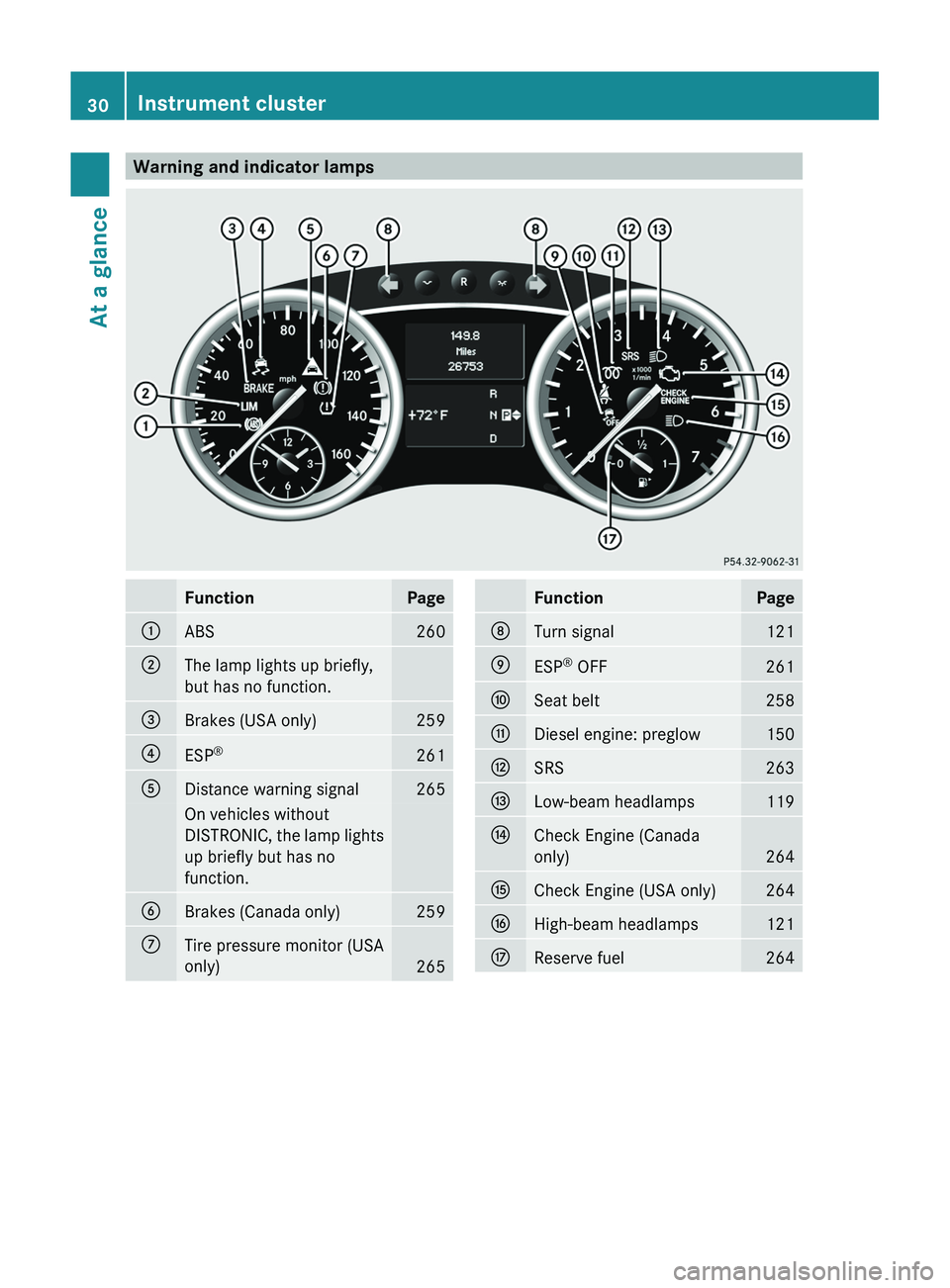
Warning and indicator lampsFunctionPage:ABS260;The lamp lights up briefly,
but has no function.=Brakes (USA only)259?ESP ®261ADistance warning signal265On vehicles without
DISTRONIC, the lamp lights
up briefly but has no
function.BBrakes (Canada only)259CTire pressure monitor (USA
only)
265
FunctionPageDTurn signal121EESP ®
OFF261FSeat belt258GDiesel engine: preglow150HSRS263ILow-beam headlamps119JCheck Engine (Canada
only)
264
KCheck Engine (USA only)264LHigh-beam headlamps121MReserve fuel26430Instrument clusterAt a glance
Page 70 of 384
Important safety notesGWARNING
The following factors increase the risk of
accidents:
R Excessive speed, especially in turns
R Wet and slippery road surfaces
R Following another vehicle too closely
The driving safety systems described in this
section cannot reduce these risks or prevent
the natural laws of physics from acting on the
vehicle. They cannot increase braking or
steering efficiency beyond that afforded by
the condition of the vehicle brakes and tires
or the traction afforded.
Only a safe, attentive, and skillful driver can
prevent accidents.
The capabilities of a vehicle equipped with the
driving safety systems described in this
section must never be exploited in a reckless
or dangerous manner which could jeopardize
the user's safety or the safety of others.
Always adjust your driving style to the
prevailing road and weather conditions and
keep a safe distance to other road users and
objects on the street.
If a driving system malfunctions, other driving
safety systems may also switch off. Observe
indicator and warning lamps that may come
on as well as messages in the multifunction
display that may appear.
i Please note that the driving safety
systems described only work as effectively
as possible when there is adequate contact
between the tires and the road surface. Pay
particular attention to the information
regarding tires, recommended minimum
tire tread depths etc. in the "Wheels and
tires" section ( Y page 338).
In wintry driving conditions, always use
winter tires (M+S tires) and if necessary,
snow chains. Only in this way will the
driving safety systems described in this
section work as effectively as possible.
ABS (Anti-lock Braking System)
Important safety notes
i Observe the "Important safety notes"
section ( Y page 68).
ABS regulates brake pressure in such a way
that the wheels do not lock when you brake.
This allows you to continue steering the
vehicle when braking.
ABS works from a speed of about
5 mph(8 km/h) upwards, regardless of road-
surface conditions. ABS works on slippery
surfaces, even when you only brake gently.
GWARNING
If the ABS malfunctions, other driving systems
such as the BAS or the ESP ®
are also switched
off. Observe indicator and warning lamps that
may come on as well as messages in the
multifunction display that may appear.
If the ABS malfunctions, the wheels may lock
during hard braking, reducing the steering
capability and extending the braking distance.
The ! warning lamp in the instrument
cluster lights up when the ignition is switched
on. It goes out when the engine is running.
Braking
If ABS intervenes when braking, you will feel
a pulsing in the brake pedal.
XIf ABS intervenes: continue to depress the
brake pedal with force until the braking
situation is over.XTo make a full brake application:
depress the brake pedal with full force.
The pulsating brake pedal can be an
indication of hazardous road conditions, and
functions as a reminder to take extra care
while driving.
GWARNING
Do not pump the brake pedal. Use firm, steady
brake pedal pressure instead. Pumping the
brake pedal defeats the purpose of the ABS
68Driving safety systemsSafety
Page 163 of 384
obtained from oil companies, e.g. at gas
stations.
Refueling
Fuel filler flap
The fuel filler flap is unlocked or locked
automatically when you open or close the
vehicle with the SmartKey or using KEYLESS-
GO.
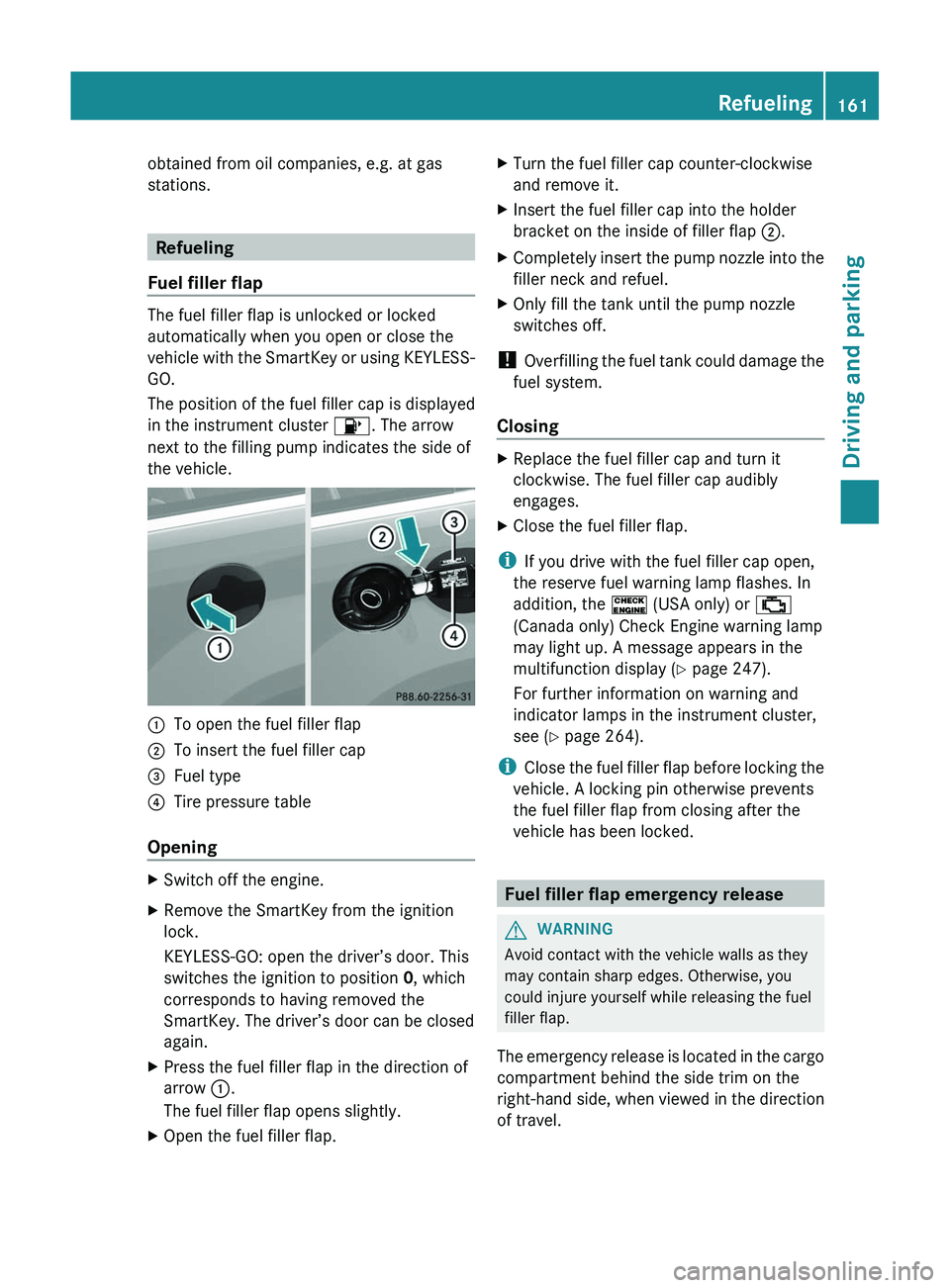
The position of the fuel filler cap is displayed
in the instrument cluster 8. The arrow
next to the filling pump indicates the side of
the vehicle.
:To open the fuel filler flap;To insert the fuel filler cap=Fuel type?Tire pressure table
Opening
XSwitch off the engine.XRemove the SmartKey from the ignition
lock.
KEYLESS-GO: open the driver’s door. This
switches the ignition to position 0, which
corresponds to having removed the
SmartKey. The driver’s door can be closed
again.XPress the fuel filler flap in the direction of
arrow :.
The fuel filler flap opens slightly.XOpen the fuel filler flap.XTurn the fuel filler cap counter-clockwise
and remove it.XInsert the fuel filler cap into the holder
bracket on the inside of filler flap ;.XCompletely insert the pump nozzle into the
filler neck and refuel.XOnly fill the tank until the pump nozzle
switches off.
! Overfilling the fuel tank could damage the
fuel system.
Closing
XReplace the fuel filler cap and turn it
clockwise. The fuel filler cap audibly
engages.XClose the fuel filler flap.
i If you drive with the fuel filler cap open,
the reserve fuel warning lamp flashes. In
addition, the ! (USA only) or ;
(Canada only) Check Engine warning lamp
may light up. A message appears in the
multifunction display ( Y page 247).
For further information on warning and
indicator lamps in the instrument cluster,
see ( Y page 264).
i Close the fuel filler flap before locking the
vehicle. A locking pin otherwise prevents
the fuel filler flap from closing after the
vehicle has been locked.
Fuel filler flap emergency release
GWARNING
Avoid contact with the vehicle walls as they
may contain sharp edges. Otherwise, you
could injure yourself while releasing the fuel
filler flap.
The emergency release is located in the cargo
compartment behind the side trim on the
right-hand side, when viewed in the direction
of travel.
Refueling161Driving and parkingZ
Page 170 of 384
Driving tips
General driving tips
Important safety notes
GWARNING
Always remember that you must concentrate
primarily on driving the vehicle. The driver's
concentration must always be directed
primarily at road traffic. For your own safety
and that of others, we recommend that you
stop the vehicle at a safe place and in
accordance with the traffic conditions before
making or accepting a phone call.
Comply with all legal requirements if you use
the telephone while driving. Use the hands-
free system and only use the telephone when
road, weather and traffic conditions permit. In
some jurisdictions, it is forbidden for drivers
to use mobile phones while driving.
Only operate COMAND (Cockpit Management
and Data System) in compliance with all legal
requirements and when the road, weather and
traffic conditions permit. You may otherwise
not be able to observe the traffic conditions,
endangering yourself and others.
Remember that your vehicle covers a distance
of 44 feet (approximately 14 m) a second
when it is traveling at only 30 mph
(approximately 50 km/h).
Drive sensibly – save fuel
Observe the following tips to save fuel:
XThe tires should always be inflated to the
recommended tire pressure.XRemove unnecessary loads.XRemove roof carriers when they are not
needed.XRemove basic carriers when they are not
needed.XWarm up the engine at low engine speeds.XAvoid frequent acceleration or braking.XHave all maintenance work carried out as
indicated by the service intervals in theService Booklet or by the service interval
display.
Fuel consumption also increases when
driving in cold weather, in stop-and-go traffic
and in mountainous terrain.
Drinking and driving
GWARNING
Drinking and driving and/or taking drugs and
driving are very dangerous combinations.
Even a small amount of alcohol or drugs can
affect your reflexes, perceptions and
judgment.
The possibility of a serious or even fatal
accident are greatly increased when you drink
or take drugs and drive.
Do not drink or take drugs and drive or allow
anyone to drive who has been drinking or
taking drugs.
Pedals
GWARNING
Make sure absolutely no objects are
obstructing the pedals' range of movement.
Keep the driver's footwell clear of all
obstacles. If there are any floormats or
carpets in the footwell, make sure that the
pedals still have sufficient clearance.
During sudden driving or braking maneuvers,
the objects could get caught between the
pedals. You could then no longer brake or
accelerate. This could lead to accidents and
injury.
Rolling with the engine switched off
GWARNING
There is no power assistance for the steering
and the brake when the engine is not running.
Steering and braking requires significantly
more effort and you could lose control of the
vehicle and cause an accident as a result.
Do not turn off the engine while the vehicle is
in motion.
168Driving tipsDriving and parking
Page 175 of 384
conditions. Only these tires will allow driving
safety systems such as ABS and ESP ®
to
function optimally in winter, as these tires
have been designed specifically for driving on
snow.
Use M+S tires of the same make and tread on
all wheels to maintain safe handling
characteristics.GWARNING
M+S tires with a tread depth of less than 1
/ 6
inch (4 mm) must be replaced immediately.
They are no longer suitable for use in winter.
Always observe the maximum permissible
speed specified for the M+S tires you have
mounted.
Once you have mounted the winter tires:
XCheck the tire pressures ( Y page 345).XRestart the tire pressure monitor
( Y page 347).GWARNING
If you use your spare wheel when M+S tires
are mounted on the other wheels, be aware
that the difference in tire characteristics
impairs cornering ability and reduces driving
stability. Adapt your driving style accordingly.
Have the spare wheel replaced by a normal
wheel with an M+S tire at the nearest
Mercedes-Benz Center.
Snow chains
For safety reasons, Mercedes-Benz
recommends that you only use snow chains
which have been specially approved for your
vehicle by Mercedes-Benz, or are of a
corresponding standard of quality.
! Vehicles with the Adaptive Damping
System (ADS): do not drive in ADS SPORT
mode if snow chains have been mounted.
The vehicle may otherwise be damaged.
! There is not enough space for snow
chains on some wheel sizes. Observe the
information under "Tires and wheels" in the
"Technical Data" section to avoid damage
to the vehicle or the wheels.
R Only use snow chains when driving on
roads completely covered by snow. Do not
exceed the maximum permissible speed of
30 mph (50 km/h). Remove the snow
chains as soon as possible when you are no
longer driving on snow-covered roads.
R Local regulations may restrict the use of
snow chains. Applicable regulations must
be observed if you wish to mount snow
chains.
R Snow chains must not be mounted on
emergency spare wheels.
If you intend to mount snow chains, please
bear the following points in mind:
R you may not attach snow chains to all
wheel-tire combinations; see the
information under "Wheel and tire
combinations" in the "Wheels and tires"
section.
R mount snow chains only in pairs and only
to the rear wheels. Observe the
manufacturer's installation instructions.
! If snow chains are mounted on the front
wheels, the snow chains could grind
against the bodywork or components of the
chassis. This could result in damage to the
vehicle or the tires.
! Vehicles with steel wheels: if you wish
to install snow chains to steel wheels, make
sure that you remove the respective
wheels' hubcaps first. The hubcaps may
otherwise be damaged.
i You may wish to deactivate
ESP ®
(Y page 69) when pulling away with
snow chains mounted. This way you can
allow the wheels to spin in a controlled
manner, achieving an increased driving
force (cutting action).Driving tips173Driving and parkingZ
Page 176 of 384
Slippery road surfacesGWARNING
The outside temperature indicator is not
designed to serve as an ice-warning device
and is therefore unsuitable for that purpose.
Indicated temperatures just above the
freezing point do not guarantee that the road
surface is free of ice. The road may still be icy,
especially in wooded areas or on bridges.
GWARNING
On slippery road surfaces, never downshift in
order to obtain braking action. This could
result in drive wheel slip and reduced vehicle
control. Your vehicle's ABS will not prevent
this type of control loss.
Do not engage the transfer case in position
LOW when driving on ice or packed snow. At
speeds below 18 mph (30 km/h) vehicle
steering is adversely affected by the Off-road
ABS.
Drive particularly carefully on slippery road
surfaces. Avoid sudden acceleration, steering
and braking maneuvers. Do not use cruise
control.
If the vehicle threatens to skid or cannot be
stopped when moving at low speed:
XShift the transmission to position N.
i
For more information on driving with
snow chains, see ( Y page 173).
GWARNING
Make sure that you do not endanger other
road users when you apply the brakes.
Off-road driving
Important safety notes
GWARNING
Grains of sand, particles of dirt and other
abrasive materials can enter the brake
system. This can lead to excessive wear and
unpredictable braking efficiency.
After the brakes have been exposed to dirty
conditions, have them checked and cleaned
at a qualified specialist workshop, e.g. an
authorized Mercedes-Benz Center.
Otherwise, there is a risk that braking power
may be insufficient in the event of an
emergency, or that the braking effect may be
unpredictable.GWARNING
Do not load items on the crossbars. It may
cause instability during some maneuvers
which could result in an accident.
Drive slowly in unknown terrain. This will
make it easier to recognize unexpected
obstacles and avoid damage to the vehicle.
To help avoid the vehicle rolling over, never
turn it around on steep inclines. If the vehicle
cannot complete the attempted climb, back it
down in reverse gear.
Do not drive along the side of a slope. The
vehicle might otherwise rollover. If in doing so
the vehicle begins to show a tendency to roll,
immediately steer into a line of gravity
(straight up or downhill).
Never let the vehicle roll backwards in idle.
You may lose control of the vehicle if you use
only the service brake. For information on
driving downhill, see "Driving downhill".
GWARNING
Please be aware that by raising the vehicle
level, the center of gravity also rises.
Therefore, always ensure that the vehicle
level is as low as possible. With higher ride
height the ESP ®
may activate earlier in certain
situations.
GWARNING
Do not reduce the tire inflation pressure
before driving through sand. However, if you
do so, remember to correct the tire inflation
pressure before continuing your trip. Driving
with reduced tire inflation pressure increases
174Driving tipsDriving and parking