light MERCEDES-BENZ GL 2013 User Guide
[x] Cancel search | Manufacturer: MERCEDES-BENZ, Model Year: 2013, Model line: GL, Model: MERCEDES-BENZ GL 2013Pages: 454, PDF Size: 6.31 MB
Page 20 of 454
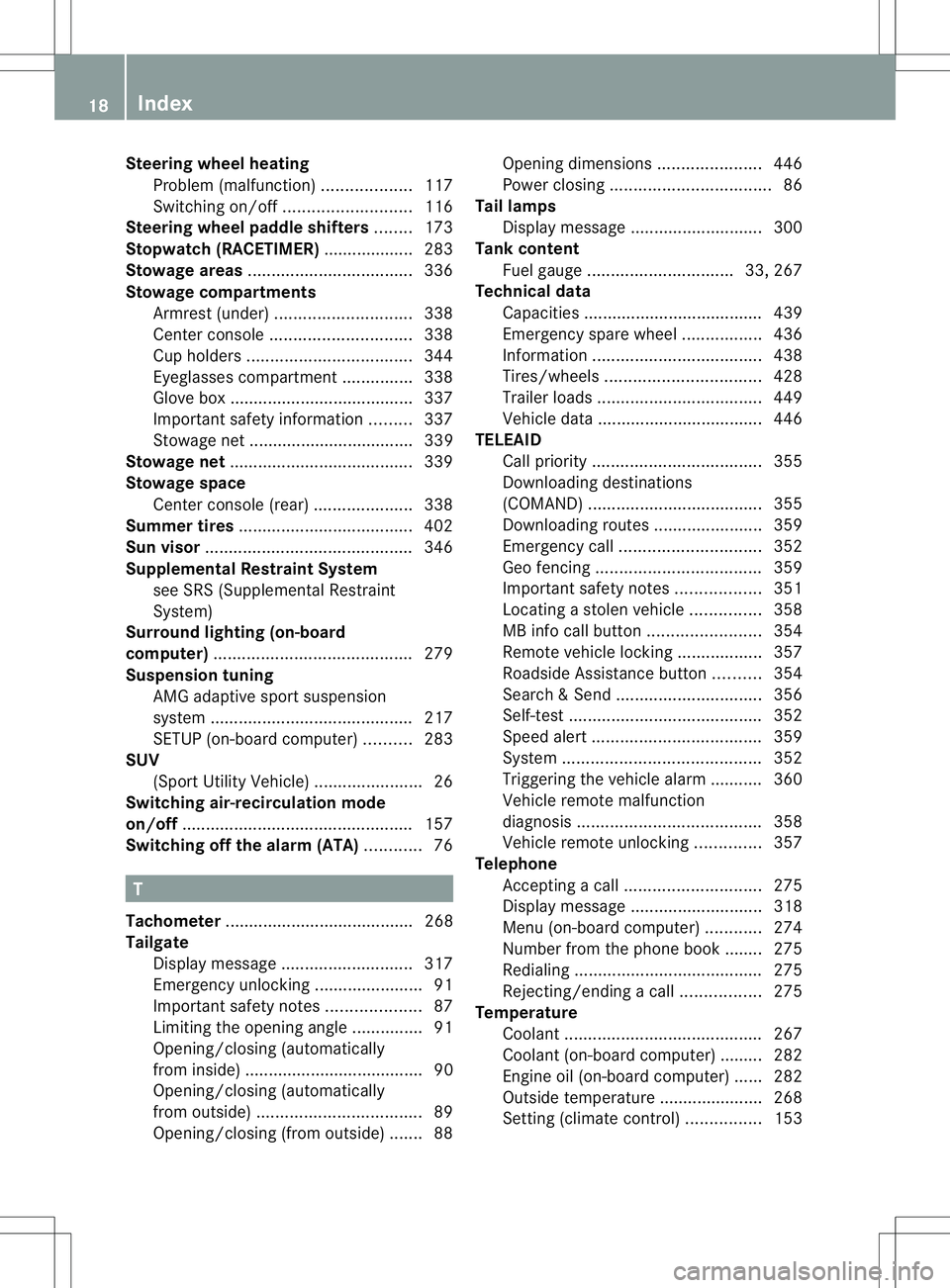
Steering wheel heating
Problem (malfunction) ...................117
Switching on/off ........................... 116
Steering wheel paddle shifters ........173
Stopwatch (RACETIMER) ................... 283
Stowage areas ................................... 336
Stowage compartments Armrest (under) ............................. 338
Center console .............................. 338
Cuph olders ................................... 344
Eyeglasses compartment ...............338
Glove box ...................................... .337
Important safety information .........337
Stowage net ................................... 339
Stowage net ....................................... 339
Stowage space Center console (rear) .....................338
Summer tires ..................................... 402
Sun visor ............................................ 346
Supplemental Restraint System see SRS (Supplemental Restraint
System)
Surround lighting (on-board
computer) .......................................... 279
Suspension tuning AMG adaptive sport suspension
system ........................................... 217
SETUP (on-board computer) ..........283
SUV
(Sport Utility Vehicle) .......................26
Switching air-recirculation mode
on/off ................................................. 157
Switching off the alarm (ATA) ............76 T
Tachometer ........................................ 268
Tailgate Display message ............................ 317
Emergency unlocking .......................91
Important safety notes ....................87
Limiting the opening angle ...............91
Opening/closing (automatically
from inside) ...................................... 90
Opening/closing (automatically
from outside) ................................... 89
Opening/closing (from outside) .......88 Opening dimensions
......................446
Power closing .................................. 86
Tail lamps
Display message ............................ 300
Tank content
Fuel gauge ............................... 33, 267
Technical data
Capacities ...................................... 439
Emergency spare wheel .................436
Information .................................... 438
Tires/wheels ................................. 428
Trailer loads ................................... 449
Vehicle data ................................... 446
TELEAID
Call priority .................................... 355
Downloading destinations
(COMAND) ..................................... 355
Downloading route s....................... 359
Emergency call .............................. 352
Geo fencing ................................... 359
Important safety notes ..................351
Locating astolen vehicl e............... 358
MB info call button ........................354
Remote vehicle locking ..................357
Roadside Assistance button ..........354
Search &Send ............................... 356
Self-test ......................................... 352
Speed alert .................................... 359
System .......................................... 352
Triggering the vehicle alarm ........... 360
Vehicle remote malfunction
diagnosi s....................................... 358
Vehicle remote unlocking ..............357
Telephone
Accepting acall............................. 275
Display message ............................ 318
Menu (on-board computer) ............274
Number from the phone book ....... .275
Redialing ........................................ 275
Rejecting/ending acall................. 275
Temperature
Coolant .......................................... 267
Coolant (on-board computer) ......... 282
Engine oil (on-board computer) ...... 282
Outside temperature ..................... .268
Setting (climate control) ................15318
Index
Page 34 of 454
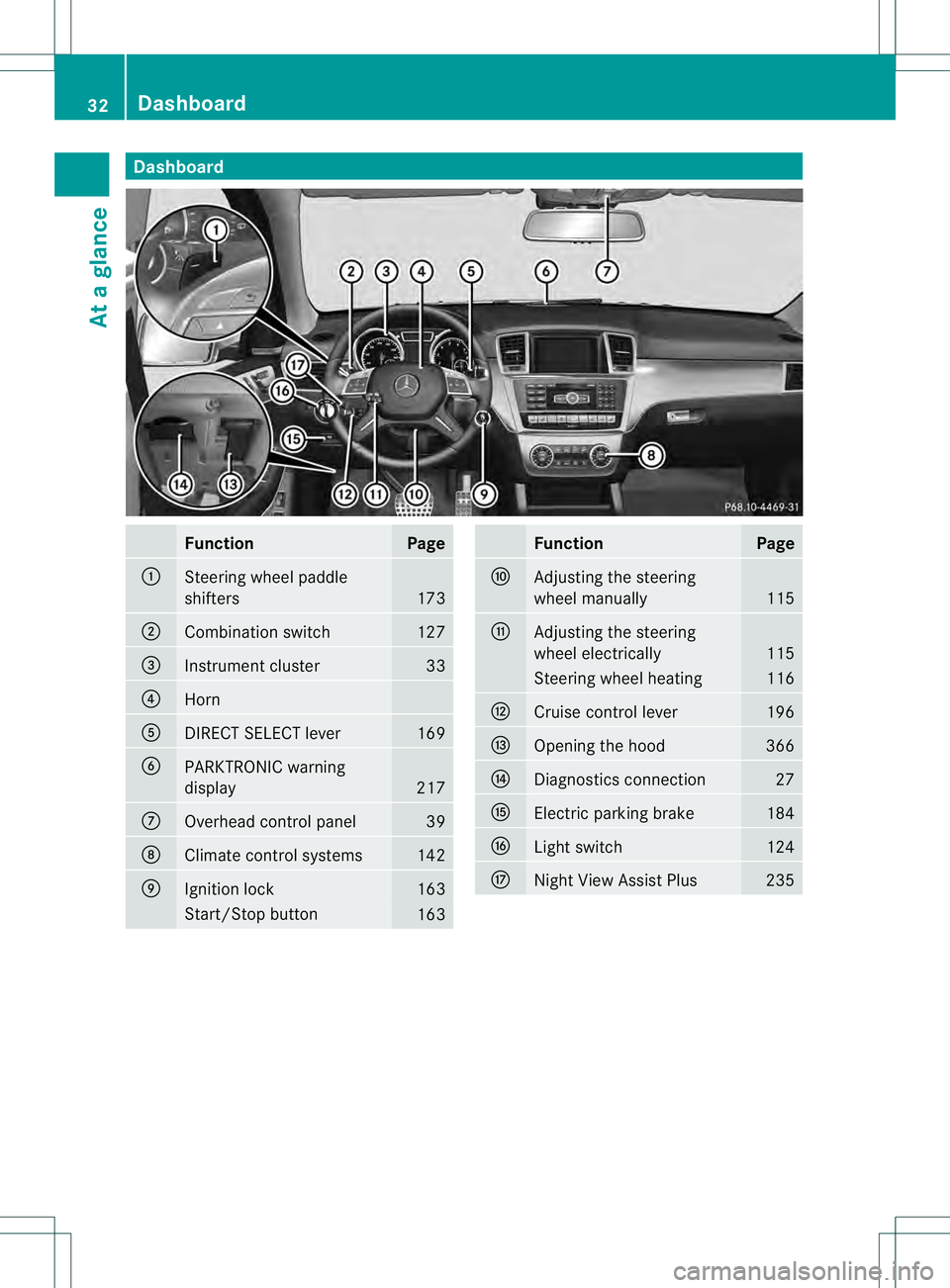
Dashboard
Function Page
0002
Steering wheel paddle
shifters
173
0003
Combination switch 127
0021
Instrument cluster 33
0020
Horn
001E
DIRECT SELECT lever 169
001F
PARKTRONIC warning
display
217
0013
Overhead control panel 39
0014
Climate control systems 142
0015
Ignition lock 163
Start/Stop button
163 Function Page
0016
Adjusting the steering
wheel manually 115
0017
Adjusting the steering
wheel electrically 115
Steering wheel heating 116
0018
Cruise control lever 196
0019
Opening the hood 366
001A
Diagnostics connection 27
001B
Electric parking brake 184
001C
Light switch 124
001D
Night View Assis
tPlus 23532
DashboardAt a glance
Page 35 of 454
Instrumen
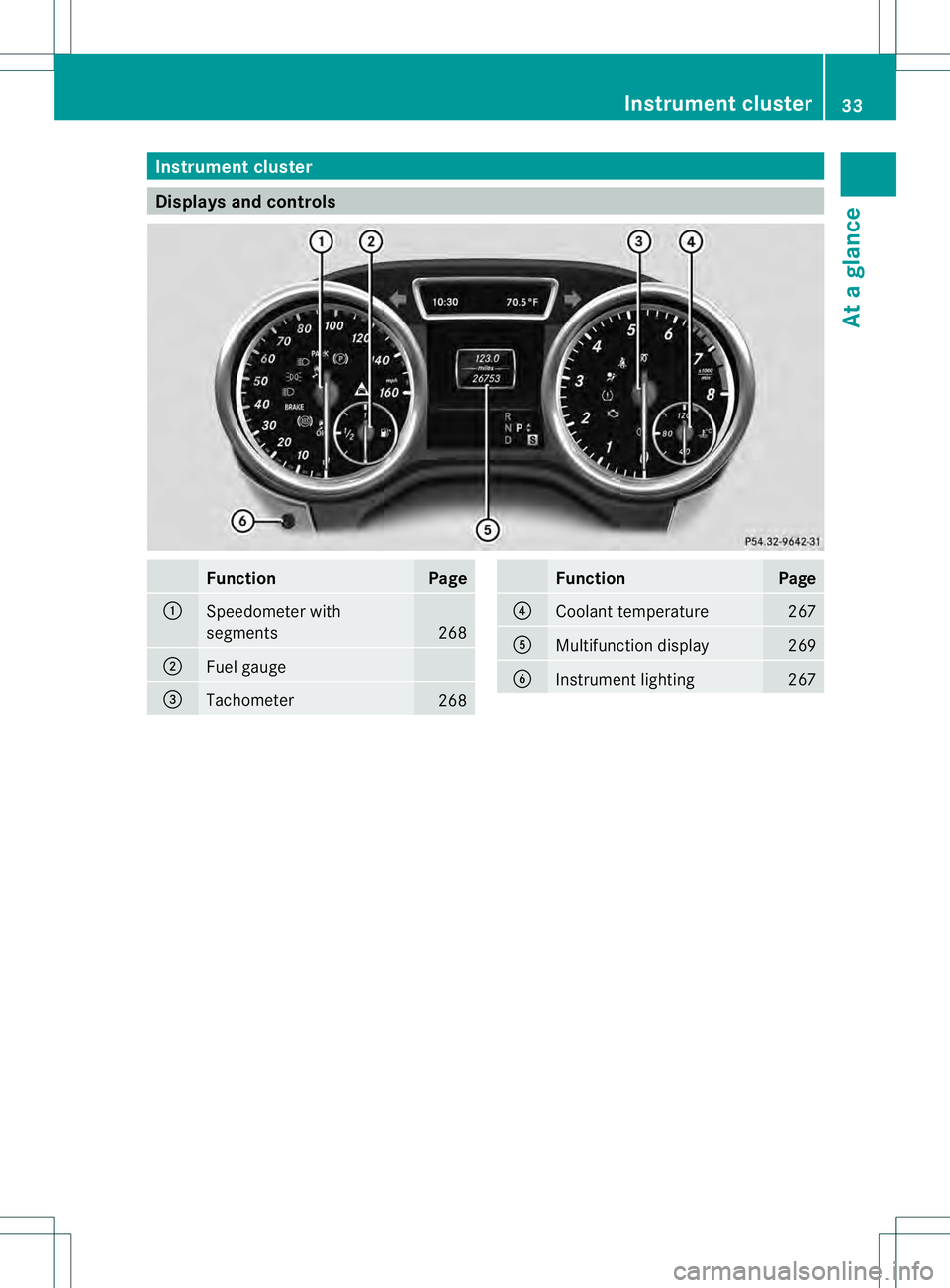
tcluster Displays and controls
Function Page
0002
Speedometer with
segments
268
0003
Fuel gauge
0021
Tachometer
268 Function Page
0020
Coolant temperature 267
001E
Multifunction display 269
001F
Instrument lighting 267Instrument cluster
33At a glance
Page 39 of 454
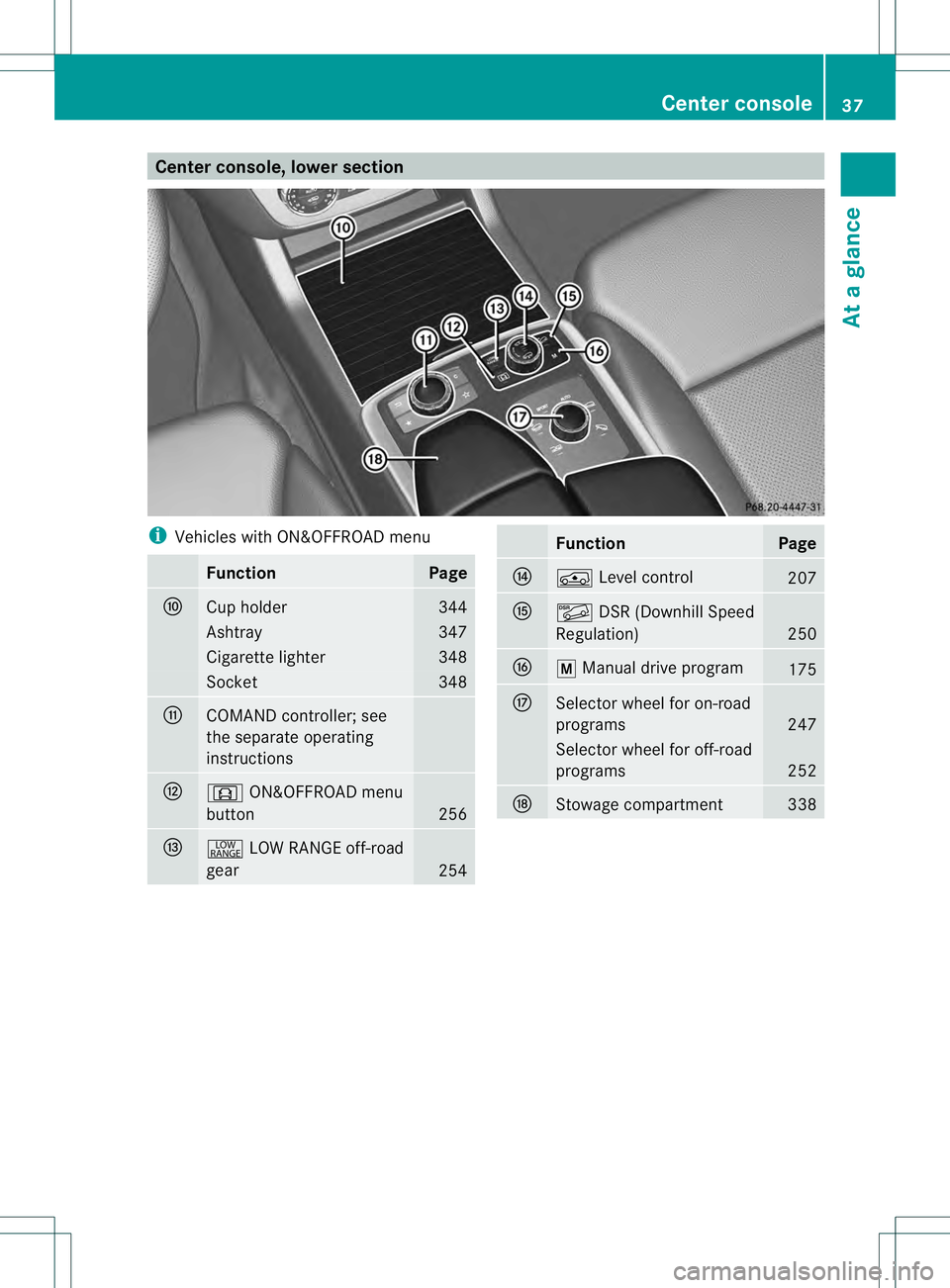
Center console, lower section
i
Vehicles with ON&OFFROAD menu Function Page
0016
Cup holder 344
Ashtray 347
Cigarette lighter 348
Socket 348
0017
COMAND controller; see
the separate operating
instructions
0018
0009
ON&OFFROAD menu
button 256
0019
0011
LOW RANGE off-road
gear 254 Function Page
001A
0002
Level control 207
001B
0001
DSR (Downhill Speed
Regulation) 250
001C
0012
Manual drive program 175
001D
Selector wheel for on-road
programs
247
Selector wheel for off-road
programs
252
0023
Stowage compartment 338Center console
37At a glance
Page 40 of 454
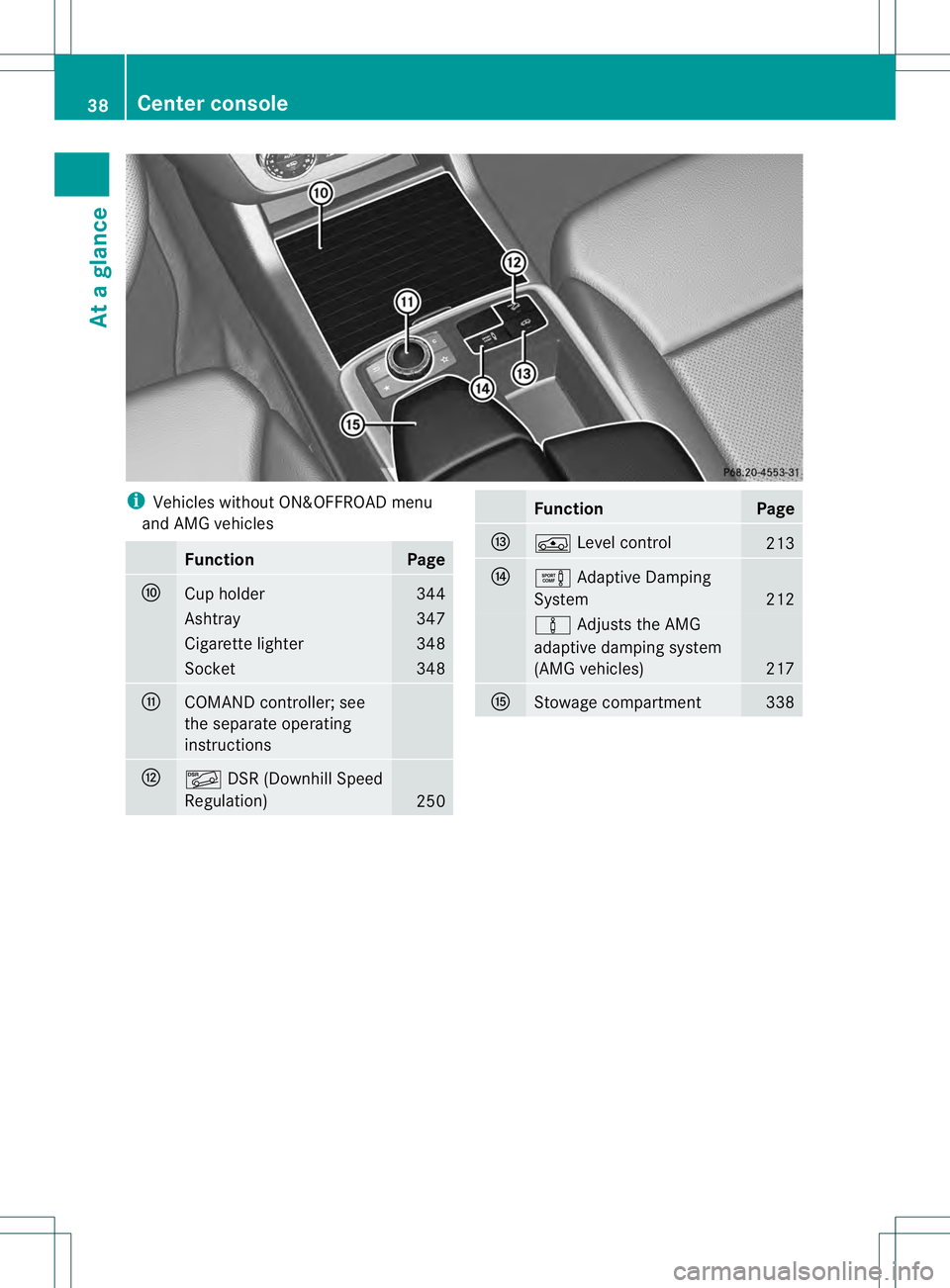
i
Vehicles without ON&OFFROAD menu
and AMG vehicles Function Page
0016
Cup holder 344
Ashtray 347
Cigarette lighter 348
Socket 348
0017
COMAND controller; see
the separate operating
instructions
0018
0001
DSR (Downhill Speed
Regulation) 250 Function Page
0019
0002
Level control 213
001A
000A
Adaptive Damping
System 212
000A
Adjusts the AMG
adaptive damping system
(AMG vehicles) 217
001B
Stowage compartment 33838
Center consoleAt a glance
Page 41 of 454
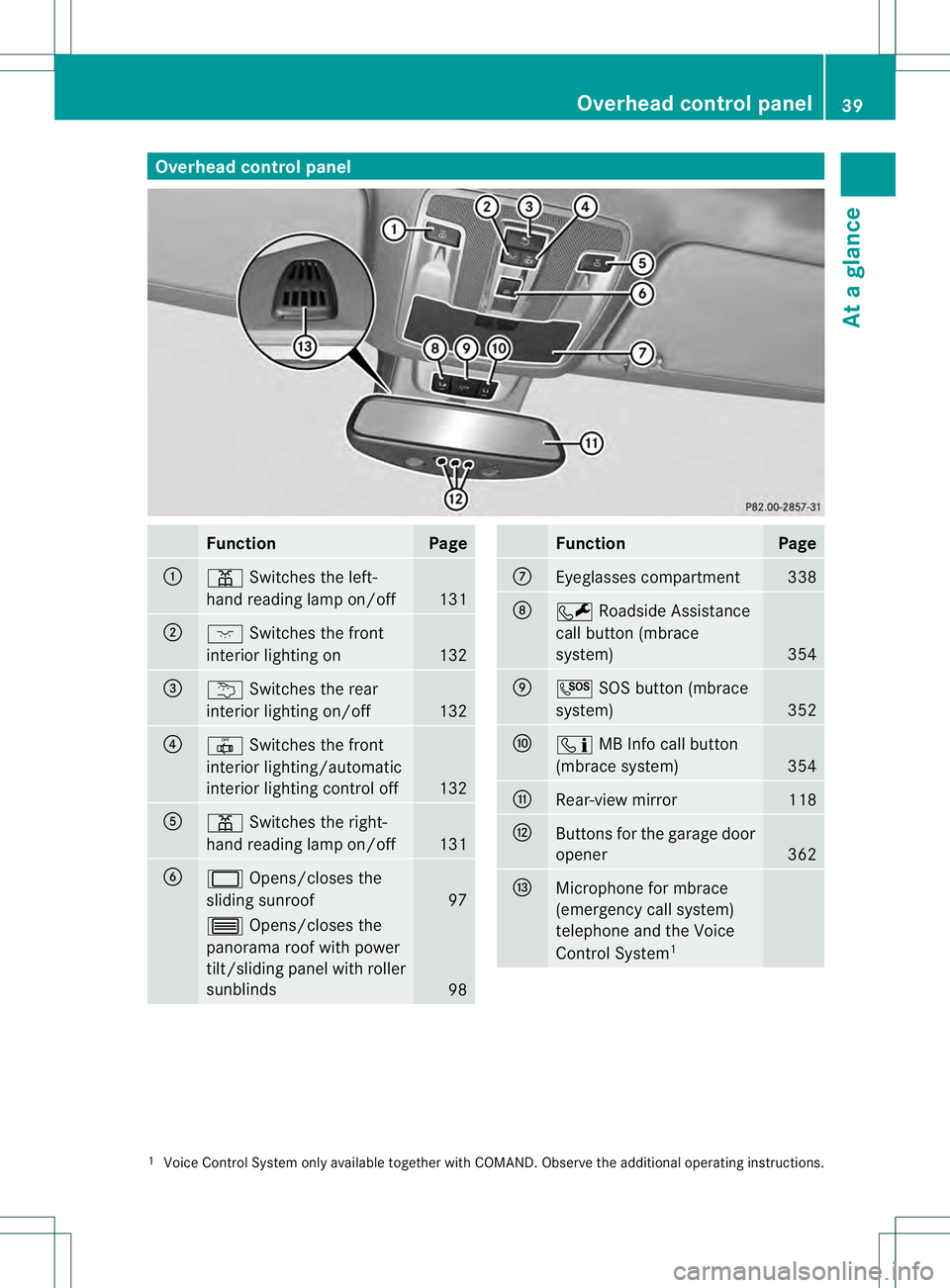
Overhea
dcontrol panel Function Page
0002
0015
Switches the left-
hand reading lamp on/off 131
0003
0006
Switches the front
interio rlighting on 132
0021
0002
Switches the rear
interior lighting on/off 132
0020
001D
Switches the front
interior lighting/automatic
interior lighting control off 132
001E
0015
Switches the right-
hand reading lamp on/off 131
001F
0002
Opens/closes the
sliding sunroof 97
0003
Opens/closes the
panorama roof with power
tilt/sliding panel with roller
sunblinds 98 Function Page
0013
Eyeglasses compartment 338
0014
0009
Roadside Assistance
call button (mbrace
system) 354
0015
000A
SOS button (mbrace
system) 352
0016
000B
MB Info call button
(mbrace system) 354
0017
Rear-view mirror 118
0018
Buttons for the garage door
opener
362
0019
Microphone for mbrace
(emergency call system)
telephone and the Voice
Control System 1 1
Voice Control System only available together with COMAND. Observe the additional operating instructions. Overhead control panel
39At a glance
Page 44 of 454
Useful information
i This Operator's Manual describes all
models and all standard and optional
equipment of your vehicle available at the
time of publication of the Operator's
Manual. Country-specific differences are
possible. Please note that your vehicle may
not be equipped with all features
described. This also applies to safety-
related systems and functions.
i Read the information on qualified
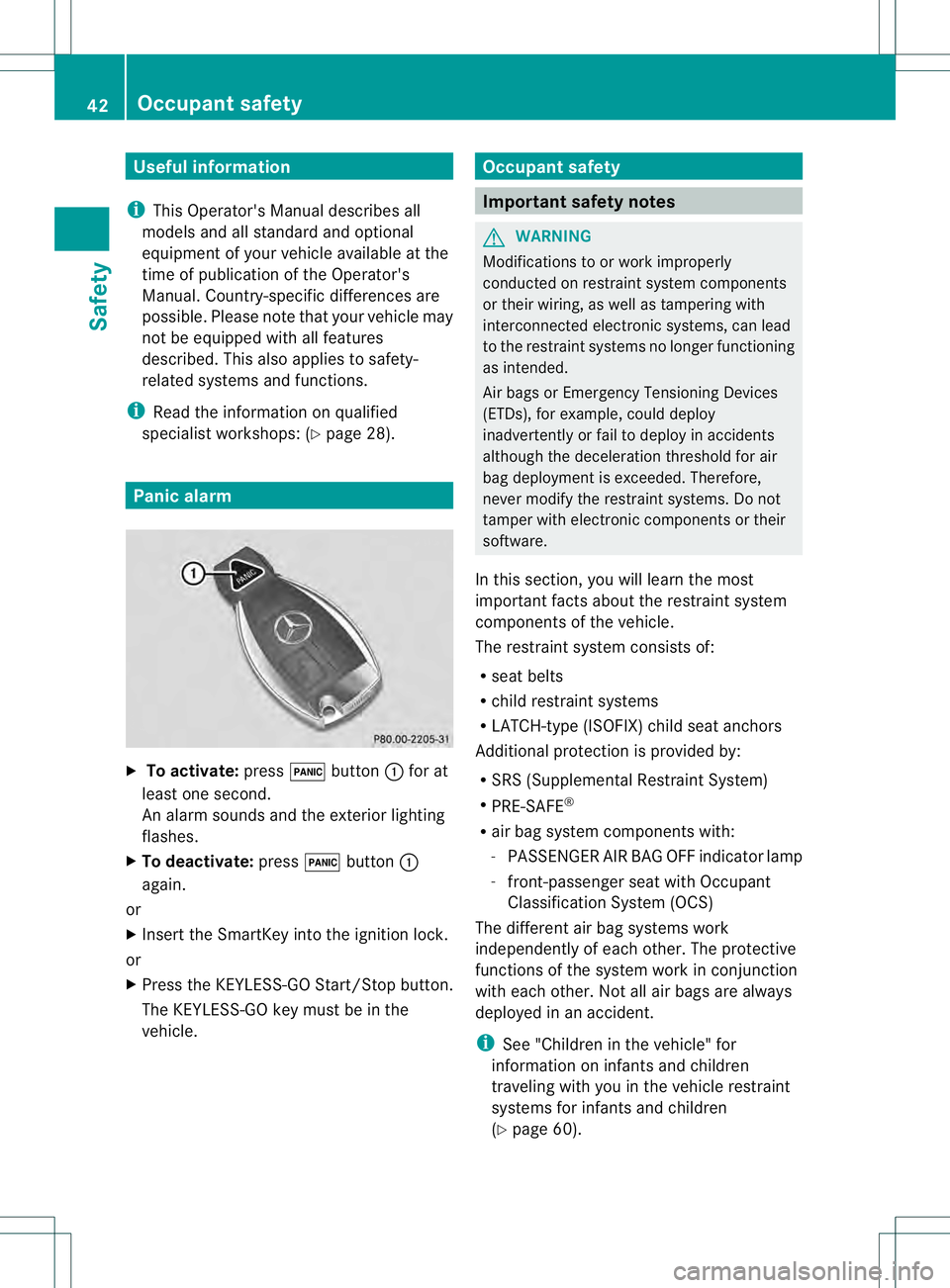
specialist workshops: (Y page 28).Panic alarm
X
To activate: press000Ebutton 0002for at
least one second.
An alarm sounds and the exterior lighting
flashes.
X To deactivate: press000Ebutton 0002
again.
or
X Insert the SmartKey into the ignition lock.
or
X Press the KEYLESS-GO Start/Stop button.
The KEYLESS-GO key must be in the
vehicle. Occupant safety
Important safety notes
G
WARNING
Modifications to or work improperly
conducted on restraint system components
or their wiring, as well as tampering with
interconnected electronic systems, can lead
to the restraint system sno longer functioning
as intended.
Air bags or Emergency Tensioning Devices
(ETDs), for example, could deploy
inadvertently or fail to deploy in accidents
although the deceleration threshold for air
bag deployment is exceeded. Therefore,
never modify the restraint systems. Do not
tamper with electronic components or their
software.
In this section, you will learn the most
important facts about the restraint system
components of the vehicle.
The restraint system consists of:
R seat belts
R child restraint systems
R LATCH-type (ISOFIX) child seat anchors
Additional protection is provided by:
R SRS (Supplemental Restraint System)
R PRE-SAFE ®
R air bag system components with:
-PASSENGER AIR BAG OFF indicator lamp
- front-passenger seat with Occupant
Classification System (OCS)
The different air bag systems work
independently of each other. The protective
functions of the system work in conjunction
with each other. Not all air bags are always
deployed in an accident.
i See "Children in the vehicle" for
information on infants and children
traveling with you in the vehicle restraint
systems for infants and children
(Y page 60). 42
Occupant safetySafety
Page 45 of 454
SRS (Supplemental Restraint System)
Introduction SRS consists of:
R
001F SRS warning lamp
R Air bags
R The air bag control unit with crash sensors
R Emergency Tensioning Devices for the
front seat belts and the outer seat belts in
the rear
R Belt force limiters
SRS reduces the risk of occupants coming
into contact with the vehicle's interior in the
event of an accident. It can also reduce the
effect of the forces to which occupants are
subjected during an accident.
SRS warning lamp G
WARNING
The SRS self-chec khas detected a
malfunction if the 001FSRS indicator lamp:
R does no tlight up at all
R does not go out after approximately four
seconds after the engine is started
R lights up after the engin eis started or while
the vehicle is in motion
For your safety, Mercedes-Benz strongly
recommends that you have the system
checked as soon as possible at a qualified
specialist workshop. SRS may otherwise fail
to activate when it is needed in the event of
an accident, which could lead to serious or
fatal injuries. SRS might also be activated
unexpectedly and unnecessarily, which could
also result in injury.
In addition, work carried out improperly on
SRS may render SRS inoperative or cause
unintended air bag deployment. Work on the
SRS system should only be carried out by
qualified specialist personnel. Consult a
qualified specialist workshop.
If it is necessary to modify an air bag system
to accommodate a person with disabilities,
contact an authorized Mercedes-Benz Center for details. USA only: for further information,
contact our Customer Assistance Center at
1-800-FOR-MERCedes (1-800-367-6372).
SRS functions are checked regularly when
you switch on the ignition and when the
engine is running. Therefore, malfunctions
can be detected in good time.
The 001F SRS warning lamp in the instrument
cluster lights up when the ignition is switched
on. It goes out no later than a few seconds
after the engine is started.
The SRS components are in operational
readiness when the 001FSRS warning lamp
goes out while the engine is running.
Safety guidelines for seat belts,
Emergency Tensioning Devices (ETDs)
and air bags G
WARNING
R Damaged seat belts or seat belts that have
been subjected to stress in an accident
must be replaced. Their anchoring points
must also be checked. Only use seat belts
installed or supplied by an authorized
Mercedes-Benz Center.
R Air bags and pyrotechnic Emergency
Tensioning Devices (ETDs) contain
perchlorate material, which may require
special handling and regard for the
environment.C heck your national disposal
guidelines. California residents, see
www.dtsc.ca.gov/HazardousWaste/
Perchlorate/index.cfm.
R Air bags and ETDs are designed to function
on a one-time-only basis. An air bag or ETD
that has deployed must be replaced. PRE-
SAFE ®
has electrically operated reversible
belt tensioners in addition to the
pyrotechnic ETDs.
R Do not pass seat belts over sharp edges.
They could tear.
R Do not make any modification that could
change the effectiveness of the seat belts. Occupant safety
43Safety
Z
Page 47 of 454
must always be correctly seated and wear
their seat belts.
For maximum protection in the event of a
collision, you must always be in the normal
seat position with yourb ack against the
backrest. Faste nyour seat belt and make sure
that it is correctly positioned on your body.
As the air bag inflates with considerable
speed and force, a proper seating position
and correct positioning of the hands on the
steering wheel will help to keep you at a safe
distance from the air bag. Occupants who are
not wearing their seat belt, are not seated
properly or are too close to the air bag can be
seriously injured or killed by an air bag, as it
inflates with great force instantaneously:
R sit with the seat belt fastened correctly and
in a position that is as upright as possible
with your back against the backrest.
R move the driver's seat as far back as
possible, still permitting proper operation
of vehicle controls. The distance from the
center of the driver's chest to the center of
the air bag cover on the steering wheel
must be at least 10 inches (25 cm). You
should be able to accomplish this by
adjusting the seat and steering wheel. If
you have any difficulties, please contact an
authorized Mercedes-Benz Center.
R do not lean your head or chest close to the
steering wheel or dashboard.
R only hold the steering wheel on the outside.
Placing hands and arms inside the rim can
increase the risk and potential severity of
hand/arm injury if the driver front air bag
inflates.
R adjust the front-passenger seat as far back
as possible from the dashboard when the
seat is occupied.
R occupants, especially children, should
never place their bodies or lean their heads
in the area of the door where the side
impact air bag inflates. This could result in
serious or fatal injuries should the side
impact air bag be deployed. Always sit as
upright as possible, wear the seat belt properly and use an appropriately sized
infant restraint, toddler restraint or booster
seat recommended for the size and weight
of the child.
Failure to follow these instructions can result
in severe injuries to you or other occupants.
If you sell your vehicle, it is important that you
make the buyer aware of this safety
information. Be sure to give the buyer this
Operator's Manual. G
WARNING
Accident research shows that the safest place
for children in an automobile is in a rear seat.
As ide impact air bag related injury may occur
if occupants, especially children, are not
properly seated or restraine dwhen next to a
side impact air bag which needs to deploy
rapidly in a side impact in order to do its job.
To help avoid the possibility of injury, please
follow these guidelines:
(1) Always sit as upright as possible and use the seat belts properly.
Make sure that children 12 years
old and under use an appropriately
sized child restraint, infant
restraint, or booster seat
recommended for the size and
weight of the child.
(2) Always wear seat belts properly.
If the air bags are deployed, you will hear a
bang, and a small amount of powder may also
be released. Only in rare cases will the bang
affect your hearing. The powder that is
released generally does not constitute a
health hazard. The 001FSRS warning lamp
lights up.
The air bags are deployed if the air bag control
unit detects the need for deployment. Only in
the event of such a situation will the air bags
provide their supplemental protection.
If the driver and front passenger do not wear
their seat belts, it is not possible for the air
bags to provide their supplemental
protection. Occupant safety
45Safety Z
Page 48 of 454
In the event of other types of impacts and
impacts below air bag deployment
thresholds, the air bags will not deploy. The
driver and passengers will then be protected
to the extent possible by a properly fastened
seat belt.
Aproperly fastened seat belti s also
needed to provide the best possible
protection in a rollover.
Air bags provide additional protection; they
are not, however, a substitute for seat belts.
All vehicle occupants must fasten their seat
belts regardless of whether your vehicle is
equipped with air bags or not.
It is important for your safety and that of your
passengers to have deployed air bags
replaced and to have any malfunctioning air
bags repaired. This will help to make sure the
air bags continue to perform their protective
function for the vehicle occupants in the
event of a crash.
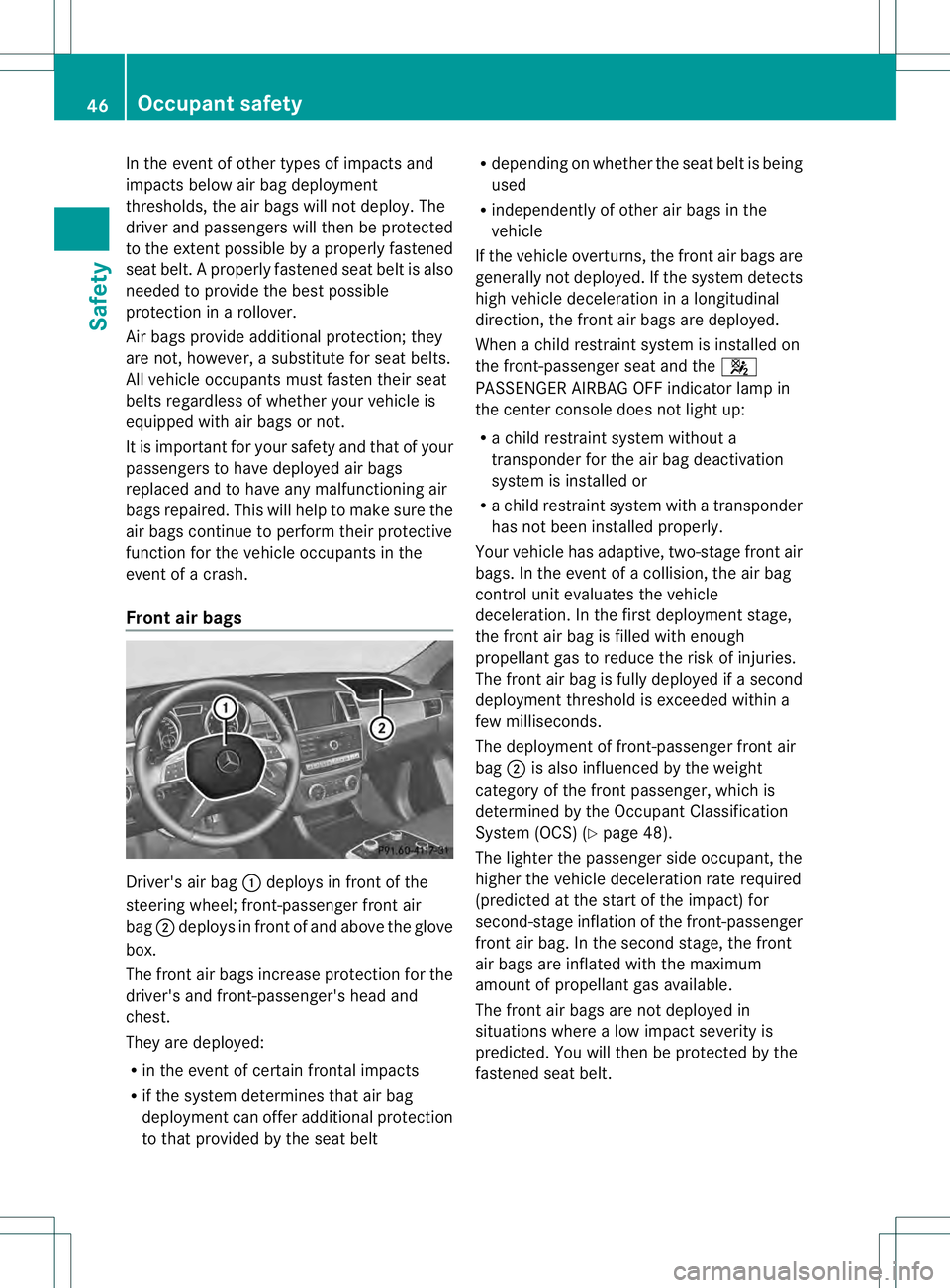
Front air bags Driver's air bag
0002deploys in front of the
steering wheel; front-passenger front air
bag 0003deploys in front of and above the glove
box.
The front air bags increase protection for the
driver's and front-passenger's head and
chest.
They are deployed:
R in the event of certain frontal impacts
R if the system determines that air bag
deployment can offer additional protection
to that provided by the seat belt R
depending on whether the seat belt is being
used
R independently of other air bags in the
vehicle
If the vehicle overturns, the front air bags are
generally not deployed. If the system detects
high vehicle deceleration in alongitudinal
direction, the front air bags are deployed.
When a child restraint system is installed on
the front-passenger seat and the 001A
PASSENGER AIRBAG OFF indicator lamp in
the center console does not light up:
R a child restraint system without a
transponder for the air bag deactivation
system is installed or
R a child restraint system with a transponder
has not been installed properly.
Your vehicle has adaptive, two-stage front air
bags. In the event of a collision, the air bag
control unit evaluates the vehicle
deceleration. In the first deployment stage,
the front air bag is filled with enough
propellant gas to reduce the risk of injuries.
The front air bag is fully deployed if a second
deployment threshold is exceeded within a
few milliseconds.
The deployment of front-passenger front air
bag 0003is also influenced by the weight
category of the front passenger, which is
determined by the Occupant Classification
System (OCS) (Y page 48).
The lighter the passenger side occupant, the
higher the vehicle deceleration rate required
(predicted at the start of the impact) for
second-stage inflation of the front-passenger
front air bag. In the second stage, the front
air bags are inflated with the maximum
amount of propellant gas available.
The front air bags are not deployed in
situations where a low impact severity is
predicted. You will then be protected by the
fastened seat belt. 46
Occupant safetySafety