lock MERCEDES-BENZ GL 2013 User Guide
[x] Cancel search | Manufacturer: MERCEDES-BENZ, Model Year: 2013, Model line: GL, Model: MERCEDES-BENZ GL 2013Pages: 454, PDF Size: 6.31 MB
Page 22 of 454
Tread wear
..................................... 416
TWR (permissible trailer drawbar
noseweight) (definition) .................423
Uniform Tire Quality Grading
Standard s...................................... 415
Uniform Tire Quality Grading
Standard s(definition) .................... 421
Unladen weight (definition) ............422
Wea rindicato r(definition) .............423
Whee lrim (definition ).................... 421
see Flat tire
Top Tether ............................................ 63
Towing Important safety guidelines ...........393
Installing the towing eye ................394
Removing the towing eye. ..............395
Towing atrailer
Activ eParking Assist ..................... 225
Axle load, permissible ....................449
Cleaning the trailer tow hitch ......... 376
Coupling up atrailer ...................... 260
Decoupling atrailer ....................... 262
Driving tips .................................... 257
ESP ®
(Electronic Stability Program) .72
Important safety notes ..................257
Installing the ball coupling .............259
Mounting dimensions ....................448
Power supply ................................. 264
Pulling away with a trailer ..............166
Removing the ball coupling ............263
Shift range ..................................... 172
Storing the ball coupling ................263
Trailer drive program .....................249
Trailer loads ................................... 449
Towing away
With both axles on the ground .......395
Tow-starting
Emergency engine starting ............396
Important safety notes ..................393
Trailer coupling
see Towing atrailer
Trailer loads and drawbar
noseweights ...................................... 263
Trailer towing Active Blind Spot Assist .................244
Active Lane Keeping Assist ............247
Blind Spot Assist ............................ 239 PARKTRONI
C................................. 220
Permissible trailer loads and
drawba rnoseweights ..................... 263
Transfer case ..................................... 177
Transmission see Automatic transmission
Transmission position display .........169
Transmission position display
(DIRECT SELECTl ever)...................... 169
Transporting the vehicle ..................395
Traveling uphill Brow of hill ..................................... 195
Driving downhill ............................. 195
Maximum gradient-climbing
capability ....................................... 195
Trim pieces (cleaning instructions) .378
Trip computer (on-board computer) 271
Trip odometer Calling up ....................................... 270
Resetting (on-board computer) ......272
see Trip odometer
Trunk
see Tailgate
Turn signals
Display message ............................ 299
Switching on/off ........................... 127
TWR (Tongue Weight Rating)
(definition) ......................................... 423
Type identification plate see Vehicle identification plate U
Unlocking Emergency unlocking .......................86
From inside the vehicle (central
unlocking button) ............................. 85 V
Vanity mirror (in the sun visor) ........346
Vehicle Correct use ...................................... 28
Data acquisition ............................... 29
Display message ............................ 316
Equipment ....................................... 24
Individua lsettings .......................... 278
Limited Warranty ............................. 2920
Index
Page 23 of 454
Loading
.......................................... 412
Locking (in an emergency) ...............87
Locking (SmartKey) .......................... 79
Lowering ........................................ 428
Maintenance .................................... 25
Parking for a long period ................ 186
Pulling away ................................... 165
Raising ........................................... 425
Reporting problems .........................28
Securing from rolling away ............424
Towing away .................................. 393
Transporting .................................. 395
Unlocking (in an emergency) ...........86
Unlocking (SmartKey) ......................79
Vehicle data ................................... 446
Vehicle battery
see Battery (vehicle)
Vehicle data ....................................... 446
Vehicle dimensions ...........................446
Vehicle emergency locking ................87
Vehicle identification number see VIN
Vehicle identification plate ..............438
Vehicle level AMG adaptive sport suspension
system ........................................... 216
Vehicle level (display message) .......306
Vehicle maintenance see ASSYST PLUS
Vehicle tool kit .................................. 382
Video Operating the DVD ......................... 274
VIN ...................................................... 438W
Warning and indicator lamps ABS ................................................ 323
Brakes ........................................... 322
Check Engine ................................. 329
Coolant .......................................... 330
Distance warning ........................... 332
DISTRONI CPLUS ........................... 332
ESP ®
.............................................. 325
ESP ®
OFF ....................................... 326
Fuel tank ........................................ 329
Overview .................................. 34, 320 PASSENGER AIR BAG OFF
indicator lamp
.................................. 48
Reserve fuel ................................... 329
Seat bel t........................................ 321
SRS ................................................ 328
Tire pressure monitor ....................333
Warranty ............................................ 438
Washer fluid Display message ............................ 318
Wheel bol ttightening torque ...........428
Wheel chock ...................................... 424
Wheels Changing awheel .......................... 423
Checking ........................................ 401
Cleaning ......................................... 374
Cleaning (warning) .........................424
Emergency spare wheel .................434
Important safety notes ..................400
Interchanging/changing ................423
Mounting anew wheel ................... 427
Mounting awheel .......................... 424
Overview ........................................ 400
Removing awheel .......................... 427
Storing ........................................... 424
Tightening torque ........................... 428
Whee lsize/tir esize ....................... 428
Window curtain air bag
Display message ............................ 296
Operation ........................................ .48
Windows
see Side windows
Windshield
Defrosting ...................................... 155
Infrared reflective .......................... 363
Windshiel dwasher fluid
see Windshield washer system
Windshiel dwasher system
Adding washer fluid .......................370
Notes ............................................. 446
Windshiel dwipers
Problem (malfunction) ...................139
Rea rwindow wiper ........................ 137
Replacing the wiper blades ............137
Switching on/off ........................... 136
Winte rdriving
Slippery roa dsurface s................... 190
Snow chains .................................. 403 Index
21
Page 34 of 454
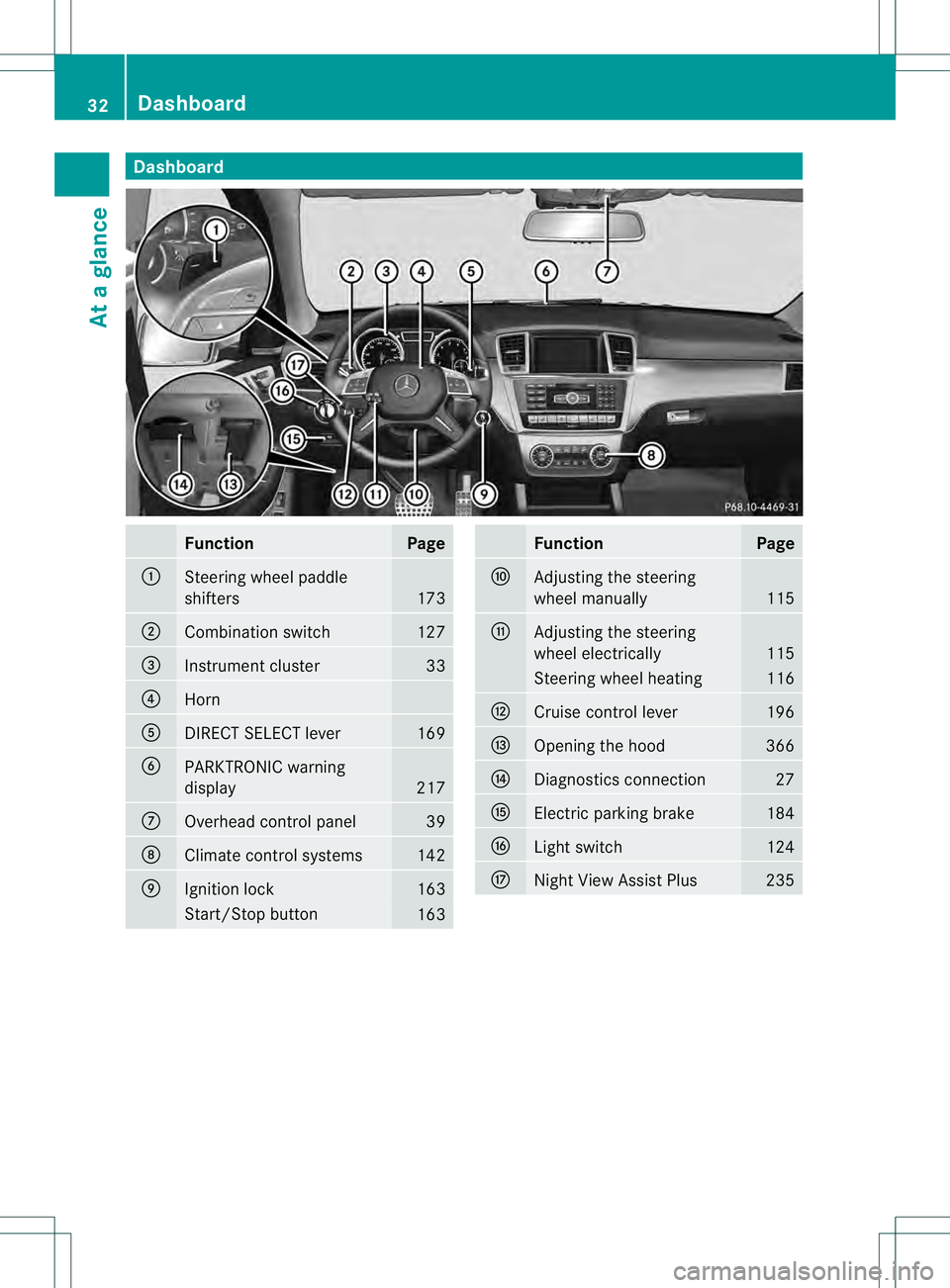
Dashboard
Function Page
0002
Steering wheel paddle
shifters
173
0003
Combination switch 127
0021
Instrument cluster 33
0020
Horn
001E
DIRECT SELECT lever 169
001F
PARKTRONIC warning
display
217
0013
Overhead control panel 39
0014
Climate control systems 142
0015
Ignition lock 163
Start/Stop button
163 Function Page
0016
Adjusting the steering
wheel manually 115
0017
Adjusting the steering
wheel electrically 115
Steering wheel heating 116
0018
Cruise control lever 196
0019
Opening the hood 366
001A
Diagnostics connection 27
001B
Electric parking brake 184
001C
Light switch 124
001D
Night View Assis
tPlus 23532
DashboardAt a glance
Page 42 of 454
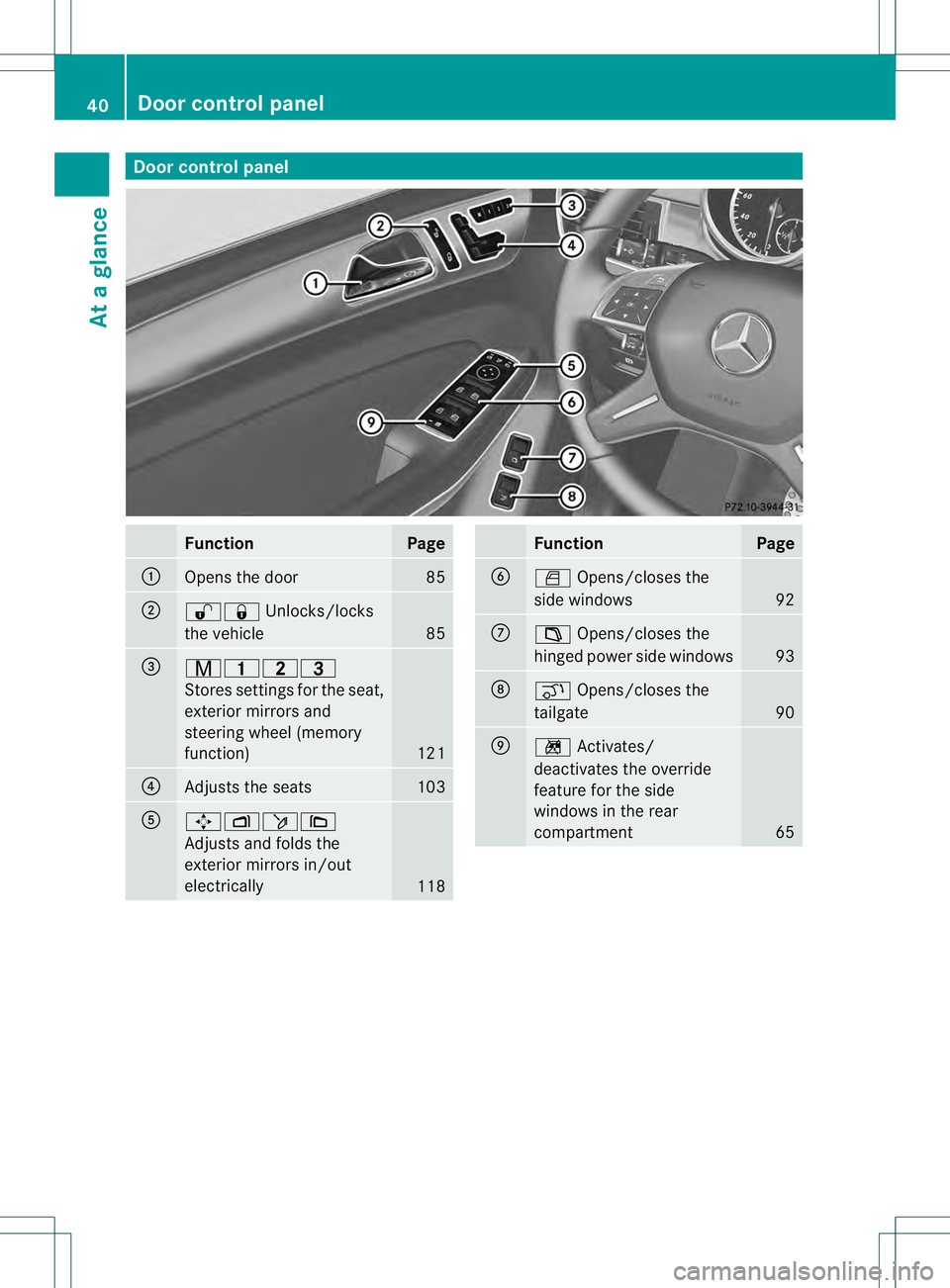
Door control panel
Function Page
0002
Opens the door 85
0003
000D000C
Unlocks/locks
the vehicle 85
0021
00110014000E
Stores settings fo
rthe seat,
exterior mirrors and
steering wheel (memory
function) 121
0020
Adjusts the seats 103
001E
000500090011000A
Adjusts and folds the
exterior mirrors in/out
electrically
118 Function Page
001F
0005
Opens/closes the
side windows 92
0013
0014
Opens/closes the
hinged power side windows 93
0014
0010
Opens/closes the
tailgate 90
0015
000F
Activates/
deactivates the override
feature for the side
windows in the rear
compartment 6540
Doorc
ontrol panelAt a glance
Page 43 of 454
Useful information
..............................42
Panic alarm .......................................... 42
Occupant safety .................................. 42
Children in the vehicle ........................60
Driving safet ysystems ....................... 66
Theft deterrent locking system .........75 41Safety
Page 44 of 454
Useful information
i This Operator's Manual describes all
models and all standard and optional
equipment of your vehicle available at the
time of publication of the Operator's
Manual. Country-specific differences are
possible. Please note that your vehicle may
not be equipped with all features
described. This also applies to safety-
related systems and functions.
i Read the information on qualified
specialist workshops: (Y page 28).Panic alarm
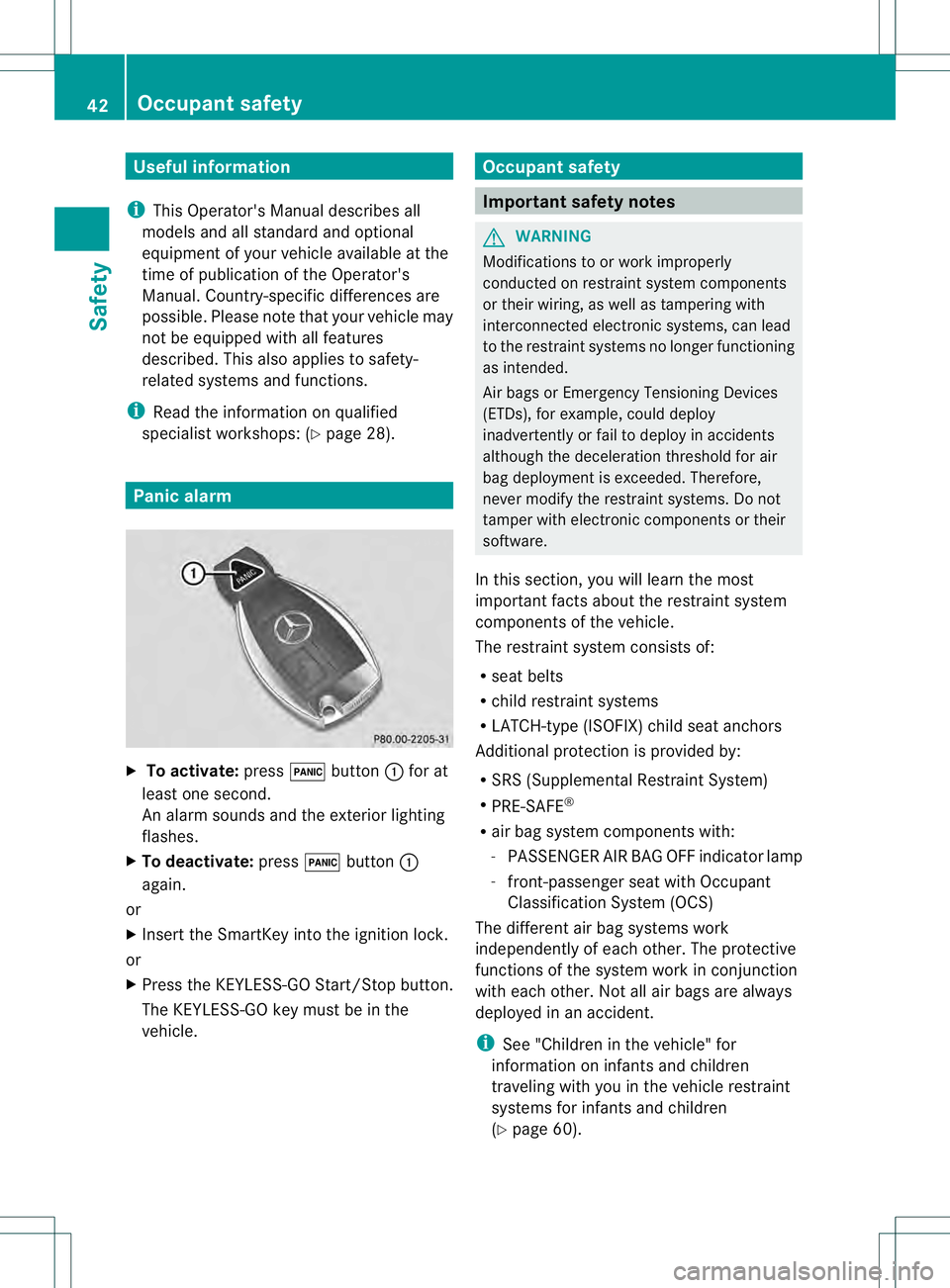
X
To activate: press000Ebutton 0002for at
least one second.
An alarm sounds and the exterior lighting
flashes.
X To deactivate: press000Ebutton 0002
again.
or
X Insert the SmartKey into the ignition lock.
or
X Press the KEYLESS-GO Start/Stop button.
The KEYLESS-GO key must be in the
vehicle. Occupant safety
Important safety notes
G
WARNING
Modifications to or work improperly
conducted on restraint system components
or their wiring, as well as tampering with
interconnected electronic systems, can lead
to the restraint system sno longer functioning
as intended.
Air bags or Emergency Tensioning Devices
(ETDs), for example, could deploy
inadvertently or fail to deploy in accidents
although the deceleration threshold for air
bag deployment is exceeded. Therefore,
never modify the restraint systems. Do not
tamper with electronic components or their
software.
In this section, you will learn the most
important facts about the restraint system
components of the vehicle.
The restraint system consists of:
R seat belts
R child restraint systems
R LATCH-type (ISOFIX) child seat anchors
Additional protection is provided by:
R SRS (Supplemental Restraint System)
R PRE-SAFE ®
R air bag system components with:
-PASSENGER AIR BAG OFF indicator lamp
- front-passenger seat with Occupant
Classification System (OCS)
The different air bag systems work
independently of each other. The protective
functions of the system work in conjunction
with each other. Not all air bags are always
deployed in an accident.
i See "Children in the vehicle" for
information on infants and children
traveling with you in the vehicle restraint
systems for infants and children
(Y page 60). 42
Occupant safetySafety
Page 53 of 454
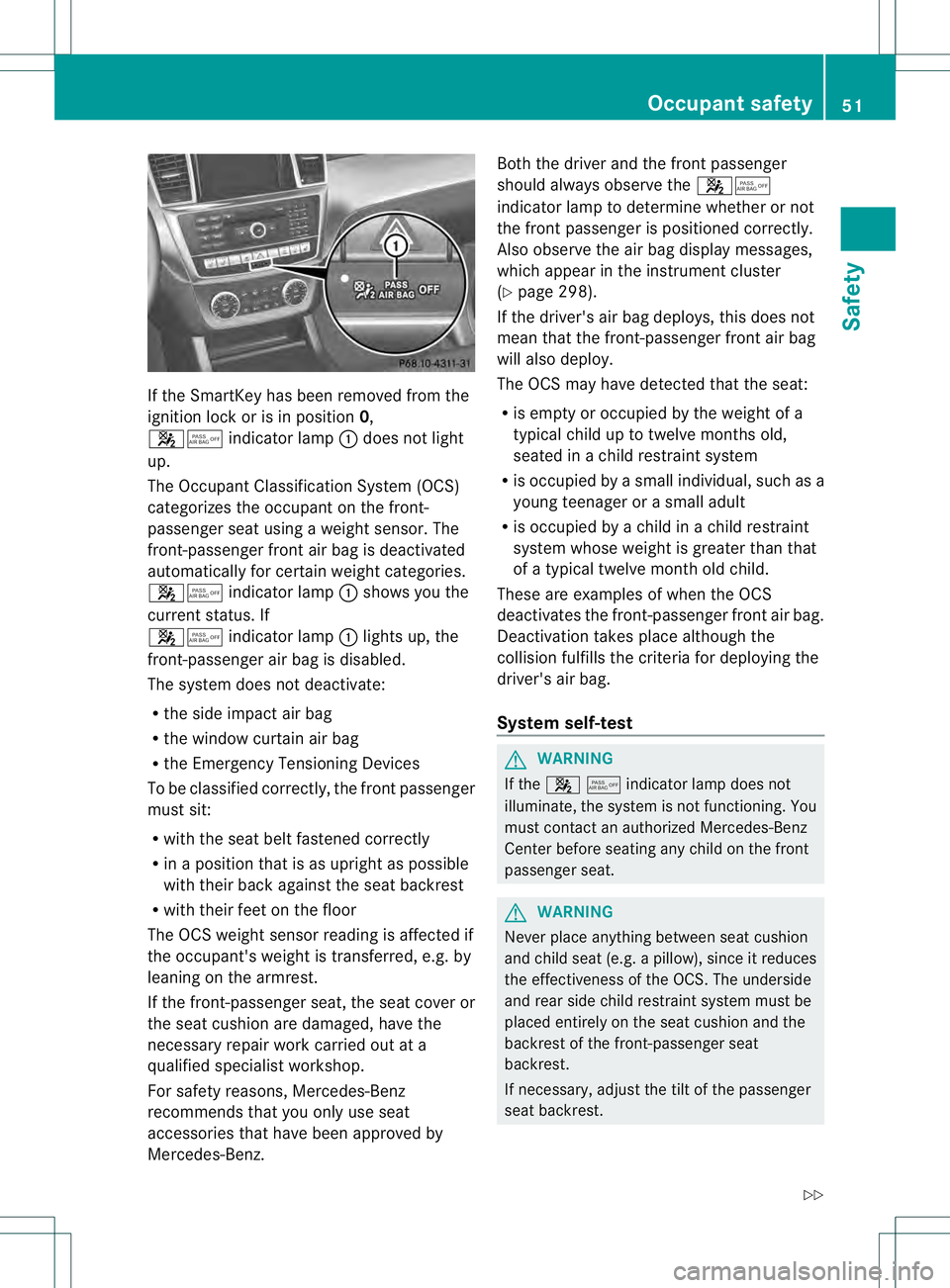
If the SmartKey has been removed from the
ignition lock or is in position 0,
001A001C indicator lamp 0002does not light
up.
The Occupant Classification System (OCS)
categorizes the occupant on the front-
passenger seat using a weight sensor. The
front-passenger front air bag is deactivated
automatically for certain weight categories.
001A001C indicator lamp 0002shows you the
current status. If
001A001C indicator lamp 0002lights up, the
front-passenger air bag is disabled.
The system does not deactivate:
R the side impact air bag
R the window curtain air bag
R the Emergency Tensioning Devices
To be classified correctly, the front passenger
must sit:
R with the seat belt fastened correctly
R in a positio nthat is as upright as possible
with their back against the seat backrest
R with their feet on the floor
The OCS weight sensor reading is affected if
the occupant's weight is transferred, e.g. by
leaning on the armrest.
If the front-passenger seat, the seat cover or
the seat cushion are damaged, have the
necessary repair work carried out at a
qualified specialist workshop.
For safety reasons, Mercedes-Benz
recommends that you only use seat
accessories that have been approved by
Mercedes-Benz. Both the driver and the front passenger
should always observe the
001A001C
indicator lamp to determine whether or not
the front passenger is positioned correctly.
Also observe the air bag display messages,
which appearint he instrumentcluster
(Y page 298).
If the driver's air bag deploys, this does not
mean that the front-passenger front air bag
will also deploy.
The OCS may have detected that the seat:
R is empty or occupied by the weight of a
typical child up to twelve months old,
seated in a child restraint system
R is occupied by a small individual, such as a
young teenager or a small adult
R is occupied by a child in a child restraint
system whose weight is greater than that
of a typical twelve month old child.
These are examples of when the OCS
deactivates the front-passenger front air bag.
Deactivation takes place although the
collision fulfills the criteria for deploying the
driver's air bag.
System self-test G
WARNING
If the 001A001Cindicator lamp does not
illuminate, the system is not functioning. You
must contact an authorized Mercedes-Benz
Center before seating any child on the front
passenger seat. G
WARNING
Never place anything betwee nseat cushion
and child seat (e.g. a pillow), since it reduces
the effectiveness of the OCS. The underside
and rear side child restraint system must be
placed entirely on the seat cushion and the
backrest of the front-passenger seat
backrest.
If necessary, adjust the tilt of the passenger
seat backrest. Occupant safety
51Safety
Z
Page 54 of 454
An incorrectly mounted child sea
tcould cause
injuries to the child in case of an accident,
instead of increasing protection for the child.
Follow the manufacturer's instructions for
installation of child restraint systems.
The 001A001C indicator lamp lights up:
R if you turn the SmartKey in the ignition lock
to position 1or 2
R if you press the KEYLESS-GO Start/Stop
button once or twice on vehicles with
KEYLESS-GO
R if an adult is seated properly on the front-
passenger seat and the OCS classifies the
occupant as an adult
The 001A001C indicator lamp goes out
after approximately six seconds.
If the seat is not occupied and the OCS
detects that the front-passenger seat is
empty, the 001A001Cindicator lamp will
continue to light up. The 001A001C
indicator lamp will not go out.
For more information about the OCS, see
"Problems with the Occupant Classification
System" (Y page 53). 52
Occupant safetySafety
Page 56 of 454
PRE-SAFE
®
(anticipatory occupant
protection system) G
WARNING
The PRE-SAFE ®
system reduces the impact of
an accident on vehicle occupants, as long as
their seat belts have been fastened correctly.
Although your vehicle is equipped with a PRE-
SAFE ®
system, the possibility of injury in the
event of an accident cannot be ruled out. You
should therefore always drive carefully and
adapt your driving style to the prevailing road,
weather and traffic conditions. G
WARNING
Make sure that nobody can become trapped
as you adjust the seat.
! Make sure that there are no objects in the
footwell or behind the seats when resetting
the seats. There is a risk that the seats
and/or the objects could be damaged.
PRE-SAFE ®
takes preemptive measures to
protect occupants in certain hazardous
situations.
PRE-SAFE ®
intervenes:
R if BAS intervenes, e.g. in emergency
braking situations
R if BAS PLUS intervenes powerfully — on
vehicles with DISTRONIC PLUS
R if, on vehicles with DISTRONIC PLUS, the
radar sensor system detectsani mminent
dange rofcollision in certain situations
R in critical driving situations, e.g. when
physical limits are exceeded and the
vehicle understeers or oversteers severely
PRE-SAFE ®
takes the following measures
depending on the hazardous situation
detected:
R the front seat belts are pre-tensioned.
R vehicles with the memory function: the
front-passenger seat is adjusted if it is in an
unfavorable position. R
vehicles with a multicontour seat: the air
pressure in the side bolsters of the seat
backrest is increased.
R if the vehicle skids, the sliding sunroof/
panorama roof with power tilt/sliding
panel and the side windows are closed so
that only a small gap remains.
If the hazardous situation passes without
resulting in an accident, PRE-SAFE ®
slackens
the belt pretensioning. In vehicles with
multicontour seats, the air pressure in the
side bolsters is reduced again. All settings
made by PRE-SAFE ®
can then be reversed.
If the seat belts are not released:
X Move the backrest or seat back slightly, but
only when the vehicle is stationary.
The belt pretensioning is reduced and the
locking mechanism is released.
More information about seat belt adjustment,
a convenience function integrated into PRE-
SAFE ®
, can be found in the "Seat belt
adjustment" section (Y page 57). Seat belts
Important safety notes G
WARNING
Always fasten your seat belt before driving off.
Always make sure all of your passengers are
properly restrained. You and your passengers
should always wear seat belts.
Failure to wear and properly fasten and
position your seat belt greatly increases your
risk of injuries and their likely severity in an
accident.
If you are ever in an accident, your injuries can
be considerably more severe without your
seat belt properly buckled. Without your seat
belt buckled, you are much more likely to hit
the interior of the vehicle or be ejected from
it. You can be seriously injured or killed.
In the same crash, the possibility of injury or
death is lessened if you are properly wearing
your seat belt. The air bags can only protect 54
Occupant safetySafety
Page 59 of 454
X
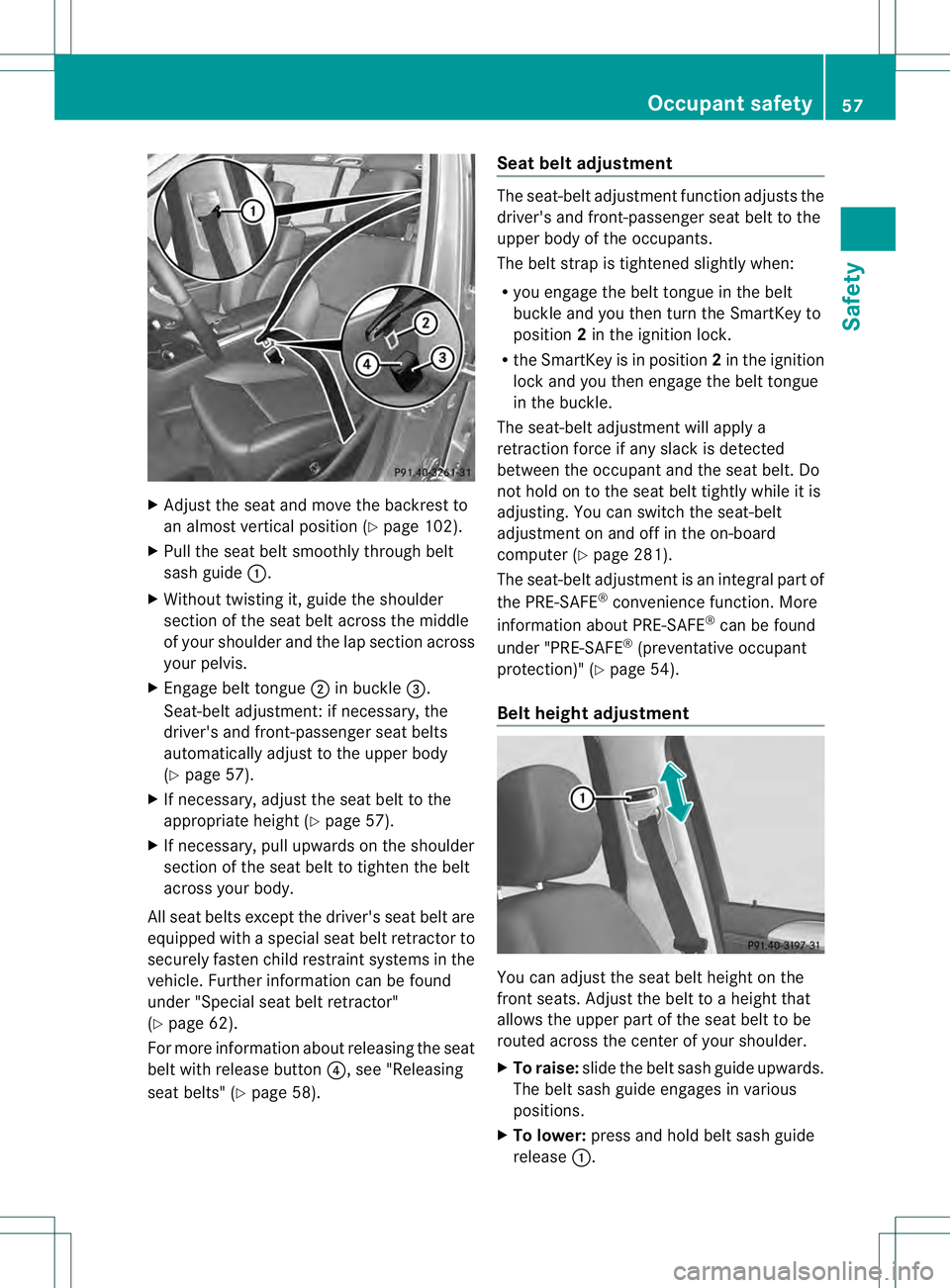
Adjust the seat and move the backrest to
an almos tvertical position (Y page 102).
X Pull the seat belt smoothly through belt
sash guide 0002.
X Without twisting it, guide the shoulder
section of the seat belt across the middle
of your shoulder and the lap section across
your pelvis.
X Engage belt tongue 0003in buckle 0021.
Seat-belt adjustment:ifn ecessary, the
driver's and front-passenger seat belts
automatically adjust to the upper body
(Y page 57).
X If necessary, adjust the seat belt to the
appropriate height (Y page 57).
X If necessary, pull upwards on the shoulder
section of the seat belt to tighten the belt
across your body.
All seat belts except the driver's seat belt are
equipped with a special seat belt retractor to
securely fasten child restraint systems in the
vehicle. Further information can be found
under "Special seat belt retractor"
(Y page 62).
For more information about releasing the seat
belt with release button 0020, see "Releasing
seat belts" (Y page 58). Seat belt adjustment The seat-belt adjustment function adjusts the
driver's and front-passenger seat belt to the
upper body of the occupants.
The belt strap is tightened slightly when:
R
you engage the belt tongue in the belt
buckle and you then turn the SmartKey to
position 2in the ignition lock.
R the SmartKey is in position 2in the ignition
lock and you then engage the belt tongue
in the buckle.
The seat-belt adjustment will apply a
retraction force if any slack is detected
between the occupant and the seat belt. Do
not hold on to the seat belt tightly while it is
adjusting. You can switch the seat-belt
adjustment on and off in the on-board
computer (Y page 281).
The seat-belt adjustment is an integral part of
the PRE-SAFE ®
convenience function. More
information about PRE-SAFE ®
can be found
under "PRE-SAFE ®
(preventative occupant
protection)" (Y page 54).
Belt height adjustment You can adjust the seat belt height on the
fron
tseats. Adjust the belt to a height that
allows the upper part of the seat belt to be
routed across the center of your shoulder.
X To raise: slide the belt sash guide upwards.
The belt sash guide engages in various
positions.
X To lower: press and hold belt sash guide
release 0002. Occupant safety
57Safety Z