display MERCEDES-BENZ GL 2013 Owner's Manual
[x] Cancel search | Manufacturer: MERCEDES-BENZ, Model Year: 2013, Model line: GL, Model: MERCEDES-BENZ GL 2013Pages: 454, PDF Size: 6.31 MB
Page 34 of 454
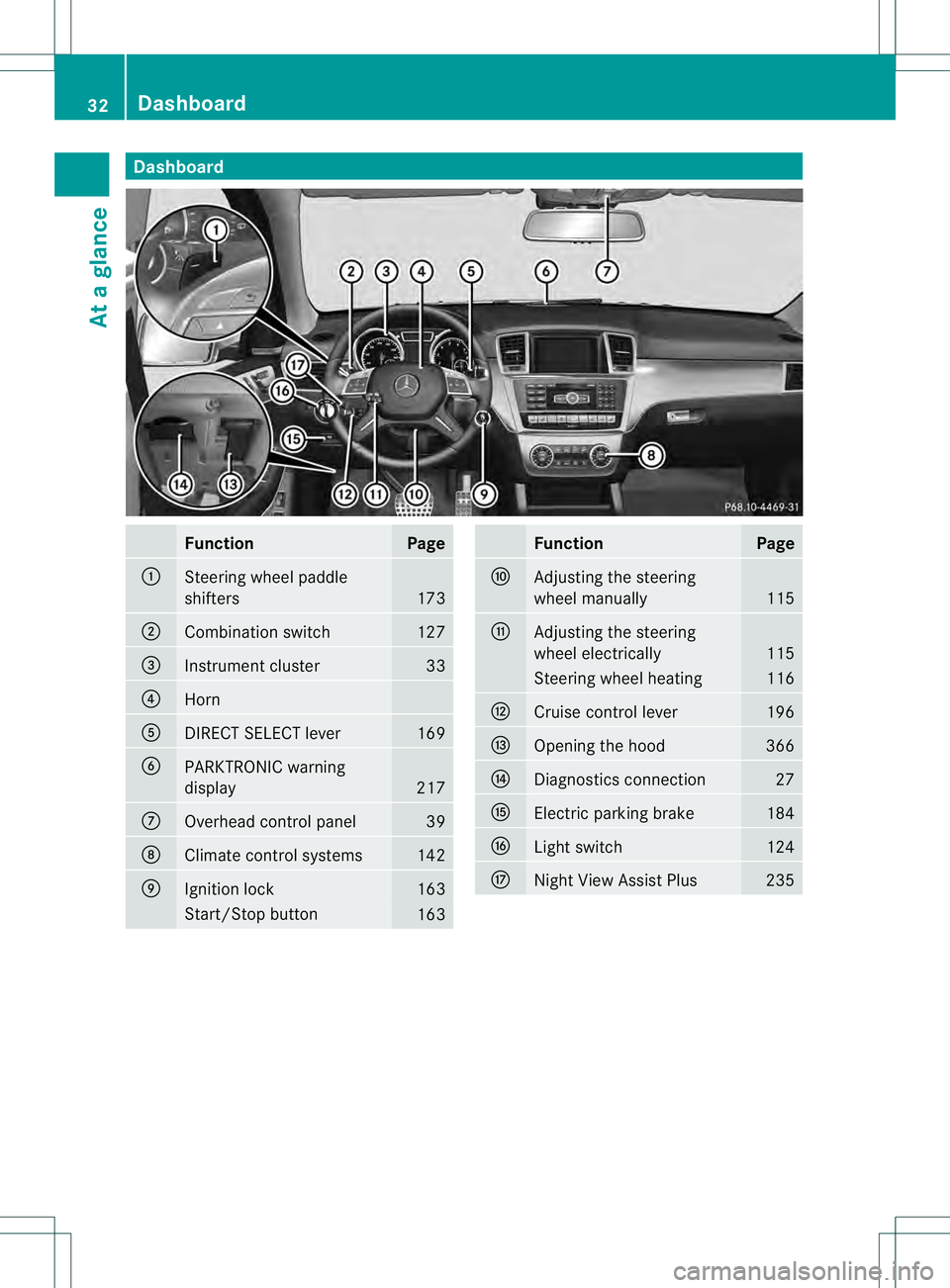
Dashboard
Function Page
0002
Steering wheel paddle
shifters
173
0003
Combination switch 127
0021
Instrument cluster 33
0020
Horn
001E
DIRECT SELECT lever 169
001F
PARKTRONIC warning
display
217
0013
Overhead control panel 39
0014
Climate control systems 142
0015
Ignition lock 163
Start/Stop button
163 Function Page
0016
Adjusting the steering
wheel manually 115
0017
Adjusting the steering
wheel electrically 115
Steering wheel heating 116
0018
Cruise control lever 196
0019
Opening the hood 366
001A
Diagnostics connection 27
001B
Electric parking brake 184
001C
Light switch 124
001D
Night View Assis
tPlus 23532
DashboardAt a glance
Page 35 of 454
Instrumen
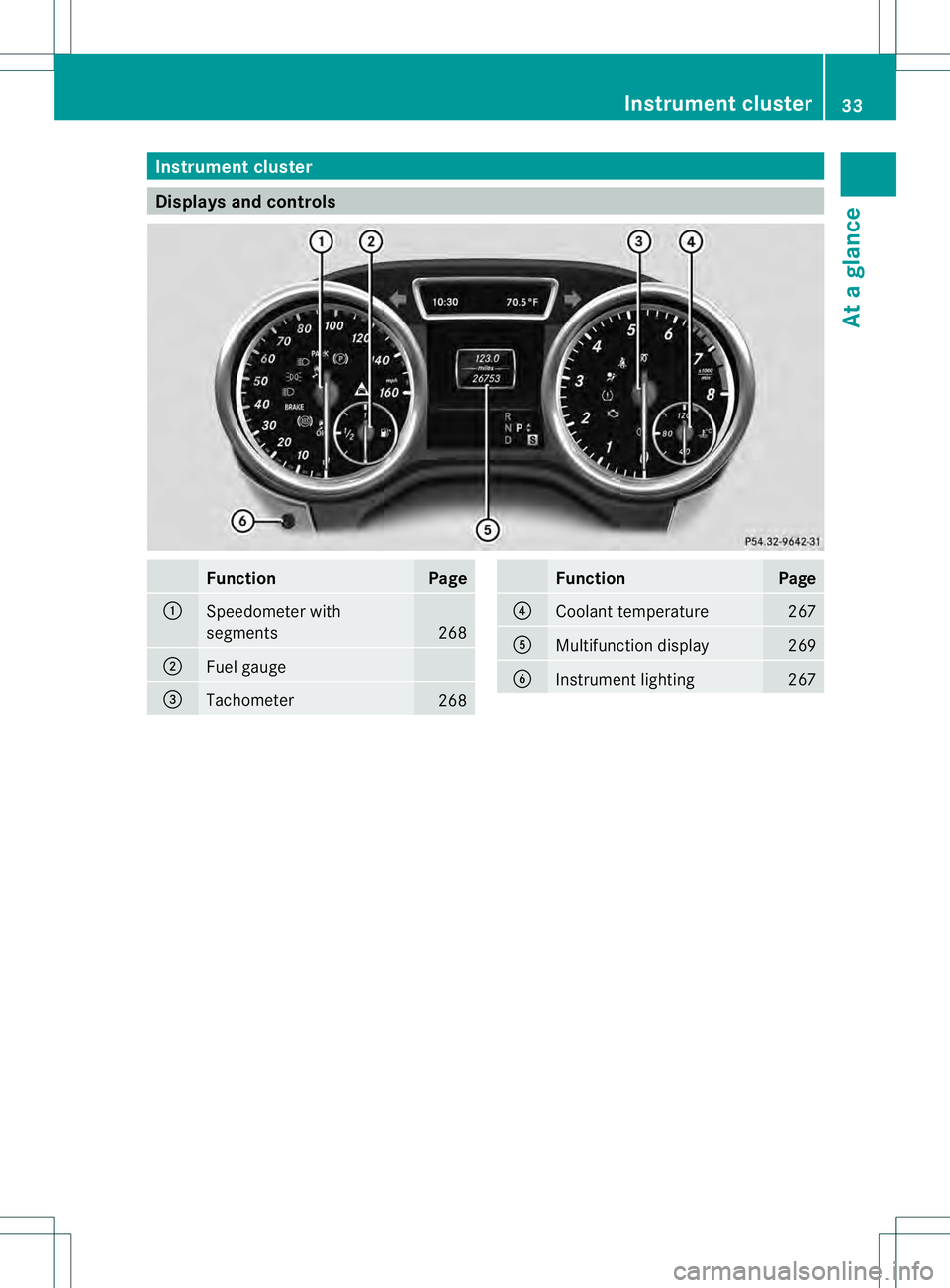
tcluster Displays and controls
Function Page
0002
Speedometer with
segments
268
0003
Fuel gauge
0021
Tachometer
268 Function Page
0020
Coolant temperature 267
001E
Multifunction display 269
001F
Instrument lighting 267Instrument cluster
33At a glance
Page 37 of 454
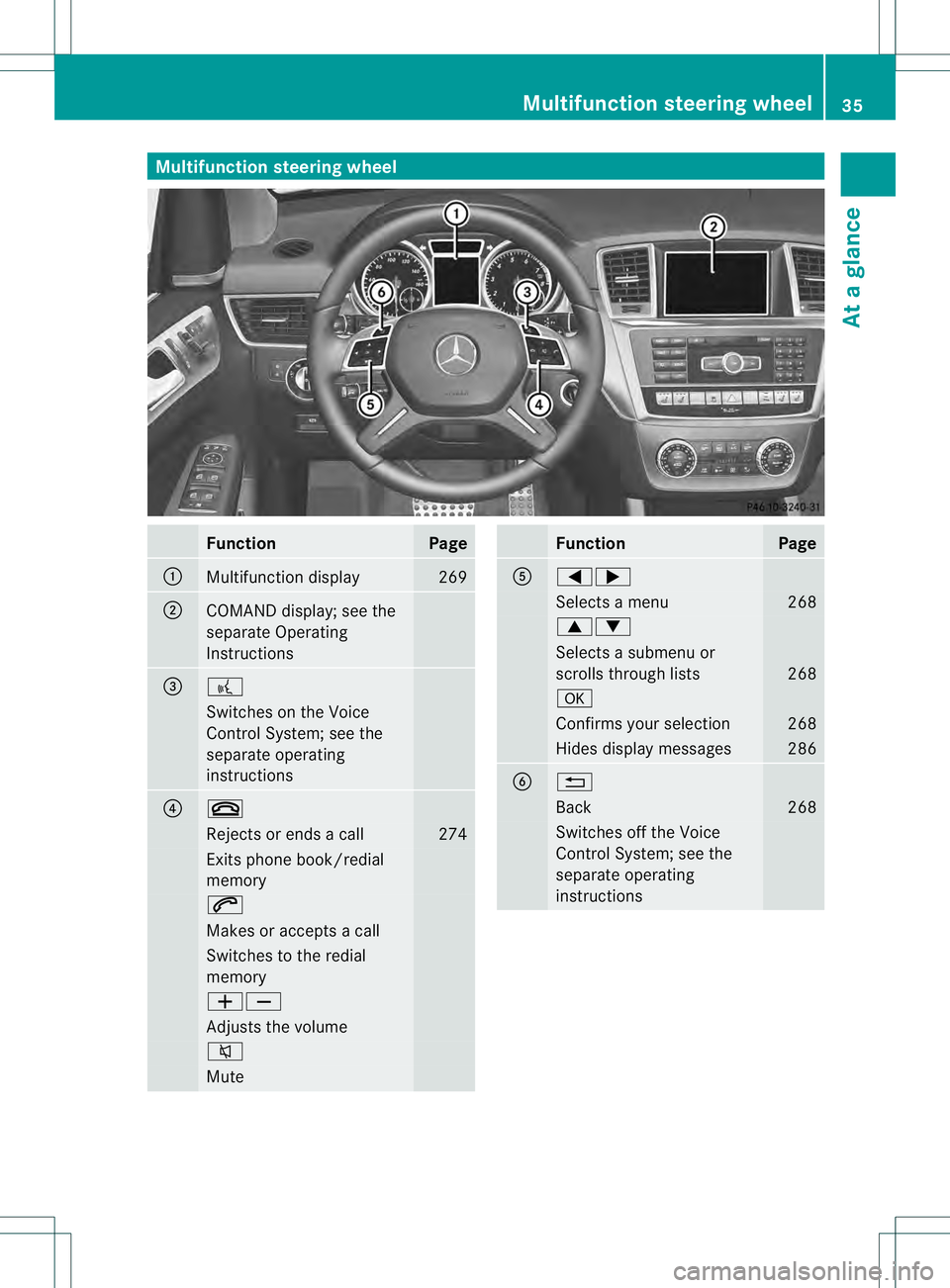
Multifunction steering wheel
Function Page
0002
Multifunction display 269
0003
COMAND display; see the
separate Operating
Instructions
0021
0003
Switches on the Voice
Control System; see the
separate operating
instructions
0020
000D
Rejects or ends a call 274
Exits phone book/redial
memory
0004
Makes or accepts a call
Switches to the redial
memory
0009000A
Adjusts the volume
0006
Mute Function Page
001E
00020005
Selects a menu 268
00030004
Selects a submenu or
scrolls through lists
268
000B
Confirms yours
election 268
Hides display messages 286
001F
0007
Back 268
Switches off the Voice
Control System; see the
separate operating
instructionsMultifunction steering wheel
35At a glance
Page 53 of 454
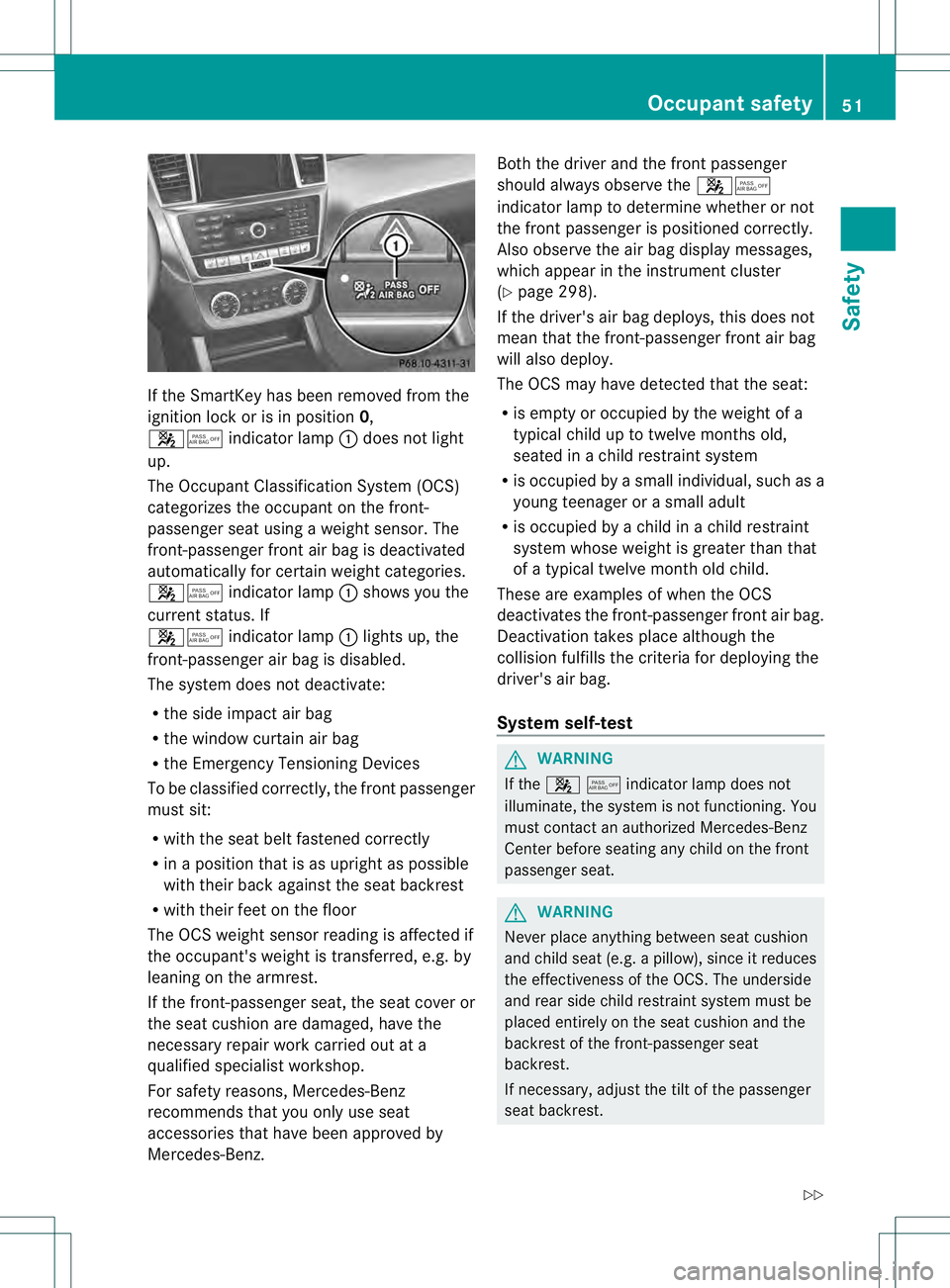
If the SmartKey has been removed from the
ignition lock or is in position 0,
001A001C indicator lamp 0002does not light
up.
The Occupant Classification System (OCS)
categorizes the occupant on the front-
passenger seat using a weight sensor. The
front-passenger front air bag is deactivated
automatically for certain weight categories.
001A001C indicator lamp 0002shows you the
current status. If
001A001C indicator lamp 0002lights up, the
front-passenger air bag is disabled.
The system does not deactivate:
R the side impact air bag
R the window curtain air bag
R the Emergency Tensioning Devices
To be classified correctly, the front passenger
must sit:
R with the seat belt fastened correctly
R in a positio nthat is as upright as possible
with their back against the seat backrest
R with their feet on the floor
The OCS weight sensor reading is affected if
the occupant's weight is transferred, e.g. by
leaning on the armrest.
If the front-passenger seat, the seat cover or
the seat cushion are damaged, have the
necessary repair work carried out at a
qualified specialist workshop.
For safety reasons, Mercedes-Benz
recommends that you only use seat
accessories that have been approved by
Mercedes-Benz. Both the driver and the front passenger
should always observe the
001A001C
indicator lamp to determine whether or not
the front passenger is positioned correctly.
Also observe the air bag display messages,
which appearint he instrumentcluster
(Y page 298).
If the driver's air bag deploys, this does not
mean that the front-passenger front air bag
will also deploy.
The OCS may have detected that the seat:
R is empty or occupied by the weight of a
typical child up to twelve months old,
seated in a child restraint system
R is occupied by a small individual, such as a
young teenager or a small adult
R is occupied by a child in a child restraint
system whose weight is greater than that
of a typical twelve month old child.
These are examples of when the OCS
deactivates the front-passenger front air bag.
Deactivation takes place although the
collision fulfills the criteria for deploying the
driver's air bag.
System self-test G
WARNING
If the 001A001Cindicator lamp does not
illuminate, the system is not functioning. You
must contact an authorized Mercedes-Benz
Center before seating any child on the front
passenger seat. G
WARNING
Never place anything betwee nseat cushion
and child seat (e.g. a pillow), since it reduces
the effectiveness of the OCS. The underside
and rear side child restraint system must be
placed entirely on the seat cushion and the
backrest of the front-passenger seat
backrest.
If necessary, adjust the tilt of the passenger
seat backrest. Occupant safety
51Safety
Z
Page 55 of 454
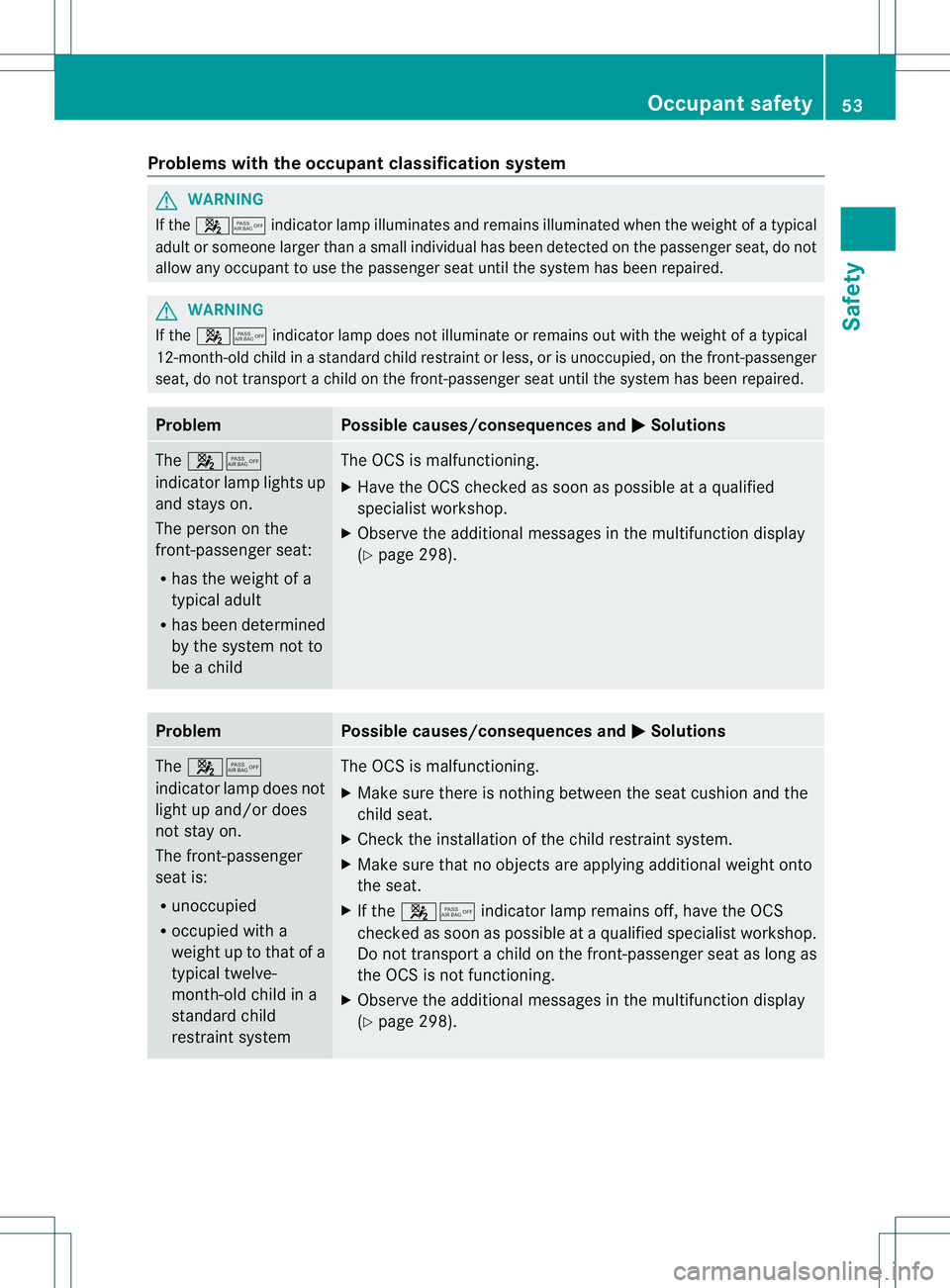
Problems with the occupant classification system
G
WARNING
If the 001A001C indicator lamp illuminates and remains illuminated when the weight of a typical
adult or someone larger than a small individual has been detected on the passenger seat, do not
allow any occupant to use the passenger seat until the system has been repaired. G
WARNING
If the 001A001C indicator lamp does not illuminate or remains out with the weight of a typical
12-month-old child in a standard child restraint or less, or is unoccupied, on the front-passenger
seat, do not transport achild on the front-passenger seat until the system has been repaired. Problem Possible causes/consequences and
0001 Solutions
The
001A001C
indicator lamp lights up
and stays on.
The person on the
front-passenger seat:
R has the weight of a
typical adult
R has been determined
by the system not to
be a child The OCS is malfunctioning.
X
Have the OCS checked as soon as possible at a qualified
specialist workshop.
X Observe the additional messages in the multifunction display
(Y page 298). Problem Possible causes/consequences and
0001 Solutions
The
001A001C
indicator lamp does not
light up and/or does
not stay on.
The front-passenger
seat is:
R unoccupied
R occupied with a
weight up to that of a
typical twelve-
month-old child in a
standard child
restraint system The OCS is malfunctioning.
X
Make sure there is nothing between the seat cushion and the
child seat.
X Check the installation of the child restraint system.
X Make sure that no objectsa re applying additional weight onto
the seat.
X If the 001A001C indicator lamp remains off, have the OCS
checked as soon as possible at a qualified specialist workshop.
Do not transport a child on the front-passenge rseat as long as
the OCS is not functioning.
X Observe the additional messages in the multifunction display
(Y page 298). Occupant safety
53Safety Z
Page 68 of 454
only possible using the switches in the
driver's door. If indicator lamp
0003is off,
operation is possible using the switches in
the rear compartment. Driving safety systems
Overview of driving safety systems
In this section, you will find information about
the following driving safety systems:
R ABS (Anti-lock BrakingSystem)
(Y page 66)
R BAS (Brake AssistSystem) (Y page 67)
R BAS PLUS ( BrakeAssist System Plus)
(Y page 67)
R COLLISION PREVENTION ASSIST
(Y page 68)
R ESP ®
(Electronic StabilityProgram)
(Y page 71)
R EBD ( Electronic Brake force Distribution)
(Y page 73)
R ADAPTIVE BRAKE (Y page 73)
R PRE-SAFE ®
Brake (Y page 73)
R STEER CONTROL (Y page 75)Important safety notes
If you fail to adapt your driving style or
become distracted, the driving safety
systems can neither reduce the risk of
accident nor override the laws of physics.
Driving safety systems are merely aids
designed to assist driving. You are
responsible for the distance to the vehicle in
front, for vehicle speed and for braking in
good time. Always adapt your driving style to
suit the prevailing road and weather
conditions and maintain asafe distance from
the vehicle in front. Drive carefully.
i The driving safety systems described only
work as effectively as possible when there
is adequate contact between the tires and
the road surface. Please pay special attention to the note
son tires,
recommended minimu mtire tread depths,
etc. (Y page 400).
In wintry driving conditions, always use
winter tires (M+S tires) and if necessary,
snow chains. Only in this way will the
driving safety systems described in this
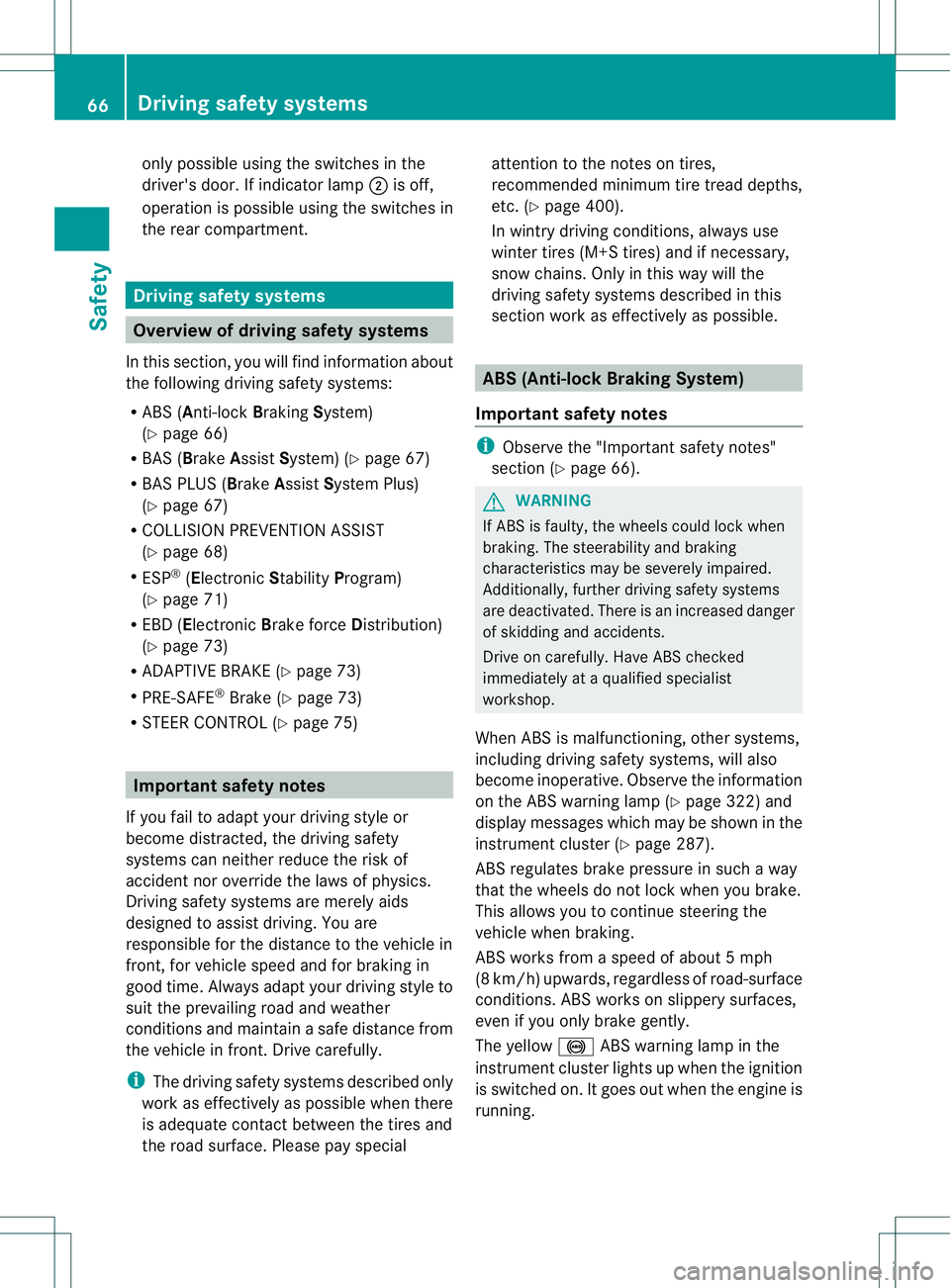
section work as effectively as possible. ABS (Anti-lock Braking System)
Important safety notes i
Observe the "Importan tsafety notes"
sectio n(Ypage 66). G
WARNING
If ABSi s faulty, the wheels could lock when
braking. The steerability and braking
characteristics may be severely impaired.
Additionally, further driving safety systems
are deactivated. There is an increased danger
of skidding and accidents.
Drive on carefully. Have ABS checked
immediately at a qualified specialist
workshop.
When ABS is malfunctioning, other systems,
including driving safety systems, will also
become inoperative. Observe the information
on the ABS warning lamp (Y page 322) and
display messages which may be shown in the
instrument cluster (Y page 287).
ABS regulates brake pressure in such a way
that the wheels do not lock when you brake.
This allows you to continue steering the
vehicle when braking.
ABS works from a speed of about 5 mph
(8 km/h) upwards, regardless of road-surface
conditions. ABS works on slippery surfaces,
even if you only brake gently.
The yellow 0019ABS warning lamp in the
instrument cluster lights up when the ignition
is switched on. It goes out when the engine is
running. 66
Driving safety systemsSafety
Page 71 of 454
In such cases, the distance warning function
may:
R give an unnecessary warning
R not give a warning
Always pay careful attention to the traffic
situation and do not rely solely on the
distance warning function.
Function
X To activate/deactivate: activate or
deactivate the distance warning function in
the on-board computer (Y page 276).
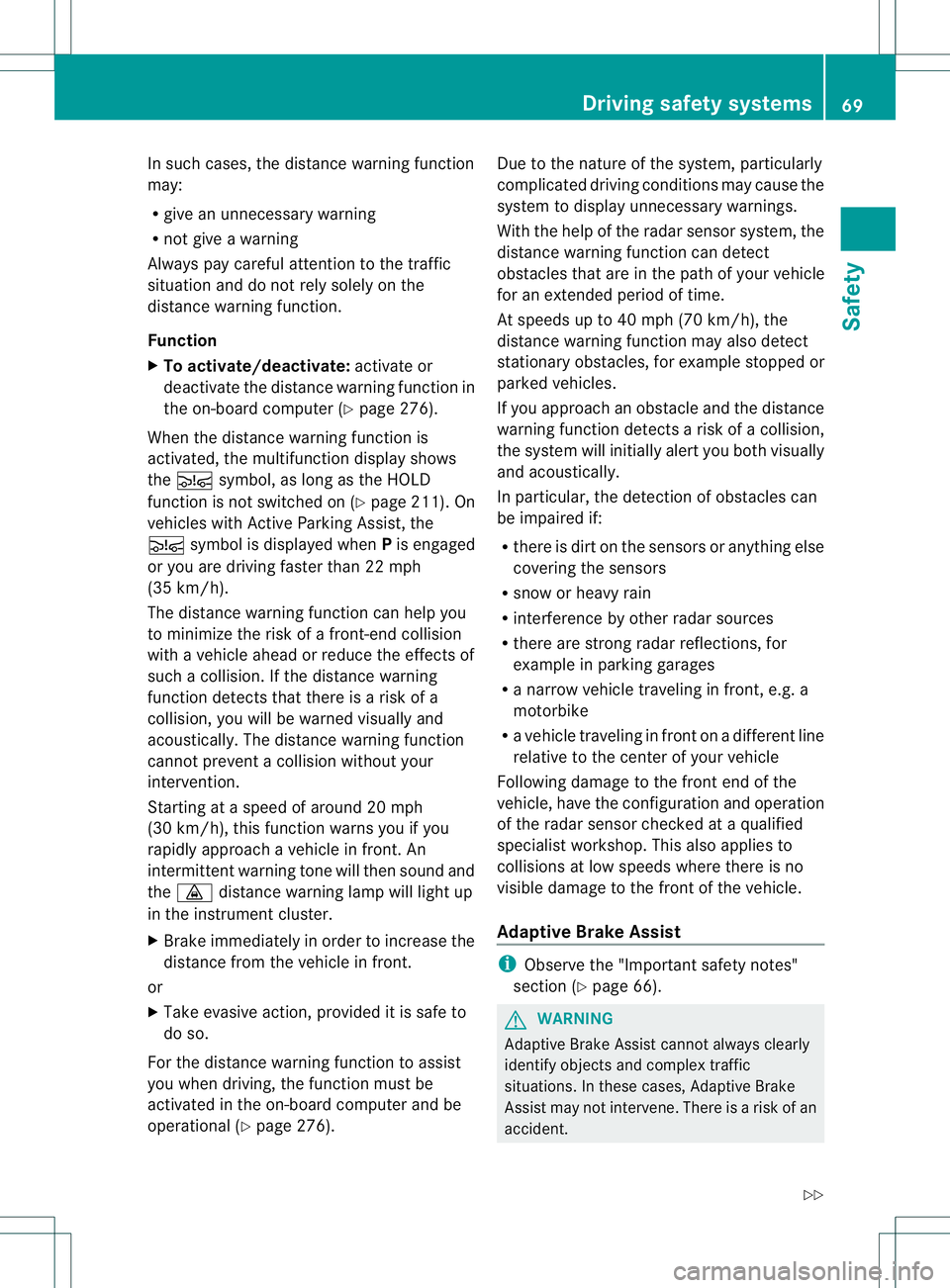
When the distance warning function is
activated, the multifunction display shows
the 0003 symbol, as long as the HOLD
function is not switched on (Y page 211). On
vehicles with Active Parking Assist, the
0003 symbol is displayed when Pis engaged
or you are driving faster than 22 mph
(35 km/h).
The distance warning function can help you
to minimize the risk of a front-end collision
with a vehicle ahead or reduce the effects of
such a collision. If the distance warning
function detects that there is a risk of a
collision, you will be warned visually and
acoustically. The distance warning function
cannot prevent a collision withou tyour
intervention.
Starting at a speed of around 20 mph
(30 km/h), this function warns you if you
rapidly approach a vehicle in front.An
intermitten twarning tone will then sound and
the 000F distance warning lamp will light up
in the instrument cluster.
X Brake immediately in order to increase the
distance from the vehicle in front.
or
X Take evasive action, provide ditis safe to
do so.
For the distance warning function to assist
you when driving, the function must be
activated in the on-board computer and be
operational (Y page 276). Due to the nature of the system, particularly
complicated driving conditions may cause the
system to display unnecessary warnings.
With the help of the radar sensor system, the
distance warning function can detect
obstacles that are in the path of your vehicle
for an extended period of time.
At speeds up to 40 mph (70 km/h), the
distance warning function may also detect
stationary obstacles, for example stopped or
parked vehicles.
If you approach an obstacle and the distance
warning function detects a risk of a collision,
the system will initially alert you both visually
and acoustically.
In particular, the detection of obstacles can
be impaired if:
R there is dirt on the sensors or anything else
covering the sensors
R snow or heavy rain
R interference by other radar sources
R there are strong radar reflections, for
example in parking garages
R a narrow vehicle traveling in front, e.g. a
motorbike
R a vehicle traveling in front on a different line
relative to the center of your vehicle
Following damage to the front end of the
vehicle, have the configuration and operation
of the radar sensor checked at a qualified
specialist workshop. This also applies to
collisions at low speeds where there is no
visible damage to the front of the vehicle.
Adaptive Brake Assist i
Observe the "Important safety notes"
section (Y page 66). G
WARNING
Adaptive Brake Assist cannot always clearly
identify objects and complex traffic
situations. In these cases, Adaptive Brake
Assist may not intervene. There is a risk of an
accident. Driving safety systems
69Safety
Z
Page 73 of 454
or more wheels are braked to stabilize the
vehicle. The engine output is also modified to
keep the vehicle on the desired course within
physical limits. ESP ®
assists the driver when
pulling away on wet or slippery roads. ESP ®
can also stabilize the vehicle during braking.
4ETS (Electronic Traction System) 4ETS traction control is part of ESP
®
.
Traction control brakes the drive wheels
individually if they spin. This enables you to
pull away and accelerate on slippery surfaces,
for example if the road surface is slippery on
one side. In addition, more drive torque is
transferred to the wheel or wheels with
traction.
Traction control remains active, even if you
deactivate ESP ®
.
In appropriate driving situations, activate the
off-road program:
X Vehicles without the ON&OFFROAD
package (Y page 252)
X Vehicles with the ON&OFFROAD package
(Y page 252)
Off-road 4ETS (Electronic Traction
System) A4
ETS syste mspecifically suited to off-road
terrain is activated automatically once the off-
road program is activated on:
R Vehicles without the ON&OFFROAD
package (Y page 252)
R Vehicles with the ON&OFFROA Dpackage
(Y page 252)
Important safety notes G
WARNING
If ESP ®
is malfunctioning, ESP ®
is unable to
stabilize the vehicle .Additionally, further
driving safety systems are deactivated. This
increases the risk of skidding and an accident.
Drive on carefully. Have ESP ®
checked at a
qualified specialist workshop. !
Only operate the vehicle for a maximum
of ten seconds on a brake test
dynamometer. Switch off the ignition.
Application of the brakes by ESP ®
may
otherwise destroy the brake system.
! A function or performance test should
only be carried out on atwo-axle
dynamometer. Before you operate the
vehicle on such a dynamometer, please
consult a qualified workshop .You could
otherwise damage the drive train or the
brake system.
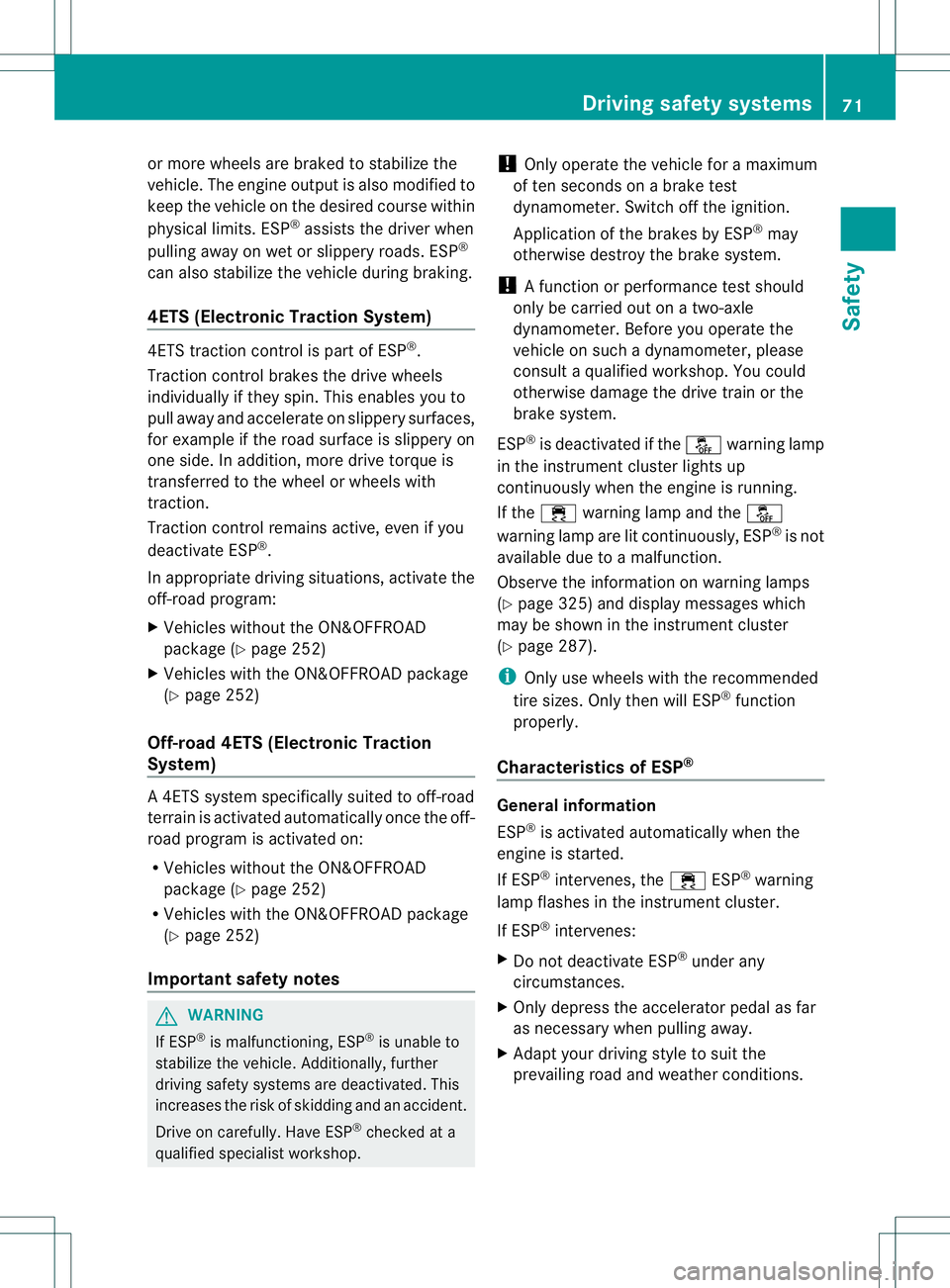
ESP ®
is deactivated if the 0017warning lamp
in the instrument cluster lights up
continuously when the engine is running.
If the 000F warning lamp and the 0017
warning lamp are lit continuously, ESP ®
is not
available due to a malfunction.
Observe the information on warning lamps
(Y page 325) and display messages which
may be shown in the instrument cluster
(Y page 287).
i Only use wheels with the recommended
tire sizes. Only then will ESP ®
function
properly.
Characteristics of ESP ® General information
ESP
®
is activated automatically when the
engine is started.
If ESP ®
intervenes, the 000FESP®
warning
lamp flashes in the instrument cluster.
If ESP ®
intervenes:
X Do not deactivate ESP ®
under any
circumstances.
X Only depress the accelerator pedal as far
as necessary when pulling away.
X Adapt your driving style to suit the
prevailing road and weather conditions. Driving safety systems
71Safety Z
Page 75 of 454
If yourv
ehicle with trailer (vehicle/trailer
combination) begins to lurch, you can only
stabilize the vehicle/trailer combination by
depressing the brake firmly.
In this situation, ESP ®
assists you and can
detec tifthe vehicle/trailer combination
begins to lurch. ESP ®
slows the vehicle down
by braking and limiting the engine output until
the vehicle/trailer combination has
stabilized.
Trailer stabilization is active above speeds of
about 37 mph (60 km/h).
Trailer stabilization does not work if ESP ®
is
deactivated because of a malfunction.
Crosswindd riving assistance Strong crosswinds ca
ncause your vehicle to
deviate from a straigh tcourse. The crosswind
driving assistance function integrated into
ESP ®
significantly reduces these effects.
ESP ®
intervenes automatically according to
the direction and intensity of the crosswinds
affecting your vehicle.
When driving on straight roads or gentle
bends, your vehicle is kept safely on course
by a stabilizing brake intervention.
Crosswind driving assistance is active above
a vehicle speed of 80 km/h.
Crosswind driving assistance does not work
if ESP ®
is deactivated or disabled because of
a malfunction. EBD (electronic brake force
distribution)
i Observe the "Important safety notes"
section (Y page 66). G
WARNING
If EBD has malfunctioned, the rear wheels can
still lock, e.g. under full braking. This
increases the risk of skidding and an accident.
You should therefore adapt your driving style
to the different handling characteristics. Have the brake system checked at a qualified
specialist workshop.
Observe information regarding indicator and
warning lamps (Y page 323) as well as
display messages (Y page 289).
EBD monitors and controls the brake
pressure on the rear wheels to improve
driving stability while braking. ADAPTIVE BRAKE
ADAPTIVE BRAKE enhances braking safety
and offers increased braking comfort. In
addition to the braking function, ADAPTIVE
BRAKE also has the HOLD function
(Y page 211) and hill start assist
(Y page 166). PRE-SAFE
®
Brake
i Observe the "Important safety notes"
section (Y page 66).
PRE-SAFE ®
Brake is only available in vehicles
with DISTRONIC PLUS.
If PRE-SAFE ®
Brake is to aid you, the radar
sensor system must be:
R activated (Y page 281)
R operational
With the help of the radar sensor system,
PRE-SAFE ®
Brake can detect obstacles that
are in front of your vehicle for an extended
period of time.
PRE-SAFE ®
Brake can help you to minimize
the risk of a collision with a vehicle ahead or
reduce the effects of such a collision. If PRE-
SAFE ®
Brake has detected a risk of collision,
you will be warned visually and acoustically
as well as by automatic braking. PRE-SAFE ®
Brake cannot prevent a collision without your
intervention.
Starting at a speed of around
4 mph (7 km/h), this function warns you if
you very quickly approach a vehicle in front. Driving safety systems
73Safety Z
Page 77 of 454
R
a narrow vehicle traveling in front, e.g. a
motorbike
R a vehicle traveling in fron tonadifferent line
relative to the center of your vehicle G
WARNING
PRE-SAFE ®
Brake does not react:
R to people or animals
R to oncoming vehicles
R to crossing traffic
R when cornering
As a result, PRE-SAFE ®
Brake may neither
give warnings nor intervene in all critical
situations. There is a risk of an accident.
Always pay careful attention to the traffic
situation and be ready to brake.
In order to maintain an appropriate distance
from the vehicle in front and thus prevent a
collision, you must apply the brakes yourself.
X To activate/deactivate: activate or
deactivate PRE-SAFE ®
Brake in the on-
board computer (Y page 276).
When PRE-SAFE ®
Brake is activated, the
0003 symbol appears in the multifunction
display as long as the HOLD function is
deactivated (Y page 211). On vehicles with
Active Parking Assist, the 0003symbol is
displayed when Pis engaged or you are
driving faster than 22 mph (35 km/h).
Following damage to the fron tend of the
vehicle, have the configuratio nand operation
of the rada rsensors checked at a qualified
specialist workshop. This also applies to
collisions at low speeds where there is no
visible damage to the fron tofthe vehicle. STEER CONTROL
i Observe the "Important safety notes"
section (Y page 66).
STEER CONTROL helps you by transmitting a
noticeable steering force to the steering
wheel in the direction required for vehicle
stabilization. This steering assistance is provided in
particular if:
R
both right wheels or both left wheels are on
a wet or slippery road surface when you
brake
R the vehicle starts to skid
If ESP ®
is malfunctioning, you will not receive
steering support from STEER CONTROL.
Power steering will, however, continue to
function. Theft deterrent locking system
Immobilizer
X To activate with the SmartKey: remove
the SmartKey from the ignition lock.
X To activate with KEYLESS-GO: switch the
ignition off and open the driver's door.
X To deactivate: switch on the ignition.
The immobilizer prevents your vehicle from
being started without the correct SmartKey.
When leaving the vehicle, always take the
SmartKey with you and lock the vehicle.
Anyone can start the engine if a valid
SmartKey has been left inside the vehicle.
i The immobilizer is always deactivated
when you start the engine.
In the event that the engine cannot be
started when the starter battery is fully
charged, the immobilizer may be faulty.
Contact an authorized Mercedes-Benz
Center or call 1-800-FOR-MERCedes (in the
USA) or 1-800-387-0100 (in Canada). Theft deterrent locking system
75Safety Z