dimensions MERCEDES-BENZ GL 2014 Owners Manual
[x] Cancel search | Manufacturer: MERCEDES-BENZ, Model Year: 2014, Model line: GL, Model: MERCEDES-BENZ GL 2014Pages: 462, PDF Size: 8.98 MB
Page 21 of 462
Switching air-recirculation mode
on/off.................................................161
T
Tachometer........................................ 273
Tailgate
Display message............................321
Emergency unlocking.......................93
Important safety notes....................89
Limiting the opening angle...............92
Opening/closing (automatically
from inside) ...................................... 92
Opening/closing (automatically
from outside)...................................90
Opening/closing (from outside).......90
Opening dimensions......................453
Power closing..................................88
Tail lamps
Display message............................304
Tank
see Fuel tank
Tank content
Fuel gauge.......................................33
Technical data
Capacities......................................445
Emergency spare wheel.................441
Information....................................444
Tires/wheels.................................432
Trailer loads...................................457
Vehicle data...................................453
TELEAID
Call priority....................................359
Downloading destinations
(COMAND).....................................359
Downloading routes.......................363
Emergency call..............................356
Geo fencing...................................363
Locating a stolen vehicle...............362
MB info call button........................358
Remote vehicle locking..................361
Roadside Assistance button..........358
Search & Send...............................360
Self-test.........................................356
Speed alert....................................363
System..........................................356
Triggering the vehicle alarm ........... 364
Vehicle remote malfunction
diagnosis.......................................362
Vehicle remote unlocking..............361
Tele Aid
General notes................................355
Telephone
Accepting a call.............................279
Display message............................322
Menu (on-board computer)............279
Number from the phone book ........280
Redialing........................................280
Rejecting/ending a call.................279
Temperature
Coolant..........................................272
Coolant (on-board computer) ......... 287
Engine oil (on-board computer) ...... 287
Outside temperature ......................273
Setting (climate control)................157
Theft deterrent systems
ATA (Anti-Theft Alarm system).........77
Immobilizer......................................77
Through-loading................................343
Time
see separate operating instructions
Timing (RACETIMER).........................287
TIREFIT kit..........................................388
Tire pressure
Calling up (on-board computer).....412
Checking manually........................411
Display message............................318
Important safety notes..................412
Maximum.......................................410
Notes.............................................409
Not reached (TIREFIT)....................390
Reached (TIREFIT)..........................390
Recommended ............................... 408
Tire pressure loss warning
system
General notes................................411
Important safety notes..................411
Restarting......................................412
Tire pressure monitoring system
Checking the tire pressure
electronically.................................414
Function/notes.............................412
General notes................................412
Important safety notes..................413
Restarting......................................415
Index19
Page 23 of 462
Important safety notes..................263
Installing the ball coupling.............265
Mounting dimensions....................456
Power supply.................................270
Pulling away with a trailer..............170
Removing the ball coupling............269
Storing the ball coupling................269
Trailer drive program.....................255
Trailer loads...................................457
Towing away
With both axles on the ground.......399
Tow-starting
Emergency engine starting............400
Important safety notes..................397
Trailer coupling
see Towing a trailer
Trailer loads and drawbar
noseweights......................................269
Trailer towing
Active Blind Spot Assist.................250
Active Lane Keeping Assist............253
Blind Spot Assist ............................ 245
PARKTRONIC.................................225
Permissible trailer loads and
drawbar noseweights.....................269
Transfer case.....................................182
Transmission
see Automatic transmission
Transmission position display.........173
Transmission position display
(DIRECT SELECT lever)......................173
Transporting the vehicle..................399
Traveling uphill
Brow of hill ..................................... 200
Driving downhill.............................201
Maximum gradient-climbing
capability.......................................200
Trim pieces (cleaning instructions).382
Trip computer (on-board computer)275
Trip meter
see Trip odometer
Trip odometer
Calling up ....................................... 275
Resetting (on-board computer)......276
Trunk
see Tailgate
Turn signals
Display message............................303
Switching on/off...........................131
TWR (Tongue Weight Rating)
(definition).........................................427
Type identification plate
see Vehicle identification plate
U
Unlocking
Emergency unlocking.......................88
From inside the vehicle (central
unlocking button).............................87
V
Vanity mirror (in the sun visor)........350
Vehicle
Correct use......................................28
Data acquisition...............................29
Display message............................320
Equipment.......................................24
Individual settings..........................282
Limited Warranty.............................29
Loading..........................................415
Locking (in an emergency)...............88
Locking (SmartKey) .......................... 80
Lowering........................................432
Maintenance....................................25
Parking for a long period ................ 191
Pulling away...................................170
Raising...........................................429
Reporting problems.........................28
Securing from rolling away............428
Towing away..................................397
Transporting..................................399
Unlocking (in an emergency)...........88
Unlocking (SmartKey)......................80
Vehicle data...................................453
Vehicle battery
see Battery (vehicle)
Vehicle data.......................................453
Vehicle data (off-road driving)
Approach/departure angle............455
Fording depth................................454
Maximum gradient climbing ability 455
Vehicle dimensions...........................453
Index21
Page 91 of 462
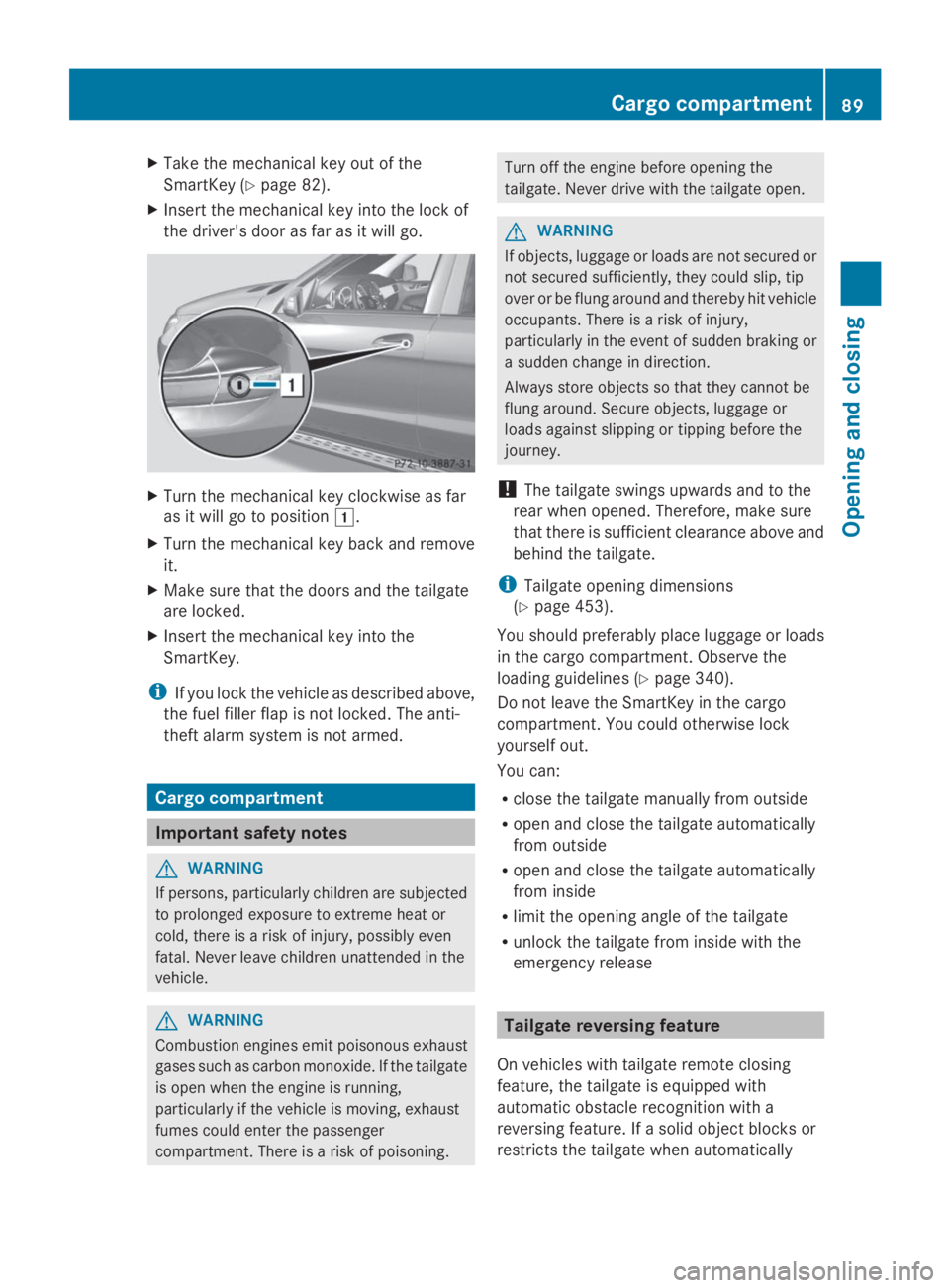
XTake the mechanical key out of the
SmartKey (Ypage 82).
XInsert the mechanical key into the lock of
the driver's door as far as it will go.
XTurn the mechanical key clockwise as far
as it will go to positionG.
XTurn the mechanical key back and remove
it.
XMake sure that the doors and the tailgate
are locked.
XInsert the mechanical key into the
SmartKey.
iIf you lock the vehicle as described above,
the fuel filler flap is not locked. The anti-
theft alarm system is not armed.
Cargo compartment
Important safety notes
GWARNING
If persons, particularly children are subjected
to prolonged exposure to extreme heat or
cold, there is a risk of injury, possibly even
fatal. Never leave children unattended in the
vehicle.
GWARNING
Combustion engines emit poisonous exhaust
gases such as carbon monoxide. If the tailgate
is open when the engine is running,
particularly if the vehicle is moving, exhaust
fumes could enter the passenger
compartment. There is a risk of poisoning.
Turn off the engine before opening the
tailgate. Never drive with the tailgate open.
GWARNING
If objects, luggage or loads are not secured or
not secured sufficiently, they could slip, tip
over or be flung around and thereby hit vehicle
occupants. There is a risk of injury,
particularly in the event of sudden braking or
a sudden change in direction.
Always store objects so that they cannot be
flung around. Secure objects, luggage or
loads against slipping or tipping before the
journey.
!The tailgate swings upwards and to the
rear when opened. Therefore, make sure
that there is sufficient clearance above and
behind the tailgate.
iTailgate opening dimensions
(Ypage 453).
You should preferably place luggage or loads
in the cargo compartment. Observe the
loading guidelines (Ypage 340).
Do not leave the SmartKey in the cargo
compartment. You could otherwise lock
yourself out.
You can:
Rclose the tailgate manually from outside
Ropen and close the tailgate automatically
from outside
Ropen and close the tailgate automatically
from inside
Rlimit the opening angle of the tailgate
Runlock the tailgate from inside with the
emergency release
Tailgate reversing feature
On vehicles with tailgate remote closing
feature, the tailgate is equipped with
automatic obstacle recognition with a
reversing feature. If a solid object blocks or
restricts the tailgate when automatically
Cargo compartment89
Opening and closing
Z
Page 93 of 462
Rpress the closing or locking button on the
tailgate.
Rpull the handle on the tailgate.
GWARNING
Combustion engines emit poisonous exhaust
gases such as carbon monoxide. If the tailgate
is open when the engine is running,
particularly if the vehicle is moving, exhaust
fumes could enter the passenger
compartment. There is a risk of poisoning.
Turn off the engine before opening the
tailgate. Never drive with the tailgate open.
!The tailgate swings upwards and to the
rear when opened. Therefore, make sure
that there is sufficient clearance above and
behind the tailgate.
iTailgate opening dimensions
(Ypage 453).
iNotes on the reversing feature for the
tailgate (Ypage 89).
Opening the tailgate automatically
You can open the tailgate automatically with
the SmartKey or the handle in the tailgate.
XPress and hold theTbutton on the
SmartKey until the tailgate opens.
or
XIf the tailgate is unlocked, pull the handle
and let it go again immediately.
Closing the tailgate automatically
GWARNING
Parts of the body could become trapped
during automatic closing of the tailgate.
Moreover, people, e.g. children, may be
standing in the closing area or may enter the
closing area during the closing process. There
is a risk of injury.
Make sure that nobody is in the vicinity of the
closing area during the closing process.
Use one of the following options to stop the
closing process:
Rpress theTbutton on the SmartKey.
Rpress the remote operating switch on the
driver's door.
Rpress the closing or locking button on the
tailgate.
Rpull the handle on the tailgate.
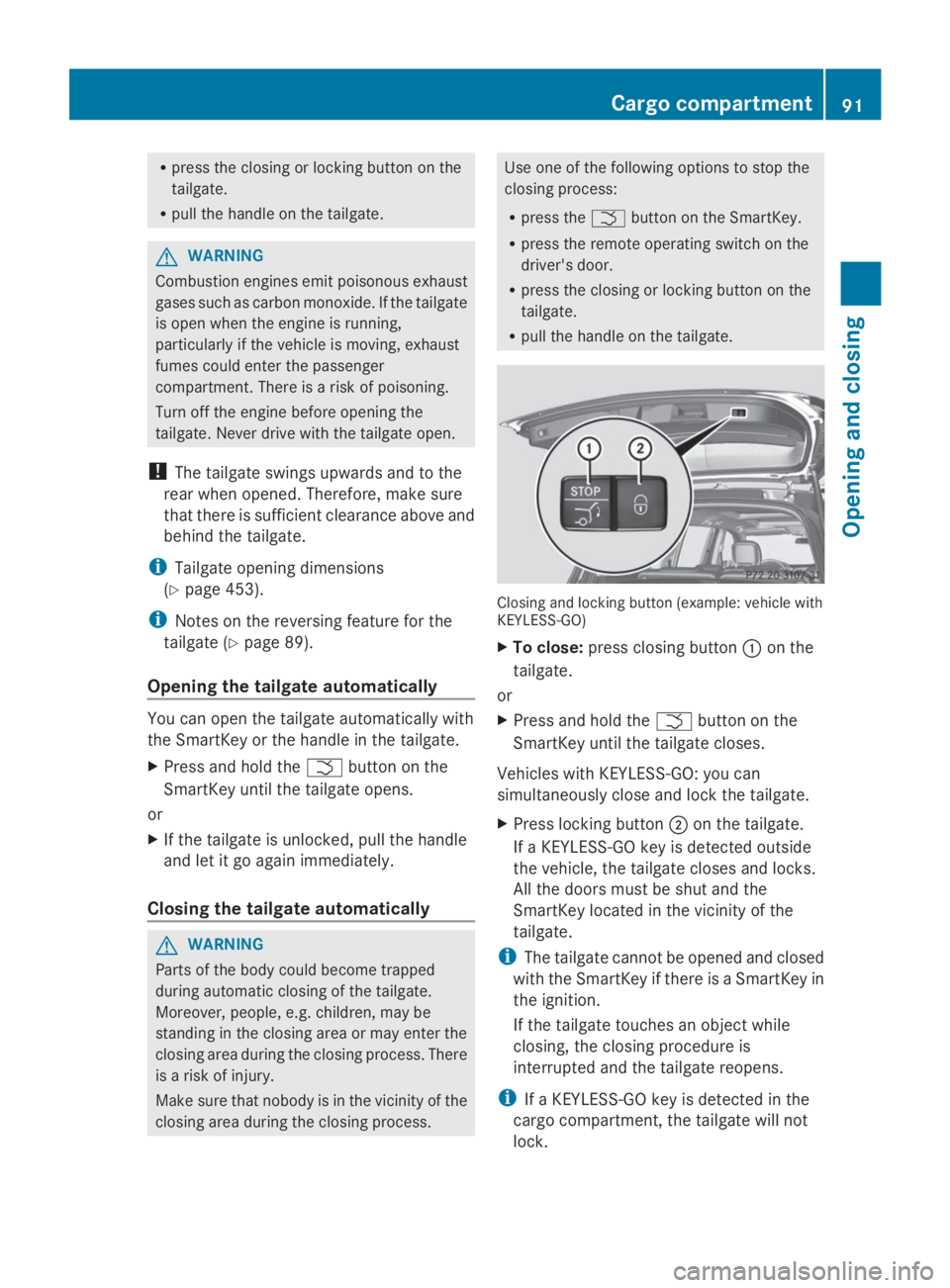
Closing and locking button (example: vehicle withKEYLESS-GO)
XTo close:press closing buttonCon the
tailgate.
or
XPress and hold theTbutton on the
SmartKey until the tailgate closes.
Vehicles with KEYLESS-GO: you can
simultaneously close and lock the tailgate.
XPress locking buttonDon the tailgate.
If a KEYLESS-GO key is detected outside
the vehicle, the tailgate closes and locks.
All the doors must be shut and the
SmartKey located in the vicinity of the
tailgate.
iThe tailgate cannot be opened and closed
with the SmartKey if there is a SmartKey in
the ignition.
If the tailgate touches an object while
closing, the closing procedure is
interrupted and the tailgate reopens.
iIf a KEYLESS-GO key is detected in the
cargo compartment, the tailgate will not
lock.
Cargo compartment91
Opening and closing
Z
Page 94 of 462
Opening/closing automatically from
inside
Important safety notes
GWARNING
Parts of the body could become trapped
during automatic closing of the tailgate.
Moreover, people, e.g. children, may be
standing in the closing area or may enter the
closing area during the closing process. There
is a risk of injury.
Make sure that nobody is in the vicinity of the
closing area during the closing process.
Use one of the following options to stop the
closing process:
Rpress theTbutton on the SmartKey.
Rpress the remote operating switch on the
driver's door.
Rpress the closing or locking button on the
tailgate.
Rpull the handle on the tailgate.
GWARNING
Combustion engines emit poisonous exhaust
gases such as carbon monoxide. If the tailgate
is open when the engine is running,
particularly if the vehicle is moving, exhaust
fumes could enter the passenger
compartment. There is a risk of poisoning.
Turn off the engine before opening the
tailgate. Never drive with the tailgate open.
!The tailgate swings upwards and to the
rear when opened. Therefore, make sure
that there is sufficient clearance above and
behind the tailgate.
iTailgate opening dimensions
(Ypage 453).
iNotes on the reversing feature for the
tailgate (Ypage 89).
Opening and closing
You can open and close the tailgate from the
driver's seat when the vehicle is stationary
and unlocked.
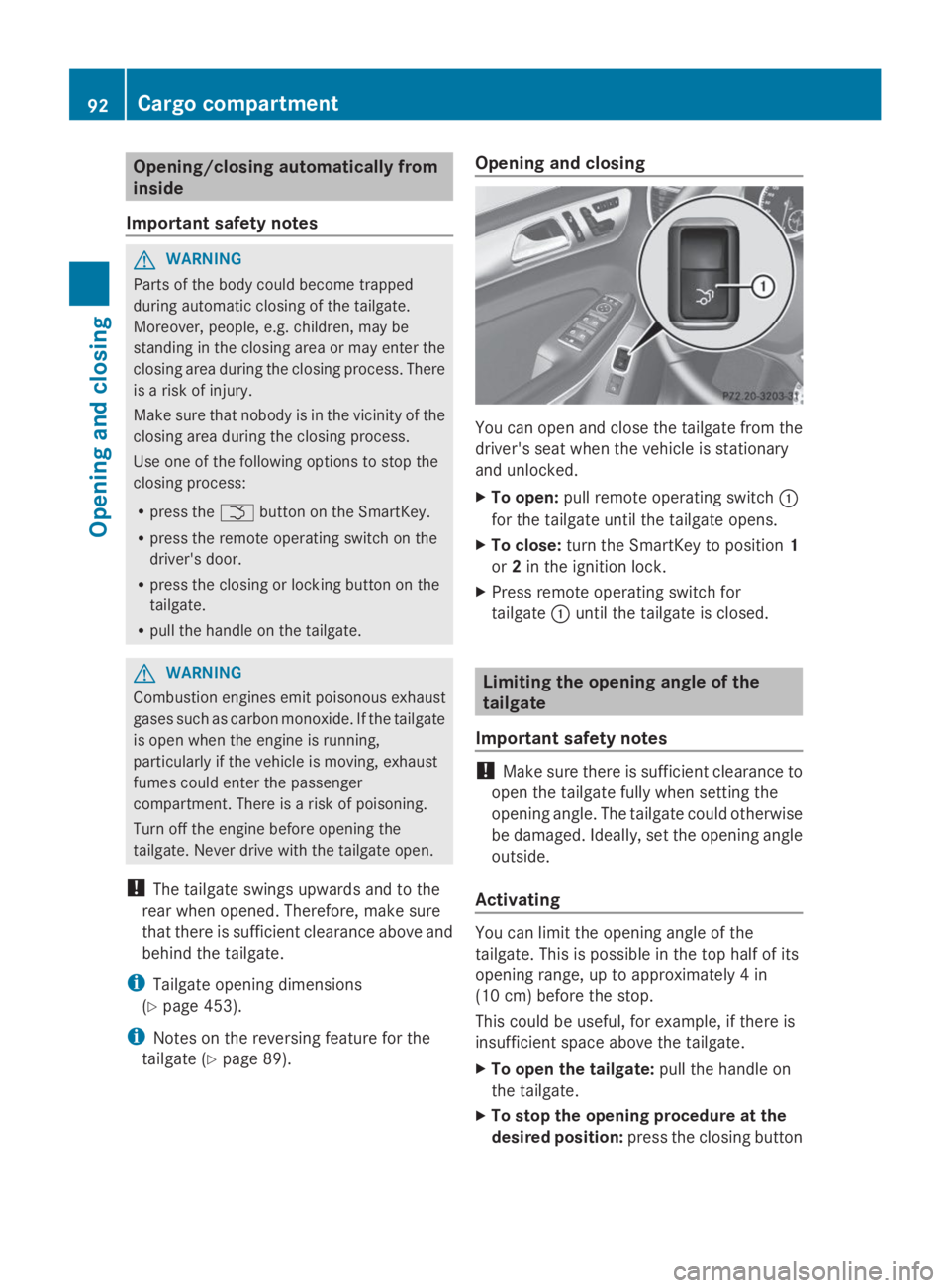
XTo open:pull remote operating switchC
for the tailgate until the tailgate opens.
XTo close:turn the SmartKey to position1
or2in the ignition lock.
XPress remote operating switch for
tailgateCuntil the tailgate is closed.
Limiting the opening angle of the
tailgate
Important safety notes
!Make sure there is sufficient clearance to
open the tailgate fully when setting the
opening angle. The tailgate could otherwise
be damaged. Ideally, set the opening angle
outside.
Activating
You can limit the opening angle of the
tailgate. This is possible in the top half of its
opening range, up to approximately 4 in
(10 cm) before the stop.
This could be useful, for example, if there is
insufficient space above the tailgate.
XTo open the tailgate:pull the handle on
the tailgate.
XTo stop the opening procedure at the
desired position:press the closing button
92Cargo compartment
Opening and closing
Page 95 of 462
(Ypage 90) in the tailgate or pull the handle
on the outside of the tailgate again.
XTo store the position:press and hold the
closing button in the tailgate until you hear
a short tone.
The opening angle limiter is activated. The
tailgate will now stop in the stored position
when opening.
Deactivating
XPress and hold the closing button
(Ypage 90) in the tailgate until you hear
two short tones.
Tailgate emergency release
Important safety notes
!The tailgate swings upwards and to the
rear when opened. Therefore, make sure
that there is sufficient clearance above and
behind the tailgate.
iTailgate opening dimensions
(Ypage 453).
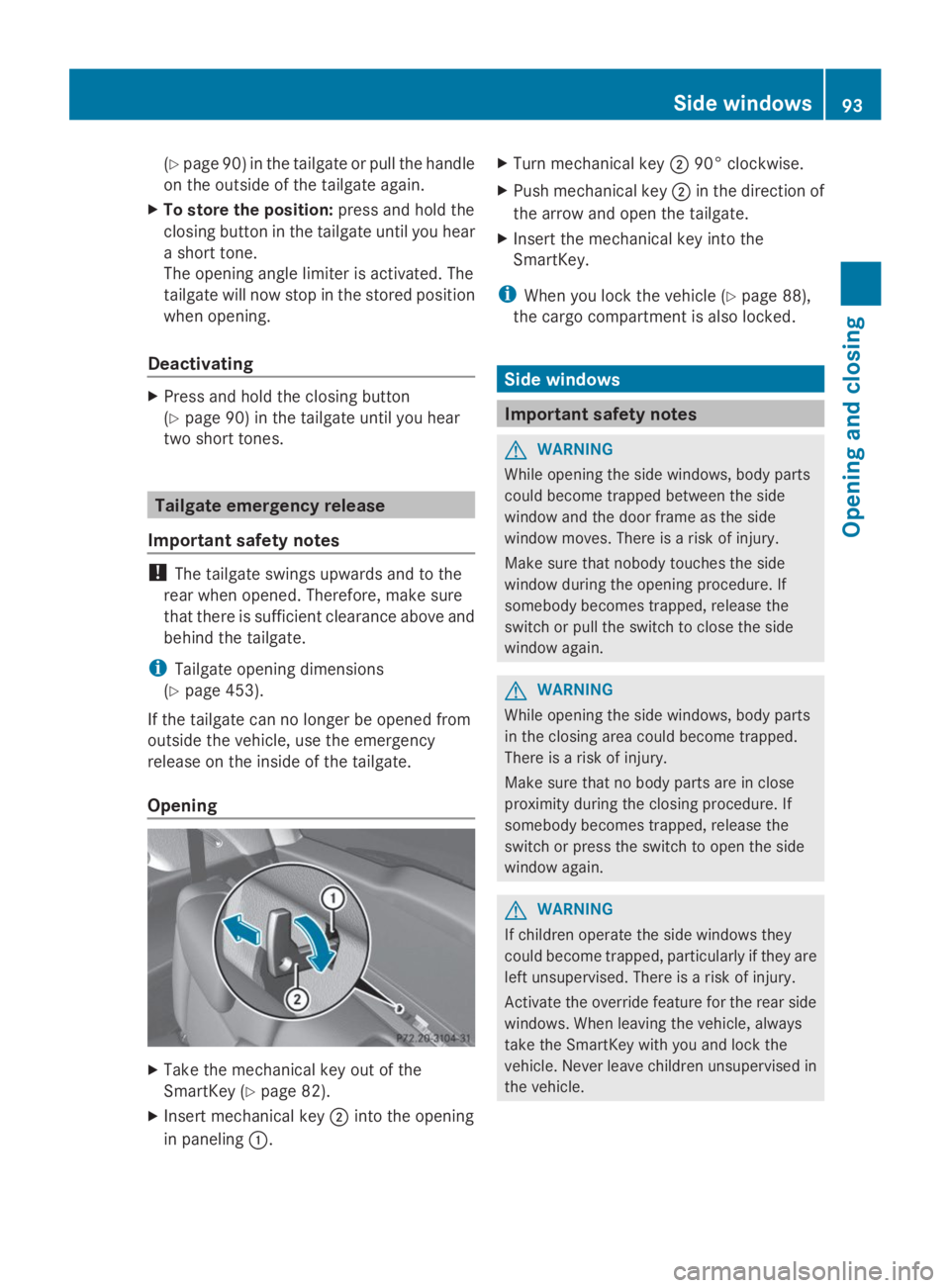
If the tailgate can no longer be opened from
outside the vehicle, use the emergency
release on the inside of the tailgate.
Opening
XTake the mechanical key out of the
SmartKey (Ypage 82).
XInsert mechanical keyDinto the opening
in panelingC.
XTurn mechanical keyD90° clockwise.
XPush mechanical keyDin the direction of
the arrow and open the tailgate.
XInsert the mechanical key into the
SmartKey.
iWhen you lock the vehicle (Ypage 88),
the cargo compartment is also locked.
Side windows
Important safety notes
GWARNING
While opening the side windows, body parts
could become trapped between the side
window and the door frame as the side
window moves. There is a risk of injury.
Make sure that nobody touches the side
window during the opening procedure. If
somebody becomes trapped, release the
switch or pull the switch to close the side
window again.
GWARNING
While opening the side windows, body parts
in the closing area could become trapped.
There is a risk of injury.
Make sure that no body parts are in close
proximity during the closing procedure. If
somebody becomes trapped, release the
switch or press the switch to open the side
window again.
GWARNING
If children operate the side windows they
could become trapped, particularly if they are
left unsupervised. There is a risk of injury.
Activate the override feature for the rear side
windows. When leaving the vehicle, always
take the SmartKey with you and lock the
vehicle. Never leave children unsupervised in
the vehicle.
Side windows93
Opening and closing
Z
Page 265 of 462
Ruphill or downhill gradient in percentage
Ron-road/off-road program selected
Rcondition of the differential lock for the
transfer case
Rthe LOW RANGE off-road gear is selected
Rcondition of the LOW RANGE off-road
gear
Rthe on-road trailer program is selected
Towing a trailer
Important safety notes
GWARNING
Installing an unsuitable ball coupling may
result in overloading of the trailer tow hitch
and the rear axle. This applies especially if the
ball coupling in question is longer or angled
differently. This could seriously impair the
driving characteristics and the trailer can
come loose. There is a risk of an accident.
You should only ever install a ball coupling
that has the permissible dimensions and that
is designed to meet your trailer-towing
requirements. Do not modify the ball coupling
or the trailer tow hitch.
You will find the values approved by the
manufacturer on the vehicle identification
plates and those for the towing vehicle under
"Technical data" (Ypage 457).
GWARNING
If the ball coupling is not installed correctly or
not secured with the bolt provided and the
corresponding spring cotter, the trailer may
come loose. There is a risk of an accident.
Always install and secure the ball coupling as
described. Before every journey, ensure that
the ball coupling is secured with the bolt and
the corresponding spring cotter.
GWARNING
If you rest your foot on the brake pedal while
driving, the braking system can overheat. This
increases the stopping distance and can even
cause the braking system to fail. There is a
risk of an accident.
Never use the brake pedal as a footrest. Never
depress the brake pedal and the accelerator
pedal at the same time.
GWARNING
When the vehicle/trailer combination begins
to lurch, you could lose control of it. The
vehicle/trailer combination could even
rollover. There is a risk of an accident.
On no account should you attempt to
straighten up the vehicle/trailer combination
by increasing the speed. Reduce vehicle
speed and do not countersteer. Apply the
brake as necessary.
!Depressing the brake pedal constantly
results in excessive and premature wear to
the brake pads.
Please observe the manufacturer's operating
instructions for the trailer coupling if a
detachable trailer coupling is used.
Couple and uncouple the trailer carefully. If
you do not couple the trailer to the towing
vehicle correctly, the trailer could become
detached.
Make sure that the following values are not
exceeded:
Rthe permissible trailer drawbar noseweight
Rthe permissible trailer load
Rthe permissible rear axle load of the towing
vehicle
Rthe maximum permissible gross vehicle
weight of both the towing vehicle and the
trailer
The applicable permissible values, which
must not be exceeded, can be found:
Rin the vehicle documents
Ron the identification plates for the trailer
tow hitch and the trailer
Ron the vehicle identification plate
If the values differ, the lowest value applies.
Towing a trailer263
Driving and pa rking
Z
Page 266 of 462
When towing a trailer, your vehicle's handling
characteristics will be different in comparison
with when driving without a trailer.
The vehicle/trailer combination:
Ris heavier
Ris restricted in its acceleration and
gradient-climbing capability
Rhas an increased braking distance
Ris affected more by strong crosswinds
Rdemands more sensitive steering
Rhas a larger turning radius
This could impair the handling
characteristics.
When towing a trailer, always adjust your
speed to the current road and weather
conditions. Do not exceed the maximum
permissible speed for your vehicle/trailer
combination.
Notes on towing a trailer
General notes
RDo not exceed the legally prescribed
maximum speed for vehicle/trailer
combinations in the relevant country.
This lowers the risk of an accident.
ROnly install an approved trailer coupling on
your vehicle.
Further information on availability and on
installation is available from any authorized
Mercedes-Benz Center.
RThe bumpers of your vehicle are not
suitable for installing detachable trailer
couplings.
RDo not install hired trailer couplings or
other detachable trailer couplings on the
bumpers of your vehicle.
RIf you no longer need the ball coupling,
remove it from the ball coupling recess.
This will reduce the risk of damage to the
ball coupling.
iWhen towing a trailer, set the tire
pressure on the rear axle of the towing
vehicle for a maximum load; see the tire
pressure table in the fuel filler flap
(Ypage 425).
Please note that when towing a trailer,
PARKTRONIC (Ypage 222) and Blind Spot
Assist (Ypage 243) are only available with
limitations, or not at all.
You will find installing dimensions and loads
under "Technical data" (Ypage 456).
Driving tips
iObserve the information on ESP®trailer
stabilization (Ypage 74) and on pulling
away with a trailer (Ypage 170).
The maximum permissible speed for vehicle/
trailer combinations depends on the type of
trailer. Before beginning the journey, check
the trailer's documents to see what the
maximum permissible speed is. Observe the
legally prescribed maximum speed in the
relevant country.
For certain Mercedes-Benz vehicles, the
maximum permissible rear axle load is
increased when towing a trailer. See
"Technical data" to find out whether this
applies to your vehicle (Ypage 457). If you
utilize any of the added maximum rear axle
load when towing a trailer, the vehicle/trailer
combination may not exceed a maximum
speed of 60 mph (100 km/h) for reasons
concerning the operating permit. This also
applies in countries in which the permissible
maximum speed for vehicle/trailer
combinations is above 60 mph (100 km/h).
When towing a trailer, your vehicle's handling
characteristics will be different in comparison
with when driving without a trailer.
Use the left-hand paddle shifter to shift into
a lower gear in good time on long and steep
downhill gradients.
iThis also applies if you have activated
cruise control or DISTRONIC PLUS.
This will use the braking effect of the engine,
so that less braking will be required to
maintain the speed. This relieves the load on
264Towing a trailer
Driving and parking
Page 269 of 462
of the towing vehicle, as the latter is
equipped with an anti-lock brake system.
Doing so will result in a loss of function of
the brake systems of both the vehicle and
the trailer.
XMake sure that the automatic transmission
is set to positionP.
XApply the vehicle's electric parking brake.
XStart the engine.
XVehicles with the AIRMATIC package:
select highway level.
XVehicles with ADS:set ADS toAUTOor
COMF.
XSwitch off the engine.
XClose all doors and the tailgate.
XCouple up the trailer.
XEstablish all electrical connections.
XCheck that the trailer lighting system is
working.
iVehicles with the AIRMATIC package:
with a trailer attached, the vehicle will
always remain at highway level. When
coupling up a trailer, please observe the
following:
RUnless highway level has been set
manually, the vehicle is automatically
lowered to highway level. This is the case
if a speed of 5 mph(8km/h) is reached.
RHigh-speed level is not available.
These restrictions apply to all accessories
powered through a connection to the trailer
power socket of your vehicle, e.g. a bicycle
carrier.
Observe the maximum permissible trailer
dimensions (width and length).
Most U.S. states and all Canadian provinces
require by law:
RSafety chains between the towing vehicle
and the trailer. The chains should be cross-
wound under the trailer drawbar. They must
be fastened to the vehicle's trailer
coupling, not to the bumper or the axle.
Leave enough play in the chains to make
tight cornering possible.
RA separate brake system for certain types
of trailer.
RA safety switch for braked trailers. Check
the specific legal requirements applicable
to your state.
If the trailer detaches from the towing
vehicle, the safety switch applies the
trailer's brakes.
Towing a trailer
There are numerous legal requirements
concerning the towing of a trailer, e.g. speed
restrictions. Make sure that your vehicle/
trailer combination complies with the local
requirements not only in your area of
residence but also at any location to which
you are traveling. The police and local
authorities can provide reliable information.
Please observe the following when towing a
trailer:
RIn order to accumulate driving experience
and accustom yourself to the new handling
characteristics, practice the following at a
location where there is no traffic:
-Cornering
-Stopping
-Backing up
RBefore driving, check:
-the trailer tow hitch
-the safety switch for braked trailers
-the safety chains
-electrical connections
-the lights
-the wheels
RAdjust the exterior mirrors to provide an
unobstructed view of the rear section of the
trailer.
RIf the trailer has electronically controlled
brakes, pull away carefully. Brake manually
using the brake controller and check
whether the brakes function correctly.
Towing a trailer267
Driving an d parking
Z
Page 271 of 462
Permissible trailer loads and drawbar
loads
Weight specifications
Maximum permissible gross vehicle
weight rating
The gross trailer weight is calculated by
adding the weight of the trailer to the weight
of the load and equipment on the trailer.
You will find installing dimensions and loads
under "Technical data" (Ypage 456).
Permissible noseweight
You will find installing dimensions and loads
under "Technical data" (Ypage 456).
Loading a trailer
RWhen loading the trailer, make sure that
neither the permissible gross weight of the
trailer nor the gross vehicle weight is
exceeded. The permissible gross vehicle
weight is indicated on the identification
plate on the B-pillar on the driver's side of
the vehicle.
You can find the maximum permissible
values on the type plates of your vehicle
and the trailer. When calculating how much
weight the vehicle and trailer may carry,
pay attention to the respective lowest
values.
RThe trailer drawbar load on the ball coupling
must be added to the rear axle load to avoid
exceeding the permissible gross axle
weight. The permissible gross vehicle
weight is indicated on the identification
plate on the B-pillar on the driver's side of
the vehicle.
iMercedes-Benz recommends a trailer
load where the trailer drawbar noseweight
accounts for 8% to 15% of the trailer's
permissible gross weight.
iThe weight of additional accessories,
passengers, and cargo reduces the
permissible trailer load and drawbar load
for your vehicle.
Checking the vehicle and trailer weight
RTo check that the weights of the towing
vehicle and the trailer comply with the
maximum permissible values, have the
vehicle/trailer combination (including the
driver, passengers, and cargo with a fully
laden trailer) weighed on a calibrated
weighbridge.
RCheck the gross axle weight rating of the
front and rear axles, the gross weight of the
trailer and trailer drawbar load.
Removing the ball coupling
XRemove the spring cotter.
XRemove the bolt from the ball coupling
recess.
XRemove the ball coupling from the ball
coupling recess.
XClean the ball coupling if it is dirty.
XStow the ball coupling so that it cannot be
thrown around.
Observe the loading guidelines
(Ypage 340) and the safety notes regarding
stowage spaces (Ypage 341).
Information on cleaning and care of the trailer
tow hitch can be found at (Ypage 381).
Storing the ball coupling
GWARNING
Do not carry the ball coupling in the vehicle
interior if it is not secured.
Otherwise, you and others could be injured by
the ball coupling being thrown around if you:
Rbrake sharply
Rchange direction suddenly
Rare involved in an accident
Towing a trailer269
Driving and parking
Z