height MERCEDES-BENZ GL 2014 User Guide
[x] Cancel search | Manufacturer: MERCEDES-BENZ, Model Year: 2014, Model line: GL, Model: MERCEDES-BENZ GL 2014Pages: 462, PDF Size: 8.98 MB
Page 200 of 462
RAlways keep the engine running and in gear
when driving on a downhill gradient.
Activate DSR (Ypage 256).
RAlways keep the doors, tailgate, windows
and sliding sunroof closed while driving.
RAdapt your speed to the terrain. The
rougher, steeper or more ruts on the
terrain, the slower your speed should be.
RDrive slowly and at an even speed through
the water. Ensure that a bow wave does not
form as you drive.
RDrive with extreme care on unfamiliar off-
road routes where visibility is poor. For
safety reasons, get out of the vehicle first
and survey the off-road route.
RLook out for obstacles, such as rocks,
holes, tree stumps and furrows.
RCheck the depth of water before fording
rivers and streams.
RWhen fording, do not stop and do not
switch off the engine.
ROn sand, drive quickly to overcome the
rolling resistance. Otherwise the vehicle's
wheels could become stuck in loose
ground.
RDo not jump with the vehicle as this will
interrupt the vehicle's propulsion.
RAlways keep the engine running and in gear
when driving on a slope.
RDo not shift the automatic transmission to
transmission positionN.
iDo not use the HOLD function when
driving off-road, on steep uphill or downhill
gradients or on slippery or loose surfaces.
The HOLD function cannot hold the vehicle
on such surfaces.
Checklist before driving off-road
!If the engine oil warning lamp lights up
while the vehicle is in motion, stop the
vehicle in a safe place as soon as possible.
Check the engine oil level. The engine oil
warning lamp warning must not be ignored.
Continuing the journey while the symbol is
displayed could lead to engine damage.
XEngine oil level:check the engine oil level
and add oil if necessary.
When driving on steep gradients, the
engine oil level must be sufficiently high to
ensure a correct oil supply in the vehicle.
XDEF tank (BlueTEC vehicles):check the
level and top up if necessary (Ypage 186).
XTire-changing tool kit:check that the jack
is working and make sure you have the lug
wrench, a robust tow cable and a folding
spade in the vehicle.
XWheels and tires:check the tire tread
depth and tire pressure.
XCheck for damage and remove any foreign
objects, e.g. small stones, from the
wheels/tires.
XReplace any missing valve caps.
XReplace dented or damaged wheels.
XRims:dented or bent rims can result in a
loss of tire pressure and damage the tire
bead. Therefore, check your rims before
driving off-road and replace them as
required.
Checklist after driving off-road
!If you detect damage to the vehicle after
driving off-road, have the vehicle checked
immediately at a qualified specialist
workshop.
XVehicles with the ON&OFFROAD
package:activate the on-road program
(Ypage 258).
XDeactivate the LOW RANGE off-road gear
(Ypage 259).
XDeactivate DSR (Ypage 256).
XVehicles with the AIRMATIC package:
lower the vehicle to a ride height suitable
for the road conditions, e.g. to the
highway/high-speed level.
XClean the headlamps and rear lights and
check for damage.
XClean the front and rear license plates.
XClean the wheels/tires with a water jet and
remove any foreign objects.
198Driving tips
Driving an d parking
Page 215 of 462
height if the chassis is raised. There is a risk
of an accident.
Adjust the vehicle level before pulling away.
GWARNING
Due to the high center of gravity, the vehicle
may start to skid and roll over in the event of
an abrupt steering maneuver and/or when
the vehicle's speed is not adapted to the road
conditions. There is a risk of an accident.
Always adapt your speed and driving style to
the vehicle's driving characteristics and to the
prevailing road and weather conditions.
!When driving on extremely rough terrain,
select a high vehicle level in good time.
Make sure there is always sufficient ground
clearance. You will otherwise damage the
vehicle.
RUtility vehicles have a significantly higher
rollover rate than other types of vehicles.
Failure to operate this vehicle safely may
result in an accident, rollover of the vehicle,
and severe or fatal injury.
RIn a rollover crash, an unbelted person is
significantly more likely to die than a
person wearing a seat belt.
You and all vehicle occupants should
always wear your seat belts.
Basic settings
The extent to which the vehicle is raised or
lowered depends on the basic setting
selected.
Select:
Rhighway/high-speed level for driving on
normal roads
Roff-road level 1 for driving on easily
negotiable off-road terrain
Roff-road level 2 for driving on normal off-
road terrain
Roff-road level 3 for freeing the vehicle in
particularly rough terrain at low speeds
only
The individual vehicle levels differ from
highway level as follows:
Rhighway level: +/–0 in (+/–0 mm)
Rhigh-speed level: –0.6 in (–15 mm)
Roff-road level 1: + 1.2 in (+ 30 mm)
Roff-road level 2: + 2.3 in (+ 60 mm)
Roff-road level 3: + 3.6 in (+ 90 mm)
Highway/high-speed level
!Make sure that there is enough ground
clearance when the vehicle is being
lowered. It could otherwise hit the ground,
damaging the underbody.
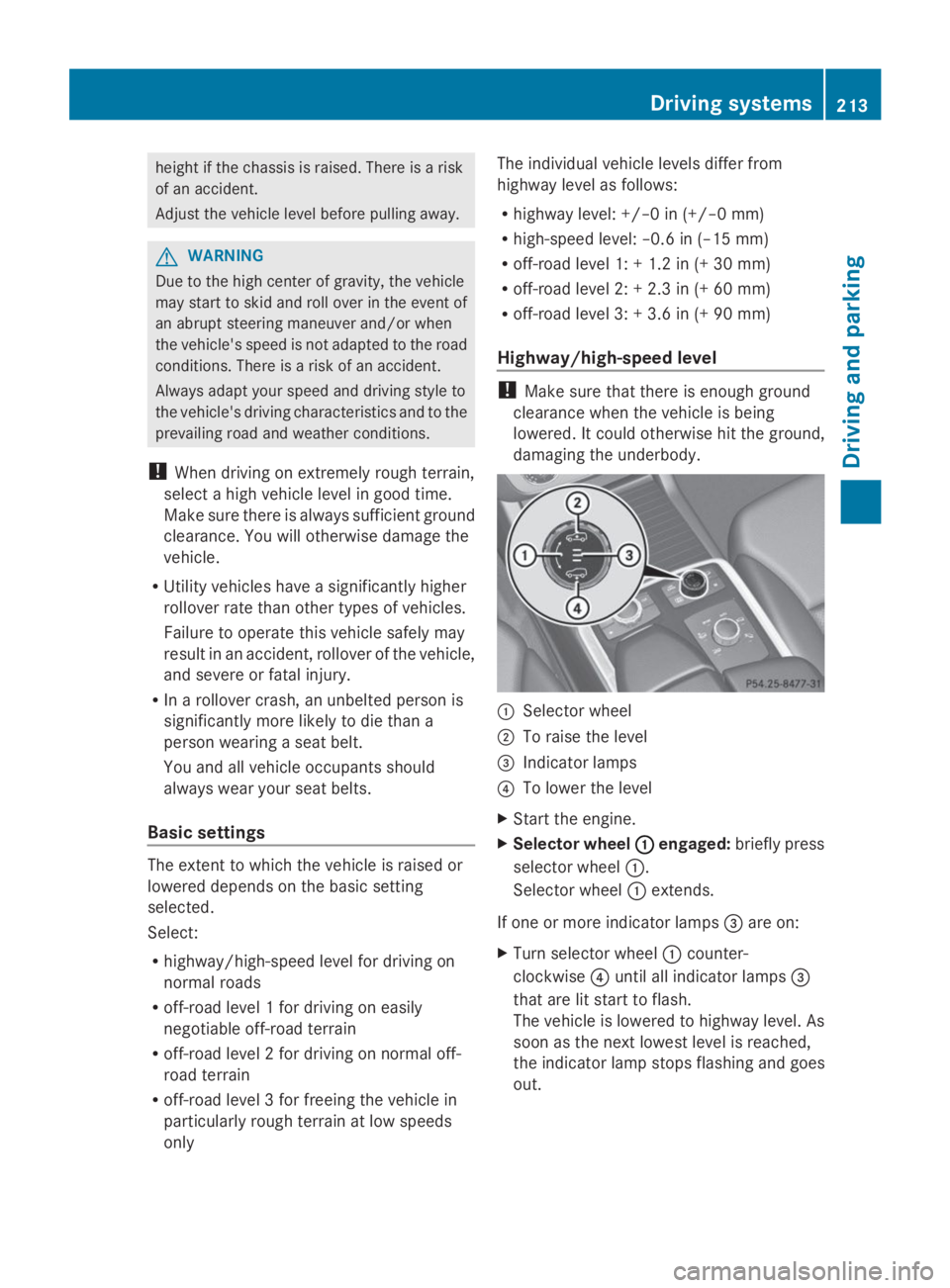
CSelector wheel
DTo raise the level
Page 229 of 462
Active Parking Assist may possibly indicate
parking spaces which are not suitable for
parking, for example:
Rwhere parking or stopping is prohibited
Rin front of driveways or entrances and exits
Ron unsuitable surfaces
Parking tips:
ROn narrow roads, drive as close to the
parking space as possible.
RParking spaces that are littered or
overgrown might be identified or measured
incorrectly.
RParking spaces that are partially occupied
by trailer drawbars might not be identified
as such or be measured incorrectly.
RSnowfall or heavy rain may lead to a parking
space being measured inaccurately.
RPay attention to the PARKTRONIC
(Ypage 224) warning messages during the
parking procedure.
RAt any time, you can intervene in the
steering procedure to correct it. Active
Parking Assist will then be canceled.
RWhen transporting a load which protrudes
from your vehicle, you should not use
Active Parking Assist.
RNever use Active Parking Assist when snow
chains are installed.
RMake sure that the tire pressures are
always correct. This has a direct influence
on the parking characteristics of the
vehicle.
Use Active Parking Assist for parking spaces:
Rthat are parallel to the direction of travel
Rthat are on straight roads, not bends
Rthat are on the same level as the road, e.g.
not on the pavement
Detecting parking spaces
Objects located above the height range of
Active Parking Assist will not be detected
when the parking space is measured. These
are not taken into account when the parking
procedure is calculated, e.g. overhanging
loads, tail sections or loading ramps of goods
vehicles.
GWARNING
If there are objects above the detection range,
Active Parking Assist may turn prematurely.
You may cause a collision as a result. There is
a risk of an accident.
If there are objects above the detection range,
stop and deactivate Active Parking Assist.
For further information on the detection
range (Ypage 223).
Active Parking Assist does not support you
with parking spaces parallel to the direction
of travel if:
Rthe parking space is on a curb
Rthe system reads the parking space as
being blocked, for example by foliage or
grass paving blocks
Rthe area is too small for the vehicle to
maneuver into
Rthe parking space is bordered by an
obstacle, e.g. a tree, a post or a trailer
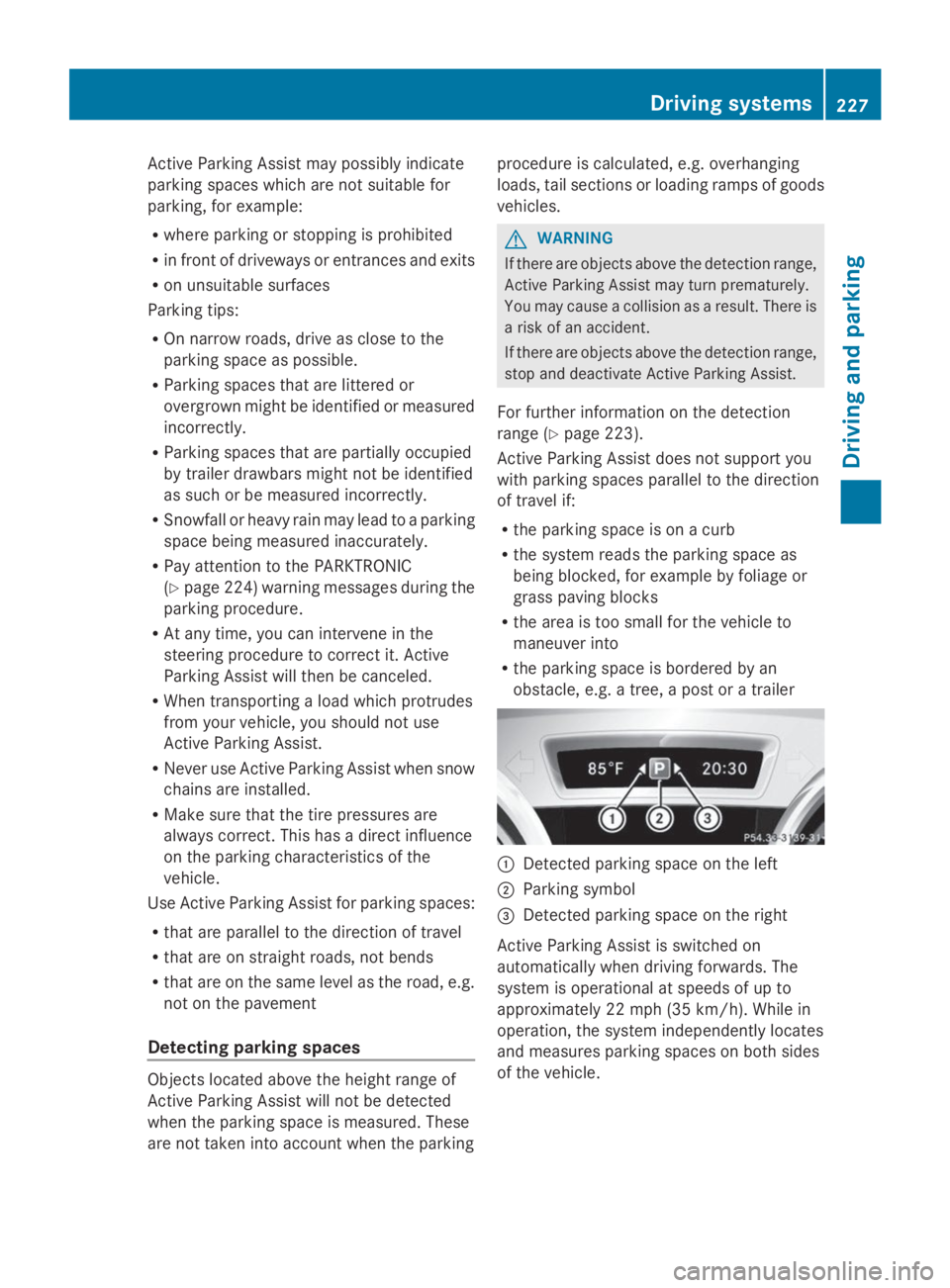
CDetected parking space on the left
DParking symbol
Page 373 of 462
!Make sure that the windshield wipers are
not folded away from the windshield. You
could otherwise damage the windshield
wipers or the hood.
XMake sure that the windshield wipers are
turned off.
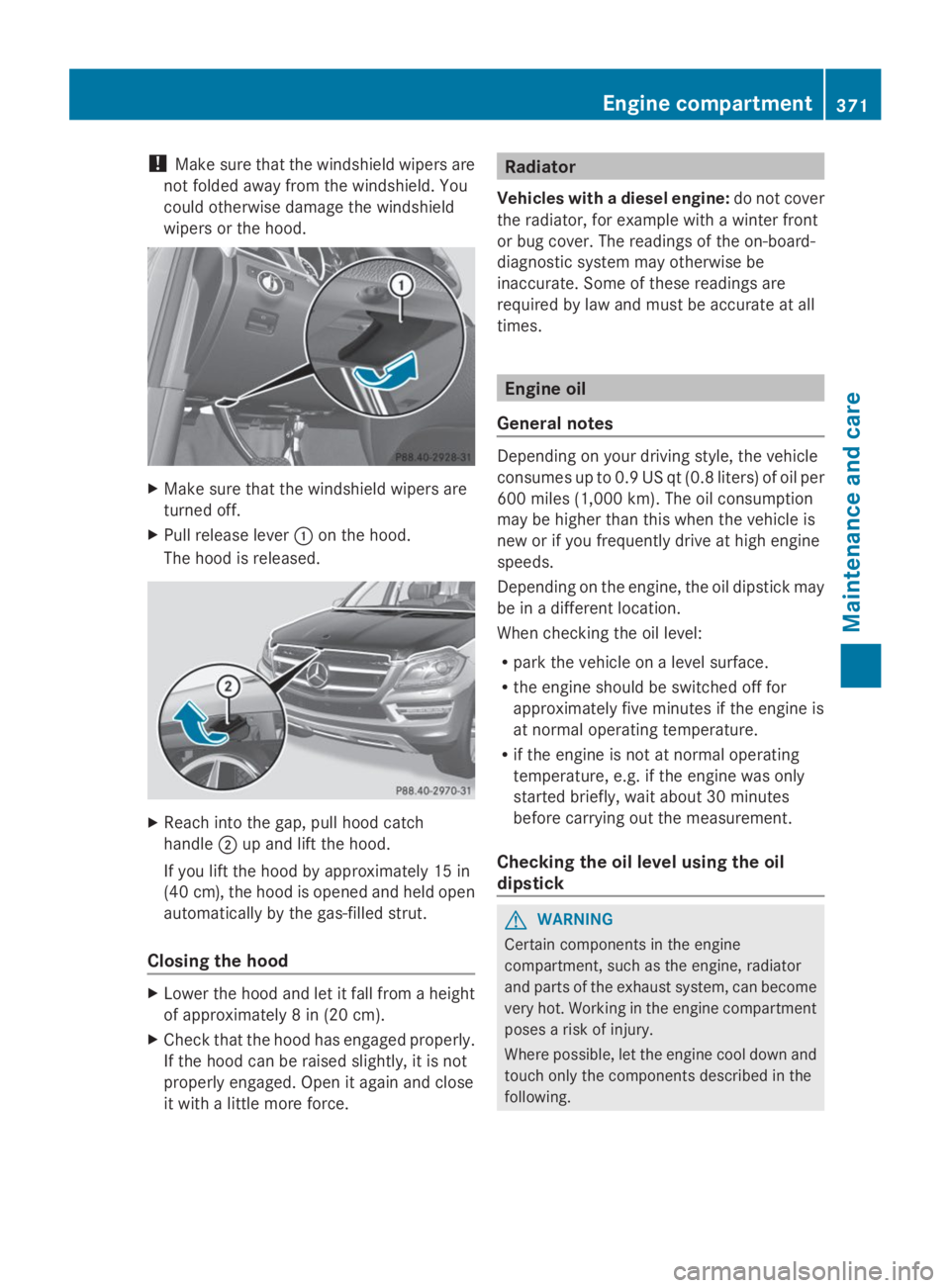
XPull release leverCon the hood.
The hood is released.
XReach into the gap, pull hood catch
handleDup and lift the hood.
If you lift the hood by approximately 15 in
(40 cm), the hood is opened and held open
automatically by the gas-filled strut.
Closing the hood
XLower the hood and let it fall from a height
of approximately 8 in (20 cm).
XCheck that the hood has engaged properly.
If the hood can be raised slightly, it is not
properly engaged. Open it again and close
it with a little more force.
Radiator
Vehicles with a diesel engine:do not cover
the radiator, for example with a winter front
or bug cover. The readings of the on-board-
diagnostic system may otherwise be
inaccurate. Some of these readings are
required by law and must be accurate at all
times.
Engine oil
General notes
Depending on your driving style, the vehicle
consumes up to 0.9 US qt (0.8 liters) of oil per
600 miles (1,000 km). The oil consumption
may be higher than this when the vehicle is
new or if you frequently drive at high engine
speeds.
Depending on the engine, the oil dipstick may
be in a different location.
When checking the oil level:
Rpark the vehicle on a level surface.
Rthe engine should be switched off for
approximately five minutes if the engine is
at normal operating temperature.
Rif the engine is not at normal operating
temperature, e.g. if the engine was only
started briefly, wait about 30 minutes
before carrying out the measurement.
Checking the oil level using the oil
dipstick
GWARNING
Certain components in the engine
compartment, such as the engine, radiator
and parts of the exhaust system, can become
very hot. Working in the engine compartment
poses a risk of injury.
Where possible, let the engine cool down and
touch only the components described in the
following.
Engine compartment371
Maintenance and care
Z
Page 409 of 462
Only winter tires bearing theMsnowflake
symbol in addition to the M+S marking
provide the best possible grip in wintry road
conditions.
Only these tires will allow driving safety
systems such as ABS and ESP®to function
optimally in winter. These tires have been
developed specifically for driving in snow.
Use M+S tires of the same make and tread on
all wheels to maintain safe handling
characteristics.
Always observe the maximum permissible
speed specified for the M+S tires you have
mounted.
Once the winter tires are mounted:
XCheck the tire pressures (Ypage 411).
XRestart the tire pressure monitor
(Ypage 412).
XVehicles for Canada:restart the tire
pressure loss warning system
(Ypage 412).
For more information on driving with the
emergency spare wheel, see (Ypage 439).
Snow chains
GWARNING
If snow chains are installed to the front
wheels, they may drag against the vehicle
body or chassis components. This could
cause damage to the vehicle or the tires.
There is a risk of an accident.
To avoid hazardous situations:
Rnever install snow chains to the front
wheels
Ralways install snow chains in pairs to the
rear wheels.
!You must drive at raised vehicle level
(height 1) if snow chains have been
installed. The vehicle may otherwise be
damaged.
!Vehicles with Adaptive Damping
System (ADS):do not use the sports mode
if you have installed snow chains. The
vehicle may otherwise be damaged.
!On some tire sizes there is not enough
space for snow chains. To avoid damage to
the vehicle or tires, observe the "Wheel and
tire combinations" section under "Tires and
wheels".
For safety reasons, Mercedes-Benz
recommends that you only use snow chains
that have been specially approved for your
vehicle by Mercedes-Benz, or are of a
corresponding standard of quality.
If you intend to mount snow chains, please
bear the following points in mind:
ROnly use snow chains when driving on
roads completely covered by snow.
Remove the snow chains as soon as
possible when you come to a road that is
not snow-covered.
RDo not exceed the maximum permissible
speed of 30 mph (50 km/h).
RLocal regulations may restrict the use of
snow chains. Observe the appropriate
regulations if you wish to mount snow
chains.
RSnow chains may not be mounted on all
wheel/tire combinations. Permissible
wheel-tire combinations (Ypage 432).
iYou may wish to deactivate ESP®
(Ypage 73) when pulling away with snow
chains installed. You can thereby allow the
wheels to spin in a controlled manner,
achieving an increased driving force
(cutting action).
For more information on driving with the
emergency spare wheel, see (Ypage 439).
Winter operation407
Wheels and tires
Z
Page 424 of 462
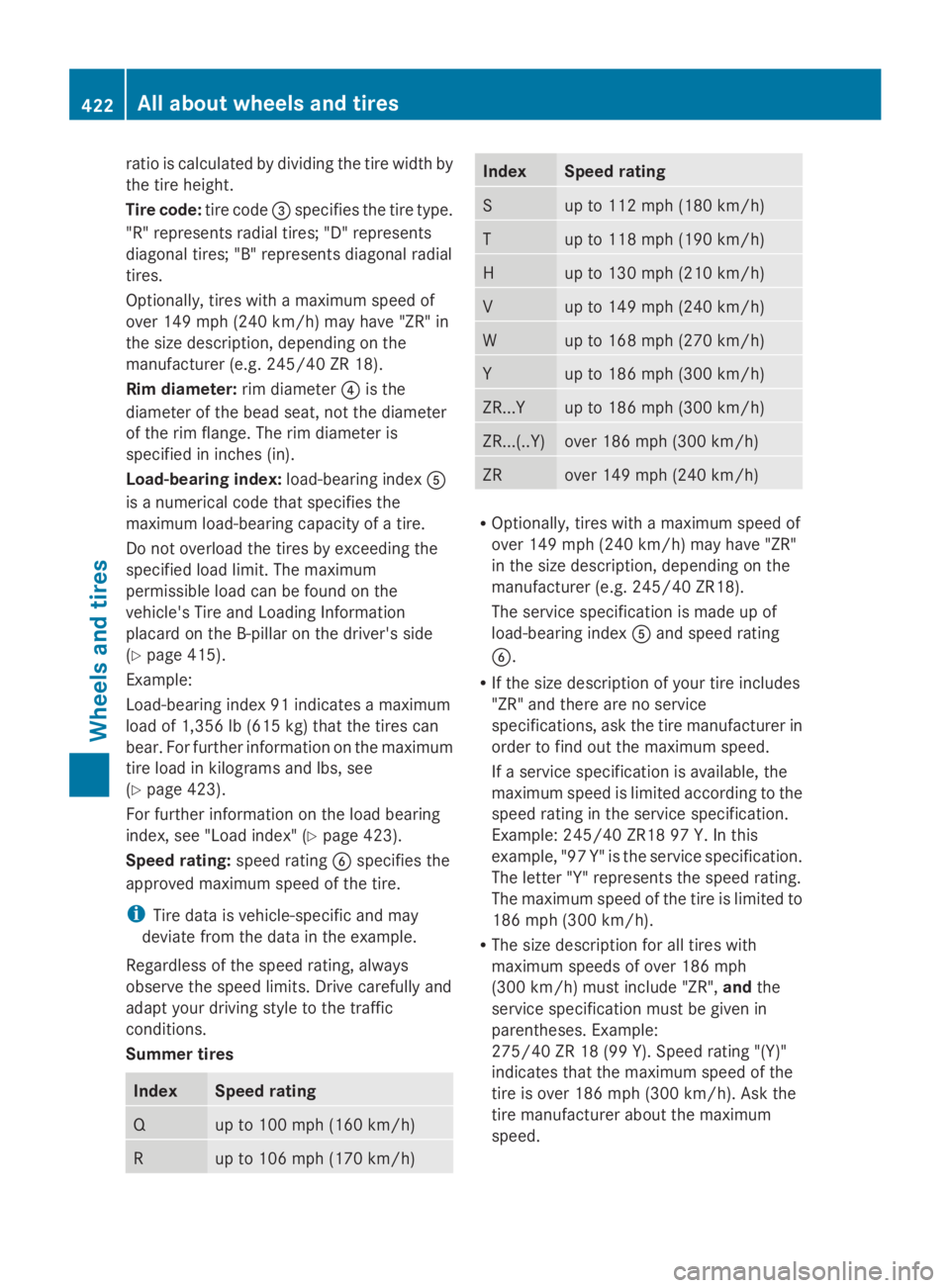
ratio is calculated by dividing the tire width by
the tire height.
Tire code:tire code
Page 428 of 462
Load index
In addition to the load-bearing index, the load
index may also be imprinted on the sidewall
of the tire. This specifies the load-bearing
capacity more precisely.
Curb weight
The weight of a vehicle with standard
equipment including the maximum capacity
of fuel, oil and coolant. It also includes the air-
conditioning system and optional equipment
if these are installed in the vehicle, but does
not include passengers or luggage.
Maximum load rating
The maximum tire load is the maximum
permissible weight in kilograms or lbs for
which a tire is approved.
Maximum permissible tire pressure
Maximum permissible tire pressure for one
tire.
Maximum load on one tire
Maximum load on one tire. This is calculated
by dividing the maximum axle load of one axle
by two.
PSI (pounds per square inch)
A standard unit of measure for tire pressure.
Aspect ratio
Relationship between tire height and tire
width in percent.
Tire pressure
This is pressure inside the tire applying an
outward force to each square inch of the tire's
surface. The tire pressure is specified in
pounds per square inch (psi), in kilopascal
(kPa) or in bar. The tire pressure should only
be corrected when the tires are cold.
Cold tire pressure
The tires are cold:
Rif the vehicle has been parked without
direct sunlight on the tires for at least three
hours and
Rif the vehicle has been driven for less than
1 mile (1.6 km).
Tread
The part of the tire that comes into contact
with the road.
Bead
The tire bead ensures that the tire sits
securely on the wheel. There are several steel
wires in the bead to prevent the tire from
coming loose from the wheel rim.
Sidewall
The part of the tire between the tread and the
bead.
Weight of optional extras
The combined weight of those optional extras
that weigh more than the replaced standard
parts and more than 2.3 kilograms (5 lbs).
These optional extras, such as high-
performance brakes, level control, a roof rack
or a high-performance battery, are not
included in the curb weight and the weight of
the accessories.
TIN (Tire Identification Number)
This is a unique identifier which can be used
by a tire manufacturer to identify tires, for
example for a product recall, and thus identify
the purchasers. The TIN is made up of the
manufacturer's identity code, tire size, tire
type code and the manufacturing date.
Load bearing index
The load bearing index (also load index) is a
code that contains the maximum load bearing
capacity of a tire.
426All about wheels and tires
Wheels and tires
Page 432 of 462
Rbefore raising the vehicle, secure it from
rolling away by applying the parking brake
and inserting wheel chocks. Do not
disengage the parking brake while the
vehicle is raised.
Rthe jack must be placed on a firm, flat and
non-slip surface. On a loose surface, a
large, flat, load-bearing underlay must be
used. On a slippery surface, a non-slip
underlay must be used, e.g. rubber mats.
Rdo not use wooden blocks or similar
objects as a jack underlay. Otherwise, the
jack will not be able to achieve its load-
bearing capacity due to the restricted
height.
Rmake sure that the distance between the
underside of the tires and the ground does
not exceed 1.2 in (3 cm).
Rnever place your hands and feet under the
raised vehicle.
Rdo not lie under the vehicle.
Rdo not start the engine when the vehicle is
raised.
Rnever open or close a door or the tailgate
when the vehicle is raised.
Rmake sure that no persons are present in
the vehicle when the vehicle is raised.
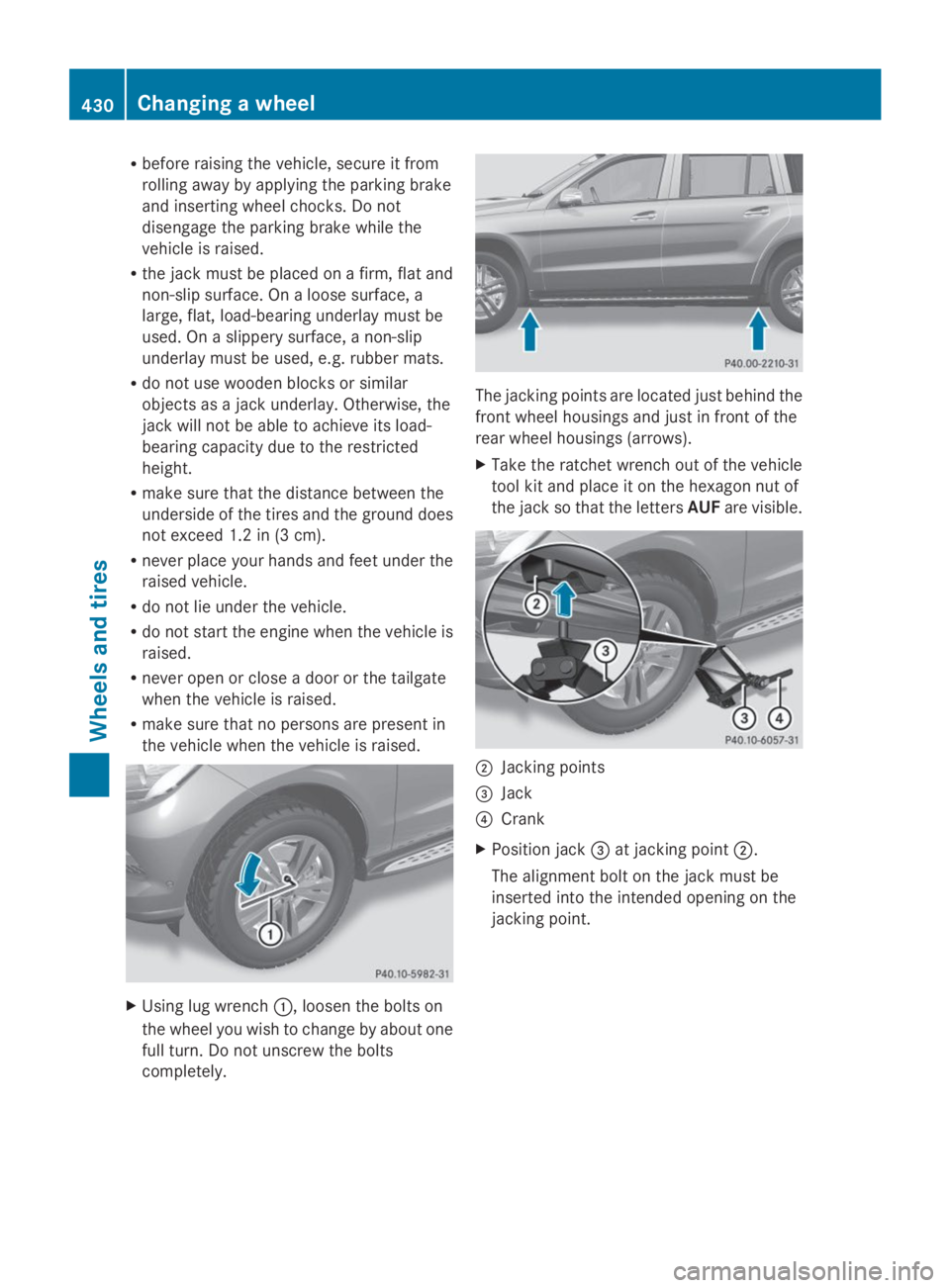
XUsing lug wrenchC, loosen the bolts on
the wheel you wish to change by about one
full turn. Do not unscrew the bolts
completely.
The jacking points are located just behind the
front wheel housings and just in front of the
rear wheel housings (arrows).
XTake the ratchet wrench out of the vehicle
tool kit and place it on the hexagon nut of
the jack so that the lettersAUFare visible.
DJacking points
Page 455 of 462
Vehicle data
General notes
Please note that for the specified vehicle
data:
Rthe heights specified may vary as a result
of:
-tires
-load
-condition of the suspension
-optional equipment
Roptional equipment reduces the maximum
payload.
Dimensions and weights
Missing values were not available at time of
going to print.
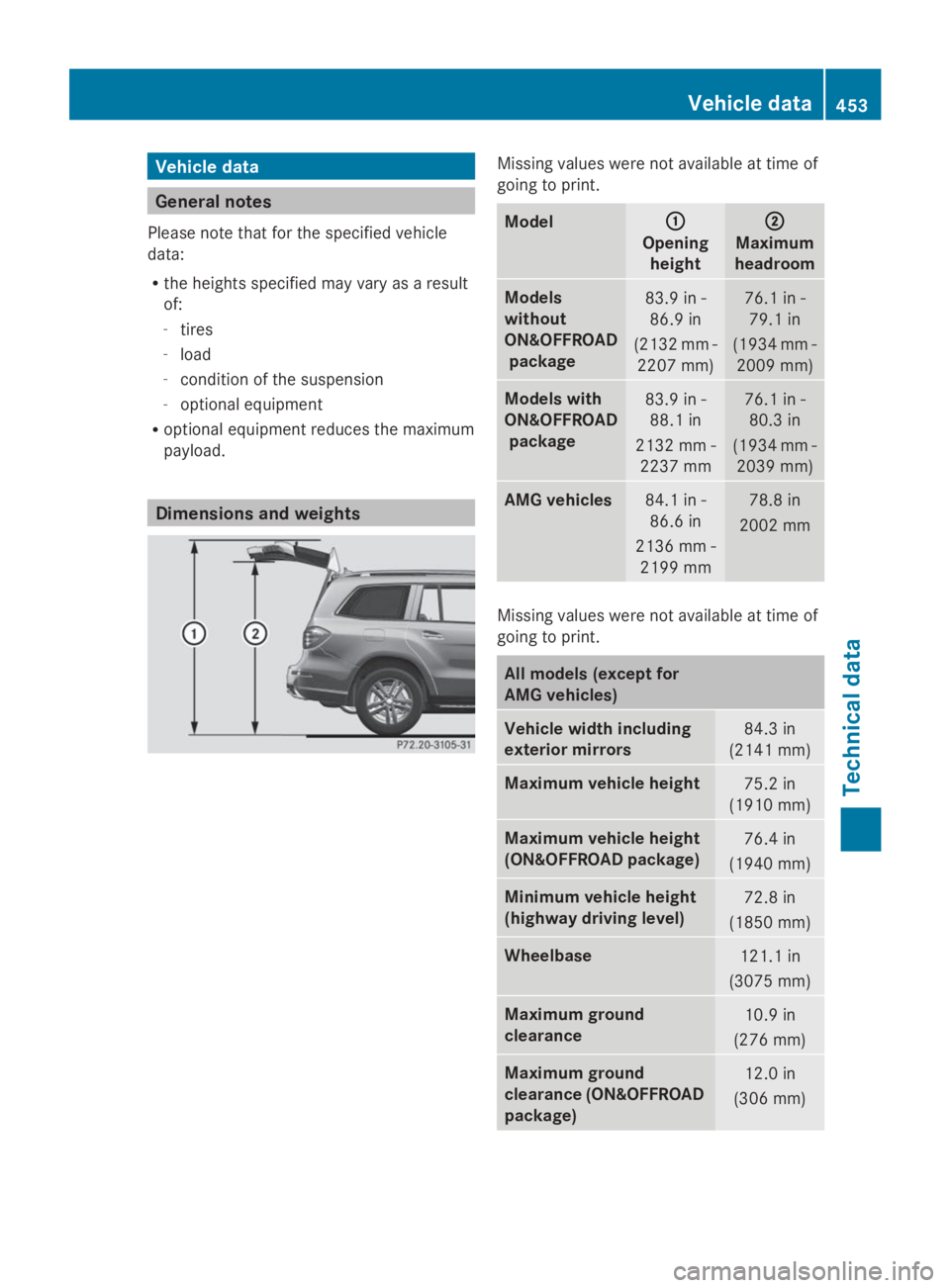
ModelCC
Opening
height
DD
Maximum
headroom
Models
without
ON&OFFROAD
package
83.9 in -
86.9 in
(2132 mm -
2207 mm)
76.1 in -
79.1 in
(1934 mm -
2009 mm)
Models with
ON&OFFROAD
package
83.9 in -
88.1 in
2132 mm -
2237 mm
76.1 in -
80.3 in
(1934 mm -
2039 mm)
AMG vehicles84.1 in -
86.6 in
2136 mm -
2199 mm
78.8 in
2002 mm
Missing values were not available at time of
going to print.
All models (except for
AMG vehicles)
Vehicle width including
exterior mirrors
84.3 in
(2141 mm)
Maximum vehicle height75.2 in
(1910 mm)
Maximum vehicle height
(ON&OFFROAD package)
76.4 in
(1940 mm)
Minimum vehicle height
(highway driving level)
72.8 in
(1850 mm)
Wheelbase121.1 in
(3075 mm)
Maximum ground
clearance
10.9 in
(276 mm)
Maximum ground
clearance (ON&OFFROAD
package)
12.0 in
(306 mm)
Vehicle data453
Technical data
Z
Page 456 of 462
All models (except for
AMG vehicles)
Minimum ground
clearance
7.9 in
(201 mm)
Turning radius40.7 ft
(12.40 m)
Maximum roof load220 lb
(100 kg)
Model (except AMG
vehicles)
Vehicle
length
GL 450 4MATIC
GL 350 BlueTEC 4MATIC
201.6 in
(5120 mm)
GL 550 4MATIC202.6 in
(5146 mm)
AMG vehicles
Vehicle length202.6 in
(5146 mm)
Vehicle width including
exterior mirrors
84.3 in
(2141 mm)
Vehicle width without
exterior mirrors
78.0 in
(1982 mm)
Maximum vehicle height74.9 in
(1902 mm)
Minimum vehicle height72.4 in
(1839 mm)
Wheelbase121.1 in
(3075 mm)
Maximum ground
clearance
9.8 in
(249 mm)
Minimum ground
clearance
7.4 in
(188 mm)
Turning radius40.8 ft
(12.45 m)
Maximum roof load220 lb
(100 kg)
Vehicle data for off-road driving
Fording depth
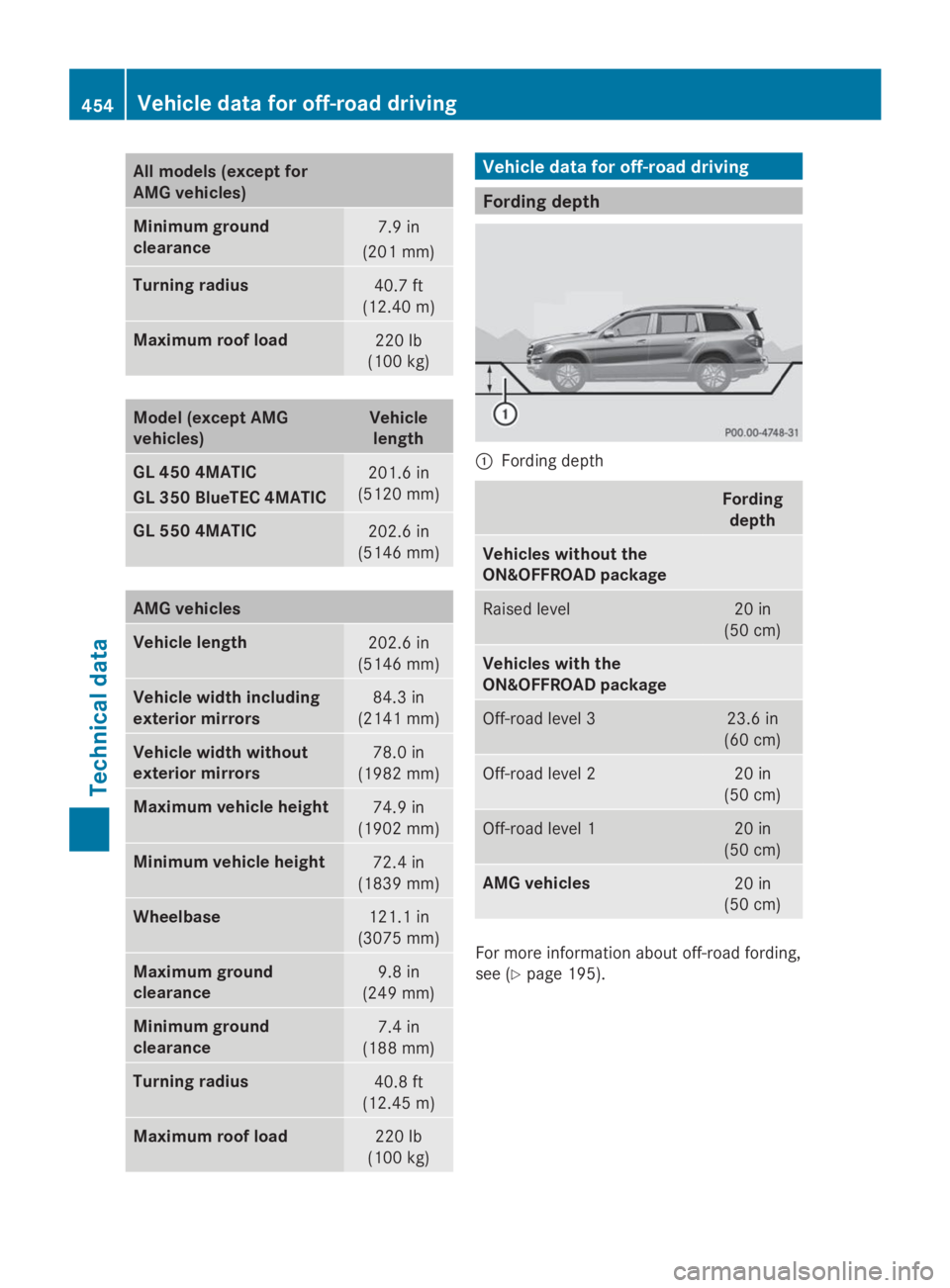
CFording depth
Fording
depth
Vehicles without the
ON&OFFROAD package
Raised level20 in
(50 cm)
Vehicles with the
ON&OFFROAD package
Off-road level 323.6 in
(60 cm)
Off-road level 220 in
(50 cm)
Off-road level 120 in
(50 cm)
AMG vehicles20 in
(50 cm)
For more information about off-road fording,
see (Ypage 195).
454Vehicle data for off-road driving
Technical data