maintenance MERCEDES-BENZ GL 2014 User Guide
[x] Cancel search | Manufacturer: MERCEDES-BENZ, Model Year: 2014, Model line: GL, Model: MERCEDES-BENZ GL 2014Pages: 462, PDF Size: 8.98 MB
Page 188 of 462
DEF (BlueTEC vehicles only)
Important notes on use
To function properly, BlueTEC exhaust gas
aftertreatment must be operated with the
reducing agent DEF. Adding DEF is one of the
tasks performed during maintenance. Under
normal operating conditions, a tank of DEF
lasts until the next service due date.
When the supply of DEF is almost used up,
theCheck Additive See Operator'sCheck Additive See Operator's
ManualManualmessage is shown in the
multifunction display.
If you drive the vehicle faster than 10 mph
(16 km/h), theCheck Additive SeeCheck Additive See
Operator'sOperator'sManualManualmessage goes out after
approximately one minute.
When the supply of DEF is down to a reserve
of approximately 1 gal (3.8 l) theRefillRefill
AdBlue/DEF See Operator's ManualAdBlue/DEF See Operator's Manual
message is shown in the multifunction
display.
When the DEF supply drops to a minimum, the
Remaining Starts: 16Remaining Starts: 16message is shown
in the multifunction display.
If theRefill AdBlue/DEF No Start inRefill AdBlue/DEF No Start in
XXXX kmXXXX kmmessage is shown in the
multifunction display, you can still drive the
vehicle over the distance shown. If DEF is not
refilled, you will subsequently beunable to
start the engine. If theRefill AdBlue/Refill AdBlue/
DEF Eng. Start Not PossDEF Eng. Start Not Possmessage
appears in the multifunction display and the
engine does not start, you must add DEF.
XAdd at least 1 gal(3.8l) of DEF.
XSwitch on the ignition for at least 60
seconds.
XStart the engine.
iHave the DEF tank refilled at a qualified
specialist workshop.
Use the special DEF refill bottle when adding
DEF between maintenance intervals. Contact
an authorized Mercedes-Benz Center with
any questions or, if necessary, contact
Roadside Assistance (Ypage 25).
If the outside temperature is below 12 ‡
(
Page 194 of 462
a distance of 44 ft (approximately 14 m) per
second.
Drive sensibly – save fuel
Observe the following tips to save fuel:
XThe tires should always be inflated to the
recommended tire pressure.
XRemove unnecessary loads.
XRemove roof carriers when they are not
needed.
XWarm up the engine at low engine speeds.
XAvoid frequent acceleration or braking.
XHave all maintenance work carried out as
indicated by the service intervals in the
Maintenance Booklet or by the service
interval display.
Fuel consumption also increases when
driving in cold weather, in stop-start traffic
and in hilly terrain.
Drinking and driving
GWARNING
Drinking and driving and/or taking drugs and
driving are very dangerous combinations.
Even a small amount of alcohol or drugs can
affect your reflexes, perceptions and
judgment.
The possibility of a serious or even fatal
accident is greatly increased when you drink
or take drugs and drive.
Do not drink or take drugs and drive or allow
anyone to drive who has been drinking or
taking drugs.
Emission control
GWARNING
Combustion engines emit poisonous exhaust
gases such as carbon monoxide. Inhaling
these exhaust gases leads to poisoning. There
is a risk of fatal injury. Therefore never leave
the engine running in enclosed spaces
without sufficient ventilation.
Certain engine systems are designed to keep
the level of poisonous components in exhaust
fumes within legal limits.
These systems only work at peak efficiency if
they are serviced exactly in accordance with
the manufacturer's specifications. For this
reason, all work on the engine must be carried
out by qualified and authorized Mercedes-
Benz technicians.
The engine settings must not be changed
under any circumstances. Furthermore, all
specific service work must be carried out at
regular intervals and in accordance with the
Mercedes-Benz service requirements. Details
can be found in the Maintenance Booklet.
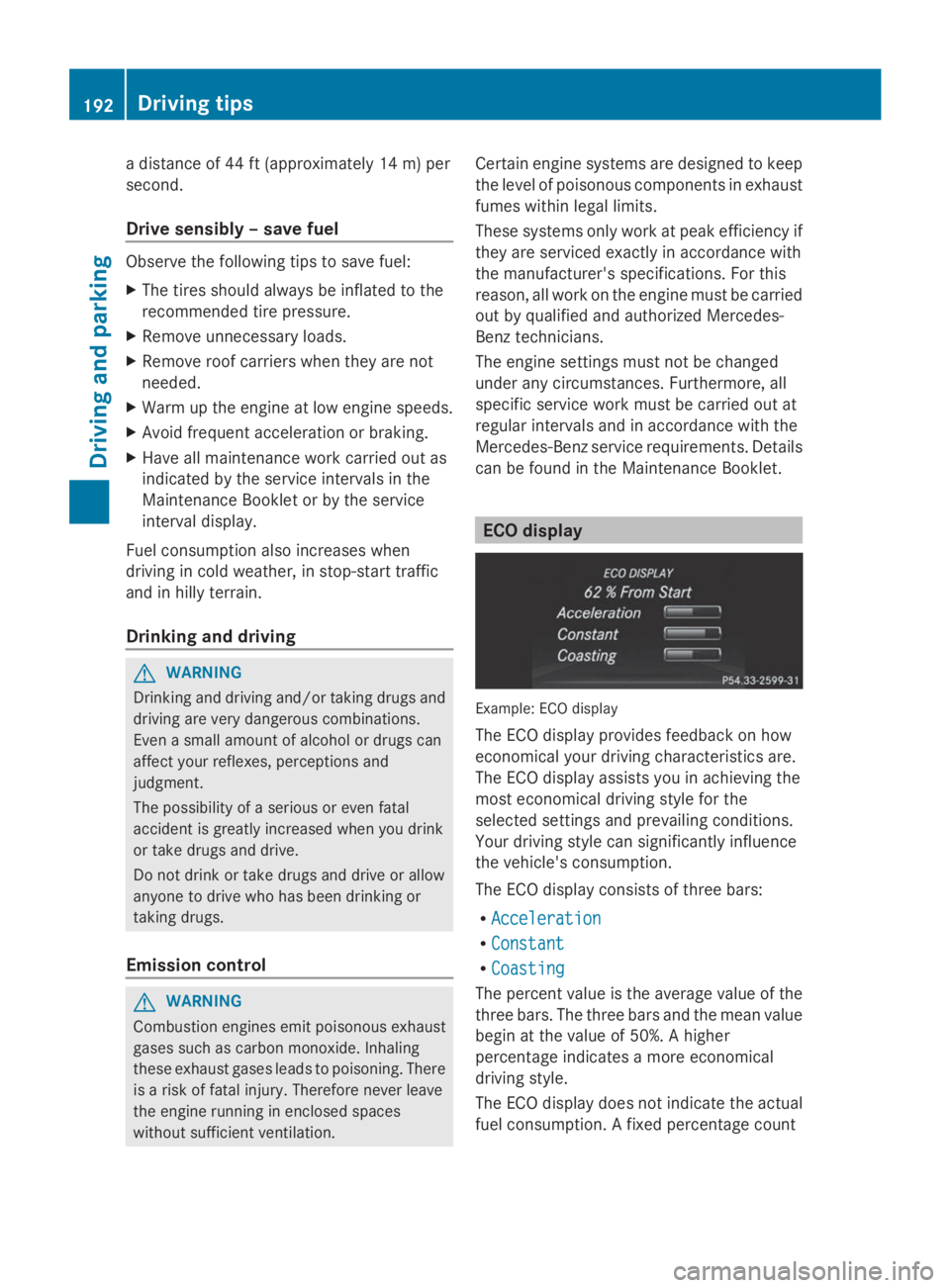
ECO display
Example: ECO display
The ECO display provides feedback on how
economical your driving characteristics are.
The ECO display assists you in achieving the
most economical driving style for the
selected settings and prevailing conditions.
Your driving style can significantly influence
the vehicle's consumption.
The ECO display consists of three bars:
RAccelerationAcceleration
RConstantConstant
RCoastingCoasting
The percent value is the average value of the
three bars. The three bars and the mean value
begin at the value of 50%. A higher
percentage indicates a more economical
driving style.
The ECO display does not indicate the actual
fuel consumption. A fixed percentage count
192Driving tips
Driving and parking
Page 196 of 462
increases the stopping distance and can even
cause the braking system to fail. There is a
risk of an accident.
Never use the brake pedal as a footrest. Never
depress the brake pedal and the accelerator
pedal at the same time.
!Depressing the brake pedal constantly
results in excessive and premature wear to
the brake pads.
If the brakes have been subjected to a heavy
load, do not stop the vehicle immediately.
Drive on for a short while. This allows the
airflow to cool the brakes more quickly.
Wet roads
If you have driven for a long time in heavy rain
without braking, there may be a delayed
reaction from the brakes when braking for the
first time. This may also occur after the
vehicle has been washed or driven through
deep water.
You then have to depress the brake pedal
more firmly. Maintain a greater distance from
the vehicle in front.
After driving on a wet road or having the
vehicle washed, brake firmly while paying
attention to the traffic conditions. This will
warm up the brake discs, thereby drying them
more quickly and protecting them against
corrosion.
Limited braking performance on salt-
treated roads
If you drive on salted roads, a layer of salt
residue may form on the brake discs and
brake pads. This can result in a significantly
longer braking distance.
RBrake occasionally to remove any possible
salt residue. Make sure that you do not
endanger other road users when doing so.
RCarefully depress the brake pedal and the
beginning and end of a journey.
RMaintain a greater distance to the vehicle
ahead.
Servicing the brakes
!If the red brake warning lamp lights up in
the instrument cluster and you hear a
warning tone while the engine is running,
the brake fluid level may be too low.
Observe additional warning messages in
the multifunction display.
The brake fluid level may be too low due to
brake pad wear or leaking brake lines.
Have the brake system checked
immediately. This work should be carried
out at a qualified specialist workshop.
!A function or performance test should
only be carried out on a 2-axle
dynamometer. If you are planning to have
the vehicle tested on such a dynamometer,
contact an authorized Mercedes-Benz
Center to obtain further information first.
Otherwise, you could damage the drive
train or the brake system.
!Because ESP®is an automatic system,
the engine and ignition must be switched
off (SmartKey in position0or1or Start/
Stop button in position0or1) when the
electric parking brake is being tested on a
brake dynamometer (maximum
10 seconds).
Braking triggered automatically by ESP®
may seriously damage the brake system.
All checks and maintenance work on the
brake system must be carried out at a
qualified specialist workshop. Consult a
qualified specialist workshop to arrange this.
Have brake pads installed and brake fluid
replaced at a qualified specialist workshop.
If the brake system has only been subject to
moderate loads, you should test the
functionality of your brakes at regular
intervals. To do so, press firmly on the brake
pedal when driving at a high speed. This
improves the grip of the brake pads.
You can find a description of Brake Assist
(BAS) on (Ypage 68) or of BAS PLUS on
(Ypage 68).
194Driving tips
Driving and parking
Page 284 of 462
Activating/deactivating Lane Keeping
Assist
XPressYoreon the steering wheel
to select theDriveAssistDriveAssistmenu.
XPresscordto selectLaneLane
Keeping AssistKeeping Assist.
XPress thevbutton.
The current selection is displayed.
XPressvto confirm.
XPress thedorcbutton to setOffOff,
StandardStandardorAdaptiveAdaptive.
When Lane Keeping Assist or Active Lane
Keeping Assist is activated, the
multifunction display shows the lane
markings as bright lines in the assistance
graphic.
XPress thevbutton to save the setting.
For further information about Lane Keeping
Assist, see (Ypage 245).
For further information about Active Lane
Keeping Assist, see (Ypage 251).
Maintenance menu
In theServServmenu, you have the following
options:
RCalling up display messages in message
memory (Ypage 290)
RRestarting the tire pressure loss warning
system (Ypage 412)
RChecking the tire pressure electronically
(Ypage 412)
RCalling up the service due date
(Ypage 375)
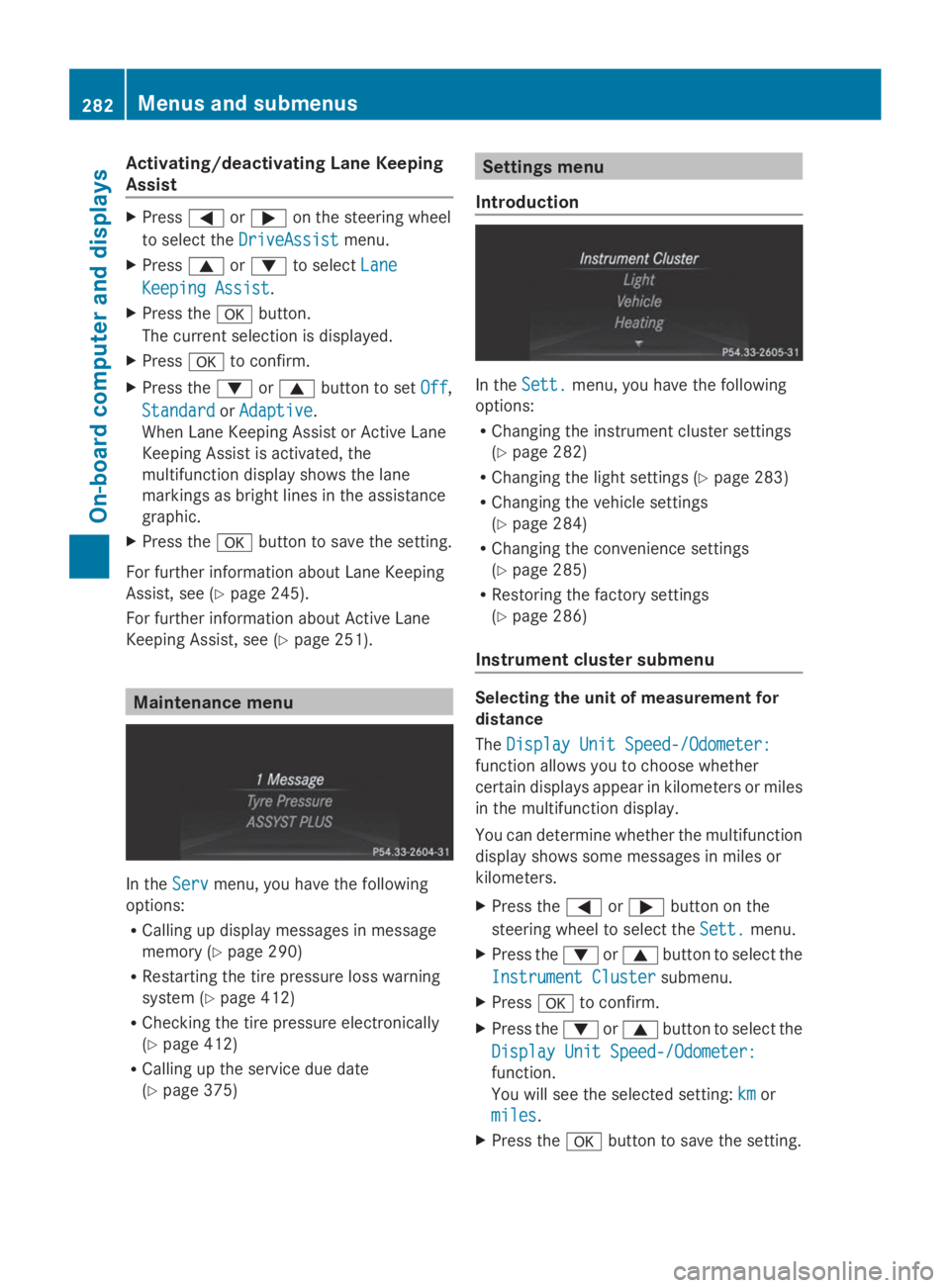
Settings menu
Introduction
In theSett.Sett.menu, you have the following
options:
RChanging the instrument cluster settings
(Ypage 282)
RChanging the light settings (Ypage 283)
RChanging the vehicle settings
(Ypage 284)
RChanging the convenience settings
(Ypage 285)
RRestoring the factory settings
(Ypage 286)
Instrument cluster submenu
Selecting the unit of measurement for
distance
TheDisplay Unit Speed-/Odometer:Display Unit Speed-/Odometer:
function allows you to choose whether
certain displays appear in kilometers or miles
in the multifunction display.
You can determine whether the multifunction
display shows some messages in miles or
kilometers.
XPress theYorebutton on the
steering wheel to select theSett.Sett.menu.
XPress thedorcbutton to select the
Instrument ClusterInstrument Clustersubmenu.
XPressvto confirm.
XPress thedorcbutton to select the
Display Unit Speed-/Odometer:Display Unit Speed-/Odometer:
function.
You will see the selected setting:kmkmor
milesmiles.
XPress thevbutton to save the setting.
282Menus and submenus
On-b oard computer and displays
Page 365 of 462
about various special offers at your
workshop.
Rmonthly status information e-mail on oil
level, air pressure, maintenance, brakes,
etc. If applicable, you will receive
information on special offers in the e-mail.
USA only: this information can also be
called up under "Owners Online" at http://
www.mbusa.com.
Information on the data stored in the vehicle
(Ypage 29).
Information on Roadside Assistance
(Ypage 25).
Downloading routes
Downloading routes allows you to transfer
and save predefined routes in the navigation
system. To do this, an SD memory card must
be inserted into the COMAND system. If no
SD memory card is inserted, you must insert
the card into the card slot on the COMAND
system before saving.
A route can be prepared and sent either by a
customer service representative or via the
mbrace portal on the Internet.
Each route can include up to 20 way points.
Once a route has been received by the
navigation system, you will see the
Do you want to start routeDo you want to start route
guidance?guidance?message in the COMAND display.
The route is saved to the SD memory card.
XTo start route guidance:selectYesYes.
An overview of the route is shown in the
display.
iIf you selectNoNo, the saved route can be
called up later via the navigation menu.
XSelectStartStart.
Route guidance is started.
iDownloaded and saved data can be called
up again in COMAND.
You can find further information in the
separate COMAND Operating Instructions.
Speed alert
You can define the upper speed limit, which
must not be exceeded by the vehicle.
If this selected speed is exceeded by the
vehicle, a message will be sent to the
Customer Assistance center. The Customer
Assistance center then forwards this
information to you.
You can select the way in which you receive
this information beforehand. Possible options
include text message, e-mail or an automated
call.
The data you receive contains the following
information:
Rthe location where the speed limit was
exceeded
Rthe time at which the speed limit was
exceeded
Rthe selected speed limit which was
exceeded
Geo fencing
Geo fencing allows you to select areas which
the vehicle should not enter or leave. You will
be informed if the vehicle crosses the
boundaries of the selected areas. You can
select the way in which you receive this
information beforehand. Possible options
include text message, e-mail or an automated
call.
The area can be determined as either a circle
or a polygon with a maximum of ten corners.
You can specify up to ten areas
simultaneously. Different settings are
possible for each area.
USA only: these settings can be called up
under "Owners Online" at http://
www.mbusa.com.
Alternatively, you can trigger an MB Info call
and inform the customer service
representative that you wish to activate geo
fencing.
Currently inactive areas can be activated by
text message.
Features363
Stowage and features
Z
Page 371 of 462
Useful information............................370
Engine compartment........................370
ASSYST PLUS....................................374
Care....................................................376
369
Maintenance and care
Page 372 of 462
Useful information
iThis Operator's Manual describes all
models and all standard and optional
equipment of your vehicle available at the
time of publication of the Operator's
Manual. Country-specific differences are
possible. Please note that your vehicle may
not be equipped with all features
described. This also applies to safety-
related systems and functions.
iRead the information on qualified
specialist workshops: (Ypage 28).
Engine compartment
Hood
Important safety notes
GWARNING
If the hood is unlatched, it may open up when
the vehicle is in motion and block your view.
There is a risk of an accident.
Never unlatch the hood while driving.
GWARNING
When opening and closing the hood, it may
suddenly fall into the closed position. There is
a risk of injury to persons within range of
movement of the hood.
Open and close the hood only when no one is
within its range of movement.
GWARNING
Opening the hood when the engine is
overheated or when there is a fire in the
engine compartment could expose you to hot
gases or other service products. There is a
risk of injury.
Let an overheated engine cool down before
opening the hood. If there is a fire in the
engine compartment, keep the hood closed
and contact the fire department.
GWARNING
The engine compartment contains moving
components. Certain components, such as
the radiator fan, may continue to run or start
again suddenly when the ignition is off. There
is a risk of injury.
If you need to do any work inside the engine
compartment:
Rswitch off the ignition
Rnever reach into the area where there is a
risk of danger from moving components,
such as the fan rotation area
Rremove jewelery and watches
Rkeep items of clothing and hair, for
example, away from moving parts
GWARNING
The ignition system and the fuel injection
system work under high voltage. If you touch
components which are under voltage, you
could get an electric shock. There is a risk of
injury.
Never touch components of the ignition
system or fuel injection system when the
ignition is switched on.
Opening the hood
GWARNING
Certain components in the engine
compartment, such as the engine, radiator
and parts of the exhaust system, can become
very hot. Working in the engine compartment
poses a risk of injury.
Where possible, let the engine cool down and
touch only the components described in the
following.
GWARNING
When the hood is open and the windshield
wipers are set in motion, you can be injured
by the wiper linkage. There is a risk of injury.
Always switch off the windshield wipers and
the ignition before opening the hood.
370Engine compartment
Maintenance and care
Page 373 of 462
!Make sure that the windshield wipers are
not folded away from the windshield. You
could otherwise damage the windshield
wipers or the hood.
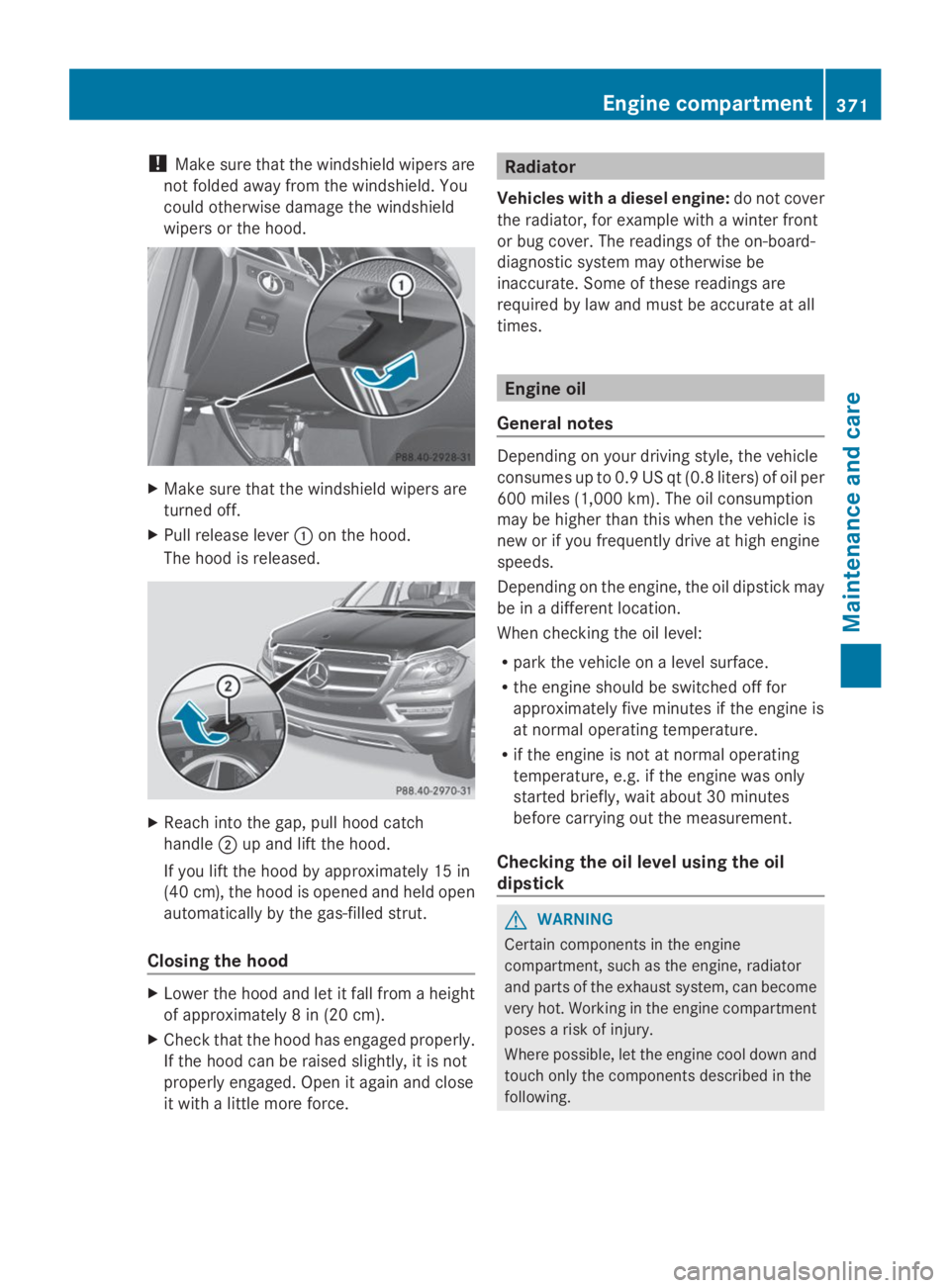
XMake sure that the windshield wipers are
turned off.
XPull release leverCon the hood.
The hood is released.
XReach into the gap, pull hood catch
handleDup and lift the hood.
If you lift the hood by approximately 15 in
(40 cm), the hood is opened and held open
automatically by the gas-filled strut.
Closing the hood
XLower the hood and let it fall from a height
of approximately 8 in (20 cm).
XCheck that the hood has engaged properly.
If the hood can be raised slightly, it is not
properly engaged. Open it again and close
it with a little more force.
Radiator
Vehicles with a diesel engine:do not cover
the radiator, for example with a winter front
or bug cover. The readings of the on-board-
diagnostic system may otherwise be
inaccurate. Some of these readings are
required by law and must be accurate at all
times.
Engine oil
General notes
Depending on your driving style, the vehicle
consumes up to 0.9 US qt (0.8 liters) of oil per
600 miles (1,000 km). The oil consumption
may be higher than this when the vehicle is
new or if you frequently drive at high engine
speeds.
Depending on the engine, the oil dipstick may
be in a different location.
When checking the oil level:
Rpark the vehicle on a level surface.
Rthe engine should be switched off for
approximately five minutes if the engine is
at normal operating temperature.
Rif the engine is not at normal operating
temperature, e.g. if the engine was only
started briefly, wait about 30 minutes
before carrying out the measurement.
Checking the oil level using the oil
dipstick
GWARNING
Certain components in the engine
compartment, such as the engine, radiator
and parts of the exhaust system, can become
very hot. Working in the engine compartment
poses a risk of injury.
Where possible, let the engine cool down and
touch only the components described in the
following.
Engine compartment371
Maintenance and care
Z
Page 376 of 462
XIf necessary, add coolant that has been
tested and approved by Mercedes-Benz.
XReplace capCand turn it clockwise as far
as it will go.
For further information on coolant, see
(Ypage 450).
Adding washer fluid to the windshield
washer system
GWARNING
Certain components in the engine
compartment, such as the engine, radiator
and parts of the exhaust system, can become
very hot. Working in the engine compartment
poses a risk of injury.
Where possible, let the engine cool down and
touch only the components described in the
following.
GWARNING
Windshield washer concentrate is highly
flammable. If it comes into contact with hot
engine components or the exhaust system it
could ignite. There is a risk of fire and injury.
Make sure that no windshield washer
concentrate is spilled next to the filler neck.
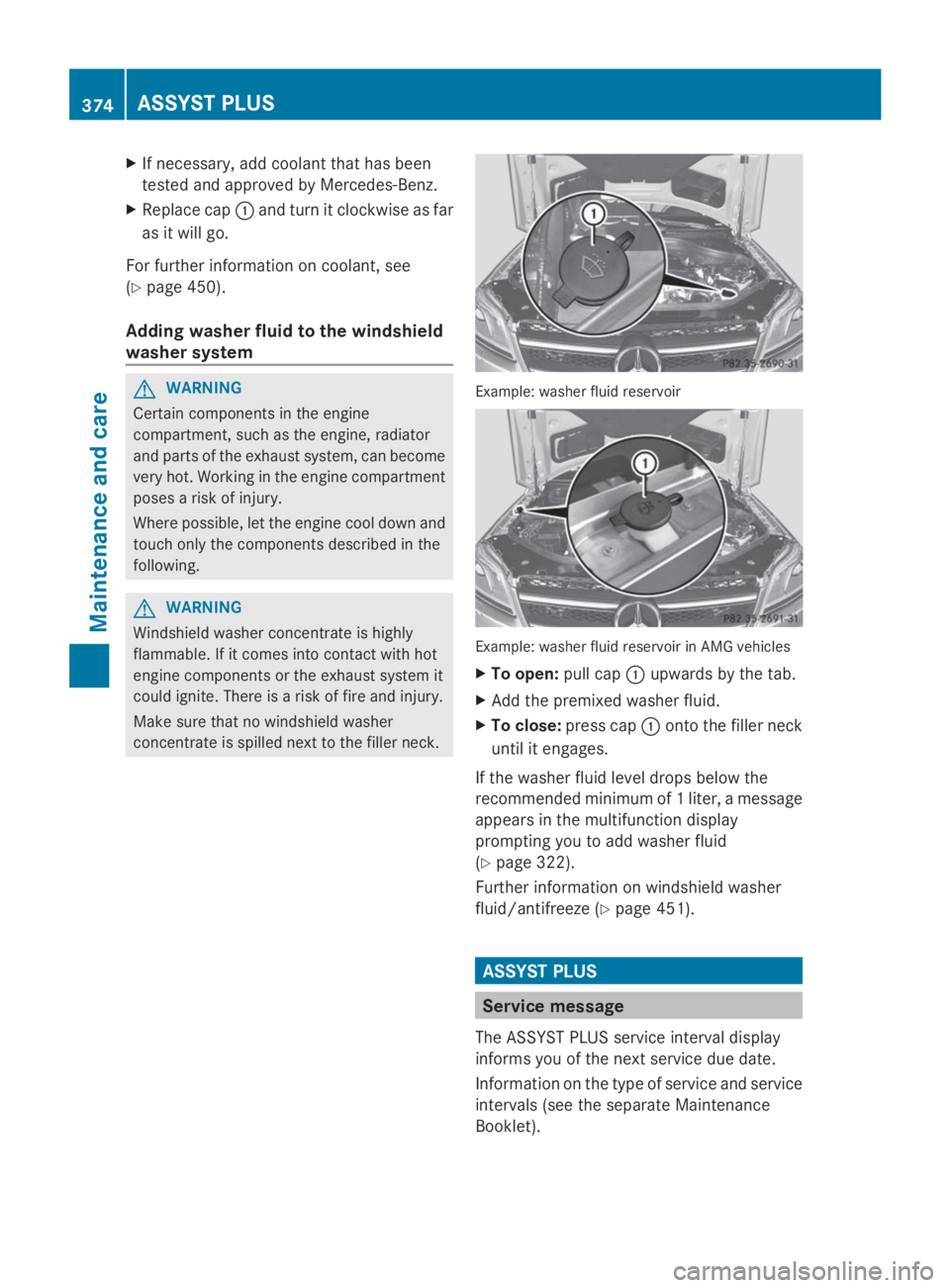
Example: washer fluid reservoir
Example: washer fluid reservoir in AMG vehicles
XTo open:pull capCupwards by the tab.
XAdd the premixed washer fluid.
XTo close:press capConto the filler neck
until it engages.
If the washer fluid level drops below the
recommended minimum of 1 liter, a message
appears in the multifunction display
prompting you to add washer fluid
(Ypage 322).
Further information on windshield washer
fluid/antifreeze (Ypage 451).
ASSYST PLUS
Service message
The ASSYST PLUS service interval display
informs you of the next service due date.
Information on the type of service and service
intervals (see the separate Maintenance
Booklet).
374ASSYST PLUS
Maintenance and care
Page 377 of 462
You can obtain further information from an
authorized Mercedes-Benz Center or at
http://www.mbusa.com (USA only).
iThe ASSYST PLUS service interval display
does not show any information on the
engine oil level. Observe the notes on the
engine oil level (Ypage 371).
The multifunction display shows a service
message for several seconds, e.g.:
RService A in .. DaysService A in .. Days
RService A DueService A Due
RService A Exceeded by .. DaysService A Exceeded by .. Days
Depending on the operating conditions of the
vehicle, the remaining time or distance until
the next service due date is displayed.
The letterAAorBB, possibly in connection with
a number or another letter, shows the type of
service.AAstands for a minor service andBBfor
a major service.
You can obtain further information from an
authorized Mercedes-Benz Center.
The ASSYST PLUS service interval display
does not take into account any periods of
time during which the battery is
disconnected.
Maintaining the time-dependent service
schedule:
XNote down the service due date displayed
in the multifunction display before
disconnecting the battery.
or
XAfter reconnecting the battery, subtract
the battery disconnection periods from the
service date shown on the display.
Hiding a service message
XPress the8orvbutton on the
steering wheel.
Displaying service messages
XSwitch on the ignition.
XPress theYorebutton on the
steering wheel to select theServ.Serv.menu.
XPress thecordbutton to select the
ASSYST PLUSASSYST PLUSsubmenu and confirm by
pressing thevbutton.
The service due date appears in the
multifunction display.
Information about Service
Resetting the ASSYST PLUS service
interval display
!If the ASSYST PLUS service interval
display has been inadvertently reset, this
setting can be corrected at a qualified
specialist workshop.
Have service work carried out as described
in the Maintenance Booklet. This may
otherwise lead to increased wear and
damage to the major assemblies or the
vehicle.
A qualified specialist workshop, e.g. an
authorized Mercedes-Benz Center, will reset
the ASSYST PLUS service interval display
after the service work has been carried out.
You can also obtain further information on
maintenance work, for example.
Special service requirements
The specified maintenance interval takes only
the normal operation of the vehicle into
account. Under arduous operating conditions
or increased load on the vehicle,
maintenance work must be carried out more
frequently, for example:
Rregular city driving with frequent
intermediate stops
Rif the vehicle is primarily used to travel
short distances
ASSYST PLUS375
Maintenance and care
Z