ESP MERCEDES-BENZ GL 2014 Manual PDF
[x] Cancel search | Manufacturer: MERCEDES-BENZ, Model Year: 2014, Model line: GL, Model: MERCEDES-BENZ GL 2014Pages: 462, PDF Size: 8.98 MB
Page 264 of 462
Messages in the multifunction display
If a gear change process has not been successful, the following messages may be displayed
in the multifunction display:
Display messagesPossible causes/consequences andPPSolutions
LOW RANGE Max.LOW RANGE Max.
Speed 40 km/hSpeed 40 km/h
You have been driving faster than 40 km/h. Additionally, the
indicator lamp on the button in the center console blinks.
XDrive more slowly to carry out the gear change process.
LOWLOWRANGERANGEShiftShifttoto
Position N BrieflyPosition N Briefly
The transmission is in positionDand you are driving at below
40 km/h.
XShift the transmission toNto complete the gear change
process.
LOWLOWRANGERANGEShiftingShifting
Canceled PleaseCanceled Please
ReactivateReactivate
The gear change process was not carried out.
XEnsure that all gear change conditions are fulfilled and carry out
the gear change process again.
LOW RANGE StopLOW RANGE Stop
ApplyApplyParkingParkingBrakeBrake
A warning tone also sounds. The gear change process has not been
completed. LOW RANGE is in the neutral position. There is no
connection between the engine and the drive wheels.
!Do not drive any further. You could otherwise damage the
vehicle's drive train.
XStop the vehicle. Take into account the road and traffic
conditions when doing this.
XDepress the electric parking brake (Ypage 189).
XCarry out the gear change process again.
If the gear change process has been carried out, theLOWLOWRANGERANGE
Stop Apply Parking BrakeStop Apply Parking Brakemessage disappears.
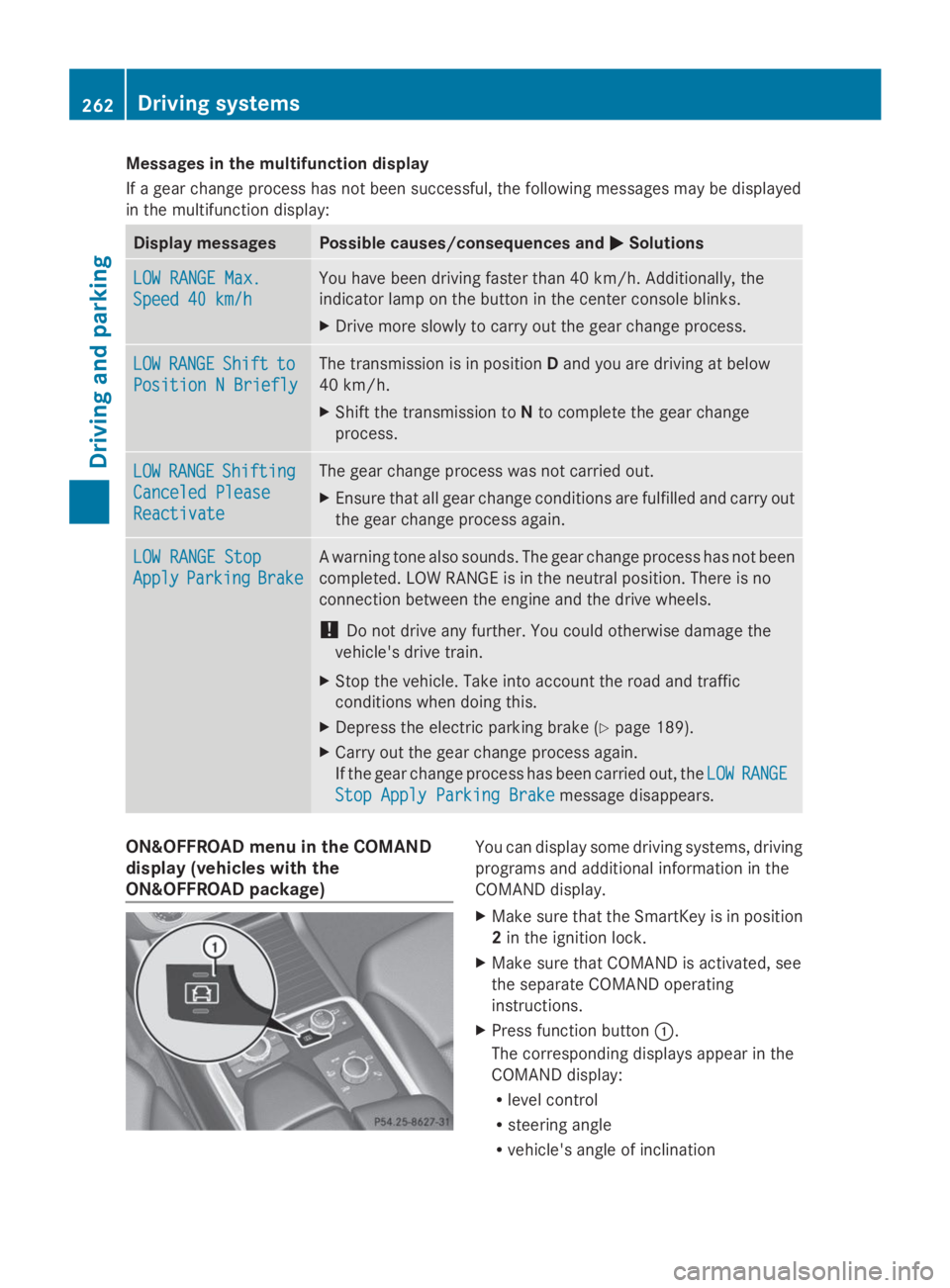
ON&OFFROAD menu in the COMAND
display (vehicles with the
ON&OFFROAD package)
You can display some driving systems, driving
programs and additional information in the
COMAND display.
XMake sure that the SmartKey is in position
2in the ignition lock.
XMake sure that COMAND is activated, see
the separate COMAND operating
instructions.
XPress function buttonC.
The corresponding displays appear in the
COMAND display:
Rlevel control
Rsteering angle
Rvehicle's angle of inclination
262Driving systems
Driving and parking
Page 265 of 462
Ruphill or downhill gradient in percentage
Ron-road/off-road program selected
Rcondition of the differential lock for the
transfer case
Rthe LOW RANGE off-road gear is selected
Rcondition of the LOW RANGE off-road
gear
Rthe on-road trailer program is selected
Towing a trailer
Important safety notes
GWARNING
Installing an unsuitable ball coupling may
result in overloading of the trailer tow hitch
and the rear axle. This applies especially if the
ball coupling in question is longer or angled
differently. This could seriously impair the
driving characteristics and the trailer can
come loose. There is a risk of an accident.
You should only ever install a ball coupling
that has the permissible dimensions and that
is designed to meet your trailer-towing
requirements. Do not modify the ball coupling
or the trailer tow hitch.
You will find the values approved by the
manufacturer on the vehicle identification
plates and those for the towing vehicle under
"Technical data" (Ypage 457).
GWARNING
If the ball coupling is not installed correctly or
not secured with the bolt provided and the
corresponding spring cotter, the trailer may
come loose. There is a risk of an accident.
Always install and secure the ball coupling as
described. Before every journey, ensure that
the ball coupling is secured with the bolt and
the corresponding spring cotter.
GWARNING
If you rest your foot on the brake pedal while
driving, the braking system can overheat. This
increases the stopping distance and can even
cause the braking system to fail. There is a
risk of an accident.
Never use the brake pedal as a footrest. Never
depress the brake pedal and the accelerator
pedal at the same time.
GWARNING
When the vehicle/trailer combination begins
to lurch, you could lose control of it. The
vehicle/trailer combination could even
rollover. There is a risk of an accident.
On no account should you attempt to
straighten up the vehicle/trailer combination
by increasing the speed. Reduce vehicle
speed and do not countersteer. Apply the
brake as necessary.
!Depressing the brake pedal constantly
results in excessive and premature wear to
the brake pads.
Please observe the manufacturer's operating
instructions for the trailer coupling if a
detachable trailer coupling is used.
Couple and uncouple the trailer carefully. If
you do not couple the trailer to the towing
vehicle correctly, the trailer could become
detached.
Make sure that the following values are not
exceeded:
Rthe permissible trailer drawbar noseweight
Rthe permissible trailer load
Rthe permissible rear axle load of the towing
vehicle
Rthe maximum permissible gross vehicle
weight of both the towing vehicle and the
trailer
The applicable permissible values, which
must not be exceeded, can be found:
Rin the vehicle documents
Ron the identification plates for the trailer
tow hitch and the trailer
Ron the vehicle identification plate
If the values differ, the lowest value applies.
Towing a trailer263
Driving and pa rking
Z
Page 266 of 462
When towing a trailer, your vehicle's handling
characteristics will be different in comparison
with when driving without a trailer.
The vehicle/trailer combination:
Ris heavier
Ris restricted in its acceleration and
gradient-climbing capability
Rhas an increased braking distance
Ris affected more by strong crosswinds
Rdemands more sensitive steering
Rhas a larger turning radius
This could impair the handling
characteristics.
When towing a trailer, always adjust your
speed to the current road and weather
conditions. Do not exceed the maximum
permissible speed for your vehicle/trailer
combination.
Notes on towing a trailer
General notes
RDo not exceed the legally prescribed
maximum speed for vehicle/trailer
combinations in the relevant country.
This lowers the risk of an accident.
ROnly install an approved trailer coupling on
your vehicle.
Further information on availability and on
installation is available from any authorized
Mercedes-Benz Center.
RThe bumpers of your vehicle are not
suitable for installing detachable trailer
couplings.
RDo not install hired trailer couplings or
other detachable trailer couplings on the
bumpers of your vehicle.
RIf you no longer need the ball coupling,
remove it from the ball coupling recess.
This will reduce the risk of damage to the
ball coupling.
iWhen towing a trailer, set the tire
pressure on the rear axle of the towing
vehicle for a maximum load; see the tire
pressure table in the fuel filler flap
(Ypage 425).
Please note that when towing a trailer,
PARKTRONIC (Ypage 222) and Blind Spot
Assist (Ypage 243) are only available with
limitations, or not at all.
You will find installing dimensions and loads
under "Technical data" (Ypage 456).
Driving tips
iObserve the information on ESP®trailer
stabilization (Ypage 74) and on pulling
away with a trailer (Ypage 170).
The maximum permissible speed for vehicle/
trailer combinations depends on the type of
trailer. Before beginning the journey, check
the trailer's documents to see what the
maximum permissible speed is. Observe the
legally prescribed maximum speed in the
relevant country.
For certain Mercedes-Benz vehicles, the
maximum permissible rear axle load is
increased when towing a trailer. See
"Technical data" to find out whether this
applies to your vehicle (Ypage 457). If you
utilize any of the added maximum rear axle
load when towing a trailer, the vehicle/trailer
combination may not exceed a maximum
speed of 60 mph (100 km/h) for reasons
concerning the operating permit. This also
applies in countries in which the permissible
maximum speed for vehicle/trailer
combinations is above 60 mph (100 km/h).
When towing a trailer, your vehicle's handling
characteristics will be different in comparison
with when driving without a trailer.
Use the left-hand paddle shifter to shift into
a lower gear in good time on long and steep
downhill gradients.
iThis also applies if you have activated
cruise control or DISTRONIC PLUS.
This will use the braking effect of the engine,
so that less braking will be required to
maintain the speed. This relieves the load on
264Towing a trailer
Driving and parking
Page 267 of 462
the brake system and prevents the brakes
from overheating and wearing too quickly. If
you need additional braking, depress the
brake pedal repeatedly rather than
continuously.
Driving tips
If the trailer swings from side to side:
XDo not accelerate.
XDo not counter-steer.
XBrake if necessary.
RMaintain a greater distance from the
vehicle in front than when driving without a
trailer.
RAvoid braking abruptly. If possible, brake
gently at first to allow the trailer to run on.
Then, increase the braking force rapidly.
RThe values given for gradient-climbing
capabilities from a standstill refer to sea
level. When driving in mountainous areas,
note that the power output of the engine
and, consequently, the vehicle's gradient-
climbing capability, decreases with
increasing altitude.
Installing the ball coupling
GWARNING
If the ball coupling is not correctly installed
and secured, it can come loose during the
journey and endanger other road users. There
is a risk of an accident and injury.
Always install and secure the ball coupling as
described. Before every journey, ensure that
the ball coupling is secured with the bolt and
the corresponding spring cotter.
GWARNING
If the ball coupling is not installed correctly or
not secured with the bolt provided and the
corresponding spring cotter, the trailer may
come loose. There is a risk of an accident.
Always install and secure the ball coupling as
described. Before every journey, ensure that
the ball coupling is secured with the bolt and
the corresponding spring cotter.
GWARNING
If the ball coupling is not installed and secured
correctly the trailer may come loose. There is
a risk of an accident.
Install and secure the ball coupling as
described in the ball coupling installation
instructions. Make sure that the ball coupling
is installed and secured correctly before every
journey.
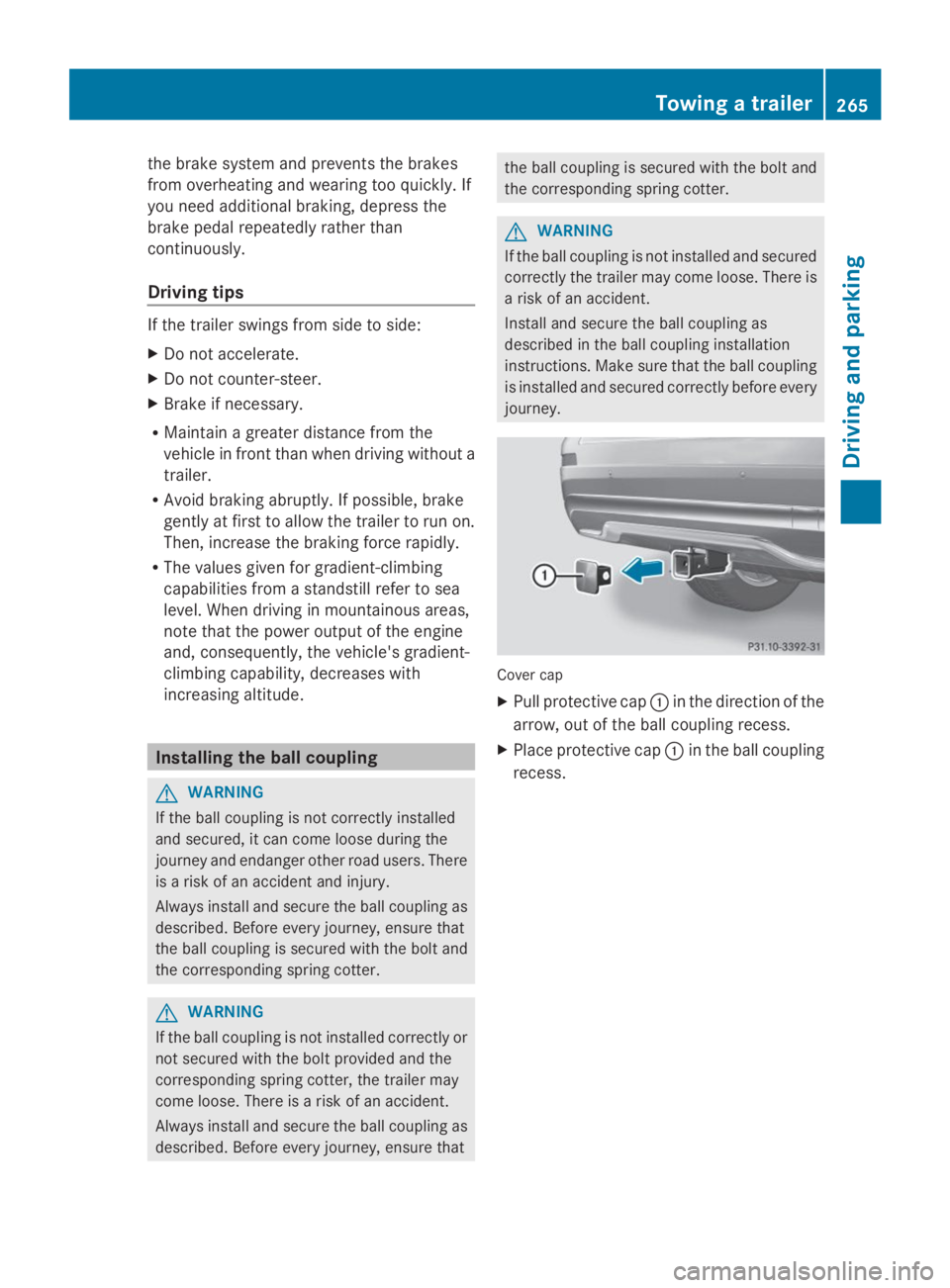
Cover cap
XPull protective capCin the direction of the
arrow, out of the ball coupling recess.
XPlace protective capCin the ball coupling
recess.
Towing a trailer265
Driving an d parking
Z
Page 271 of 462
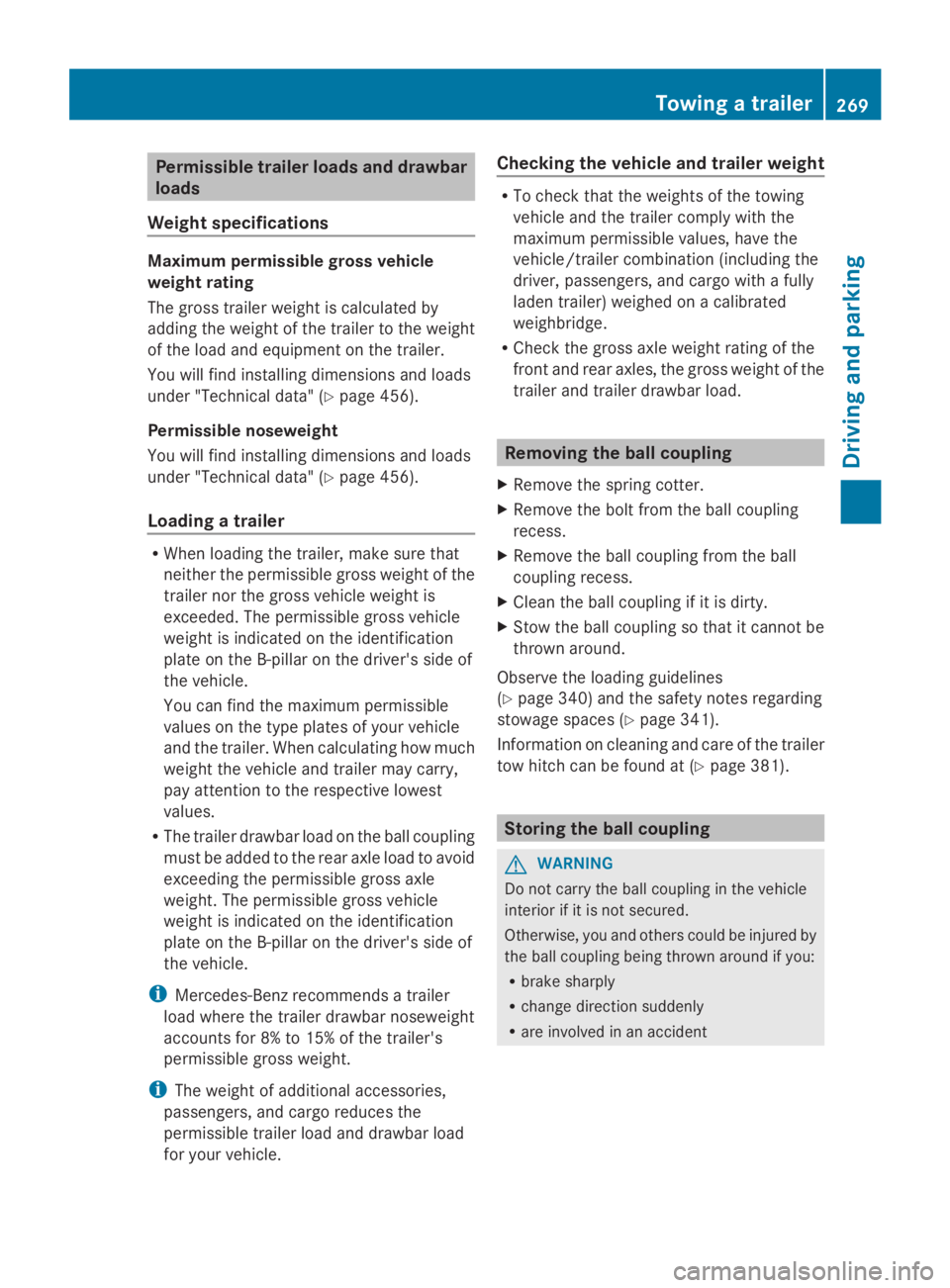
Permissible trailer loads and drawbar
loads
Weight specifications
Maximum permissible gross vehicle
weight rating
The gross trailer weight is calculated by
adding the weight of the trailer to the weight
of the load and equipment on the trailer.
You will find installing dimensions and loads
under "Technical data" (Ypage 456).
Permissible noseweight
You will find installing dimensions and loads
under "Technical data" (Ypage 456).
Loading a trailer
RWhen loading the trailer, make sure that
neither the permissible gross weight of the
trailer nor the gross vehicle weight is
exceeded. The permissible gross vehicle
weight is indicated on the identification
plate on the B-pillar on the driver's side of
the vehicle.
You can find the maximum permissible
values on the type plates of your vehicle
and the trailer. When calculating how much
weight the vehicle and trailer may carry,
pay attention to the respective lowest
values.
RThe trailer drawbar load on the ball coupling
must be added to the rear axle load to avoid
exceeding the permissible gross axle
weight. The permissible gross vehicle
weight is indicated on the identification
plate on the B-pillar on the driver's side of
the vehicle.
iMercedes-Benz recommends a trailer
load where the trailer drawbar noseweight
accounts for 8% to 15% of the trailer's
permissible gross weight.
iThe weight of additional accessories,
passengers, and cargo reduces the
permissible trailer load and drawbar load
for your vehicle.
Checking the vehicle and trailer weight
RTo check that the weights of the towing
vehicle and the trailer comply with the
maximum permissible values, have the
vehicle/trailer combination (including the
driver, passengers, and cargo with a fully
laden trailer) weighed on a calibrated
weighbridge.
RCheck the gross axle weight rating of the
front and rear axles, the gross weight of the
trailer and trailer drawbar load.
Removing the ball coupling
XRemove the spring cotter.
XRemove the bolt from the ball coupling
recess.
XRemove the ball coupling from the ball
coupling recess.
XClean the ball coupling if it is dirty.
XStow the ball coupling so that it cannot be
thrown around.
Observe the loading guidelines
(Ypage 340) and the safety notes regarding
stowage spaces (Ypage 341).
Information on cleaning and care of the trailer
tow hitch can be found at (Ypage 381).
Storing the ball coupling
GWARNING
Do not carry the ball coupling in the vehicle
interior if it is not secured.
Otherwise, you and others could be injured by
the ball coupling being thrown around if you:
Rbrake sharply
Rchange direction suddenly
Rare involved in an accident
Towing a trailer269
Driving and parking
Z
Page 292 of 462
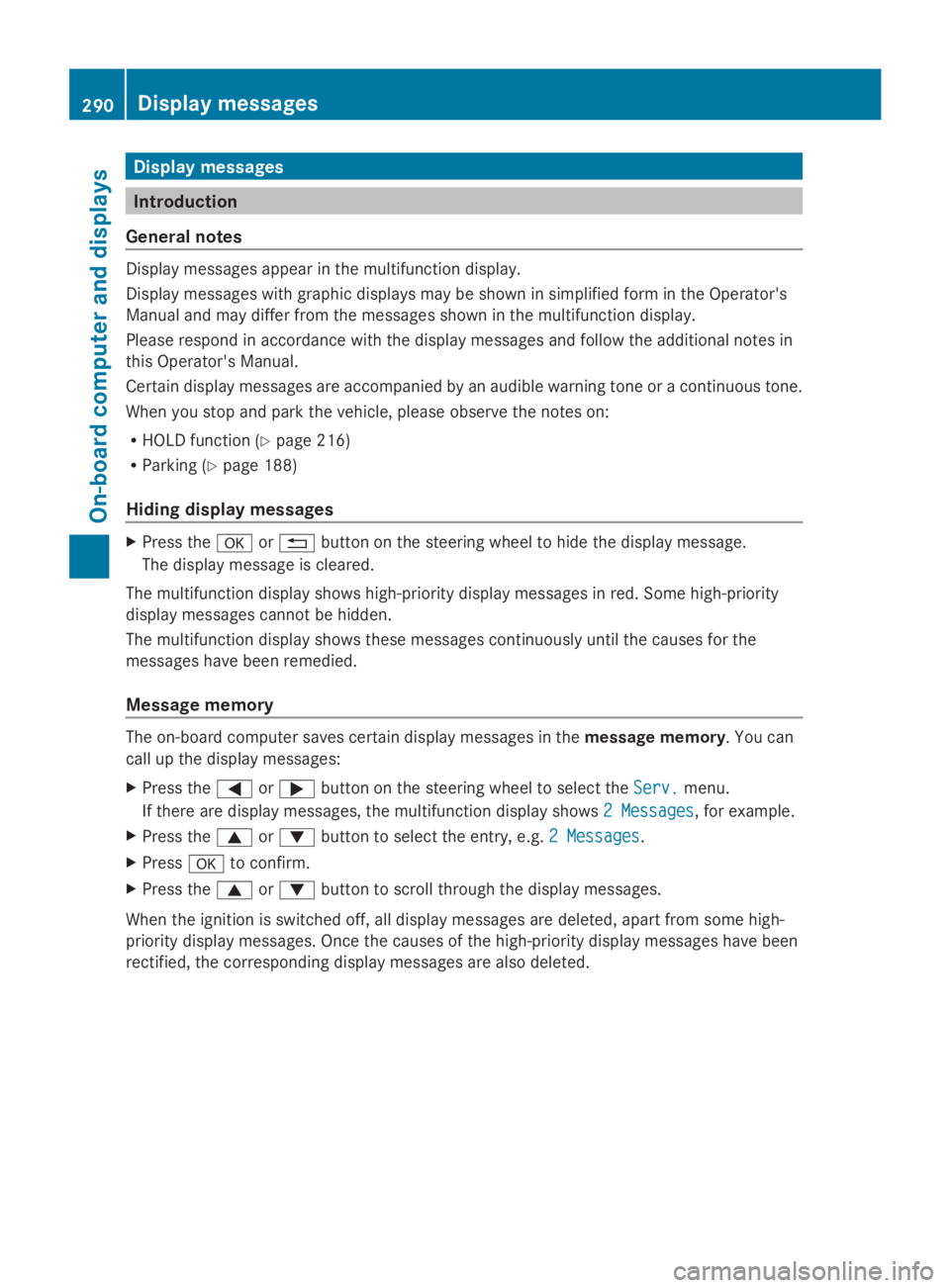
Display messages
Introduction
General notes
Display messages appear in the multifunction display.
Display messages with graphic displays may be shown in simplified form in the Operator's
Manual and may differ from the messages shown in the multifunction display.
Please respond in accordance with the display messages and follow the additional notes in
this Operator's Manual.
Certain display messages are accompanied by an audible warning tone or a continuous tone.
When you stop and park the vehicle, please observe the notes on:
RHOLD function (Ypage 216)
RParking (Ypage 188)
Hiding display messages
XPress thevor8button on the steering wheel to hide the display message.
The display message is cleared.
The multifunction display shows high-priority display messages in red. Some high-priority
display messages cannot be hidden.
The multifunction display shows these messages continuously until the causes for the
messages have been remedied.
Message memory
The on-board computer saves certain display messages in themessage memory. You can
call up the display messages:
XPress theYorebutton on the steering wheel to select theServ.Serv.menu.
If there are display messages, the multifunction display shows2 Messages2 Messages, for example.
XPress thecordbutton to select the entry, e.g.2 Messages2 Messages.
XPressvto confirm.
XPress thecordbutton to scroll through the display messages.
When the ignition is switched off, all display messages are deleted, apart from some high-
priority display messages. Once the causes of the high-priority display messages have been
rectified, the corresponding display messages are also deleted.
290Displaymessages
On-b oard computer and displays
Page 293 of 462
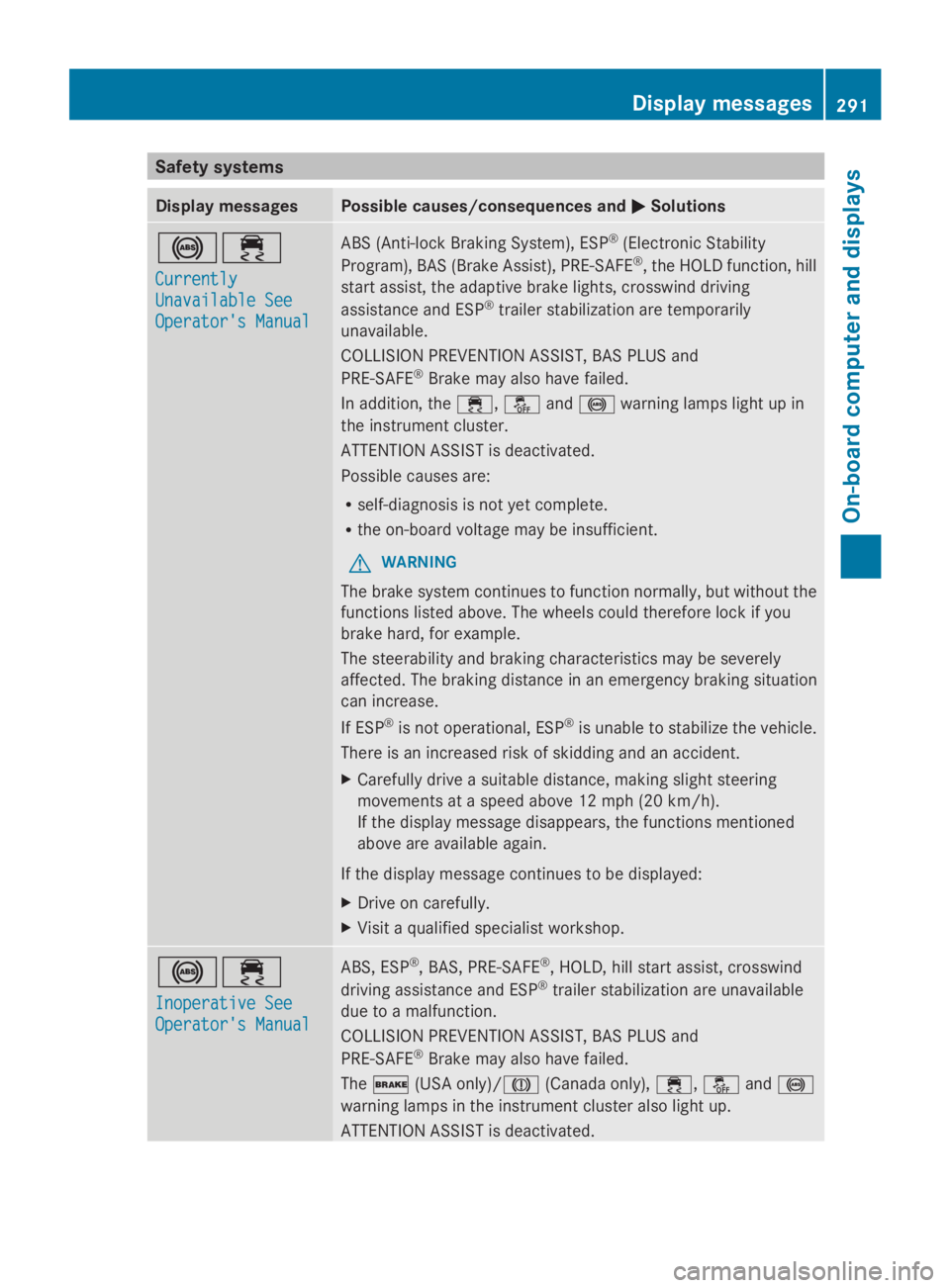
Safety systems
Display messagesPossible causes/consequences andPPSolutions
%
Page 294 of 462
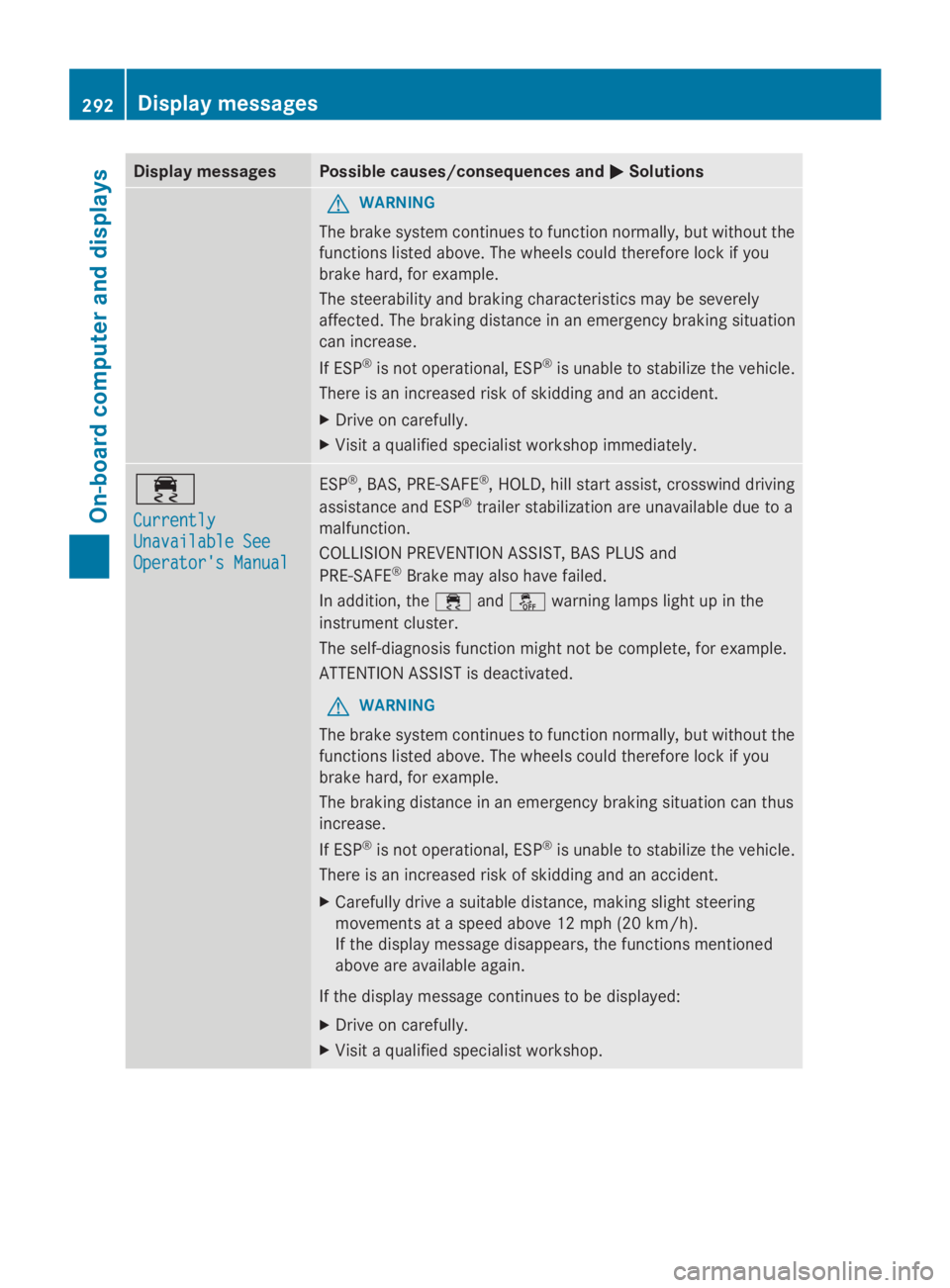
Display messagesPossible causes/consequences andPPSolutions
GWARNING
The brake system continues to function normally, but without the
functions listed above. The wheels could therefore lock if you
brake hard, for example.
The steerability and braking characteristics may be severely
affected. The braking distance in an emergency braking situation
can increase.
If ESP®is not operational, ESP®is unable to stabilize the vehicle.
There is an increased risk of skidding and an accident.
XDrive on carefully.
XVisit a qualified specialist workshop immediately.
Page 295 of 462
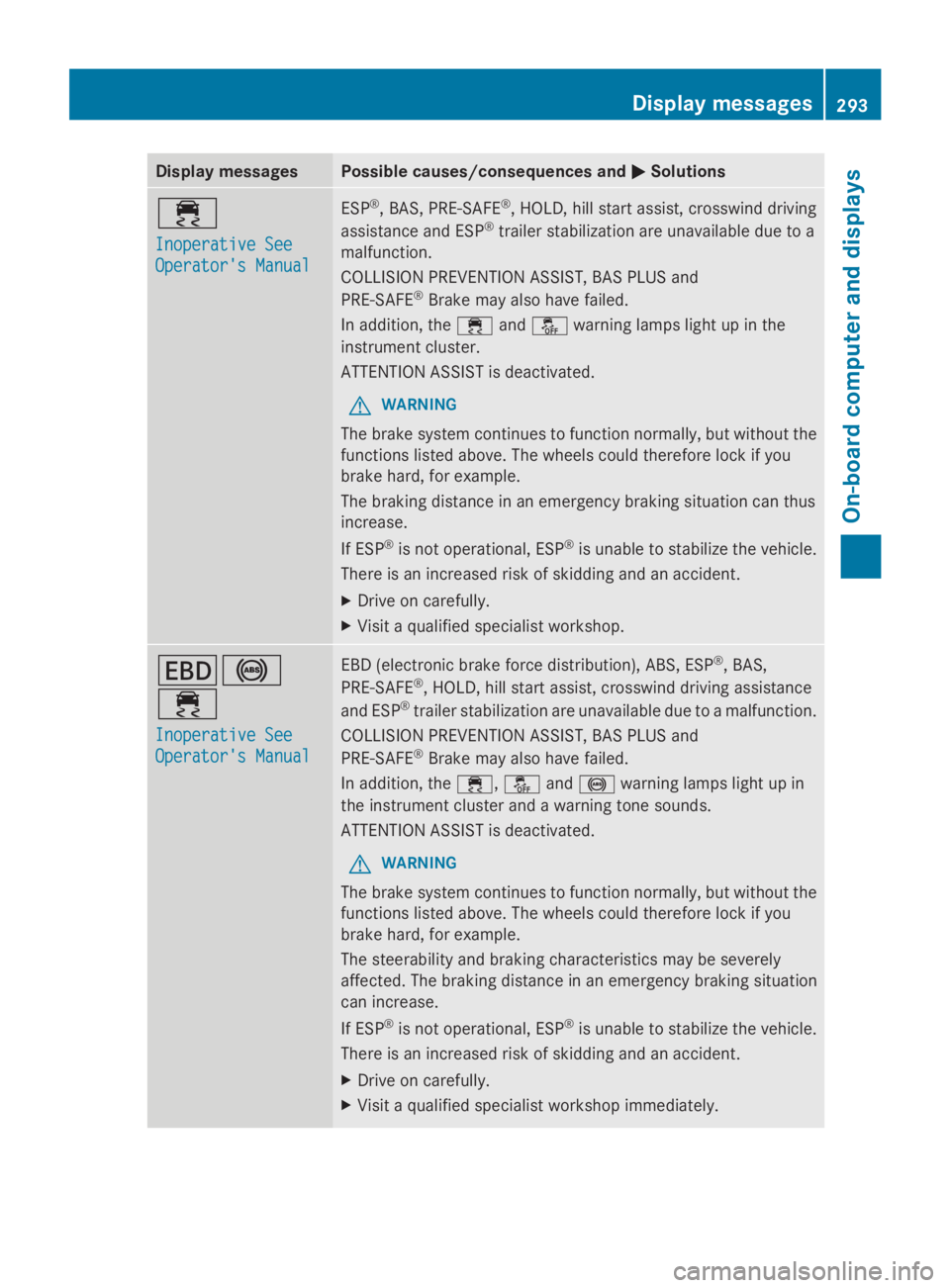
Display messagesPossible causes/consequences andPPSolutions
Page 296 of 462
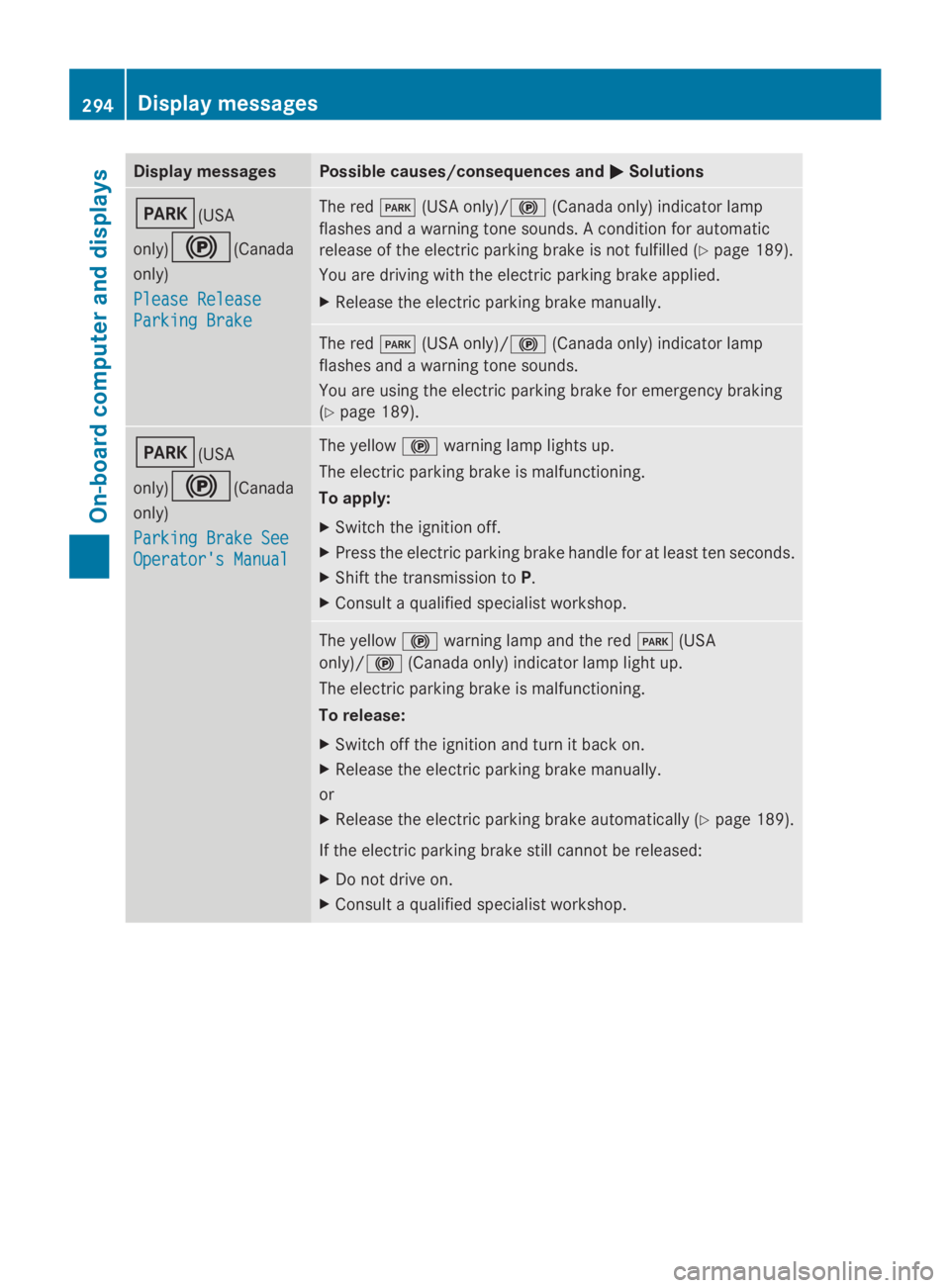
Display messagesPossible causes/consequences andPPSolutions
I(USA
only)$(Canada
only)
Please ReleasePlease Release
Parking BrakeParking Brake
The redI(USA only)/$(Canada only) indicator lamp
flashes and a warning tone sounds. A condition for automatic
release of the electric parking brake is not fulfilled (Ypage 189).
You are driving with the electric parking brake applied.
XRelease the electric parking brake manually.
The redI(USA only)/$(Canada only) indicator lamp
flashes and a warning tone sounds.
You are using the electric parking brake for emergency braking
(Ypage 189).
I(USA
only)$(Canada
only)
Parking Brake SeeParking Brake See
Operator's ManualOperator's Manual
The yellow$warning lamp lights up.
The electric parking brake is malfunctioning.
To apply:
XSwitch the ignition off.
XPress the electric parking brake handle for at least ten seconds.
XShift the transmission toP.
XConsult a qualified specialist workshop.
The yellow$warning lamp and the redI(USA
only)/$(Canada only) indicator lamp light up.
The electric parking brake is malfunctioning.
To release:
XSwitch off the ignition and turn it back on.
XRelease the electric parking brake manually.
or
XRelease the electric parking brake automatically (Ypage 189).
If the electric parking brake still cannot be released:
XDo not drive on.
XConsult a qualified specialist workshop.
294Displaymessages
On-b oard computer and displays