lock MERCEDES-BENZ GL 2016 Owners Manual
[x] Cancel search | Manufacturer: MERCEDES-BENZ, Model Year: 2016, Model line: GL, Model: MERCEDES-BENZ GL 2016Pages: 462, PDF Size: 12.66 MB
Page 201 of 462
specialist workshop as soon as possible.
Adapt your driving style to the different brak-
ing characteristics.
Driving off-road increases the likelihood of
damage to the vehicle, which, in turn, can lead
to failure of the mechanical assembly or sys-
tems. Adapt your driving style to suit the ter-
rain conditions. Drive carefully. Have damage
to the vehicle rectified immediately at a quali-
fied specialist workshop.
Do not switch to transmission position N
when driving off-road. If you try to brake the
vehicle using the service brake, you could
lose control of the vehicle. If the gradient is
too steep for your vehicle, drive back down in
reverse gear.
General notes Read this section carefully before driving your
vehicle off-road. Practice by driving over more
gentle off-road terrain first.
Familiarize yourself with the characteristics
of your vehicle and the gear shift operation
before driving through difficult terrain.
The following driving systems are specially
adapted to off-road driving: R
Off-road program 1 and 2 (vehicles with the
ON&OFFROAD package) ( Y
page 258)R
LOW RANGE off-road gear (vehicles with
the ON&OFFROAD package)
( Y
page 259) R
Differential lock (vehicles with the
ON&OFFROAD package) ( Y
page 259)R
Off-road ABS ( Y
page 69)R
Off-road 4ETS ( Y
page 73)R
AIRMATIC package (vehicle level)
( Y
page 218) R
DSR (Downhill Speed Regulation)
( Y
page 257)
Observe the following notes: R
Stop the vehicle before starting to drive
along an off-road route. R
Select a vehicle level that is suitable for the
terrain. To avoid damaging the vehicle, make sure there is always sufficient ground
clearance. R
Check that items of luggage and loads are
stowed safely and are well secured
( Y
page 345). R
Always keep the engine running and in gear
when driving on a downhill gradient. Acti-
vate DSR ( Y
page 257). R
Always keep the engine running and in gear
when driving on a slope. R
Adapt your speed to the terrain. The
rougher, steeper or more ruts on the ter-
rain, the slower your speed should be. R
Do not jump with the vehicle as this will
interrupt the vehicle's propulsion. R
Drive with extreme care on unfamiliar off-
road routes where visibility is poor. For
safety reasons, get out of the vehicle first
and survey the off-road route. R
Look out for obstacles, such as rocks,
holes, tree stumps and furrows. R
Always keep the doors, the tailgate, the
side windows and the sliding sunroof
closed while the vehicle is in motion. R
Do not shift the automatic transmission to
transmission position N .R
Observe the notes on off-road fording
( Y
page 197).
i Do not use the HOLD function when driv-
ing off-road, on steep uphill or downhill gra-
dients or on slippery or loose surfaces. The
HOLD function cannot hold the vehicle on
such surfaces.
Checklist before driving off-road
! If the engine oil warning lamp lights up
while the vehicle is in motion, stop the vehi-
cle in a safe place as soon as possible.
Check the engine oil level. The engine oil
warning lamp warning must not be ignored.
Continuing the journey while the symbol is
displayed could lead to engine damage. X
Engine oil level: check the engine oil level
and add oil if necessary. Driving tips 199
Driving and parking Z
Page 204 of 462
R
Before driving on extreme uphill and down-
hill gradients, select the LOW RANGE off-
road gear ( Y
page 259).R
Drive slowly. R
Avoid high engine speeds. Drive at appro-
priate engine speeds (maximum
3,000 rpm). R
Use the left-hand steering wheel paddle
shifter to shift into a lower gear in good time
on long and steep downhill gradients. R
Check the brakes after prolonged off-road
driving.
Hill start assist will aid you when pulling away
on a hill. For further information about hill
start assist, see ( Y
page 168).
Do not switch to transmission position N
when driving off-road. If you try to brake the
vehicle using the service brake, you could
lose control of the vehicle. If the gradient is
too steep for your vehicle, drive back down in
reverse gear.
Always observe the approach/departure
angle values ( Y
page 456).
Maximum gradient-climbing capability
Always observe the maximum gradient climb-
ing ability values ( Y
page 456).
Hilltops
When driving up an uphill gradient, slightly
reduce pressure on the accelerator immedi-
ately before reaching the brow of the hill.
Make use of the vehicle's own impetus to
travel over the brow.
This style of driving prevents: R
the vehicle from lifting off the ground on the
brow of a hill R
the vehicle from traveling too quickly down
the other side
Driving downhill R
Drive slowly. R
Do not drive at an angle down steep
inclines. Steer into the line of fall and drive with the front wheels aligned straight. Oth-
erwise, the vehicle could slip sideways, tip
and rollover. R
Shift to a lower gear using the left-hand
paddle shifter before tackling steep down-
hill gradients. R
Activate DSR. If this is not sufficient, brake
gently. When doing so, make sure that the
vehicle is facing in the direction of the line
of fall. R
Check that the brakes are working normally
after a long downhill stretch.
i The special off-road ABS setting enables a
precise, brief and repeated locking of the
front wheels. This causes them to dig into
loose earth. Be aware that the front wheels
easily skid across the ground surface if
completely braked and therefore lose their
ability to steer.
Driving systems
Intelligent Drive
Mercedes-Benz Intelligent Drive stands for
innovative driver assistance and safety sys-
tems which enhance comfort and support the
driver in critical situations. With these intelli-
gent co-ordinated systems Mercedes-Benz
has set a milestone on the path towards
autonomous driving.
Mercedes-Benz Intelligent Drive embraces all
elements of active and passive safety in one
well thought out system – for the safety of the
vehicle occupants and that of other road
users.
Further information on driving safety systems
( Y
page 68).
Cruise control
General notes
Cruise control maintains a constant road
speed for you. It brakes automatically in order
to avoid exceeding the set speed. You must202
Driving systems
Driving and parking
Page 215 of 462
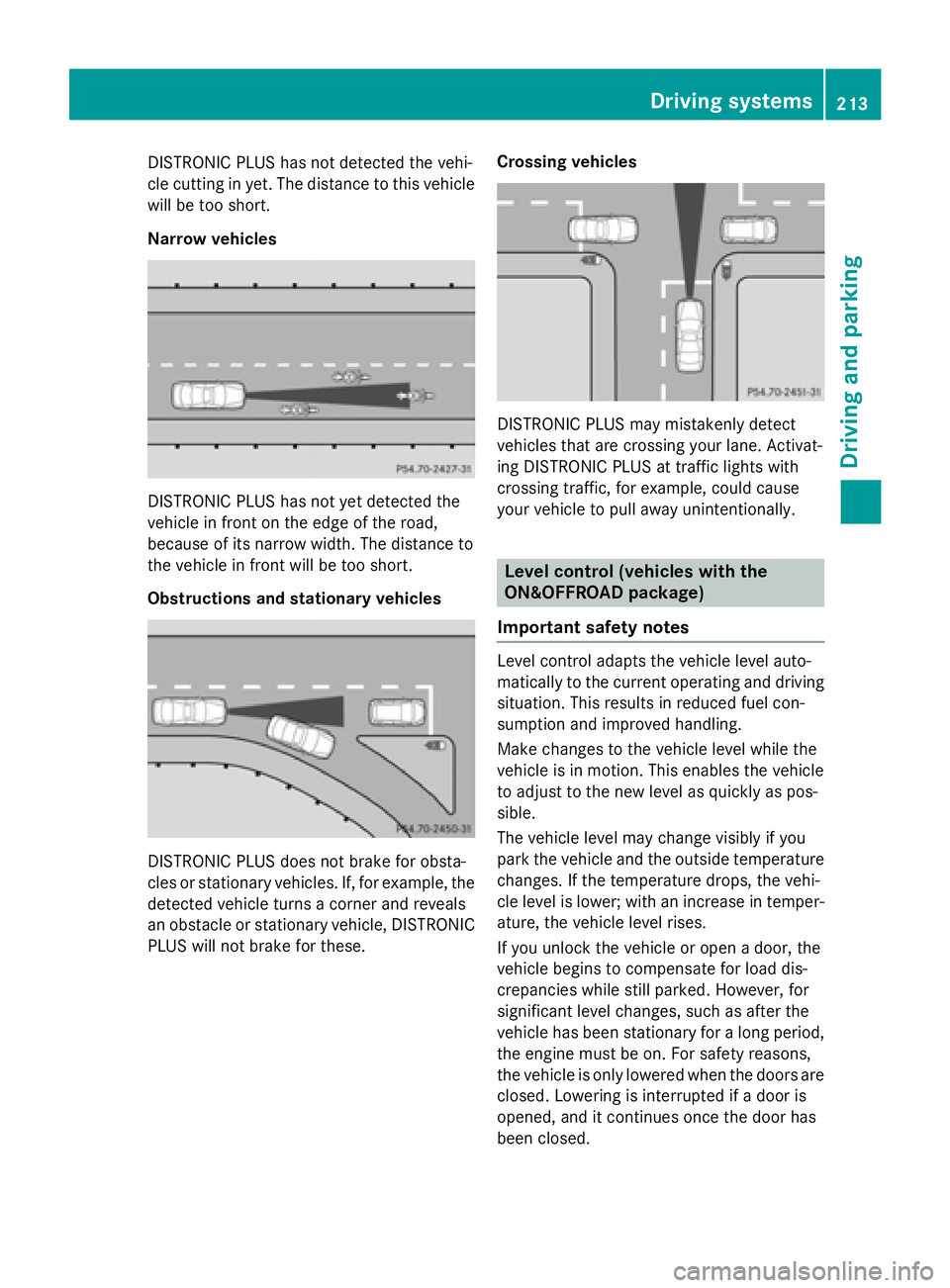
DISTRONIC PLUS has not detected the vehi-
cle cutting in yet. The distance to this vehicle
will be too short.
Narrow vehicles
DISTRONIC PLUS has not yet detected the
vehicle in front on the edge of the road,
because of its narrow width. The distance to
the vehicle in front will be too short.
Obstructions and stationary vehicles
DISTRONIC PLUS does not brake for obsta-
cles or stationary vehicles. If, for example, the
detected vehicle turns a corner and reveals
an obstacle or stationary vehicle, DISTRONIC
PLUS will not brake for these. Crossing vehicles
DISTRONIC PLUS may mistakenly detect
vehicles that are crossing your lane. Activat-
ing DISTRONIC PLUS at traffic lights with
crossing traffic, for example, could cause
your vehicle to pull away unintentionally.
Level control (vehicles with the
ON&OFFROAD package)
Important safety notes
Level control adapts the vehicle level auto-
matically to the current operating and driving
situation. This results in reduced fuel con-
sumption and improved handling.
Make changes to the vehicle level while the
vehicle is in motion. This enables the vehicle
to adjust to the new level as quickly as pos-
sible.
The vehicle level may change visibly if you
park the vehicle and the outside temperature
changes. If the temperature drops, the vehi-
cle level is lower; with an increase in temper-
ature, the vehicle level rises.
If you unlock the vehicle or open a door, the
vehicle begins to compensate for load dis-
crepancies while still parked. However, for
significant level changes, such as after the
vehicle has been stationary for a long period,
the engine must be on. For safety reasons,
the vehicle is only lowered when the doors are
closed. Lowering is interrupted if a door is
opened, and it continues once the door has
been closed. Driving system s 213
Dr ivi ng an d parking Z
Page 220 of 462
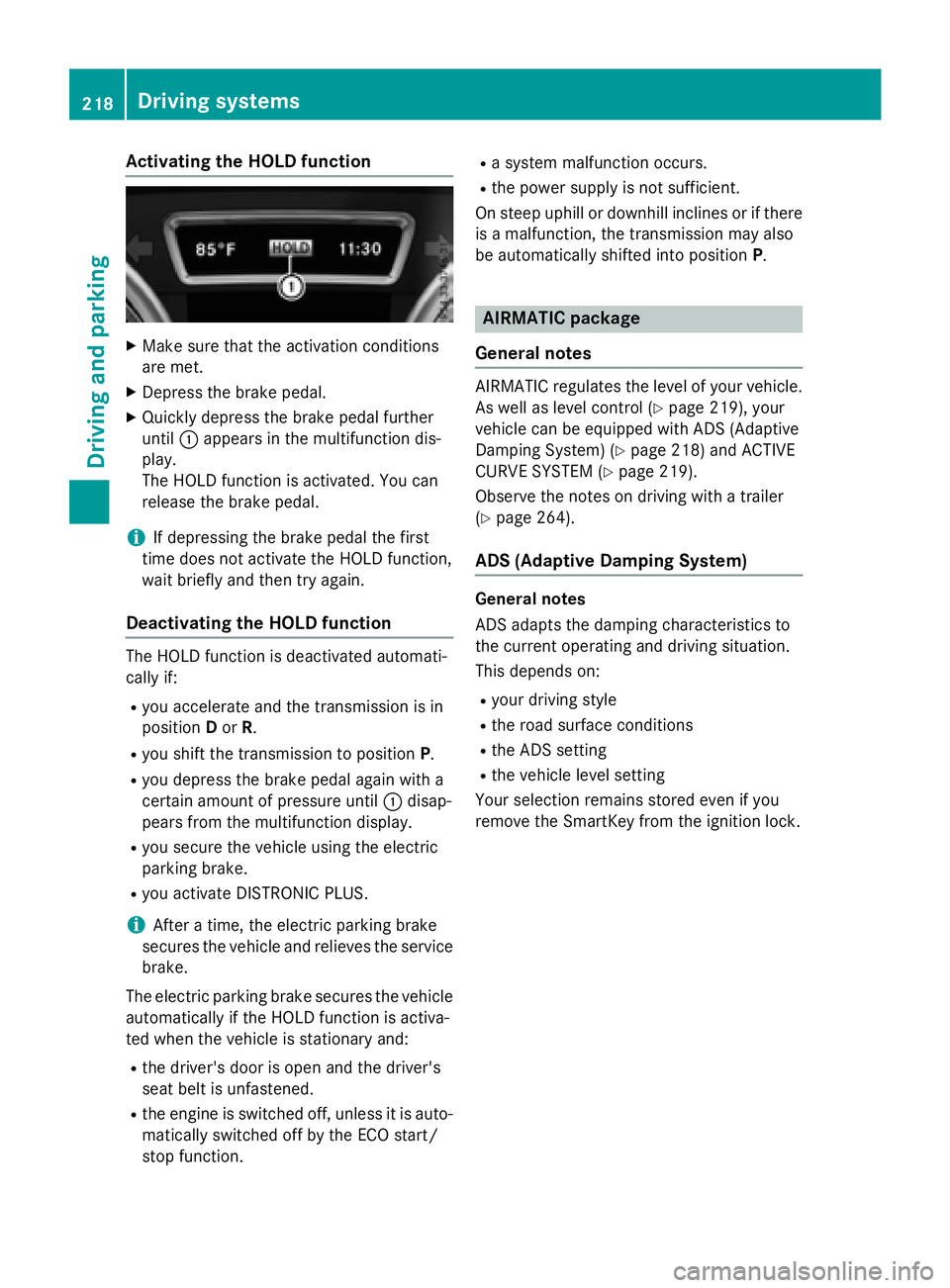
Activating the HOLD function X
Mak e sur e that th e activation condition s
are met .X
Depress th e brak e pedal .X
Quickl y depress th e brak e pedal further
until C appear s in th e multifunction dis-
play.
The HOLD function is activated. You can
release th e brak e pedal .
i If depressing th e brak e pedal th e first
time does no t activat e th e HOLD function ,
wait briefly and then tr y again .
Deactivating the HOLD function
The HOLD function is deactivated automati-
call y if: R
you accelerate and th e transmission is in
position D or R .R
you shif t th e transmission to position P .R
you depress th e brak e pedal again wit h a
certain amoun t of pressur e until C disap -
pear s from th e multifunction display.R
you secure th e vehicl e usin g th e electric
parking brake. R
you activat e DISTRONI C PLUS.
i Afte r a time, th e electric parking brak e
secures th e vehicl e and relieves th e servic e
brake.
The electric parking brak e secures th e vehicl e
automatically if th e HOLD function is activa-
te d when th e vehicl e is stationary and :R
th e driver' s door is open and th e driver' s
seat belt is unfastened. R
th e engin e is switched off , unless it is auto -
matically switched off by th e ECO start /
stop function . R
a system malfunction occurs. R
th e power suppl y is no t suf ficient.
On steep uphill or downhill inclines or if there
is a malfunction , th e transmission may also
be automatically shifte d int o position P .
AIRMATIC package
Gene ra l notesAIRMATIC regulates th e level of your vehicle.
As well as level control ( Y
page 219), your
vehicl e can be equipped wit h AD S (Adaptive
Dampin g System) ( Y
page 218) and ACTIVE
CURVE SYSTE M ( Y
page 219).
Obs erv e th e note s on driving wit h a trailer
( Y
page 264).
ADS (Adaptive Damping System)
Genera l notes
AD S adapt s th e damping characteristics to
th e curren t operating and driving sit uation .
This depend s on : R
your driving style R
th e road sur fac e condition sR
th e AD S setting R
th e vehicl e level setting
Your selection remain s st ore d eve n if you
remove th e SmartKey from th e ignition lock.218
Driving systems
Driving and parking
Page 222 of 462
cle could rollover more easily, for example on
a bend. There is a risk of an accident.
Always select as low a vehicle level as possi-
ble and adjust your driving style.
G WARNING
When you drive with the chassis lowered or
raised, the vehicle's braking and driving char-
acteristics can be significantly impaired. You
could also exceed the permissible vehicle
height if the chassis is raised. There is a risk of
an accident.
Adjust the vehicle level before pulling away.
G WARNING
Due to the high center of gravity, the vehicle
may start to skid and roll over in the event of
an abrupt steering maneuver and/or when
the vehicle's speed is not adapted to the road
conditions. There is a risk of an accident.
Always adapt your speed and driving style to
the vehicle's driving characteristics and to the
prevailing road and weather conditions.
! When driving on extremely rough terrain,
select a high vehicle level in good time.
Make sure there is always sufficient ground
clearance. You will otherwise damage the
vehicle.
! When you raise the vehicle in such a way
that not all wheels have contact with the
ground, remove the SmartKey from the
ignition lock. R
Utility vehicles have a significantly higher
rollover rate than other types of vehicles.
Failure to operate this vehicle safely may
result in an accident, rollover of the vehicle,
and severe or fatal injury. R
In a rollover crash, an unbelted person is
significantly more likely to die than a per-
son wearing a seat belt.
You and all vehicle occupants should
always wear your seat belts. General notes
Further information about "Driving off-road"
( Y
page 198).
Level control adapts the vehicle level auto-
matically to the current operating and driving
situation. This results in reduced fuel con-
sumption and improved handling.
If y
ou select ADS comfort mode ( Y
page 218),
the vehicle is lowered to high-speed level as
the speed increases. As the vehicle speed
decreases, the vehicle is raised back up to
highway level.
If you select ADS sport mode ( Y
page 218),
the vehicle skips highway level and lowers
directly to high-speed level depending on the
basic setting ( Y
page 220).
Make changes to the vehicle level while the
vehicle is in motion. This enables the vehicle
to adjust to the new level as quickly as pos-
sible.
The vehicle level may change visibly if you
park the vehicle and the outside temperature
changes. If the temperature drops, the vehi-
cle level is lower; with an increase in temper-
ature, the vehicle level rises.
If you unlock the vehicle or open a door, the
vehicle begins to compensate for load dis-
crepancies while still parked. However, for
significant level changes, such as after the
vehicle has been stationary for a long period,
the engine must be on. For safety reasons,
the vehicle is only lowered when the doors are
closed. Lowering is interrupted if a door is
opened, and it continues once the door has
been closed.
Basic settings (excluding Mercedes-AMG
vehicles)
The extent to which the vehicle is raised or
lowered depends on the basic setting selec-
ted. Sele ct raised level for off-road driving or
hi g
hway/high-speed level for normal roads.220
Driving systems
Driving and parking
Page 224 of 462
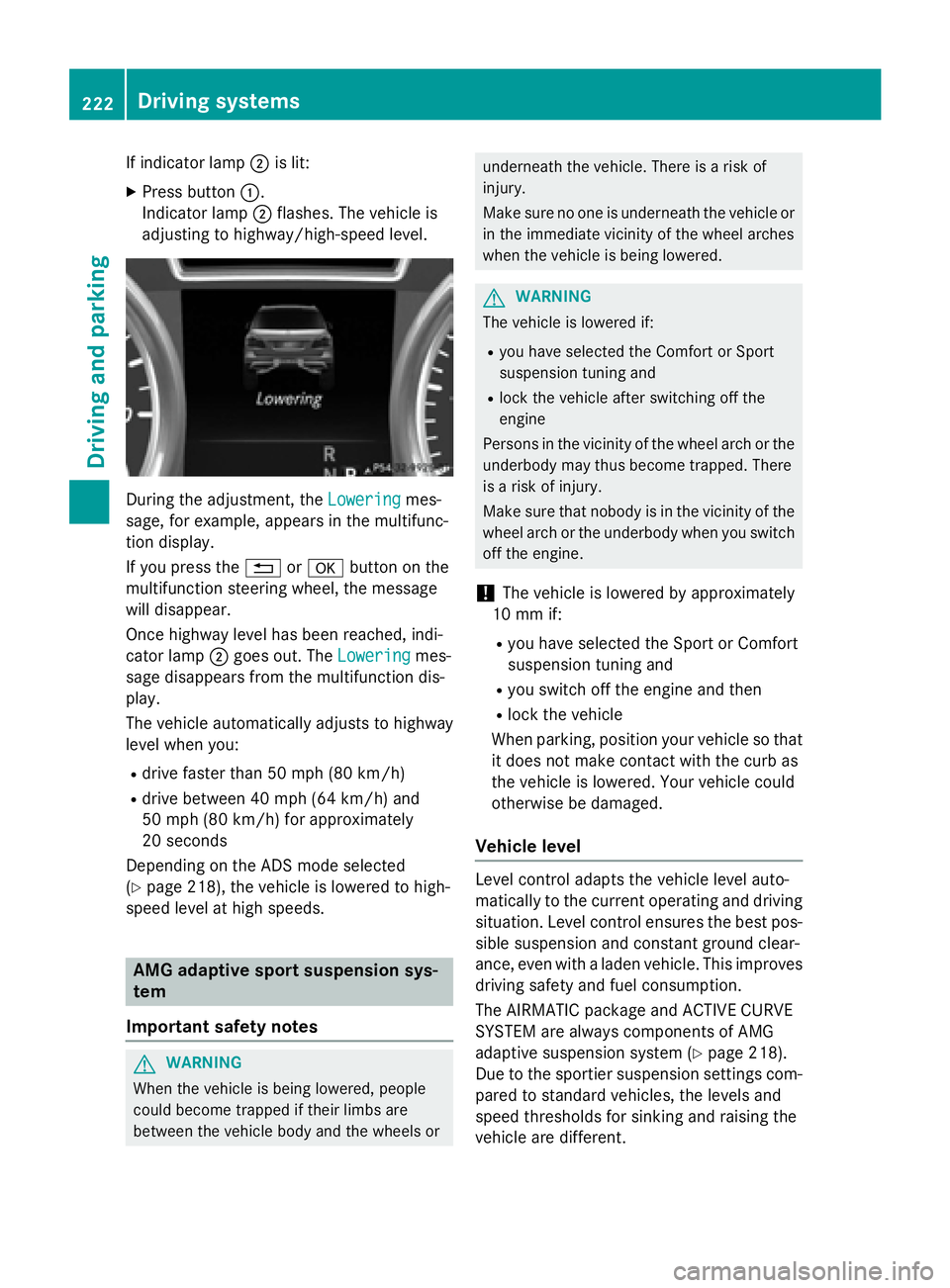
If indicator lamp D is lit:X
Press button C .
Indicator lamp D flashes. The vehicle is
adjusting to highway/high-speed level.
During the adjustment, the Lowering mes-
sage, for example, appears in the multifunc-
tion display.
If you press the 8 or v button on the
multifunction steering wheel, the message
will disappear.
Once highway level has been reached, indi-
cator lamp D goes out. The Lowering
mes-
sage disappears from the multifunction dis-
play.
The vehicle automatically adjusts to highway
level when you: R
drive faster than 50 mph (80 km/h) R
drive between 40 mph (64 km/h) and
50 mph (80 km/h) for approximately
20 seconds
Depending on the ADS mode selected
( Y
page 218), the vehicle is lowered to high-
speed level at high speeds.
AMG adaptive sport suspension sys-
tem
Important safety notes
G WARNING
When the vehicle is being lowered, people
could become trapped if their limbs are
between the vehicle body and the wheels or underneath the vehicle. There is a risk of
injury.
Make sure no one is underneath the vehicle or
in the immediate vicinity of the wheel arches
when the vehicle is being lowered.
G WARNING
The vehicle is lowered if: R
you have selected the Comfort or Sport
suspension tuning and R
lock the vehicle after switching off the
engine
Persons in the vicinity of the wheel arch or the
underbody may thus become trapped. There
is a risk of injury.
Make sure that nobody is in the vicinity of the
wheel arch or the underbody when you switch
off the engine.
! The vehicle is lowered by approximately
10 mm if: R
you have selected the Sport or Comfort
suspension tuning and R
you switch off the engine and then R
lock the vehicle
When parking, position your vehicle so that
it does not make contact with the curb as
the vehicle is lowered. Your vehicle could
otherwise be damaged.
Vehicle level
Level control adapts the vehicle level auto-
matically to the current operating and driving
situation. Level control ensures the best pos-
sible suspension and constant ground clear-
ance, even with a laden vehicle. This improves
driving safety and fuel consumption.
The AIRMATIC package and ACTIVE CURVE
SYSTEM are always components of AMG
adaptive suspension system ( Y
page 218).
Due to the sportier suspension settings com-
pared to standard vehicles, the levels and
speed thresholds for sinking and raising the
vehicle are different.222
Driving systems
Driving and parking
Page 225 of 462
In Comfort and Sport driving modes, after
locking the vehicle it lowers to the Sport+
level. When locking the vehicle at the raised
level, the vehicle does not lower.
The settings will remain stored after you
switch off the engine. When starting the
engine, the selected setting, e.g. AMG adap-
tive suspension system Comfort, is restored.
i The vehicle level may change visibly if you
park the vehicle and the outside tempera-
ture changes. If the temperature drops, the
vehicle level lowers; with an increase in
temperature, the vehicle level rises.
Suspension tuning General notes
The electronically controlled damping system
works continuously. This improves driving
safety and ride comfort.
The damping is tuned individually to each
wheel and depends on: R
your driving style R
the road surface conditions R
your individual selection of Sport, Sport +
or Comfort
Your selection remains stored even if you
remove the SmartKey from the ignition lock.
Sport mode
The firmer suspension tuning in Sport mode
ensures even better contact with the road.
Select this mode when employing a sporty
driving style, e.g. on winding country roads. X
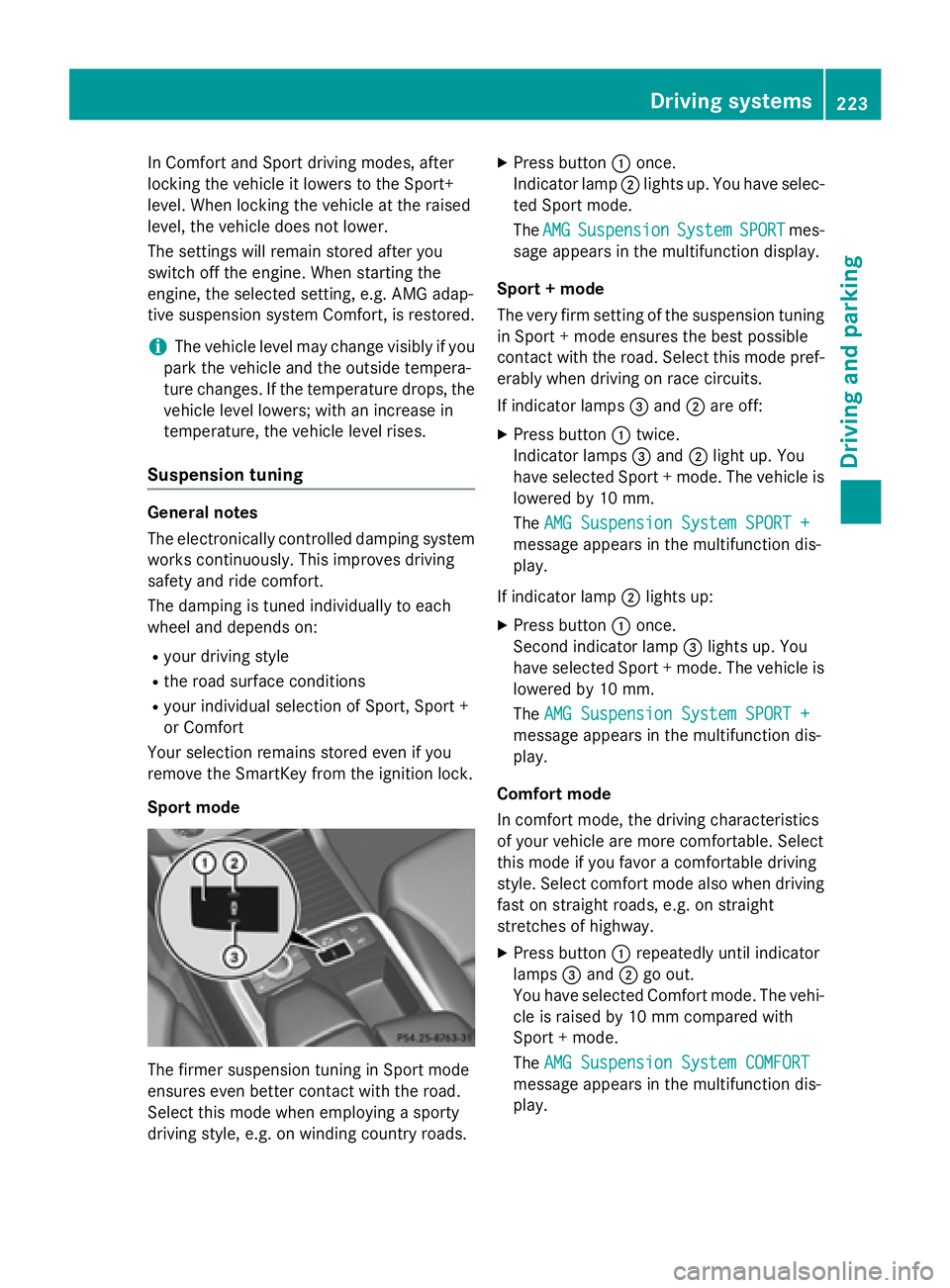
Press button C once.
Indicator lamp D lights up. You have selec-
ted Sport mode.
The AMG Suspension System SPORT mes-
sage appears in the multifunction display.
Sport + mode
The very firm setting of the suspension tuning
in Sport + mode ensures the best possible
contact with the road. Select this mode pref-
erably when driving on race circuits.
If indicator lamps
Page 228 of 462
One or more segments light up as the vehicle
approaches an obstacle, depending on the
vehicle's distance from the obstacle.
From the: R
sixth segment onwards, you will hear an
intermittent warning tone for approx-
imately two seconds. R
seventh segment onwards, you will hear a
warning tone for approximately two sec-
onds. This indicates that you have now
reached the minimum distance.
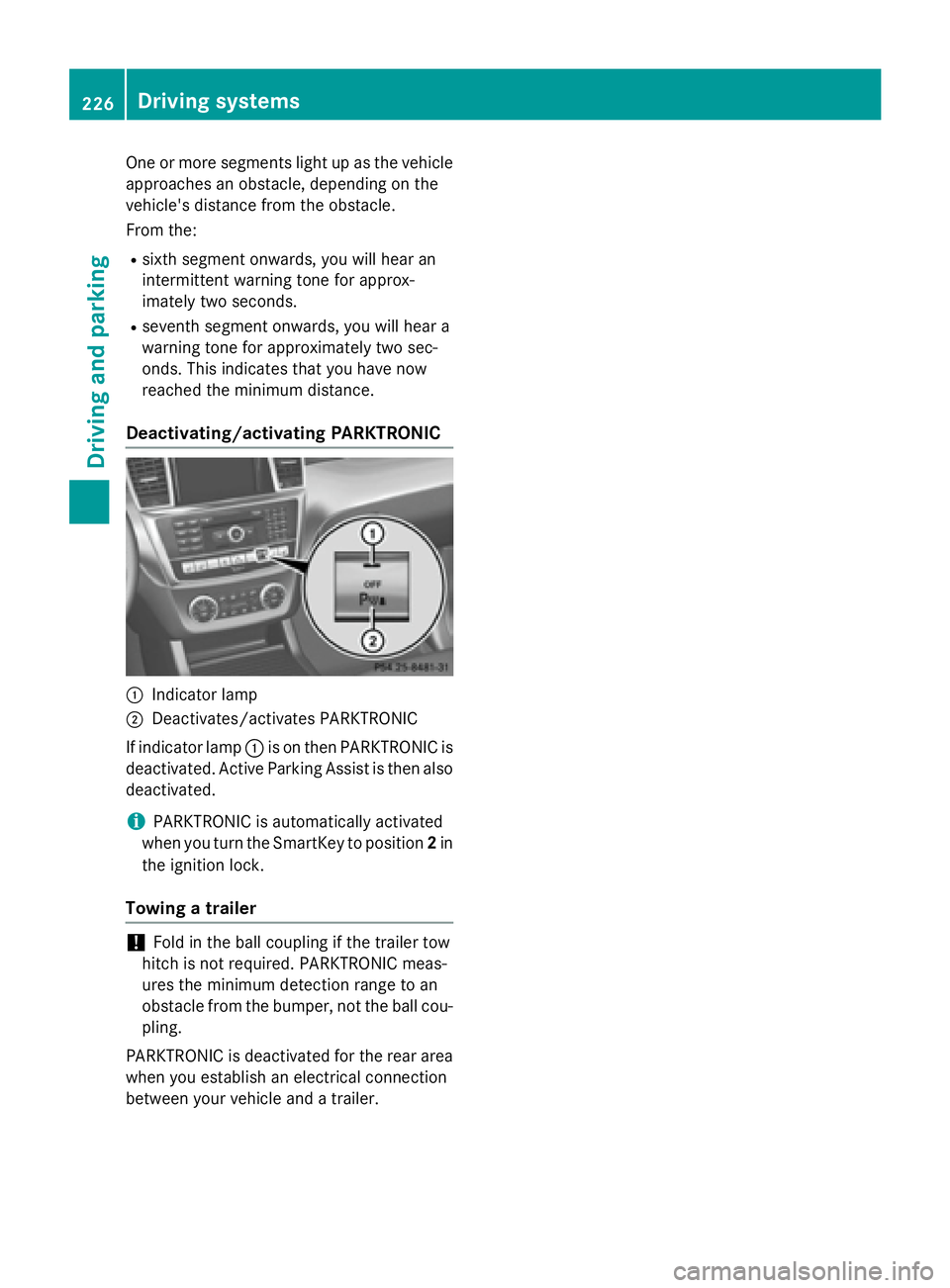
Deactivating/activating PARKTRONIC
C
Indicator lampD
Deactivates/activates PARKTRONIC
If indicator lamp C is on then PARKTRONIC is
deactivated. Active Parking Assist is then also
deactivated.
i PARKTRONIC is automatically activated
when you turn the SmartKey to position 2 in
the ignition lock.
Towing a trailer
! Fold in the ball coupling if the trailer tow
hitch is not required. PARKTRONIC meas-
ures the minimum detection range to an
obstacle from the bumper, not the ball cou-
pling.
PARKTRONIC is deactivated for the rear area
when you establish an electrical connection
between your vehicle and a trailer.226
Driving systems
Driving and parking
Page 230 of 462
Parking tips: R
On narrow roads, drive as close to the park-
ing space as possible. R
Parking spaces that are littered or over-
grown might be identified or measured
incorrectly. R
Parking spaces that are partially occupied
by trailer drawbars might not be identified
as such or be measured incorrectly. R
Snowfall or heavy rain may lead to a parking
space being measured inaccurately. R
Pay attention to the PARKTRONIC
( Y
page 225) warning messages during the
parking procedure. R
At any time, you can intervene in the steer-
ing procedure to correct it. Active Parking
Assist will then be canceled. R
When transporting a load which protrudes
from your vehicle, you should not use
Active Parking Assist. R
Never use Active Parking Assist when snow
chains are installed. R
Make sure that the tire pressures are
always correct. This has a direct influence
on the parking characteristics of the vehi-
cle.
Use Active Parking Assist for parking spaces: R
that are parallel to the direction of travel R
that are on straight roads, not bends R
that are on the same level as the road, e.g.
not on the pavement
Detecting parking spaces
Objects located above the height range of
Active Parking Assist will not be detected
when the parking space is measured. These
are not taken into account when the parking
procedure is calculated, e.g. overhanging
loads, tail sections or loading ramps of goods
vehicles.
G WARNING
If there are objects above the detection range,
Active Parking Assist may turn prematurely. You may cause a collision as a result. There is
a risk of an accident.
If there are objects above the detection range,
stop and deactivate Active Parking Assist.
For further information on the detection
range ( Y
page 224).
Active Parking Assist does not support you
parking in spaces that are parallel to the
direction of travel if: R
the parking space is on a curb R
the system reads the parking space as
being blocked, for example by foliage or
grass paving blocks R
the area is too small for the vehicle to
maneuver into R
the parking space is bordered by an obsta-
cle, e.g. a tree, a post or a trailer
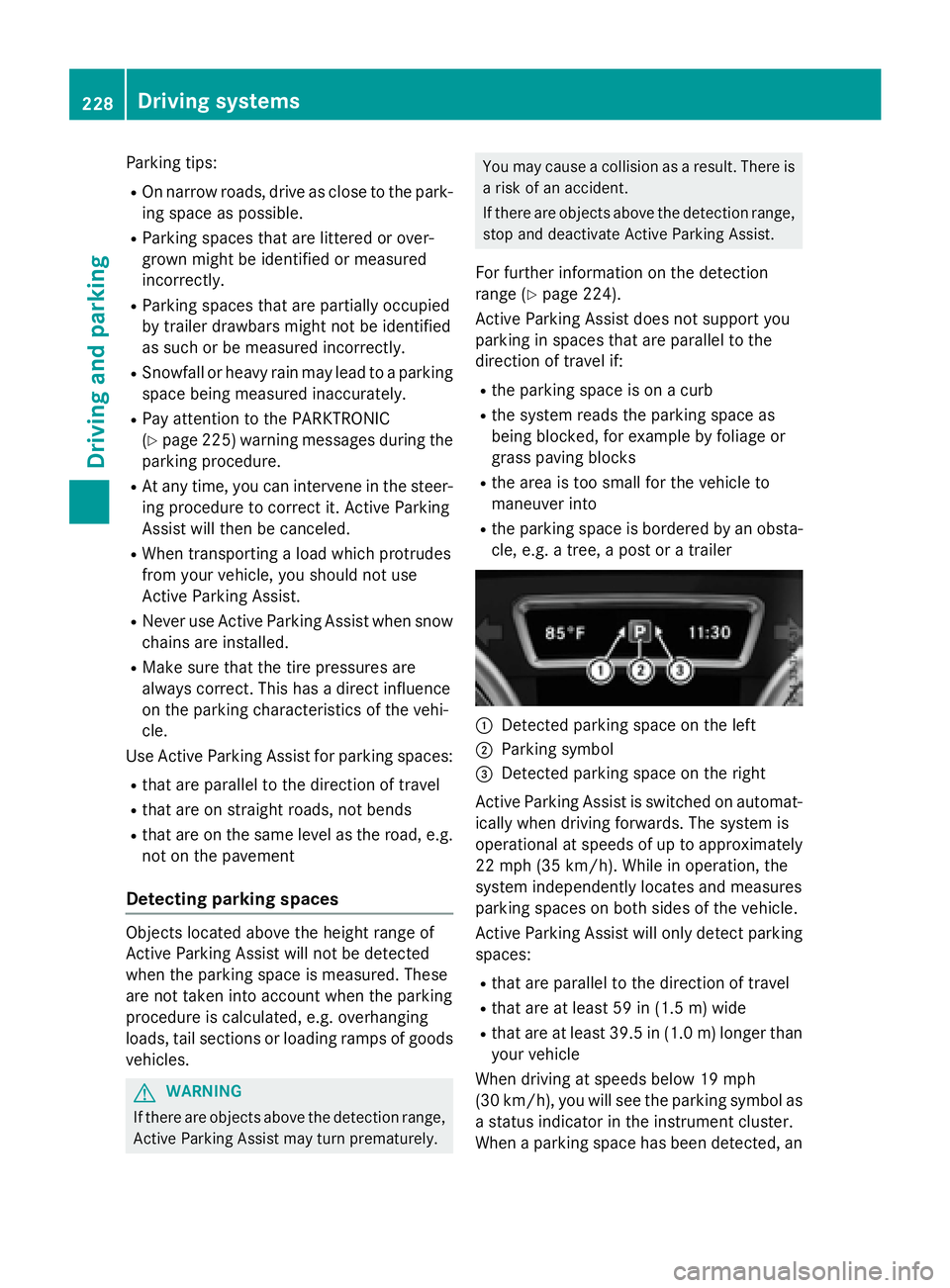
C
Detected parking space on the left D
Parking symbol
Page 234 of 462
R
if there is a sudden change in temperature,
e.g. when driving into a heated garage in
winter R
if the camera lens is dirty or obstructed.
Observe the notes on cleaning
( Y
page 380) R
if the rear of your vehicle is damaged. In this
event, have the camera position and setting
checked at a qualified specialist workshop
The field of vision and other functions of the
rear view camera may be restricted due to
additional accessories on the rear of the vehi-
cle (e.g. license plate holder, bicycle rack).
For technical reasons, leaving the standard
height can result in inaccuracies in the guide
lines on vehicles with a height-adjustable
chassis.
Activating/deactivating the rear view
camera
X
To activate: make sure that the SmartKey
is in position 2 in the ignition lock.X
Make sure that the "Show rear view camera
display" function is selected in COMAND
(see the Digital Operator's Manual). X
Engage reverse gear.
The area behind the vehicle is shown in the
COMAND display with guide lines. X
To change the function mode for vehi-
cles with trailer tow hitch: using the
COMAND controller, select symbol C for
the "Reverse parking" function or sym- bol D for "Coupling up a trailer" (see the
separate COMAND operating instructions).
The symbol of the selected function is high-
lighted.
To deactivate: the rear view camera deacti-
vates if you shift the transmission to P or after
driving forwards a short distance.
Displays in the COMAND display The rear view camera may show a distorted
view of obstacles, show them incorrectly or
not at all. The rear view camera does not show
objects in the following positions: R
very close to the rear bumper R
under the rear bumper R
in the area immediately above the tailgate
handle
! Objects not at ground level may appear to
be further away than they actually are, e.g.: R
the bumper of a parked vehicle R
the drawbar of a trailer R
the ball coupling of a trailer tow hitch R
the rear section of an HGV R
a slanted post
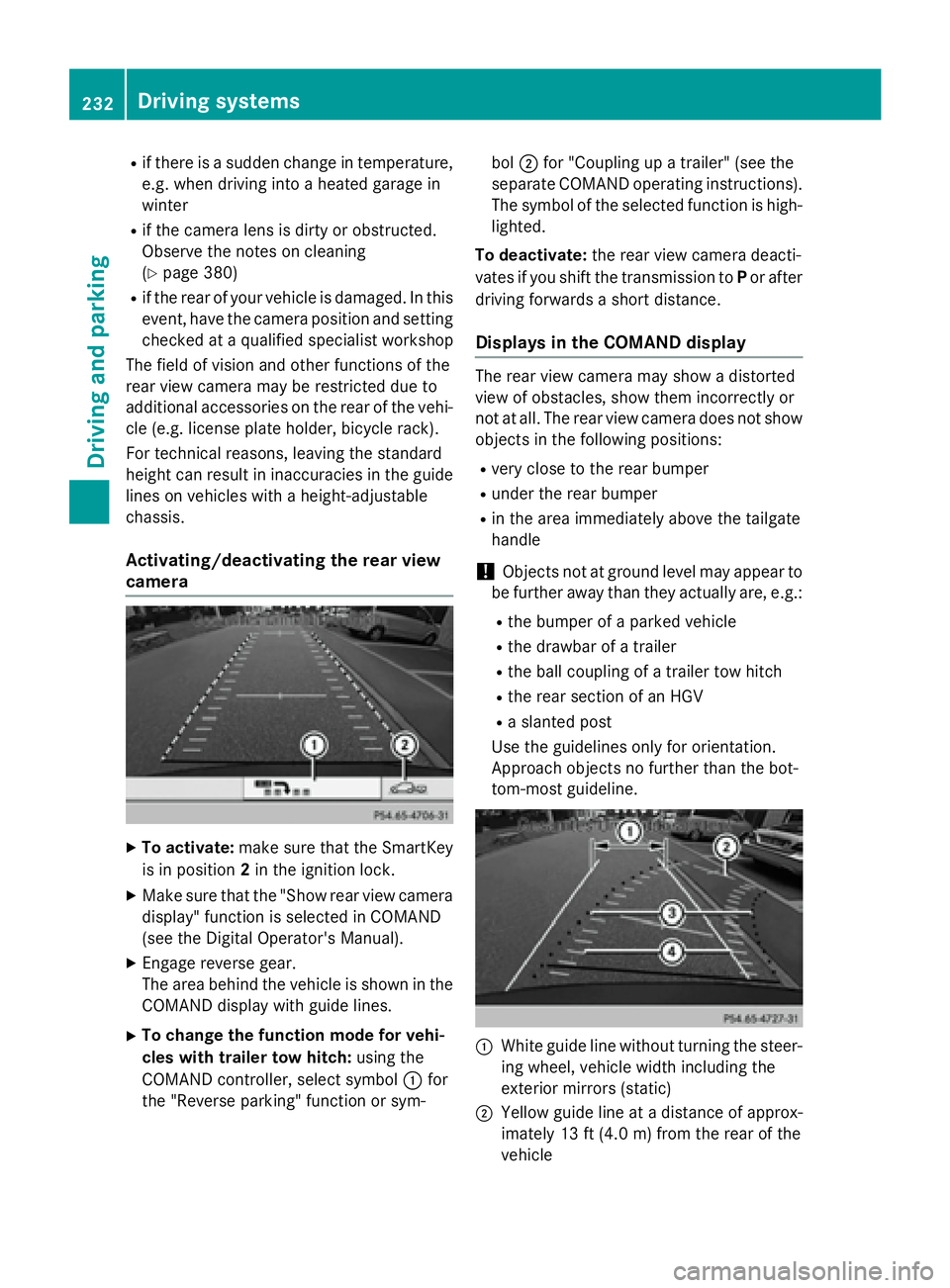
Use the guidelines only for orientation.
Approach objects no further than the bot-
tom-most guideline.
C
White guide line without turning the steer-
ing wheel, vehicle width including the
exterior mirrors (static)
D
Yellow guide line at a distance of approx-
imately 13 ft (4.0 m) from the rear of the
vehicle232
Driving system s
Dr ivi ng an d parking