wheel MERCEDES-BENZ GL 2016 Owner's Manual
[x] Cancel search | Manufacturer: MERCEDES-BENZ, Model Year: 2016, Model line: GL, Model: MERCEDES-BENZ GL 2016Pages: 462, PDF Size: 12.66 MB
Page 62 of 462
How the air bag system works is deter-
mined by the severity of the accident detec-
ted, especially the vehicle deceleration or
acceleration and the apparent type of acci-
dent: R
frontal collision R
side impact R
rollover
PRE-SAFE ®
(anticipatory occupant
protection system)
Introduction In certain hazardous situations, PRE-SAFE ®
takes pre-emptive measures to protect the
vehicle occupants.
Important safety notes
! Make sure that there are no objects in the
footwell or behind the seats. There is a dan-
ger that the seats and/or objects could be
damaged when PRE-SAFE ®
is activated.
Although your vehicle is equipped with PRE-
SAFE ®
, the possibility of injury in the event of
an accident cannot be ruled out. Always
adapt your driving style to suit the prevailing
road and weather conditions and maintain a
safe distance from the vehicle in front. Drive
carefully.
Function
PRE-SAFE ®
intervenes:R
in emergency braking situations, e.g. when
BAS is activated R
in critical driving situations, e.g. when phys-
ical limits are exceeded and the vehicle
understeers or oversteers severely R
on vehicles with the Driving Assistance
package: if BAS PLUS intervenes power-
fully or the radar sensor system detects an
imminent danger of collision in certain sit-
uations PRE-SAFE ®
takes the following measures
depending on the hazardous situation detec-
ted: R
the front seat belts are pre-tensioned. R
if the vehicle skids, the sliding sunroof and
the side windows are closed so that only a
small gap remains. The panorama roof with
power tilt/sliding panel is completely
closed. R
vehicles with the memory function: the
front-passenger seat is adjusted if it is in an
unfavorable position. R
vehicles with a multicontour seat: the air
pressure in the side bolsters of the seat
backrest is increased.
If the hazardous situation passes without
resulting in an accident, PRE-SAFE ®
slackens
the belt pre-tensioning. On vehicles with mul-
ticontour seats, the air pressure in the side
bolsters is reduced again. All settings made
by PRE-SAFE ®
can then be reversed.
If the seat belt pre-tensioning is not reduced: X
Move the seat backrest or seat back
slightly when the vehicle is stationary.
The seat belt pre-tensioning is reduced and
the locking mechanism is released.
The seat-belt adjustment is an integral part of
the PRE-SAFE ®
convenience function. You
will find information on the convenience func-
tion under "Belt adjustment" ( Y
page 49).
Automatic measures after an acci-
dent
Immediately after an accident, the following
measures are implemented, depending on
the type and severity of the impact: R
the hazard warning lamps are activated R
the emergency lighting is activated R
the vehicle doors are unlocked R
the front side windows are lowered R
vehicles with a memory function: the elec-
trically adjustable steering wheel is raised60
Occupant safety
Safety
Page 70 of 462
Drivin g safet y systems
Overview of drivin g safet y systemsIn this section , you will fin d information about
th e following drivin g safet y systems :R
AB S ( A nti-loc k B rakin g S ystem)
( Y
page 68) R
BA S ( B rake A ssist S ystem) ( Y
page 69 )R
BA S PLU S ( B rake A ssist S ystem Plus )
( Y
page 69 )R
COLLISION PREVENTION ASSIST PLU S
(distanc e warnin g function and Adaptive
Brak e Assist) ( Y
page 70 )R
ES P ®
( E lectronic S t ability P r ogram)
( Y
page 73) R
EB D ( E lectroni c B r ak e forc e D i stribution )
( Y
page 75) R
ADAPTIV E BRAKE ( Y
page 76 )R
PRE-SAF E ®
Brak e ( Y
page 76)R
STEE R CONTROL ( Y
page 77)
Important safet y notes
If you fail to adapt your drivin g style or if you
are inattentive , th e drivin g safet y systems can
neither reduce th e ris k of an acciden t no r
override th e laws of physics. Driving safet y
systems are merely aids designed to assist
driving. You are responsible fo r maintainin g
th e distanc e to th e vehicle in front, fo r vehicle
speed, fo r braking in goo d time, and fo r stay-
in g in lane. Always adapt your drivin g style to
suit th e prevailin g road and weather condi-
tion s and maintain a saf e distanc e from th e
vehicle in front. Drive carefully.
The drivin g safet y systems described only
wor k as effectively as possible when there is
adequat e contact between th e tires and th e
road surface. Please pay special attention to
th e note s on tires , recommended minimum
tire tread depths, etc. ( Y
page 404).
In wintr y drivin g conditions, always use winte r
tires (M+ S tires ) and if necessary, snow
chains. Only in this way will th e drivin g safet y systems described in this section wor k as
effectively as possible.
ABS (Anti-lock Braking System)
General information AB S regulates brake pressure in suc h a way
that th e wheels do no t loc k when you brake .
Thi s allow s you to continue steerin g th e vehi-
cl e when braking .
The % AB S warnin g lamp in th e instrumen t
cluster lights up when th e ignition is switched
on . It goe s out when th e engin e is running .
AB S works from a speed of about 5 mph
(8 km/h), regardles s of road-surfac e condi-
tions. AB S works on slipper y surfaces, eve n
when you only brake gently.
Important safet y notes
i Observ e th e "Important safet y notes" sec -
tion ( Y
page 68) .
G WARNING
If AB S is faulty, th e wheels could loc k when
braking . The steerability and braking charac -
teristics may be severely impaired. Addition -
ally, further drivin g safet y systems are deac -
tivated. There is an increase d danger of skid-
din g and accidents .
Drive on carefully. Hav e AB S checke d imme-
diately at a qualified specialis t workshop .
Whe n AB S is malfunctioning, other systems ,
includin g drivin g safet y systems , will also
becom e inoperative . Observ e th e information
on th e AB S warnin g lamp ( Y
page 327) and
display message s whic h may be shown in th e
instrumen t cluster ( Y
page 291).
Braking X
If ABS intervenes: continue to depress th e
brake peda l vigorousl y until th e braking sit -
uation is over. X
To make a full brak e application:
depress th e brake peda l wit h full force.68
Driving safety systems
Safety
Page 71 of 462
If ABS intervenes when braking, you will feel a
pulsing in the brake pedal.
The pulsating brake pedal can be an indica-
tion of hazardous road conditions, and func-
tions as a reminder to take extra care while
driving.
Off-road ABS A 4ETS system specifically suited to off-road
terrain is activated automatically once the off-
road program is activated ( Y
page 258).
At speeds below 20 mph (30 km/h), the front
wheels lock cyclically during braking. The dig-
ging-in effect achieved in the process reduces
the stopping distance on off-road terrain. This
limits steering capability.
BAS (Brake Assist System)
General information BAS operates in emergency braking situa-
tions. If you depress the brake pedal quickly,
BAS automatically boosts the braking force,
thus shortening the stopping distance.
Important safety notes
i Observe the "Important safety notes" sec-
tion ( Y
page 68).
G WARNING
If BAS is malfunctioning, the braking distance
in an emergency braking situation is
increased. There is a risk of an accident.
In an emergency braking situation, depress
the brake pedal with full force. ABS prevents
the wheels from locking.
Braking X
Keep the brake pedal firmly depressed until
the emergency braking situation is over.
ABS prevents the wheels from locking.
The brakes will function as usual once you
release the brake pedal. BAS is deactivated. BAS PLUS (Brake Assist System
PLUS)
General information BAS PLUS can help you to minimize the risk of
a collision with a vehicle or reduce the effects
of such a collision. If BAS PLUS detects a
danger of collision, you are assisted when
braking.
i Observe the "Important safety notes" sec-
tion ( Y
page 68).
BAS PLUS is only available in vehicles equip-
ped with DISTRONIC PLUS.
For BAS PLUS to assist you, the radar sensor
system must be operational.
With the help of the radar sensor system, BAS
PLUS can detect obstacles that are in the
path of your vehicle for an extended period of
time.
If the radar sensor system is malfunctioning,
BAS PLUS will not be available. The brake
system is still available with complete brake
boosting effect and BAS.
Important safety notes
G WARNING
BAS PLUS cannot always clearly identify
objects and complex traffic situations.
In such cases, BAS PLUS may: R
intervene unnecessarily R
not intervene
There is a risk of an accident.
Always pay careful attention to the traffic sit-
uation and be ready to brake. Terminate the
intervention in a non-critical driving situation.
G WARNING
BAS PLUS does not react: R
to people or animals R
to oncoming vehicles R
to crossing traffic R
when corneringDriving safety systems 69
Safety Z
Page 72 of 462
As a result, BAS PLUS may not intervene in all
critical situations. There is a risk of an acci-
dent.
Always pay careful attention to the traffic sit-
uation and be ready to brake.
In the event of snowfall or heavy rain, the rec-
ognition can be impaired.
Recognition by the radar sensor system is
also impaired in the event of: R
there is dirt on the sensors or anything else
covering the sensors R
there is interference by other radar sources R
there are strong radar reflections, for
example in parking garages R
a narrow vehicle traveling in front, e.g. a
motorbike R
a vehicle traveling in front on a different line
relative to the center of your vehicle
Following damage to the front end of the vehi-
cle, have the configuration and operation of
the radar sensors checked at a qualified spe-
cialist workshop. This also applies to colli-
sions at low speeds where there is no visible
damage to the front of the vehicle.
Function
To avoid a collision, BAS PLUS calculates the
brake force necessary if: R
you approach an obstacle, and R
BAS PLUS has detected a risk of collision
When driving at a speed under 20 mph
(30 km/h) : if you depress the brake pedal,
BAS PLUS is activated. The increase in brake
pressure will be carried out at the last possi-
ble moment.
When driving at a speed above 20 mph
(30 km/h) : if you depress the brake pedal
sharply, BAS PLUS automatically raises the
brake pressure to a value adapted to the traf-
fic situation.
BAS PLUS provides braking assistance in haz-
ardous situations with vehicles in front within a speed range between 4 mph (7 km/h) and
155 mph (250 km/h).
At speeds of up to approximately 40 mph
(70 km/h), BAS PLUS can also react to sta-
tionary objects. Examples of stationary
objects are stopped or parked vehicles.
i If BAS PLUS demands particularly high
braking force, preventative passenger pro-
tection measures (PRE-SAFE ®
) are activa-
ted simultaneously. X
Keep the brake pedal depressed until the
emergency braking situation is over.
ABS prevents the wheels from locking.
BAS PLUS is deactivated and the brakes func-
tion as usual again, if: R
you release the brake pedal. R
there is no longer a risk of collision. R
no obstacle is detected in front of your
vehicle.
If you have activated DSR ( Y
page 257), BAS
PLUS is likewise deactivated.
COLLISION PREVENTION ASSIST
General notes
COLLISION PREVENTION ASSIST consists of
Adaptive Brake Assist and the distance warn-
ing function, which are described in the fol-
lowing.
Distance warning function
Important safety notes
i Observe the "Important safety notes" sec-
tion ( Y
page 68).
G WARNING
The distance warning function does not react: R
to people or animals R
to oncoming vehicles R
to crossing traffic R
when cornering70
Driving safety systems
Safety
Page 74 of 462
Adaptive Brake Assist
i Obs erv e th e "Importan t safet y notes" sec -
tion ( Y
page 68) .
Adaptive Brake Assis t provide s braking assis-
tance in hazardous situation s at speeds
abov e 4 mph (7 km/h). It uses radar sensor
technology to assess th e traffic situation .
G WARNIN G
Adaptive Brake Assis t canno t always clearly
identify objects and complex traffic situa-
tions.
In suc h cases, Adaptive Brake Assis t can :R
interven e unnecessarilyR
no t interven e
There is a ris k of an accident.
Always pay careful attention to th e traffic sit -
uation and be read y to brake. Terminate th e
intervention in a non-critical drivin g situation .
G WARNIN G
Adaptive Brake Assis t does no t react:R
to people or animals R
to oncomin g vehiclesR
to crossing traffic R
to stationary obstacles R
when cornering
As a result , th e Adaptive Brake Assis t may no t
interven e in all critical conditions. There is a
ris k of an accident.
Always pay careful attention to th e traffic sit -
uation and be read y to brake.
Due to th e nature of th e system, particularly
complicated but non-critical driving condi-
tion s may also caus e Brake Assis t to inter-
vene.
Wit h th e help of Adaptive Brake Assist, th e
distanc e warning signal can detec t obstacles
that are in th e pat h of your vehicl e for an
extended period of time.
If adaptive Brake Assis t has detecte d that
there is a ris k of a collision , it calculates th e
braking force necessar y to avoi d a collision . Should you apply th e brakes vigorously,
Adaptive Brake As sist will automatically
increas e th e braking force to a level suitable
for th e traffic conditions. X
Kee p th e brak e pedal depressed until th e
emergenc y braking situation is over.
AB S prevents th e wheels from locking .
The brakes will wor k normally again if: R
you release th e brak e pedal .R
there is no longer any danger of a collision .R
no obstacle is detecte d in fron t of your
vehicle.
Adaptive Brake As sist is then deactivated.
Vehicles wit h PRE-SAFE ®
: if adaptive Brake
Assis t require s particularly high brak e pre s-
sure, preventive passenger protection meas -
ures (PRE-SAF E ®
) are deployed sim ultane -
ously.
Up to vehicl e speeds of aroun d 15 5 mph
(25 0 km/h), adaptive Brake Assis t is capable
of reacting to moving objects that hav e
already been recognized as suc h at least once
ove r th e period of observation . Adaptive
Brake Assis t does no t reac t to st ationary
obstacles.
If Adaptive Brake As sist is no t available due to
a malfunction in th e radar sensor system, th e
brak e system remain s available wit h full
brak e boosting effec t and BAS.
In particular, th e detection of obstacles can
be impaire d if there is: R
there is dirt on th e sensors or anythin g else
covering th e sensors R
there is sn ow or heav y rainR
there is interferenc e by other radar source sR
there are st ron g radar reflections, for
exampl e in parking garages R
a narrow vehicl e traveling in front, e.g. a
motorbik e R
a vehicl e traveling in fron t on a differen t lin e
relative to th e center of your vehicl eR
ne w vehicles or after th e COLLISION PRE -
VE NTION ASSIST system has been ser v-
ice d72
Driving safety systems
Safety
Page 75 of 462
Observe the notes in the section on break-
ing-in ( Y
page 164).
Following damage to the front end of the vehi-
cle, have the configuration and operation of
the radar sensor checked at a qualified spe-
cialist workshop. This also applies to colli-
sions at low speeds where there is no visible
damage to the front of the vehicle.
ESP ®
(Electronic Stability Program)
General notes
i Observe the "Important safety notes" sec-
tion ( Y
page 68).
ESP ®
monitors driving stability and traction,
i.e. power transmission between the tires and
the road surface.
If ESP ®
detects that the vehicle is deviating
from the direction desired by the driver, one
or more wheels are braked to stabilize the
vehicle. The engine output is also modified to
keep the vehicle on the desired course within
physical limits. ESP ®
assists the driver when
pulling away on wet or slippery roads. ESP ®
can also stabilize the vehicle during braking.
ETS/4ETS (Electronic Traction System)
4ETS traction control is part of ESP ®
.
Traction control brakes the drive wheels indi-
vidually if they spin. This enables you to pull
away and accelerate on slippery surfaces, for
example if the road surface is slippery on one
side. In addition, more drive torque is trans-
ferred to the wheel or wheels with traction.
Traction control remains active, even if you
deactivate ESP ®
.
In appropriate driving situations, activate the
off-road program ( Y
page 258). Off-road 4ETS (Electronic Traction Sys-
tem) A 4ETS system specifically suited to off-road
terrain is activated automatically once the off-
road program is activated ( Y
page 258).
Important safety notes
G WARNING
If ESP ®
is malfunctioning, ESP ®
is unable to
stabilize the vehicle. Additionally, further driv-
ing safety systems are deactivated. This
increases the risk of skidding and an accident.
Drive on carefully. Have ESP ®
checked at a
qualified specialist workshop.
! Only operate the vehicle for a maximum of
ten seconds on a brake test dynamometer.
Switch off the ignition.
Application of the brakes by ESP ®
may oth-
erwise destroy the brake system.
! A function or performance test should
only be carried out on a two-axle dyna-
mometer. Before you operate the vehicle
on such a dynamometer, please consult a
qualified workshop. You could otherwise
damage the drive train or the brake system.
ESP ®
is only deactivated if the
Page 77 of 462
The spinning of the wheels results in a cut-
ting action for better traction on loose sur-
faces. R
traction control is still activated. R
ESP ®
still provides support when you
brake.
Off-road ESP ®
(vehicles with ON&OFF-
ROAD package) An ESP ®
system specifically suited to off-road
terrain is activated automatically once the off-
road program is activated ( Y
page 258).
Off-road ESP ®
intervenes with a delay if there
is oversteering or understeering, thus improv-
ing traction.
ESP ®
trailer stabilization
General information
If your vehicle/trailer combination begins to
swerve, ESP ®
assists you in this situation.
ESP ®
slows the vehicle down by braking and
limiting the engine output until the vehicle/
trailer combination has stabilized.
Important safety notes
G WARNING
If road and weather conditions are poor,
trailer stabilization will not be able to prevent
the vehicle/trailer combination from swerv-
ing. Trailers with a high center of gravity can
tip over before ESP ®
can detect this. There is
a risk of an accident.
Always adapt your driving style to the prevail-
ing road and weather conditions.
If your vehicle with trailer (vehicle/trailer
combination) begins to lurch, you can only
stabilize the vehicle/trailer combination by
depressing the brake firmly.
Trailer stabilization is active above speeds of
about 37 mph (60 km/h).
ESP ®
trailer stabilization does not work if
ESP ®
is deactivated or disabled because of a
malfunction. Crosswind Assist General information
Strong crosswinds can cause your vehicle to
deviate from a straight course. The crosswind
driving assistance function integrated into
ESP ®
significantly reduces these effects.
ESP ®
intervenes automatically according to
the direction and intensity of the crosswinds
affecting your vehicle.
ESP intervenes with stabilizing braking to
assist you in keeping the vehicle in the lane.
Crosswind Assist is active at vehicle speeds
above 50 mph (80 km/h) when driving
straight ahead or cornering gently.
Important safety notes
Crosswind Assist does not work if ESP ®
is
deactivated or disabled because of a mal-
function.
EBD (electronic brake force distribu-
tion)
General information
EBD monitors and controls the brake pres-
sure on the rear wheels to improve driving
stability while braking.
Important safety notes
i Observe the "Important safety notes" sec-
tion for driving safety systems ( Y
page 68).
G WARNING
If EBD is malfunctioning, the rear wheels can
lock, e.g. under full braking. This increases the
risk of skidding and an accident.
You should therefore adapt your driving style
to the different handling characteristics. Have
the brake system checked at a qualified spe-
cialist workshop.
Observe information regarding indicator and
warning lamps ( Y
page 327) as well as dis-
play messages ( Y
page 293).Driving safety systems 75
Safety Z
Page 93 of 462
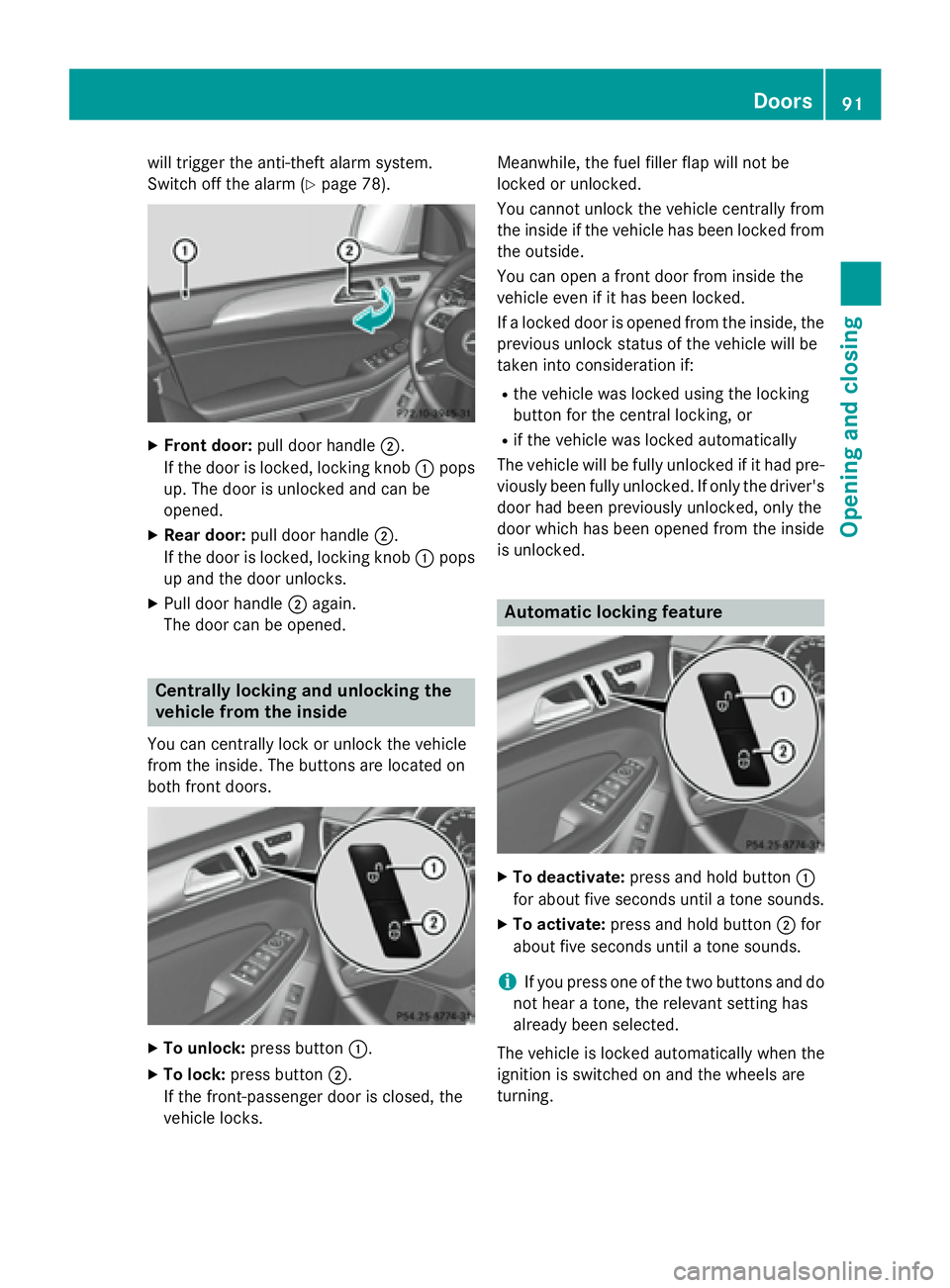
will trigger the anti-theft alarm system.
Switch off the alarm ( Y
page 78).X
Front door: pull door handle D .
If the door is locked, locking knob C pops
up. The door is unlocked and can be
opened. X
Rear door: pull door handle D .
If the door is locked, locking knob C pops
up and the door unlocks. X
Pull door handle D again.
The door can be opened.
Centrally locking and unlocking the
vehicle from the inside
You can centrally lock or unlock the vehicle
from the inside. The buttons are located on
both front doors.
X
To unlock: press button C .X
To lock: press button D .
If the front-passenger door is closed, the
vehicle locks. Meanwhile, the fuel filler flap will not be
locked or unlocked.
You cannot unlock the vehicle centrally from
the inside if the vehicle has been locked from
the outside.
You can open a front door from inside the
vehicle even if it has been locked.
If a locked door is opened from the inside, the
previous unlock status of the vehicle will be
taken into consideration if: R
the vehicle was locked using the locking
button for the central locking, or R
if the vehicle was locked automatically
The vehicle will be fully unlocked if it had pre-
viously been fully unlocked. If only the driver's
door had been previously unlocked, only the
door which has been opened from the inside
is unlocked.
Automatic locking feature
X
To deactivate: press and hold button C
for about five seconds until a tone sounds. X
To activate: press and hold button D for
about five seconds until a tone sounds.
i If you press one of the two buttons and do
not hear a tone, the relevant setting has
already been selected.
The vehicle is locked automatically when the
ignition is switched on and the wheels are
turning. Doors 91
Opening and closing Z
Page 109 of 462
Useful information ............................ 108
Correct driver's seat position .......... 108
Seats .................................................. 109
Steering wheel .................................. 121
Mirrors ............................................... 124
Memory function ............................... 127 107
Seats, steering wheel and mirrors
Page 110 of 462
Useful information
i This Operator's Manual describes all
models and all standard and optional equip-
ment of your vehicle available at the time of
publication of the Operator's Manual.
Country-specific differences are possible.
Please note that your vehicle may not be
equipped with all features described. This
also applies to safety-related systems and
functions.
i Read the information on qualified special-
ist workshops ( Y
page 29).
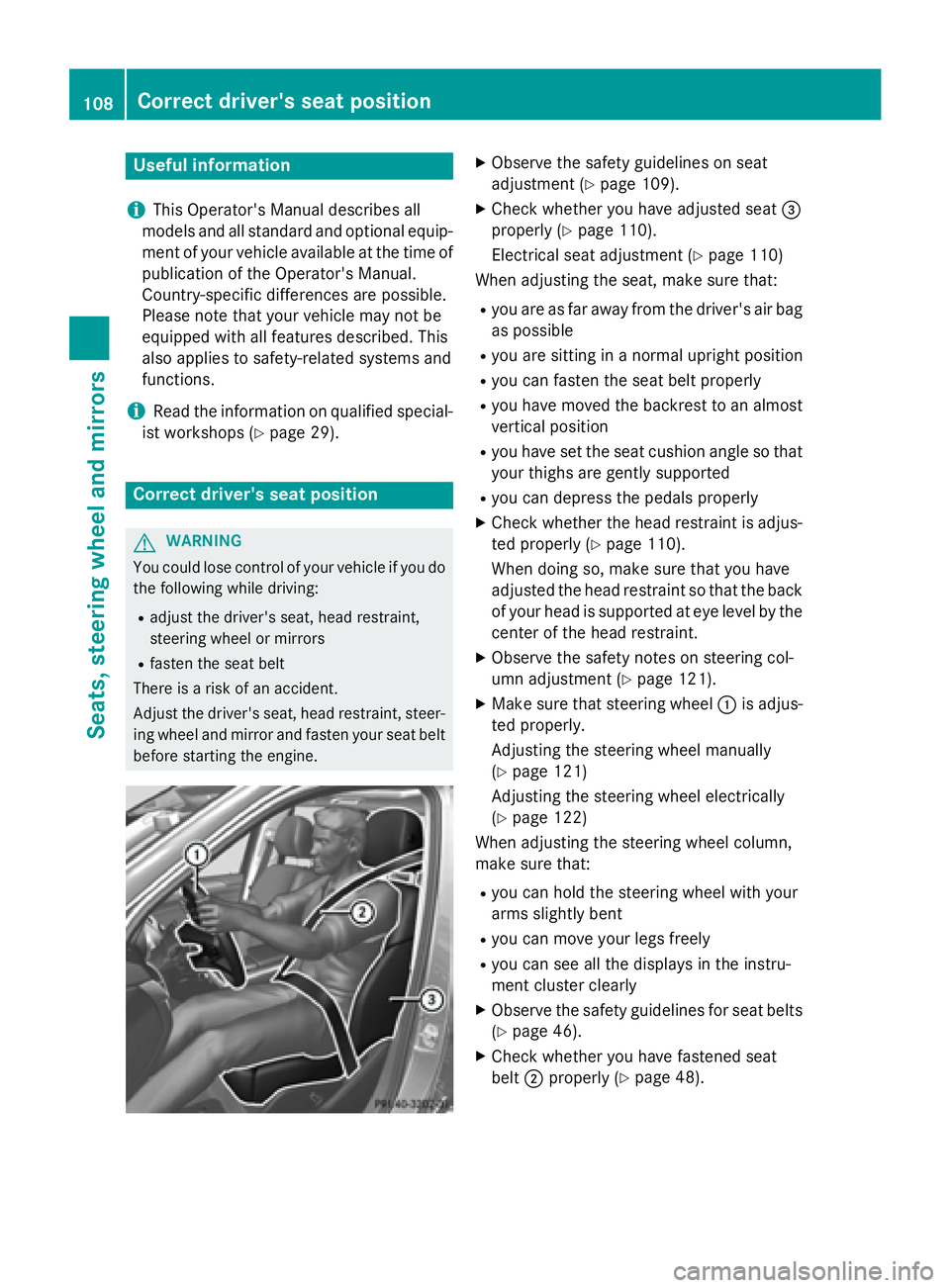
Correct driver's seat position
G WARNING
You could lose control of your vehicle if you do
the following while driving: R
adjust the driver's seat, head restraint,
steering wheel or mirrors R
fasten the seat belt
There is a risk of an accident.
Adjust the driver's seat, head restraint, steer-
ing wheel and mirror and fasten your seat belt
before starting the engine. X
Observe the safety guidelines on seat
adjustment ( Y
page 109). X
Check whether you have adjusted seat