trailer MERCEDES-BENZ GL 2016 Workshop Manual
[x] Cancel search | Manufacturer: MERCEDES-BENZ, Model Year: 2016, Model line: GL, Model: MERCEDES-BENZ GL 2016Pages: 462, PDF Size: 12.66 MB
Page 427 of 462
DOT (Department of Transportation)
DOT-marke d tires fulfill th e requirements of
th e U S Departmen t of Transportation .
Normal occupant weigh t
The number of occupant s fo r whic h th e vehi-
cle is designed multiplie d by 68 kilograms
(15 0 lbs) .
Unifor m Tire Qualit y Grading Standards
A uniform standard to grade th e qualit y of
tires wit h regards to tread quality, tire traction
and temperature characteristics . The qualit y
gradin g assessmen t is made by th e manufac -
turer following specification s from th e U.S.
government. The ratings are molded into th e
sidewall of th e tire.
Recommended tire pressure s
The recommended tire pressur e applies to
th e tires mounted at th e factory.
The Tir e and Loadin g Information placard con-
tains th e recommended tire pressures fo r
cold tires on a full y loade d vehicl e and fo r th e
maximum permissibl e vehicl e speed.
The tire pressur e table contain s th e recom-
mended pressures fo r cold tires fo r various
operating conditions, i.e. differin g load and
speed conditions.
Increased vehicle weigh t du e to optiona l
equipment
The combine d weight of all standard and
optional equipmen t available fo r th e vehicle,
regardless of whether it is actually installed
o n th e vehicl e or not.
Ri m
This is th e part of th e whee l on whic h th e tire
is mounted.
GAW R (Gross Axle Weight Rating)
The GAW R is th e maximum gross axl e weight
rating. The actual load on an axl e mus t never
exceed th e gross axl e weight rating. The
gross axl e weight ratin g can be found on th e
vehicl e identification plat e on th e B-pillar on
th e driver's side . Speed rating
The speed ratin g is part of th e tire identifica-
tion . It specifies th e speed range fo r whic h th e
tire is approved.
GT W (Gross Trailer Weight )
The GTW is th e weight of a trailer includin g th e
weight of th e load, luggage, accessories etc.
on th e trailer .
GV W (Gross Vehicle Weight )
The gross vehicl e weight includes th e weight
of th e vehicl e includin g fuel , tools , th e spar e
wheel, accessories installed , occupants, lug-
gage and th e drawbar noseweight , if applica-
ble. The gross vehicl e weight mus t no t exceed
th e gross vehicl e weight ratin g GVWR as
specified on th e vehicl e identification plat e on
th e B-pillar on th e driver's side .
GVWR (Gross Vehicle Weight Rating)
The GVWR is th e maximum permissibl e gross
weight of a full y loade d vehicl e (the weight of
th e vehicl e includin g a ll accessories, occu-
p ants , fuel, luggage and th e drawbar nose-
weight , if applicable). The gross vehicl e
weight ratin g is specified on th e vehicl e iden -
tification plat e on th e B-pillar on th e driver's
side .
Maximum loaded vehicle weigh t
The maximum weight is th e sum of :R
th e cur b weight of th e vehicl eR
th e weight of th e accessories R
th e load limi t R
th e weight of th e factory installed optional
equipmen t
Kilopascal (kPa)
Metric uni t fo r tire pressure. 6. 9 kP a corre-
spond s to 1 psi . Another uni t fo r tire pressur e
is bar. 10 0 kilopascal s (kPa) are th e equiva-
len t of 1 bar.
Load index
In addition to th e load-bearin g index , th e load
index may also be imprinte d on th e sidewall ofAll about wheels and tires 42 5
Wheels and tires Z
Page 428 of 462
the tire. This specifies the load-bearing capa-
city more precisely.
Curb weight
The weight of a vehicle with standard equip-
ment including the maximum capacity of fuel,
oil and coolant. It also includes the air-condi-
tioning system and optional equipment if
these are installed in the vehicle, but does not
include passengers or luggage.
Maximum load rating
The maximum load rating is the maximum
permissible weight in kilograms or lbs for
which a tire is approved.
Maximum permissible tire pressure
Maximum permissible tire pressure for one
tire.
Maximum load on one tire
Maximum load on one tire. This is calculated
by dividing the maximum axle load of one axle
by two.
PSI (pounds per square inch)
A standard unit of measure for tire pressure.
Aspect ratio
Relationship between tire height and tire
width in percent.
Tire pressure
This is pressure inside the tire applying an
outward force to each square inch of the tire's
surface. The tire pressure is specified in
pounds per square inch (psi), in kilopascal
(kPa) or in bar. The tire pressure should only
be corrected when the tires are cold.
Cold tire pressure
The tires are cold: R
if the vehicle has been parked without
direct sunlight on the tires for at least three
hours and R
if the vehicle has not been driven further
than 1 mile (1.6 km) Tread
The part of the tire that comes into contact
with the road.
Bead
The tire bead ensures that the tire sits
securely on the wheel. There are several steel
wires in the bead to prevent the tire from
coming loose from the wheel rim.
Sidewall
The part of the tire between the tread and the
bead.
Weight of optional extras
The combined weight of those optional extras
that weigh more than the replaced standard
parts and more than 2.3 kg (5 lbs). These
optional extras, such as high-performance
brakes, level control, a roof rack or a high-
performance battery, are not included in the
curb weight and the weight of the accesso-
ries.
TIN (Tire Identification Number)
This is a unique identifier which can be used
by a tire manufacturer to identify tires, for
example for a product recall, and thus identify
the purchasers. The TIN is made up of the
manufacturer's identity code, tire size, tire
type code and the manufactu ring date.
L o ad bearing index
The load bearing index (also load index) is a
code that contains the maximum load bearing
capacity of a tire.
Traction
Traction is the result of friction between the
tires and the road surface.
TWR (Tongue Weight Rating)
The TWR specifies the maximum permissible
weight that the ball coupling of the trailer tow
hitch can support.426
All about wheels an d tires
Wheels and tires
Page 445 of 462
Useful information ............................ 444
Information regarding technical
data .................................................... 444
Vehicle electronics ........................... 444
Identification plates ......................... 446
Service products and filling capaci-
ties ..................................................... 447
Vehicle data ....................................... 454
Vehicle data for off-road driving ...... 455
Trailer tow hitch ................................ 457 443
Technical data
Page 459 of 462
Vehicles with the ON&OFFROAD package:
the maximum gradient climbing ability is
100% when the LOW RANGE off-road gear is
selected.
Vehicles without the ON&OFFROAD pack-
age: the maximum gradient climbing ability is
80%.
Accelerate carefully and make sure that the
wheels do not spin when driving on steep ter-
rain.
i If the load on the front axle is reduced
when pulling away on a steep uphill slope,
the front wheels have a tendency to spin.
4ETS recognizes this and brakes the
wheels accordingly. The rear wheel torque
is increased, making it easier to drive off.
For further information about the maximum
gradient climbing ability, see ( Y
page 202).
Trailer tow hitch
Mounting dimensions
! If you have a trailer tow hitch retrofitted,
changes to the cooling system and drive
train may be necessary, depending on the
vehicle type.
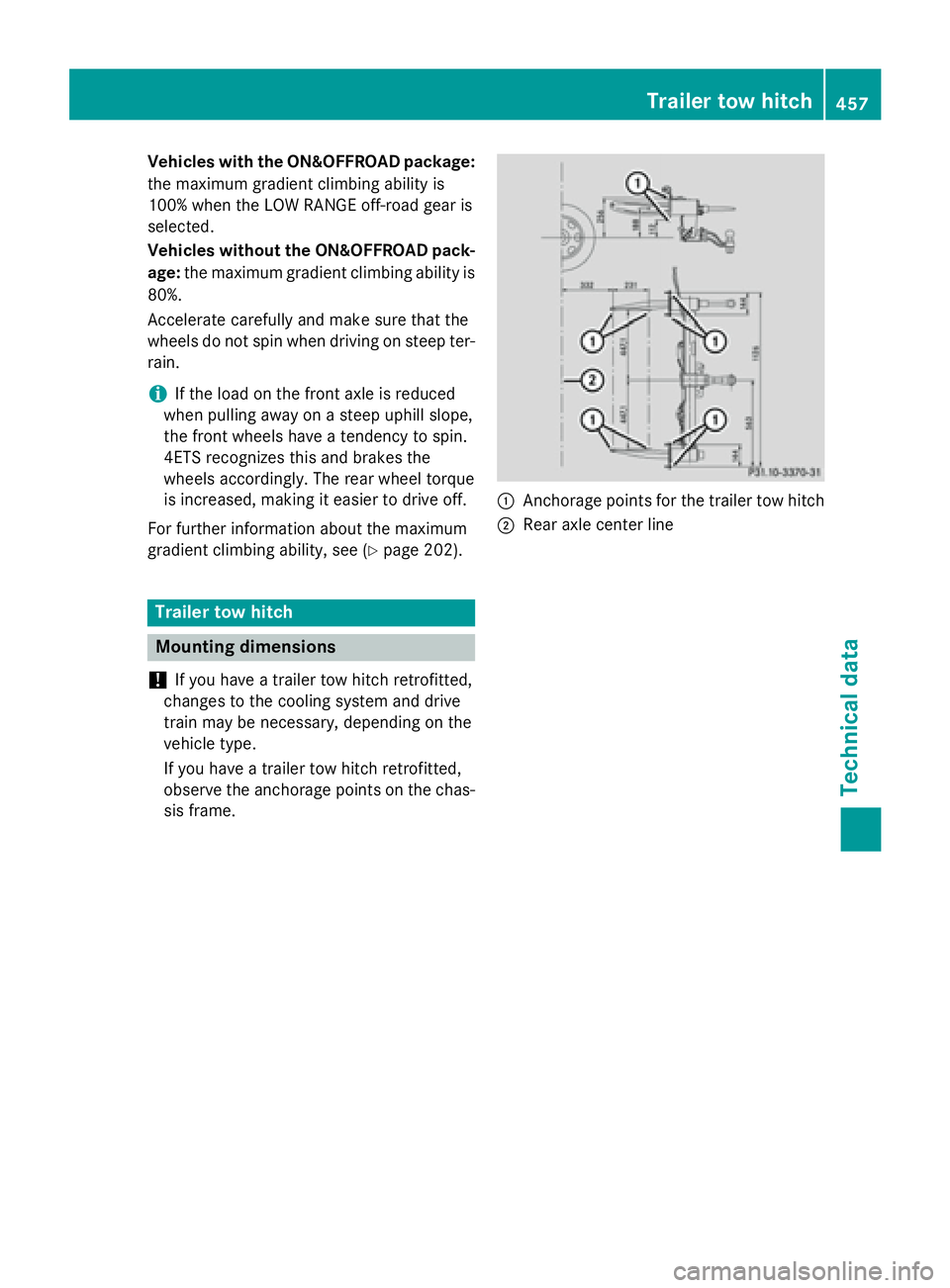
If you have a trailer tow hitch retrofitted,
observe the anchorage points on the chas-
sis frame. C
Anchorage points for the trailer tow hitch D
Rear axle center lineTrailer tow hitch 457
Technical data Z
Page 460 of 462
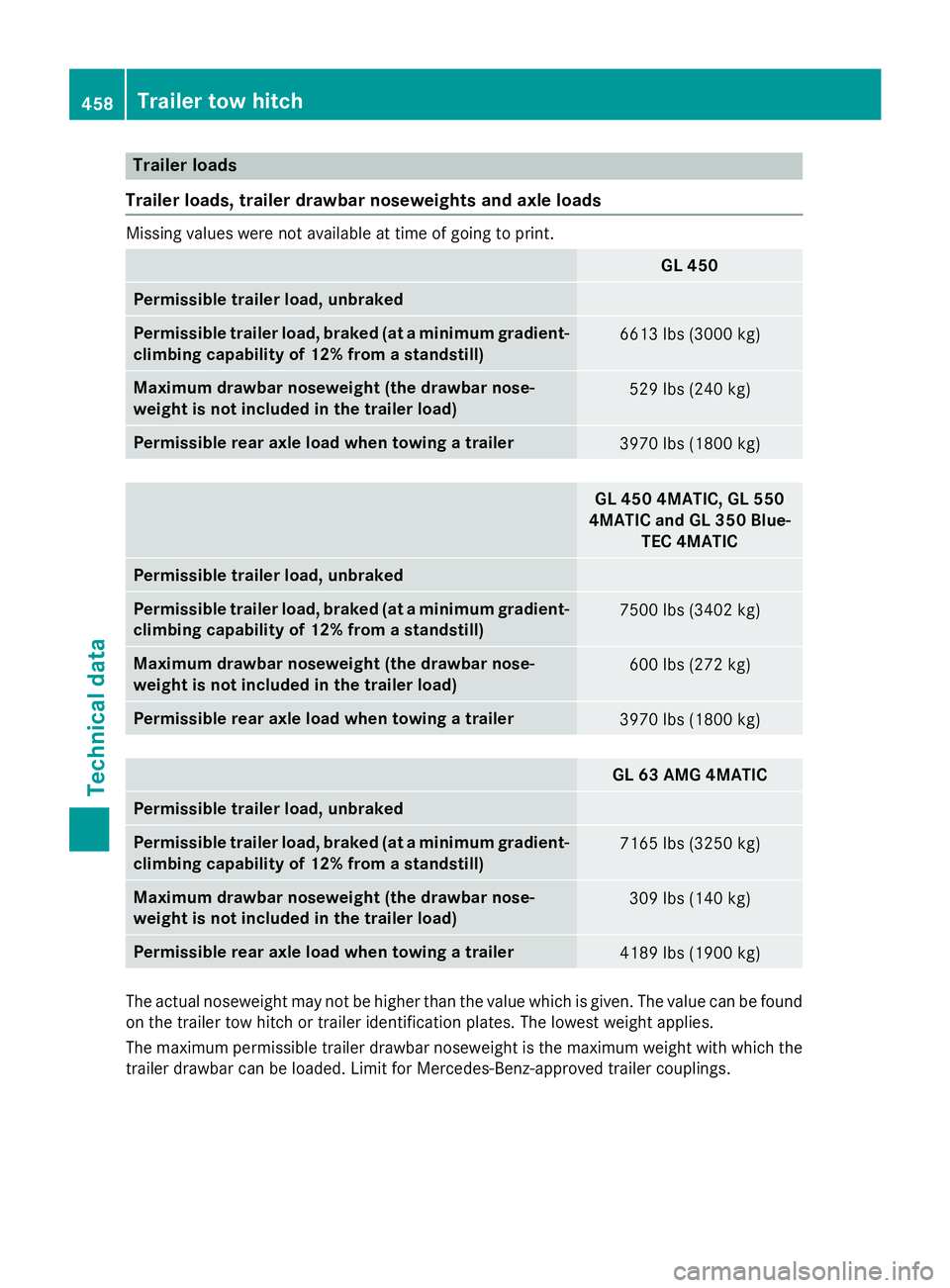
Trailer loads
Trailer loads, trailer drawbar noseweights and axle loads Missing values were not available at time of going to print.
GL 450
Permissible trailer load, unbraked
Permissible trailer load, braked (at a minimum gradient-
climbing capability of 12% from a standstill) 6613 lbs (3000 kg)
Maximum drawbar noseweight (the drawbar nose-
weight is not included in the trailer load) 529 lbs (240 kg)
Permissible rear axle load when towing a trailer
3970 lbs (1800 kg)
GL 450 4MATIC, GL 550
4MATIC and GL 350 Blue-
TEC 4MATIC
Permissible trailer load, unbraked
Permissible trailer load, braked (at a minimum gradient-
climbing capability of 12% from a standstill) 7500 lbs (3402 kg)
Maximum drawbar noseweight (the drawbar nose-
weight is not included in the trailer load) 600 lbs (272 kg)
Permissible rear axle load when towing a trailer
3970 lbs (1800 kg)
GL 63 AMG 4MATIC
Permissible trailer load, unbraked
Permissible trailer load, braked (at a minimum gradient-
climbing capability of 12% from a standstill) 7165 lbs (3250 kg)
Maximum drawbar noseweight (the drawbar nose-
weight is not included in the trailer load) 309 lbs (140 kg)
Permissible rear axle load when towing a trailer
4189 lbs (1900 kg)
The actual noseweight may not be higher than the value which is given. The value can be found
on the trailer tow hitch or trailer identification plates. The lowest weight applies.
The maximum permissible trailer drawbar noseweight is the maximum weight with which the
trailer drawbar can be loaded. Limit for Mercedes-Benz-approved trailer couplings.458
Trailer tow hitch
Technical data
Page 461 of 462
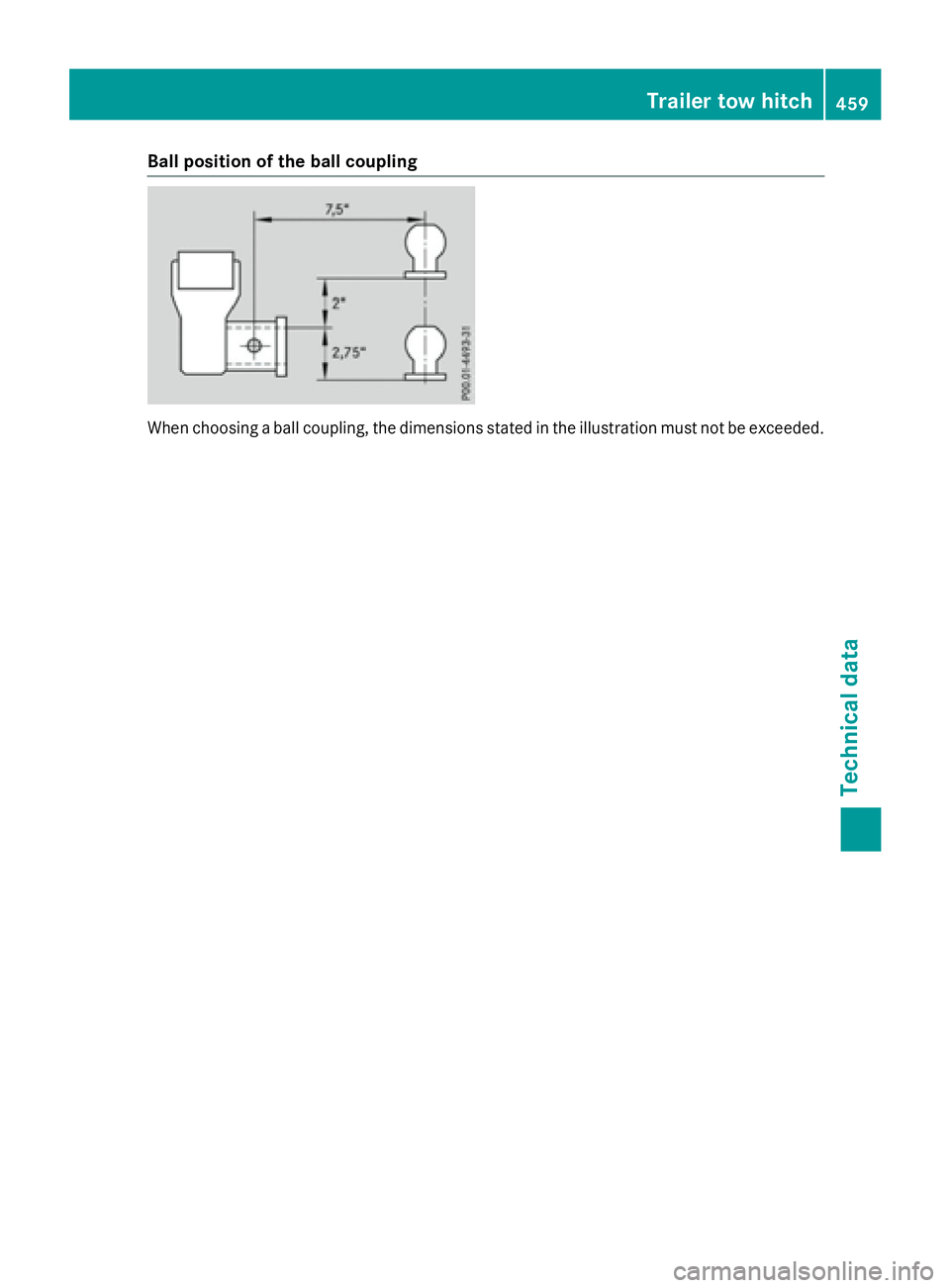
Ball position of the ball coupling
When choosing a ball coupling, the dimensions stated in the illustration must not be exceeded. Trailer tow hitch 459
Technical data Z