steering MERCEDES-BENZ GL 2016 Repair Manual
[x] Cancel search | Manufacturer: MERCEDES-BENZ, Model Year: 2016, Model line: GL, Model: MERCEDES-BENZ GL 2016Pages: 462, PDF Size: 12.66 MB
Page 265 of 462
R
Uphill or downhill gradient in percentage R
On-road/off-road program selected R
Condition of the differential lock for the
transfer case R
LOW RANGE off-road gear is selected R
Condition of the LOW RANGE off-road
gear R
On-road trailer program is selected
Towing a trailer
Important safety notes
G WARNING
Installing an unsuitable ball coupling may
result in overloading of the trailer tow hitch
and the rear axle. This applies especially if the
ball coupling in question is longer or angled
differently. This could seriously impair the
driving characteristics and the trailer can
come loose. There is a risk of an accident.
You should only ever install a ball coupling
that has the permissible dimensions and that
is designed to meet your trailer-towing
requirements. Do not modify the ball coupling
or the trailer tow hitch.
You will find the values approved by the man-
ufacturer on the vehicle identification plates
and those for the towing vehicle under "Tech-
nical data" ( Y
page 458).
G WARNING
If the ball coupling is not installed correctly or
not secured with the bolt provided and the
corresponding spring cotter, the trailer may
come loose. There is a risk of an accident.
Always install and secure the ball coupling as
described. Before every journey, ensure that
the ball coupling is secured with the bolt and
the corresponding spring cotter.
G WARNING
When the vehicle/trailer combination begins
to lurch, you could lose control of it. The vehi- cle/trailer combination could even rollover.
There is a risk of an accident.
On no account should you attempt to
straighten up the vehicle/trailer combination
by increasing the speed. Reduce vehicle
speed and do not countersteer. Apply the
brake as necessary.
Please observe the manufacturer's operating
instructions for the trailer coupling if a
detachable trailer coupling is used.
Couple and uncouple the trailer carefully. If
you do not couple the trailer to the towing
vehicle correctly, the trailer could become
detached.
Make sure that the following values are not
exceeded: R
the permissible trailer drawbar noseweight R
the permissible trailer load R
the permissible rear axle load of the towing
vehicle R
the maximum permissible gross vehicle
weight of both the towing vehicle and the
trailer
The applicable permissible values, which
must not be exceeded, can be found: R
in the vehicle documents R
on the identification plates for the trailer
tow hitch and the trailer R
on the vehicle identification plate
If the values differ, the lowest value applies.
When towing a trailer, your vehicle's handling
characteristics will be different in comparison
with when driving without a trailer.
The vehicle/trailer combination: R
is heavier R
is restricted in its acceleration and gradi-
ent-climbing capability R
has an increased braking distance R
is affected more by strong crosswinds R
demands more sensitive steering R
has a larger turning radius Towing a trailer 263
Driving and parking Z
Page 266 of 462
This could impair the handling characteris-
tics.
When towing a trailer, always adjust your
speed to the current road and weather con-
ditions. Do not exceed the maximum permis-
sible speed for your vehicle/trailer combina-
tion.
Notes on towing a trailer
General notes The following models cannot be used to tow a
trailer: R
GLE 550 e 4MATIC Sport Utility Vehicle R
Do not exceed the legally prescribed max-
imum speed for vehicle/trailer combina-
tions in the relevant country.
This lowers the risk of an accident. R
Only install an approved trailer coupling on
your vehicle.
Further information on availability and on
installation is available from any authorized
Mercedes-Benz Center. R
The bumpers of your vehicle are not suita-
ble for installing detachable trailer cou-
plings. R
Do not install hired trailer couplings or
other detachable trailer couplings on the
bumpers of your vehicle. R
If you no longer need the ball coupling,
remove it from the ball coupling recess.
This will reduce the risk of damage to the
ball coupling.
When towing a trailer, set the tire pressure on
the rear axle of the towing vehicle for the
maximum load. You will find the values in the
tire pressure table in the fuel filler flap of the
vehicle ( Y
page 425).
Please note that when towing a trailer, the
following driving systems have limited avail-
ability or are not available at all: R
PARKTRONIC ( Y
page 224)R
Blind Spot Assist ( Y
page 244)R
Active Lane Keeping Assist ( Y
page 251) You will find installing dimensions and loads
under "Technical data" ( Y
page 457).
Driving tips Observe the information on ESP ®
trailer sta-
bilization ( Y
page 75) and on pulling away with
a trailer ( Y
page 168).
The maximum permissible speed for vehicle/
trailer combinations depends on the type of
trailer. Before beginning the journey, check
the trailer's documents to see what the max-
imum permissible speed is. Observe the
legally prescribed maximum speed in the rel-
evant country.
For certain Mercedes-Benz vehicles, the max-
imum permissible rear axle load is increased
when towing a trailer. See "Technical data" to
find out whether this applies to your vehicle
( Y
page 458). If you utilize any of the added
maximum rear axle load when towing a trailer,
the vehicle/trailer combination may not
exceed a maximum speed of 60 mph
(100 km/h) for reasons concerning the oper-
ating permit. This also applies in countries in
which the permissible maximum speed for
vehicle/trailer combinations is above 60 mph
(100 km/ h) .
When towing a trailer, your vehicle's handling
characteristics will be different in comparison
with when driving without a trailer.
Use the left-hand steering wheel paddle
shifter to shift into a lower gear in good time
on long and steep downhill gradients.
This also applies if you have activated cruise
control or DISTRONIC PLUS.
This will use the braking effect of the engine,
so that less braking will be required to main-
tain the speed. This relieves the load on the
brake system and prevents the brakes from
overheating and wearing too quickly. If you
need additional braking, depress the brake
pedal repeatedly rather than continuously.264
Towing a trailer
Driving and parking
Page 270 of 462
using the brake controller and check
whether the brakes function correctly. R
Se cure any objects on the trailer to prevent
the cargo from slipping when the vehicle is
in motion. R
When you couple up a trailer, check at reg-
ular intervals that the load is firmly secured.
If the trailer is equipped with trailer lights
and brakes, check the trailer to ensure that
these are working. R
Bear in mind that the han dlin g will be less
st able when towing a trailer than when driv-
ing wit hout one. Avoid sudden steering
movements. R
The vehicle/trailer combination is heavier,
accelerates more slowly, has a decreased
gradient cli mbin g capability and a longer
braking dist ance.
It is more susceptible to side winds and
requires more careful steering. R
If poss ible, do not brake suddenly, but
instead depr ess the brake pedal moder-
ate ly at first so that the trailer can activate
it s brakes. Then increase the pressure on
the brake pedal. R
If the automat ic transmission repeat edly
shifts between gears on uphill or down hill
gradients, shift to a lower gear using the
left-hand steering wheel paddle shifter.
A lower gear and lower speed reduce the
risk of engine failure. R
When driv ing down hill, shift to a lower gear
to uti liz e the engine's braking effect.
Avoid continuous brake application as this
m ay
overheat the vehicle brakes and, if
instal led, the trailer brakes.R
If the coolant temperature increases dra-
matical ly while the air-cond it ioning system
is swit ched on, switch off the air-condition-
ing system.
Coolant heat can also be dissipated by
opening the win dows and switching the ventilation blowe r and the interior temper-
ature to the highest leve l.R
When overtaking, pay particular attention
to the extended length of your vehicle/
trailer combination.
Due to the length of the vehicle/trailer
combination, you require additional road
space in relation to the vehicle you are
overtaking before you can change back to
the original lane.
Decoupling a trailer
G WARNIN G
If you uncouple a trailer wit h th e overrun
brak e engaged , you could trap your han d
between th e vehicl e and th e trailer drawbar.
Ther e is a ris k of injury.
Do no t uncouple a trailer if th e overrun brak e
is engaged .
G WARNIN G
Vehicles wit h leve l control :
The vehicl e is lowered as soo n as you discon -
nect th e trailer cable. This could result in your
limb s or those of other people that are
between th e vehicl e body and tires or under-
neath th e vehicl e bein g trapped . Ther e is a
ris k of injury.
Mak e sure that nobody is in th e immediat e
vicinity of th e whee l housing s or under th e
vehicl e when you disconnect th e trailer cable.
! Do not disc onnect a trailer wit h an
engaged overrun brake. Otherwise, your
vehicle could be damaged by the reboun d-
ing of the overrun brake. X
Sh ift the transmission to position P .X
Ap ply the vehicle's electr ic parking brake.X
St art the engine. X
Close the doors and tailgate. X
Apply the trailer's parking brake.268
Towing a trailer
Driving and parking
Page 278 of 462
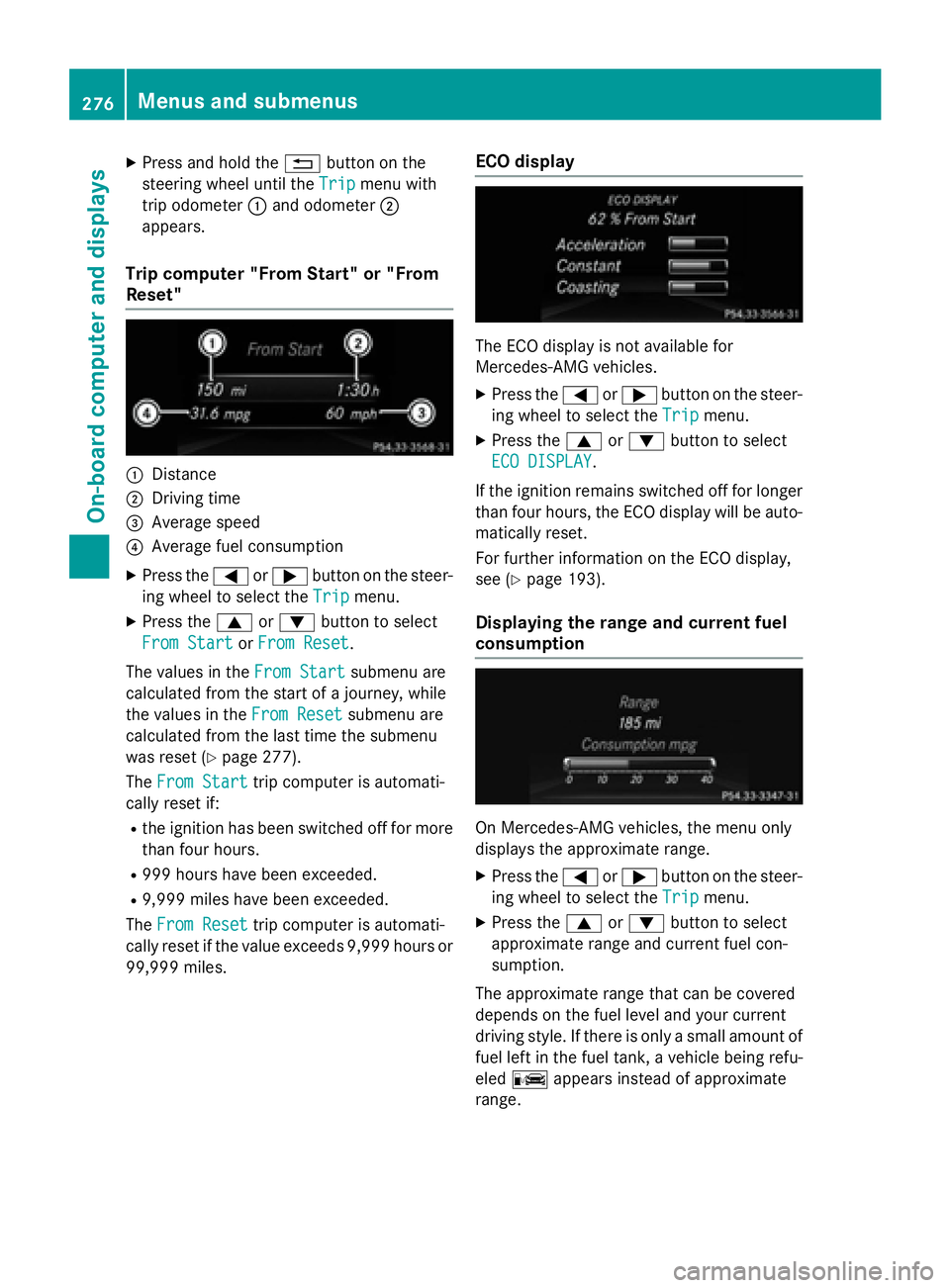
X
Press and hold the 8 button on the
steering wheel until the Trip
menu with
trip odometer C and odometer D
appears.
Trip computer "From Start" or "From
Reset"
C
DistanceD
Driving time
Page 282 of 462
to traffic conditions and operate the equip-
ment when the vehicle is stationary.
When telephoning, you must observe the
legal requirements for the country in which
you are currently driving. X
Switch on the mobile phone (see the man-
ufacturer’s operating instructions). X
Switch on COMAND (see the separate
operating instructions). X
Establish a Bluetooth ®
connection to
COMAND, see the separate operating
instructions. X
Press the Y or e button on the steer-
ing wheel to select the Tel
menu.
You will see one of the following display mes-
sages in the multifunction display: R
Telephone READY or the name of the net-
work provider: the mobile phone has found
a network and is ready to receive. R
Telephone No service : there is no net-
work available or the mobile phone is
searching for a network.
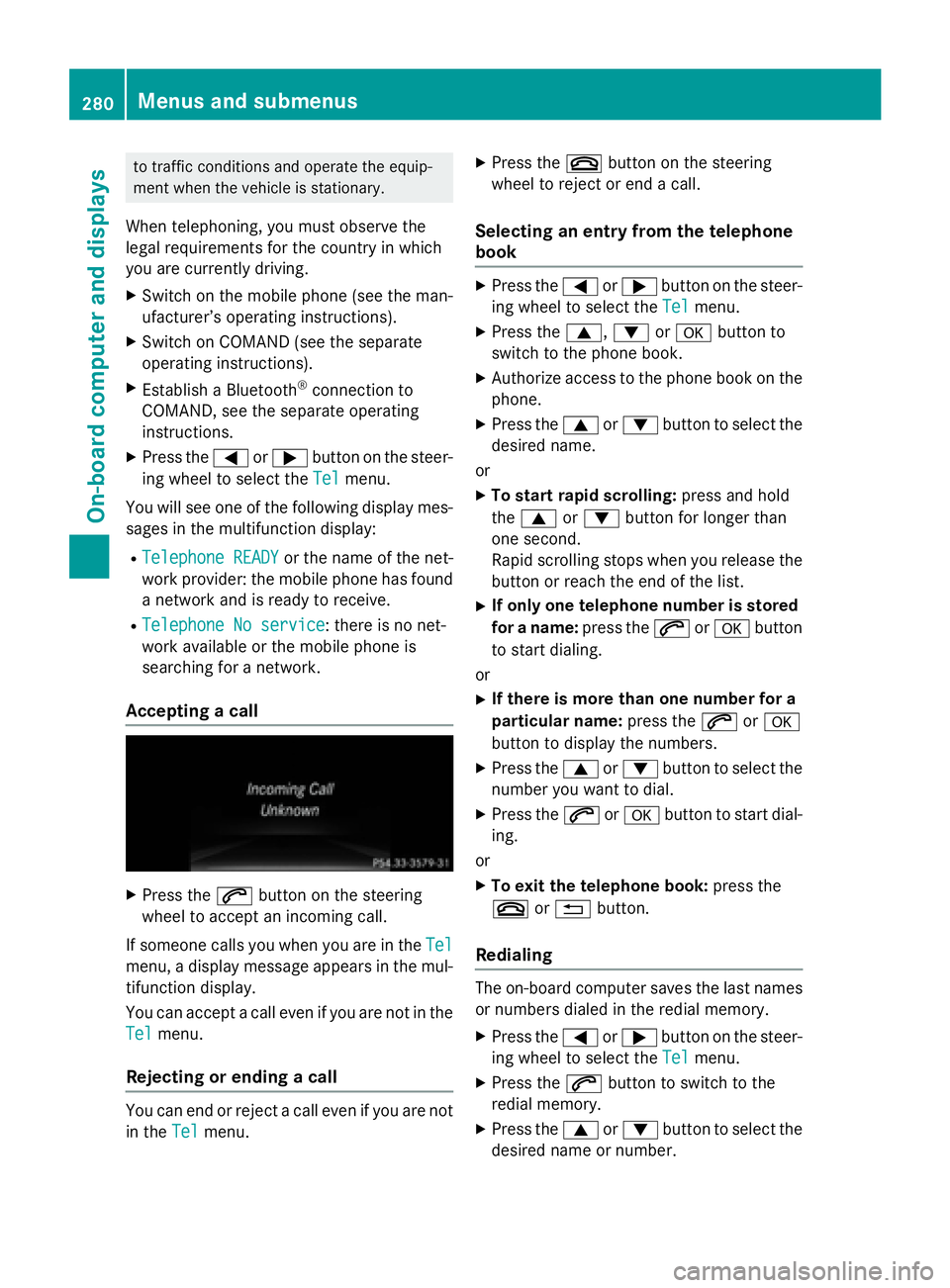
Accepting a call
X
Press the a button on the steering
wheel to accept an incoming call.
If someone calls you when you are in the Tel
menu, a display message appears in the mul-
tifunction display.
You can accept a call even if you are not in the
Tel
menu.
Rejecting or ending a call
You can end or reject a call even if you are not
in the Tel
menu. X
Press the v button on the steering
wheel to reject or end a call.
Selecting an entry from the telephone
book X
Press the Y or e button on the steer-
ing wheel to select the Tel
menu.X
Press the c , d or v button to
switch to the phone book. X
Authorize access to the phone book on the
phone. X
Press the c or d button to select the
desired name.
or X
To start rapid scrolling: press and hold
the c or d button for longer than
one second.
Rapid scrolling stops when you release the
button or reach the end of the list. X
If only one telephone number is stored
for a name: press the a or v button
to start dialing.
or X
If there is more than one number for a
particular name: press the a or v
button to display the numbers. X
Press the c or d button to select the
number you want to dial. X
Press the a or v button to start dial-
ing.
or X
To exit the telephone book: press the
v or 8 button.
Redialing
The on-board computer saves the last names
or numbers dialed in the redial memory. X
Press the Y or e button on the steer-
ing wheel to select the Tel
menu.X
Press the a button to switch to the
redial memory. X
Press the c or d button to select the
desired name or number.280
Menus and submenus
On-board computer and displays
Page 283 of 462
X
Press the a or v button to start dial-
ing.
or X
To exit the redial memory: press the
v or 8 button.
Assistance menu
Introduction
Depending on your vehicle's equipment, in
the Assist.
menu, you have the following
options: R
Displaying the assistance graphic
( Y
page 281) R
Activating/deactivating the distance warn-
ing function ( Y
page 281)R
Activating/deactivating PRE-SAFE ®
Brake
( Y
page 282) R
Activating/deactivating ATTENTION
ASSIST ( Y
page 282)R
Activating/deactivating Blind Spot Assist
or Active Blind Spot Assist ( Y
page 282)R
Activating/deactivating Lane Keeping
Assist or Active Lane Keeping Assist
( Y
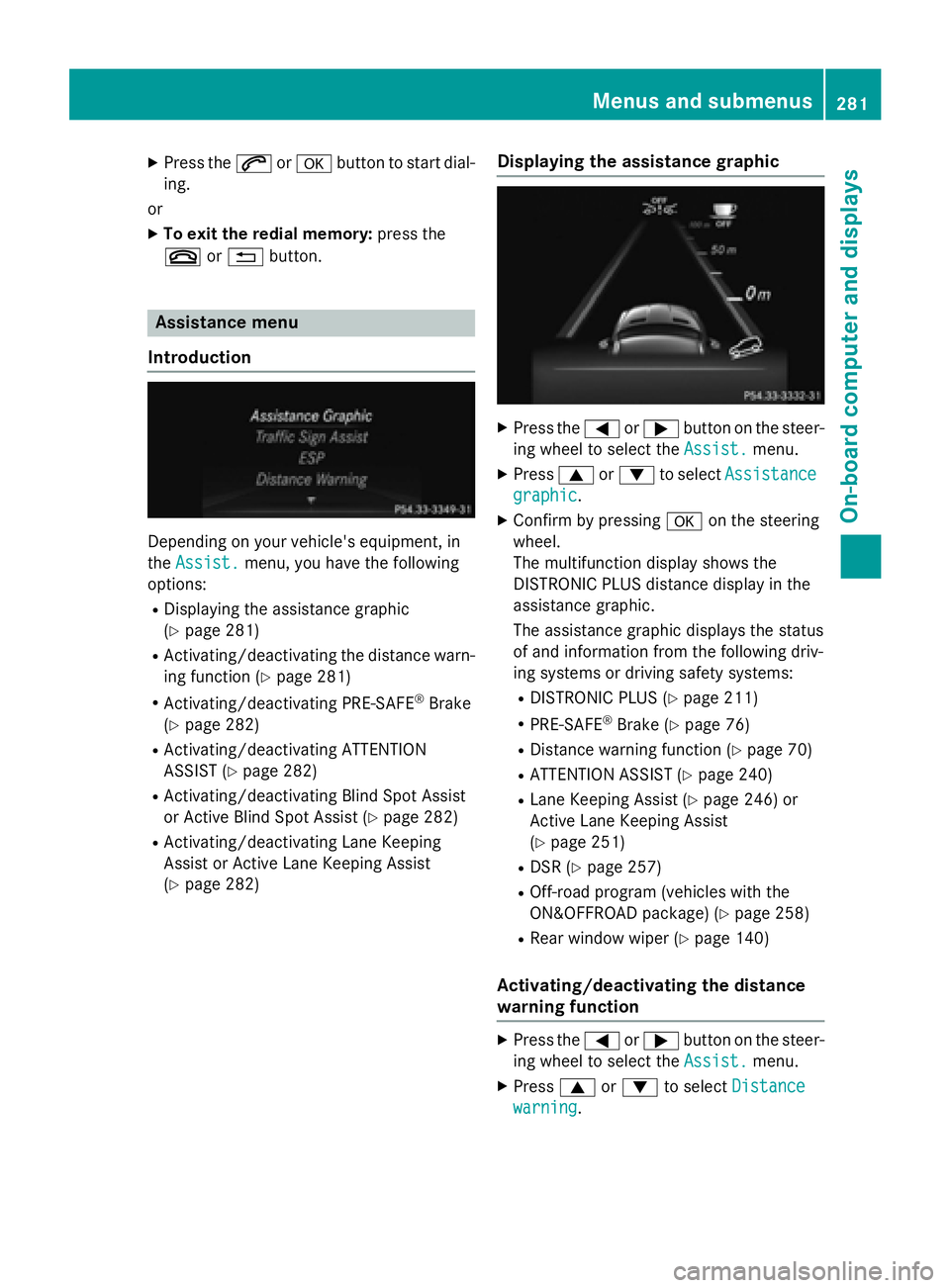
page 282) Displaying the assistance graphic X
Press the Y or e button on the steer-
ing wheel to select the Assist.
menu.X
Press c or d to select Assistance
graphic . X
Confirm by pressing v on the steering
wheel.
The multifunction display shows the
DISTRONIC PLUS distance display in the
assistance graphic.
The assistance graphic displays the status
of and information from the following driv-
ing systems or driving safety systems: R
DISTRONIC PLUS ( Y
page 211) R
PRE-SAFE ®
Brake ( Y
page 76) R
Distance warning function ( Y
page 70)R
ATTENTION ASSIST ( Y
page 240)R
Lane Keeping Assist ( Y
page 246) or
Active Lane Keeping Assist
( Y
page 251) R
DSR ( Y
page 257) R
Off-road program (vehicles with the
ON&OFFROAD package) ( Y
page 258)R
Rear window wiper ( Y
page 140)
Activating/deactivating the distance
warning function X
Press the Y or e button on the steer-
ing wheel to select the Assist.
menu.X
Press c or d to select Distance
warning .Menus and submenus 281
On-board computer and displays Z
Page 287 of 462
R
surround lighting: the exterior lighting
remains lit for 40 seconds after unlocking
with the SmartKey. If you start the engine,
the surround lighting is switched off and
automatic headlamp mode is activated
( Y
page 130). R
exterior lighting delayed switch-off: the
exterior lighting remains lit for 60 seconds
after the engine is switched off. If you close
all the doors and the tailgate, the exterior
lighting goes off after 15 seconds.
i Depending on your vehicle's equipment,
when the surround lighting and delayed
switch-off exterior lighting are on, the fol-
lowing light up: R
Parking lamps R
Daytime running lamps R
Side marker lamps R
Surround lighting in the exterior mirrors
Activating/deactivating the interior light-
ing delayed switch-off
If you activate the Light. Delay
function,
the interior lighting remains on for
20 seconds after you remove the SmartKey
from the ignition lock. X
Press the Y or e button on the steer-
ing wheel to select the Settings
menu.X
Press the d or c button to select the
Lights
submenu.X
Press v to confirm.X
Press the d or c button to select the
Lighting delayed sw.-off
function.
If the Interior
Lighting Delay function
has been switched on, the vehicle interior is
displayed in orange in the multifunction
display. X
Press the v button to save the setting. Vehicle submenu Activating/deactivating the automatic
door locking mechanism
If you activate the Automatic Door Lock
function, the vehicle is centrally locked above
a speed of approximately 9 mph (15 km/h). X
Press the Y or e button on the steer-
ing wheel to select the Sett
menu.X
Press the d or c button to select the
Vehicle
submenu. X
Press v to confirm. X
Press the d or c button to select the
Automatic Door Lock
function.
When the Automatic
Door Lock function
is activated, the vehicle doors are displayed
in orange in the multifunction display. X
Press the v button to save the setting.
For further information on the automatic lock-
ing feature, see ( Y
page 91).
Activating/deactivating the acoustic
locking verification signal
If you switch on the Acoustic
Lock function,
an acoustic signal sounds when you lock the
vehicle. X
Press the Y or e button on the steer-
ing wheel to select the Sett.
menu.X
Press d or c to select the Vehicle
submenu. X
Press v to confirm. X
Press the d or c button to select the
Acoustic Lock
function.
If the Acoustic
Lock function is activated,
the 7 symbol in the multifunction dis-
play lights up orange. X
Press the v button to save the setting.
Convenience submenu
Activating/deactivating the EASY-
ENTRY/EXIT feature
G WARNING
When the EASY-ENTRY/EXIT feature adjusts
the steering wheel, you and other vehicleMenus and submenus 285
On-board computer and displays Z
Page 288 of 462
occupants – particularly children – could
become trapped. There is a risk of injury.
While the EASY-ENTRY/EXIT feature is mak-
ing adjustments, make sure that no one has
any body parts in the sweep of the steering
wheel.
If somebody becomes trapped: R
press one of the memory function position
buttons, or R
move the switch for steering wheel adjust-
ment in the opposite direction to that in
which the steering wheel is moving.
The adjustment process is stopped. X
Press the Y or e button on the steer-
ing wheel to select the Sett
menu.X
Press the d or c button to select the
Convenience
submenu.X
Press v to confirm.X
Press the d or c button to select the
Easy Entry/Exit:
function.
If the Easy Entry/Exit
function is activa-
ted, the vehicle steering wheel is displayed
in orange in the multifunction display. X
Press the v button to save the setting.
Further information on the EASY-ENTRY/EXIT
feature ( Y
page 123).
Switching the belt adjustment on/off X
Press the Y or e button on the steer-
ing wheel to select the Sett.
menu.X
Press the d or c button to select the
Convenience
submenu.X
Press v to confirm.X
Press the d or c button to select the
Belt Adjustment
function.
If the Belt Adjustment
function is activa-
ted, the vehicle seat belt is shown in orange
in the multifunction display. X
Press the v button to save the setting.
For further information on belt adjustment,
see ( Y
page 49). Switching the fold-in mirrors when lock-
ing feature on/off
This function is only available when the vehi-
cle is equipped with the electrical fold-in func-
tion.
When you activate the Auto. Mirror Fold‐
ing function, the exterior mirrors are folded
in when the vehicle is locked. The exterior
mirrors fold out automatically again as soon
as you unlock the vehicle. X
Press the Y or e button on the steer-
ing wheel to select the Sett.
menu.X
Press the d or c button to select the
Convenience
submenu. X
Press v to confirm. X
Press the d or c button to select the
Auto. Mirror Folding
function.
If the Auto.
fold-in mirrors function is
switched on, the multifunction display
shows the exterior mirror in orange. X
Press the v button to save the setting.
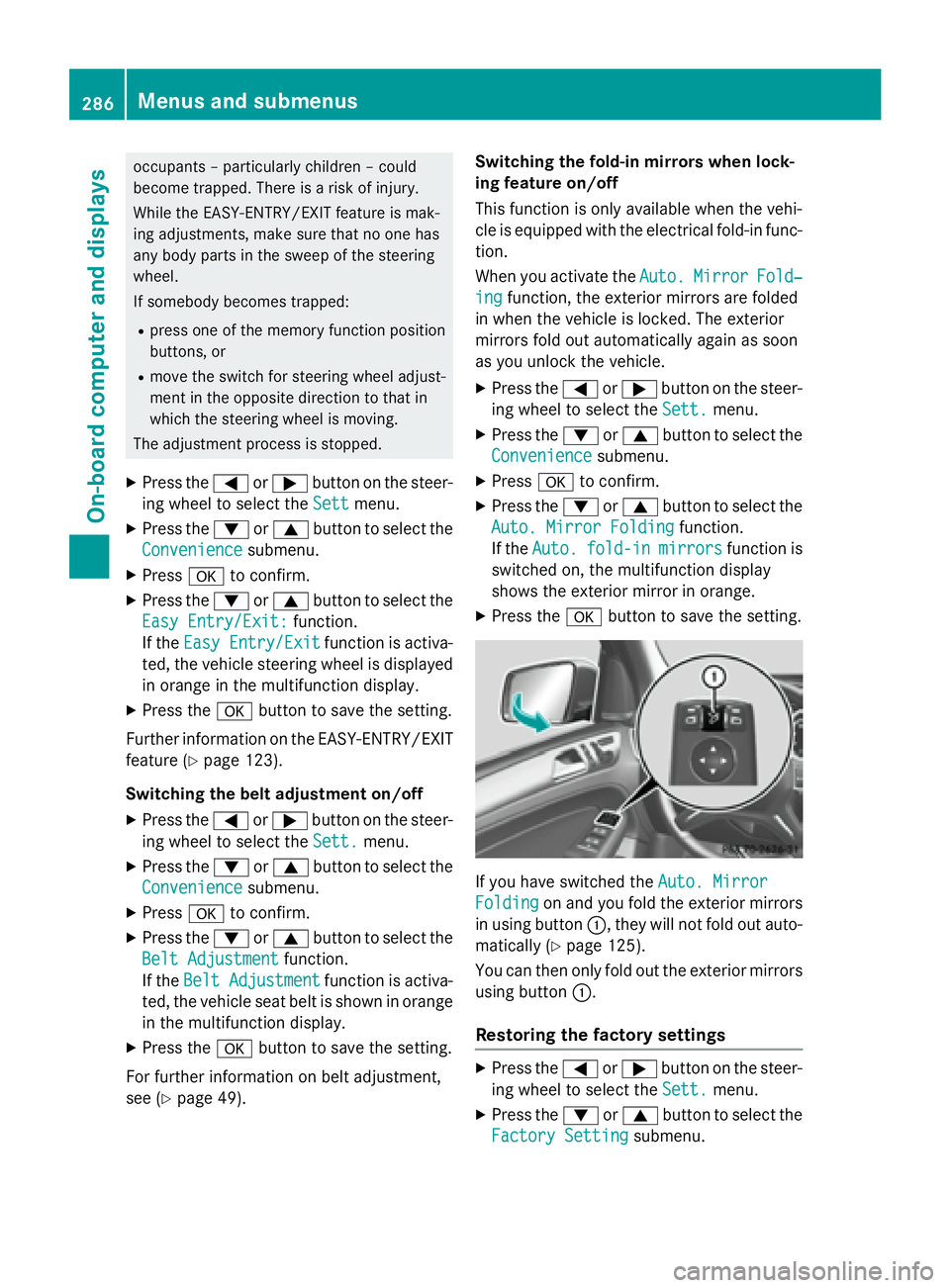
If you have switched the Auto. Mirror
Folding on and you fold the exterior mirrors
in using button C , they will not fold out auto-
matically ( Y
page 125).
You can then only fold out the exterior mirrors
using button C .
Restoring the factory settings X
Press the Y or e button on the steer-
ing wheel to select the Sett.
menu.X
Press the d or c button to select the
Factory Setting
submenu.286
Menus and submenus
On-board computer and displays
Page 320 of 462
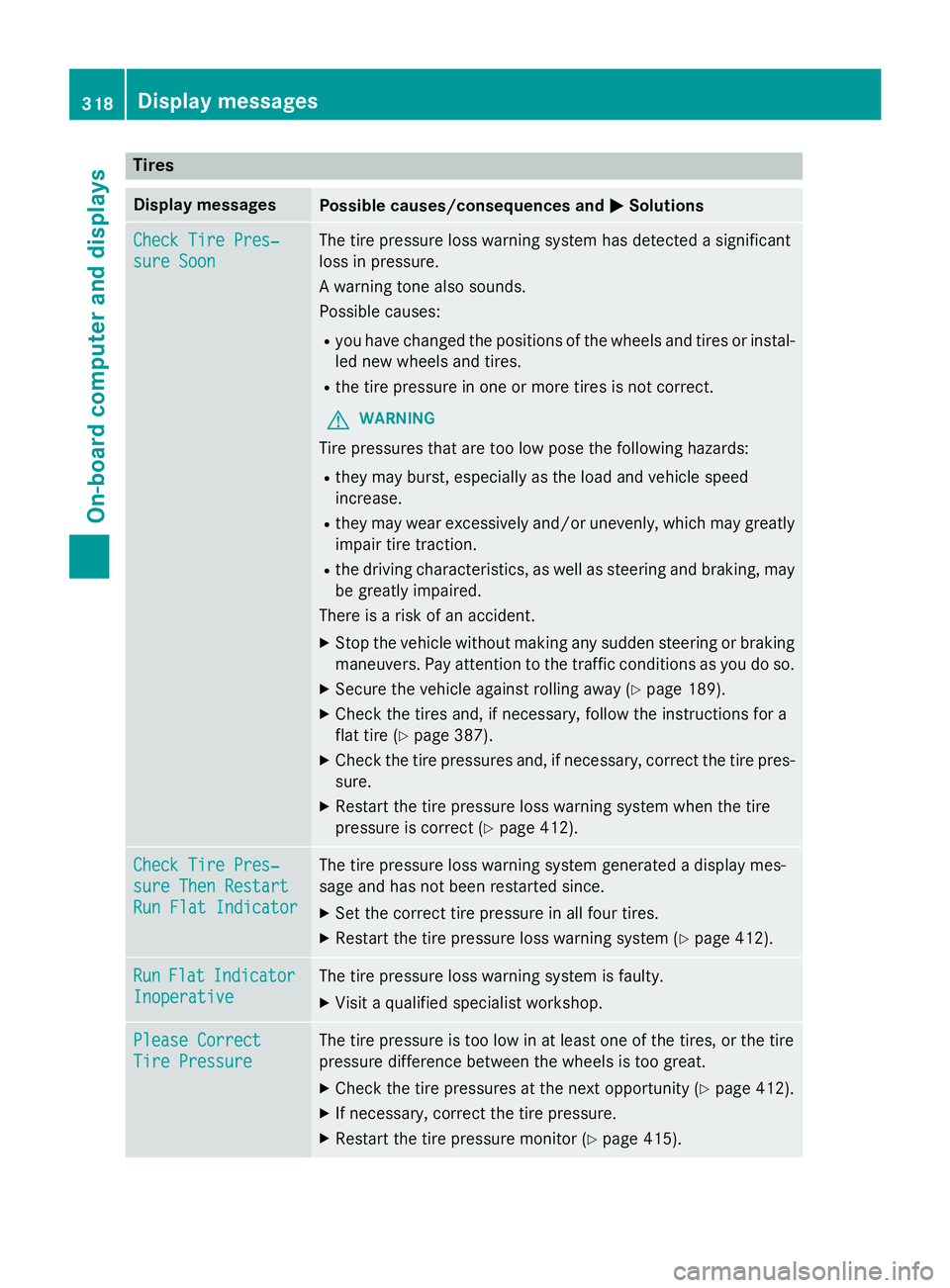
Tires Display messages
Possible causes/consequences and P Solutions
Check Tire Pres‐
sure Soon The tire pressure loss warning system has detected a significant
loss in pressure.
A warning tone also sounds.
Possible causes: R
you have changed the positions of the wheels and tires or instal-
led new wheels and tires. R
the tire pressure in one or more tires is not correct.
G WARNING
Tire pressures that are too low pose the following hazards: R
they may burst, especially as the load and vehicle speed
increase. R
they may wear excessively and/or unevenly, which may greatly
impair tire traction. R
the driving characteristics, as well as steering and braking, may
be greatly impaired.
There is a risk of an accident. X
Stop the vehicle without making any sudden steering or braking
maneuvers. Pay attention to the traffic conditions as you do so. X
Secure the vehicle against rolling away ( Y
page 189).X
Check the tires and, if necessary, follow the instructions for a
flat tire ( Y
page 387). X
Check the tire pressures and, if necessary, correct the tire pres-
sure. X
Restart the tire pressure loss warning system when the tire
pressure is correct ( Y
page 412).
Check Tire Pres‐
sure Then Restart
Run Flat Indicator The tire pressure loss warning system generated a display mes-
sage and has not been restarted since. X
Set the correct tire pressure in all four tires. X
Restart the tire pressure loss warning system ( Y
page 412).
Run Flat Indicator
Inoperative The tire pressure loss warning system is faulty. X
Visit a qualified specialist workshop.
Please Correct
Tire Pressure The tire pressure is too low in at least one of the tires, or the tire
pressure difference between the wheels is too great. X
Check the tire pressures at the next opportunity ( Y
page 412).X
If necessary, correct the tire pressure. X
Restart the tire pressure monitor ( Y
page 415).318
Displa y messages
On-board computer and displays
Page 340 of 462
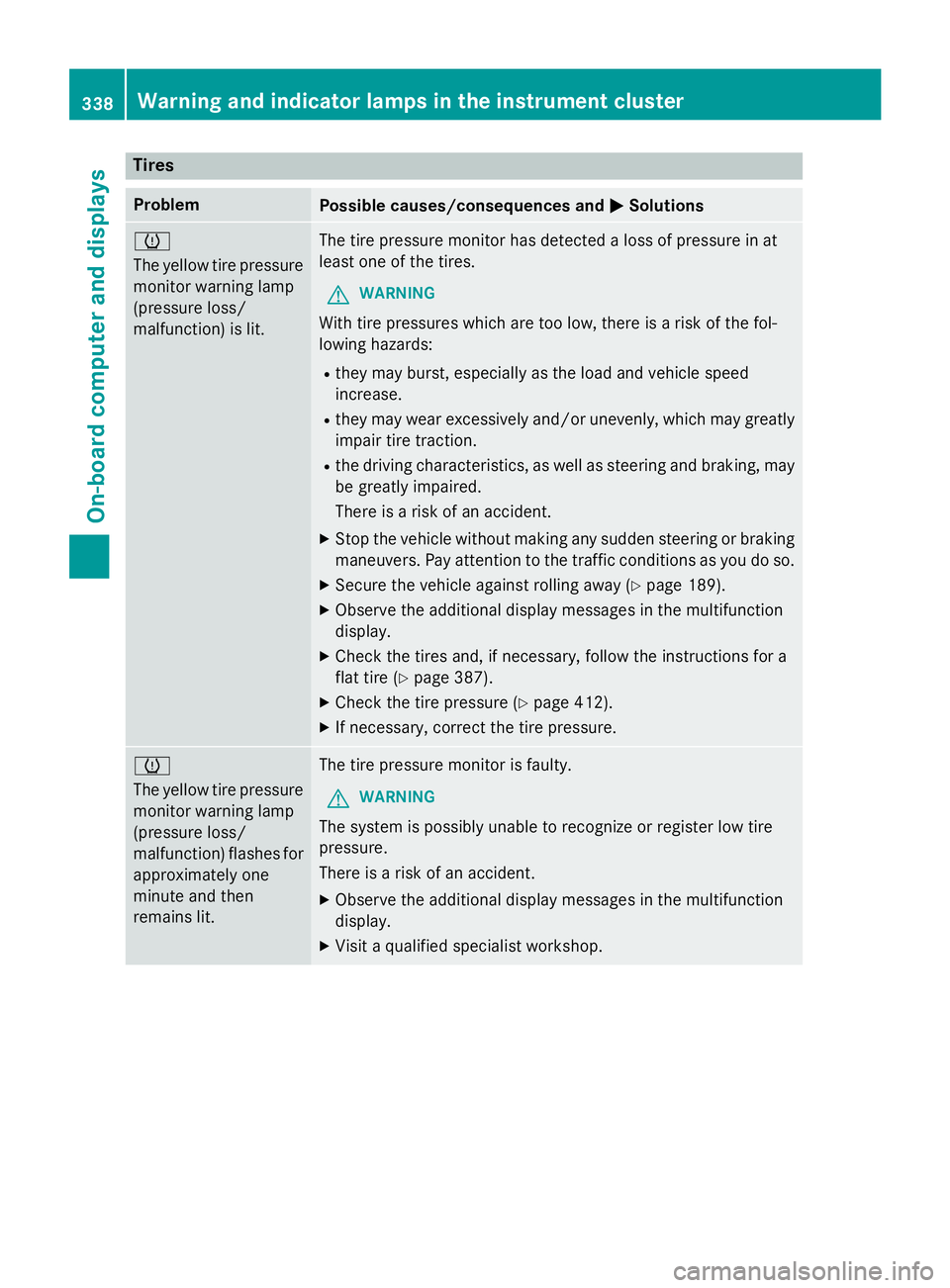
Tires Problem
Possible causes/consequences and P Solutions
w
The yellow tire pressure
monitor warning lamp
(pressure loss/
malfunction) is lit. The tire pressure monitor has detected a loss of pressure in at
least one of the tires.
G WARNING
With tire pressures which are too low, there is a risk of the fol-
lowing hazards: R
they may burst, especially as the load and vehicle speed
increase. R
they may wear excessively and/or unevenly, which may greatly
impair tire traction. R
the driving characteristics, as well as steering and braking, may
be greatly impaired.
There is a risk of an accident. X
Stop the vehicle without making any sudden steering or braking
maneuvers. Pay attention to the traffic conditions as you do so. X
Secure the vehicle against rolling away ( Y
page 189).X
Observe the additional display messages in the multifunction
display. X
Check the tires and, if necessary, follow the instructions for a
flat tire ( Y
page 387). X
Check the tire pressure ( Y
page 412).X
If necessary, correct the tire pressure.
w
The yellow tire pressure
monitor warning lamp
(pressure loss/
malfunction) flashes for
approximately one
minute and then
remains lit. The tire pressure monitor is faulty.
G WARNING
The system is possibly unable to recognize or register low tire
pressure.
There is a risk of an accident. X
Observe the additional display messages in the multifunction
display. X
Visit a qualified specialist workshop.338
Warning and indicator lamps in the instrument cluster
On-board computer and displays