light MERCEDES-BENZ GL-Class 2016 X166 User Guide
[x] Cancel search | Manufacturer: MERCEDES-BENZ, Model Year: 2016, Model line: GL-Class, Model: MERCEDES-BENZ GL-Class 2016 X166Pages: 462, PDF Size: 10.44 MB
Page 23 of 462
Maximum loaded vehicle weight
(definition) .....................................425
Maximum permissible tire pres-
sure (definition) .............................4 26
Maximum tire load ......................... 423
Maximum tire load (definition) ....... 426
MOExtended tires .......................... 406
Optional equipment weight (defi-
nition) ............................................ 426
PSI (pounds per square inch) (def-
inition) ...........................................4 26
Replacing ....................................... 427
Service life ..................................... 406
Sidewall (definition) ....................... 426
Speed rating (definition) ................ 425
Storing ...........................................4 27
Structure and characteristics
(definition) ..................................... 424
Temperature .................................. 420
TIN (Tire Identification Number)
(definition) ..................................... 426
Tire bead (definition) ......................4 26
Tire pressure (definition) ................ 426
Tire pressures (recommended) ...... 425
Tire size (data) ............................... 432
Tire size designation, load-bearing
capacity, speed rating .................... 421
Tire tread ....................................... 405
Tire tread (definition) ..................... 426
Total load limit (definition) ............. 427
Traction ......................................... 420
Traction (definition) ....................... 426
Tread wear ..................................... 420
TWR (permissible trailer drawbar
noseweight) (definition) ................. 426
Uniform Tire Quality Grading
Standards ...................................... 419
Uniform Tire Quality Grading
Standards (definition) .................... 425
Wear indicator (definition) ............. 427
Wheel and tire combination ........... 434
Wheel rim (definition) .................... 425
see Flat tire
Tool
see Vehicle tool kit
Top Tether ............................................ 64
To
w-starting
Emergency engine starting ............ 400 Important safety notes .................. 397
Towing a trailer
Active Parking Assist ..................... 231
Axle load, permissible .................... 458
Cleaning the trailer tow hitch ......... 381
Coupling up a trailer ...................... 266
Decoupling a trailer ....................... 268
Driving tips .................................... 264
ESP
®(Electronic Stability Pro-
gram) ............................................... 75
Important safety notes .................. 263
Installing the ball coupling ............. 265
Lights display message .................. 303
Mounting dimensions .................... 457
Power supply ................................. 269
Pulling away with a trailer .............. 168
Removing the ball coupling ............ 269
Trailer drive program ..................... 256
Trailer loads ................................... 458
Towing away
Important safety guidelines ........... 397
Installing the towing eye ................ 398
Removing the towing eye ............... 399
With both axles on the ground ....... 399
Trailer coupling
see Towing a trailer
Trailer loads and drawbar nose-
weights ............................................... 269
Trailer towing
Active Blind Spot Assist ................. 251
Active Lane Keeping Assist ............ 254
Blind Spot Assist ............................ 246
PARKTRONIC ................................. 226
Permissible trailer loads and
drawbar noseweights ..................... 269
Transfer case ..................................... 182
Transmission
see Automatic transmission
Transmission position display ......... 174
Transmission position display
(DIRECT SELECT lever) ...................... 174
Transporting the vehicle .................. 399
Traveling uphill
Brow of hill ..................................... 202
Driving downhill ............................. 202
Maximum gradient-climbing capa-
bility ............................................... 202
Index21
Page 36 of 462
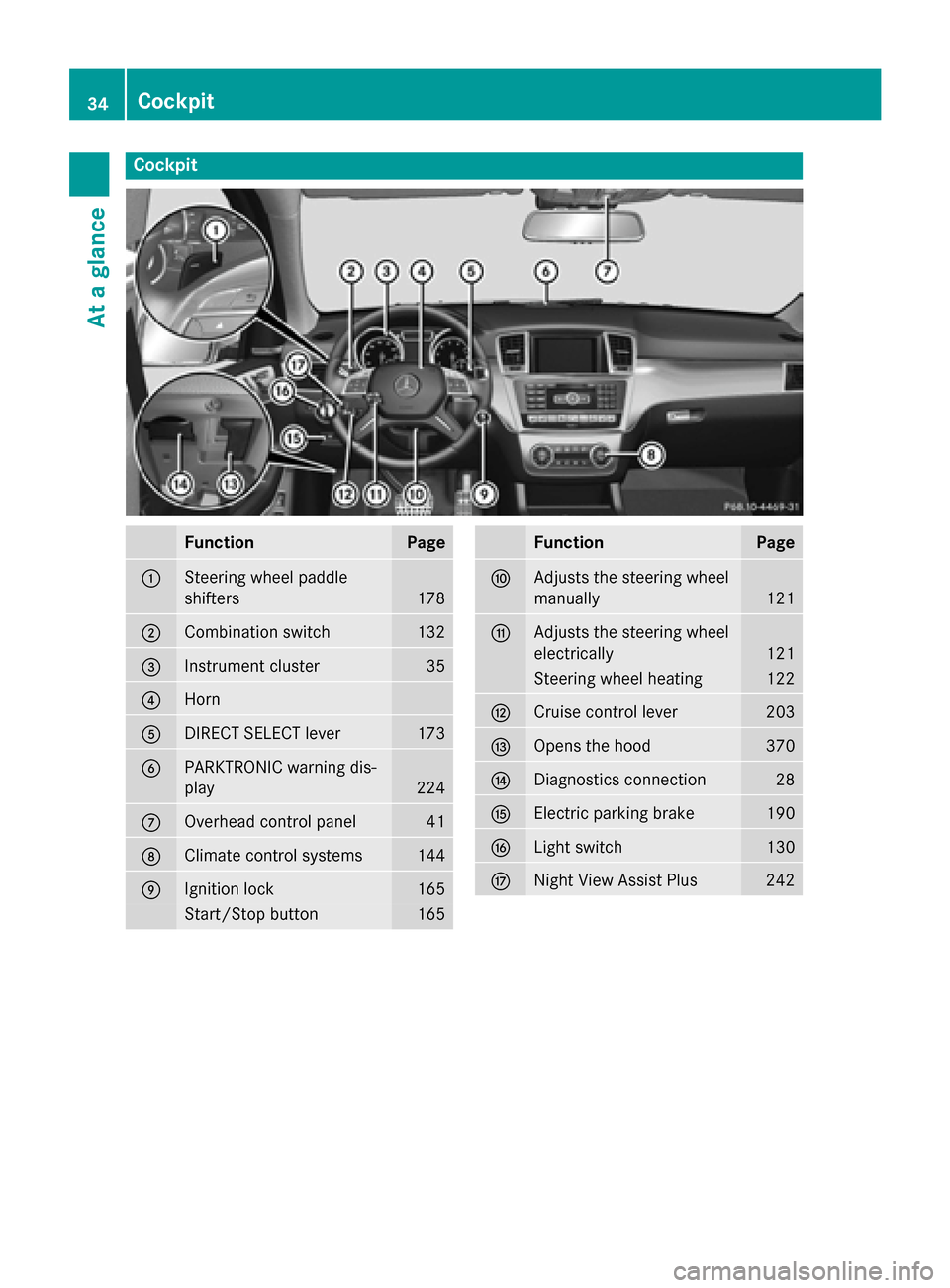
Cockpit
FunctionPage
:Steering wheel paddle
shifters
178
;Combination switch132
=Instrument cluster35
?Horn
ADIRECT SELECT lever173
BPARKTRONIC warning dis-
play
224
COverhead control panel41
DClimate control systems144
EIgnition lock165
Start/Stop button165
FunctionPage
FAdjusts the steering wheel
manually
121
GAdjusts the steering wheel
electrically
121
Steering wheel heating122
HCruise control lever203
IOpens the hood370
JDiagnostics connection28
KElectric parking brake190
LLight switch130
MNight View Assist Plus242
34Cockpit
At a glance
Page 37 of 462
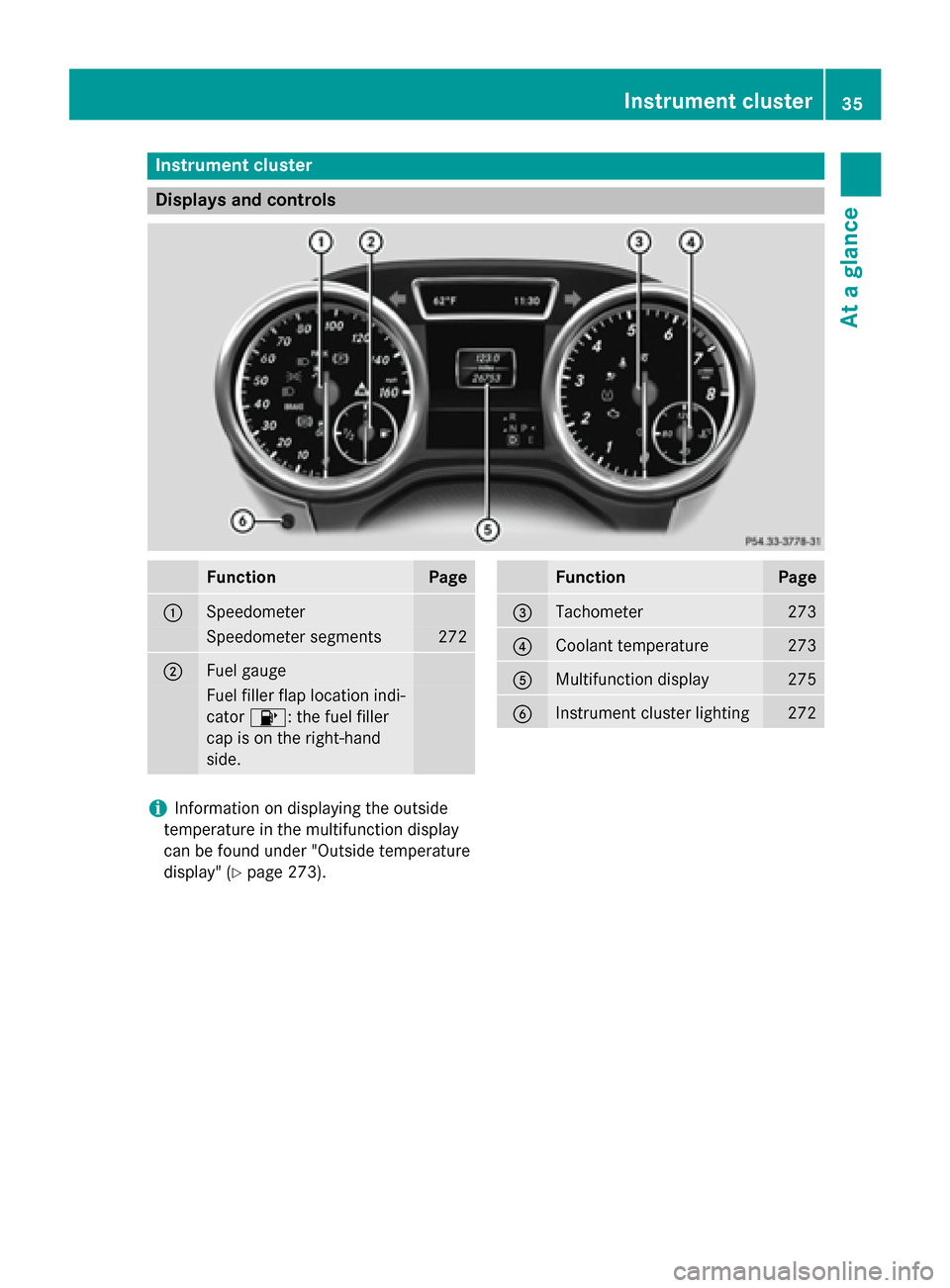
Instrument cluster
Displays and controls
FunctionPage
:Speedometer
Speedometer segments272
;Fuel gauge
Fuel filler flap location ind i-
cator 8: the fuel filler
cap ison the right-hand
side .
FunctionPage
=Tachometer273
?Coolant temperature273
AMultifunction display275
BInstrument cluster lighting272
iInformation on displaying the outside
temperature inthe multifunction display
can befound under "Outside temperature
disp lay" (
Ypage 273).
Instrument cluster35
At a glance
Page 41 of 462
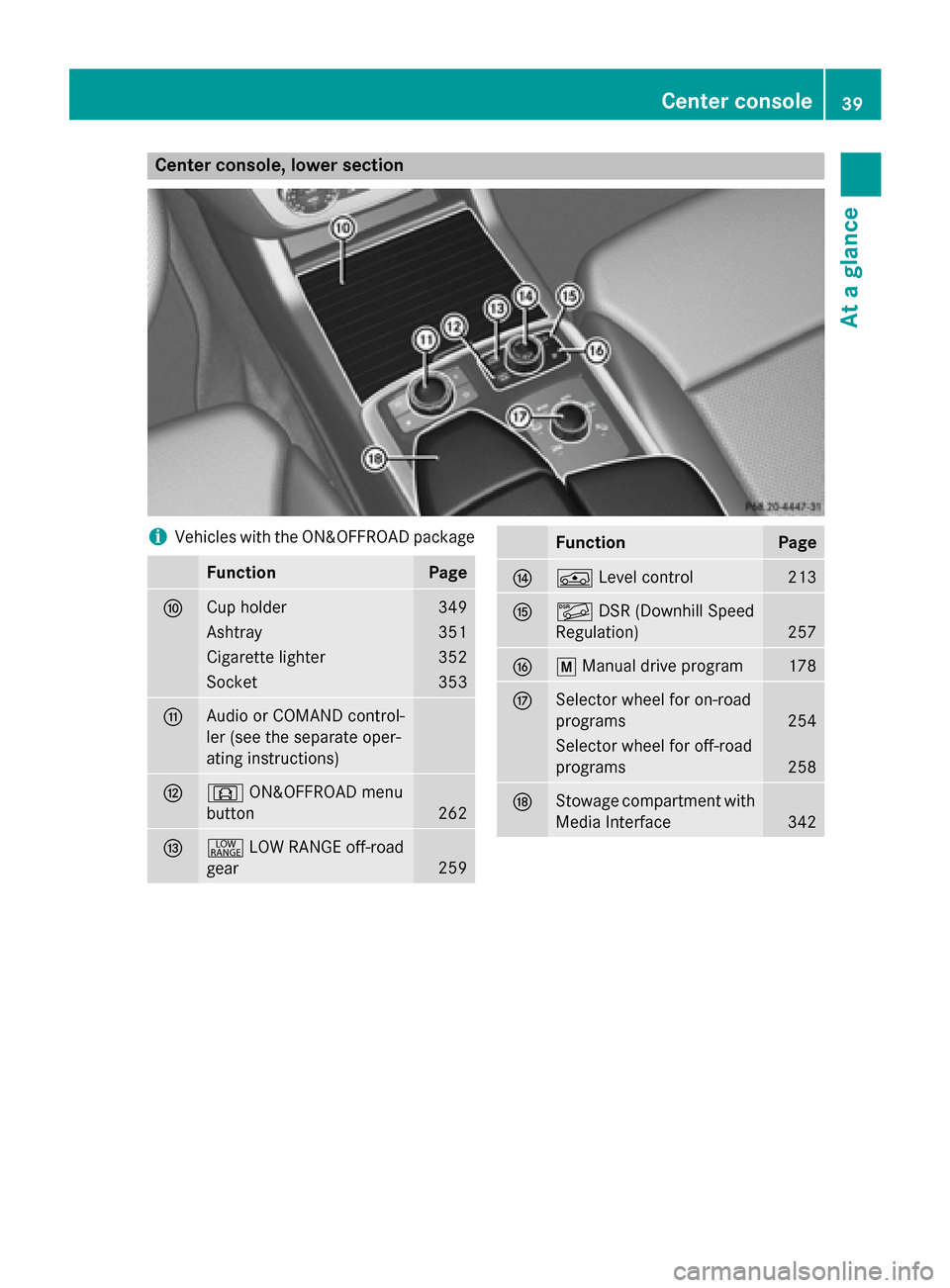
Center console, lower section
iVehicles with the ON&OFFROAD package
FunctionPage
FCup holder349
Ashtray351
Cigarette lighter352
Socket353
GAudio or COMAND control-
ler (see the separate oper-
ating instructions)
HdON&OFFROAD menu
button
262
I+ LOW RANGE off-road
gear
259
FunctionPage
JÁ Level control213
KÃDSR (Downhill Speed
Regulation)
257
Lp Manual drive program178
MSelector wheel for on-road
programs
254
Selector wheel for off-road
programs
258
NStowage compartment with
Media Interface
342
Center console39
At a glance
Page 42 of 462
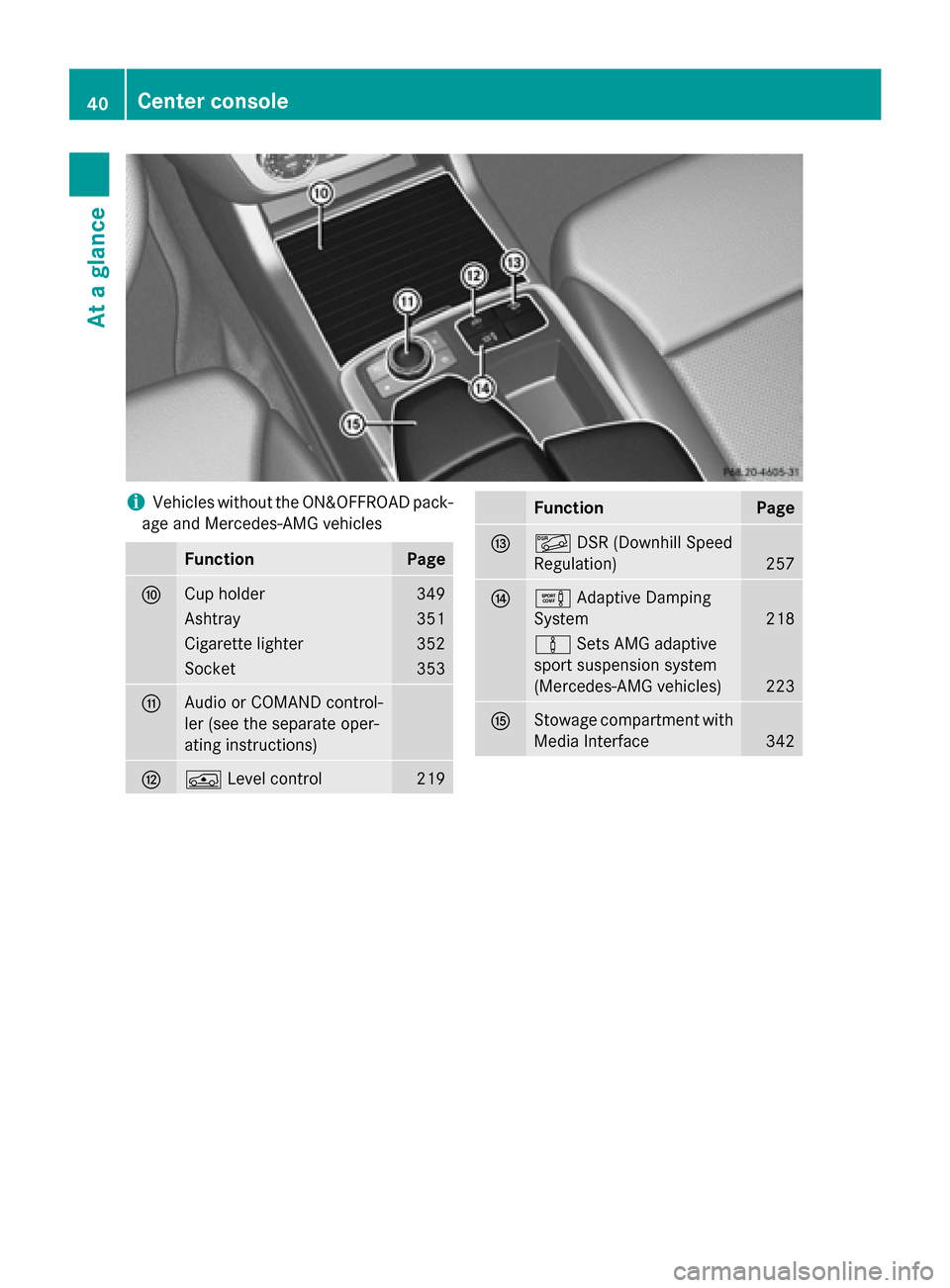
iVehicles without the ON&OFFROAD pack-
age and Mercedes-AMG vehicles
FunctionPage
FCup holder349
Ashtray351
Cigarette lighter352
Socket353
GAudio or COMAND control-
ler (see the separate oper-
ating instructions)
HÁ Level control219
FunctionPage
IÃDSR (Downhill Speed
Regulation)
257
Je Adaptive Damping
System
218
à Sets AMG adaptive
sport suspension system
(Mercedes-AMG vehicles)
223
KStowage compartment with
Media Interface
342
40Center console
At a glance
Page 43 of 462
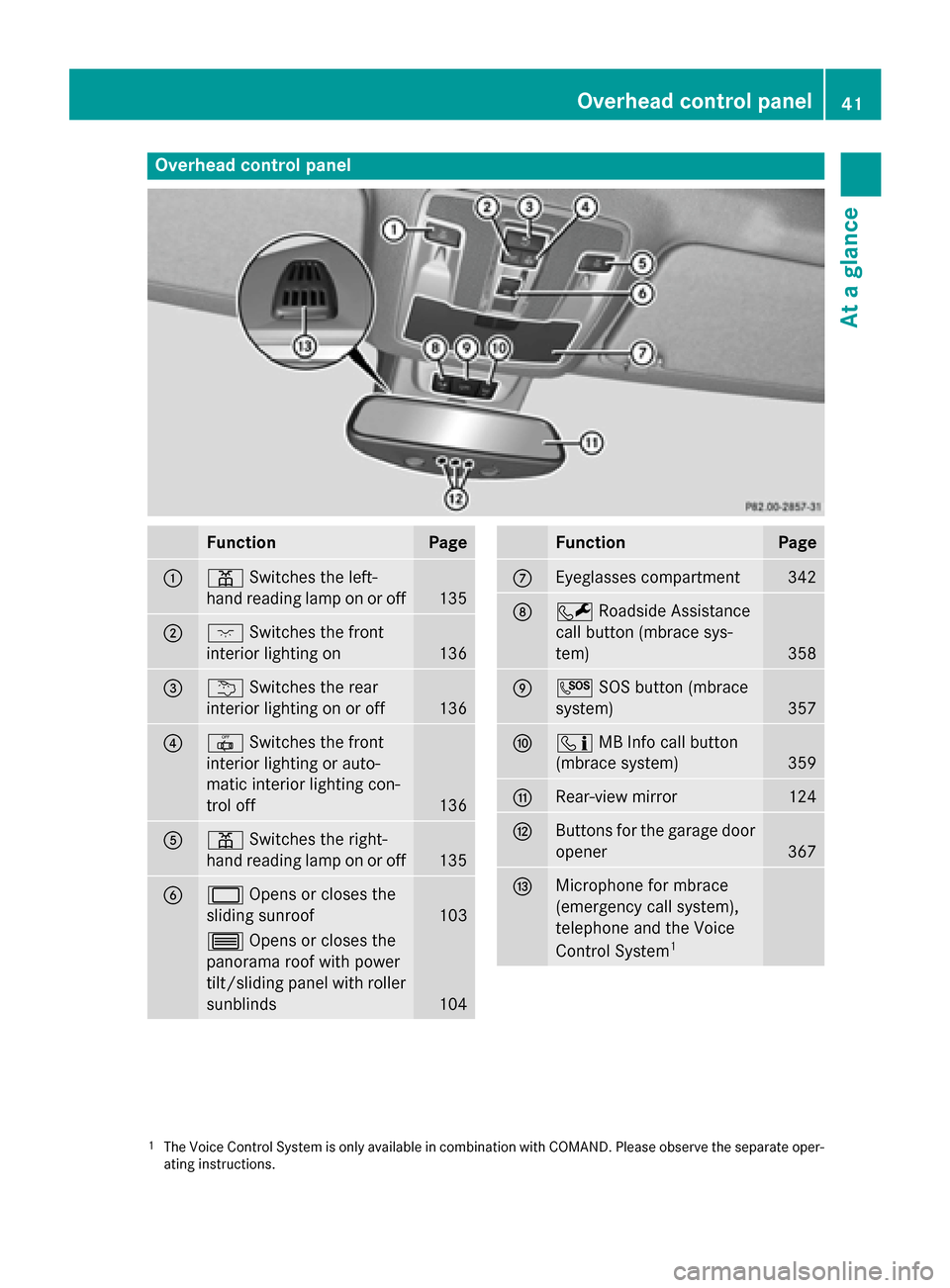
Overhead control panel
FunctionPage
:pSwitches the left-
hand reading lamp on or off
135
;c Switches the front
interior lighting on
136
=u Switches the rear
interior lighting on or off
136
?| Switches the front
interior lighting or auto-
matic interior lighting con-
trol off
136
Ap Switches the right-
hand reading lamp on or off
135
B2 Opens or closes the
sliding sunroof
103
3 Opens or closes the
panorama roof with power
tilt/sliding panel with roller
sunblinds
104
FunctionPage
CEyeglasses compartment342
DF Roadside Assistance
call button (mbrace sys-
tem)
358
EG SOS button (mbrace
system)
357
Fï MB Info call button
(mbrace system)
359
GRear-view mirror124
HButtons for the garage door
opener
367
IMicrophone for mbrace
(emergency call system),
telephone and the Voice
Control System
1
1The Voice Control System is only available in combination with COMAND. Please observe the separate oper-
ating instructions.
Overhead control panel41
At a glance
Page 47 of 462

For more information about children traveling
with you in the vehicle and on child restraint
systems, see "Children in the vehicle"
(
Ypage 61).
Important safety notes
GWARNING
Modifications to the restraint system may
cause it to no longer work as intended. The
restraint system may then not perform its
intended protective function and may fail in an
accident or trigger unexpectedly, for example.
This poses an increased risk of injury or even fatal injury.
Never modify parts of the restraint system.
Never tamper with the wiring, the electronic
components or their software.
If it is necessary to modify an air bag system to
accommodate a person with disabilities, con-
tact an authorized Mercedes-Benz Center for
details. USA only: for further information con-
tact our Customer Assistance Center at
1-800-FOR-MERCedes (1‑800‑367 ‑6372).
Restraint system warning lamp
The functions of the restraint system are
checked after the ignition is switched on and
at regular intervals while the engine is run-
ning. Therefore, malfunctions can be detec-
ted in good time.
The 6 restraint system warning lamp in
the instrument cluster lights up when the igni-
tion is switched on. It goes out no later than a
few seconds after the vehicle is started. The
components of the restraint system are in
operational readiness.
A malfunction has occurred if the 6
restraint system warning lamp:
Rdoes not light up after the ignition is
switched on
Rdoes not go out after a few seconds with
the engine running
Rlights up again while the engine is running
GWARNING
If restraint system is malfunctioning, restraint
system components may be triggered unin-
tentionally or might not be triggered at all in
the event of an accident with a high rate of
vehicle deceleration. This can affect the Emer- gency Tensioning Device or air bag, for exam-
ple. This poses an increased risk of injury or
even fatal injury.
Have the restraint system checked and
repaired in a qualified specialist workshop as
soon as possible.
PASSENGER AIR BAG OFF indicator
lamp
PASSENGER AIR BAG OFF indicator lamp :
is part of the Occupant Classification System
(OCS).
The PASSENGER AIR BAG OFF indicator lamp
informs you about the status of the front-
passenger front air bag.
If the PASSENGER AIR BAG OFF indicator
lamp:
Ris lit: the front-passenger front air bag is
deactivated. It will then not be deployed in
the event of an accident.
Rdoes not light up: the front-passenger
front air bag is enabled. If, in the event of an
accident, all deployment criteria are met,
the front-passenger front air bag is
deployed.
Occupant safety45
Safety
Z
Page 51 of 462
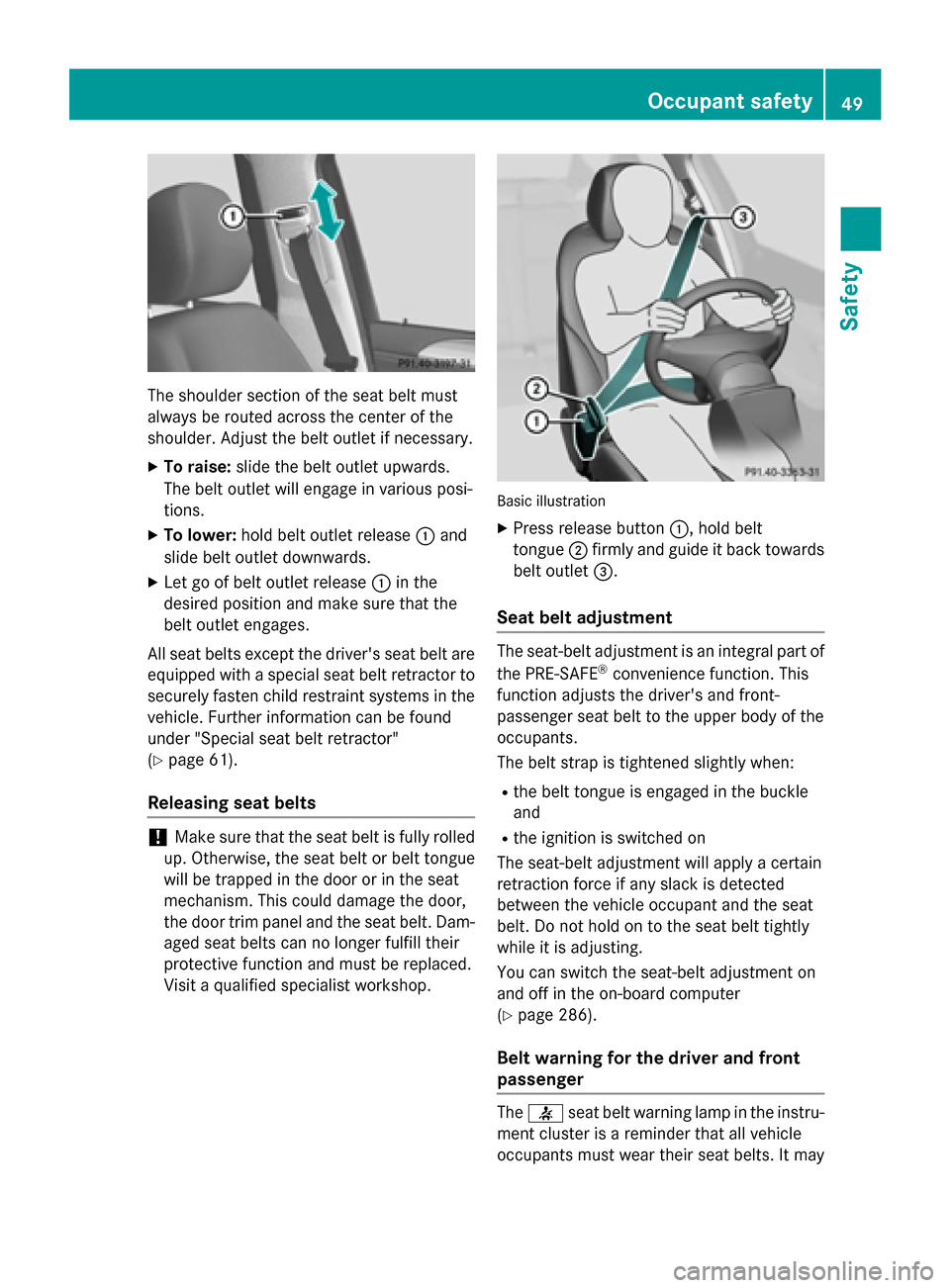
The shoulder section of the seat belt must
always be routed across the center of the
shoulder. Adjust the belt outlet if necessary.
XTo raise:slide the belt outlet upwards.
The belt outlet will engage in various posi-
tions.
XTo lower: hold belt outlet release :and
slide belt outlet downwards.
XLet go of belt outlet release :in the
desired position and make sure that the
belt outlet engages.
All seat belts except the driver's seat belt are
equipped with a special seat belt retractor to
securely fasten child restraint systems in the
vehicle. Further information can be found
under "Special seat belt retractor"
(
Ypage 61).
Releasing seat belts
!Make sure that the seat belt is fully rolled
up. Otherwise, the seat belt or belt tongue
will be trapped in the door or in the seat
mechanism. This could damage the door,
the door trim panel and the seat belt. Dam-
aged seat belts can no longer fulfill their
protective function and must be replaced.
Visit a qualified specialist workshop.
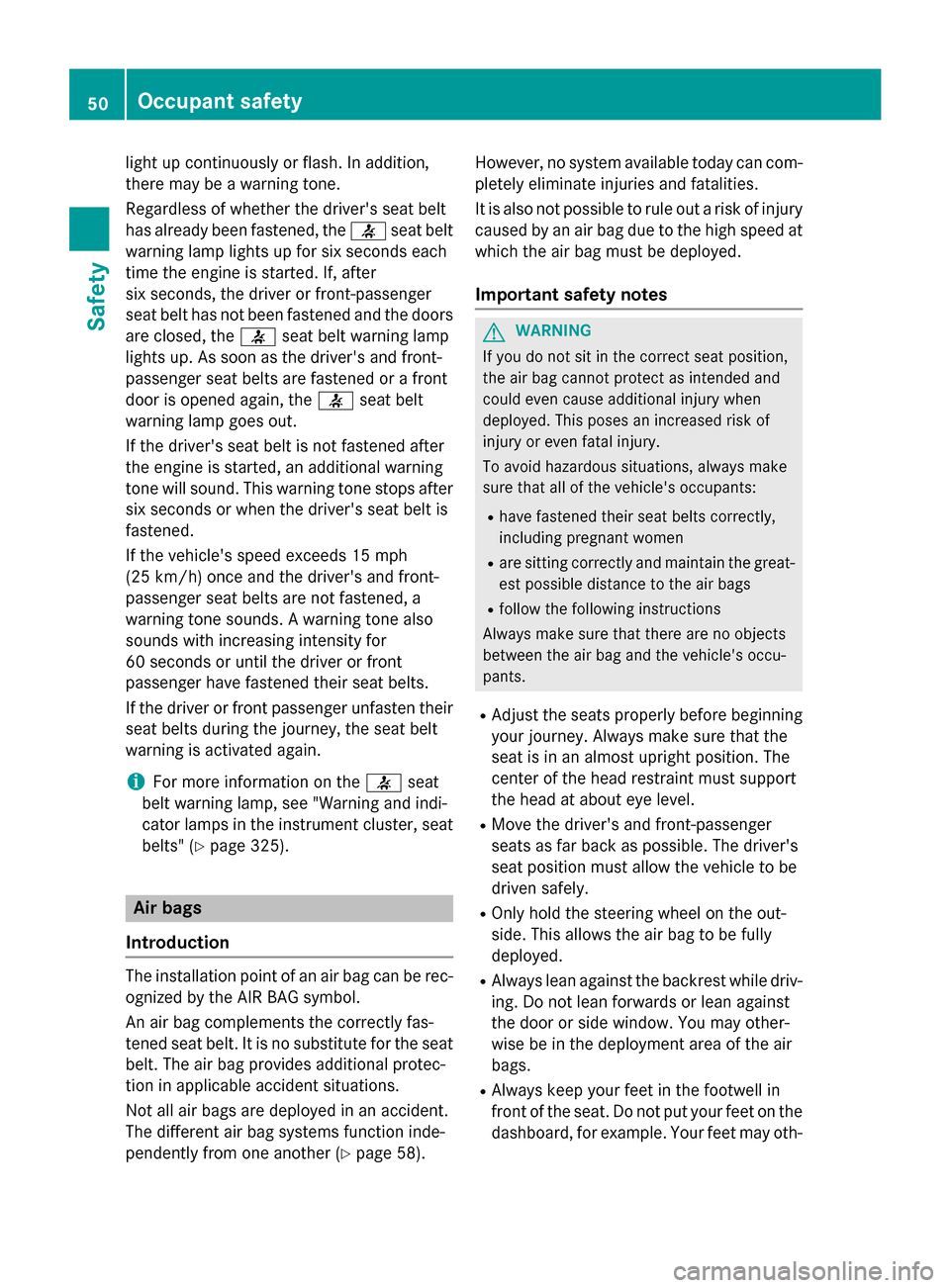
Basic illustration
XPress release button :, hold belt
tongue ;firmly and guide it back towards
belt outlet =.
Seat belt adjustment
The seat-belt adjustment is an integral part of
the PRE-SAFE®convenience function. This
function adjusts the driver's and front-
passenger seat belt to the upper body of the
occupants.
The belt strap is tightened slightly when:
Rthe belt tongue is engaged in the buckle
and
Rthe ignition is switched on
The seat-belt adjustment will apply a certain
retraction force if any slack is detected
between the vehicle occupant and the seat
belt. Do not hold on to the seat belt tightly
while it is adjusting.
You can switch the seat-belt adjustment on
and off in the on-board computer
(
Ypage 286).
Belt warning for the driver and front
passenger
The 7 seat belt warning lamp in the instru-
ment cluster is a reminder that all vehicle
occupants must wear their seat belts. It may
Occupant safety49
Safety
Z
Page 52 of 462
light up continuously or flash. In addition,
there may be a warning tone.
Regardless of whether the driver's seat belt
has already been fastened, the7seat belt
warning lamp lights up for six seconds each
time the engine is started. If, after
six seconds, the driver or front-passenger
seat belt has not been fastened and the doors
are closed, the 7seat belt warning lamp
lights up. As soon as the driver's and front-
passenger seat belts are fastened or a front
door is opened again, the 7seat belt
warning lamp goes out.
If the driver's seat belt is not fastened after
the engine is started, an additional warning
tone will sound. This warning tone stops after
six seconds or when the driver's seat belt is
fastened.
If the vehicle's speed exceeds 15 mph
(25 km/h) once and the driver's and front-
passenger seat belts are not fastened, a
warning tone sounds. A warning tone also
sounds with increasing intensity for
60 seconds or until the driver or front
passenger have fastened their seat belts.
If the driver or front passenger unfasten their
seat belts during the journey, the seat belt
warning is activated again.
iFor more information on the 7seat
belt warning lamp, see "Warning and indi-
cator lamps in the instrument cluster, seat
belts" (
Ypage 325).
Air bags
Introduction
The installation point of an air bag can be rec- ognized by the AIR BAG symbol.
An air bag complements the correctly fas-
tened seat belt. It is no substitute for the seat
belt. The air bag provides additional protec-
tion in applicable accident situations.
Not all air bags are deployed in an accident.
The different air bag systems function inde-
pendently from one another (
Ypage 58). However, no system available today can com-
pletely eliminate injuries and fatalities.
It is also not possible to rule out a risk of injury
caused by an air bag due to the high speed at
which the air bag must be deployed.
Important safety notes
GWARNING
If you do not sit in the correct seat position,
the air bag cannot protect as intended and
could even cause additional injury when
deployed. This poses an increased risk of
injury or even fatal injury.
To avoid hazardous situations, always make
sure that all of the vehicle's occupants:
Rhave fastened their seat belts correctly,
including pregnant women
Rare sitting correctly and maintain the great-
est possible distance to the air bags
Rfollow the following instructions
Always make sure that there are no objects
between the air bag and the vehicle's occu-
pants.
RAdjust the seats properly before beginning
your journey. Always make sure that the
seat is in an almost upright position. The
center of the head restraint must support
the head at about eye level.
RMove the driver's and front-passenger
seats as far back as possible. The driver's
seat position must allow the vehicle to be
driven safely.
ROnly hold the steering wheel on the out-
side. This allows the air bag to be fully
deployed.
RAlways lean against the backrest while driv-
ing. Do not lean forwards or lean against
the door or side window. You may other-
wise be in the deployment area of the air
bags.
RAlways keep your feet in the footwell in
front of the seat. Do not put your feet on the
dashboard, for example. Your feet may oth-
50Occupant safety
Safety
Page 56 of 462
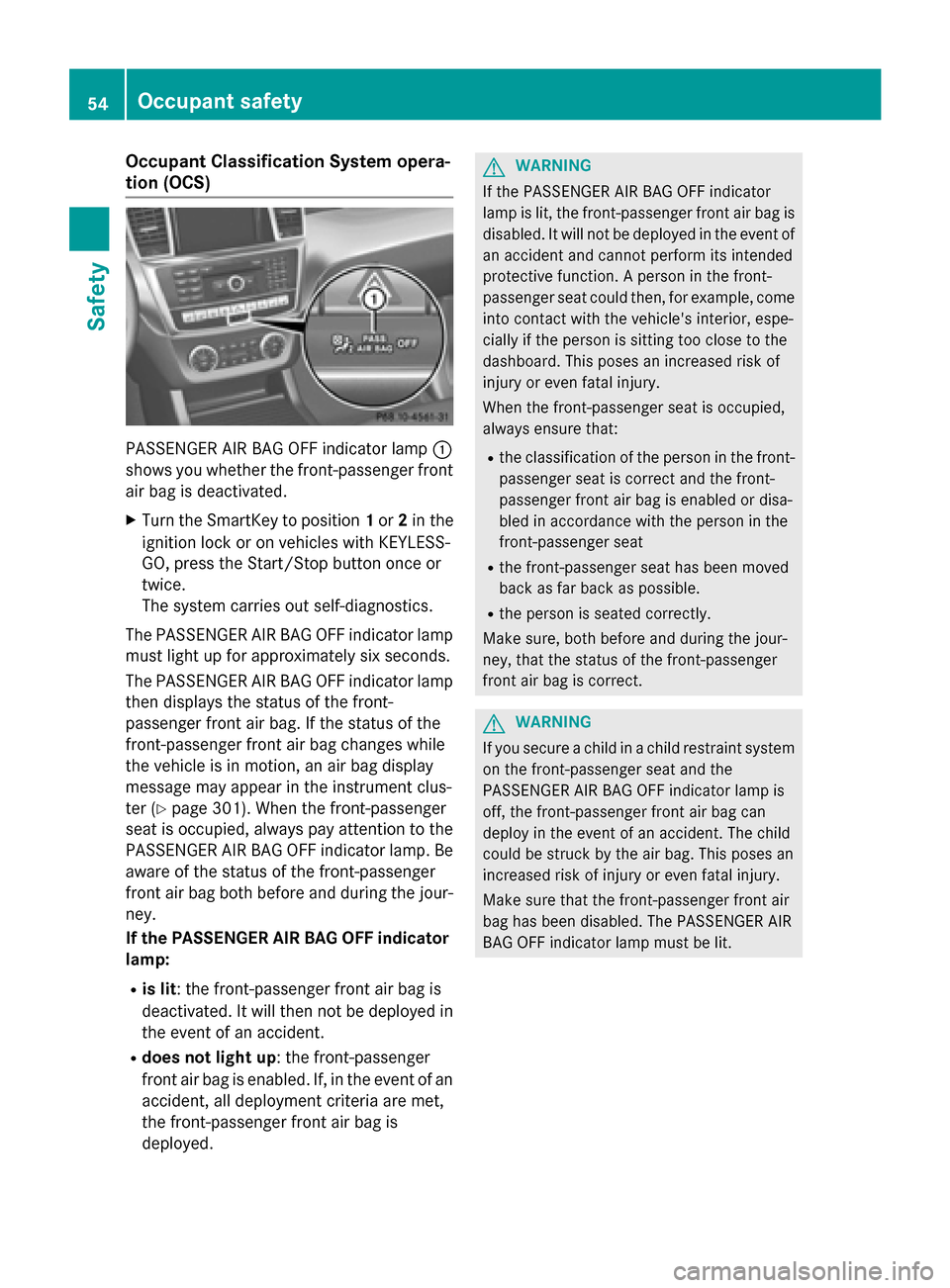
Occupant Classification System opera-
tion (OCS)
PASSENGER AIR BAG OFF indicator lamp:
shows you whether the front-passenger front
air bag is deactivated.
XTurn the SmartKey to position 1or 2in the
ignition lock or on vehicles with KEYLESS-
GO, press the Start/Stop button once or
twice.
The system carries out self-diagnostics.
The PASSENGER AIR BAG OFF indicator lamp
must light up for approximately six seconds.
The PASSENGER AIR BAG OFF indicator lamp
then displays the status of the front-
passenger front air bag. If the status of the
front-passenger front air bag changes while
the vehicle is in motion, an air bag display
message may appear in the instrument clus-
ter (
Ypage 301). When the front-passenger
seat is occupied, always pay attention to the
PASSENGER AIR BAG OFF indicator lamp. Be
aware of the status of the front-passenger
front air bag both before and during the jour-
ney.
If the PASSENGER AIR BAG OFF indicator
lamp:
Ris lit: the front-passenger front air bag is
deactivated. It will then not be deployed in
the event of an accident.
Rdoes not light up: the front-passenger
front air bag is enabled. If, in the event of an
accident, all deployment criteria are met,
the front-passenger front air bag is
deployed.
GWARNING
If the PASSENGER AIR BAG OFF indicator
lamp is lit, the front-passenger front air bag is
disabled. It will not be deployed in the event of
an accident and cannot perform its intended
protective function. A person in the front-
passenger seat could then, for example, come
into contact with the vehicle's interior, espe-
cially if the person is sitting too close to the
dashboard. This poses an increased risk of
injury or even fatal injury.
When the front-passenger seat is occupied,
always ensure that:
Rthe classification of the person in the front- passenger seat is correct and the front-
passenger front air bag is enabled or disa-
bled in accordance with the person in the
front-passenger seat
Rthe front-passenger seat has been moved
back as far back as possible.
Rthe person is seated correctly.
Make sure, both before and during the jour-
ney, that the status of the front-passenger
front air bag is correct.
GWARNING
If you secure a child in a child restraint system on the front-passenger seat and the
PASSENGER AIR BAG OFF indicator lamp is
off, the front-passenger front air bag can
deploy in the event of an accident. The child
could be struck by the air bag. This poses an
increased risk of injury or even fatal injury.
Make sure that the front-passenger front air
bag has been disabled. The PASSENGER AIR
BAG OFF indicator lamp must be lit.
54Occupant safety
Safety