check engine MERCEDES-BENZ GL SUV 2009 Owner's Manual
[x] Cancel search | Manufacturer: MERCEDES-BENZ, Model Year: 2009, Model line: GL SUV, Model: MERCEDES-BENZ GL SUV 2009Pages: 309, PDF Size: 10.27 MB
Page 217 of 309
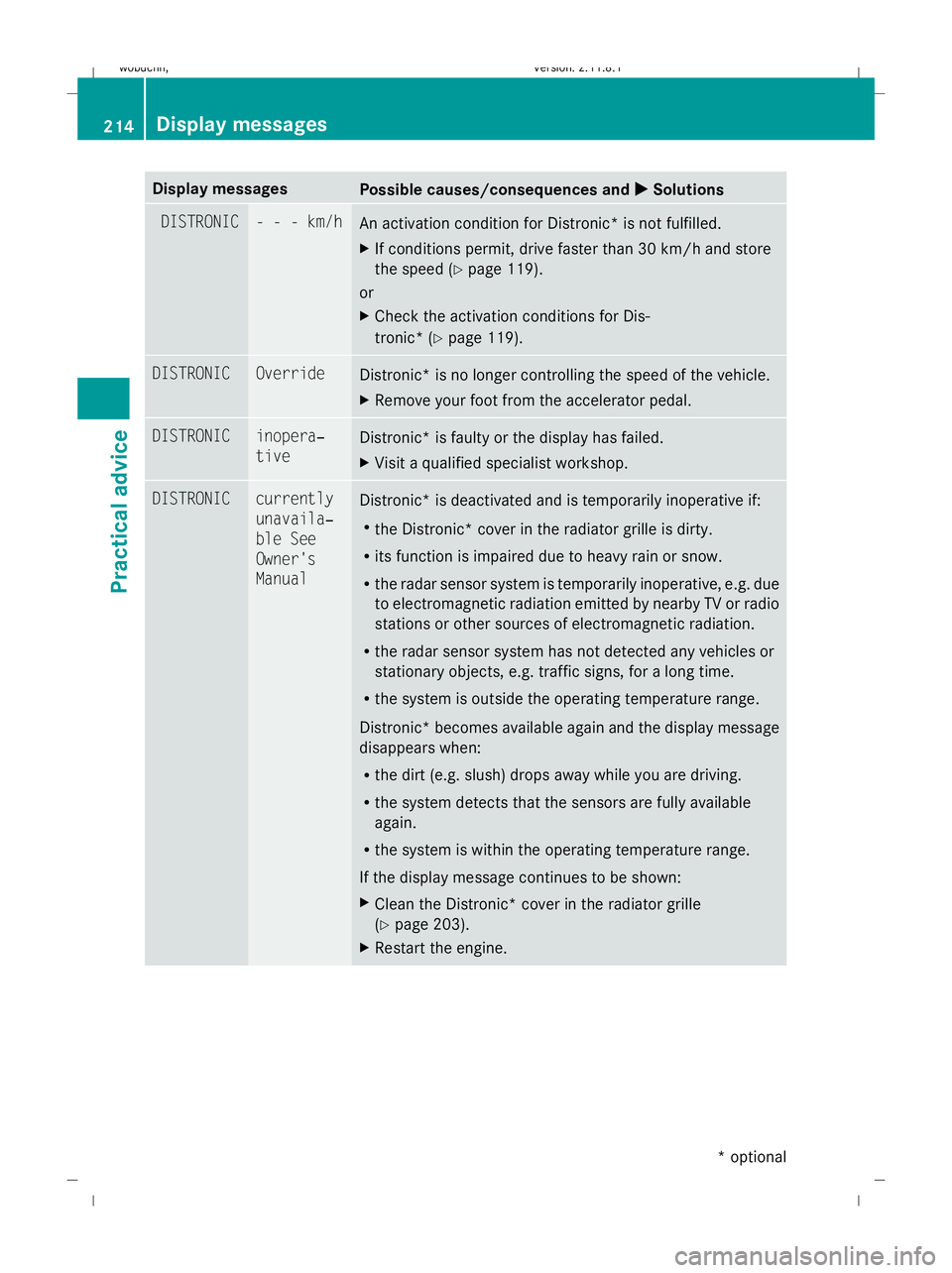
Display messages
Possible causes/consequences and
X
X Solutions DISTRONIC - - - km/h
An activation condition for Distronic* is not fulfilled.
X
If conditions permit, drive faster than 30 km/h and store
the speed (Y page 119).
or
X Check the activation conditions for Dis-
tronic* (Y page 119). DISTRONIC Override
Distronic* is no longer controlling the speed of the vehicle.
X
Remove your foot from the accelerator pedal. DISTRONIC inopera‐
tive
Distronic* is faulty or the display has failed.
X
Visit a qualified specialist workshop. DISTRONIC currently
unavaila‐
ble See
Owner's
Manual
Distronic* is deactivated and is temporarily inoperative if:
R
the Distronic* cover in the radiator grille is dirty.
R its function is impaired due to heavy rain or snow.
R the radar sensor system is temporarily inoperative, e.g. due
to electromagnetic radiation emitted by nearby TV or radio
stations or other sources of electromagnetic radiation.
R the radar sensor system has not detected any vehicles or
stationary objects, e.g. traffic signs, for a long time.
R the system is outside the operating temperature range.
Distronic* becomes available again and the display message
disappears when:
R the dirt (e.g. slush) drops away while you are driving.
R the system detects that the sensors are fully available
again.
R the system is within the operating temperature range.
If the display message continues to be shown:
X Clean the Distronic* cover in the radiator grille
(Y page 203).
X Restart the engine. 214
Display
messagesPractical advice
* optional
X164_AKB; 2; 3, en-GB
wobuchh
,V ersion: 2.11.8.1
2009-03-31T14:14:58+02:00 - Seite 214
Dateiname: 6515431202_buchblock.pdf; erzeugt am 01. Apr 2009 00:17:59; WK
Page 220 of 309
Display messages
Possible causes/consequences and
X
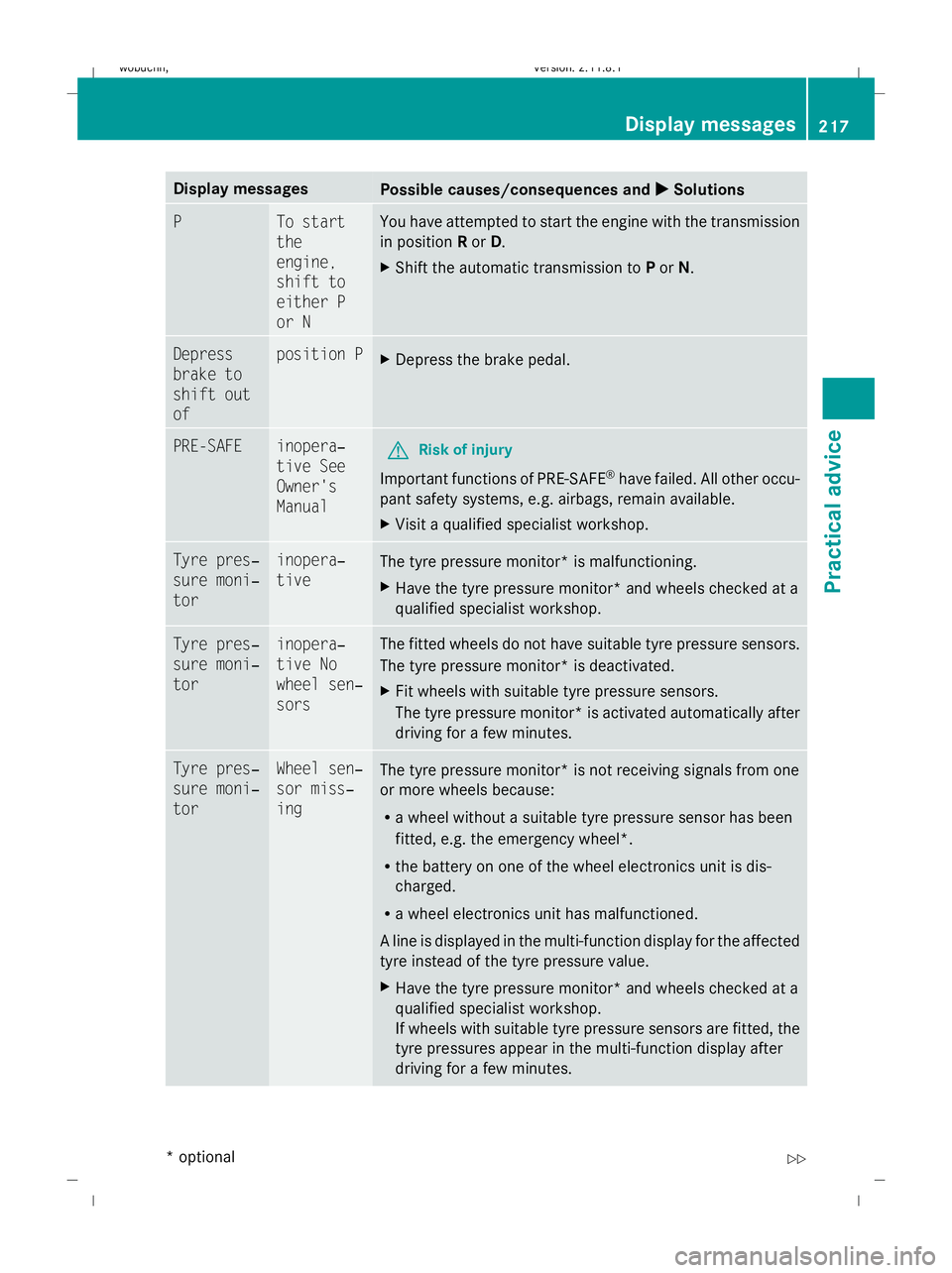
X Solutions P To start
the
engine,
shift to
either P
or N You have attempted to start the engine with the transmission
in position
Ror D.
X Shift the automatic transmission to Por N. Depress
brake to
shift out
of position P
X
Depress the brake pedal. PRE-SAFE inopera‐
tive See
Owner's
Manual
G
Risk of injury
Important functions of PRE-SAFE ®
have failed. All other occu-
pant safety systems, e.g. airbags, remain available.
X Visit a qualified specialist workshop. Tyre pres‐
sure moni‐
tor inopera‐
tive
The tyre pressure monitor* is malfunctioning.
X
Have the tyre pressure monitor* and wheels checked at a
qualified specialist workshop. Tyre pres‐
sure moni‐
tor inopera‐
tive No
wheel sen‐
sors The fitted wheels do not have suitable tyre pressure sensors.
The tyre pressure monitor* is deactivated.
X
Fit wheels with suitable tyre pressure sensors.
The tyre pressure monitor* is activated automatically after
driving for a few minutes. Tyre pres‐
sure moni‐
tor Wheel sen‐
sor miss‐
ing
The tyre pressure monitor* is not receiving signals from one
or more wheels because:
R
a wheel without a suitable tyre pressure sensor has been
fitted, e.g. the emergency wheel*.
R the battery on one of the wheel electronics unit is dis-
charged.
R a wheel electronics unit has malfunctioned.
A line is displayed in the multi-function display for the affected
tyre instead of the tyre pressure value.
X Have the tyre pressure monitor* and wheels checked at a
qualified specialist workshop.
If wheels with suitable tyre pressure sensors are fitted, the
tyre pressures appear in the multi-function display after
driving for a few minutes. Display
messages
217Practical advice
* optional
X164_AKB; 2; 3, en-GB
wobuchh
,V ersion: 2.11.8.1
2009-03-31T14:14:58+02:00 - Seite 217 Z
Dateiname: 6515431202_buchblock.pdf; erzeugt am 01. Apr 2009 00:17:59; WK
Page 223 of 309
Display messages
Possible causes/consequences and
X
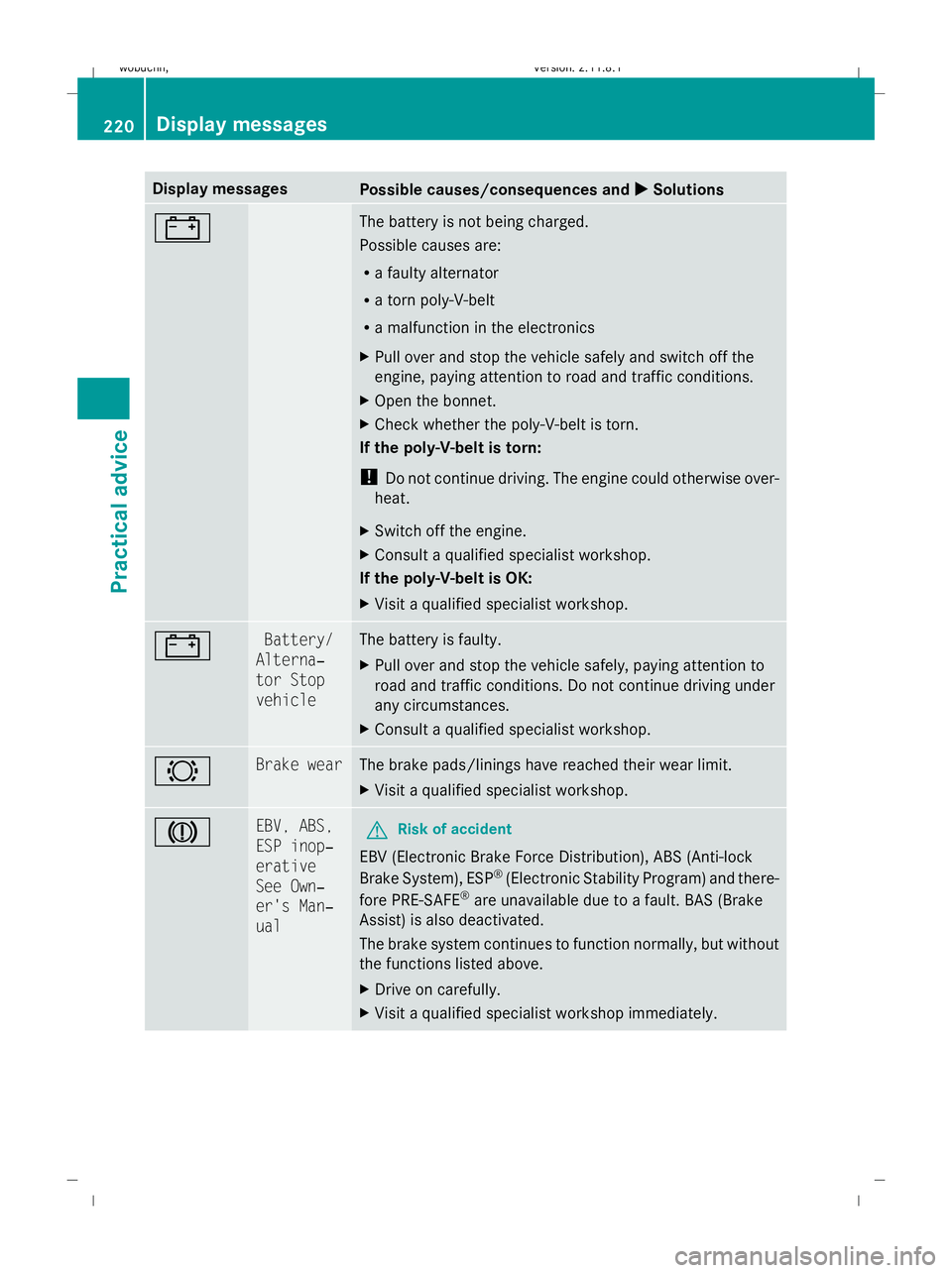
X Solutions # The battery is not being charged.
Possible causes are:
R
a faulty alternator
R a torn poly-V-belt
R a malfunction in the electronics
X Pull over and stop the vehicle safely and switch off the
engine, paying attention to road and traffic conditions.
X Open the bonnet.
X Check whether the poly-V-belt is torn.
If the poly-V-belt is torn:
! Do not continue driving. The engine could otherwise over-
heat.
X Switch off the engine.
X Consult a qualified specialist workshop.
If the poly-V-belt is OK:
X Visit a qualified specialist workshop. # Battery/
Alterna‐
tor Stop
vehicle The battery is faulty.
X
Pull over and stop the vehicle safely, paying attention to
road and traffic conditions. Do not continue driving under
any circumstances.
X Consult a qualified specialist workshop. # Brake wear The brake pads/linings have reached their wear limit.
X
Visit a qualified specialist workshop. J EBV, ABS,
ESP inop‐
erative
See Own‐
er's Man‐
ual
G
Risk of accident
EBV (Electronic Brake Force Distribution), ABS (Anti-lock
Brake System), ESP ®
(Electronic Stability Program) and there-
fore PRE-SAFE ®
are unavailable due to a fault. BAS (Brake
Assist) is also deactivated.
The brake system continues to function normally, but without
the functions listed above.
X Drive on carefully.
X Visit a qualified specialist workshop immediately. 220
Display
messagesPractical advice
X164_AKB; 2; 3, en-GB
wobuchh,V ersion: 2.11.8.1
2009-03-31T14:14:58+02:00 - Seite 220
Dateiname: 6515431202_buchblock.pdf; erzeugt am 01. Apr 2009 00:17:59; WK
Page 226 of 309
Display messages
Possible causes/consequences and
X
X Solutions 8 Diff.
lock sys‐
tem over‐
heated.
Wait
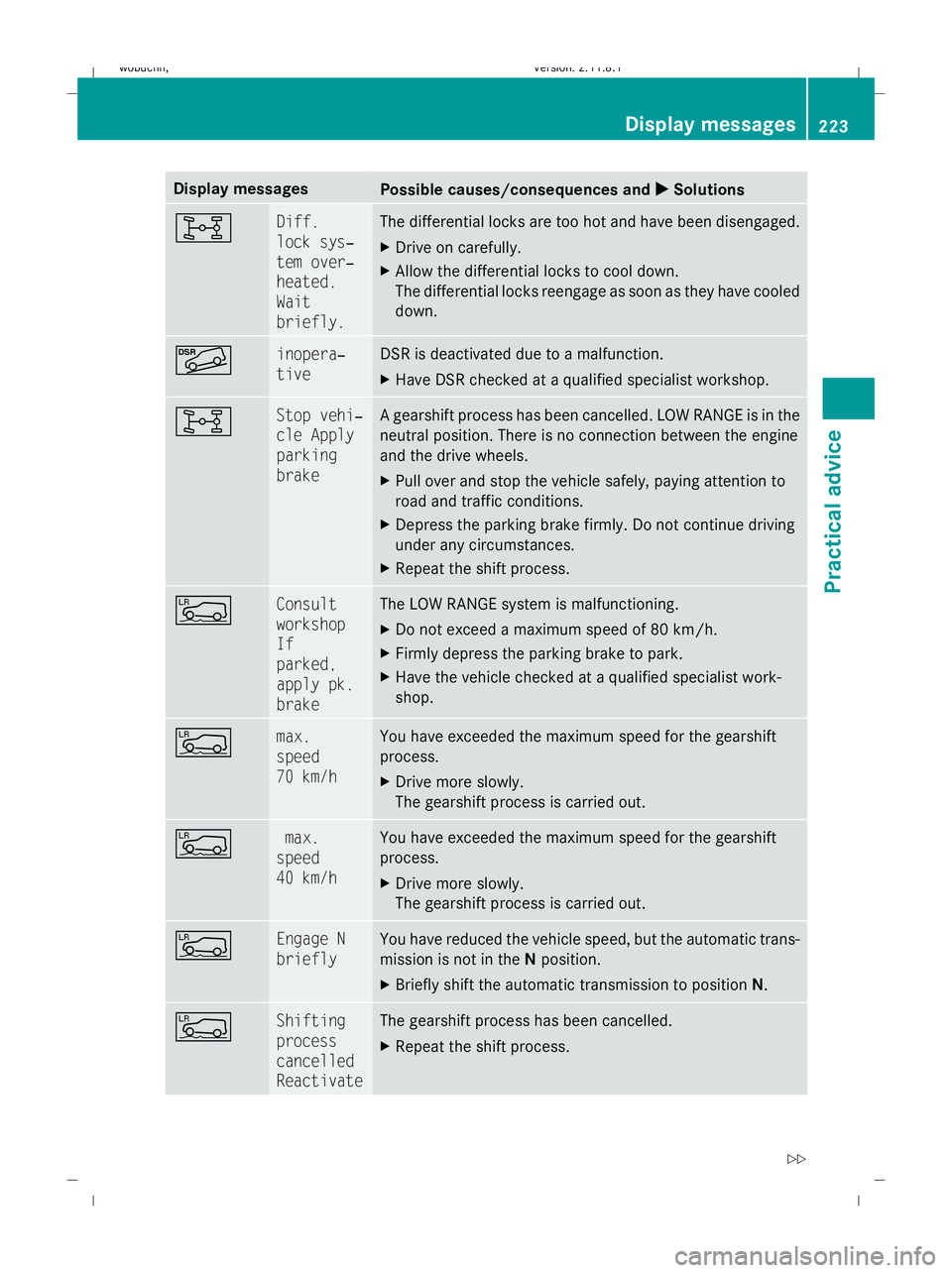
briefly. The differential locks are too hot and have been disengaged.
X
Drive on carefully.
X Allow the differential locks to cool down.
The differential locks reengage as soon as they have cooled
down. Ã inopera‐
tive DSR is deactivated due to a malfunction.
X
Have DSR checked at a qualified specialist workshop. 8 Stop vehi‐
cle Apply
parking
brake A gearshift process has been cancelled. LOW RANGE is in the
neutral position. There is no connection between the engine
and the drive wheels.
X
Pull over and stop the vehicle safely, paying attention to
road and traffic conditions.
X Depress the parking brake firmly. Do not continue driving
under any circumstances.
X Repeat the shift process. Å Consult
workshop
If
parked,
apply pk.
brake The LOW RANGE system is malfunctioning.
X
Do not exceed a maximum speed of 80 km/h.
X Firmly depress the parking brake to park.
X Have the vehicle checked at a qualified specialist work-
shop. Å max.
speed
70 km/h You have exceeded the maximum speed for the gearshift
process.
X
Drive more slowly.
The gearshift process is carried out. Å max.
speed
40 km/h You have exceeded the maximum speed for the gearshift
process.
X
Drive more slowly.
The gearshift process is carried out. Å Engage N
briefly You have reduced the vehicle speed, but the automatic trans-
mission is not in the
Nposition.
X Briefly shift the automatic transmission to position N.Å Shifting
process
cancelled
Reactivate The gearshift process has been cancelled.
X
Repeat the shift process. Display
messages
223Practical advice
X164_AKB; 2; 3, en-GB
wobuchh,V ersion: 2.11.8.1
2009-03-31T14:14:58+02:00 - Seite 223 Z
Dateiname: 6515431202_buchblock.pdf; erzeugt am 01. Apr 2009 00:18:00; WK
Page 227 of 309
Display messages
Possible causes/consequences and
X
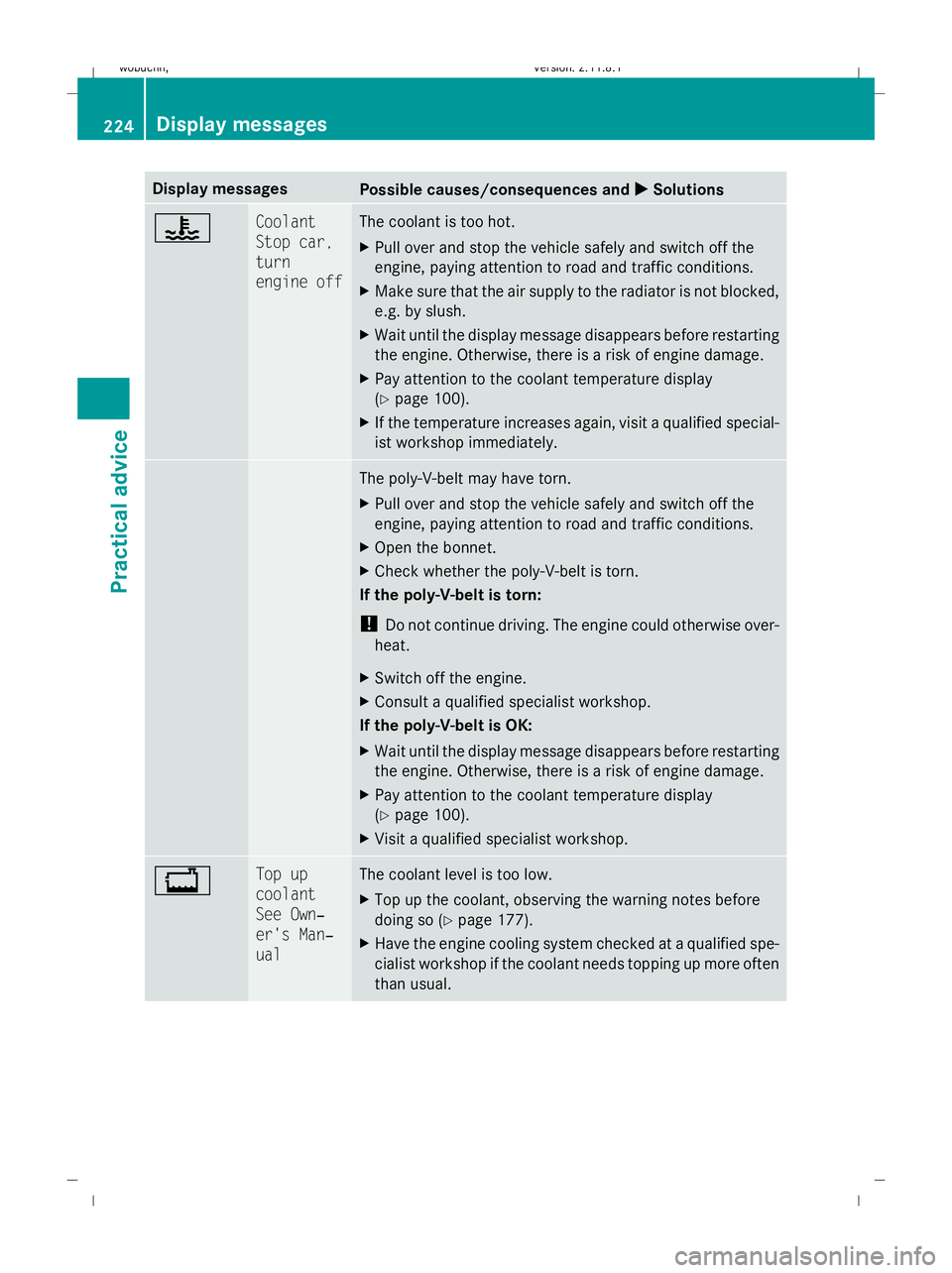
X Solutions ? Coolant
Stop car,
turn
engine off The coolant is too hot.
X
Pull over and stop the vehicle safely and switch off the
engine, paying attention to road and traffic conditions.
X Make sure that the air supply to the radiator is not blocked,
e.g. by slush.
X Wait until the display message disappears before restarting
the engine. Otherwise, there is a risk of engine damage.
X Pay attention to the coolant temperature display
(Y page 100).
X If the temperature increases again, visit a qualified special-
ist workshop immediately. The poly-V-belt may have torn.
X
Pull over and stop the vehicle safely and switch off the
engine, paying attention to road and traffic conditions.
X Open the bonnet.
X Check whether the poly-V-belt is torn.
If the poly-V-belt is torn:
! Do not continue driving. The engine could otherwise over-
heat.
X Switch off the engine.
X Consult a qualified specialist workshop.
If the poly-V-belt is OK:
X Wait until the display message disappears before restarting
the engine. Otherwise, there is a risk of engine damage.
X Pay attention to the coolant temperature display
(Y page 100).
X Visit a qualified specialist workshop. + Top up
coolant
See Own‐
er's Man‐
ual The coolant level is too low.
X
Top up the coolant, observing the warning notes before
doing so (Y page 177).
X Have the engine cooling system checked at a qualified spe-
cialist workshop if the coolant needs topping up more often
than usual. 224
Display
messagesPractical advice
X164_AKB; 2; 3, en-GB
wobuchh,V ersion: 2.11.8.1
2009-03-31T14:14:58+02:00 - Seite 224
Dateiname: 6515431202_buchblock.pdf; erzeugt am 01. Apr 2009 00:18:00; WK
Page 231 of 309
Display messages
Possible causes/consequences and
X
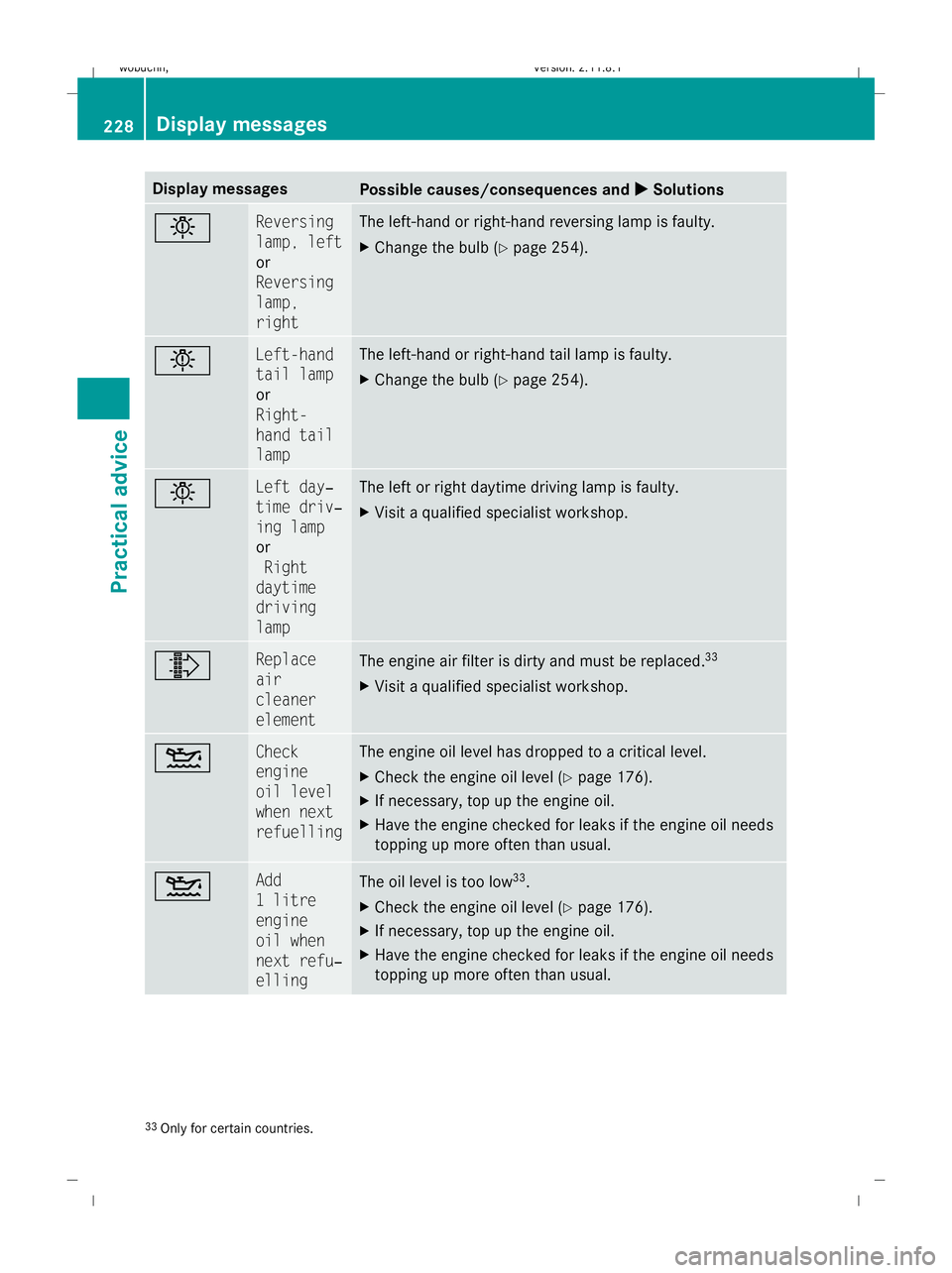
X Solutions b Reversing
lamp, left
or
Reversing
lamp,
right The left-hand or right-hand reversing lamp is faulty.
X
Change the bulb ( Ypage 254). b Left-hand
tail lamp
or
Right-
hand tail
lamp The left-hand or right-hand tail lamp is faulty.
X
Change the bulb ( Ypage 254). b Left day‐
time driv‐
ing lamp
or
Right
daytime
driving
lamp The left or right daytime driving lamp is faulty.
X
Visit a qualified specialist workshop. ¸ Replace
air
cleaner
element
The engine air filter is dirty and must be replaced.
33
X Visit a qualified specialist workshop. 4 Check
engine
oil level
when next
refuelling The engine oil level has dropped to a critical level.
X
Check the engine oil level ( Ypage 176).
X If necessary, top up the engine oil.
X Have the engine checked for leaks if the engine oil needs
topping up more often than usual. 4 Add
1 litre
engine
oil when
next refu‐
elling
The oil level is too low
33
.
X Check the engine oil level ( Ypage 176).
X If necessary, top up the engine oil.
X Have the engine checked for leaks if the engine oil needs
topping up more often than usual. 33
Only for certain countries. 228
Display
messagesPractical advice
X164_AKB; 2; 3, en-GB
wobuchh,V ersion: 2.11.8.1
2009-03-31T14:14:58+02:00 - Seite 228
Dateiname: 6515431202_buchblock.pdf; erzeugt am 01. Apr 2009 00:18:00; WK
Page 232 of 309
Display messages
Possible causes/consequences and
X
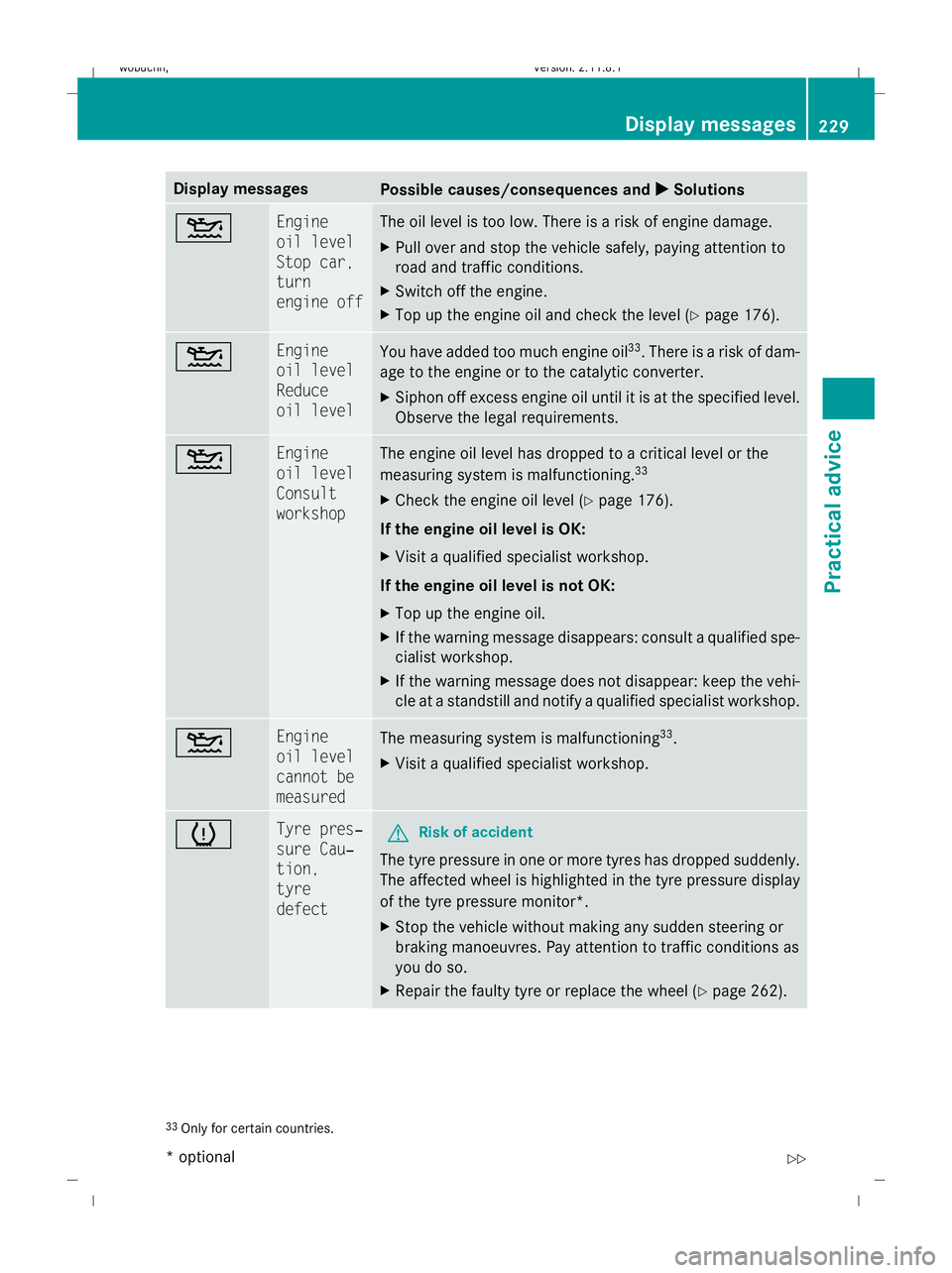
X Solutions 4 Engine
oil level
Stop car,
turn
engine off The oil level is too low. There is a risk of engine damage.
X
Pull over and stop the vehicle safely, paying attention to
road and traffic conditions.
X Switch off the engine.
X Top up the engine oil and check the level (Y page 176).4 Engine
oil level
Reduce
oil level
You have added too much engine oil
33
. There is a risk of dam-
age to the engine or to the catalytic converter.
X Siphon off excess engine oil until it is at the specified level.
Observe the legal requirements. 4 Engine
oil level
Consult
workshop The engine oil level has dropped to a critical level or the
measuring system is malfunctioning.
33
X Check the engine oil level ( Ypage 176).
If the engine oil level is OK:
X Visit a qualified specialist workshop.
If the engine oil level is not OK:
X Top up the engine oil.
X If the warning message disappears: consult a qualified spe-
cialist workshop.
X If the warning message does not disappear: keep the vehi-
cle at a standstill and notify a qualified specialist workshop. 4 Engine
oil level
cannot be
measured
The measuring system is malfunctioning
33
.
X Visit a qualified specialist workshop. h Tyre pres‐
sure Cau‐
tion,
tyre
defect
G
Risk of accident
The tyre pressure in one or more tyres has dropped suddenly.
The affected wheel is highlighted in the tyre pressure display
of the tyre pressure monitor*.
X Stop the vehicle without making any sudden steering or
braking manoeuvres. Pay attention to traffic conditions as
you do so.
X Repair the faulty tyre or replace the wheel ( Ypage 262). 33
Only for certain countries. Display
messages
229Practical advice
* optional
X164_AKB; 2; 3, en-GB
wobuchh
,V ersion: 2.11.8.1
2009-03-31T14:14:58+02:00 - Seite 229 Z
Dateiname: 6515431202_buchblock.pdf; erzeugt am 01. Apr 2009 00:18:00; WK
Page 240 of 309
Problem
Possible causes/consequences and
X
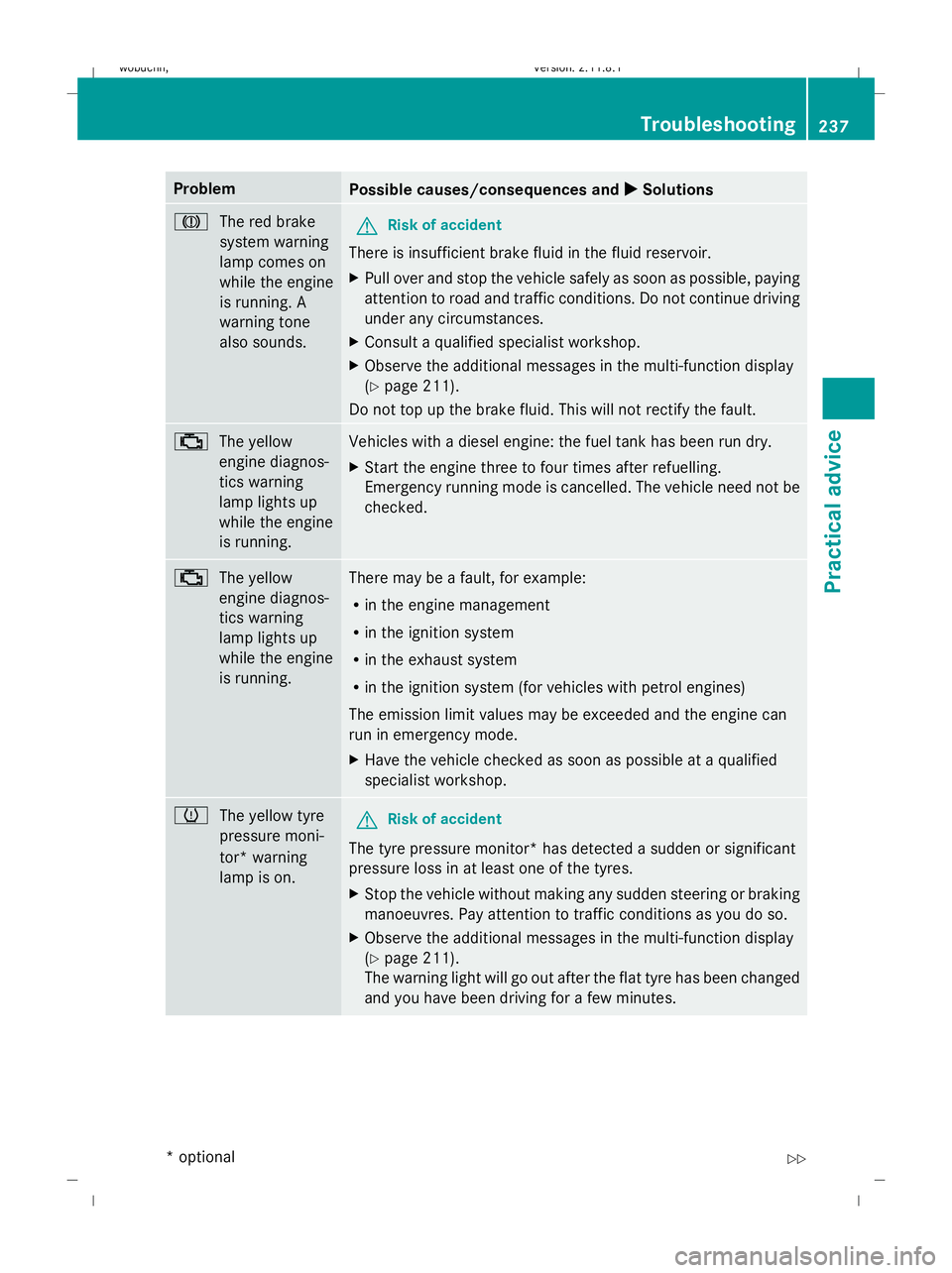
X Solutions J
The red brake
system warning
lamp comes on
while the engine
is running. A
warning tone
also sounds. G
Risk of accident
There is insufficient brake fluid in the fluid reservoir.
X Pull over and stop the vehicle safely as soon as possible, paying
attention to road and traffic conditions. Do not continue driving
under any circumstances.
X Consult a qualified specialist workshop.
X Observe the additional messages in the multi-function display
(Y page 211).
Do not top up the brake fluid. This will not rectify the fault. ;
The yellow
engine diagnos-
tics warning
lamp lights up
while the engine
is running. Vehicles with a diesel engine: the fuel tank has been run dry.
X
Start the engine three to four times after refuelling.
Emergency running mode is cancelled. The vehicle need not be
checked. ;
The yellow
engine diagnos-
tics warning
lamp lights up
while the engine
is running. There may be a fault, for example:
R
in the engine management
R in the ignition system
R in the exhaust system
R in the ignition system (for vehicles with petrol engines)
The emission limit values may be exceeded and the engine can
run in emergency mode.
X Have the vehicle checked as soon as possible at a qualified
specialist workshop. h
The yellow tyre
pressure moni-
tor* warning
lamp is on. G
Risk of accident
The tyre pressure monitor* has detected a sudden or significant
pressure loss in at least one of the tyres.
X Stop the vehicle without making any sudden steering or braking
manoeuvres. Pay attention to traffic conditions as you do so.
X Observe the additional messages in the multi-function display
(Y page 211).
The warning light will go out after the flat tyre has been changed
and you have been driving for a few minutes. Troubleshooting
237Practical advice
* optional
X164_AKB; 2; 3, en-GB
wobuchh,
Version: 2.11.8.1 2009-03-31T14:14:58+02:00 - Seite 237 Z
Dateiname: 6515431202_buchblock.pdf; erzeugt am 01. Apr 2009 00:18:01; WK
Page 246 of 309
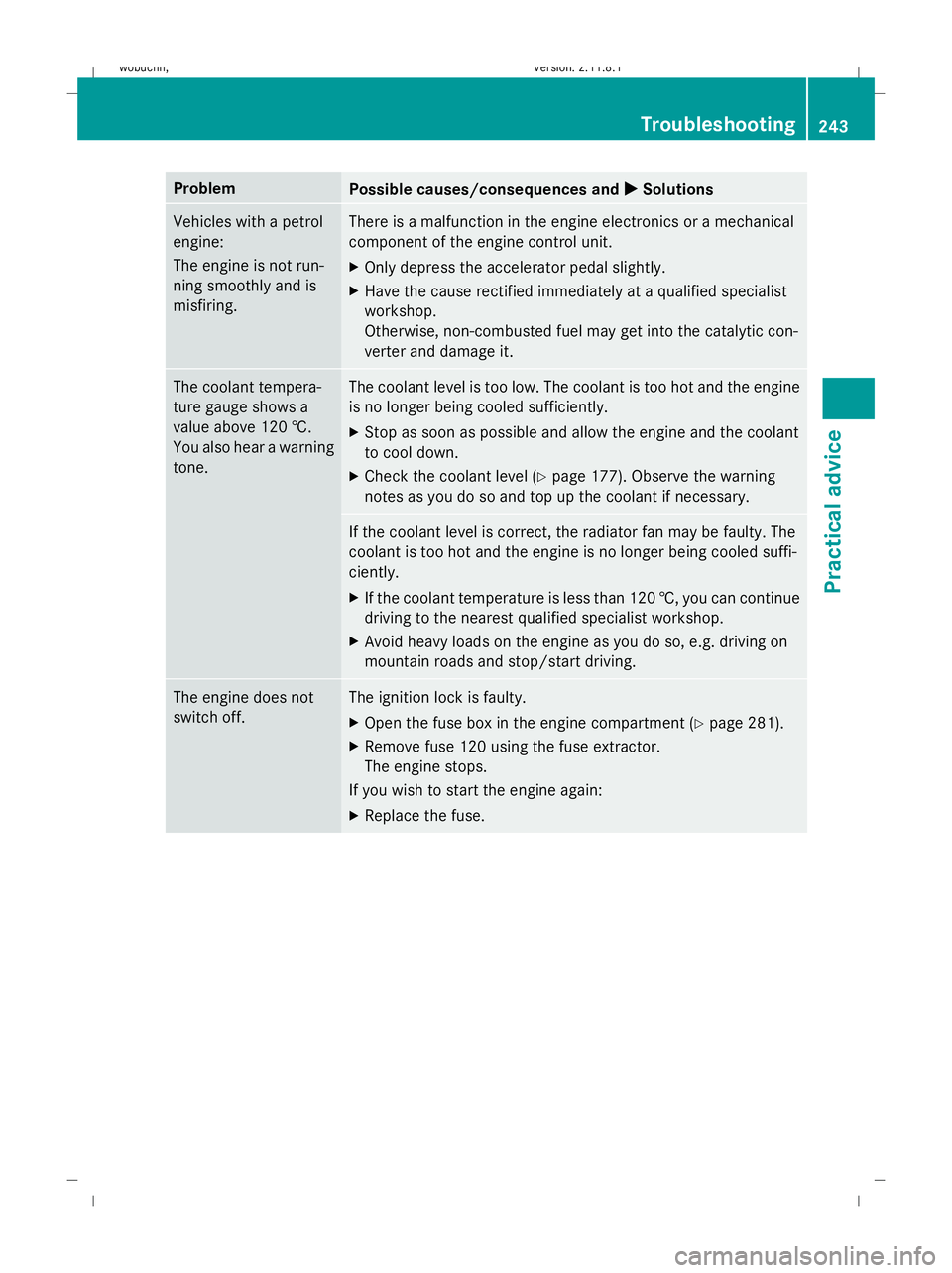
Problem
Possible causes/consequences and
X
X Solutions Vehicles with a petrol
engine:
The engine is not run-
ning smoothly and is
misfiring. There is a malfunction in the engine electronics or a mechanical
component of the engine control unit.
X
Only depress the accelerator pedal slightly.
X Have the cause rectified immediately at a qualified specialist
workshop.
Otherwise, non-combusted fuel may get into the catalytic con-
verter and damage it. The coolant tempera-
ture gauge shows a
value above 120 †.
You also hear a warning
tone. The coolant level is too low. The coolant is too hot and the engine
is no longer being cooled sufficiently.
X
Stop as soon as possible and allow the engine and the coolant
to cool down.
X Check the coolant level (Y page 177). Observe the warning
notes as you do so and top up the coolant if necessary. If the coolant level is correct, the radiator fan may be faulty. The
coolant is too hot and the engine is no longer being cooled suffi-
ciently.
X
If the coolant temperature is less than 120 †, you can continue
driving to the nearest qualified specialist workshop.
X Avoid heavy loads on the engine as you do so, e.g. driving on
mountain roads and stop/start driving. The engine does not
switch off. The ignition lock is faulty.
X
Open the fuse box in the engine compartment (Y page 281).
X Remove fuse 120 using the fuse extractor.
The engine stops.
If you wish to start the engine again:
X Replace the fuse. Troubleshooting
243Practical advice
X164_AKB; 2; 3, en-GB
wobuchh, Version: 2.11.8.1 2009-03-31T14:14:58+02:00 - Seite 243 Z
Dateiname: 6515431202_buchblock.pdf; erzeugt am 01. Apr 2009 00:18:02; WK
Page 247 of 309
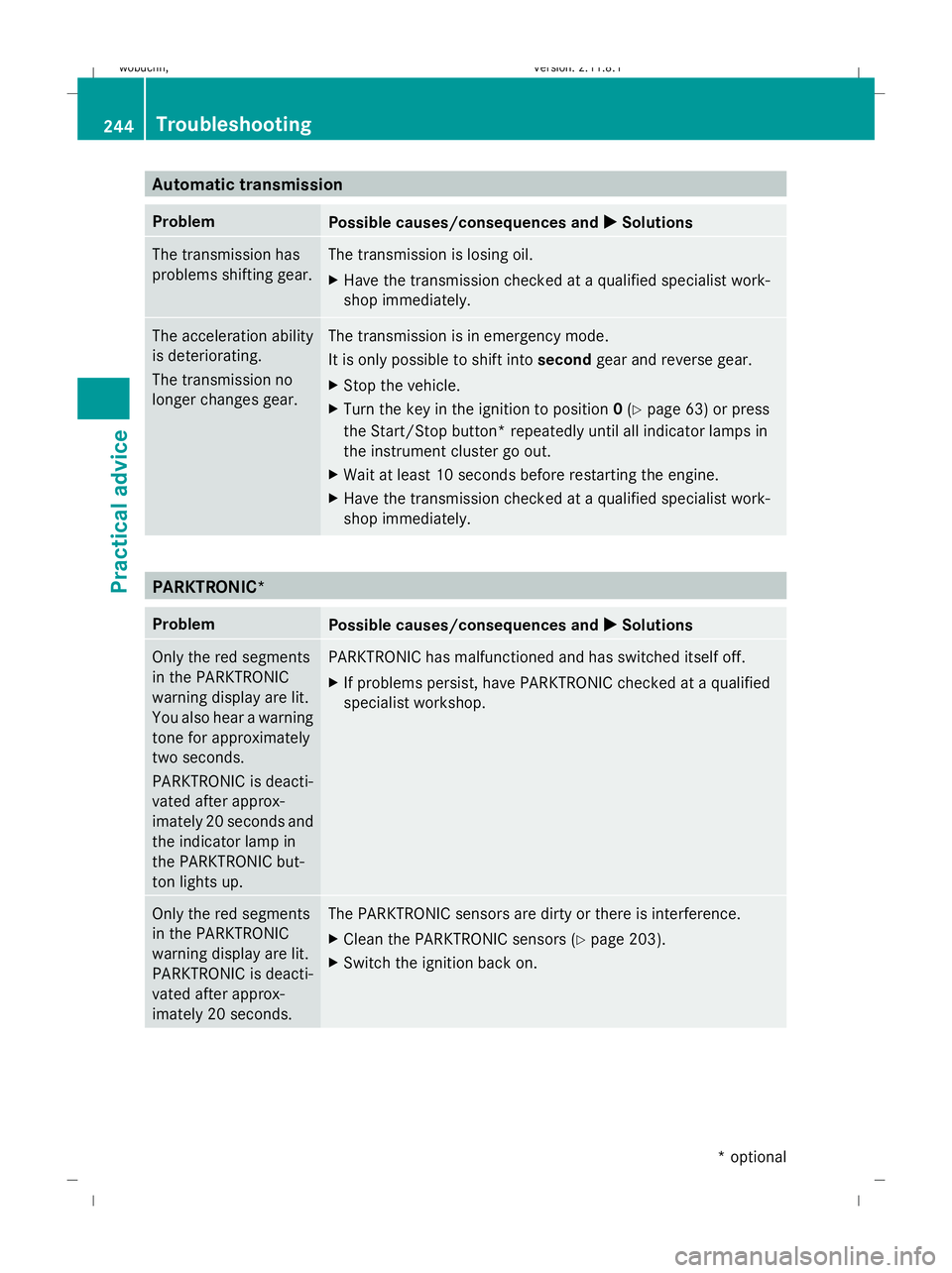
Automatic transmission
Problem
Possible causes/consequences and
X XSolutions The transmission has
problems shifting gear. The transmission is losing oil.
X
Have the transmission checked at a qualified specialist work-
shop immediately. The acceleration ability
is deteriorating.
The transmission no
longer changes gear. The transmission is in emergency mode.
It is only possible to shift into
secondgear and reverse gear.
X Stop the vehicle.
X Turn the key in the ignition to position 0(Y page 63) or press
the Start/Stop button* repeatedly until all indicator lamps in
the instrument cluster go out.
X Wait at least 10 seconds before restarting the engine.
X Have the transmission checked at a qualified specialist work-
shop immediately. PARKTRONIC*
Problem
Possible causes/consequences and
X XSolutions Only the red segments
in the PARKTRONIC
warning display are lit.
You also hear a warning
tone for approximately
two seconds.
PARKTRONIC is deacti-
vated after approx-
imately 20 seconds and
the indicator lamp in
the PARKTRONIC but-
ton lights up. PARKTRONIC has malfunctioned and has switched itself off.
X
If problems persist, have PARKTRONIC checked at a qualified
specialist workshop. Only the red segments
in the PARKTRONIC
warning display are lit.
PARKTRONIC is deacti-
vated after approx-
imately 20 seconds. The PARKTRONIC sensors are dirty or there is interference.
X
Clean the PARKTRONIC sensors (Y page 203).
X Switch the ignition back on. 244
TroubleshootingPractical advice
* optional
X164_AKB; 2; 3, en-GB
wobuchh,
Version: 2.11.8.1 2009-03-31T14:14:58+02:00 - Seite 244
Dateiname: 6515431202_buchblock.pdf; erzeugt am 01. Apr 2009 00:18:02; WK