lock MERCEDES-BENZ GL SUV 2012 Owner's Manual
[x] Cancel search | Manufacturer: MERCEDES-BENZ, Model Year: 2012, Model line: GL SUV, Model: MERCEDES-BENZ GL SUV 2012Pages: 441, PDF Size: 10.66 MB
Page 64 of 441
Important safety notes
If you fail to adapt your driving style or
become distracted, th edriving sa fetysys-
tems ca nneith er reduce th erisk of accident
no ro verri dethe law sofphysics. Driving
safety system sare mere ly aids desig nedto
assis tdrivi ng.You ar eresponsible for the dis-
tance to the vehicle in fr ont, forvehicle speed
and for braking in good time. Alway sadapt
your drivin gstyle to suit the prevailing road
and weather condition sand maintain asafe
distance from the vehicle in front .Drive care-
fully.
i Thed riving safet ysystems described only
work as effectively as possibl ewhen there
is adequate con tact betwee nthe tyres and
the roa dsurface. Pleas epay special atten-
tion to the notes on tyres, recommended
minimum tyre tread depths ,etc.
(Y page 396).
In wintry driving conditions, always use
winter tyres (M+S tyres) and if necessary,
snow chains .Only in this way will the driv-
ing safety systems described in this section
work as effectively as possible. ABS (Anti-lock Braking System)
Important safety notes i
Observe the "Important safety notes" sec-
tion (Y page61). G
WARNING
If ABS is faulty, the wheels could lock when
braking .The steerability and brakin gcharac-
teristics ma ybeseverely impaired. Addition-
ally, further driving safet ysystems are deac-
tivated. There is an increased danger of skid-
ding and accidents.
Drive on carefully. Have ABS checked imme-
diatel yata qualified specialist workshop.
When ABS is malfunctioning, other systems,
including driving safety systems, will also
become inoperative. Observe the infor mation on the ABS warning lamp (Y
page 326) and
display messages which may be shown in the
instrument cluster (Y page 291).
ABS regulate sbrake pressure in such away
that the wheels do not lock when you brake.
This allows you to continue steering the vehi-
cle when braking.
ABS works from aspeed of about 8km/h
upwards, regardless of road-surfac econdi-
tions. AB Sworksons lippery surfaces, even
when you only brake gently.
The yellow !ABS warnin glamp in the
instrument cluster lights up when the ignition
is switched on. It goes out when the engine is
running.
Brakes X
If ABS intervenes: continue to depress the
brake pedal with force until the braking sit-
uation is over.
X To mak eafull brake application:
depress th ebrake peda lwith full force.
If ABS intervenes when braking, you will feel
ap ulsing in the brake pedal.
The pulsating brake pedal can be an indica-
tion of hazardous road conditions, and func-
tions as areminder to take extr acare while
driving.
Off-road ABS An ABS system specifically suited to off-road
terrain is activated automatically once the off-
road program is activated on:
R
Vehicles without the ON&OFFROAD pack-
age (Y page 252)
R Vehicles with the ON&OFFROAD package
(Y page 253)
At speeds below 30 km/h, the front wheels
lock cyclically during braking. The digging-in
effect achieved in the process reduces the
stopping distance when driving off-road. This
limits steering capability. Driving safety systems
61Safety Z
Page 65 of 441
BAS (Brak
eAssis tSystem)
i Observet he "Imp ortant safety notes "sec-
tion (Y page 61). G
WARNING
If BAS is malfunctioning, the braking distance
in an emergency braking situation is
increased .There is arisk of accident.
In an emergenc ybraking situa tion, depress
the bra kepedal with full force. AB Sprevents
th ew heels fr om locking.
BAS operate sinemergency brakin gsitua-
tions. If you depress the brake pedal quickly,
BAS automatically boosts the brakin gforce,
thus shortening the stoppin gdistance.
The brakes will func tion as usual onc eyou
release the brake pedal. BA Sisd eactivated. BAS PLUS (Brake Assist Syste
mPlus)
i Observe the "Importan tsafety notes" sec-
tion (Y page 61).
BAS PLUS is only available on vehicles with
DISTRONIC PLUS.
BAS PLUS provides braking assistance in haz-
ardous situations at speeds greater than
7k m/h and uses rad ar sensortechnology to
assess the traffic situation.
With the help of the rada rsensor system ,BAS
PLU Scan detect obstacles that are in the
path of your vehicle for an extended period of
time.
At speeds up to approximately 70 km/ h,BAS
PLUS may also det ects tationar yobstacles,
for example, stopped or parked vehicles.
To prevent afront-en dcollision, BA SPLUS
calculate sthe brake force necessary if:
R you approach an obstacle, and
R BA SP LUS ha sdetected arisk of collision
If you ar edriving at aspeed over
30 km/h:ify ou depress the brake sharply,
BA SP LUS automatically raise sthe brake
pressur etoavalue adapted to the traffic sit-
uation. If you are driving at
aspeed under
30 km/h:ify ou depress the brake, BA SPLUS
is activated. Braking will be carried ou tatthe
last possible moment.
If BA SPLUS demand sparticularly high brak-
ing force, preventative passenger protection
measures (PRE-SAFE ®
)a re activate dsimul-
taneously.
X Keep the brake pedal depressed until the
emergenc ybraking situatio niso ver.
ABS prevents th ewheels from locking.
BA SP LUS is deactivate dand the brakes func-
tion as usual ,if:
R you release th ebrake pedal.
R there is no longe rany danger of arear-end
collision.
R no obstacl eisdetected in front of your
vehicle.
If you have activated DSR (Y page 251), BAS
PLU Sisa lso deactivated.
The radar sensor system is switched off auto-
matically in the vicinit yofradio telescope
facilities in the following vehicles:
R vehicles with COMAND Online and naviga-
tion
R vehicles with Audio 20 and Becker ®
MAP
PILOT
Becker ®
MAP PILOT must be connected;
see the separate operating instructions.
The radar senso rsystem must be switched off
using the on-board computer in the vicinit yof
radio telescop efacilities in the following vehi-
cles:
R vehicles without COMAND Online and nav-
igation
R vehicles without Audio 20 and Becker ®
MAP PILOT
R vehicles for Australia
For information on switching off the radar
senso rsystem using the on-board computer,
see (Y page 283). 62
Driving safety systemsSafety
Page 68 of 441
R
to stationary obstacles
R when cornering
As aresult, Adaptive Br akeA ssist may not
int ervene in al lcritica lconditions .There is a
risk of an accident.
Always pay carefu lattention to the traffic sit-
uation and be ready to brake.
Adaptive Brake Assist aids you in braking dur-
ing hazardous situations at speeds above
30 km/h and uses the radar sensor system
to evaluate the traffic situation.
With the hel pofthe adaptive Brake Assist ,the
distanc ewarning signal can detect obstacles
that are in the path of your vehicle for an
extended period of time.
Should you approach an obstacle and the
adaptive Brake Assis thas detected arisk of
collision, the adaptive Brake Assist calculates
the brakin gforc enecessar ytoavoidac olli-
sion with the vehicle in front .Should you
apply the brakes forcefully ,the adaptive
Brake Assist will automatically increase the
brakin gforc etoal evel suitable for the traffic
conditions.
X Keep the brak epedal depressed until the
emergency braking situation is over.
ABS prevents the wheels from locking.
The brakes will work normally again if:
R you release the brak epedal.
R there is no longer any danger of arear-end
collision.
R no obstacl eisdetected in front of your
vehicle.
Adaptive Brake Assist is then deactivated.
If adaptive Brake Assist demands particularly
high braking force, preventative passenger
protec tion measure s(PRE-SAFE ®
)a re activa-
ted simultaneousl y.
Up to vehicl espeeds of around 25 0km/h,
th ea daptiv eBrake Assist is capable of react-
ing to moving objects that have alread ybeen
recognised as such at least once over the
period of observation .Adaptiv eBrake Assist
does not react to stationary obstacles. If th
eadaptiv eBrake Assist is not available
du et oam alfunction in the radar senso rsys-
tem, the brake syste mremains available with
ful lbrake boostin geffect and BAS.
In particular, th edetection of obstacles can
be impaired if there is:
R dirt on the sensors or anything else cover-
ing the sensors
R snow or heavy rain
R interference by other rada rsources
R the possibility of stron gradar reflections,
for example, in multi-storey car parks
R an arrow vehicle travelling in front ,e.g. a
motorcycle
R av ehicle travelling in front on adifferent
line
Following damage to the front end of the vehi-
cle, have the configuration and operation of
the radar sensor checked at aqualified spe-
cialist workshop. This also applies to colli-
sions at slow speeds where there is no visible
damage to the front of the vehicle. Adaptive brake lamps
If you brake sharply from aspeed of more
than 50 km/ horifbraking is assisted by BAS
or BAS PLUS, th ebrake lamp sflash rapidly.
In this way, traffic travelling behind you is
warned in an even more noticeable manner.
If you brake sharply from aspeed of more
than 70 km/ htoastandstill, the hazard warn-
ing lamps are activated automatically .Ifthe
brakes ar eapplied again, the brak elamps
light up continuously .The hazard warning
lamps switc hoff automatically if you travel
faster than 10 km/h .You can also switc hoff
th eh azard warning lamps using the hazard
warning button (Y page 122). Driving safety systems
65Safety Z
Page 71 of 441
In this situation, ESP
®
assist syou and can
detec tifthe vehicle/trailer combination
begins to lurch. ESP ®
slows the vehicle down
by brakin gand limiting the engine outp ut until
the vehicle/trailer combinatio nhas stabi-
lised.
Trailer stabilisation is active above speeds of
about 60 km/h.
Trailer stabilisation does not work if ESP ®
is
deactivated or disabled because of amal-
function.
Crosswin dAssist Strong crosswinds can cause your vehicle to
deviate from astraight course. The crosswind
driving assistance function integrated into
ESP ®
significantly reduces thes eeffects.
ESP ®
intervene sautomatically according to
the direction and intensity of the crosswinds
affecting your vehicle.
When driving on straight roads or gentle
bends ,your vehicle is kept safel yonc ourse
by astabilising brake intervention.
Crosswind driving assistance is active above
av ehicle speed of 80 km /h.
Crosswind driving assistance does not work
if ESP ®
is deactivated or disabled because of
am alfunction. EBD (electronic brake force distribu-
tion)
i Observe the "Importan tsafety notes" sec-
tion (Y page 61). G
WARNING
If EBD has malfunctioned, the rear wheels can
still lock, e.g. under full braking. This increa-
ses the risk of skidding and an accident.
You should therefor eadapt your driving style
to the different handling characteristics. Have
the brak esystem checked at aqualified spe-
cialist workshop. Observe information regarding indicator and
warning lamps (Y
page 327) as well as dis-
play messages (Y page 293).
EBD monitors and controls the brake pres-
sure on the rear wheels to improve driving
stability while braking. ADAPTIVE BRAKE
ADAPTIVE BRAKE enhances braking safety
and offers increased braking comfort. In addi-
tion to the braking function, ADAPTIVE BRAKE
also has the HOLD function (Y page 211) and
hill start assist (Y page 162). PRE-SAFE
®
Brake
i Observe the "Important safety notes" sec-
tion (Y page 61).
PRE-SAFE ®
Brake is only available in vehicles
with DISTRONIC PLUS.
PRE-SAFE ®
Brake can help you to minimise
the risk of acollision with avehicle in front or
reduc ethe effect sofsuchacollision .IfPRE-
SAFE ®
Brake has detected arisk of collision,
you will be warned visually and acoustically
as well as by automatic braking. PRE-SAFE ®
Brake cannot prevent acollision withou tyour
interven tion.
This func tion will issue awarning if:
R at speeds of around 30 km/ horm ore over
several seconds, the distance maintained
to the vehicle travellin ginfront is insuffi-
cient.
The · distance warning lamp then lights
up in th einstrument cluster.
R at as peed of approximately 7km/h or
high er,y ou ver yquickly approach avehicle
in front.
An intermittent warning tone will then
sound and the ·distance warning lamp
will light up in the instrumen tcluster. 68
Driving safety systemsSafety
Page 74 of 441
Anti-
thefts ystems Im
mo biliser
X To activate wit hthe ke y:remove the key
from the ignition lock.
X To activat ewith KEYLESS-GO: switch the
ignitio noff and open th edriver's door.
X To deactivate: switch on the ignition.
Th eimmobil iser prev ents you rvehicle from
being star tedw ithout the correct key.
When leaving the vehicle, always take the key
with you and lock the vehicle. Anyone can
start the engin eifavalid key has been left
inside the vehicle.
i The immobiliser is alway sdeactiva ted
when you start the engine. ATA (Anti-Theft Alarm system)
X
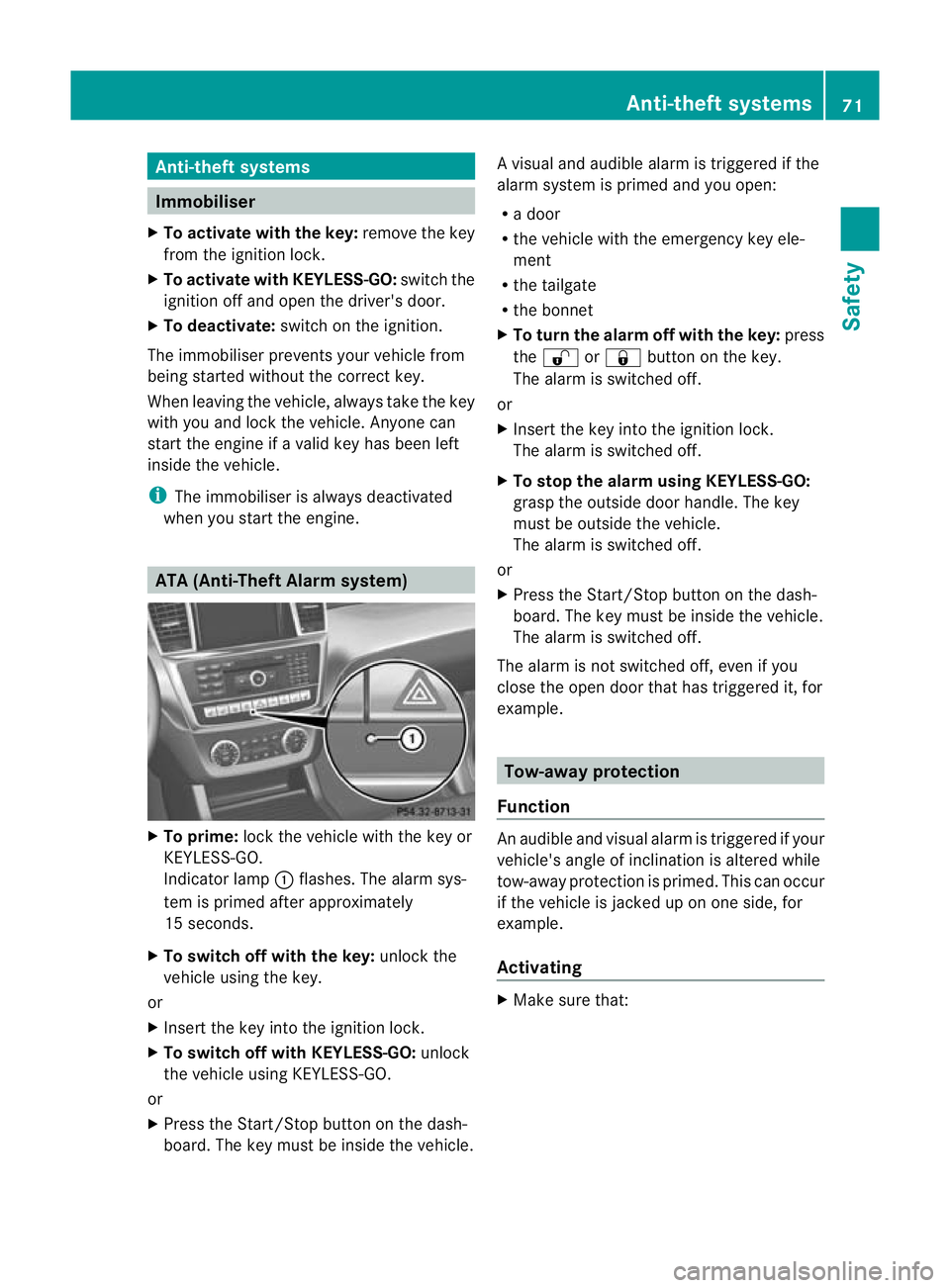
To prime: lock the vehicle with the key or
KEYL ESS-GO.
Indicator lamp :flashes .The alar msys-
tem is primed after approximately
15 seco nds.
X To switch of fwith the key: unlock the
vehicle using the key.
or
X Inser tthe key int othe ignition lock.
X To switch of fwith KEYLESS-GO: unlock
the vehicle using KEYL ESS-GO.
or
X Pres sthe Start/Stop button on the dash-
board. The key must be insid ethe vehicle. Av
isual and audible alarm is triggered if the
alarm system is prime dand you ope n:
R ad oor
R the vehicle with the emergency key ele-
ment
R the tailgate
R the bonnet
X To turn th ealarmo ff wit hthe ke y:press
the % or& button on the key.
Th ea larm is switche doff.
or
X Insert the key into the ignition lock.
Th ea larm is switche doff.
X To sto pthe alarm using KEYLESS-GO:
gras pthe outside door handle. The key
must be outside th evehicle.
The alar misswitched off.
or
X Press the Start/Stop button on the dash-
board. The key must be inside the vehicle.
The alarm is switched off.
The alarm is not switched off ,even if you
close the open door that ha striggered it, for
example. Tow
-away protection
Function An audible and visual alarm is trigge
redify our
vehicle' sangle of inclination is altered while
tow-away protection is primed. Thi scan occur
if the vehicle is jacked up on one side, for
example.
Activating X
Make sure that: Anti-theft systems
71Safety Z
Page 75 of 441
R
the doors are closed.
R the tailgate is closed.
Onl ythen is the tow-away protection
primed.
X Lock the vehicle with the key or KEYLESS-
GO.
Tow-awa yprotectio nisprimedafter
approximately 60 seconds.
Switchin goff X
To switc hoff wit hkey: unlock the vehicle
with the key.
or
X Insert the key into the ignition lock.
Tow-awa yprotectio nisswitched off auto-
matically.
X To switch off with KEYLESS-GO: unlock
the vehicle with KEYLESS-GO.
or
X Press the Start/Stop button on the dash-
board. The key must be inside the vehicle.
Tow-awa yprotectio nisswitched off auto-
matically.
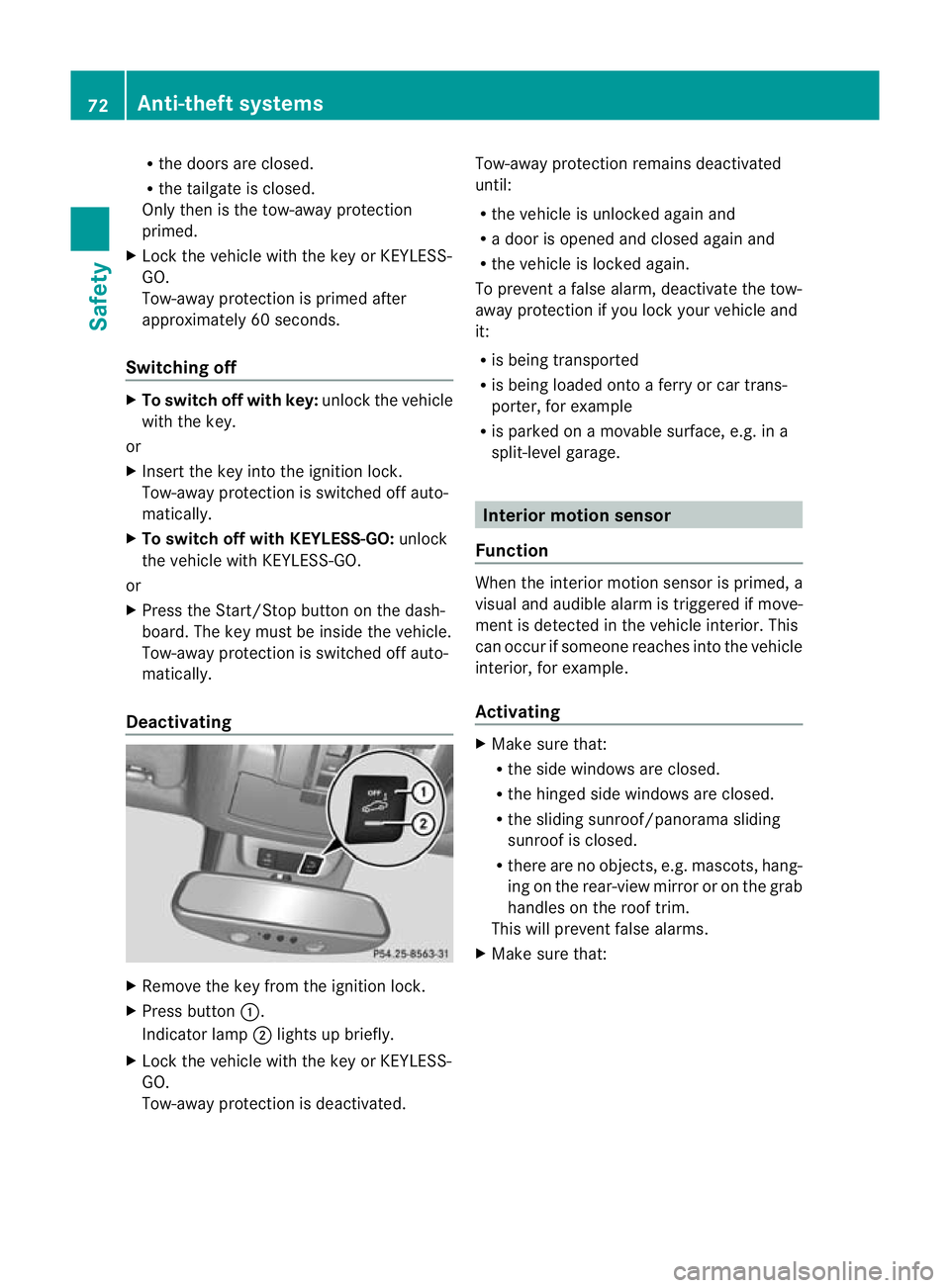
Deactivating X
Remove the key from the ignition lock.
X Press button :.
Indicator lamp ;lights up briefly.
X Lock the vehicle with the key or KEYLESS-
GO.
Tow-awa yprotectio nisdeactivated. Tow-away protec
tion remains deactivated
until:
R the vehicle is unlocked again and
R ad ooriso peneda nd closed agai nand
R the vehicl eislocked again.
To prevent afalse alarm, deactivate the tow-
away protection if yo uloc ky ourv ehicle and
it:
R is being transported
R is being loaded onto aferry or car trans-
porter, for example
R is parked on amovable surface, e.g. in a
split-level garage. Interio
rmotion sensor
Function When the interior motion sensor is primed, a
visual and audible alarm is triggered if move-
ment is detected in the vehicle interior
.This
can occur if someon ereaches into the vehicle
interior, for example.
Activating X
Make sure that:
R
the side windows are closed.
R the hinged side windows are closed.
R the sliding sunroof/panorama sliding
sunroof is closed.
R there are no objects, e.g. mascots, hang-
ing on the rear-view mirror or on the grab
handles on the roof trim.
This will prevent false alarms.
X Make sure that: 72
Anti-theft systemsSafety
Page 76 of 441
R
the sliding sunroof/panorama sliding
sunroo fisclosed.
R the doors are closed.
R the tailgate is closed.
Only then is the interior motion sensor
primed.
X Lock the vehicle with the key or KEYLESS-
GO.
The interior motion sensor is primed after
approximately 30 seconds.
Switching off X
To switch off with the key: unlock the
vehicle using the key.
or
X Insert the key into the ignition lock.
The interior motion sensor is switched off
automatically.
X To switch off with KEYLESS-GO: unlock
the vehicle using KEYLESS-GO.
or
X Press the Star t/Stopbutton on the dash-
board. The key must be inside the vehicle.
The interior motion senso riss witched off
automatically.
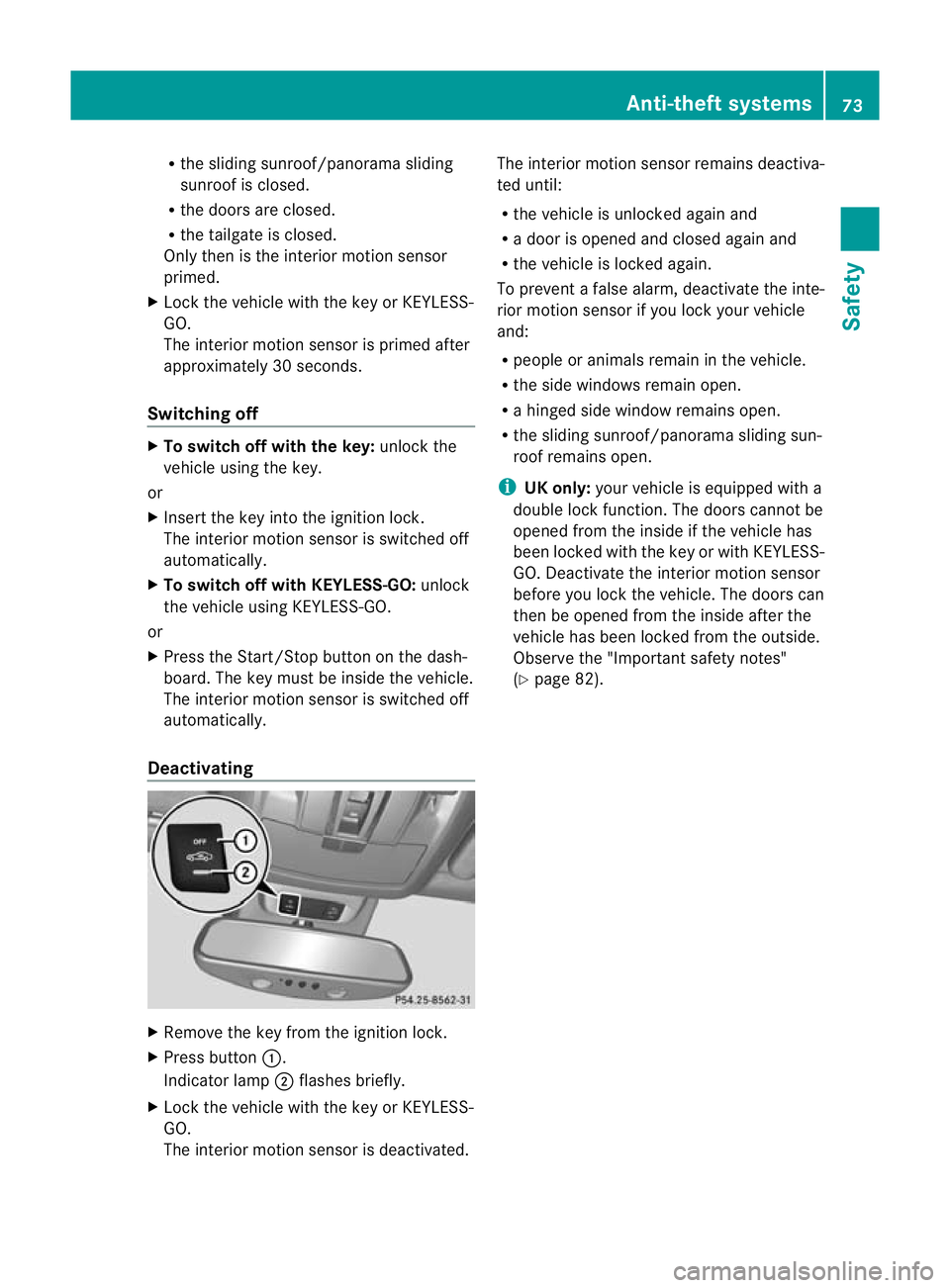
Deactivating X
Remove the key from the ignition lock.
X Press button :.
Indicator lamp ;flashes briefly.
X Lock the vehicle with the key or KEYLESS-
GO.
The interior motion sensor is deactivated. The interior motion sensor remains deactiva-
ted until:
R
the vehicle is unlocked agai nand
R ad ooriso peneda nd closed agai nand
R the vehicl eislocked again.
To prevent afalse alarm, deactivate the inte-
rio rm otion sensor if you lock your vehicle
and:
R people or animals remain in the vehicle.
R the side window sremai nopen.
R ah inged side window remains open.
R the sliding sunroof/panoram asliding sun-
roof remains open.
i UK only: your vehicle is equipped with a
double lock func tion. The doors can notbe
opened from the inside if the vehicle has
been locked with the key or with KEYLESS-
GO. Deac tivate the interior motion sensor
before you lock the vehicle .The doors can
then be opened from the insid eafter the
vehicl ehas been locked from the outside.
Observe the "Importan tsafety notes"
(Y page 82). Anti-thef
tsystems
73Safety Z
Page 79 of 441
Usefu
linfor mati on
i This Owner's Manual describes all mod-
els, series and optional equipment for your
vehicle that were available at the time of
going to press. National variation sare pos-
sible. Note that your vehicl emay not be
equippe dwith all of the function sdescri-
bed. This is also the case for system sand
functions relevant to safety.
i Read the information on qualified special-
ist workshops: (Y page25). Key
Impo
rtantsafety notes G
WARNING
Only for the Unite dKingdom: if the vehicle
has been locked with the key or with KEY-
LESS-GO, the double lock function is activa-
ted as standard. It is then not possible to open
the doors from inside the vehicle.
Therefore, do not leave any people behind in
the vehicle, particularly children ,elderly peo-
ple or people requirin gspecial assistance. As
ar esult, they may not be able to free them-
selves in the even tofanemergency. They
could be seriously or eve nfatally injured by
prolonged exposure to extremely high or low
temperatures, for example. In this case, res-
cuing peopl efrom outsid ethe vehicle is diffi-
cult.
Deac tivate th einterior motion sensor before
you lock the vehicle. The doors can then be
opened from the inside after the vehicl ehas
been locked from the outside. G
WARNING
If children are left unsupervised in the vehicle,
they could: R
open adoor from inside the vehicle at any
time, even if it has been locked
R star tthe vehicle usin gakey which has been
left in the vehicle
R release the electric parking brake
They could thereby endanger themselves and
others. Never leave children unsupervised in
the vehicle. Alway stake the key with you
when leaving the vehicle, even if you are only
leaving it for ashort time. G
WARNING
If ak ey rin gistoo heavy or too large, the
weight actin gonthe key coul dcause it to turn
in the ignition lock or catc honthe steering
wheel. This coul dcause the engine to be
switched off suddenly. You may lose control
of the vehicle and cause an accident. Do not
attac hany heavy or large key rings to the key
that is inserted in the ignition.
R Do not keep the key:
-electronic devices, e.g. amobile phone
or anothe rkey
- metallic objects, e.g. coins or metal film
- metallic objects, e.g. ametal case.
This can affect the key' sfunctionality.
Do not keep the KEYLESS-GO key in the tem-
perature-controlled cup holder. Otherwise,
the KEYLESS-GO key will not be detected.
Keep the key away from strong magnetic
fields. Otherwise, the remot econtrol function
coul dbea ffected. 76
KeyOpenin
gand closing
Page 80 of 441
Key functions
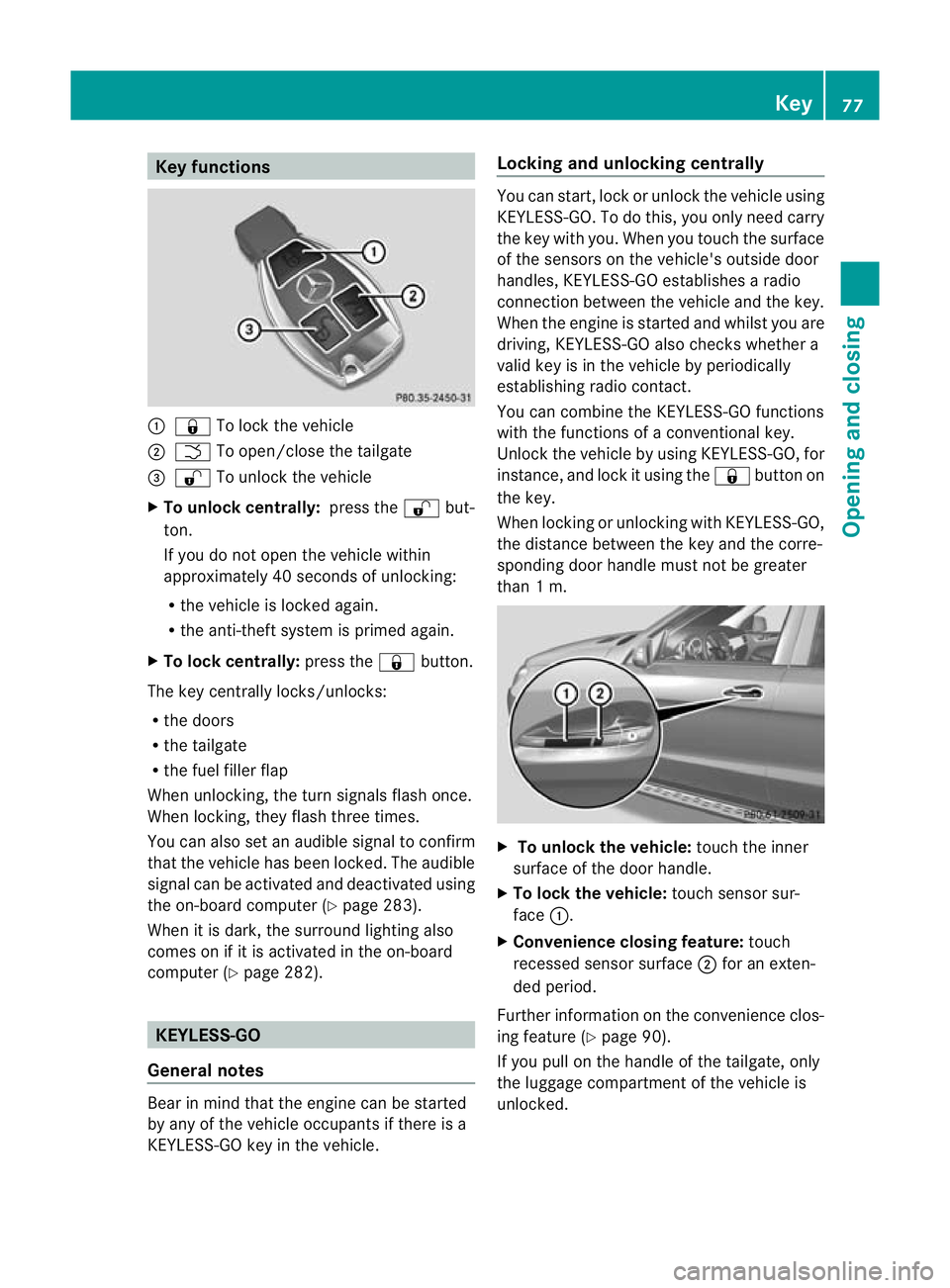
:
& To loc kthe vehicle
; F To open/close the tailgate
= % To unlock the vehicle
X To unlock centrally: press the%but-
ton.
If you do not open the vehicle within
approximatel y40seconds of unlocking:
R the vehicle is locked again.
R the anti-theft system is primed again.
X To lock centrally: press the&button.
The key centrally locks/unlocks:
R the doors
R the tailgate
R the fuel filler flap
When unlocking, the tur nsignals flash once.
When locking, they flash three times.
You can also set an audible signal to confirm
that the vehicle has been locked. The audible
signal can be activated and deactivated using
the on-board computer (Y page 283).
When it is dark, the surroun dlighting also
comes on if it is activated in the on-board
computer (Y page 282). KEYLESS-GO
Genera lnotes Bear in mind that the engine can be started
by any of the vehicle occupants if there is a
KEYL ESS-GO key in the vehicle. Locking and unlockin
gcentrally You can start, lock or unlock the vehicle using
KEYL
ESS-GO .Todot his, you only need carry
the key with you. When you touc hthe surface
of the sensor sonthe vehicle' soutside door
handles ,KEYLESS-GO establishes aradio
connection between the vehicle and the key.
When the engine is started and whils tyou are
driving, KEYLESS -GOa lso check swhether a
valid key is in the vehicle by periodically
establishin gradio contact.
You can combine the KEYLESS-GO functions
with the functions of aconventional key.
Unlock the vehicle by using KEYLESS -GO, for
instance, and lock it usin gthe & button on
the key.
When locking or unlocking with KEYL ESS-GO,
the distance between the key and the corre-
sponding doo rhandle must not be greater
than 1m. X
To unlock the vehicl e:touch the inner
surface of the doo rhandle.
X To lock the vehicle: touch sensorsur-
face :.
X Convenience closing featu re:touch
recessed sensor surface ;for an exten-
ded period.
Further information on the convenience clos-
ing feature (Y page 90).
If you pull on the handl eofthe tailgate, only
the luggage compartmen tofthe vehicle is
unlocked. Key
77Opening and closing Z
Page 81 of 441
Changing th
esettings of th elocking
system
You can chang ethe settings of th elocking
system. This mea nsthat only the driver' sdoor
and th efuel filler flap are unlocked when the
vehicle is unlocked. This is useful if you fre-
quently travel on your own.
X To change th esetting: press and hold
down the %and& buttons simulta-
neously for approximately six seconds until
the battery chec klamp flashes twice
(Y page 79).
i If the settin gofthe locki ngsystem is
changed within th esignal range of th evehi-
cle ,pressi ngthe & or% button:
R locks or
R unlock sthe vehicle
The ke ynow functions as follows:
X To unloc kthe drive r'sdoor: press the
% button once.
X To unlock cen trally:pressthe % but-
to nt wice.
X To lock centrally: pressthe & button.
The KEYLESS-GO function is changed as fol-
lows:
X To unlock th edriver's doo r:touch the
inner surface of the doo rhandle on the
driver' sdoor.
X To unlock centrally: touch theinner sur-
fac eo fthe door handle on th efront-
passenger door or th erear door.
X To lock centrally: touch theouter sensor
surface on one of the door handles
(Y page 77).
X To restor ethe facto rysettings: press
and hold down the %and& buttons
simulta neousl yfor appr oximate ly six sec-
onds until th ebatter ychec klamp flashes
twic e(Ypage 79). Emergency key element
General notes If th
evehicle can no longer be locke dor
unloc kedw itht he key ,use th eemergency
key element.
If yo uuse th eemergenc ykey elemen tto
unlock and open the driver' sdoor, the anti-
thef talarm system will be triggered
(Y page 71).
There are several ways to tur noff th ealarm:
X To turn the alarm off with the key: press
the % or& buttonont he key.
or
X Insert the key int othe ignition lock.
or
X To deactivat ethe alarm with KEYLESS-
GO: press th eStart/Stop button in the igni-
tion lock. The key must be in the vehicle.
or
X Lock or unlock the vehicle using KEYLESS-
GO. The key must be outside the vehicle.
If you unlock the vehicle using the emergency
key element, the fuel filler fla pwilln ot be
unlocked automatically.
X To unlock th efuel fil lerf lap: insert the
key into the ignition lock.
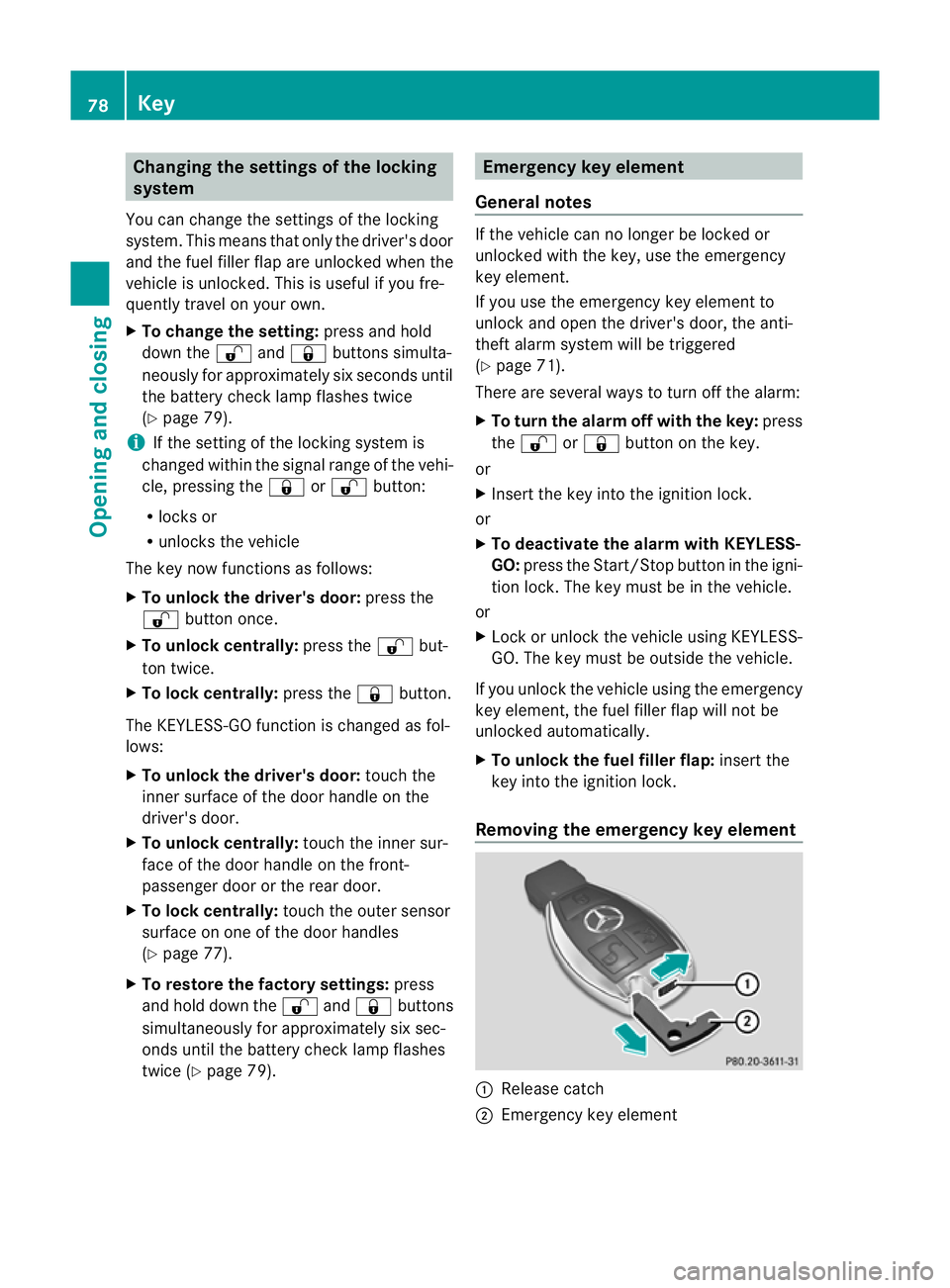
Removing the emergency key element :
Releas ecatch
; Emergency key element 78
KeyOpening and closing