ABS MERCEDES-BENZ GLA 2020 User Guide
[x] Cancel search | Manufacturer: MERCEDES-BENZ, Model Year: 2020, Model line: GLA, Model: MERCEDES-BENZ GLA 2020Pages: 346, PDF Size: 17.58 MB
Page 60 of 346
you
inst all thech ild res train tsyst emonarear
seat .
If it is abso lutely necessar yto inst all ach ild
res train tsyst emonthefron t-pass enger seat ,
always observeth einst ruc tion sand safety
no teson the"Oc cup ant Class ification Sys tem
(OCS )"(Y page 47).
You canthus avo idtheris ks that could arise
as ares ult of:
R an inco rrec tly cat ego rized per son inthe
fr on t-pass enger seat
R deac tivat ing th efron tpass enger fron tair
bag uninten tion ally
R theuns uitable position ing of thech ild
res train tsyst em, e.g. tooclo setothedash -
boar d
Rea rwa rd-facin gchil dre stra int sys tem If
cir cum stanc esreq uire youtosec ure ach ild
in arear ward -faci ng child res train tsyst emon
th efron t-pass enger seat ,always makesur e
th at thefron tpass enger fron tair bag isdeac ti-
vat ed. Onlyifth ePA SS EN GER AIR BA GOF F
in dic ato rlamp islit continuousl y(Y page 40),
is thefron tpass enger fron tair bag deac tiva-
te d.
Al ways observeth ech ild res train tsyst em
man ufacturer'sin st allat ionand oper ating
in st ruc tion s.
For war d-fa cing childre stra int sys tem If
it is abso lutely necessar yto inst all a
for ward -faci ng child res train tsyst emonthe
fr on t-pass enger seat ,always moveth efron t-
pass enger seat asfar bac kas pos sible.Full y
ret rac tth eseat cushion length. The entire
base ofthech ild res train tsyst emmus talways
res ton theseat cushion ofthefron t-
pass enger seat .The backrest ofthech ild
res train tsyst emmus tlie asflat aspos sible
again stthebac krest ofthefron t-pass enger
seat .The child res train tsyst emmus tno t
to uch theroo for be subj ectedto aload bythe
head restrain t.Ad jus tth eang leof theseat
bac krest and thehead restrain tpos ition
acc ordingly. Always makesur eth at thesho ul-
der belt strap isco rrec tly rou tedfrom theveh i-
cle belt outlettothesho ulder beltguide on
th ech ild res train tsyst em. Theshoulder belt
st rap mus tbe rou tedfor ward anddown from
th eveh iclebelt outlet.If ne cessar y,adj ust the veh
iclebelt outletand thefron t-pass enger
seat accordingly.
Al ways observeth ech ild res train tsyst em
man ufacturer'sin st allat ionand oper ating
in st ruc tion s. Chil
d-pr oof locks
Imp ortant saf ety notes G
WAR
NING
If ch ildr enare travel ing in theveh icle, they
co uld:
R open doors,th us endan gering ot her peo-
ple orroa duser s
R exitth eveh icleand becaug htby oncom-
in g traff ic
R oper atevehicleequip mentand become
tr apped
The reisaris kof an acc iden tand injur y.
Al ways activat eth ech ild- pro ofloc ksand
ove rride feat ure ifch ildr enare travel ing in
th eveh icle. Whe nleav ing th eveh icle,
always taketh eke ywit hyou and lockth e
veh icle. Nev erleav ech ildr enunat tend ed in
th eveh icle.
Ov err ide feat ure for:
R therear doors(Y page 59)
R therear side windows (Ypage 59) G
WAR
NING
If you leavech ildr enuns uper vised inthe
veh icle, they could set itin mot ionby,for
ex ampl e:
R rel ease thepark ing brak e.
R shi fttheaut oma tic trans mis sion outof
th epark ing pos ition P.
R start theen gin e.
In addit ion,th ey may operatevehicleequip -
men tand become trapped .The reisaris kof
an acc iden tand injur y.
Whe nleav ing th eveh icle, always taketh e
Sm artKey withyou and lockth eveh icle.
Nev erleav ech ildr enuns uper vised inthe
veh icle. 58
Child
reninthe vehicleSa fet y
Page 62 of 346
Dri
vin gsa fet ysys tems Over
view ofdrivin gsa fet ysys tems
In this sec tion ,you willfindinfo rm ation about
th efo llow ing dri vin gsaf etysys tems :
R AB S(An ti-loc kBrak ing Syst em)
(Y page 60)
R BA S(Brak eAss istSyst em) (Ypage 61)
R Ac tive Brak eAs sis t(Y page 61)
R ES P®
(E lec tron icStabili tyProgr am)
(Y page 63)
R EB D(Elect ronicBrak efo rc eDist ribution )
(Y page 67)
R AD APTIV EBRA KE(Ypage 67)
R ST EERCON TROL (Ypage 67) Im
por tant safet ynot es
If you failtoadapt yourdrivin gst yle orifyou
are inat te nt ive ,th edri vin gsaf etysys tems can
ne ither reduce theris kof an acc iden tno r
ov err ide thelaws ofphys ics. Dr iving safety
sys tems are mer elyaids designed toass ist
dri vin g.
You arerespon sibleformain taining th edis -
ta nc eto theveh icle in fron t,forveh icle spe ed,
fo rbra king ingoo dtime, andforst ayin gin
lan e.Always adapt yourdrivin gst yle tosuit
th epre vail ing ro ad and weat hercond ition sand
main tain asaf edis tanc efrom theveh icle in
fr on t.Dr ive carefully.
The drivin gsaf etysys tems described only
wor kas effect ive lyas pos siblewhen there is
adeq uateco ntact between thetires and the
ro ad sur face.Plea sepay special atte nt ion to
th eno teson tires ,rec ommen dedminimum
ti re tread dept hs,etc. (Y page 306).
In win try dri vin gco nd ition s,always usewinter
ti res (M+ Stires )and ifne cessa ry,snow
ch ain s.On lyin this way willthedri vin gsaf ety
sys tems described inthis sec tion wor kas
ef fect ive lyas pos sible. ABS
(Anti-lock Brak ing System)
Gen eral inf orma tion AB
Sreg ulat esbra kepre ssu reinsuc haway
th at thewhee lsdo notloc kwhen youbrake. Thi
sallow syou tocontinue steer ing th eveh i-
cl e when braking .
The 0025 ABSwarn ing lamp intheinst rum ent
cl ust erligh tsup when theign ition isswit ched
on .It goe sout when theen gin eis run ning .
AB Swor ksfrom aspe edofabout 5mph
(8 km /h), regard lessof road- sur faceco nd i-
ti on s.AB Swor kson slip perysur faces, even
when youonlybra kegen tly.
Im por tant safet ynot es i
Obs
erveth e"Im portant saf etyno tes" sec -
ti on (Ypage 60). G
WAR
NING
If AB Sis malf unction ing, thewhee lsco uld
loc kwhen braking .The steer abili tyand
bra king charac teris tics would besev erely
aff ected. The reisan incr ease ddan ger of
sk iddi ngand acciden ts.
Dr ive oncar efully. HaveAB Sch ecke dimm e-
diat elyataqualif iedspecialis twor kshop .
Whe nAB Sis malf unction ing, other systems ,
in cludin gdri vin gsaf etysyst ems ,will also
bec omeinope rative .Obs erveth einfo rm ation
on theAB Swarn ing lamp (Ypage 234)and
dis play messageswhic hmay besho wninthe
in st rum entcl ust er(Y page 205).
Br ak ing X
IfABS interven es:continue todepr essthe
bra kepeda lvig orousl yunt ilth ebra king sit-
uat ion isov er.
X To ma keafu llbr ak eap plica tion: depr ess
th ebra kepeda lwit hfull forc e.
If AB Sinte rven es when braking ,you willfeel a
puls ing in thebra kepeda l.
The pulsating bra kepeda lcan beanindic ation
of haz ardous road cond ition s,and function sas
a rem inder totake extra car ewhil edri vin g.
Off -road ABS An
ABSsys tem spe cific ally suitedtooff-ro ad
te rrain isact ivat edaut omatically once theof f-
ro ad pro gram isact ivat ed(Ypage 170).
At spe eds belo w20 mph (30km/h), thefron t
whee lsloc kcyc lically during bra king .The dig-
gin g-in effect ach ieved inthepro cess red uce s 60
Dri
ving safet ysys temsSaf ety
Page 63 of 346
the
stop ping dista nce onoff-roa dterr ain. Thi s
li mi ts ste ering cap ability . BAS
(Brak eAs sist Sys tem)
Ge neral info rmatio n BAS
opera tes ineme rgency braking situa tions.
If yo ude pre ssthe brakepedalqu ickl y,BAS
au toma tically bo osts thebraking force, thus
sho rteni ngthe stop ping dista nce.
Impo rtant safety notes i
Ob
serve the "Impo rtantsafety note s"sec-
tio n(Y page 60) . G
WA
RNING
If BAS isma lfunctio ning,the braking dis-
tance inan eme rgency braking situa tionis
incr eased. The reisaris kof an acc ident.
In an eme rgency braking situa tion,de pre ss
the brakepedalwi th fullfor ce. ABS prevents
the wheelsfro mlocking .
Braki ng X
Kee pthe brakepedalfir ml yde pre sse dunti l
the eme rgency braking situa tionis ove r.
ABS prevents thewheelsfro mlocking .
The brakes willfu nctio nas usua lonce you
rel ease the brakepedal.BAS isde acti vated . Ac
tiv eBrake Assist
Ge neral info rmatio n i
Ob
serve the "Impo rtantsafety note s"sec-
tio n(Y page 60).
Activ eBra keAssi stcons ists of adi sta nce
wa rning functio nwi th an autono mousbra king
fu nctio nand asitua tion-de pende ntbra ke
bo osti ngeffect.
Activ eBra keAssi stcan helpyouto minim ize
the riskof acol lisi on with the vehicletra vel ing
in fro ntor red uce theeffects ofsuch acol li-
si on.
If Activ eBra keAssi stdetects thatthe reisa
ris kof col lisi on, youwi llbe warned visually
and acoustica lly. Ifyo udo not reactto the vis- ua
lcol lisi on warning orthe warning tone ,
au tono mousbra king canbeinitia ted incri tica l
si tua tions. Ifyo uap plythe brakeyourse lfin a
cri tica lsi tua tion,Activ eBra keAssi stsupp orts
yo uwi th asitua tion-de pende ntbra keboosti ng
eff ect.
Impo rtant safety notes Dete
ctionof hazar dous situa tions can bepar-
ticu larly impaire dif:
R Th ere isdirt on the senso rsor any thing else
cove ringthe senso rs
R Th ere issno wor heavyra in
R Th ere isinte rferenc eby othe rra da rsou rces
R Th ere arestro ngrada rref lectio ns,forexa m-
pl e in pa rki ng garage s
R Anar row vehicleis tra vel ing infro nt, e.g.a
moto rbike
R Aveh icleis tra vel ing infro nton adi ffe rent
li ne
R Yo uar edri vin ganew vehicleor servi cing on
the Activ eBra keAssi stsyste mhasjus t
be en car riedou t
Ob serve the impo rta ntsafety note sin the
"Br eaking -innote s"sectio n(Y page 124) .
Fol lowi ng dama getothe frontend ofthe vehi-
cle ,ha ve the confi guratio nand opera tionof
the rada rse nso rche cked ataqu alifi ed spe-
cia list wo rksh op.Th isalso appliesto col lisi ons
at low sp ee ds where novisible da ma getothe
fro ntofthe vehicleis ap parent.
Ac tiv atin g/dea ctivati ng Activ
eBra keAssi stisacti veafter eve ryigni-
tio ncy cle .
Yo ucan activate or deacti vate Activ eBra ke
Assi st(Y page 197 )in the on-b oard com-
pu ter. Whendeacti vated ,the dista nce warning
fu nctio nand theautono mousbra king functio n
ar ealso deacti vated .
If Activ eBra keAssi stisde acti vated ,the 00D4
sy mbo lap pe arsin the assista nce graphicdis-
pl ay .
If yo uha ve acti vated DSR, ActiveBra keAssi st
is de acti vated .For furthe rinf orm ation onDSR,
se e(Y page 169 ). Dr
ivi ng safet ysy stem s
61Safet y Z
Page 65 of 346
Situat
ion-dependent brakingassis-
tance General
informat ion
i Observe
the"Important safetynotes" sec-
tion (Ypage 60).
With thehelp ofthe radar sensor system,
Act ive Brake Assist candetect obstacles that
are inthe path ofyour vehicle foranexten ded
period oftime.
If Act ive Brake Assist detectsa risk ofcollision
with thevehicle infront ,it calculates thebrake
pressure necessary toavoid acollision. Ifyou
apply thebrakes forcefully, <0056004C0057005800440057004C005200510010004700480053004800510047
0010[
ent braking assistance adaptstothe situation
and automatically increasesthebrake pres-
sure toadegree appropriate tothe traffic sit-
uation.
Situation- dependent brakingassistance pro-
vides braking assistance inhazardous situa-
tions atspeeds above4mph (7km/h). Ituses
radar sensor technology toassess thetraffic
situation.
Situation- dependent brakingassistance is
capable ofreacting tomoving objectsthat
have already beendetect edassuch atleast
once overtheperiod ofobservation, upto
vehicle speeds ofaround 155mph
(250 km/h).
Situation- dependent brakingassistance can
also detect stationary objects,up tovehicle
speeds ofaround 44mph (70km/h).
X Keep thebrake pedaldepressed untilthe
emergency brakingsituation isover.
ABS prevent sthe wheels fromlocking.
The brakes willwork normally againif:
R you release thebrake pedal
R there isno longer anydanger ofacollision
R no obstacle isdetect edinfront ofyour vehi-
cle
Situation- dependent brakingassistance isthen
deactivated.
Import antsafety notes
i Observe
the"Important safetynotes" sec-
tion fordriving safetysystems (Ypage 60). G
WARNING
Act ive Brake Assist doesnotreact:
R to persons, bicycles, motorcyclesorani-
mals
R to approaching vehicles
R to cross traffic
R on bends
As aresult, Active Brake Assist cannot inter-
vene inall critical situations. Thereisarisk
of an accident.
Always paycareful attentiontothe traffic
situation andbeprepared tobrake. G
WARNING
Adaptive BrakeAssist cannot alwaysclearly
identify objectsand complex trafficsitua-
tions.
In such cases, Adaptive BrakeAssist might:
R interv eneunnecessarily
R not interv ene
There isarisk ofan accident.
Always paycareful attentiontothe traffic
situation andbeready tobrake. Terminate
the interv ention inanon- critical drivingsit-
uation.
Due tothe nature ofthe system, complex but
non- critical drivingcondition smay alsocause
Act ive Brake Assist tointerv ene.
Even ifAct ive Brake Assist isnot availa bledue
to amalfunction inthe radar sensor system,
the brake system isstill availa blewith full
brake boosting effectandBAS. ESP
®
(Ele ctronic Stability Program)
General notes i
Observe
the"Important safetynotes" sec-
tion (Ypage 60).
ESP ®
monitor sdriving stability andtract ion,
i.e. power transm issionbetween thetires and
the road surface.
If ESP ®
detect sthat thevehicle isdeviating
from thedirection desiredbythe driver, oneor
more wheels arebraked tostabilize thevehi- Driving
safetysystems
63Safety Z
Page 156 of 346
G
WARNING
Flamma blemateria lsuch aslea ves, grass or
twigs mayignite ifthey come intocontact
with hotparts ofthe exhau stsystem. There
is arisk offire.
When drivingon anunpa vedroad oroff-
road ,check thevehicl eunders ideregu larly.
In particu lar,remove trappedpla ntparts or
other flamma blemateria l.Contact aqua li-
fied speci alist worksho pimmed iatelyif dam-
age isdetected.
! There
isarisk ofdama getothe vehicl eif:
R the vehicl ebecome sstuck, e.g.onahigh
curb oran unpa vedroad
R you drive toofast over anobstacl e,e.g. a
curb, aspee dbump orapothol ein the
road
R ahea vyobject strikes theunderb odyor
parts ofthe chassi s
In situa tions likethis, thebody ,the under-
body ,chassi sparts, wheelsor tires couldbe
dama gedwitho utthe dama gebeing visib le.
Comp onents damagedinthis way canunex-
pectedl yfail or,inthe case ofan accide nt,
no longer withsta ndthe loadsthey are
desi gned to.
If the underb odypanel ingisdama ged,com-
bus tible materia lssuch aslea ves, grass or
twigs cangather betweenthe underb ody
and theunderb odypanel ing.Ifthese materi-
als come incontact withhotparts ofthe
exhau stsystem, theycancatch fire.
In such situations, havethevehicl echecked
and repa iredimmed iatelyat aqua lified spe-
cial istworksho p.Ifon continuing yourjour-
ney you notice thatdrivingsafety is
impa ired,pul lover andstop thevehicl e
immed iately,pay ing attention toroad and
traffic conditions. Insuch cases, consult a
qua lified speci alist worksho p.
The vehicl eis only designed foreasi lynegotia -
ble off-road terrainandpoor roadsurfaces.
When drivingoff-road ,sub stances suchas
sand, mudandwate ror wate rmixed withoil
may getinto thebrakes .This couldresu ltin a
redu cedbraki ngeffect orintotal brake failure
and alsoin increas edwea rand tear. Thebrak-
ing chara cteristics changedepending onthe
materia lentering thebrakes .Cle anthe brakes
after drivingoff-road .If you detect aredu ced braki
ngeffect orgrindi ngnoises ,have the
brake system checked inaqua lified speci alist
worksho pas soon aspossi ble.Adapt your
drivi ngstyle tothe differ entbraki ngchara cter-
istics.
Driving off-road increasesthe likel ihoo dof
dama getothe vehicl e,whi ch, inturn, canlead
to fail ure ofthe mechani calasse mbly orsys-
tems. Adapt yourdrivi ngstyle tosui tthe ter-
rain conditions. Drivecarefu lly.Have damage
to the vehicl erectified immediatelyat aqua li-
fied speci alist worksho p.
Do not shift intotransmissi onposi tion 005C
when drivingoff-road .You couldlose control
of the vehicl eif you attempt tobrake thevehi-
cle using the service brake.Ifthe grad ientis
too steep foryou rvehicl e,drive backdownin
reverse gear.
Gene ralnote s H
Envi
ronmental note
Protection ofthe environment isof prima ry
importa nce.Treatnature withrespe ct.
Observe allprohi biting signs.
Rea dthis section carefullybefore drivingyou r
vehicl eoff-road .
Off-road drivingisonly possi blewith the
ON&OFFROAD package.
The followi ngdrivi ngsystems arespeci ally
ada pted fordrivi ngover easilynegotia bleoff-
road terrain:
R Off-road program(Y pag e170)
R Off-road ABS(Ypag e60)
R Off-road 4ETS(Ypag e64)
R Off-road ESP®
(Y pag e66)
R DSR (Downhi llSpeed Regulation)
(Y pag e169)
Observe thefollowi ngnotes:
R Stop thevehicl ebefore starting todrive
alo ng anoff-road route.Ifnecessa ry,acti-
vate theoff-road program(Y pag e132) .
R To avoi ddama gingthevehicl e,make sure
there isalw ayssuffi cient groundclea rance.
R Che ckthat items oflug gage andloadsare
stowed safelyand arewellsecure d
(Y pag e256).
R Alwa yskeep theengine running andingea r
when drivingon adow nhill gradient. Acti-
vate DSR (Ypag e169) . 154
Drivi
ngtipsDrivi ngand parking
Page 159 of 346
R
Activa teDSR. Ifthi sis not sufficie nt, bra ke
gen tly.Whe ndo ing so,makesure tha tthe
veh icleis fac ing inthe directi onofthe line
of fall.
R Ch eck thatthe brakes arewo rking norma lly
afte ra long downh ill stre tch.
Off-r oadABS isacti vated when the off-r oad
pro gramissel ecte d.
At spe edsbe low 18 mph (30km/h ),the front
wh eelslock cyc lical lydu ring braking .The dig-
gi ng-i neffe ctach ieved inthe proces sred uce s
the stop ping dista nce onoff-r oadterra in.The
stee rability of the vehicleis consi derably
red uce difthe wheelslock. Dri
ving sys tems Crui
secontro l
Ge neral notes Cr
uise contro lma inta insaconsta ntroa d
spe edfor you. Itbra kes automa tically in ord er
to avoid exce eding the setspeed.On long and
stee pdo wnh ill gra dients, especially ifthe vehi-
cle islade n,youmu stsel ect alow gea rin
goo dtime .Yo unee dto shi ftma nua lly us ing
the stee ring wheelpa dd leshi fters before hand.
By doing so,youwi llma keuseof the braking
effe ctof the engine.Thi srel ieves theload on
the brakesystem andprevents thebrakes
from overheating and wearing too quickl y.
Whe nthe engineisrunning ,yo ucan usethe
cru ise contro lle ver tolimit the speedtoany
spe edbetwe en20 mph (30km/h )and the
tech nically pe rmi tted maximu mspe edofthe
veh icle.
Use cruise contro lif roa dand trafficcond i-
tio ns ma keitap pro priate toma inta inastea dy
spe edfor apro longe dpe rio d.
The speedindicated inthe speedome termay
di ffer slig htl yfrom thespeedstor ed.
Impo rtant safetynotes If
yo ufai lto adaptyo ur driving style,cru ise
contro lcan neither reduce theriskof an acci -
de nt nor override the laws ofphy sics. Cruise
contro lcanno ttake intoacco unttheroad,
traf ficand weath ercond itions. Cruise contro l
is onl yan aid. Yo uar eres ponsi ble for the dis-
tance tothe vehiclein front, forveh iclespe ed, for
braking ingoo dtime andforstaying inyour
la ne.
Do not usecru ise contro l:
R in roa dand trafficcond itions which donot
al lo w yo uto ma inta inaconsta ntspe ed,e.g .
in hea vytraf ficoron windi ng roa ds
R on slip pe ry roa dsu rfa ces .Bra king oracce l-
era ting couldcau sethe drive wheelsto lose
trac tionand thevehiclecou ldthen skid
R in po or vis ibility ,e.g .du eto fog ,hea vyrain
or snow
If ther eis acha nge ofdri ver s,ad vis ethe new
dri ver ofthe speedstor ed.
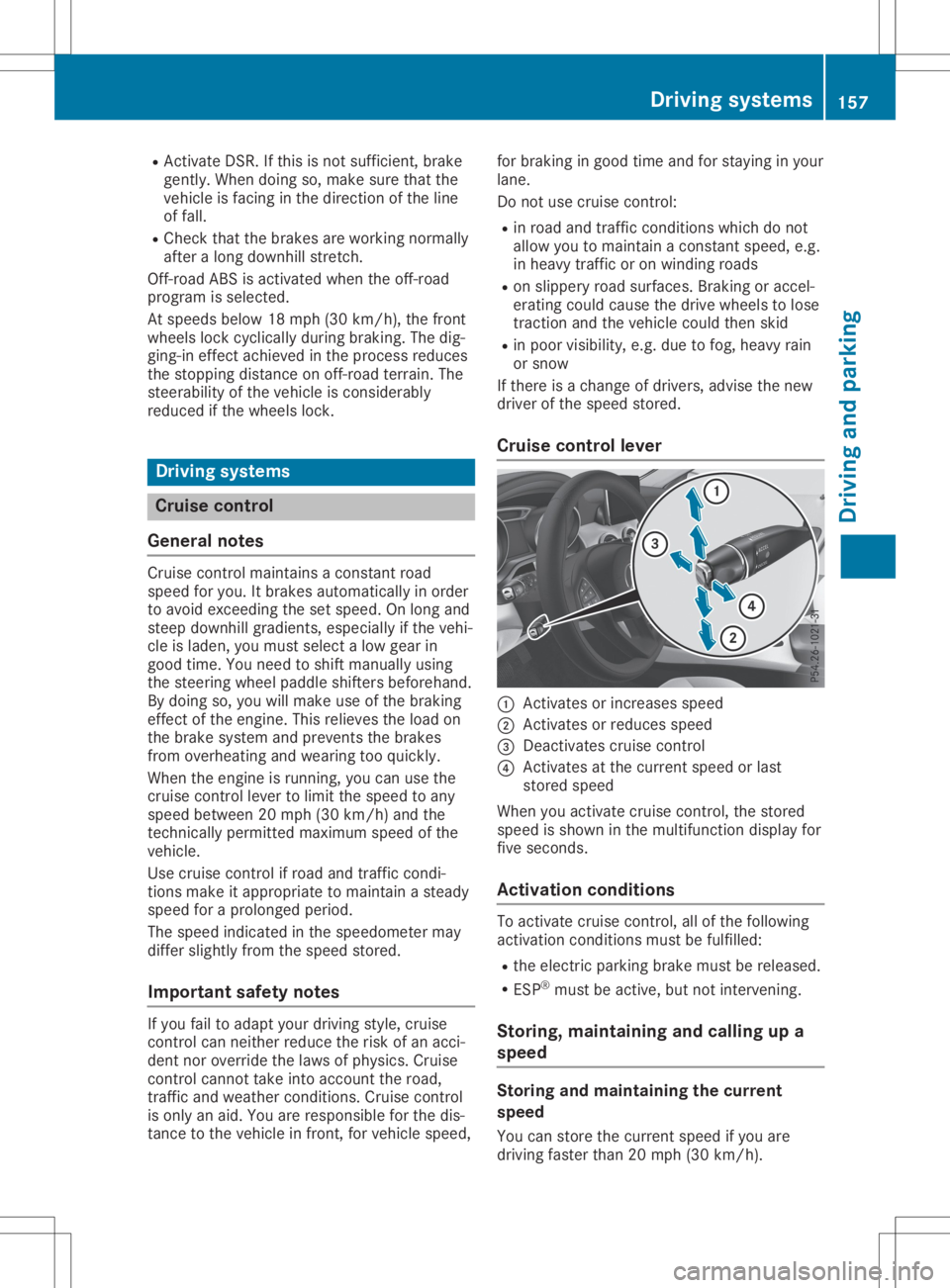
Crui secontro lle ve r 0043
Activa tesorincr eases speed
0044 Activa tesorred uce sspe ed
0087 Dea ctiva tescruise contro l
0085 Activa tesatthe current speedorlast
stor edspe ed
Whe nyo uacti vate cru ise contro l,the stor ed
spe edissho wninthe multifu nctio ndispl ayfor
fiv esec ond s.
Ac tiv atio nco ndi tions To
acti vate cru ise contro l,allof the followi ng
acti vatio ncond itions mustbe fulfilled :
R the electri cpa rking brakemu stbe released .
R ESP ®
mu stbe acti ve,butnot intervening .
Sto ring,main tainingand calling up a
spe ed Sto
ringand main tainingthe curren t
spe ed
Yo ucan storethe current speedifyo uar e
dri ving faster than20 mph (30km/h ). Dri
ving sys tems
157Dr ivi ng andparki ng Z
Page 174 of 346
object
swhen theyareinthe immediate
vicinit yof the vehicle. Youcould damage the
vehicle orthe object s.
The sensors maynotdetect snowandother
object sthat absorb ultrasonic waves.
Ultrasonic sourcessuchasan automatic car
wash, thecompressed- airbrakes ofatruck
or apneumatic drillcould cause Parking
Assist PARKTRONIC tomalfunct ion.
Parking AssistPARKTRONIC maynotfunc-
tion correc tlyon uneven terrain.
Parking AssistPARKTRONIC isactivated auto-
matically whenyou:
R switch onthe ignition
R shift thetransm issiontoposition 005B,005Eor
005C
Parking AssistPARKTRONIC isdeactivated at
speeds above11mph (18km/ h).It is rea cti-
vate dat lowe rspe eds.
Rang eof the senso rs Gen
eral notes
Pa rking AssistPAR KTRONIC doesnot take into
acco untobstacl eslocate d:
R bel ow the dete ction range,such asper sons ,
ani mal sor obje cts
R ab ove thedete ction range,e.g. overhanging
lo ad s,tai lsecti onsorload ing ram psof
trucks 0043
Senso rsinthe front bumpe r,left-ha ndside
(e xamp le)
The sens orsmus tbe free from dirt, ice or
slu sh. The ycan othe rwisenot functi oncor-
rectl y.Clea nthe sens orsregularl y,taki ngcare
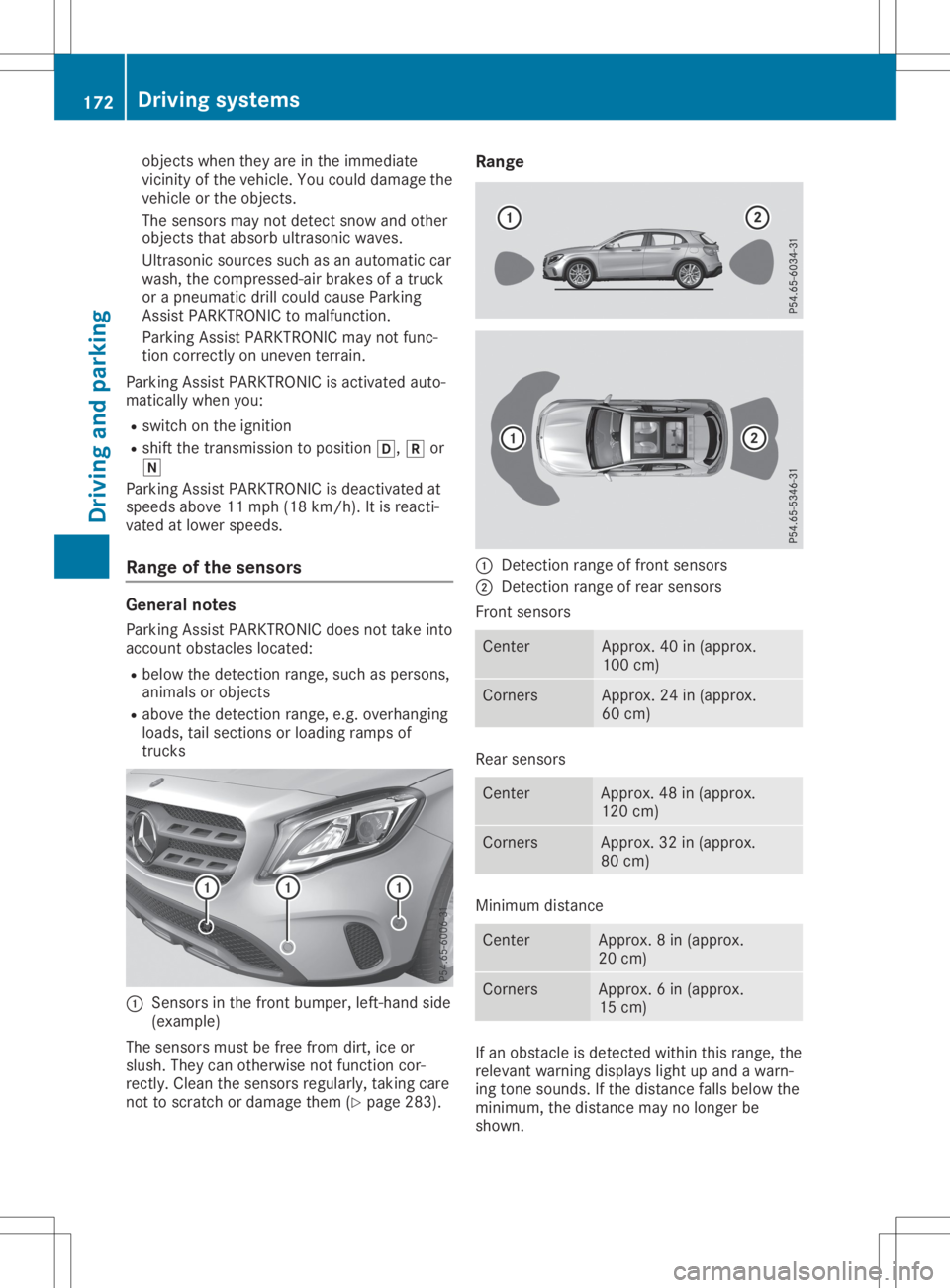
not toscra tchordamag ethem (Ypage 283 ). Rang
e 0043
Detecti onrang eof front sensors
0044 Detecti onrang eof rea rsens ors
Front sensors Ce
nter Appr
ox.40in(app rox.
100 cm) Co
rners Appr
ox.24in(app rox.
60 cm) Re
ar sens ors Ce
nter Appr
ox.48in(app rox.
120 cm) Co
rners Appr
ox.32in(app rox.
80 cm) Mini
mum distance Ce
nter Appr
ox.8in (app rox.
20 cm) Co
rners Appr
ox.6in (app rox.
15 cm) If
an obs tacl eis dete cted within thisrang e,the
rel eva ntwa rning displ ayslight upand awa rn-
ing tone sounds. Ifthe distance fallsbel ow the
mini mum ,the distance maynolonger be
sho wn. 17
2 Dri
ving sys temsDriving and parkin g
Page 189 of 346
In
such cases, LaneKeepi ngAssist can:
R give anunnecessary warning
R not give awarning
There isarisk ofan accident.
Alway spay particul arattention tothe traffic
situa tionandkeep within thelane, espe-
ciall yif Lane Keepi ngAssist alerts you . G
WARNING
The Lane Keepi ngAssist warning doesnot
return thevehicle tothe origina llane. There
is arisk ofan accident.
You shoul dalw ays steer, brakeoraccelera te
you rself, inparticul arifwarned byLane
Keepi ngAssist.
If you failtoada ptyou rdriving style,Lane
Keepi ngAssist canneither reducetherisk of
an accident noroverride thelawsof phys ics.
Lane Keepi ngAssist cannot takeintoaccount
the road, traffic andweather conditions. Lane
Keepi ngAssist ismerely anaid.You are
responsib lefor the distance tothe vehicle in
front, forvehicle speed,for braking ingood
time andforstayi nginyou rlane.
The Lane Keepi ngAssist doesnotkeep the
vehicle inthe lane.
The system maybeimpa iredormay notfunc-
tion if:
R there ispoor visibility,e.g. due toinsuffi-
cient illuminatio nof the road, ordue to
snow, rain,fogorspray
R there isglare ,e.g. from oncoming traffic,
the sun orreflection fromother vehicle s
(e.g. ifthe road surface iswet)
R the windshi eldisdirty, fogged up,dama ged
or covered, forinstance byasticker, inthe
vicinity ofthe camera
R there arenoorseveral unclearlane mark-
ings forone lane, e.g.roadw orks
R the lane markings areworn away,dark or
covered up,e.g. bydirt orsnow
R the distance tothe vehicle infront istoo
short andthus thelane markings cannotbe
detected
R the lane markings changequickly, e.g.lanes
branch off,cross oneanother ormerge R
the road isnarrow andwindi ng
R there arehighl yvaria bleshade conditions
on the roadw ay
Swi tching onLane Keeping Assist
X Switch onActive LaneKeepi ngAssist using
the on-board computer; todo so, select
Standard Standard
orAdaptive Adaptive
(Ypage 186).
If you drive atspeed sabove 40mph
(60 km/h) andlane markings aredetected,
the lines inthe assis tance graphi care
shown ingreen (Ypage 197). LaneKeepi ng
Assist isready foruse.
If Standard Standard
isselected, nowarning vibration
occurs if:
R you have switched onthe turn signal .In this
event, thewarnings aresupp ressed fora
certain periodoftime.
R adriving safetysystem intervenes, e.g.ABS,
BAS orESP ®
.
When Adaptive Adaptive
isselected, nowarning vibra-
tion occurs if:
R you have switched onthe turn signal .In this
event, thewarnings aresupp ressed fora
certain periodoftime.
R adriving safetysystem intervenes, e.g.ABS,
BAS orESP ®
.
R you accelera tehard, e.g.kickdown.
R you brake hard.
R you steer actively ,e.g. swerve toavoid an
obstacle orchange lanesquickly.
R you cutthe corner onasharp bend.
In order thatyouarewarned onlywhen neces-
sary andingood timeifyou cross thelane
marking, thesystem detects certaincondi-
tions andwarns youaccordingly .
The warning vibrationoccurs earlierif:
R you appro achtheouter lanemarking ona
bend
R the road hasvery widelanes, e.g.afreewa y
R the system detects solidlanemarkings
The warning vibrationoccurs laterif:
R the road hasnarrow lanes.
R you cutthe corner onabend Drivi
ngsystems
187Drivingand parking Z
Page 207 of 346
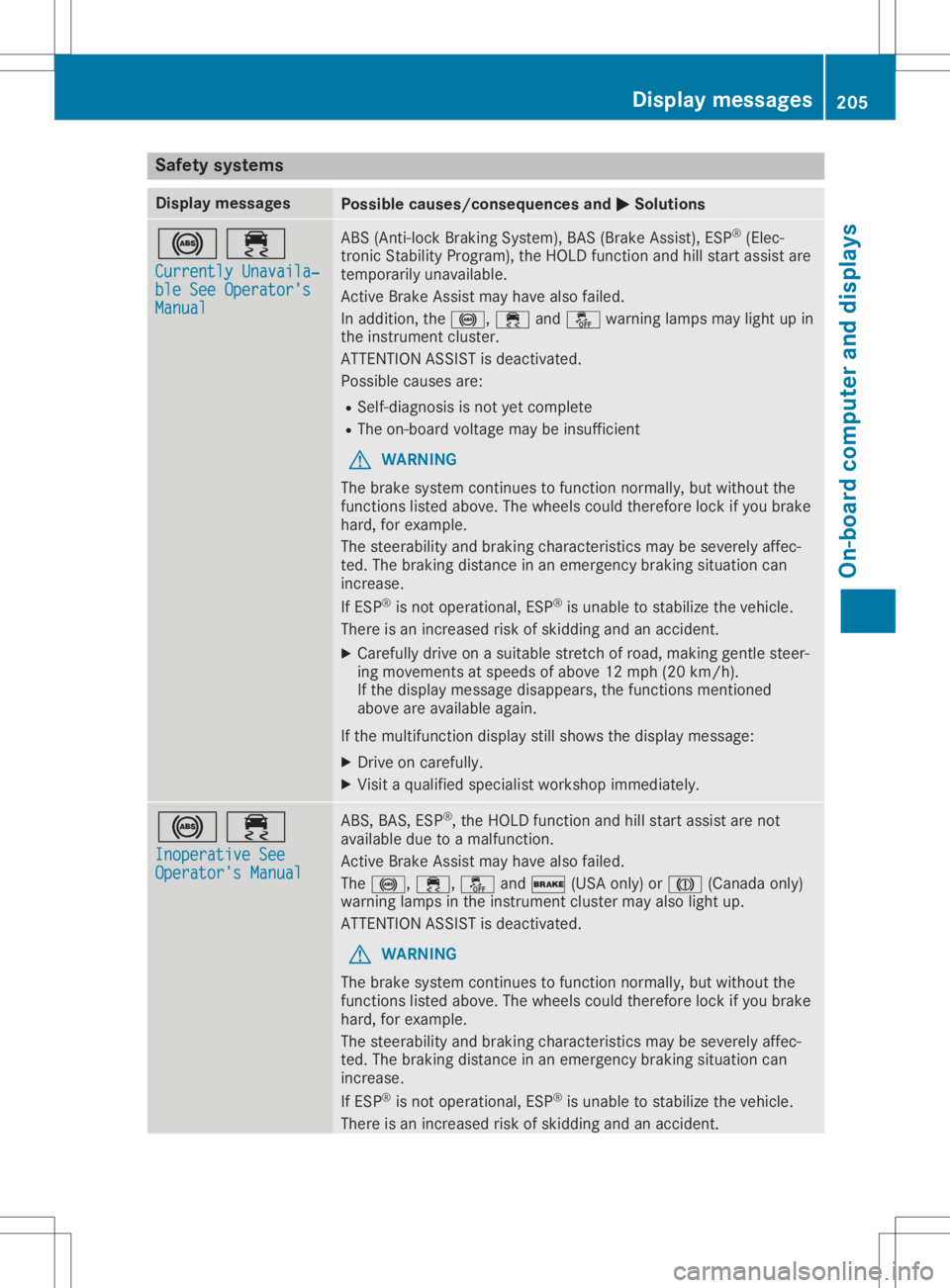
Safety
systems Display
messages Possible
causes/co nsequences and0050 0050
Solutions 002500E5
Currently Unavaila‐ Currently
Unavaila‐
ble SeeOperator's ble
SeeOperator's
Manual Manual ABS
(Anti- lockBraking System), BAS(Brake Assist), ESP®
(Elec-
tronic Stability Program), theHOLD function andhillstart assist are
temporarily unavailable.
Act ive Brake Assist mayhave alsofailed .
In addition, the0025, 00E5and00BB warning lampsmaylight upin
the instrument cluster.
ATTENTION ASSISTisdeactivated.
Possible causesare:
R Self-diagnosis isnot yetcomplete
R The on-board voltagemaybeinsufficient
G WARNING
The brake system continues tofunction normally, butwithout the
functions listedabove. Thewheels couldtherefore lockifyou brake
hard, forexample.
The steerabili tyand braking characteristics maybeseverely affec-
ted. Thebraking distance inan emergency brakingsituation can
increase.
If ESP ®
is not operational, ESP®
is unable tostabilize thevehicle.
There isan increased riskofskidding andanaccident.
X Carefu llydrive onasuitabl estretc hof road, making gentlesteer-
ing movements atspeeds ofabove 12mph (20km/h).
If the displa ymessage disappears,thefunctions mentioned
above areavail able again.
If the multifunction displaystill shows thedispla ymessage:
X Drive oncarefully .
X Visit aqual ified speciali stworkshop immediately . 002500E5
Inoperative See Inoperative
See
Operator's Manual Operator's
Manual ABS,
BAS,ESP®
,the HOLD function andhillstart assist arenot
avail able duetoamalfunction.
Act ive Brake Assist mayhave alsofailed .
The 0025, 00E5,00BBand0027 (USAonly)or004D (Canad aonly)
warning lampsinthe instrument clustermayalsolight up.
ATTENTION ASSISTisdeactivated.
G WARNING
The brake system continues tofunction normally, butwithout the
functions listedabove. Thewheels couldtherefore lockifyou brake
hard, forexample.
The steerabili tyand braking characteristics maybeseverely affec-
ted. Thebraking distance inan emergency brakingsituation can
increase.
If ESP ®
is not operational, ESP®
is unable tostabilize thevehicle.
There isan increased riskofskidding andanaccident. Dis
play messages
205On-boardcomp uter anddisplays Z
Page 236 of 346
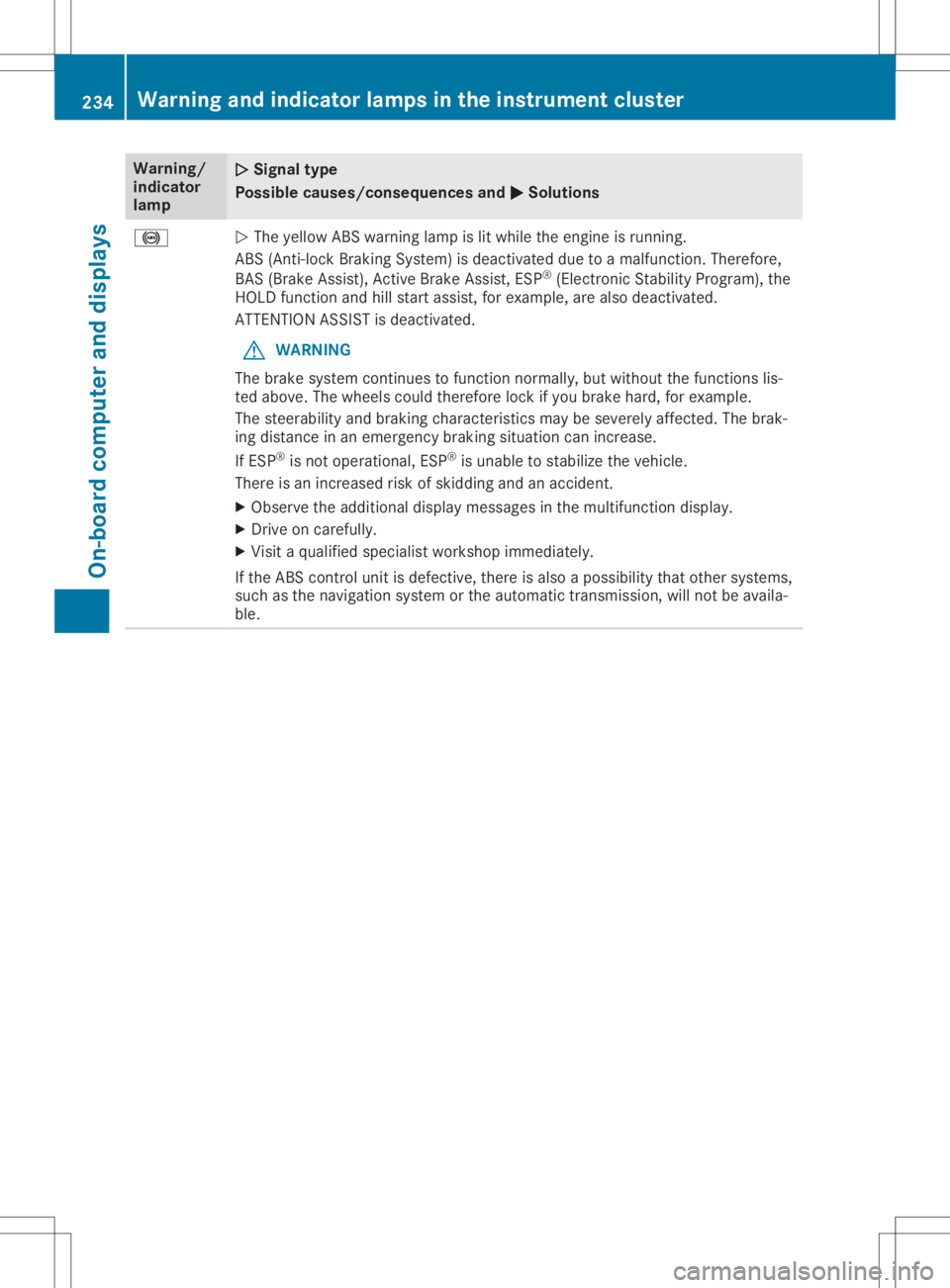
Warning/
indic ator
lamp 00510051
Sign altype
Poss iblecause s/cons equen cesand 0050 0050
Sol utions 0025
0051
The yellow ABS warning lamp islit whi lethe engine isrunning.
ABS (Anti-lock BrakingSystem) isdea ctivated duetoamalfu nction. Therefore,
BAS (Brake Assist), ActiveBrakeAssist, ESP®
(Electronic StabilityProgra m),the
HOLD function andhillstart assist,for exampl e,are alsodea ctivated.
ATTENTION ASSISTisdea ctivated.
G WARNING
The brake system continues tofunction normally,but witho utthe functions lis-
ted above.The whee lscoul dtherefore lockifyou brake hard,for exampl e.
The steerab ility and braki ngchara cteristics maybesevere lyaffected. Thebrak-
ing dista nceinan emerge ncybraki ngsitua tioncanincreas e.
If ESP ®
is not opera tional,ESP ®
is unab leto stabi lizethevehicl e.
There isan increas edrisk ofskiddi ngand anaccide nt.
X Observe theadditiona ldisp laymessa gesinthe multi function display.
X Drive oncarefu lly.
X Visi ta qua lified speci alist worksho pimmed iately.
If the ABS control unitisdefective ,there isals oapossi bility that other systems ,
such asthe naviga tionsystem orthe automatic transmissi on,willnot beava ila-
ble . 234
Warning
andindic atorlamps inthe instrum entclusterOn-bo ardcomput erand displays