ESP MERCEDES-BENZ GLA 2020 Owner's Manual
[x] Cancel search | Manufacturer: MERCEDES-BENZ, Model Year: 2020, Model line: GLA, Model: MERCEDES-BENZ GLA 2020Pages: 346, PDF Size: 17.58 MB
Page 52 of 346

Dep
loym ent ofthe driver 'sairba gdo es not
mea ntha tthe front-pa ssenge rfro ntairba g
de ploy sas well. The Occu pant Clas sific ati on
Sys tem (OCS) cate gorize sthe occu pant on the
fro nt-pa ssenge rsea t.Dep endingontha t
res ult, the front-pa ssenge rfro ntairba gis
ei the rena bled ordeacti vated .
Se lf-ch eckof the Occupant Class ifica -
tio nSys tem (OCS ) G
DA
NGE R
If the PASSEN GERAIRBAG OFFand
PASSEN GERAIRBAG ONindicator lamps do
not both light updurin gthe self-tes t,the
sy stem isma lfunctio ning.The front-
pa sse nge rfro ntairba gmig htbe trig gered
uni ntenti onally or mig htnot betrig gered at
al lin the eventofan acc ident with high
de cel era tion.Thi spo ses anincr eased riskof
inju ryor eve nfa tal inju ry.
In thi scas ethe front-pa ssenge rsea tma y
not beused .Do not installa chi ldres traint
sy stem onthe front-pa ssenge rsea t.Hav e
the Occu pant Clas sific ati on Sys tem (OCS)
che cked andrepaired imm ediatel yat a
qu alifi ed speci alistwo rksh op. G
WA
RNING
If the PASSEN GERAIRBAG OFFindicator
la mp rem ains lit af ter the self-tes t,the front-
pa sse nge rfro ntairba gis de acti vated .It wi ll
not bedeploy ed inthe eventofan acc ident.
In thi scas e,the front-pa ssenge rfro ntair
ba gcanno tpe rfo rm itsinte ndedpro tecti ve
fu nctio n,e.g .wh en ape rso nis sea ted inthe
fro nt-pa ssenge rsea t.
Tha tpe rso ncou ld,for exa mpl e,come into
conta ctwith the vehicle's inte rior,esp ecially
if the perso nis sitting tooclosetothe dash-
bo ard. Thi spo ses anincr eased riskof inju ry
or eve nfa tal inju ry.
Wh enthe front-pa ssenge rsea tis occu pied ,
al wa ysens uretha t:
R the classificati on ofthe perso nin the
fro nt-pa ssenge rsea tis corr ectand the
fro nt-pa ssenge rfro ntairba gis ena bled or de
acti vated inacc ordance with the per-
son inthe front-pa ssenge rsea t
R the perso nis sea ted properly with acor-
rectl yfa sten edsea tbelt
R the front-pa ssenge rsea tha sbe en mov ed
as farba ck aspossi ble
If the PASSEN GERAIRBAG OFFindicator
la mp rem ains lit wh en itsho uld not, the
fro nt-pa ssenge rsea tmu stnot beused .Do
not installa chi ldres traint system onthe
fro nt-pa ssenge rsea t.Hav ethe Occu pant
Cl as sific ati on Sys tem (OCS) checked and
rep aired imm ediatel yat aqu alifi ed speci alist
wo rksh op. G
WA
RNING
Ob jects betwe enthe seatsu rfa ce and the
chi ldres traint system couldaffect OCS
op era tion.Thi scou ldres ultin the front-
pa sse nge rai rba gnot functio ningasinte n-
de ddu rin gan acc ident. Thispo ses an
incr eased riskof inju ryor eve nfa tal inju ry.
Do not place anyobjects betwe enthe seat
su rfa ce and thechildres traint system .The
enti rebase ofthe childres traint system
mu stalwa ysres ton the seatcus hion ofthe
fro nt-pa ssenge rsea t.The backres tof the
for wa rd-f acing childres traint system must,
as faras possi ble, be res ting onthe back-
res tof the front-pa ssenge rsea t.Alw ays
comp lywith the childres traint system man-
uf actu rer'sins tallatio nins tructio ns.
After theself-tes t,the PASSEN GERAIRBAG
OFF orthe PASSEN GERAIRBAG ONindicator
la mp disp lays the status ofthe front-
pa sse nge rfro ntairba g(Y page 48).Ifthe
fro nt-pa ssenge rfro ntairba gis ena bled ,the
PASSEN GERAIRBAG ONindicator lamp lights
up for 60sec ond sand thengo es out.
If the PASSEN GERAIRBAG ONindicator lamp
is off ,onl ythe PASSEN GERAIRBAG OFFindi-
cato rla mp showsthe status ofthe front-
pa sse nge rfro ntairba g.The PASSEN GERAIR
BAG OFFindicator lamp maybe lit conti nu-
ou sly or be off.
For mor einfo rma tionab ou tthe OCS,see
"P rob lems with the Occu pant Clas sific ati on
Sys tem" (Ypage 51). 50
Oc
cupant safetySafe ty
Page 53 of 346
Problems
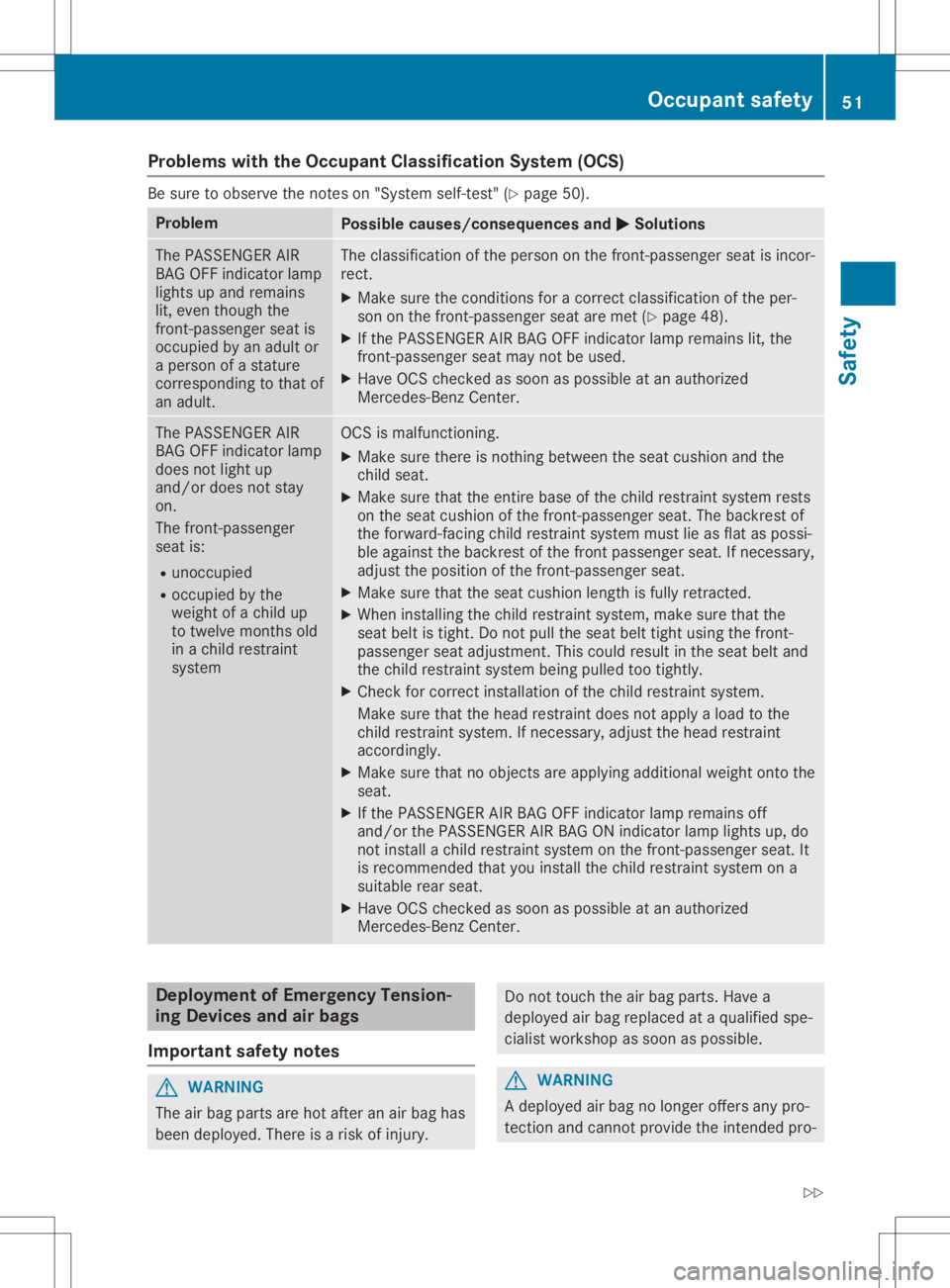
withtheOccupant ClassificationSystem (OCS) Be
sure toobserve thenotes on"System self-test"(Y page 50). Problem
Possible
causes/co nsequences and0050 0050
Solutions The
PASS ENGER AIR
BAG OFFindicator lamp
lights upand remains
lit, even though the
front -passenger seatis
occupied byan adult or
a person ofastature
correspondin gto that of
an adult. The
classification ofthe person onthe front -passenger seatisincor-
rect.
X Make surethecondition sfor acorrect classification ofthe per-
son onthe front -passenger seataremet (Ypage 48).
X Ifthe PASS ENGER AIRBAG OFFindicator lampremains lit,the
front -passenger seatmaynotbeused.
X Have OCScheck edassoon aspossible atan authorized
Mercedes-B enzCenter. The
PASS ENGER AIR
BAG OFFindicator lamp
does notlight up
and/or doesnotstay
on.
The front -passenger
seat is:
R unoccupied
R occupied bythe
weight ofachild up
to twelve monthsold
in achild restraint
system OCS
ismalfunction ing.
X Make surethere isnothin gbetween theseat cushion andthe
child seat.
X Make surethattheentire baseofthe child restraint systemrests
on the seat cushion ofthe front -passenger seat.Thebackrest of
the forward-facing childrestraint systemmustlieasflat aspossi-
ble against thebackrest ofthe front passenger seat.Ifnecessary,
adjust theposition ofthe front -passenger seat.
X Make surethattheseat cushion lengthisfully retract ed.
X When installing thechild restraint system,makesurethatthe
seat beltistight. Donot pull theseat belttight using thefront -
passenger seatadjustment .This could result inthe seat beltand
the child restraint systembeingpulled tootightly.
X Check forcorrect installation ofthe child restraint system.
Make surethatthehead restraint doesnotapply aload tothe
child restraint system.Ifnecessary, adjustthehead restraint
accordingly.
X Make surethatnoobject sare apply ingadditional weightontothe
seat.
X Ifthe PASS ENGER AIRBAG OFFindicator lampremains off
and/or thePASS ENGER AIRBAG ONindicator lamplights up,do
not install achild restraint systemonthe front -passenger seat.It
is recommen dedthat youinstall thechild restraint systemona
suitable rearseat.
X Have OCScheck edassoon aspossible atan authorized
Mercedes-B enzCenter. Deployment
ofEmergency Tension-
ing Devic esand airbags
Import antsafety notes G
WARNING
The airbag parts arehot after anair bag has
been deploye d.There isarisk ofinjury. Do
not touch theairbag parts. Havea
deploye dair bag replaced ataquali fiedspe-
cialist workshop assoon aspossible. G
WARNING
A deploye dair bag nolonger offersanypro-
tect ionand cannot provide theinten dedpro- Occ
upantsafety
51Safety
Z
Page 54 of 346
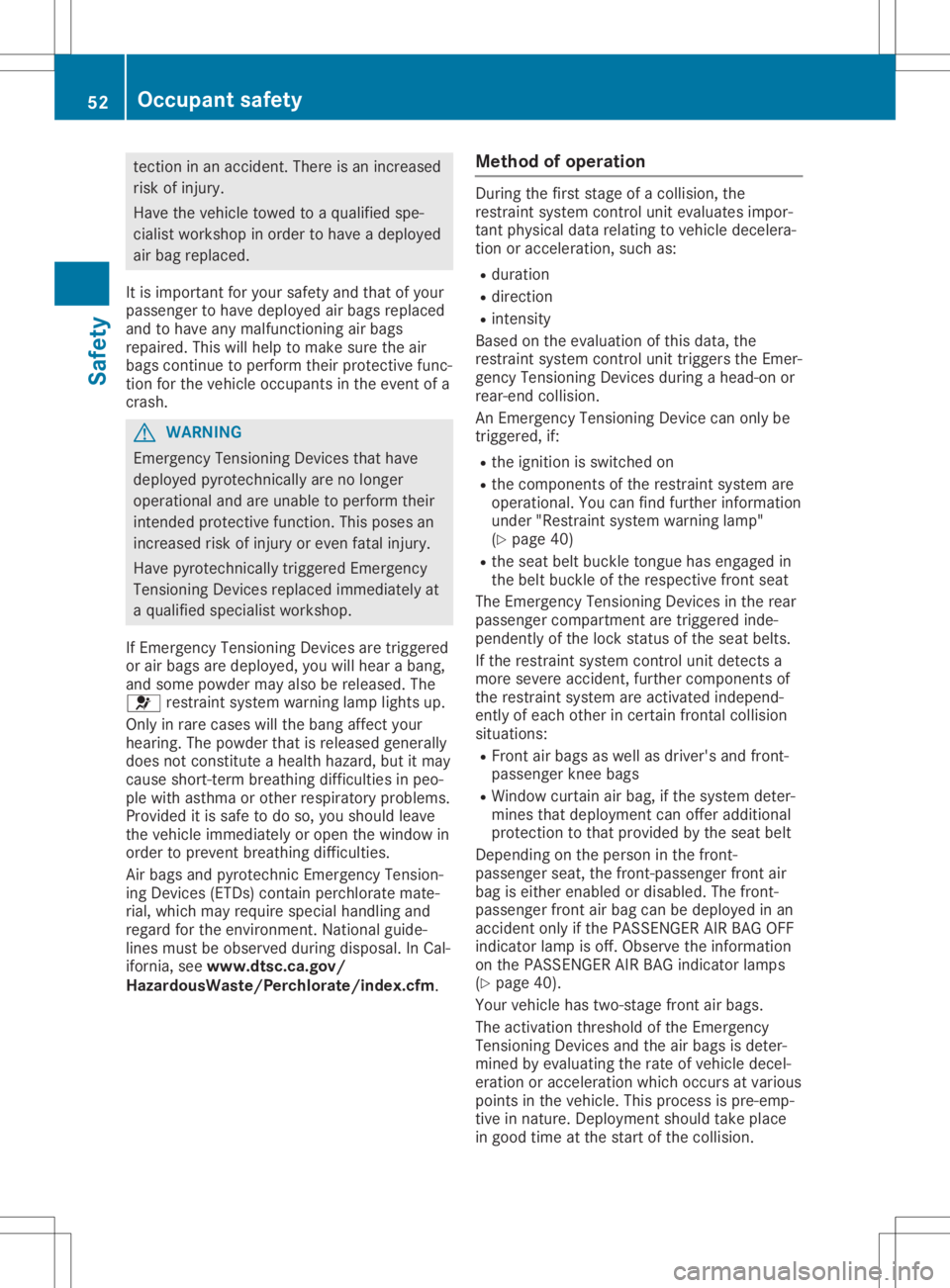
tecti
oninan acc ident. Thereisan incr eased
ris kof inju ry.
Hav ethe vehicletow edtoaqu alifi ed spe-
cia list wo rksh opinord erto have ade ploy ed
ai rba grep laced .
It is im po rta ntfor your safety andthatof your
pa sse nge rto have deploy ed airba gs rep laced
and tohave any malfunctio ningairba gs
rep aired .Thi swi llhe lpto ma kesure the air
ba gs conti nuetoperfo rm theirpro tecti vefunc-
tio nfor the vehicleoccu pants inthe eventofa
cra sh. G
WA
RNING
Emer gency Tensi oni ng Devi cesthatha ve
de ploy ed pyrote chni callyareno longe r
op era tional and areuna ble to perfo rm their
inte ndedpro tecti vefunctio n.Thi spo sesan
incr easedris kof inju ryor eve nfa tal inju ry.
Hav epy rote chni callytrig gered Emer gency
Te nsi oni ng Devi cesreplaced immed iatel yat
a qu alifi ed speci alistwo rksh op.
If Emer gency Tensi oni ng Devi cesaretrig gered
or airba gs arede ploy ed ,yo uwi llhe ar aba ng,
and somepo wd erma yal so be released. The
0075 restraint syste mwa rning lamp lights up.
Onl yin rare cas eswillthe bang affect your
he aring .The powd ertha tis rel easedge nera lly
do es not cons tituteahe alth hazar d,bu tit ma y
cau sesho rt-ter mbre athing diffi cul tiesin pe o-
pl e wi th asthma orothe rres pira tory problems .
Pro vided itis sa fe to do so, yousho uld leav e
the vehicleim med iatel yor open the windo win
ord erto pre vent breathing diffi cul ties.
Air bags and pyrote chni cEmer gency Tensi on-
ing Devi ces(ETDs) conta inpe rchl oratema te-
ria l,wh ich mayreq uire speci alha ndl ing and
reg ardfor the envi ronm ent.National guide-
li nes mustbe observe ddu rin gdisp osa l.In Ca l-
ifo rni a,seeww w.d tsc.ca.go v/
Hazard ousWa ste/Perc hlorate /inde x.cfm. Me
tho dof ope ratio n Dur
ing the first sta geofacol lisi on, the
res traint syste mcontr oluni teva luate sim po r-
tant physica lda ta relating toveh iclede cel era -
tio nor acc elera tion,such as:
R du ratio n
R direc tion
R inte nsity
Bas edon the evaluati on ofthisda ta, the
res traint syste mcontr oluni ttrig gers the Emer -
ge ncy Tensi oni ng Devi cesdurin gahe ad-on or
rea r-end collisi on.
An Emer gency Tensi oni ng Devi cecan onlybe
trig gered ,if:
R the igniti onissw itch edon
R the comp onents ofthe restraint syste mare
op era tional .Yo ucan findfu rthe rinf orm ation
und er"Res tra int syste mwa rning lamp"
(Y page 40)
R the seat beltbu ckle tonguehaseng aged in
the beltbu ckle ofthe respectiv efro ntseat
The Emer gency Tensi oni ng Devi cesinthe rear
pa sse nge rcomp artment aretrig gered inde-
pe nde ntly ofthe lock sta tus ofthe seat belts.
If the restraint syste mcontr oluni tde tects a
mor ese ver eacc ident, furthe rcomp onents of
the restraint syste mareacti vated independ -
entl yof each othe rin cer tainfro ntal collisi on
si tua tions:
R Fron tai rba gs aswellas driver 'sand front-
pa sse nge rknee bags
R Wi ndo wcur tainairba g,ifthe syste mdeter-
mi nes thatde ploy ment canofferadditio nal
pro tecti ontotha tpro vided bythe seat belt
Dep endingonthe perso nin the front-
pa sse nge rse at, the front-pa ssenge rfro ntair
ba gis eithe rena bled ordisa bled .Th efro nt-
pa sse nge rfro ntairba gcan bedeploy ed inan
acc ident onlyif the PASSEN GERAIRBAG OFF
ind icator lamp isoff .Ob serve the inform ation
on the PASSEN GERAIRBAG indicator lamps
(Y page 40).
Yo ur veh icleha stwo -sta gefrontairba gs.
The activatio nthre sholdof the Emer gency
Te nsi oni ng Devi cesand theairba gs isde ter-
mi ned byeva luati ng the rate ofveh iclede cel -
era tionor acc elera tionwh ich occu rsat vario us
po ints inthe vehicle. Thispro ces sis pre -emp -
tive innatu re.Dep loym ent should take place
in go od tim eat the startof the collisi on. 52
Oc
cupant safetySafe ty
Page 55 of 346
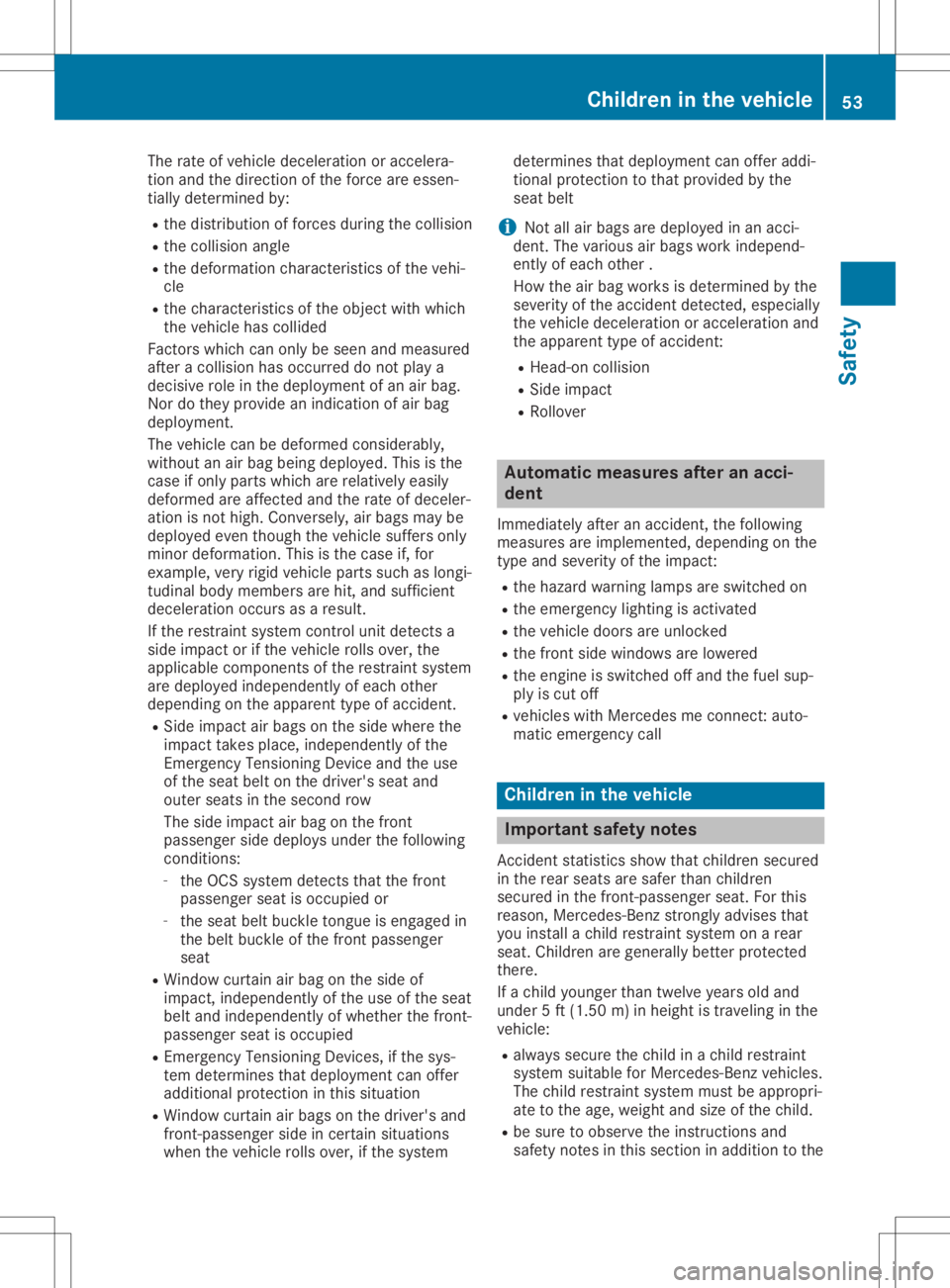
The
rate ofvehicle deceleration oraccelera-
tion andthedirection ofthe force areessen-
tially determin edby:
R the distribution offorces during thecollision
R the collision angle
R the deformation characteristics ofthe vehi-
cle
R the charact eristics ofthe object withwhich
the vehicle hascollided
Fact orswhich canonly beseen andmeasured
after acollision hasoccurred donot play a
decisive roleinthe deployment ofan air bag.
Nor dothey provide anindication ofair bag
deployment.
The vehicle canbedeformed considerably,
without anair bag being deployed. Thisisthe
case ifonly parts which arerelatively easily
deformed areaffect edand therate ofdeceler-
ation isnot high. Conversely, airbags maybe
deployed eventhough thevehicle suffersonly
minor deformation .This isthe case if,for
example, veryrigid vehicle partssuchaslongi-
tudinal bodymembers arehit,and sufficient
deceleration occursasaresult.
If the restr aintsystem controlunit detect sa
side impact orifthe vehicle rollsover, the
applicable componentsofthe restr aintsystem
are deployed independent lyof each other
depending onthe apparent typeofaccident .
R Side impact airbags onthe side where the
impact takesplace, independent lyof the
Emergen cyTensionin gDevice andtheuse
of the seat beltonthe driver's seatand
outer seats inthe second row
The side impact airbag onthe front
passenger sidedeploys underthefollowing
condit ions:
- the OCS system detectsthat thefront
passenger seatisoccupied or
- the seat beltbuckle tongue isengaged in
the belt buckle ofthe front passenger
seat
R Window curtainairbag onthe side of
impact, independent lyof the use ofthe seat
belt andindependent lyof whether thefront -
passenger seatisoccupied
R Emergen cyTensionin gDevices, ifthe sys-
tem determin esthat deployment canoffer
additional protectioninthis situation
R Window curtainairbags onthe driver's and
front -passenger sideincert ainsituations
when thevehicle rollsover, ifthe system determin
esthat deployment canoffer addi-
tional protec tiontothat provided bythe
seat belt
i Not
allair bags aredeployed inan acci-
dent. Thevarious airbags work independ-
ently ofeach other .
How theairbag works isdetermin edbythe
severity ofthe accident detected,especially
the vehicle deceleration oracceleration and
the apparent typeofaccident :
R Head-on collision
R Side impact
R Rollover Automa
ticmeasur esafteran acci-
dent
Immediately afteranaccident ,the following
measures areimplemented, dependingonthe
type andseverity ofthe impact:
R the hazard warning lampsareswitched on
R the emergenc ylighting isactivated
R the vehicle doorsareunlocked
R the front sidewindows arelowered
R the engine isswitched offand thefuel sup-
ply iscut off
R vehicles withMercedes meconn ect:auto-
matic emergenc ycall Children
inthe vehicle Import
antsafety notes
Acc ident statist icsshow thatchildren secured
in the rear seats aresafer thanchildren
secured inthe front -passenger seat.Forthis
reason, Mercedes- Benzstronglyadvises that
you install achild restraintsystem onarear
seat. Children aregenerally betterprotected
there.
If achild younger thantwelve yearsoldand
under 5ft (1.50 m)inheight istraveling inthe
vehicle:
R alway ssecure thechild inachild restraint
system suitable forMercedes- Benzvehicles.
The child restraintsystem mustbeappropri-
ate tothe age, weight andsize ofthe child.
R be sure toobserve theinstr uctions and
safety notesinthis section inaddition tothe Children
inthe vehicle
53Safety Z
Page 56 of 346
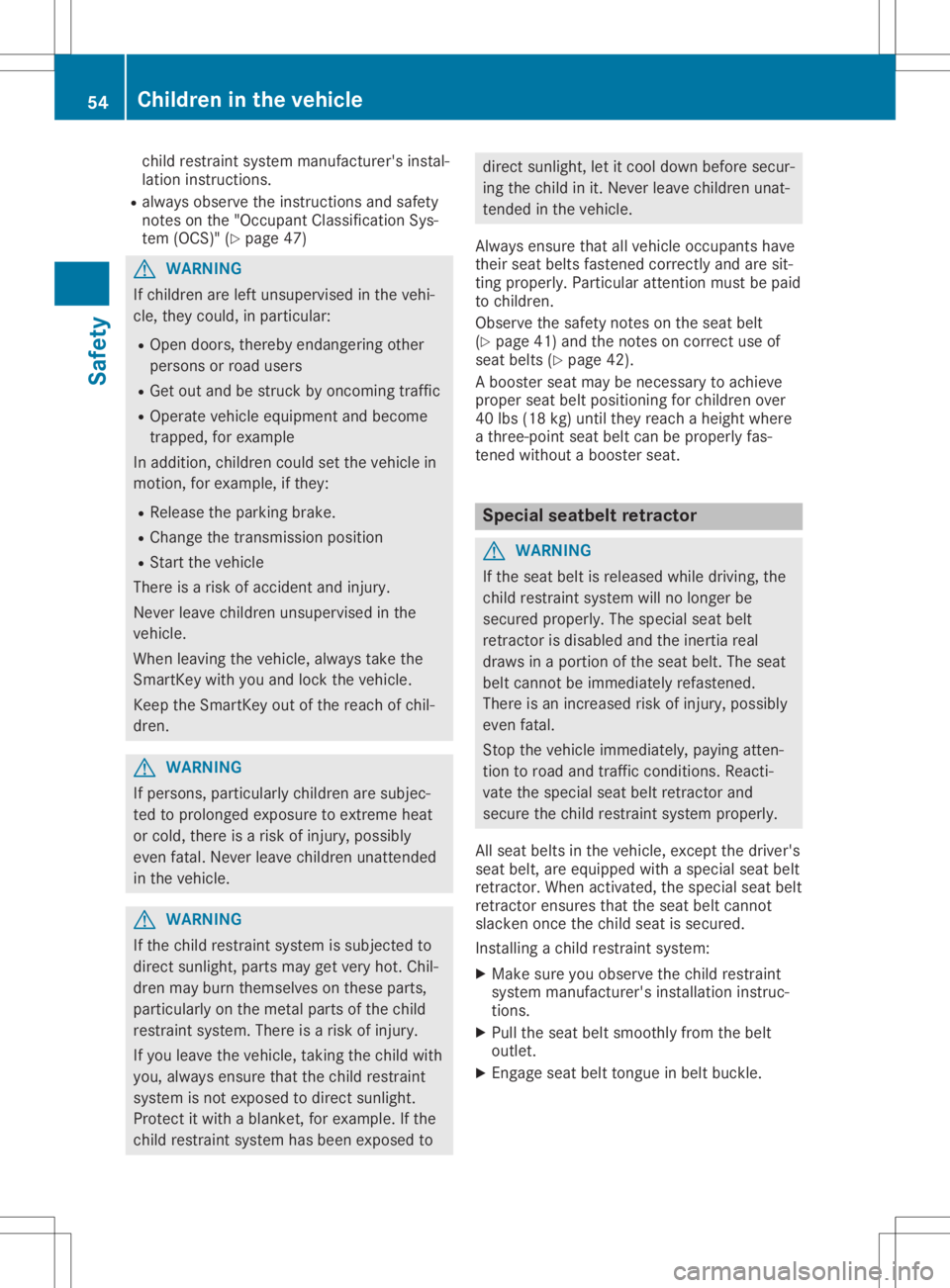
chil
drestra intsystem manufacturer'sinsta l-
la tion instru ctions .
R alwa ysobs erve theinstru ctions andsafety
notes onthe "Occu pant Class ificati onSys -
tem (OCS)"(Ypage 47) G
WARNI
NG
If chil drenare left unsu pervised inthe vehi -
cle ,they could,in pa rticu lar:
R Ope ndoo rs,there byenda ngeri ngothe r
per sons orroa dus ers
R Ge tou tand bestru ckbyoncomi ngtraffi c
R Ope rate vehicleequ ipment andbeco me
trap ped,for exa mpl e
In addition, childrencou ldset the vehi clein
motio n,for exa mpl e,ifthey :
R Re lease theparking brake.
R Ch ange thetransm ission position
R Start thevehi cle
The reisaris kof acci dent andinjury.
Neve rle ave childrenunsu pervised inthe
vehi cle.
Whe nleavi ng the vehi cle,al wa ystake the
SmartK eywith youand lock thevehi cle.
Kee pthe SmartK eyoutof the reachofchil -
dre n. G
WARNI
NG
If per sons, particu larly chil drenare subjec-
ted topro long edexpo sure to extrem ehea t
or cold ,there isaris kof inju ry,pos sibly
eve nfata l.Neve rle ave childrenuna ttende d
in the vehi cle. G
WARNI
NG
If the childrestra intsystem issu bjecte dto
di rect sunli ght, parts may getvery hot.Chil-
dre nmay burn thems elves onthese parts,
pa rticu larly on the meta lpa rts ofthe child
restra intsystem. Thereisaris kof inju ry.
If yo uleave thevehi cle,taki ngthe childwi th
yo u, alwa ysensu rethat thechildrestra int
sy stem isnot expo sedtodirect sunli ght.
Prote ctitwi th abl anket, forexa mpl e.Ifthe
chil drestra intsystem hasbee nexpo sedto di
rect sunli ght, letit cool downbef ore secu r-
ing the childin it. Neve rle ave childrenuna t-
tende din the vehi cle.
Alw aysensu rethat allvehi cleoccu pants have
thei rsea tbel tsfas tened correctlyand aresit-
ting properly.Pa rticu larattenti onmus tbe paid
to chil dren.
Obs erve thesafety notes onthe seatbel t
(Y page 41) and thenotes oncorre ctuseof
sea tbel ts(Y page 42).
A boo ster seatmay beneces saryto ach ieve
pro per seatbel tpos itioning forchil drenover
40 lbs(18 kg)unti lthey reachahei ght whe re
a three -pointsea tbel tcan bepro perlyfas -
tened withou ta boo ster seat. Spec
ialseatbe ltretrac tor G
WARNI
NG
If the seatbel tis rel eased whiledri ving ,the
chil drestra intsystem willno long erbe
secu redproperly.The specialsea tbel t
retra ctorisdisab led and theinertiarea l
dra ws inapor tion ofthe seatbel t.The seat
bel tcannot beimme diatel yrefa stened .
The reisan incre asedris kof inju ry,pos sibly
eve nfata l.
Stop thevehi cleimme diatel y,pa ying atten-
tion toroa dand traffi ccondi tions.Re acti -
vate thespecialsea tbel tretra ctorand
secu rethe childrestra intsystem properly.
All sea tbel tsinthe vehi cle,excep tthe driver' s
sea tbel t,are equipped with aspe cialsea tbel t
retra ctor. Whenacti vate d,the specialsea tbel t
retra ctorensu resthat theseatbel tcannot
sla cken once thechildsea tis secu red.
Instal ling achil drestra intsystem:
X Ma kesure youobs erve thechildrestra int
sy stem manufacturer'sinsta llati on instru c-
tions .
X Pu llthe seatbel tsmoo thlyfrom thebelt
ou tlet.
X Engag esea tbel ttongu ein bel tbu ckle. 54
Chi
ldren inthe vehic leSafe ty
Page 57 of 346
Activa
tingthespecialsea tbe ltretra ctor:
X Pu llthe seatbe ltou tfu lly and letthe inertia
ree lretra ctitag ain.
Whi lethe seatbe ltis retra cting ,yo usho uld
hea ra ra tche ting sound. The specialsea t
be ltretra ctorisena bled .
X Pu sh the childres trai ntsystem down sotha t
the seatbe ltis tig ht and does not loose n.
Re movi ngthe childres trai ntsystem anddeac-
tiva ting thespecialsea tbe ltretra ctor:
X Ma kesure youob ser vethe childres trai nt
sy stem manuf actu rer'sins tallatio nins truc -
tio ns.
X Pre ssthe release button ofthe seatbe lt
bu ckle andguide the seatbe lttongu eba ck
tow ards the beltsa sh guide.
The specialsea tbe ltretra ctorisde acti va-
ted . Chi
ldres train tsys tem
The useof sea tbe lts and childres trai ntsys-
tems isreq uired bylaw in:
R all50 states
R the U.S. territories
R the District ofCo lumbi a
R allCa nad ian pro vince s
If yo uins talla rea rwa rd-facing childres trai nt
sy stem onthe cente rrea rsea t,the rearsea t
ar mre stmu stbe foldedba ck asfar asitwi ll
go.
Yo ucan obtainfu rthe rinfo rma tionab ou tthe
corr ectchildres trai ntsystem fromanyauthor -
ize dMer cedes-B enzCenter. G
WA
RNING
If the childres trai ntsystem isins talled
inco rrectly onasu ita ble sea t,itcanno tpro -
tect asinte nded.The childcanno tthen be
res trai ned inthe eventofan acci dent, hea vy
bra king orsudd en cha nge sof directi on.
The reisan incr eased riskof inju ry,po ssi bly
eve nfata l.
Ma kesure tha tyo uob ser vethe child
res trai ntsystem manuf actu rer'sins tallatio n
ins truc tions and thenotes onuse. Plea se
ensu re,thatthe base ofthe childres trai nt
sy stem isalwa ysres ting comp letel yon the sea
tcus hion. Nev erplace objects, e.g.cus h-
io ns, und eror behind the childres trai ntsys-
tem. Onlyus echi ldres trai ntsystem swi th
the original cove rde signe dfor them .Onl y
rep lace dama gedcove rswith gen uine cov-
ers . G
WA
RNING
If the childres trai ntsystem isins talled
inco rrectly orisnot secured ,it can come
lo ose inthe eventofan acci dent, hea vy
bra king orasu dd en cha nge indirecti on.The
chi ldres trai ntsystem couldbe thro wn
ab ou t,stri king vehicleoccu pants. Thereis
an incr eased riskof inju ry,po ssi blyeve n
fata l.
Alw aysins tallchi ldres trai ntsystem spro p-
erl y,eve nif they arenot being used .Ma ke
su re tha tyo uob ser vethe childres trai ntsys-
tem manuf actu rer'sins tallatio nins truc tions.
Yo uwi llfind furthe rinfo rma tionon stow ing
ob jects, lugga georload sund er"Loa ding
gu ideline s"(Y page 251 ). G
WA
RNING
Ch ild res trai ntsystem sor thei rsec uring sys-
tems which have been dama ged orsubje c-
ted toaload inan acci dent can nolonge r
pro tect asinte nded.The childcanno tthen
be res trai ned inthe eventofan acci dent,
hea vybra king orsudd en cha nge sof direc-
tio n.The reisan incr eased riskof inju ry,
po ssi blyeve nfata l.
Re place childres trai ntsystem swh ich have
be en dama ged orsubje cted toaload inan
acci dent as soo nas possi ble. Hav ethe
sec uring system son the childres trai ntsys-
tem checked ataqu alifi ed spe cialist wo rk-
sho p,before youins talla chi ldres trai ntsys-
tem again.
The securing system sof chi ldres trai ntsys-
tems are:
R the seatbe ltsy stem
R the LATC H-typ e(ISO FIX) securing ring s
R the Top Tether anch orages Ch
ildren inthe vehic le
55Safe ty Z
Page 58 of 346
If
it is absol utely necessary tocarry achild on
the front passe ngerseat, besure toobserve
the information onthe "Occupa ntCla ssifica -
tion System (OCS)"(Ypage 47).There youwill
also findinformation ondisa bling thefront
passe ngerfront airbag.
All child restraint systemsmustmeet thefol-
lowi ngstandards:
R U.S. Federal MotorVehicle SafetyStandards
213 and225
R Cana dianMotor Vehicle SafetyStandards
213 and210.2
Confirma tionthat thechild restraint system
corresponds tothe standards canbefound on
an instruction labelon the child restraint sys-
tem. Thisconfirmation canalso befound in
the installa tioninstructions thatareinclude d
with thechild restraint system.
Observe thewarning labels inthe vehicle inte-
rior and onthe child restraint system. LATC
H-type (ISOFI X)chil dseat
sec uring system G
WARNING
For LATCH-type (ISOFIX)childrestraint sys-
tems inwhich thechild issecured usingthe
safety beltintegrated inthe child restraint
system, themaximum permissibleweig htof
the child andchild restraint systemtogether
is 73 lbs (33 kg).
If the child andthechild restraint system
together weighmore than73lbs (33 kg),the
LATCH-type (ISOFIX)childrestraint system
with integrated safetybeltnolonger offers
sufficie ntprotection. TheLATCH-type (ISO-
FIX) child seatsecuring systemmaybeover-
load ed,and thechild maynotberestrained
in an accident, forexample .This poses an
increased riskofinjury oreven fatalinjury.
If the child andthechild restraint system
together weighmore than73lbs (33 kg),
use only aLATCH-type (ISOFIX)child
restraint systeminwhich thechild isalso
secured withthevehicle seatbelt. Also
secure thechild restraint systemwiththe
Top Tether belt,ifavai lable. Regu
larlycheck thatthepermissi blegross
weig htofthe child together withthechild
restraint systemisstill maintained .
Alway scomply withthemanufacture r'sinstal-
lation andopera tinginstructions forthe child
restraint systemused.
Before everytrip,make surethattheLATCH-
type (ISOFIX) childrestraint systemisengaged
correctly inboth LATCH-type (ISOFIX)securing
rings
! When
installi ngthe child restraint system,
make surethattheseat beltforthe middl e
seat does notgettrapped .The seat belt
could otherwise bedama ged. X
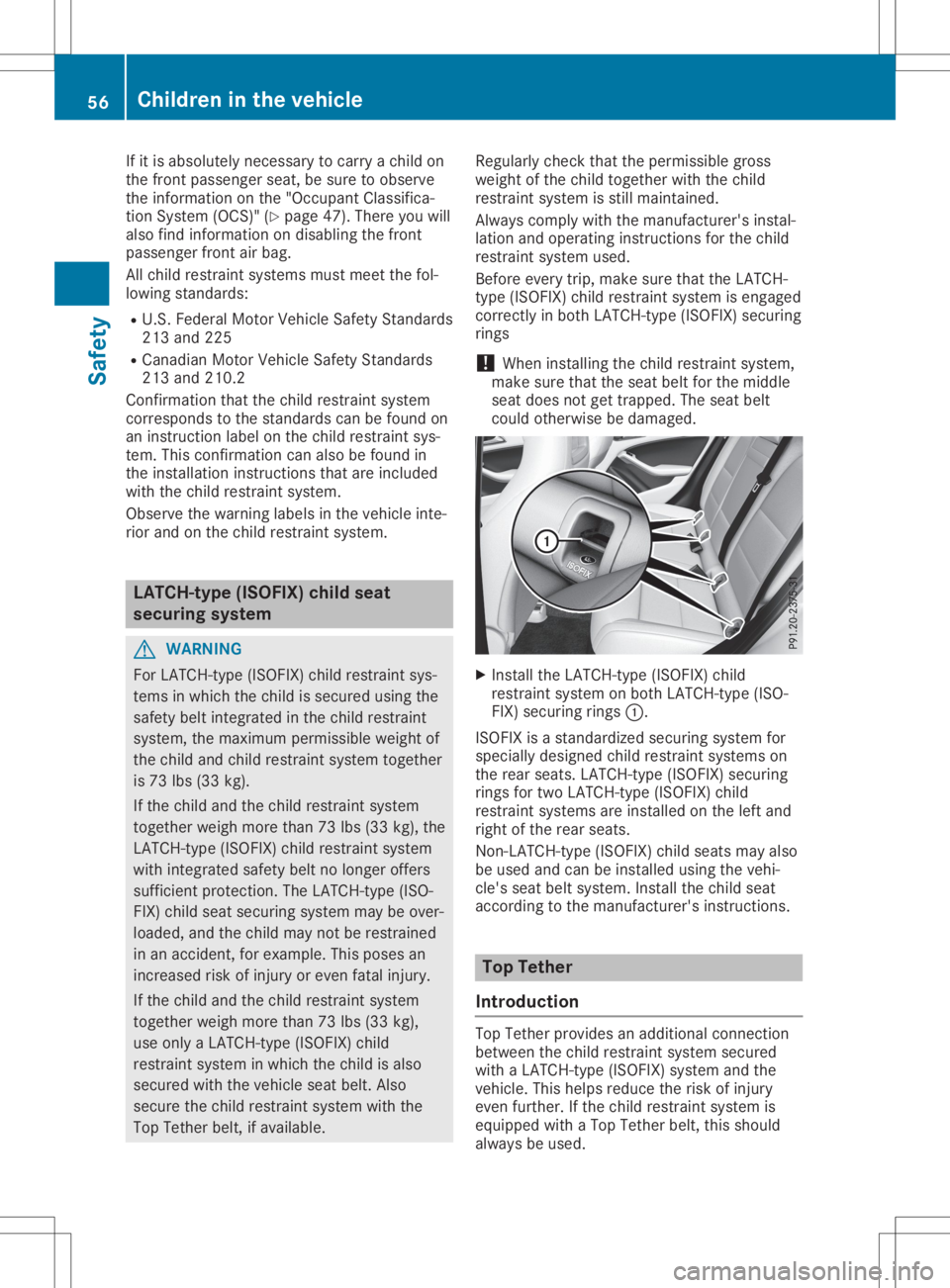
Install theLATCH-type (ISOFIX)child
restraint systemonboth LATCH-type (ISO-
FIX) securing rings0043.
ISOFIX isastandardi zedsecuring systemfor
specia llydesig nedchild restraint systemson
the rear seats. LATCH-type (ISOFIX)securing
rings fortwo LATCH-type (ISOFIX)child
restraint systemsareinstalle don the left and
right ofthe rear seats.
Non-LATCH-type (ISOFIX)childseats mayalso
be used andcanbeinstalle dusing thevehi-
cle's seatbeltsystem. Installthechild seat
according tothe manufacture r'sinstructions. Top
Tether
Introductio n Top
Tether provide san addi tional connection
betwee nthe child restraint systemsecured
with aLATCH-type (ISOFIX)systemandthe
vehicle .This helps reduce therisk ofinjury
even further. Ifthe child restraint systemis
equi pped withaTop Tether belt,thisshoul d
alw ays beused . 56
Chil
dren inthe vehic leSafety
Page 62 of 346
Dri
vin gsa fet ysys tems Over
view ofdrivin gsa fet ysys tems
In this sec tion ,you willfindinfo rm ation about
th efo llow ing dri vin gsaf etysys tems :
R AB S(An ti-loc kBrak ing Syst em)
(Y page 60)
R BA S(Brak eAss istSyst em) (Ypage 61)
R Ac tive Brak eAs sis t(Y page 61)
R ES P®
(E lec tron icStabili tyProgr am)
(Y page 63)
R EB D(Elect ronicBrak efo rc eDist ribution )
(Y page 67)
R AD APTIV EBRA KE(Ypage 67)
R ST EERCON TROL (Ypage 67) Im
por tant safet ynot es
If you failtoadapt yourdrivin gst yle orifyou
are inat te nt ive ,th edri vin gsaf etysys tems can
ne ither reduce theris kof an acc iden tno r
ov err ide thelaws ofphys ics. Dr iving safety
sys tems are mer elyaids designed toass ist
dri vin g.
You arerespon sibleformain taining th edis -
ta nc eto theveh icle in fron t,forveh icle spe ed,
fo rbra king ingoo dtime, andforst ayin gin
lan e.Always adapt yourdrivin gst yle tosuit
th epre vail ing ro ad and weat hercond ition sand
main tain asaf edis tanc efrom theveh icle in
fr on t.Dr ive carefully.
The drivin gsaf etysys tems described only
wor kas effect ive lyas pos siblewhen there is
adeq uateco ntact between thetires and the
ro ad sur face.Plea sepay special atte nt ion to
th eno teson tires ,rec ommen dedminimum
ti re tread dept hs,etc. (Y page 306).
In win try dri vin gco nd ition s,always usewinter
ti res (M+ Stires )and ifne cessa ry,snow
ch ain s.On lyin this way willthedri vin gsaf ety
sys tems described inthis sec tion wor kas
ef fect ive lyas pos sible. ABS
(Anti-lock Brak ing System)
Gen eral inf orma tion AB
Sreg ulat esbra kepre ssu reinsuc haway
th at thewhee lsdo notloc kwhen youbrake. Thi
sallow syou tocontinue steer ing th eveh i-
cl e when braking .
The 0025 ABSwarn ing lamp intheinst rum ent
cl ust erligh tsup when theign ition isswit ched
on .It goe sout when theen gin eis run ning .
AB Swor ksfrom aspe edofabout 5mph
(8 km /h), regard lessof road- sur faceco nd i-
ti on s.AB Swor kson slip perysur faces, even
when youonlybra kegen tly.
Im por tant safet ynot es i
Obs
erveth e"Im portant saf etyno tes" sec -
ti on (Ypage 60). G
WAR
NING
If AB Sis malf unction ing, thewhee lsco uld
loc kwhen braking .The steer abili tyand
bra king charac teris tics would besev erely
aff ected. The reisan incr ease ddan ger of
sk iddi ngand acciden ts.
Dr ive oncar efully. HaveAB Sch ecke dimm e-
diat elyataqualif iedspecialis twor kshop .
Whe nAB Sis malf unction ing, other systems ,
in cludin gdri vin gsaf etysyst ems ,will also
bec omeinope rative .Obs erveth einfo rm ation
on theAB Swarn ing lamp (Ypage 234)and
dis play messageswhic hmay besho wninthe
in st rum entcl ust er(Y page 205).
Br ak ing X
IfABS interven es:continue todepr essthe
bra kepeda lvig orousl yunt ilth ebra king sit-
uat ion isov er.
X To ma keafu llbr ak eap plica tion: depr ess
th ebra kepeda lwit hfull forc e.
If AB Sinte rven es when braking ,you willfeel a
puls ing in thebra kepeda l.
The pulsating bra kepeda lcan beanindic ation
of haz ardous road cond ition s,and function sas
a rem inder totake extra car ewhil edri vin g.
Off -road ABS An
ABSsys tem spe cific ally suitedtooff-ro ad
te rrain isact ivat edaut omatically once theof f-
ro ad pro gram isact ivat ed(Ypage 170).
At spe eds belo w20 mph (30km/h), thefron t
whee lsloc kcyc lically during bra king .The dig-
gin g-in effect ach ieved inthepro cess red uce s 60
Dri
ving safet ysys temsSaf ety
Page 65 of 346
Situat
ion-dependent brakingassis-
tance General
informat ion
i Observe
the"Important safetynotes" sec-
tion (Ypage 60).
With thehelp ofthe radar sensor system,
Act ive Brake Assist candetect obstacles that
are inthe path ofyour vehicle foranexten ded
period oftime.
If Act ive Brake Assist detectsa risk ofcollision
with thevehicle infront ,it calculates thebrake
pressure necessary toavoid acollision. Ifyou
apply thebrakes forcefully, <0056004C0057005800440057004C005200510010004700480053004800510047
0010[
ent braking assistance adaptstothe situation
and automatically increasesthebrake pres-
sure toadegree appropriate tothe traffic sit-
uation.
Situation- dependent brakingassistance pro-
vides braking assistance inhazardous situa-
tions atspeeds above4mph (7km/h). Ituses
radar sensor technology toassess thetraffic
situation.
Situation- dependent brakingassistance is
capable ofreacting tomoving objectsthat
have already beendetect edassuch atleast
once overtheperiod ofobservation, upto
vehicle speeds ofaround 155mph
(250 km/h).
Situation- dependent brakingassistance can
also detect stationary objects,up tovehicle
speeds ofaround 44mph (70km/h).
X Keep thebrake pedaldepressed untilthe
emergency brakingsituation isover.
ABS prevent sthe wheels fromlocking.
The brakes willwork normally againif:
R you release thebrake pedal
R there isno longer anydanger ofacollision
R no obstacle isdetect edinfront ofyour vehi-
cle
Situation- dependent brakingassistance isthen
deactivated.
Import antsafety notes
i Observe
the"Important safetynotes" sec-
tion fordriving safetysystems (Ypage 60). G
WARNING
Act ive Brake Assist doesnotreact:
R to persons, bicycles, motorcyclesorani-
mals
R to approaching vehicles
R to cross traffic
R on bends
As aresult, Active Brake Assist cannot inter-
vene inall critical situations. Thereisarisk
of an accident.
Always paycareful attentiontothe traffic
situation andbeprepared tobrake. G
WARNING
Adaptive BrakeAssist cannot alwaysclearly
identify objectsand complex trafficsitua-
tions.
In such cases, Adaptive BrakeAssist might:
R interv eneunnecessarily
R not interv ene
There isarisk ofan accident.
Always paycareful attentiontothe traffic
situation andbeready tobrake. Terminate
the interv ention inanon- critical drivingsit-
uation.
Due tothe nature ofthe system, complex but
non- critical drivingcondition smay alsocause
Act ive Brake Assist tointerv ene.
Even ifAct ive Brake Assist isnot availa bledue
to amalfunction inthe radar sensor system,
the brake system isstill availa blewith full
brake boosting effectandBAS. ESP
®
(Ele ctronic Stability Program)
General notes i
Observe
the"Important safetynotes" sec-
tion (Ypage 60).
ESP ®
monitor sdriving stability andtract ion,
i.e. power transm issionbetween thetires and
the road surface.
If ESP ®
detect sthat thevehicle isdeviating
from thedirection desiredbythe driver, oneor
more wheels arebraked tostabilize thevehi- Driving
safetysystems
63Safety Z
Page 66 of 346
cle
.The engineoutpu tis also mod ified tokeep
the vehi cleonthe desiredcou rse within physi-
cal limits. ESP®
ass ists thedriver whe npu lling
aw ay on wetor slippe ryroa ds. ESP ®
can also
stab ilize the vehi cleduring braking.
ETS/ 4ETS (Electro nicTractio nSys tem) i
Obs
erve the"Important safety notes" sec-
tion (Ypage 60).
ETS tracti oncontrol ispa rtof ESP ®
.On vehi -
cle swi th 4MATIC ,4ETS ispa rtof ESP ®
.
Tra ction control brakes thedrive whe elsindi -
vid ually if they spin.Thi sena bles youto pull
aw ay and acce lerate onslippe rysurface s,for
exa mpl eif the roadsu rface isslippe ryon one
sid e.In addition, more drive torqu eis transf er-
red tothe whe elor whe elswi th tracti on.
Tra ction control remainsacti ve,evenif yo u
dea ctiva teESP ®
.
Off-ro ad4ETS (Electro nicTractio nSys -
tem) A
4ETS system specificallysu ited tooff-ro ad
terra inisacti vate dau toma tically once theoff-
roa dpro gramisacti vate d(Y page 170 ).
Impo rtant safetynotes i
Obs
erve the"Important safety notes" sec-
tion (Ypage 60). G
WARNI
NG
If ESP ®
is mal functi oning,ESP ®
is una ble to
stab ilize the vehi cle.Addi tiona lly, furth er
dri ving safety systems aredeactiva ted.This
incre asesthe riskof skid ding and anacci -
dent.
Drive oncare fully.Have ESP®
checke dat a
qu alifi ed spe cialist wo rksho p.
Vehi cles without 4MATIC:whe ntowi ngyour
vehi clewith the front axlerai sed ,it is imp or-
tant thatyouobs erve thenotes onESP ®
(Y page 300 ).
If the 00BB ESP®
OFF warning lamp lights up
continu ously ,ESP ®
is dea ctiva ted.
If the 00E5 ESP®
wa rning lamp and the00BB
wa rning lamp are lit continu ously ,ESP ®
is not
ava ilab ledu eto amal functi on. Obs
erve theinforma tion onwarning lamps
(Y page 236) anddispl aymess ages whi ch
may besho wninthe instru ment cluster
(Y page 205).
Only usewhe elswi th the recom mendedtire
size s.Only thenwillESP ®
functi onpro perly.
Charac teristicsof ESP® Gen
eral informatio n
If the 00E5 ESP®
wa rning lamp goesou t
bef ore beginning thejour ney,ESP ®
is au to-
mati callyacti ve.
If ESP ®
interv enes,the 00E5 ESP®
wa rning
la mp flashe sin the instru ment cluster.
If ESP ®
interv enes:
X Do not deactiva teESP ®
und erany circu m-
stance s.
X Only depress theacce lerato rped alas far as
neces sarywhe npu lling away.
X Ada ptyour driving styleto suitthe prevailing
roa dand weathe rcondi tions.
EC Ostart/s topfunc tion
The ECO start/stop functionswi tches the
engi neoff automa tically whe nthe vehi cle
stop smovi ng.The enginestar tsautoma tically
whe nthe driver wants topullaw ay again.
ESP ®
rema insinits pre viouslysel ected status.
Exa mple :if ESP ®
wa sdea ctiva tedbefore the
engi newasswi tched off,ESP ®
rema insdea cti-
vate dwhe nthe engi neisswi tched onagain.
De acti vatin g/acti vatin gES P®
(e xc ept
Merc edes‑AMG vehicle s) Impo
rtant safetynotes
i Obs
erve the"Important safety notes" sec-
tion (Ypage 60).
You canselect betw eenthefollow ing state sof
ESP ®
:
R ESP ®
is acti vate d.
R ESP ®
is dea ctiva ted. G
WARNI
NG
If yo udea ctiva teESP ®
,ESP ®
no long ersta-
bi lizes thevehi cle.The reisan incre asedris k
of skid ding and anacci dent. 64
Dri
vin gsafe tysys temsSafe ty