warning MERCEDES-BENZ GLA SUV 2020 User Guide
[x] Cancel search | Manufacturer: MERCEDES-BENZ, Model Year: 2020, Model line: GLA SUV, Model: MERCEDES-BENZ GLA SUV 2020Pages: 346, PDF Size: 51.22 MB
Page 32 of 346
enfor
cemen t;by federal, stateor local govern -
ment ;in con nect ionwith orarising outofliti-
gation involvin gMBUS Aor its subsidiaries and
affiliates; or,asrequired bylaw.
Warning :The EDRis acompon entofthe
Restraint SystemModule. Tampering with,
altering, modifying orremovin gthe EDRcom-
ponen tmay result inamalfunct ionofthe
Restraint SystemModule andother systems.
St ate laws orregulations regardingEDRs that
con flict with federal regulation arepre-em p-
ted. This means thatinthe event ofsuch con-
flict ,the federal regulation governs.As ofFeb-
ruary 2013,13 stat eshave enact edlaws relat-
ing toED Rs. Informa
tiononcopyright General
information
Inf ormation onlicense forfree andopen-
source software usedinyour vehicle andits
electr oniccompon entsis available onthe fol-
lowing website:
htt p:// www.mercedes -benz.com/ opensourc e Register
edtradem arks
R Bluetoot h®
is aregister edtrademark of
Bluetoot hSIG Inc.
R DTS ™isaregister edtrademark ofDTS ,Inc .
R Dolby ®
and MLP™ areregister edtrade-
marks ofDOLB YLaboratories .
R BabySmart ™,ESP®
and PRE-S AFE®
are reg-
istered trademark sof Daimler AG.
R HomeLin k®
is aregister edtrademark of
Johnson Controls.
R iPod ®
and iTunes ®
are register edtrade-
marks ofApple Inc.
R Logic7 ®
is aregister edtrademark ofHar-
man Internat ional Indust ries.
R Microsof t®
and Windows media®
are regis-
tered trademark sof Microsof tCorporation .
R SIRIUS ®
is aregister edtrademark ofSirius
XM Radio Inc.
R HD Radio™ isaregister edtrademark of
iBiquity DigitalCorporation . R
Gracenot e®
is aregister edtrademark of
Gracenot e,Inc .
R ZAGAT Survey®
and related brandsarereg-
istered trademark sof Zagat Survey, LLC. 30
Inform
ation oncopyrightIntrod uction
Page 41 of 346
Panic
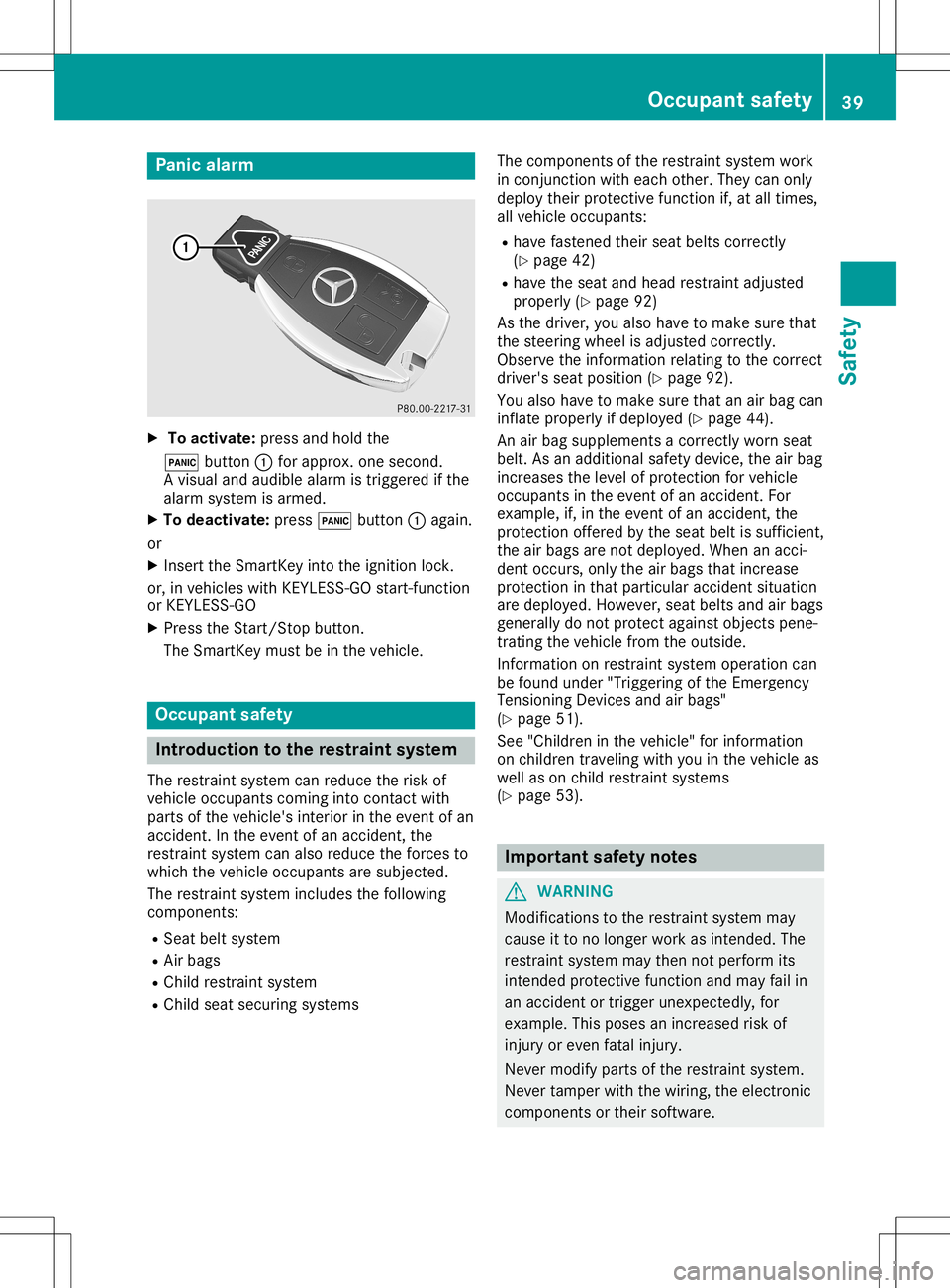
alarm X
To activate: pressandhold the
0033 button 0043for approx. onesecond.
A visual andaudib lealarm istriggered ifthe
alarm system isarmed.
X To deactivat e:press 0033button 0043again.
or X Insert theSmartK eyinto theignition lock.
or, invehicles withKEYLE SS-GO start- function
or KEYLE SS‑GO
X Press theStart /Stopbutton.
The SmartK eymust beinthe vehicle. Occupant
safety Introduct
iontothe restr aintsystem
The restraint systemcanreduce therisk of
vehicle occupants comingintocontactwith
parts ofthe vehicle's interiorinthe event ofan
accident. Inthe event ofan accident, the
restraint systemcanalso reduce theforces to
which thevehicle occupants aresubjected.
The restraint systemincludes thefollowing
componen ts:
R Seat beltsystem
R Air bags
R Child restraint system
R Child seatsecuring systems The
componen tsof the restraint systemwork
in conj unction witheach other. Theycanonly
deploy theirprotect ivefunct ionif,at all times,
all vehicle occupants:
R have fastened theirseatbelts correct ly
(Y page 42)
R have theseat andhead restraint adjusted
properly (Ypage 92)
As the driver, youalso have tomake surethat
the steering wheelisadjusted correctly.
Observe theinformation relatingtothe correct
driver's seatposition (Ypage 92).
You also have tomake surethatanair bag can
inflate properly ifdeploye d(Y page 44).
An airbag supplements acorrect lyworn seat
belt. Asanadditional safetydevice, theairbag
increases thelevel ofprotect ionforvehicle
occupants inthe event ofan accident. For
example, if,inthe event ofan accident, the
protect ionoffered bythe seat beltissufficient,
the airbags arenot deploye d.When anacci-
dent occurs, onlytheairbags thatincrease
protect ioninthat particular accidentsituation
are deploye d.However, seatbelts andairbags
generally donot protect againstobjectspene-
tratin gthe vehicle fromtheoutside.
Inform ationonrestraint systemoperation can
be found under "Triggering ofthe Emergen cy
Tensioning Devicesandairbags"
(Y page 51).
See "Chil dren inthe vehicle" forinformation
on children traveling withyouinthe vehicle as
well ason child restraint systems
(Y page 53). Import
antsafety notes G
WARNING
Modifications tothe restraint systemmay
cause itto no longer workasinten ded.The
restraint systemmaythen notperform its
inten dedprotect ivefunct ionand may failin
an accident ortrigger unexpect edly,for
example. Thisposes anincreased riskof
injury oreven fatalinjury.
Never modify partsofthe restraint system.
Never tamper withthewiring, theelectron ic
componen tsor their software. Occ
upantsafety
39Safety Z
Page 42 of 346
If
it is necessary tomodify components ofthe
restraint systemtoaccommodate aperson
with disabilities, contact anauthori zed
Mercedes-Benz Centerfordetail s.USA only:
for further information contactourCustomer
Assistance Centerat1-800 FOR-MERCEDES
(1‑800‑367‑6372).
Mercedes-Benz recommendsthatyouonly use
driving aidswhich havebeen appro vedspecifi-
cally foryou rvehicle byMercedes-Benz. Restraint
systemwarning lamp
The functions ofthe restraint systemare
checked aftertheignition isswitched onand
at regul arintervals whilethe engine isrunning.
Therefore, malfunctions canbedetected in
good time.
The 0075 restraint systemwarning lampon
the instrument clusterlightsupwhen theigni-
tion isswitched on.Itgoes outnolater thana
few seconds afterthevehicle isstarted. The
restraint systemisopera tional.
A malfu nction hasoccurred ifthe 0075
restraint systemwarning lamp:
R does notlight upafter theignition is
switched on
R does notgoout after afew seconds withthe
engine running
R lights upaga inwhil ethe engine isrunning G
WARNING
If the restraint systemismalfu nctioning,
restraint systemcomponents maybetrig-
gered unintentionally ormay notbetrig-
gered asintended inthe event ofan acci-
dent. Thismay affect theEmergency Ten-
sioning Devices orair bags, forexample .
There isarisk ofinjury.
Have therestraint systemchecked and
repai redimmedi atelyataqua lifiedspecia list
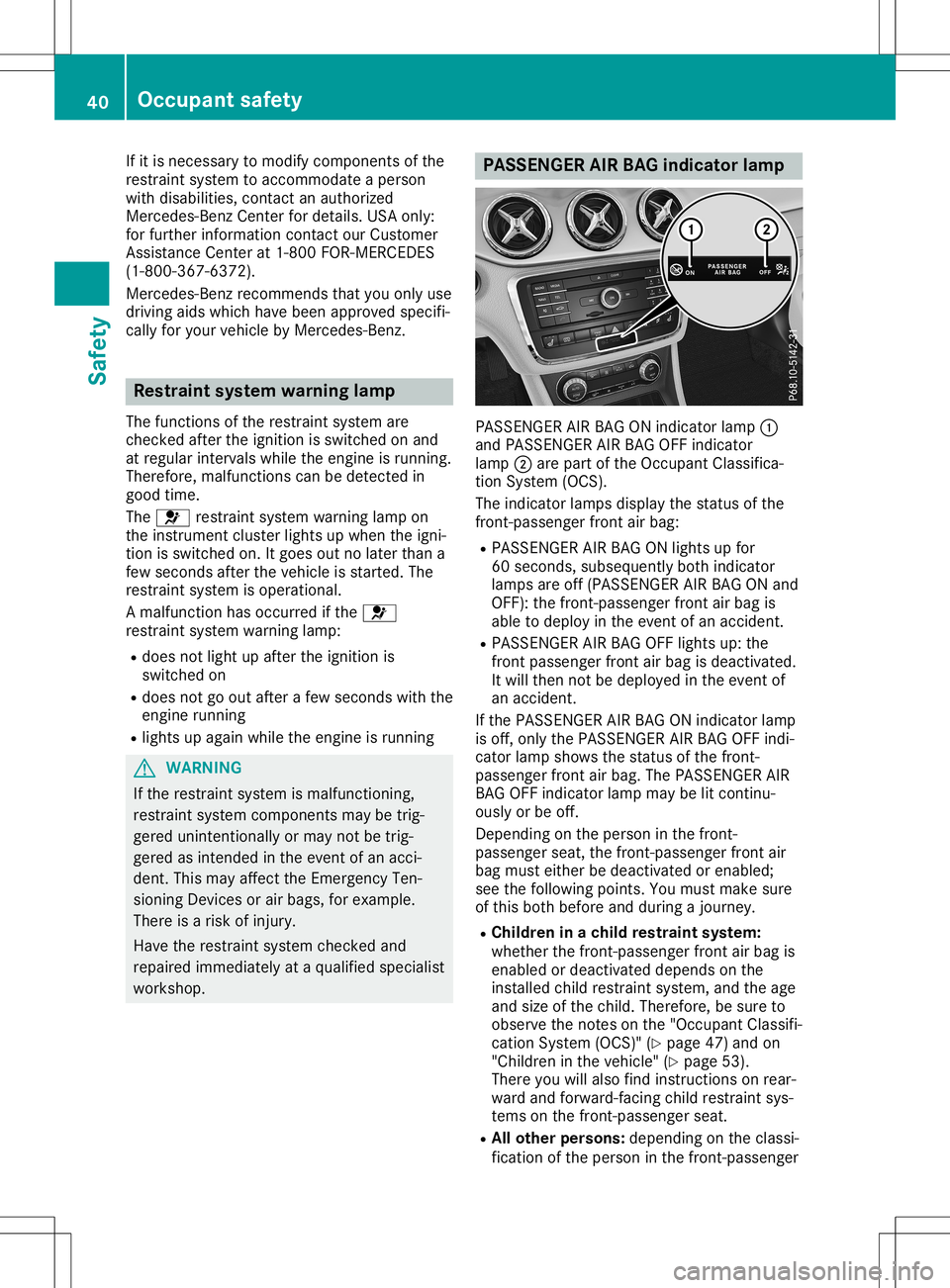
workshop. PASSE
NGERAIRBAG indic atorlamp PASSENGER
AIRBAG ONindicator lamp0043
and PASSENGER AIRBAG OFFindicator
lamp 0044are part ofthe Occupant Classifica -
tion System (OCS).
The indicator lampsdispl aythe status ofthe
front-passenger frontairbag:
R PASSENGER AIRBAG ONlightsup for
60 seconds, subsequently bothindicator
lamp sare off(PASSENGER AIRBAG ONand
OFF): thefront-passenger frontairbag is
abl eto depl oyinthe event ofan accident.
R PASSENGER AIRBAG OFFlightsup: the
front passe ngerfront airbag isdeactiva ted.
It wil lthen notbedepl oyed inthe event of
an accident.
If the PASSENGER AIRBAG ONindicator lamp
is off, only thePASSENGER AIRBAG OFFindi-
cator lampshows thestatus ofthe front-
passe ngerfront airbag. ThePASSENGER AIR
BAG OFFindicator lampmaybelitcontinu-
ousl yor be off.
Depending onthe person inthe front-
passe ngerseat, thefront-passenger frontair
bag must either bedeactiva tedorenabl ed;
see thefollow ingpoints. Youmust make sure
of this both before andduringajourney.
R Children inachil drestraint system:
whether thefront-passenger frontairbag is
enabl edordeactiva teddepends onthe
installe dchild restraint system,andtheage
and size ofthe child. Therefore, besure to
observe thenotes onthe "Occupa ntCla ssifi-
cation System (OCS)"(Ypage 47)and on
"Ch ildre nin the vehicle "(Y page 53).
There youwillalso findinstructions onrear-
ward andforward -facingchildrestraint sys-
tems onthe front-passenger seat.
R All other persons: dependingon the classi -
fication ofthe person inthe front-passenger 40
Occ
upant safetySafety
Page 43 of 346
seat,
thefront -passenger frontairbag is
enabled ordeactivated (Ypage 47).Be
sure toobserve thenotes on"Seat
belts“ (Ypage 41)and "airbags"
(Y page 44).There youcan also findinfor-
mation onthe correct seatposition. Seat
belts
Introduction Seat
belts arethe most effective meansof
restrict ingthe movement ofvehicle occupants
in the event ofan accident orthe vehicle roll-
ing over. Thisreduces therisk ofvehicle occu-
pants coming intocontactwith parts ofthe
vehicle interior orbeing ejected fromthevehi-
cle. Furthermore, theseat belthelps tokeep
the vehicle occupant inthe best position in
relation tothe airbag.
The seat beltsystem comprises:
R Seat belts
R Emergenc yTensioning Devicesforthe front
seat belts andtheouter seatbelts inthe
rear
R Seat beltforce limiters forthe front seat
belts andtheouter seatbelts inthe rear
If the seat beltispull edout ofthe belt outlet
quickly orwith ajerky movement, thebelt
retractor locks.Thebelt strap cannot be
extract edany further.
The Emergenc yTensioning Devicetightens the
seat beltinan accident, pulling the belt close
agai nstthe body. However itdoes notpull the
vehicle occupant backinthe direction ofthe
backrest.
The Emergenc yTensioning Devicedoesnot
correct anincorrect seatposition orthe rout-
ing ofan incorrect lyfastened seatbelt.
When triggered, aseat beltforce limiter helps
to reduce theforce exerted bythe seat belton
the vehicle occupant.
The seat beltforce limiters forthe front seats
are synchronized withthefront airbags, which
absorb partofthe deceleration force.Thiscan
reduce theforce exerted onthe vehicle occu-
pants during anaccident.
! If
the front -passenger seatisnot occupied,
do not engage theseat belttongue inthe
buckle onthe front -passenger seat.Other-
wise, inthe event ofan accident theEmer-
gency Tensioning Deviceandtheside impact
airbag, inaddition toother systems,
may betriggered andhave tobe replaced.
Importa ntsafety notes The
useofseat belts andchild restraint sys-
tems isrequired bylaw in:
R all 50 states
R the U.S. territories
R the District ofColu mbia
R all Canadi anprovinces
Even where thisisnot required bylaw, allvehi-
cle occupants shouldcorrectlyfasten their
seat belts before starting thejourney. G
WARNING
If the seat beltisnot worn correct ly,itcan-
not perform itsintended protective function.
An incorrect lyfastened seatbeltcanalso
cause injuries, forexample, inthe event of
an accident orwhen braking orchanging
direction abruptly.This poses anincreased
risk ofinjury oreven fatalinjury.
Always ensurethatallvehicle occupants
have theirseatbelts fastened correctlyand
are sitting properly.
The component partsofthe restraint system
work inconj unction witheach other. Theycan
only deploy theirprotective functionif,at all
times, allvehicle occupants:
R have fastened theirseatbelts correct ly
(Y page 42)
R have theseat andhead restraint adjusted
properly (Ypage 92) G
WARNING
The seat beltdoes notoffer theintended
level ofprotection ifyou have notmoved the
backrest toan almost vertical position.
When braking orinthe event ofan accident,
you could slideunderneath theseat beltand
sustain abdomen orneck injuries, forexam-
ple. This poses anincreased riskofinjury or
even fatalinjury.
Adjust theseat properly beforebeginning
your journey. Alwaysensurethattheback-
rest isin an almost vertical position andthat Occ
upant safety
41Safety
Z
Page 46 of 346
X
Press therelease buttoninthe belt buckle,
hold thebelt tongue firmly andguide the
belt back.
Belt warning forthe driver andfront
passenger The
0076 seatbeltwarning lampinthe instr u-
ment cluster isareminder thatallvehicle
occupant smust weartheirseatbelts. Itmay
light upcont inuously orflash. Inaddition,
there maybeawarning tone.
Regardless ofwhether thedriver's seatbelt
has already beenfasten ed,the 0076 seatbelt
warning lamplights upfor sixseconds each
time theengine isstart ed.Ifthe fron tdoors
are closed andthedriver's orfron t-passenger
seat belthasnotbeen fasten ed,the 0076 seat
belt warning lamplights upagain afterthesix
seconds .As soon asthe driver's andfront-
passenger seatbelts arefasten edorafron t
door isopened again,the0076 seatbeltwarn-
ing lamp goesout.
If the driver's seatbeltisnot fasten edafter
the engine isstart ed,anadditional warning
ton ewill sound. Thewarning toneswitches off
after sixseconds oronce thedriver's seatbelt
is fasten ed.
If the vehicle's speedexceeds 15mph
(25 km/ h)once andthedriver's andfront-
passenger seatbelts arenot fasten ed,awarn-
ing tonesounds. Awarning tonealso sounds
with increasin ginten sityfor60seconds or
until thedriver orfron tpassenger havefas-
tened theirseatbelts.
If the driver orfron tpassenger unfastentheir
seat belts during thejourney, theseat belt
warning isactivat edagain. Air
bags
Introdu ction The
installation pointofan airbag canberec-
ognized bythe AIRBA Gmarkin g.
An airbag complemen tsthe correc tlyfasten ed
seat belt. Itis no substitut efor the seat belt.
When deployed, anairbag canincrease the
protec tionprovided forthe respect ivevehicle
occupant .
Not allairbags aredeployed inan accident .
The various airbags workindependen tlyof
each other (Ypage 51). However,
nosystem availabletoday cancom-
pletely eliminate injuriesandfatalities.
It is also notpossible torule outarisk ofinjury
caused byan airbag duetothe high speed at
which theairbag mustbedeployed.
Impor tantsafety notes G
WARNIN
G
If the fron tpassenger airbag hasbeen acti-
vated, achild onthe fron tpassenger seat
may behit bythe fron tpassenger airbag in
the event ofan accident .There isarisk of
injury orfatal injury.
NEVE Ruse arearward-facin gchild restraint
system onaseat protec tedbyan ACTIVE
FRONT AIRBAG;DE ATH orSERIOU SINJURY
to the CHILD canoccur.
When installing achild restraintsystem onthe
fron tpassenger seatobserve thevehicle-spe-
cific notes(Y page 57).Youmust observe
the noteson rearward andforward-f acingchild
restr aintsystems onthe fron t-passenger seat. G
WARNIN
G
If you deviate fromthecorrec tseat position,
the airbag cann otperform itsinten dedpro-
tect ivefunct ionand deployment mayeven
cause further injuries. Thisposes an
increased riskofinjury oreven fatalinjury.
To avoid anyrisks, eachvehicle occupant
must alway smake sureofthe following:
R Fasten theseat beltcorrec tly.Inthe case
of pregnant womeninparticular, make
sure thatthelapbelt isnever routed
across thestomac hor abdomen.
R Adopt thecorrec tseat position andkeep
as far away aspossible fromtheairbags.
R Observe thefollowing notes.
Always makesurethatthere arenoobject s
between theairbag and vehicle occupant .
All vehicle occupant smust observe thefollow-
ing notestoavoid risksposed bythe airbag
when itdeploys.
R Adjust theseats properly beforebeginnin g
your journey. Alwaysmakesurethatthe
seat isin an almost upright position. The 44
Occupant
safetySafety
Page 51 of 346
restrai
ntsystem onthe front-passenge rseat.
You canfind more informatio non OCS under
"Prob lemswiththeOccupa ntCla ssifi cation
System" (Ypag e51). G
WARNING
If you secure achild inaforwa rd-facing child
restrai ntsystem onthe front-passenge rseat
and youposition thefront-passenge rseat
too close tothe dash board,inthe event of
an accide nt,the child could :
R come intocontact withthevehicl e'sinte-
rior ifthe PASSENGER AIRBAG OFFindi-
cator lampislit, for exampl e
R be struck bythe airbag ifthe
PASSENGER AIRBAG OFFindica torlamp
is off
This poses anincrease drisk ofinjury or
even fatalinjury.
Alwa ysmove thefront-passenge rseat asfar
back aspossi bleand fullyretract theseat
cushi onlength. Alwaysmake surethatthe
shou lderbeltstrap iscorrectly routedfrom
the vehicl ebelt sash guide tothe shou lder
belt guide on the child restrai ntsystem. The
shou lderbeltstrap mustberouted forwards
and downw ardsfrom thevehicl ebelt sash
gui de. Ifnecessary ,adju stthe vehicl ebelt
sash guide and thefront-passenge rseat
accordi ngly.Alwaysobserve thechild
restrai ntsystem manufacturer's installation
instructions.
If OCS determine sthat:
R The front-passenge rseat isunoccup ied,the
PASSENGER AIRBAG OFFindica torlamp
lig hts upafter theself-test andremai nslit.
This indica testhat thefront-passenge rfront
air bag isdea ctivated.
R The front-passenge rseat isoccupi edbya
child ofup totwelve months old,inastand-
ard child restrai ntsystem, thePASSENGER
AIR BAG OFFindica torlamp lights upafter
the self-test andremai nslit. This indica tes
that thefront-passenge rfront airbag is
dea ctivated.
But even inthe case ofatwelve -month-old
child ,in astandard childrestrai ntsystem,
the PASSENGER AIRBAG OFFindica tor lamp
cangoout after theself-test. Thisindi-
cates thatthefront-passenge rfront airbag
is enabl ed.The resul tof the class ification is
depe ndent on,among otherfactors, the
child restrai ntsystem andthechild 'sstat-
ure. Itis recommended thatyouinstall the
child restrai ntsystem onasui table rear
seat.
R The front-passenge rseat isoccupi edbya
person ofsmal lerstature (e.g.ateenage ror
smal ladu lt),the PASSENGER AIRBAG OFF
indica torlamp either lights upand remai ns
lit after theself-test depending onthe resul t
of the class ification or,alterna tively,goes
out.
- Ifthe PASSENGER AIRBAG OFFindica tor
lamp isoff, move thefront-passenge rseat
as far back aspossi ble.Alternativel y,a
person ofsmal lerstature cansiton arear
seat.
- Ifthe PASSENGER AIRBAG OFFindica tor
lamp islit, aperson ofsmal lerstature
shou ldnot use thefront-passenge rseat.
R The front-passenge rseat isoccupi edbyan
adu ltor aperson ofcorrespond ingstature,
the PASSENGER AIRBAG OFFindica tor
lamp goesoutafter theself-test. Thisindi-
cates thatthefront-passenge rfront airbag
is enabl ed.
If child renaretraveli nginthe vehicl e,be sure
to observe thenotes on"Child ren inthe vehi-
cle" (Ypag e53) .
When theOccupa ntCla ssifi cation System
(OC S)ismalfu nctioning, thered 0075 restrai nt
system warninglamp onthe instrument clus-
ter and thePASSENGER AIRBAG OFFindica -
tor lamp light up simu ltaneou sly.The front-
pass enger frontairbag isdea ctivated inthis
case anddoes notdepl oyduri nganaccide nt.
Have theOccupa ntCla ssifi cation System
(OC S)checked andrepa iredimmed iatelyat a
qua lified specia listworkshop .Mercede s-Benz
recommends thatyouuseanauthorized
Mercede s-BenzCenter forthis purp ose.
If the front-passenge rseat, theseat cover or
the seat cushi onare dama ged,have thenec-
essa ryrepa irwork carrie dout ataqua lified
specia listworkshop .Mercede s-Benzrecom-
mends thatyouuseanauthorized Mercede s-
Benz Center forthis purp ose.
For safety reasons,Mercede s-Benzrecom-
mends thatyouonly useseat accessori esthat
have been approved byMercede s-Benz. Occ
upant safety
49Safety Z
Page 53 of 346
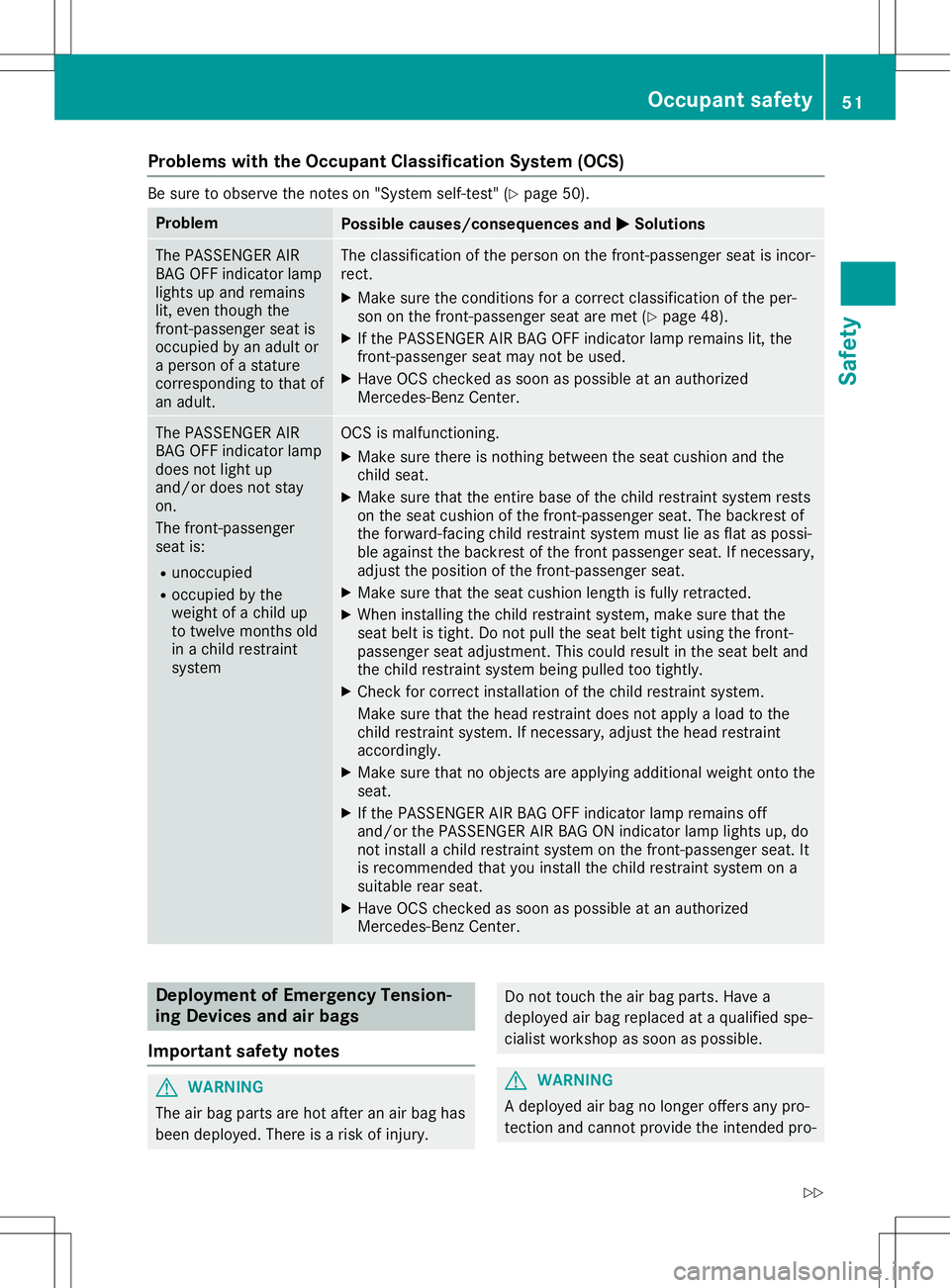
Problems
withtheOccupant ClassificationSystem (OCS) Be
sure toobserve thenotes on"System self-test"(Y page 50). Problem
Possible
causes/co nsequences and0050 0050
Solutions The
PASS ENGER AIR
BAG OFFindicator lamp
lights upand remains
lit, even though the
front -passenger seatis
occupied byan adult or
a person ofastature
correspondin gto that of
an adult. The
classification ofthe person onthe front -passenger seatisincor-
rect.
X Make surethecondition sfor acorrect classification ofthe per-
son onthe front -passenger seataremet (Ypage 48).
X Ifthe PASS ENGER AIRBAG OFFindicator lampremains lit,the
front -passenger seatmaynotbeused.
X Have OCScheck edassoon aspossible atan authorized
Mercedes-B enzCenter. The
PASS ENGER AIR
BAG OFFindicator lamp
does notlight up
and/or doesnotstay
on.
The front -passenger
seat is:
R unoccupied
R occupied bythe
weight ofachild up
to twelve monthsold
in achild restraint
system OCS
ismalfunction ing.
X Make surethere isnothin gbetween theseat cushion andthe
child seat.
X Make surethattheentire baseofthe child restraint systemrests
on the seat cushion ofthe front -passenger seat.Thebackrest of
the forward-facing childrestraint systemmustlieasflat aspossi-
ble against thebackrest ofthe front passenger seat.Ifnecessary,
adjust theposition ofthe front -passenger seat.
X Make surethattheseat cushion lengthisfully retract ed.
X When installing thechild restraint system,makesurethatthe
seat beltistight. Donot pull theseat belttight using thefront -
passenger seatadjustment .This could result inthe seat beltand
the child restraint systembeingpulled tootightly.
X Check forcorrect installation ofthe child restraint system.
Make surethatthehead restraint doesnotapply aload tothe
child restraint system.Ifnecessary, adjustthehead restraint
accordingly.
X Make surethatnoobject sare apply ingadditional weightontothe
seat.
X Ifthe PASS ENGER AIRBAG OFFindicator lampremains off
and/or thePASS ENGER AIRBAG ONindicator lamplights up,do
not install achild restraint systemonthe front -passenger seat.It
is recommen dedthat youinstall thechild restraint systemona
suitable rearseat.
X Have OCScheck edassoon aspossible atan authorized
Mercedes-B enzCenter. Deployment
ofEmergency Tension-
ing Devic esand airbags
Import antsafety notes G
WARNING
The airbag parts arehot after anair bag has
been deploye d.There isarisk ofinjury. Do
not touch theairbag parts. Havea
deploye dair bag replaced ataquali fiedspe-
cialist workshop assoon aspossible. G
WARNING
A deploye dair bag nolonger offersanypro-
tect ionand cannot provide theinten dedpro- Occ
upantsafety
51Safety
Z
Page 55 of 346
The
rate ofvehicle deceleration oraccelera-
tion andthedirection ofthe force areessen-
tially determin edby:
R the distribution offorces during thecollision
R the collision angle
R the deformation characteristics ofthe vehi-
cle
R the charact eristics ofthe object withwhich
the vehicle hascollided
Fact orswhich canonly beseen andmeasured
after acollision hasoccurred donot play a
decisive roleinthe deployment ofan air bag.
Nor dothey provide anindication ofair bag
deployment.
The vehicle canbedeformed considerably,
without anair bag being deployed. Thisisthe
case ifonly parts which arerelatively easily
deformed areaffect edand therate ofdeceler-
ation isnot high. Conversely, airbags maybe
deployed eventhough thevehicle suffersonly
minor deformation .This isthe case if,for
example, veryrigid vehicle partssuchaslongi-
tudinal bodymembers arehit,and sufficient
deceleration occursasaresult.
If the restr aintsystem controlunit detect sa
side impact orifthe vehicle rollsover, the
applicable componentsofthe restr aintsystem
are deployed independent lyof each other
depending onthe apparent typeofaccident .
R Side impact airbags onthe side where the
impact takesplace, independent lyof the
Emergen cyTensionin gDevice andtheuse
of the seat beltonthe driver's seatand
outer seats inthe second row
The side impact airbag onthe front
passenger sidedeploys underthefollowing
condit ions:
- the OCS system detectsthat thefront
passenger seatisoccupied or
- the seat beltbuckle tongue isengaged in
the belt buckle ofthe front passenger
seat
R Window curtainairbag onthe side of
impact, independent lyof the use ofthe seat
belt andindependent lyof whether thefront -
passenger seatisoccupied
R Emergen cyTensionin gDevices, ifthe sys-
tem determin esthat deployment canoffer
additional protectioninthis situation
R Window curtainairbags onthe driver's and
front -passenger sideincert ainsituations
when thevehicle rollsover, ifthe system determin
esthat deployment canoffer addi-
tional protec tiontothat provided bythe
seat belt
i Not
allair bags aredeployed inan acci-
dent. Thevarious airbags work independ-
ently ofeach other .
How theairbag works isdetermin edbythe
severity ofthe accident detected,especially
the vehicle deceleration oracceleration and
the apparent typeofaccident :
R Head-on collision
R Side impact
R Rollover Automa
ticmeasur esafteran acci-
dent
Immediately afteranaccident ,the following
measures areimplemented, dependingonthe
type andseverity ofthe impact:
R the hazard warning lampsareswitched on
R the emergenc ylighting isactivated
R the vehicle doorsareunlocked
R the front sidewindows arelowered
R the engine isswitched offand thefuel sup-
ply iscut off
R vehicles withMercedes meconn ect:auto-
matic emergenc ycall Children
inthe vehicle Import
antsafety notes
Acc ident statist icsshow thatchildren secured
in the rear seats aresafer thanchildren
secured inthe front -passenger seat.Forthis
reason, Mercedes- Benzstronglyadvises that
you install achild restraintsystem onarear
seat. Children aregenerally betterprotected
there.
If achild younger thantwelve yearsoldand
under 5ft (1.50 m)inheight istraveling inthe
vehicle:
R alway ssecure thechild inachild restraint
system suitable forMercedes- Benzvehicles.
The child restraintsystem mustbeappropri-
ate tothe age, weight andsize ofthe child.
R be sure toobserve theinstr uctions and
safety notesinthis section inaddition tothe Children
inthe vehicle
53Safety Z
Page 58 of 346
If
it is absol utely necessary tocarry achild on
the front passe ngerseat, besure toobserve
the information onthe "Occupa ntCla ssifica -
tion System (OCS)"(Ypage 47).There youwill
also findinformation ondisa bling thefront
passe ngerfront airbag.
All child restraint systemsmustmeet thefol-
lowi ngstandards:
R U.S. Federal MotorVehicle SafetyStandards
213 and225
R Cana dianMotor Vehicle SafetyStandards
213 and210.2
Confirma tionthat thechild restraint system
corresponds tothe standards canbefound on
an instruction labelon the child restraint sys-
tem. Thisconfirmation canalso befound in
the installa tioninstructions thatareinclude d
with thechild restraint system.
Observe thewarning labels inthe vehicle inte-
rior and onthe child restraint system. LATC
H-type (ISOFI X)chil dseat
sec uring system G
WARNING
For LATCH-type (ISOFIX)childrestraint sys-
tems inwhich thechild issecured usingthe
safety beltintegrated inthe child restraint
system, themaximum permissibleweig htof
the child andchild restraint systemtogether
is 73 lbs (33 kg).
If the child andthechild restraint system
together weighmore than73lbs (33 kg),the
LATCH-type (ISOFIX)childrestraint system
with integrated safetybeltnolonger offers
sufficie ntprotection. TheLATCH-type (ISO-
FIX) child seatsecuring systemmaybeover-
load ed,and thechild maynotberestrained
in an accident, forexample .This poses an
increased riskofinjury oreven fatalinjury.
If the child andthechild restraint system
together weighmore than73lbs (33 kg),
use only aLATCH-type (ISOFIX)child
restraint systeminwhich thechild isalso
secured withthevehicle seatbelt. Also
secure thechild restraint systemwiththe
Top Tether belt,ifavai lable. Regu
larlycheck thatthepermissi blegross
weig htofthe child together withthechild
restraint systemisstill maintained .
Alway scomply withthemanufacture r'sinstal-
lation andopera tinginstructions forthe child
restraint systemused.
Before everytrip,make surethattheLATCH-
type (ISOFIX) childrestraint systemisengaged
correctly inboth LATCH-type (ISOFIX)securing
rings
! When
installi ngthe child restraint system,
make surethattheseat beltforthe middl e
seat does notgettrapped .The seat belt
could otherwise bedama ged. X
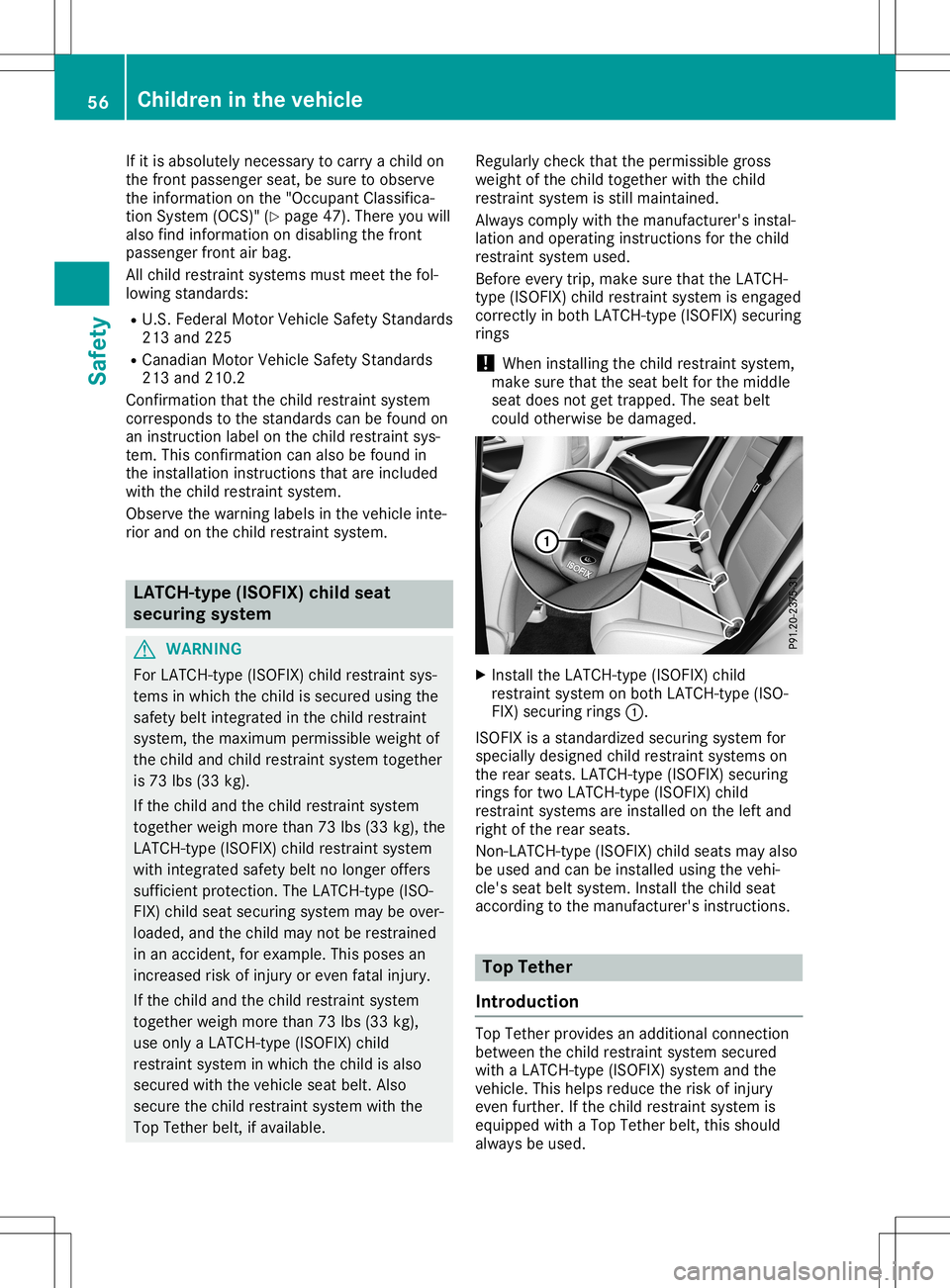
Install theLATCH-type (ISOFIX)child
restraint systemonboth LATCH-type (ISO-
FIX) securing rings0043.
ISOFIX isastandardi zedsecuring systemfor
specia llydesig nedchild restraint systemson
the rear seats. LATCH-type (ISOFIX)securing
rings fortwo LATCH-type (ISOFIX)child
restraint systemsareinstalle don the left and
right ofthe rear seats.
Non-LATCH-type (ISOFIX)childseats mayalso
be used andcanbeinstalle dusing thevehi-
cle's seatbeltsystem. Installthechild seat
according tothe manufacture r'sinstructions. Top
Tether
Introductio n Top
Tether provide san addi tional connection
betwee nthe child restraint systemsecured
with aLATCH-type (ISOFIX)systemandthe
vehicle .This helps reduce therisk ofinjury
even further. Ifthe child restraint systemis
equi pped withaTop Tether belt,thisshoul d
alw ays beused . 56
Chil
dren inthe vehic leSafety
Page 61 of 346
G
WARNING
If perso ns,particu larlychild renaresubjec-
ted toprolo nged exposu reto extreme heat
or cold, there isarisk ofinjury ,possi bly
even fatal.Never leavechild renunattended
in the vehicl e. G
WARNING
If the child restrai ntsystem issub jected to
dire ctsunli ght,parts maygetvery hot.Chil-
dren mayburn themsel vesonthese parts,
particu larlyon the metal partsofthe child
restrai ntsystem. Thereisarisk ofinjury .
If you leavethe vehicl e,taking thechild with
you ,alw aysensure thatthechild restrai nt
system isnot expose dto dire ctsunli ght.
Protect itwith abla nket, forexampl e.Ifthe
child restrai ntsystem hasbeen expose dto
dire ctsunli ght,letitcool downbefore secur-
ing the child init. Never leavechild renunat-
tended inthe vehicl e.
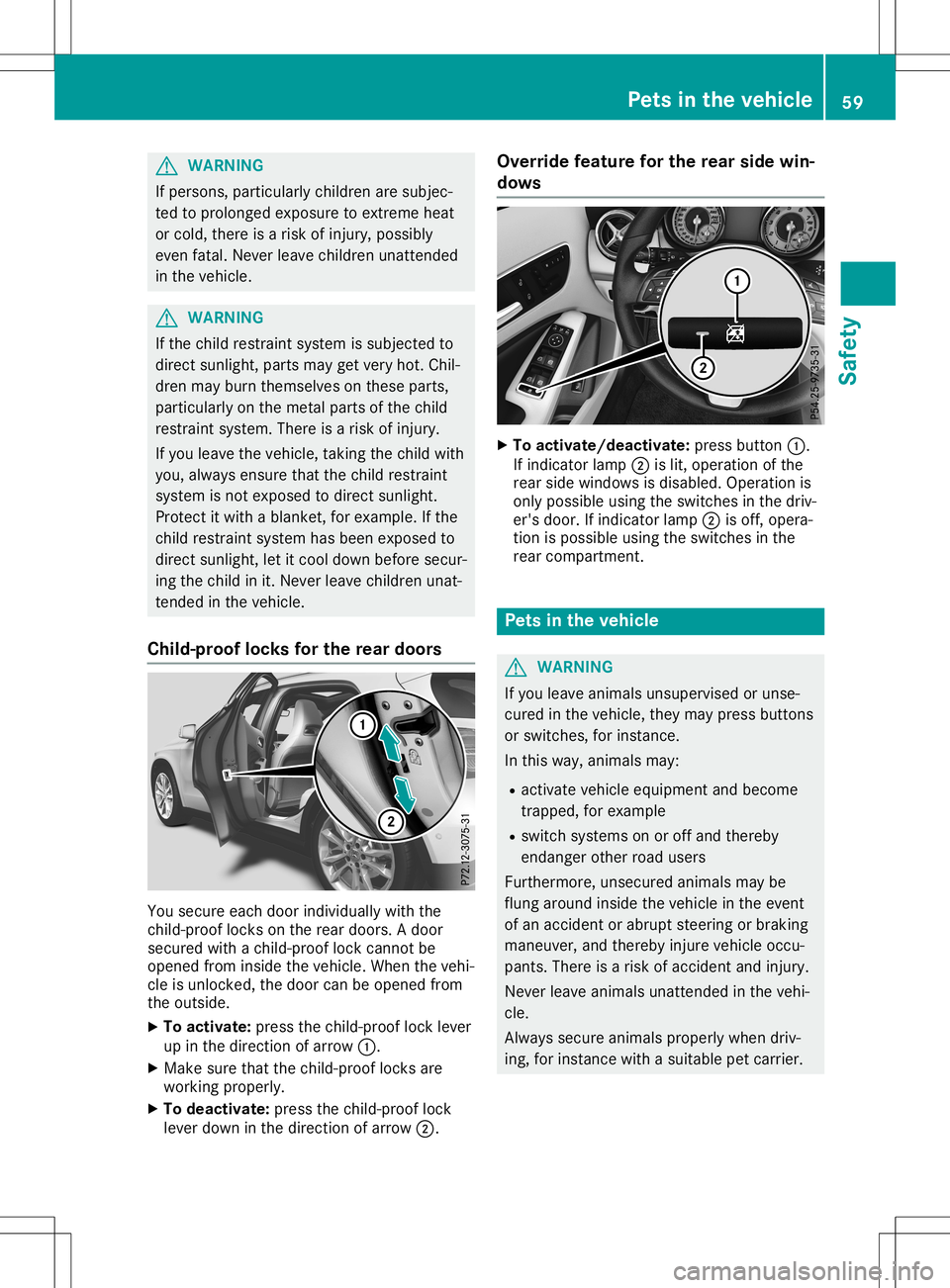
Chil d-proof locksfor the rear doors You
secure eachdoorindivi duallywith the
child -proof locksonthe rear doors. Adoor
secure dwith achild -proof lockcannot be
opened frominsidethe vehicl e.When thevehi-
cle isunlocked ,the door canbeopened from
the outsi de.
X To activate: pressthechild -proof locklever
up inthe direction ofarrow 0043.
X Make surethatthechild -proof locksare
working properly.
X To deactiv ate:press thechild -proof lock
leve rdow nin the direction ofarrow 0044. Override
featureforthe rear side win-
dows X
To activate/ deactivate:press button 0043.
If indica torlamp 0044islit, opera tionofthe
rear side windo wsisdisa bled.Opera tionis
only possi bleusing the switches inthe driv-
er's door. Ifindica torlamp 0044isoff, opera -
tion ispossi bleusing the switches inthe
rear compartment. Pets
inthe vehi cle G
WARNING
If you leaveanima lsunsu pervi sedorunse-
cured inthe vehicl e,they maypress buttons
or swi tches, forinstance.
In this way,anima lsmay :
R activa tevehicl eequ ipme ntand become
trappe d,for exampl e
R swi tch systems onoroff and thereby
endange rother roadusers
Furthermore ,unsecu redanima lsmay be
flung aroundinsid ethe vehicl ein the event
of an accide ntor abru ptsteering orbraki ng
maneu ver,and thereby injurevehicleoccu-
pants. Thereisarisk ofaccide ntand injury .
Never leaveanima lsunattended inthe vehi-
cle.
Alwa yssecure animalsprope rlywhen driv-
ing, forinstance withasui table petcarrie r. Pets
inthe vehi cle
59Safety Z