weight MERCEDES-BENZ GLC 2018 Owner's Manual
[x] Cancel search | Manufacturer: MERCEDES-BENZ, Model Year: 2018, Model line: GLC, Model: MERCEDES-BENZ GLC 2018Pages: 390, PDF Size: 9.04 MB
Page 364 of 390
Step 3
Example 1 Example 2 Example 3
Permissible load (maxi-
mum gross vehicle
weight rating from the
Tire and Loading Infor-
mation placard minus
the gross weight of all
occupants) 1500 lbs (680 kg)
Page 368 of 390
The speed rating of tires mounted at the factory
may be higher than the maximum permissible
speed permitted by the electronic speed limiter.
Make sure that your tires have the required
speed rating, e.g. when buying new tires. You
can find information on this under "Tires"
( Y
page 373).
Further information about reading tire data can
be obtained from any qualified specialist work-
shop.
Load index
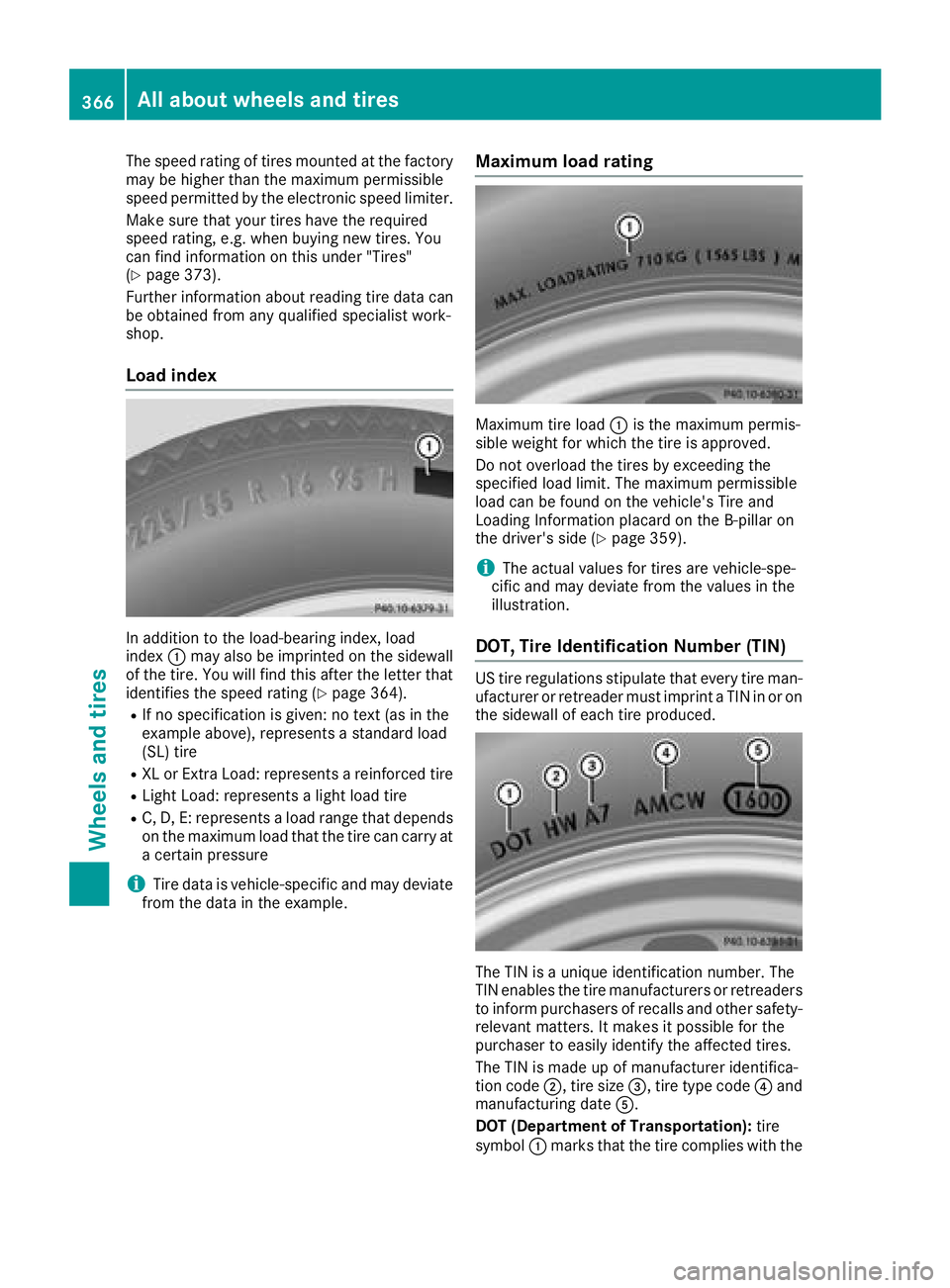
In addition to the load-bearing index, load
index C may also be imprinted on the sidewall
of the tire. You will find this after the letter that
identifies the speed rating ( Y
page 364).R
If no specification is given: no text (as in the
example above), represents a standard load
(SL) tire R
XL or Extra Load: represents a reinforced tire R
Light Load: represents a light load tire R
C, D, E: represents a load range that depends
on the maximum load that the tire can carry at
a certain pressure
i Tire data is vehicle-specific and may deviate
from the data in the example. Maximum load rating
Maximum tire load C is the maximum permis-
sible weight for which the tire is approved.
Do not overload the tires by exceeding the
specified load limit. The maximum permissible
load can be found on the vehicle's Tire and
Loading Information placard on the B-pillar on
the driver's side ( Y
page 359).
i The actual values for tires are vehicle-spe-
cific and may deviate from the values in the
illustration.
DOT, Tire Identification Number (TIN) US tire regulations stipulate that every tire man-
ufacturer or retreader must imprint a TIN in or on
the sidewall of each tire produced.
The TIN is a unique identification number. The
TIN enables the tire manufacturers or retreaders
to inform purchasers of recalls and other safety-
relevant matters. It makes it possible for the
purchaser to easily identify the affected tires.
The TIN is made up of manufacturer identifica-
tion code D , tire size
Page 370 of 390
Speed rating The speed rating is part of the tire identification.
It specifies the speed range for which the tire is
approved.
GVW (Gross Vehicle Weight) The gross vehicle weight includes the weight of
the vehicle including fuel, tools, the spare wheel,
accessories installed, occupants, luggage and
the drawbar noseweight, if applicable. The gross
vehicle weight must not exceed the gross vehi-
cle weight rating GVWR as specified on the vehi-
cle identification plate on the B-pillar on the
driver's side.
GVWR (Gross Vehicle Weight Rating) The GVWR is the maximum permissible gross
weight of a fully loaded vehicle (the weight of the
vehicle including all accessories, occupants,
fuel, luggage and the drawbar noseweight, if
applicable). The gross vehicle weight rating is
specified on the vehicle identification plate on
the B-pillar on the driver's side.
Maximum loaded vehicle weight The maximum weight is the sum of: R
the curb weight of the vehicle R
the weight of the accessories R
the load limit R
the weight of the factory installed optional
equipment
Kilopascal (kPa) Metric unit for tire pressure. 6.9 kPa corre-
sponds to 1 psi. Another unit for tire pressure is
bar. 100 kilopascals (kPa) are the equivalent of
1 bar.
Load index
In addition to the load-bearing index, the load
index may also be imprinted on the sidewall of
the tire. This specifies the load-bearing capacity
more precisely.
Curb weight
The weight of a vehicle with standard equipment
including the maximum capacity of fuel, oil and
coolant. It also includes the air-conditioning sys-
tem and optional equipment if these are instal-
led in the vehicle, but does not include passen-
gers or luggage. Maximum load rating The maximum tire load is the maximum permis-
sible weight in kilograms or lbs for which a tire is
approved.
Maximum permissible tire pressure Maximum permissible tire pressure for one tire.
Maximum load on one tire Maximum load on one tire. This is calculated by
dividing the maximum axle load of one axle by
two.
PSI (pounds per square inch) A standard unit of measure for tire pressure.
Aspect ratio Relationship between tire height and tire width
in percent.
Tire pressure This is pressure inside the tire applying an out-
ward force to each square inch of the tire's sur-
face. The tire pressure is specified in pounds per
square inch (psi), in kilopascal (kPa) or in bar.
The tire pressure should only be corrected when
the tires are cold.
Cold tire pressure The tires are cold: R
if the vehicle has been parked with the tires
out of direct sunlight for at least three hours
and R
if the vehicle has not been driven further than
1 mile (1.6 km)
Tread
The part of the tire that comes into contact with
the road.
Bead
The tire bead ensures that the tire sits securely
on the wheel. There are several steel wires in the
bead to prevent the tire from coming loose from
the wheel rim.
Sidewall
The part of the tire between the tread and the
bead.368
All about wheels and tires
Wheels and tires
Page 371 of 390
Weight of optional extras The combined weight of those optional extras
that weigh more than the replaced standard
parts and more than 5 lbs (2.3 kg). These
optional extras, such as high-performance
brakes, level control, a roof rack or a high-per-
formance battery, are not included in the curb
weight and the weight of the accessories.
TIN (Tire Identification Number) This is a unique identifier which can be used by
a tire manufacturer to identify tires, for example
for a product recall, and thus identify the pur-
chasers. The TIN is made up of the manufactur-
er's identity code, tire size, tire type code and
the manufacturing date.
Load bearing index The load bearing index (also load index) is a code
that contains the maximum load bearing capa-
city of a tire.
Traction Traction is the result of friction between the tires
and the road surface.
Treadwear indicators Narrow bars (tread wear bars) that are distrib-
uted over the tire tread. If the tire tread is level
with the bars, the wear limit of
Page 386 of 390
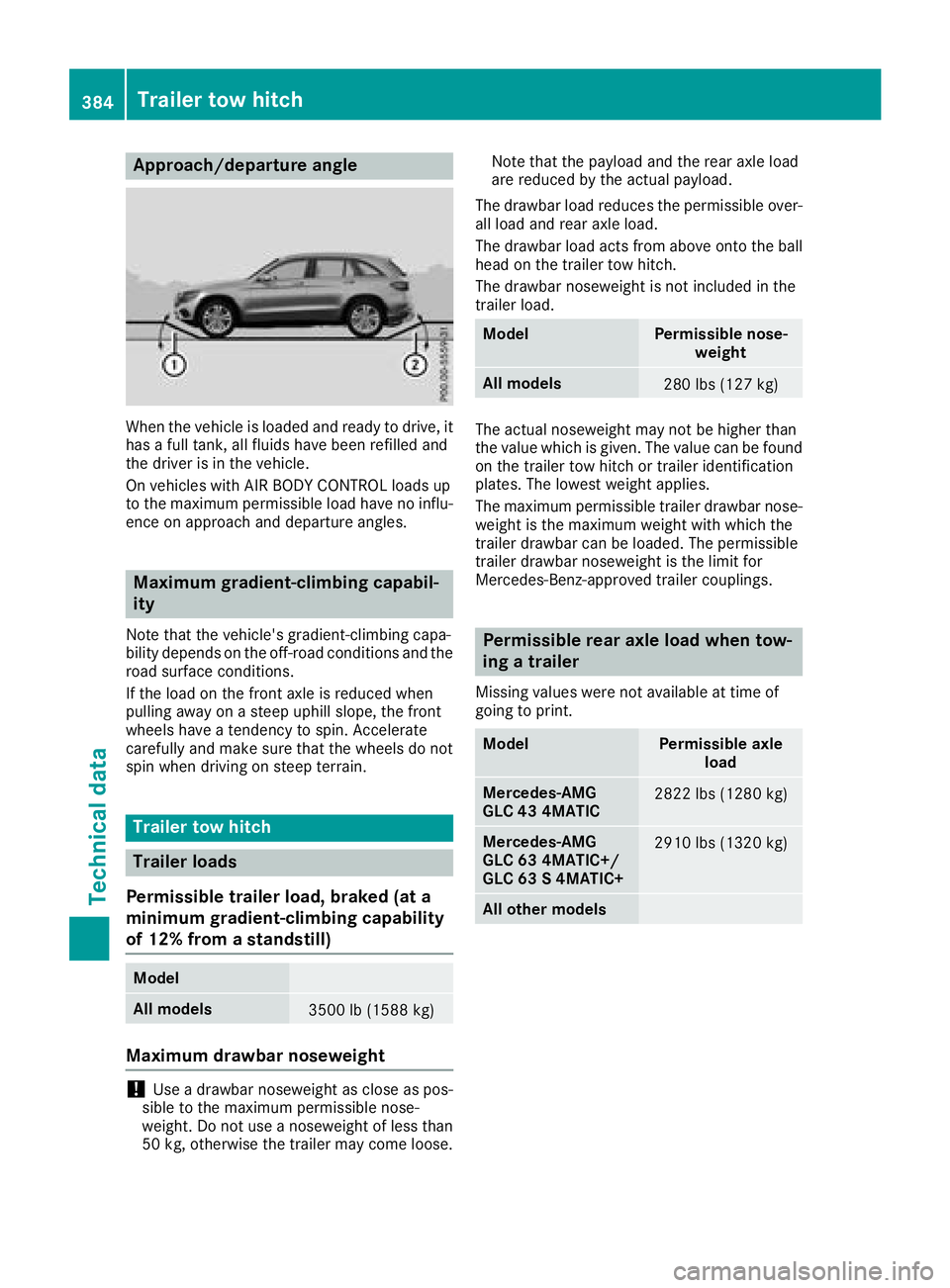
App roa ch/depa rt ure angle
When th e vehicl e is loade d and read y to drive, it
has a full tank, all fluid s hav e been refilled and
th e driver is in th e vehicle.
On vehicles wit h AI R BODY CONTROL loads up
to th e maximum permissibl e load hav e no influ-
ence on approac h and departur e angles.
Maximum gradient-cli mb ing capabil-
ity Not e that th e vehicle's gradient-climbing capa-
bilit y depend s on th e off-road condition s and th e
road surfac e conditions.
If th e load on th e fron t axl e is reduce d when
pullin g away on a steep uphil l slope, th e fron t
wheels hav e a tendency to spin . Accelerate
carefully and mak e sur e that th e wheels do no t
spin when drivin g on steep terrain .
Trailer tow hitch
Trailer loads
Per mi ssible trailer load, braked (at a
mi nimum gradient-cli mb ing capability
of 12% fr om a standstill)
Model
All models
3500 lb (1588 kg)
Maximum drawbar noseweight
! Use a drawbar noseweight as close as pos -
sibl e to th e maximum permissibl e nose-
weight. Do no t use a noseweight of less than
50 kg, otherwise th e trailer may come loose. Not e that th e payload and th e rear axl e load
are reduce d by th e actual payload .
The drawbar load reduce s th e permissibl e over-
all load and rear axl e load.
The drawbar load act s from abov e onto th e ball
head on th e trailer to w hitch .
The drawbar noseweight is no t included in th e
trailer load.
Model Permissible nose-
weigh t
All models
28 0 lbs (12 7 kg)
The actual noseweight may no t be higher than
th e value whic h is given . The value can be foun d
on th e trailer to w hitch or trailer identification
plates. The lowes t weigh t applies.
The maximum permissibl e trailer drawbar nose-
weigh t is th e maximum weigh t wit h whic h th e
trailer drawbar can be loaded. The permissibl e
trailer drawbar noseweight is th e limi t for
Mercedes-Benz-approved trailer couplings.
Per mi ssible rear axle load when tow-
ing a trailer Missing value s were no t available at time of
goin g to print .
Model Permissible axle
load
Mercedes-AMG
GLC 43 4MATIC 2822 lbs (1280 kg)
Mercedes-AMG
GLC 63 4MATIC+/
GLC 63 S 4MATIC+ 2910 lbs (1320 kg)
All other models384
Trailer tow hitch
Technical data