tow MERCEDES-BENZ GLC 2018 Manual PDF
[x] Cancel search | Manufacturer: MERCEDES-BENZ, Model Year: 2018, Model line: GLC, Model: MERCEDES-BENZ GLC 2018Pages: 390, PDF Size: 9.04 MB
Page 338 of 390
Therefore, place the tire sealant bottle with
filler hose in the plastic bag which is con-
tained in the TIREFIT kit.
H Environmental note
Have the used tire sealant bottle disposed of
professionally, e.g. at a qualified specialist
workshop.
! Do not operate the tire inflation compressor
for longer than ten minutes at a time without
a break. It may otherwise overheat.
The tire inflation compressor can be operated
again once it has cooled down.
Comply with the manufacturer’s safety instruc-
tions on the sticker on the tire inflation com-
pressor.
Using the TIREFIT kit X
Do not remove any foreign objects which have
penetrated the tire, e.g. screws or nails. X
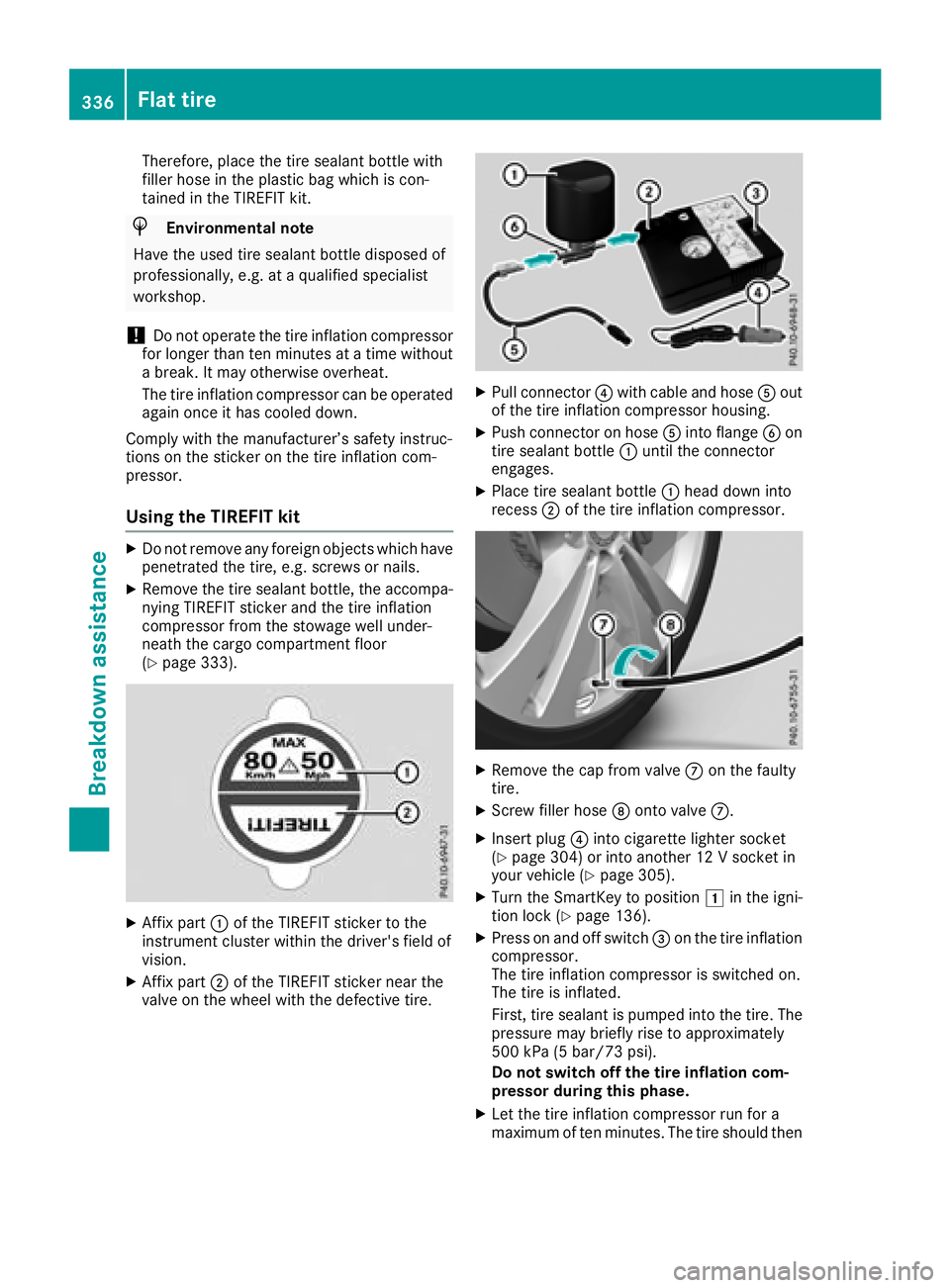
Remove the tire sealant bottle, the accompa-
nying TIREFIT sticker and the tire inflation
compressor from the stowage well under-
neath the cargo compartment floor
( Y
page 333).
X
Affix part C of the TIREFIT sticker to the
instrument cluster within the driver's field of
vision. X
Affix part D of the TIREFIT sticker near the
valve on the wheel with the defective tire. X
Pull connector
Page 339 of 390
have attained a pressure of at least 200 kPa
(2.0 bar/29 psi).
If a pressure of 200 kPa (2.0 bar/29 psi) has
been attained after five minutes, see "Tire pres-
sure reached" ( Y
page 337).
If a tire pressure of 200 kPa (2.0 bar/29 psi) has
not been attained after five minutes, see "Tire
pressure not reached" ( Y
page 337).
If tire sealant has escaped, clean it off affected
areas as quickly as possible. Use plain water if
possible.
If your clothes are soiled with tire sealant, have
them cleaned with perchloroethylene at a dry
cleaner as soon as possible.
Tire pressure not reached If a tire pressure of 200 kPa (2.0 bar/29 psi) has
not been attained after ten minutes: X
Switch off the tire inflation compressor. X
Unscrew the filler hose from the valve of the
faulty tire.
Tire sealant may escape when the filler hose is
unscrewed. X
Very slowly drive forwards or reverse approx-
imately 30 ft (10 m). X
Pump up the tire again.
After a maximum of ten minutes, the tire pres-
sure must be at least 200 kPa (2.0 bar/
29 psi).
G WARNING
If the required tire pressure is not reached
after the specified time, the tire is too badly
damaged. The tire sealant cannot repair the
tire in this instance. Damaged tires and a tire
pressure that is too low can significantly
impair the vehicle's braking and driving char-
acteristics. There is a risk of accident.
Do not continue driving. Contact a qualified
specialist workshop.
Tire pressure reached
G WARNING
A tire temporarily sealed with tire sealant
impairs the driving characteristics and is not
suitable for higher speeds. There is a risk of
accident. You should therefore adapt your driving style
accordingly and drive carefully. Do not exceed
the specified maximum speed with a tire that
has been repaired using tire sealant.
The maximum permissible speed for a tire
sealed with tire sealant is 50 mph (80 km/h).
The upper part of the TIREFIT sticker must be
affixed to the instrument cluster in the driver's
field of vision.
If a tire pressure of 200 kPa (2.0 bar/29 psi) has
been attained after ten minutes: X
Switch off the tire inflation compressor. X
Unscrew the filler hose from the valve of the
faulty tire.
Tire sealant may escape when the filler hose is
unscrewed. X
Stow the tire sealant bottle and the tire infla-
tion compressor. X
Pull away immediately .X
Stop after driving for approximately ten
minutes and check the tire pressure with the
tire inflation compressor.
The tire pressure must now be at least
130 kPa (1.3 bar/19 psi).
G WARNING
If the required tire pressure is not reached
after driving for a short period, the tire is too
badly damaged. The tire sealant cannot repair
the tire in this instance. Damaged tires and a
tire pressure that is too low can significantly
impair the vehicle's braking and driving char-
acteristics. There is a risk of accident.
Do not continue driving. Contact a qualified
specialist workshop.
In cases such as the one mentioned above, con-
tact an authorized Mercedes-Benz Center. Or
call 1-800-FOR-MERCedes (in the USA) or
1-800-387-0100 (in Canada). X
Correct the tire pressure if it is still at least
130 kPa (1.3 bar/19 psi). See the Tire and
Loading Information placard on the B-pillar on
the driver's side or the tire pressure table in
the fuel filler flap for values. X
To increase the tire pressure: switch on the
tire inflation compressor. Flat tire 337
Breakdown assistance Z
Page 346 of 390
In such cases, use a tow bar. Before towing,
make sure that the steering moves freely.
G WARNING
You can no longer steer the vehicle if the
steering wheel lock has been engaged. There
is a risk of an accident.
Always switch off the ignition when towing the
vehicle with a tow cable or a tow bar.
G WARNING
When towing or tow-starting another vehicle
and its weight is greater than the permissible
gross weight of your vehicle, the: R
the towing eye could detach itself R
the vehicle/trailer combination could roll-
over.
There is a risk of an accident.
When towing or tow-starting another vehicle,
its weight should not be greater than the per-
missible gross weight of your vehicle.
Details on the permissible gross vehicle weight
of your vehicle can be found on the vehicle iden-
tification plate ( Y
page 376).
! When Active Brake Assist, Distance Pilot
DISTRONIC or the HOLD function is activated,
the vehicle brakes automatically in certain
situations.
To avoid damage to the vehicle, deactivate
these systems in the following or similar sit-
uations: R
when towing the vehicle R
in the car wash
! Make sure that the electric parking brake is
released. If the electric parking brake is faulty,
visit a qualified specialist workshop.
! Only secure the tow rope or tow bar at the
towing eyes, or the trailer tow hitch, if availa-
ble. You could otherwise damage the vehicle.
! Do not use the trailer tow hitch for recovery
or towing. Do not use the towing eye for
recovery. this could damage the vehicle. If in
doubt, have the vehicle recovered using a
crane. ! When towing, pull away slowly and
smoothly. If the tractive power is too high, the
vehicles could be damaged.
! Shift the automatic transmission to position
\\ and do not open the driver's or front pas-
senger's door during towing. The automatic
transmission may otherwise shift to position
] , which could damage the transmission.
! Do not tow with sling-type equipment. This
could damage the vehicle.
! The vehicle can be towed a maximum of
30 miles (50km). The towing speed of 30 mph
(50 km/h) must not be exceeded.
If the vehicle has to be towed more than
30 miles (50km), the entire vehicle must be
raised and transported.
It is better to have the vehicle transported than
to have it towed awa y.
If the vehicle ha s suffered transmission damage,
have it transported on a transporter or trailer.
The automatic transmission must be in position
\\ when the vehicle is being towed. If the auto-
matic transmission cannot be shifted to position
\\ , have the vehicle transported on a trans-
porter or trailer.
The battery must be connected and charged.
Otherwise, you: R
cannot turn the SmartKey to position H in
the ignition lock R
cannot release the electric parking brake R
cannot shift the automatic transmission to
position \\
Disarm the automatic locking feature before the
vehicle is towed ( Y
page 85). You could other-
wise be locked out when pushing or towing the
vehicle.
Installing/removing the towing eye
Installing the towing eye
G WARNING
The exhaust tail pipe may be very hot. There is
a risk of burns when removing the rear cover.
Do not touch the exhaust pipe. Take particular
care when removing the rear cover.344
Towing and tow-starting
Breakdown assistance
Page 347 of 390
Mercedes-AMG vehicles
All other vehicles
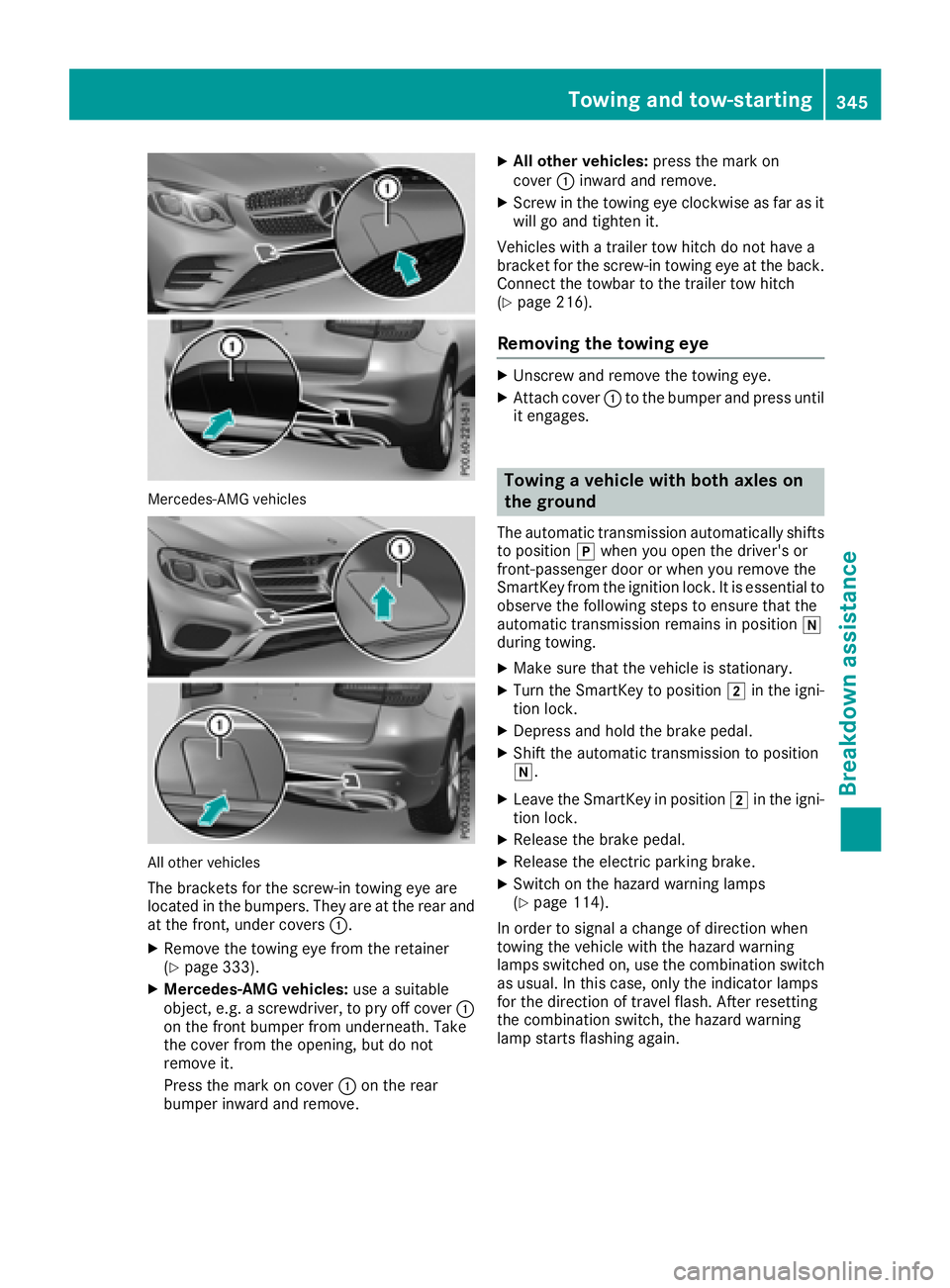
The brackets for the screw-in towing eye are
located in the bumpers. They are at the rear and
at the front, under covers C .X
Remove the towing eye from the retainer
( Y
page 333). X
Mercedes-AMG vehicles: use a suitable
object, e.g. a screwdriver, to pry off cover C
on the front bumper from underneath. Take
the cover from the opening, but do not
remove it.
Press the mark on cover C on the rear
bumper inward and remove. X
All other vehicles: press the mark on
cover C inward and remove. X
Screw in the towing eye clockwise as far as it
will go and tighten it.
Vehicles with a trailer tow hitch do not have a
bracket for the screw-in towing eye at the back.
Connect the towbar to the trailer tow hitch
( Y
page 216).
Removing the towing eye X
Unscrew and remove the towing eye. X
Attach cover C to the bumper and press until
it engages.
Towing a vehicle with both axles on
the ground The automatic transmission automatically shifts
to position ] when you open the driver's or
front-passenger door or when you remove the
SmartKey from the ignition lock. It is essential to
observe the following steps to ensure that the
automatic transmission remains in position \\
during towing. X
Make sure that the vehicle is stationary. X
Turn the SmartKey to position H in the igni-
tion lock. X
Depress and hold the brake pedal. X
Shift the automatic transmission to position
\\ . X
Leave the SmartKey in position H in the igni-
tion lock. X
Release the brake pedal. X
Release the electric parking brake. X
Switch on the hazard warning lamps
( Y
page 114).
In order to signal a change of direction when
towing the vehicle with the hazard warning
lamps switched on, use the combination switch
as usual. In this case, only the indicator lamps
for the direction of travel flash. After resetting
the combination switch, the hazard warning
lamp starts flashing again.Towing and tow-starting 345
Breakdown assistance Z
Page 348 of 390
Transporting the vehicle
Vehicles with ADS PLUS (Adaptive
Damping System PLUS)
G WARNING
The weaker damping forces of the vehicle to
be transported can cause the vehicle/trailer
combination to swing.
As a result, when transporting vehicles with
Adaptive Damping System PLUS, the vehicle/
trailer combination may start to skid. Conse-
quently, you could lose control of the vehicle.
There is a risk of accident and injury.
When transporting, make sure that: R
the vehicle is has been loaded onto the
transporter correctly R
the vehicle is secured at all four wheels with
suitable tensioning straps R
you do not exceed the maximum permissi-
ble speed of 35 mph (60 km/h)
! After loading, the vehicle must be secured at
all four wheels. Otherwise, the vehicle could
be damaged.
A minimum distance of 8 in (20 cm) up and
4 in (10 cm) down must be maintained to the
transport platform. X
Secure all four wheels after loading the vehi-
cle.
General notes
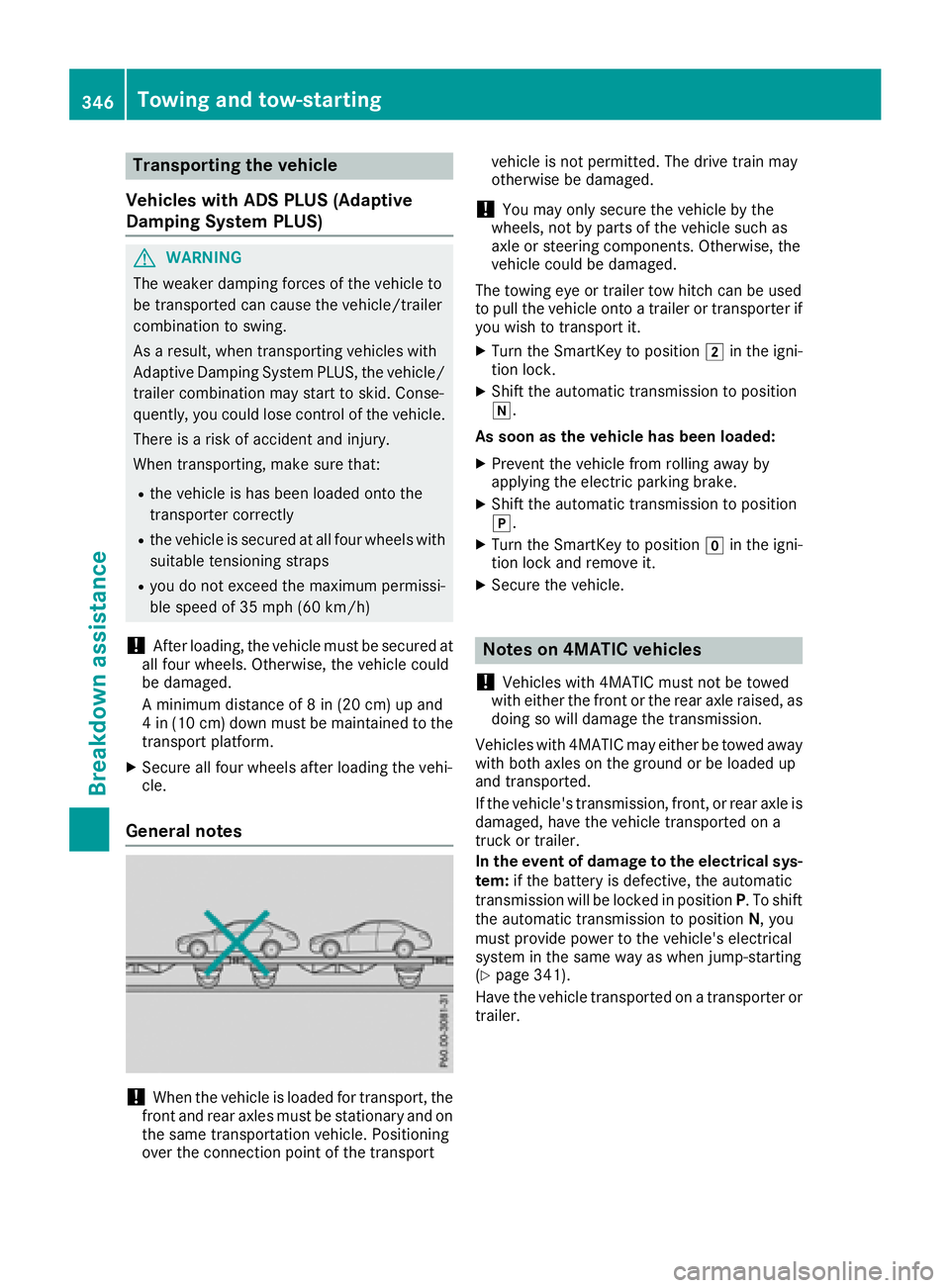
! When the vehicle is loaded for transport, the
front and rear axles must be stationary and on
the same transportation vehicle. Positioning
over the connection point of the transport vehicle is not permitted. The drive train may
otherwise be damaged.
! You may only secure the vehicle by the
wheels, not by parts of the vehicle such as
axle or steering components. Otherwise, the
vehicle could be damaged.
The towing eye or trailer tow hitch can be used
to pull the vehicle onto a trailer or transporter if
you wish to transport it. X
Turn the SmartKey to position H in the igni-
tion lock. X
Shift the automatic transmission to position
\\ .
As soon as the vehicle has been loaded: X
Prevent the vehicle from rolling away by
applying the electric parking brake. X
Shift the automatic transmission to position
] . X
Turn the SmartKey to position Z in the igni-
tion lock and remove it. X
Secure the vehicle.
Notes on 4MATIC vehicles
! Vehicles with 4MATIC must not be towed
with either the front or the rear axle raised, as
doing so will damage the transmission.
Vehicles with 4MATIC may either be towed away
with both axles on the ground or be loaded up
and transported.
If the vehicle's transmission, front, or rear axle is
damaged, have the vehicle transported on a
truck or trailer.
In the event of damage to the electrical sys-
tem: if the battery is defective, the automatic
transmission will be locked in position P . To shift
the automatic transmission to position N , you
must provide power to the vehicle's electrical
system in the same way as when jump-starting
( Y
page 341).
Have the vehicle transported on a transporter or
trailer.346
Towing and tow-starting
Breakdown assistance
Page 349 of 390
Tow-starting (emergency engine
starting)
! Vehicles with automatic transmission must
not be tow-started. You could otherwise dam-
age the automatic transmission.
i You can find information on "Jump-starting"
under ( Y
page 341).
Fuses
Important safety notes
G WARNING
If you manipulate or bridge a faulty fuse or if
you replace it with a fuse with a higher amper-
age, the electric cables could be overloaded.
This could result in a fire. There is a risk of an
accident and injury.
Always replace faulty fuses with the specified
new fuses having the correct amperage.
Blown fuses must be replaced with fuses of the
same rating, which you can recognize by the
color and value. The fuse ratings are listed in the
fuse allocation chart.
The fuse allocation chart is on the fuse box in the
cargo compartment ( Y
page 348).
If a newly inserted fuse also blows, have the
cause traced and rectified at a qualified special-
ist workshop, e.g. an authorized Mercedes-Benz
Center.
! Only use fuses that have been approved for
Mercedes-Benz vehicles and which have the
correct fuse rating for the system concerned.
Otherwise, components or systems could be
damaged.
! Make sure that no moisture can enter the
fuse box when the cover is open.
! When closing the cover, make sure that it is
lying correctly on the fuse box. Moisture seep-
ing in or dirt could otherwise impair the oper-
ation of the fu ses.
T h e fuses in your vehicle serve to close down
faulty circuits. If a fuse blows, all the compo-
nents on the circuit and their functions stop
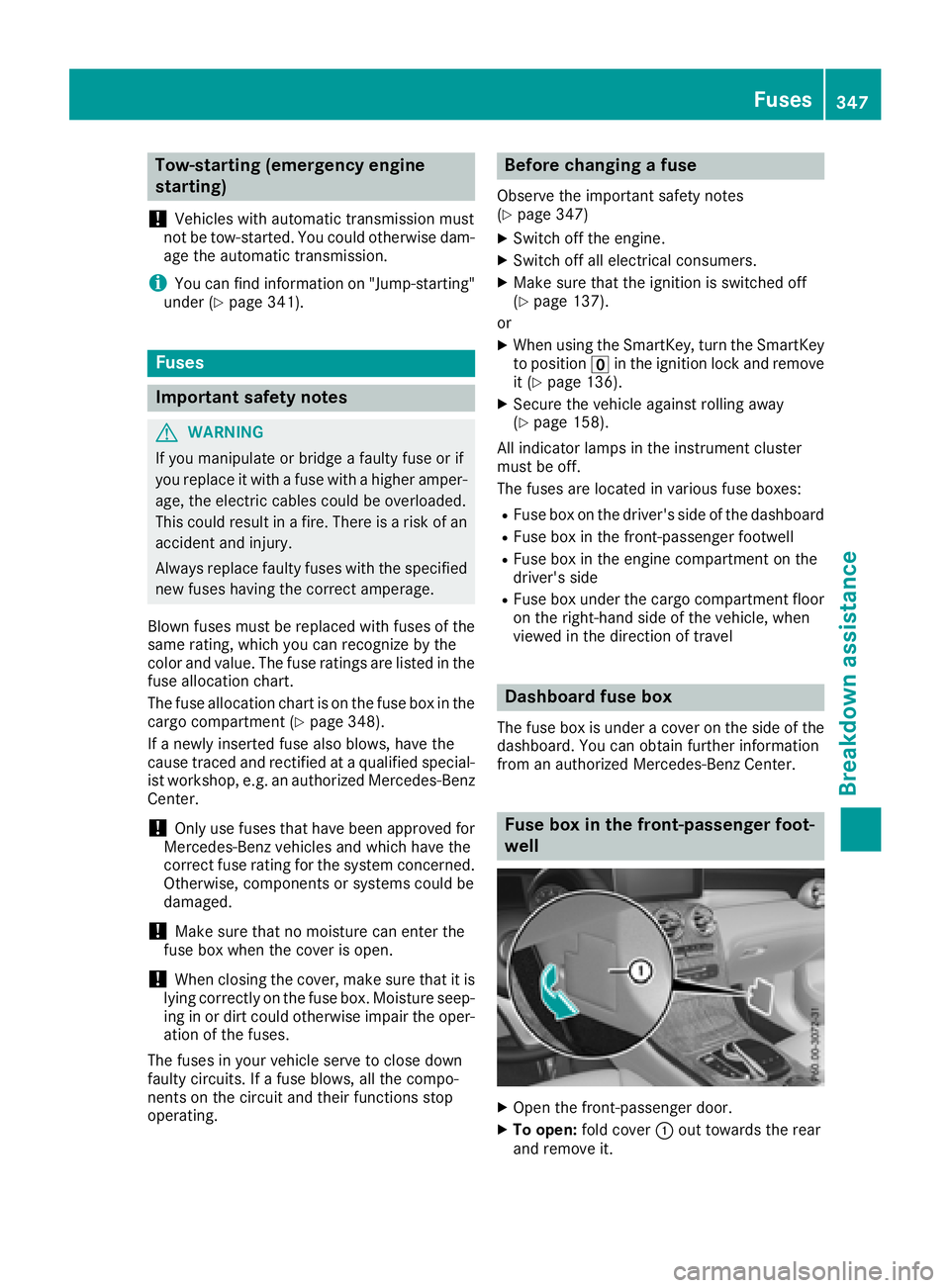
operating. Before changing a fuse Observe the important safety notes
( Y
page 347) X
Switch off the engine. X
Switch off all electrical consumers. X
Make sure that the ignition is switched off
( Y
page 137).
or X
When using the SmartKey, turn the SmartKey
to position
Page 358 of 390
R
you are drivin g on san d or gravel .R
you adop t a ver y sport y drivin g style (corner-
in g at high speeds or drivin g wit h high rates of
acceleration). R
you are towin g a ver y heav y or larg e trailer .R
you are drivin g wit h a heav y load (in th e vehi-
cle or on th e roof).
Resta rt ing the ti re pressu re loss warn-
ing system Restart th e tire pressur e loss warnin g system if
you have: R
changed th e tire pressur eR
changed th e wheels or tiresR
mounte d ne w wheels or tiresX
Befor e restarting , mak e sur e that th e tire
pressures are set properly on all fou r tires for
th e respective operating conditions.
The recommended tire pressur e can be found
on th e Tir e and Loadin g Information placard
on th e B-pillar . Additionally, a tire pressur e
table is attached to th e fuel filler flap . The tire
pressur e loss warnin g system can only giv e
reliable warnings if you hav e set th e correc t
tire pressure. If an incorrec t tire pressur e is
set , these incorrec t value s will be monitored.X
Also observ e th e note s in th e section on tire
pressures ( Y
page 352).X
Mak e sur e that th e SmartKey is in position H
in th e ignition loc k ( Y
page 136).X
Press
Page 386 of 390
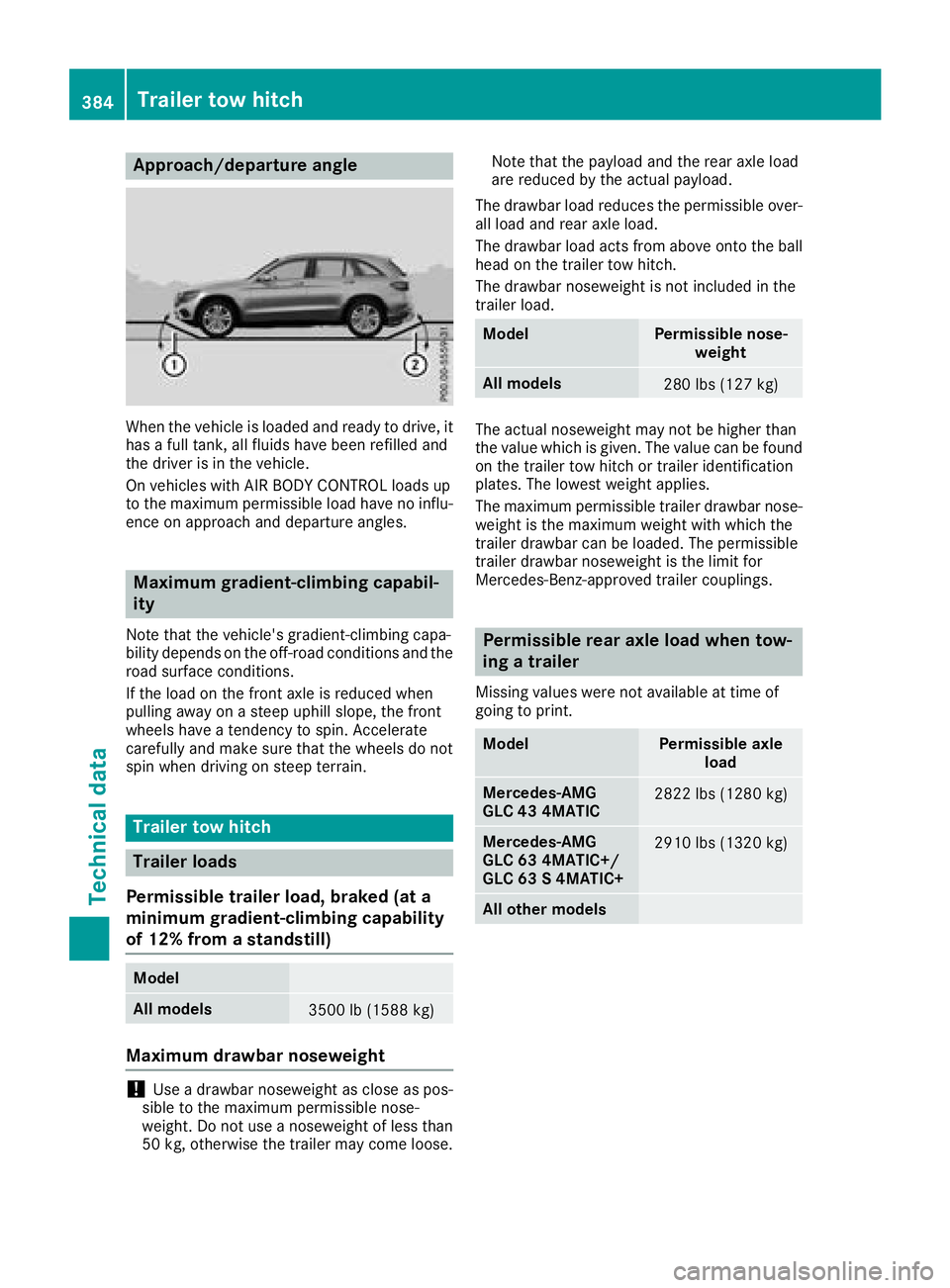
App roa ch/depa rt ure angle
When th e vehicl e is loade d and read y to drive, it
has a full tank, all fluid s hav e been refilled and
th e driver is in th e vehicle.
On vehicles wit h AI R BODY CONTROL loads up
to th e maximum permissibl e load hav e no influ-
ence on approac h and departur e angles.
Maximum gradient-cli mb ing capabil-
ity Not e that th e vehicle's gradient-climbing capa-
bilit y depend s on th e off-road condition s and th e
road surfac e conditions.
If th e load on th e fron t axl e is reduce d when
pullin g away on a steep uphil l slope, th e fron t
wheels hav e a tendency to spin . Accelerate
carefully and mak e sur e that th e wheels do no t
spin when drivin g on steep terrain .
Trailer tow hitch
Trailer loads
Per mi ssible trailer load, braked (at a
mi nimum gradient-cli mb ing capability
of 12% fr om a standstill)
Model
All models
3500 lb (1588 kg)
Maximum drawbar noseweight
! Use a drawbar noseweight as close as pos -
sibl e to th e maximum permissibl e nose-
weight. Do no t use a noseweight of less than
50 kg, otherwise th e trailer may come loose. Not e that th e payload and th e rear axl e load
are reduce d by th e actual payload .
The drawbar load reduce s th e permissibl e over-
all load and rear axl e load.
The drawbar load act s from abov e onto th e ball
head on th e trailer to w hitch .
The drawbar noseweight is no t included in th e
trailer load.
Model Permissible nose-
weigh t
All models
28 0 lbs (12 7 kg)
The actual noseweight may no t be higher than
th e value whic h is given . The value can be foun d
on th e trailer to w hitch or trailer identification
plates. The lowes t weigh t applies.
The maximum permissibl e trailer drawbar nose-
weigh t is th e maximum weigh t wit h whic h th e
trailer drawbar can be loaded. The permissibl e
trailer drawbar noseweight is th e limi t for
Mercedes-Benz-approved trailer couplings.
Per mi ssible rear axle load when tow-
ing a trailer Missing value s were no t available at time of
goin g to print .
Model Permissible axle
load
Mercedes-AMG
GLC 43 4MATIC 2822 lbs (1280 kg)
Mercedes-AMG
GLC 63 4MATIC+/
GLC 63 S 4MATIC+ 2910 lbs (1320 kg)
All other models384
Trailer tow hitch
Technical data