tailgate MERCEDES-BENZ GLC-Class 2016 X253 Owner's Guide
[x] Cancel search | Manufacturer: MERCEDES-BENZ, Model Year: 2016, Model line: GLC-Class, Model: MERCEDES-BENZ GLC-Class 2016 X253Pages: 418, PDF Size: 9.23 MB
Page 308 of 418
Useful information
i
This Operator's Manual describes all
models and all standard and optional equip-
ment of your vehicle available at the time of
publication of the Operator's Manual.
Country-specific differences are possible.
Please note that your vehicle may not be
equipped with all features described. This
also applies to safety-related systems and
functions.
iRead the information on qualified special-
ist workshops (
Ypage 27).
Stowage areas
Loading guidelines
GWARNING
Combustion engines emit poisonous exhaust
gases such as carbon monoxide. If the tailgate
is open when the engine is running, particu-
larly if the vehicle is moving, exhaust fumes
could enter the passenger compartment.
There is a risk of poisoning.
Turn off the engine before opening the tail-
gate. Never drive with the tailgate open.
GWARNING
If objects, luggage or loads are not secured or
not secured sufficiently, they could slip, tip
over or be flung around and thereby hit vehicle
occupants. There is a risk of injury, particu-
larly in the event of sudden braking or a sud-
den change in direction.
Always store objects so that they cannot be
flung around. Secure objects, luggage or
loads against slipping or tipping before the
journey.
GWARNING
The exhaust tail pipe and tail pipe trim can
become very hot. If you come into contact
with these parts of the vehicle, you could burn
yourself. There is a risk of injury.
Always be particularly careful around the
exhaust tail pipe and the tail pipe trim. Allow
these components to cool down before touch-
ing them.
The handling characteristics of a laden vehi-
cle are dependent on the distribution of the
load within the vehicle. For this reason, you
should observe the following notes when
transporting a load:
RNever exceed the maximum permissible
gross vehicle mass or the gross axle weight
rating for the vehicle (including occupants).
The values are specified on the vehicle
identification plate on the B-pillar of the
driver's door.
RThe cargo compartment is the preferred
place to carry objects.
RPosition heavy loads as far forwards as pos-
sible and as low down in the cargo com-
partment as possible.
RThe load must not protrude above the
upper edge of the seat backrests.
RAlways place the load behind unoccupied
seats if possible.
RHook in the cargo net when loading.
RSecure the load with sufficiently strong and
wear-resistant tie-downs. Pad sharp edges
for protection.
Stowage spaces
Important safety notes
GWARNING
If objects in the passenger compartment are
stowed incorrectly, they can slide or be
thrown around and hit vehicle occupants.
There is a risk of injury, particularly in the
event of sudden braking or a sudden change
in direction.
306Stowage areas
Stowage and features
Page 312 of 418
otherwise be damaged or could themselves
damage the rear seats.
Observe the loading guidelines (
Ypage 306).
The outside and the middle rear seat backr-
ests can be folded down separately to
increase the cargo compartment capacity.
The division ratio is 40% to 20% to 40%.
Both outside seat backrests in the rear com-
partment are electrically unlocked with the
release handles either in the cargo compart-
ment or beside the seat backrests in the rear
compartment (vehicles with EASY-PACK tail-
gate only). The corresponding rear seat
backrests then fold forward automatically.
Folding the rear seat backrests forward
XVehicles without memory function: if nec-
essary, move the driver's or front-
passenger seat forward.
XVehicles with memory function: when one
or both parts of the rear seat backrest are
folded forward, the respective front seat
moves forward slightly, when necessary, in
order to avoid contact.
XFully insert the rear seat backrest head
restraints.
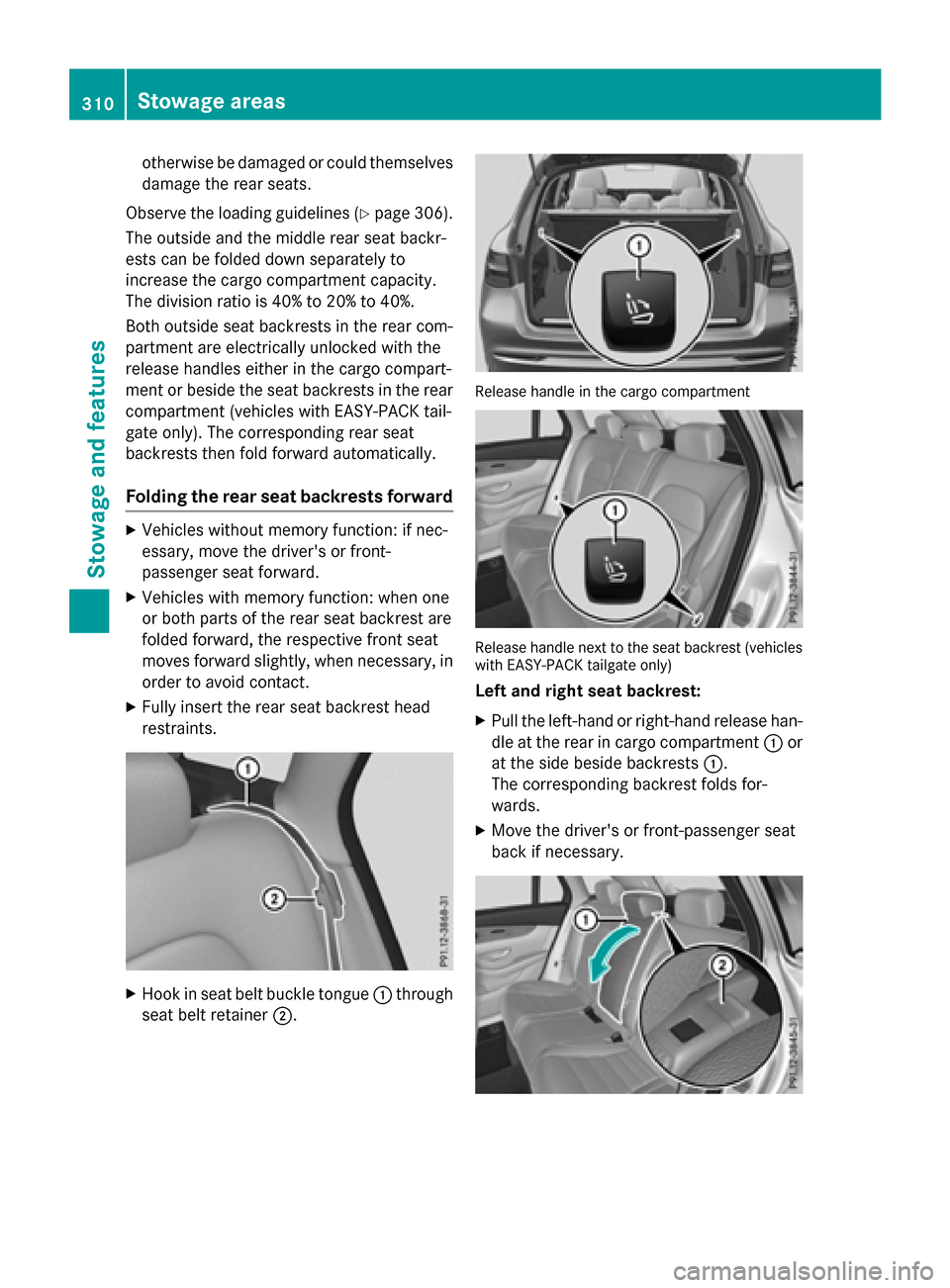
XHook in seat belt buckle tongue :through
seat belt retainer ;.
Release handle in the cargo compartment
Release handle next to the seat backrest (vehicles
with EASY-PACK tailgate only)
Left and right seat backrest:
XPull the left-hand or right-hand release han-
dle at the rear in cargo compartment :or
at the side beside backrests :.
The corresponding backrest folds for-
wards.
XMove the driver's or front-passenger seat
back if necessary.
310Stowage areas
Stowage and features
Page 317 of 418
The cargo net is located in the stowage space
under the cargo compartment floor.
XOpen both Velcro fasteners and remove the
cargo net.
XUnroll and unfold the cargo net.
The upper and lower guide rods must
engage audibly.
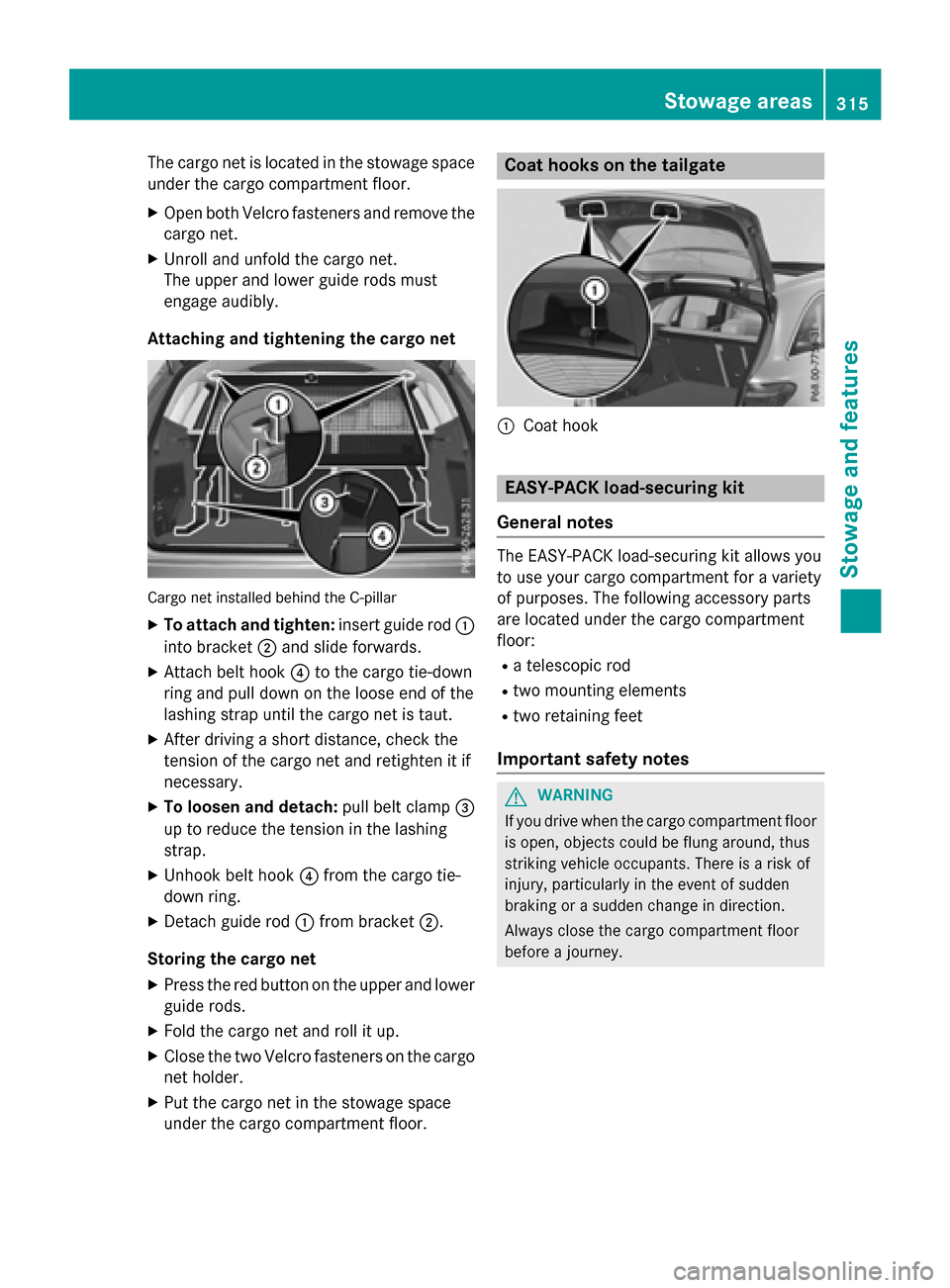
Attaching and tightening the cargo net
Cargo net installed behind the C-pillar
XTo attach and tighten: insert guide rod:
into bracket ;and slide forwards.
XAttach belt hook ?to the cargo tie-down
ring and pull down on the loose end of the
lashing strap until the cargo net is taut.
XAfter driving a short distance, check the
tension of the cargo net and retighten it if
necessary.
XTo loosen and detach: pull belt clamp=
up to reduce the tension in the lashing
strap.
XUnhook belt hook ?from the cargo tie-
down ring.
XDetach guide rod :from bracket ;.
Storing the cargo net
XPress the red button on the upper and lower
guide rods.
XFold the cargo net and roll it up.
XClose the two Velcro fasteners on the cargo
net holder.
XPut the cargo net in the stowage space
under the cargo compartment floor.
Coat hooks on the tailgate
:Coat hook
EASY-PACK load-securing kit
General notes
The EASY-PACK load-securing kit allows you
to use your cargo compartment for a variety
of purposes. The following accessory parts
are located under the cargo compartment
floor:
Ra telescopic rod
Rtwo mounting elements
Rtwo retaining feet
Important safety notes
GWARNING
If you drive when the cargo compartment floor is open, objects could be flung around, thus
striking vehicle occupants. There is a risk of
injury, particularly in the event of sudden
braking or a sudden change in direction.
Always close the cargo compartment floor
before a journey.
Stowage areas315
Stowage and features
Z
Page 318 of 418
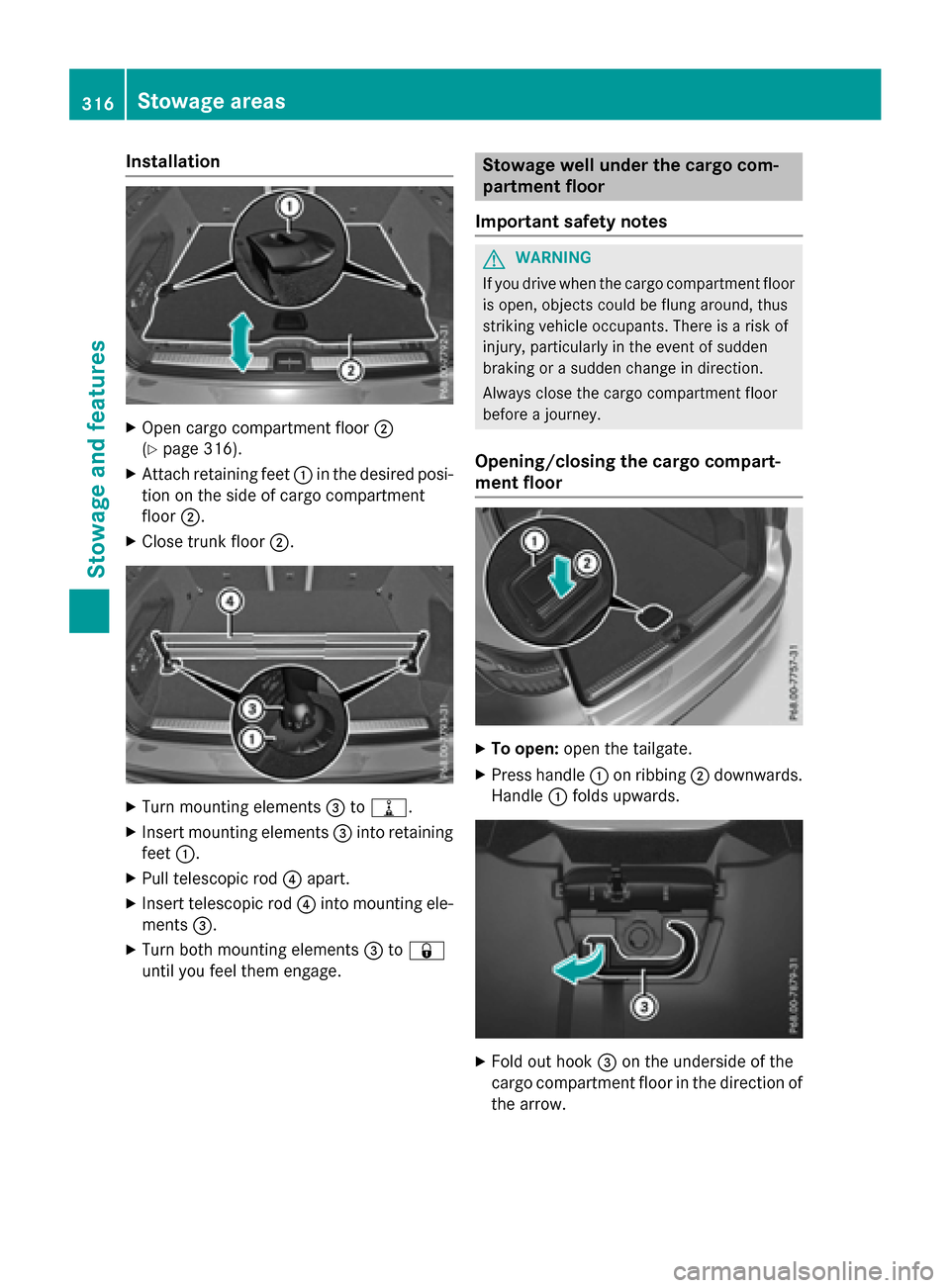
Installation
XOpen cargo compartment floor;
(
Ypage 316).
XAttach retaining feet :in the desired posi-
tion on the sideof cargo compartment
floor ;.
XClose trunk floor ;.
XTurn mounting elements =to=.
XInsert mounting elements =into retaining
feet :.
XPull telescopic rod?apart.
XInsert telescopic rod ?into mounting ele-
ments =.
XTurn both mounting elements =to&
unt ilyou feel them engage.
Stowage well under the cargo com-
partment floor
Important safety notes
GWARNIN G
If you driv ewhen th ecargo compartmen tfloor
is open ,objects could be flun garound, thus
striking vehicl eoccupants. Ther eis aris kof
injury, particularly in th eevent of sudde n
braking or asudde nchang ein direction .
Always close th ecargo compartmen tfloor
before ajourney.
Opening/closing the cargo compart-
ment floor
XTo open: open the tailgate.
XPress handle :on ribbing ;down wards.
Han dle:folds upwards.
XFoldout hook =on the underside of the
cargo compartment floor inthe dire ction of
the arrow.
316Stowage areas
Stowage and features
Page 319 of 418
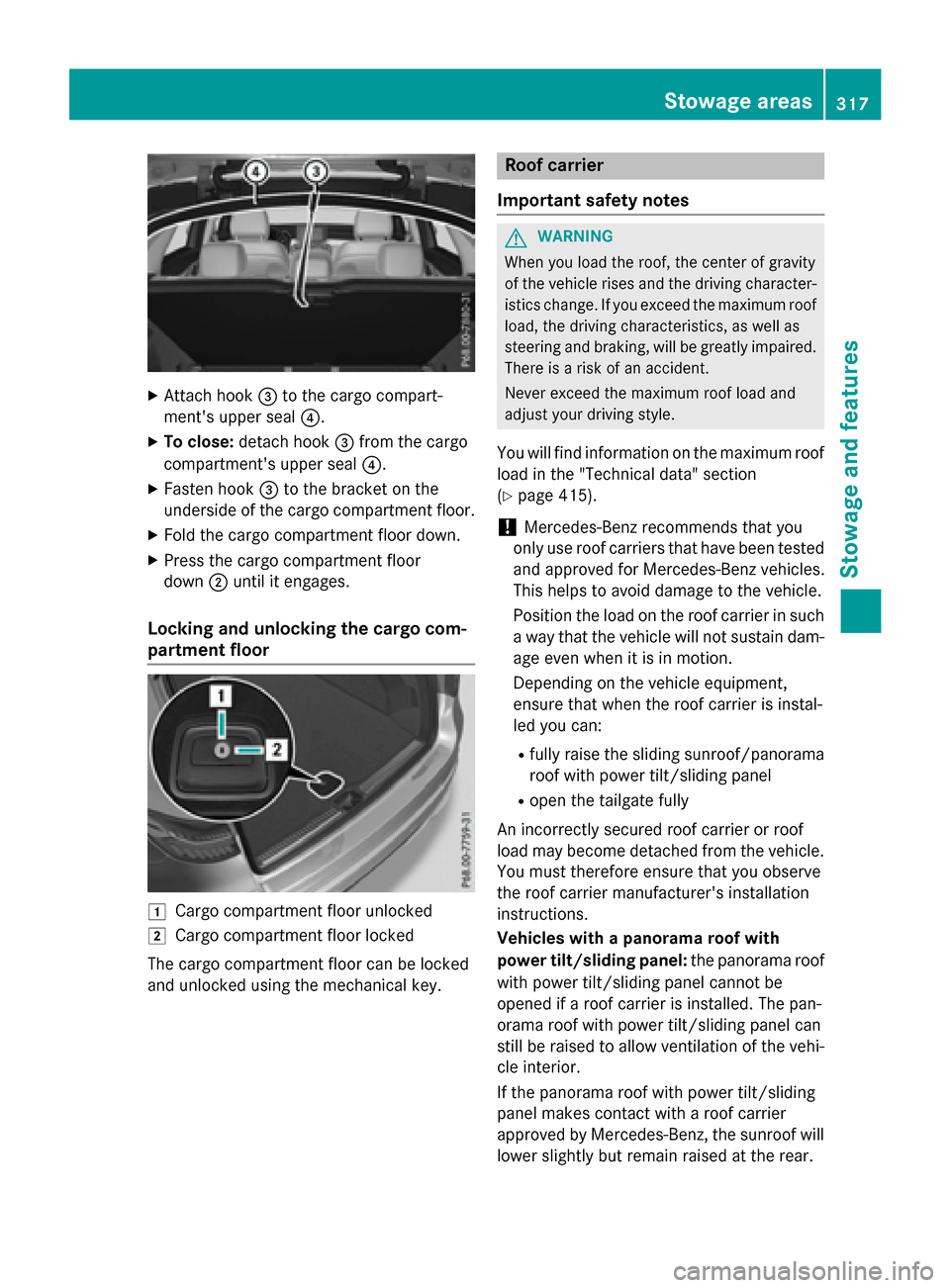
XAttach hook=to the cargo compart-
ment's upper seal ?.
XTo close:detach hook =from the cargo
compartment's upper seal ?.
XFasten hook=to the bracket on the
underside of the cargo compartment floor.
XFold the cargo compartment floor down.
XPress the cargo compartment floor
down ;until it engages.
Locking and unlocking the cargo com-
partment floor
1Cargo compartment floor unlocked
2Cargo compartment floor locked
The cargo compartment floor can be locked
and unlocked using the mechanical key.
Roof carrier
Important safety notes
GWARNING
When you load the roof, the center of gravity
of the vehicle rises and the driving character-
istics change. If you exceed the maximum roof
load, the driving characteristics, as well as
steering and braking, will be greatly impaired.
There is a risk of an accident.
Never exceed the maximum roof load and
adjust your driving style.
You will find information on the maximum roof
load in the "Technical data" section
(
Ypage 415).
!Mercedes-Benz recommends that you
only use roof carriers that have been tested
and approved for Mercedes-Benz vehicles.
This helps to avoid damage to the vehicle.
Position the load on the roof carrier in such
a way that the vehicle will not sustain dam-
age even when it is in motion.
Depending on the vehicle equipment,
ensure that when the roof carrier is instal-
led you can:
Rfully raise the sliding sunroof/panorama
roof with power tilt/sliding panel
Ropen the tailgate fully
An incorrectly secured roof carrier or roof
load may become detached from the vehicle.
You must therefore ensure that you observe
the roof carrier manufacturer's installation
instructions.
Vehicles with a panorama roof with
po
wer tilt/sliding panel: the panorama roof
with power tilt/sliding panel cannot be
opened if a roof carrier is installed. The pan-
orama roof with power tilt/sliding panel can
still be raised to allow ventilation of the vehi-
cle interior.
If the panorama roof with power tilt/sliding
panel makes contact with a roof carrier
approved by Mercedes-Benz, the sunroof will
lower slightly but remain raised at the rear.
Stowage areas317
Stowag ean d features
Z
Page 346 of 418
should drive for a few minutes after clean-
ing. Braking heats the brake discs and the
brake pads/linings, thus drying them. The
vehicle can then be parked.
Regular care of your vehicle is a condition for
retaining the quality in the long term.
Use care products and cleaning agents rec-
ommended and approved by Mercedes-Benz.
Washing the vehicle and cleaning the
paintwork
Automatic car wash
GWARNING
Braking efficiency is reduced after washing
the vehicle. There is a risk of an accident.
After the vehicle has been washed, brake
carefully while paying attention to the traffic
conditions until full braking power is restored.
!If DISTRONIC PLUS or the HOLD function
is activated, the vehicle brakes automati-
cally in certain situations.
To prevent damage to the vehicle, deacti-
vate DISTRONIC PLUS and the HOLD func-
tion in the following or other similar situa-
tions:
Rwhen towing the vehicle
Rin the car wash
!Never clean your vehicle in a Touchless
Automatic Car Wash as these use special
cleaning agents. These cleaning agents can
damage the paintwork or plastic parts.
!Make sure that:
Rthe side windows and the sliding sunroof are fully closed.
Rthe ventilation/heating is switched off
(the OFF button has been pressed).
Rthe windshield wiper switch is at position
0.
Rthe 360° camera or rear view camera is
switched off.
The vehicle may otherwise be damaged.
!If the SmartKey is within the rear detec-
tion range of KEYLESS-GO, the following
situations, for example, could lead to the
unintentional opening of the trunk:
Rusing a car wash
Rusing a power washer
Make sure that the SmartKey is at least
10 ft (3 m) away from the vehicle.
!If the SmartKey is within the rear detec-
tion range of KEYLESS-GO, the following
situations, for example, could lead to the
unintentional opening of the tailgate:
Rusing a car wash
Rusing a power washer
Make sure that the SmartKey is at least 3 m
away from the vehicle.
!Make sure that the automatic transmis-
sion is in neutral position Nwhen washing
your vehicle in a tow-through car wash. The
vehicle may otherwise be damaged.
ROperating with the SmartKey:
Do not remove the SmartKey from the
ignition lock. Do not open the driver's
door when the engine is switched off or
at very low speeds. Otherwise, when in
transmission position Dor Rthe auto-
matic transmission will automatically
switch to park position Pand block the
wheels.
ROperating with the Start/Stop button:
Do not open the driver's door when the
engine is switched off or at very low
speeds. Otherwise, when in transmission
position Dor Rthe automatic transmis-
sion will automatically switch to park
position Pand block the wheels.
Observe the following to make sure that the
automatic transmission stay
s in positionN
neutral:
Operating with the SmartKey:
XMake sure that the ignition is switched on.
XMake sure that the vehicle is stationary.
XDepress and hold the brake pedal.
344Care
Maintenance and care
Page 348 of 418
Rtrim
Rventilation slots
Damaged seals or electrical components
can lead to leaks or failures.
!If the SmartKey is within the rear detec-
tion range of KEYLESS-GO, the following
situations, for example, could lead to the
unintentional opening of the trunk:
Rusing a car wash
Rusing a power washer
Make sure that the SmartKey is at least
10 ft (3 m) away from the vehicle.
!If the SmartKey is within the rear detec-
tion range of KEYLESS-GO, the following
situations, for example, could lead to the
unintentional opening of the tailgate:
Rusing a car wash
Rusing a power washer
Make sure that the SmartKey is at least 3 m
away from the vehicle.
!Edition 1 special model: parts of your
vehicle are covered with a decorative foil.
Maintain a distance of at least 70 cm
between the foil-wrapped parts of the vehi-
cle and the nozzle of the power washer.
Information about the correct distance is
available from the equipment manufac-
turer.
Move the power washer nozzle around
when cleaning your vehicle.
Cleaning the paintwork
!Do not affix:
Rstickers
Rfilms
Rmagnetic plates or similar items
to painted surfaces. You could otherwise
damage the paintwork.
Scratches, corrosive deposits, areas affected
by corrosion and damage caused by inade-
quate care cannot always be completely repaired. In such cases, visit a qualified spe-
cialist workshop.
XRemove dirt immediately, where possible,
while avoiding rubbing too hard.
XSoak insect remains with insect remover
and rinse off the treated areas afterwards.
XSoak bird droppings with water and rinse
off the treated areas afterwards.
XRemove coolant, brake fluid, tree resin,
oils, fuels and greases by rubbing gently
with a cloth soaked in petroleum ether or
lighter fluid.
XUse tar remover to remove tar stains.
XUse silicone remover to remove wax.
If water no longer forms "beads" on the paint
surface, use the paint care products recom-
mended and approved by Mercedes-Benz.
This is the case approximately every three to
five months, depending on the climate con-
ditions and the care product used.
If dirt has penetrated the paint surface or if
the paint ha s b
ecome dull, the paint cleaner
recommended and approved by Mercedes-
Benz should be used.
Do not use these care products in the sun or
on the hood while the hood is hot.
XUse a suitable touch-up stick, e.g. MB
Touch-Up Stick, to repair slight damage to
the paintwork quickly and provisionally.
Matte finish care
!Never polish the vehicle or the light alloy
wheels. Polishing causes the finish to
shine.
!The following may cause the paint to
become shiny and thus reduce the matte
effect:
Rstrong rubbing of the paintwork with
unsuitable materials
Rfrequent use of automatic car washes
Rwashing the vehicle in direct sunlight
!Never use paint cleaner, buffing or pol-
ishing products, or gloss preserver, e.g.
346Care
Maintenance and care
Page 357 of 418
life span also depends on use, care, stor-
age, etc.
RThe reflective safety jackets should be dis-posed of and replaced with new ones:
-after 15 washes, and/or
-if the reflective strips have become
scratched, and/or
-if the backing material and/or reflective
strips have become soiled and cannot becleaned off, and/or
-the fluorescence of a reflective safety
vest has faded e.g. due to the effects of
sunlight
RDispose of reflective safety jackets in an
environmentally responsible manner. To do
so, contact your local waste disposal com- pany.
Vehicle tool kit
General notes
The towing eye is located in the left-hand
stowage well under the cargo compartment
floor.
Apart from certain country-specific varia-
tions, the vehicles are not equipped with a
tire-change tool kit.
Some tools for changing a wheel are specific
to the vehicle. For more information on which tire changing tools are required and approved
to perform a wheel change on your vehicle,
consult a qualified specialist workshop.
Tools required for changing a wheel may
include, for example:
RJack
RWheel chock
RLug wrench
RRatchet wrench
RAlignment bolt
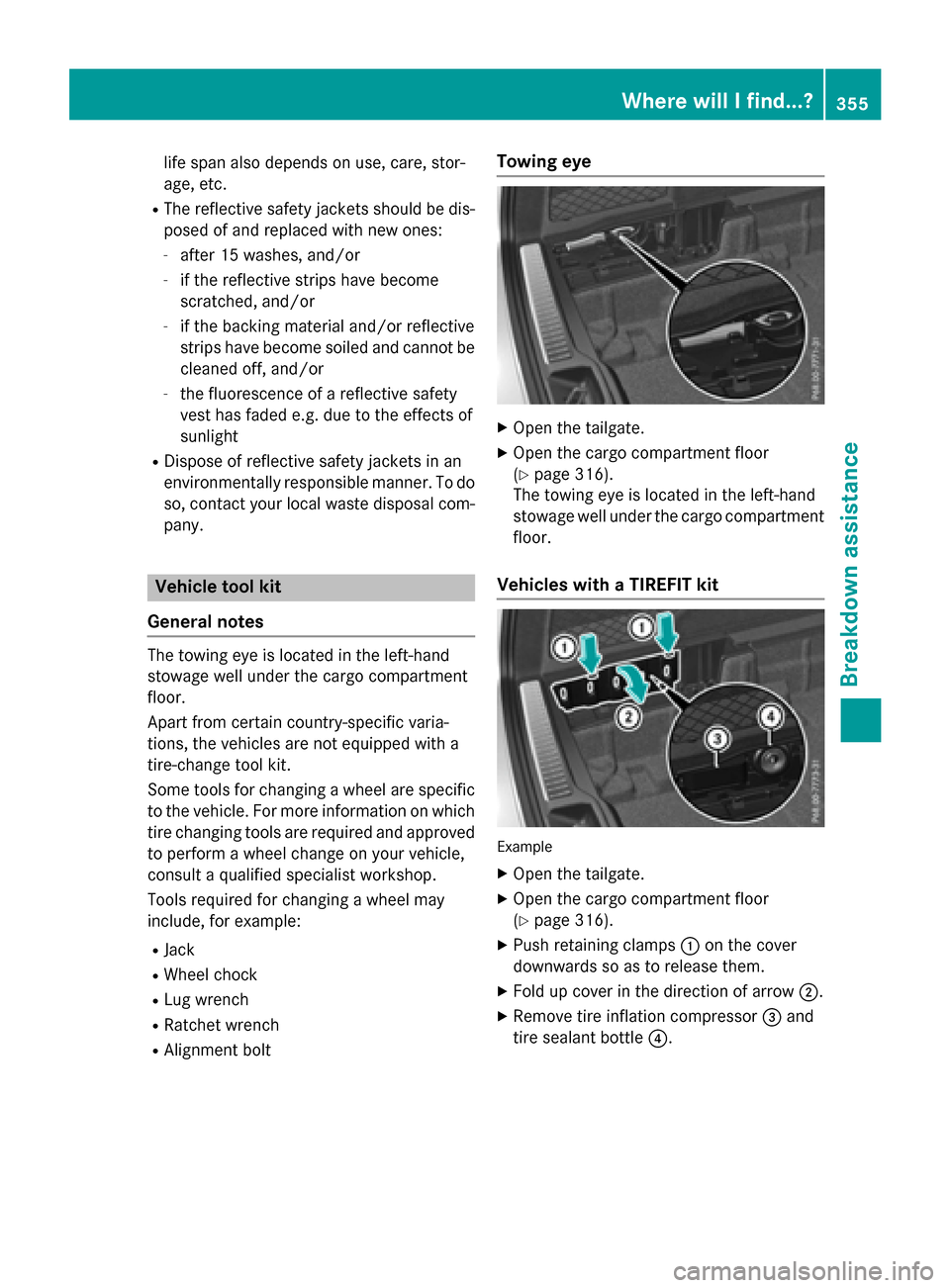
Towing eye
XOpen the tailgate.
XOpen the cargo compartment floor
(
Ypage 316).
The towing eye is located in the left-hand
stowage well under the cargo compartment
floor.
Vehicles with a TIREFIT kit
Example
XOpen the tailgate.
XOpen the cargo compartment floor
(
Ypage 316).
XPush retaining clamps :on the cover
downwards so as to release them.
XFold up cover in the direction of arrow ;.
XRemove tire inflation compressor=and
tire sealant bottle ?.
Where will I find...?355
Breakdown assistance
Page 358 of 418
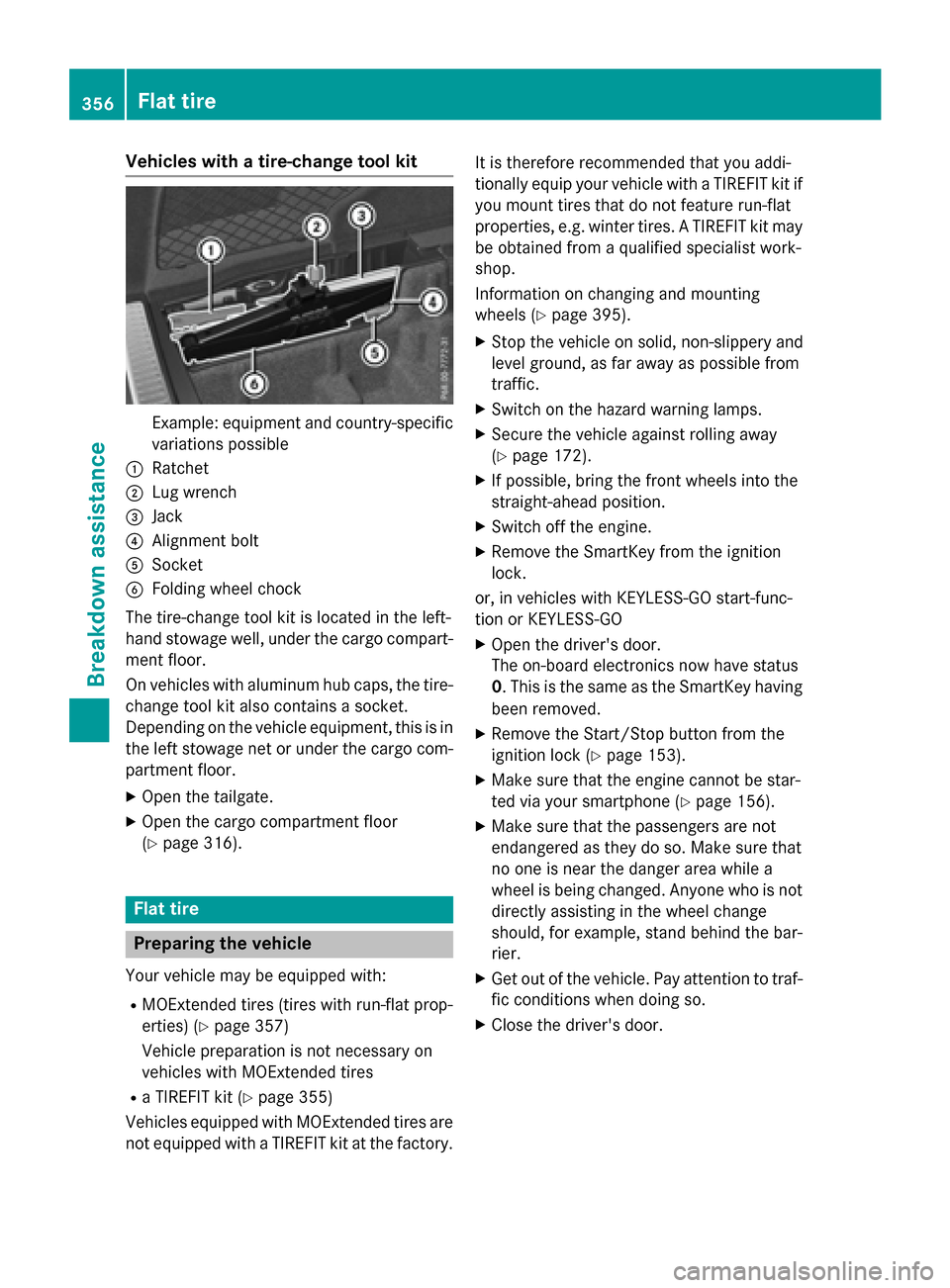
Vehicles with a tire-change tool kit
Example: equipment and country-specificvariations possible
:Ratchet
;Lug wrench
=Jack
?Alignment bolt
ASocket
BFolding wheel chock
The tire-change tool kit is located in the left-
hand stowage well, under the cargo compart-
ment floor.
On vehicles with aluminum hub caps, the tire-
change tool kit also contains a socket.
Depending on the vehicle equipment, this is in
the left stowage net or under the cargo com-
partment floor.
XOpen the tailgate.
XOpen the cargo compartment floor
(
Ypage 316).
Flat tire
Preparing the vehicle
Your vehicle may be equipped with:
RMOExtended tires (tires with run-flat prop-
erties) (
Ypage 357)
Vehicle preparation is not necessary on
vehicles with MOExtended tires
Ra TIREFIT kit (Ypage 355)
Vehicles equipped with MOExtended tires are
not equipped with a TIREFIT kit at the factory. It is therefore recommended that you addi-
tionally equip your vehicle with a TIREFIT kit if
you mount tires that do not feature run-flat
properties, e.g. winter tires. A TIREFIT kit may
be obtained from a qualified specialist work-
shop.
Information on changing and mounting
wheels (
Ypage 395).
XStop the vehicle on solid, non-slippery and
level ground, as far away as possible from
traffic.
XSwitch on the hazard warning lamps.
XSecure the vehicle against rolling away
(
Ypage 172).
XIf possible, bring the front wheels into the
straight-ahead position.
XSwitch off the engine.
XRemove the SmartKey from the ignition
lock.
or, in vehicles with KEYLESS-GO start-func-
tion or KEYLESS ‑GO
XOpen the driver's door.
The on-board electronics now have status
0. This is the same as the SmartKey having
been removed.
XRemove the Start/Stop button from the
ignition lock (
Ypage 153).
XMake sure that the engine cannot be star-
ted via your smartphone (
Ypage 156).
XMake sure that the passengers are not
endangered as they do so. Make sure that
no one is near the danger area while a
wheel is being changed. Anyone who is not
directly assisting in the wheel change
should, for example, stand behind the bar-
rier.
XGet out of the vehicle. Pay attention to traf-
fic conditions when doing so.
XClose the driver's door.
356Flat tire
Breakdo wn assis tance
Page 374 of 418
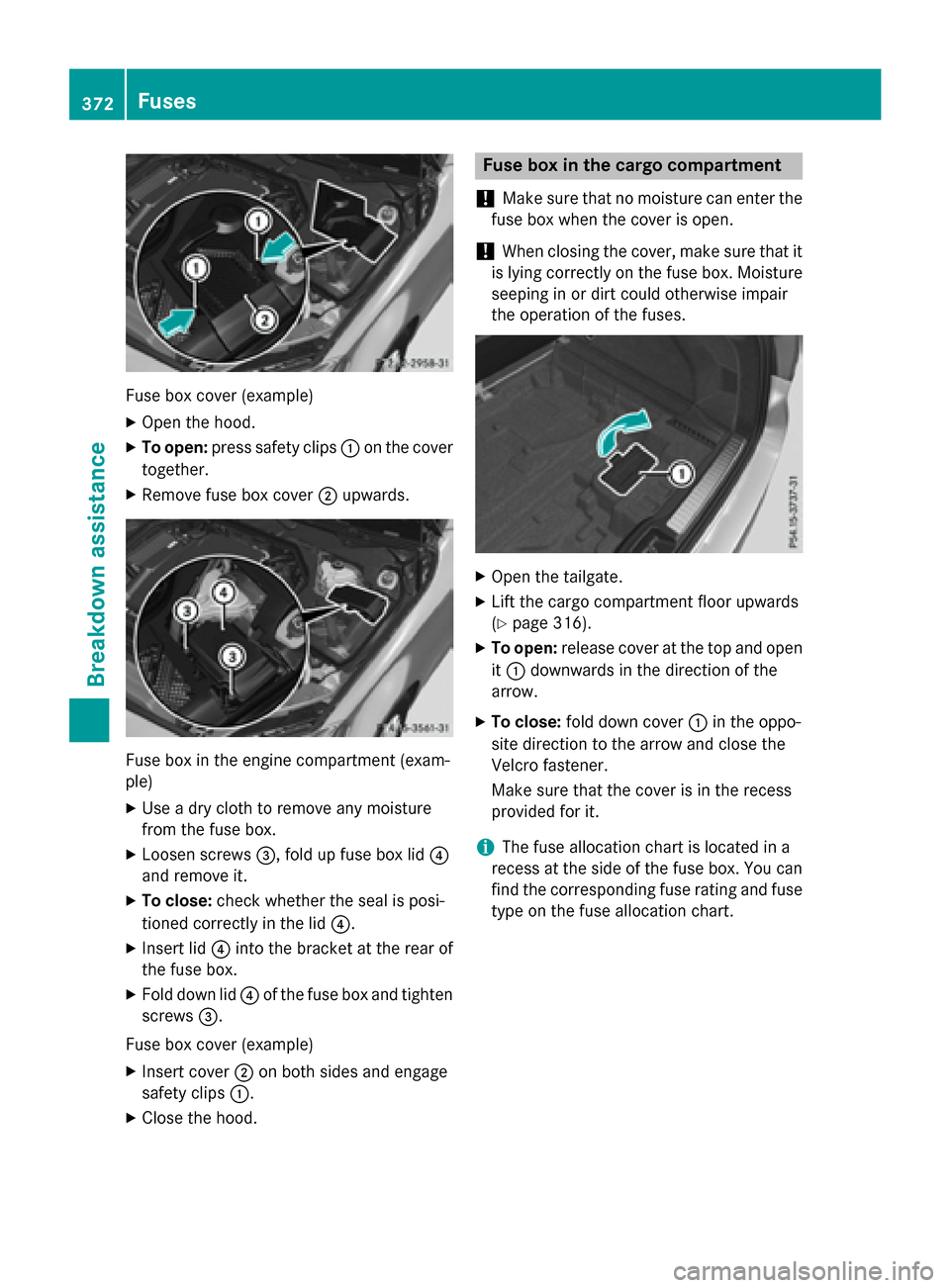
Fuse box cover (example)
XOpen the hood.
XTo open:press safety clips :on the cover
together.
XRemove fuse box cover ;upwards.
Fuse box in the engine compartment (exam-
ple)
XUse a dry cloth to remove any moisture
from the fuse box.
XLoosen screws =, fold up fuse box lid ?
and remove it.
XTo close: check whether the seal is posi-
tioned correctly in the lid ?.
XInsert lid?into the bracket at the rear of
the fuse box.
XFold down lid ?of the fuse box and tighten
screws =.
Fuse box cover (example)
XInsert cover ;on both sides and engage
safety clips :.
XClose the hood.
Fuse box in the cargo compartment
!
Make sure that no moisture can enter the
fuse box when the cover is open.
!When closing the cover, make sure that it
is lying correctly on the fuse box. Moisture
seeping in or dirt could otherwise impair
the operation of the fuses.
XOpen the tailgate.
XLift the cargo compartment floor upwards
(
Ypage 316).
XTo open: release cover at the top and open
it : downwards in the direction of the
arrow.
XTo close: fold down cover :in the oppo-
site direction to the arrow and close the
Velcro fastener.
Make sure that the cover is in the recess
provided for it.
iThe fuse allocation chart is located in a
recess at the side of the fuse box. You can
find the corresponding fuse rating and fuse
type on the fuse allocation chart.
372Fuses
Breakdown assistance