ECO mode MERCEDES-BENZ GLC-Class 2016 X253 Owner's Manual
[x] Cancel search | Manufacturer: MERCEDES-BENZ, Model Year: 2016, Model line: GLC-Class, Model: MERCEDES-BENZ GLC-Class 2016 X253Pages: 418, PDF Size: 9.23 MB
Page 7 of 418
Driving abroad ............................... 343
Hiding a service message .............. 342
Resetting the service interval dis-
play ................................................ 343
Service message ............................ 342
Special service requirements ......... 343
ATA (Anti-Theft Alarm system)
Activating/deactivating ................... 78
Function ........................................... 78
Switching off the alarm .................... 78
ATTENTION ASSIST
Activating/deactivating ................. 253
Display message ............................ 279
Function/notes ............................. 214
Authorized Mercedes-Benz Center
see Qualified specialist workshop
AUTO lights
Display message ............................ 275
see Lights
Automatic car wash (care) ............... 344
Automatic engine start (ECO start/
stop function) .................................... 159
Automatic engine switch-off (ECO
start/stop function) .......................... 158
Automatic headlamp mode .............. 124
Automatic transmission
Accelerator pedal position ............. 165
Changing gear ............................... 165
DIRECT SELECT lever ..................... 162
Display message ............................ 287
Double-clutch function .................. 165
Drive program ................................ 166
Drive program display .................... 163
Driving tips .................................... 165
DYNAMIC SELECT switch .............. 161
Emergency running mode .............. 169
Engaging drive position .................. 163
Engaging neutral ............................ 163
Engaging park position automati-
cally ............................................... 162
Engaging reverse gear ................... 162
Engaging the park position ............ 162
Kickdown ....................................... 165
Manual shifting .............................. 167
Overview ........................................ 161
Problem (malfunction) ................... 169
Pulling away ................................... 157
Rocking the vehicle free ................ 165 Starting the engine
........................ 155
Ste
ering wheel paddle shifters ...... 167
Trailer towing ................................. 165
Transmission position display
(DIRECT SELECT lever) ................... 163
Transmission positions .................. 164
Automatic transmission emer-
gency mode ....................................... 169
Axle load, permissible (trailer tow-
ing) ...................................................... 416
B
Backup lamp
Changing bulbs .............................. 132
Bag hook ............................................ 313
Ball coupling
Installing ........................................ 230
Removing ....................................... 234
BAS (Brake Assist System) ................. 68
BAS PLUS with Cross-Traffic Assist
(Brake Assist PLUS with Cross-
Traffic Assist)
Function/notes ................................ 68
Important safety notes .................... 68
Battery (SmartKey)
Checking .......................................... 86
Important safety notes .................... 85
Replacing ......................................... 86
Battery (vehicle)
Charging ........................................ 363
Display message ............................ 277
Important safety notes .................. 361
Jump starting ................................. 365
Blind Spot Assist
Activating/deactivating (on-
board computer) ............................ 253
Display message ............................ 281
Notes/function .............................. 217
see Active Blind Spot Assist
Brake fluid
Display message ............................ 264
Notes ............................................. 412
Brake force distribution
see EBD (electronic brake force
distribution)
Brake lamps
Display message ............................ 273
Index5
Page 9 of 418
Top Tether ....................................... 63
Child-proof locks
Important safety notes .................... 65
Rear doors ....................................... 66
Children
Special seat belt retractor ............... 61
Cigarette lighter ................................ 320
Cleaning
Mirror turn signal ........................... 348
Trailer tow hitch ............................. 349
Climate control
Control panel for dual-zone auto-
matic climate control ..................... 141
Controlling automatically ............... 144
Cooling with air dehumidification .. 142
Defrosting the windows ................. 146
Defrosting the windshield .............. 146
ECO start/stop function (dual-
zone automatic climate control) ....1 42
General notes ................................ 140
Indicator lamp ................................ 144
Information about using dual-zone
automatic climate control .............. 141
Ionization ....................................... 149
Overview of systems ......................1 40
Perfume atomizer .......................... 147
Problem with the rear window
defroster ........................................ 147
Problems with cooling with air
dehumidification ............................ 144
Refrigerant ..................................... 414
Refrigerant filling capacity ............. 414
Setting the air distribution ............. 145
Setting the air vents ......................1 49
Setting the airflow ......................... 145
Setting the temperature ................ 145
Switching air-recirculation mode
on/off ............................................ 147
Switching on/off ........................... 142
Switching the rear window
defroster on/off ............................ 146
Switching the synchronization
function on and off ........................ 145
Coat hooks ......................................... 315
Cockpit
Overview ....... ................................... 32 C
OLLISION PREVENTION ASSIST
PLUS
Activating/deactivating ................. 252
Display message ............................ 265
Operation/notes .............................. 70
COMAND display
Cleaning ......................................... 350
Combination switch .......................... 126
Consumption statistics (on-board
computer) .......................................... 245
Convenience closing feature .............. 99
Convenience opening feature ............ 99
Coolant (engine)
Checking the level ......................... 341
Display message ............................ 276
Filling capacity ............................... 413
Important safety notes .................. 412
Temperature display in the instru-
ment cluster .................................. 239
Warning lamp ................................. 299
Cooling
see Climate control
Copyright ............................................. 29
Cornering light function
Display message ............................ 272
Function/notes .............................1 27
Crash-responsive emergency light-
ing ....................................................... 130
Crosswind Assist ................................. 75
Cruise control
Cruise control lever ....................... 182
Deactivating ................................... 183
Display message ............................ 284
Driving system ............................... 181
Function/notes .............................1 81
General notes ................................ 181
Important safety notes .................. 181
Setting a speed .............................. 183
Storing and maintaining current
speed ............................................. 182
Storing the current speed or call-
ing up the last stored speed .......... 182
Cup holder
Center console .............................. 318
Important safety notes .................. 318
Rear compartment ......................... 318
Index7
Page 20 of 418
Stowage compartmentsArmrest (under) ............................. 308
Center console .............................. 307
Cup holders ................................... 318
Door ............................................... 308
Eyeglasses compartment ............... 307
Glove box ....................................... 307
Important safety information ......... 306
Map pockets ..................................3 08
Rear ............................................... 308
Stowage net ................................... 308
see Stowage areas
Stowage net ....................................... 308
Summer tires
In winter ........................................ 376
Sun visor ............................................ 319
Suspension settings
AIR BODY CONTROL ......................1 96
SUV
(Sport Utility Vehicle) ....................... 25
Switching air-recirculation mode
on/off ................................................. 147
T
Tachometer ........................................ 239
Tail lamps
see Lights
Tailgate
Display message ............................ 288
Emergency unlocking ....................... 97
Limiting the opening angle ...............9 7
Obstruction detection ......................9 2
Opening dimensions ......................4 15
Opening/closing .............................. 92
Opening/closing (automatically
from inside) ...................................... 96
Opening/closing (automatically
from outside) ................................... 93
Opening/closing (manually from
outside) ............................................ 93
Tank content
Fuel gauge ....................................... 33
Technical data
Capacities ...................................... 409
Information ....................................4 06
Tires/wheels ................................. 399
Trailer loads ................................... 416 Vehicle data ................................... 415
Telephone
Accepting a call (multifunction
steering wheel) .............................. 250
Display message ............................ 289
Introduction ................................... 250
Menu (on-board computer) ............ 250
Number from the phone book ........2 51
Redialing ........................................ 251
Rejecting/ending a call ................. 250
Temperature
Coolant (display in the instrument
cluster) .......................................... 239
Outside temperature ......................2 39
Setting (climate control) ................ 145
Tire pressure
Calling up (on-board computer) ..... 381
Checking manually ........................ 381
Display message ............................ 285
Maximum ....................................... 380
Not reached (TIREFIT) .................... 359
Notes ............................................. 379
Reached (TIREFIT) .......................... 359
Recommended ............................... 377
Tire pressure monitor
Checking the tire pressure elec-
tronically ........................................ 383
Function/notes .............................3 81
G
eneral notes ................................ 381
Important safety notes .................. 381
Radio type approval for the tire
pressure monitor ........................... 384
Restarting ...................................... 383
Warning lamp ................................. 302
Warning message .......................... 383
Tire-change tool kit ........................... 356
TIREFIT kit .......................................... 358
Tire pressure not reached .............. 359
Tire pressure reached .................... 359
Tires
Aspect ratio (definition) ................. 394
Average weight of the vehicle
occupants (definition) .................... 393
Bar (definition) ............................... 392
Changing a wheel .......................... 395
Characteristics .............................. 392
Checking ........................................ 375
Curb weight (definition) ................. 394
18Index
Page 27 of 418
the Service and Guarantee booklet or simply
call the Mercedes-Benz Customer Assistance
Center (USA) at the hotline number
1-800-FOR-MERCedes(1-800-367-6372) or
Customer Service (Canada) at
1-800-387-0100.
Vehicle operation outside the USA
and Canada
If you plan to operate your vehicle in foreign
countries, please be aware that:
Rservice facilities or replacement parts may
not be readily available.
Runleaded fuel for vehicles with a catalytic
converter may not be available. Leaded fuel may cause damage to the catalytic con-
verter.
Rthe fuel may have a considerably lower
octane rating. Unsuitable fuel can cause
engine damage.
Some Mercedes-Benz models are available
for delivery in Europe through our European
Delivery Program. For details, consult an
authorized Mercedes-Benz Center or write to
one of the following addresses.
In the USA
Mercedes-Benz USA, LLC
European Delivery Department
One Mercedes Drive
Montvale, NJ 07645-0350
In Canada
Mercedes-Benz Canada, Inc.
European Delivery Department
98 Vanderhoof Avenue
Toronto, Ontario M4G 4C9
Sports Utility Vehicle
GWARNING
Due to the high center of gravity, the vehicle
may start to skid and roll over in the event of
an abrupt steering maneuver and/or when
the vehicle's speed is not adapted to the road
conditions. There is a risk of an accident.
Always adapt your speed and driving style to
the vehicle's driving characteristics and to the
prevailing road and weather conditions.
Utility vehicles have a significantly higher roll-
over rate than other types of vehicles.
Failure to operate this vehicle safely may
result in an accident, rollover of the vehicle,
and severe or fatal injury.
In a rollover crash, an unbelted person is sig-
nificantly more likely to die than a person
wearing a seat belt.
You and all vehicle occupants should always
wear your seat belts.
Operating safety
Important safety notes
GWARNING
If you do not have the prescribed service/
maintenance work or any required repairs
carried out, this can result in malfunctions or system failures. There is a risk of an accident.
Always have the prescribed service/mainte-
nance work as well as any required repairs
carried out at a qualified specialist workshop.
GWARNING
Flammable material such as leaves, grass or
twigs may ignite if they come into contact with
hot parts of the exhaust system. There is a risk of fire.
When driving off road or on unpaved roads,
check the vehicle's underside regularly. In
particular, remove parts of plants or other
flammable materials which have become
trapped. In the case of damage, contact a
qualified specialist workshop.
GWARNING
Modifications to electronic components, their software as well as wiring can impair their
function and/or the function of other net-
Introduction25
Z
Page 44 of 418
Useful information
i
This Operator's Manual describes all
models and all standard and optional equip-
ment of your vehicle available at the time of
publication of the Operator's Manual.
Country-specific differences are possible.
Please note that your vehicle may not be
equipped with all features described. This
also applies to safety-related systems and
functions.
iRead the information on qualified special-
ist workshops (
Ypage 27).
Panic alarm
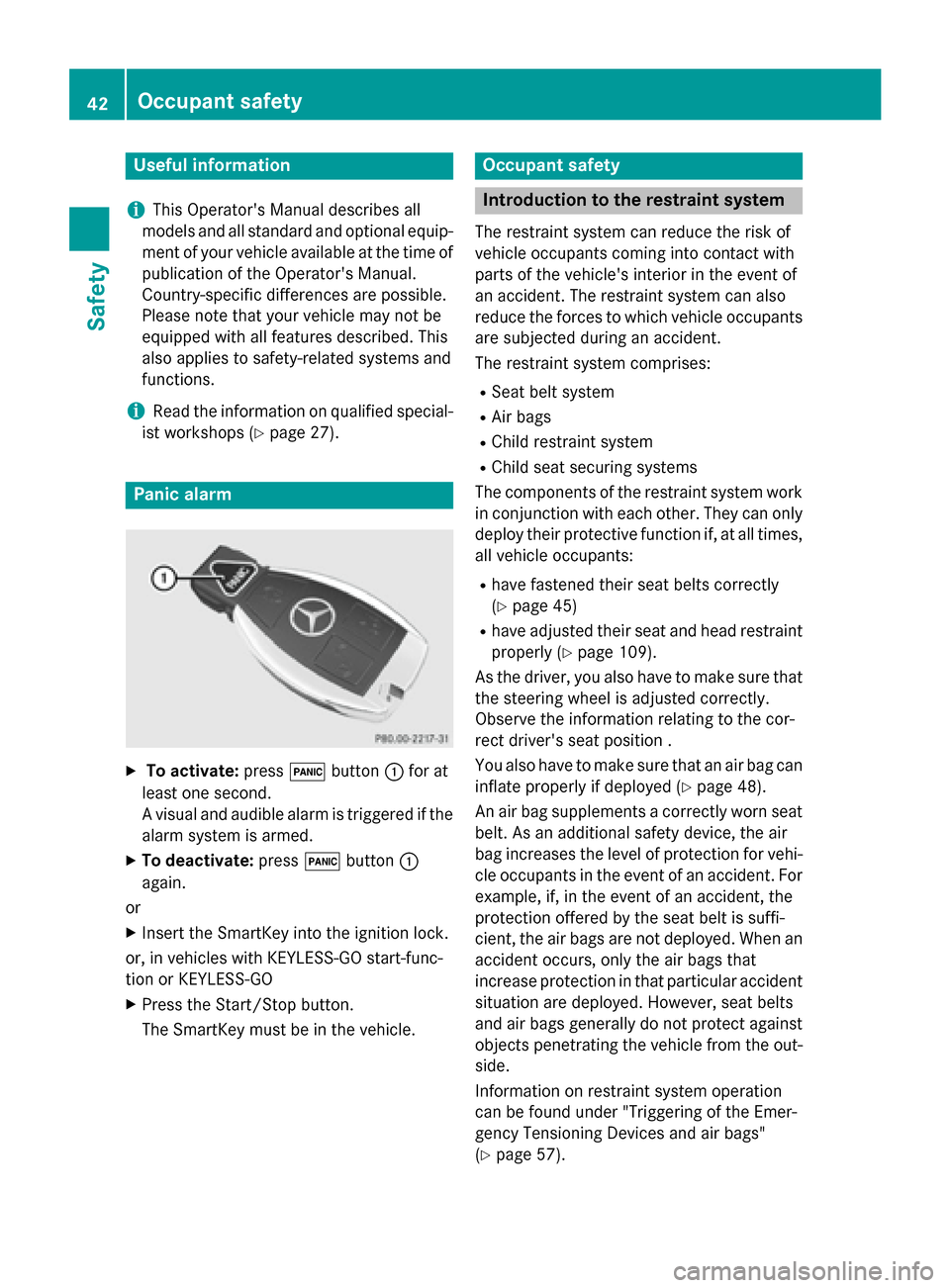
XTo activate: press!button :for at
least one second.
A visual and audible alarm is triggered if the
alarm system is armed.
XTo deactivate: press!button :
again.
or
XInsert the SmartKey into the ignition lock.
or, in vehicles with KEYLESS-GO start-func-
tion or KEYLESS ‑GO
XPress the Start/Stop button.
The SmartKey must be in the vehicle.
Occupant safety
Introduction to the restraint system
The restraint system can reduce the risk of
vehicle occupants coming into contact with
parts of the vehicle's interior in the event of
an accident. The restraint system can also
reduce the forces to which vehicle occupants
are subjected during an accident.
The restraint system comprises:
RSeat belt system
RAir bags
RChild restraint system
RChild seat securing systems
The components of the restraint system work in conjunction with each other. They can only
deploy their protective function if, at all times,
all vehicle occupants:
Rhave fastened their seat belts correctly
(
Ypage 45)
Rhave adjusted their seat and head restraint
properly (
Ypage 109).
As the driver, you also have to make sure that
the steering wheel is adjusted correctly.
Observe the information relating to the cor-
rect driver's seat position .
You also have to make sure that an air bag can
inflate properly if deployed (
Ypage 48).
An air bag supplements a correctly worn seat
belt. As an additional safety device, the air
bag increases the level of protection for vehi-
cle occupants in the event of an accident. For
example, if, in the event of an accident, the
protection offered by the seat belt is suffi-
cient, the air bags are not deployed. When an
accident occurs, only the air bags that
increase protection in that particular accident
situation are deployed. However, seat belts
and air bags generally do not protect against objects penetrating the vehicle from the out-
side.
Information on restraint system operation
can be found under "Triggering of the Emer-
gency Tensioning Devices and air bags"
(
Ypage 57).
42Occupant safety
Safety
Page 142 of 418
Useful information
i
This Operator's Manual describes all
models and all standard and optional equip-
ment of your vehicle available at the time of
publication of the Operator's Manual.
Country-specific differences are possible.
Please note that your vehicle may not be
equipped with all features described. This
also applies to safety-related systems and
functions.
iRead the information on qualified special-
ist workshops (
Ypage 27).
Overview of climate control systems
General notes
Observe the settings recommended on the
following pages. The windows could other-
wise fog up.
To prevent the windows from fogging up:
Rswitch off climate control only briefly
Rswitch on air-recirculation mode only
briefly
Rswitch on the cooling with air dehumidifi-
cation function
Rswitch on the defrost windshield function
briefly, if required
Climate control regulates the temperature
and air humidity in the vehicle interior. The
interior filter cleans the air, thus improving
the interior climate.
If you start the engine using your smartphone,
the last selected climate control setting is
reactivated (
Ypage 156).
iVentilate the vehicle for a brief period
during warm weather, e.g. using the con-
venience opening feature (
Ypage 99). This
will speed up the cooling process and the
desired interior temperature will be
reached more quickly.
iThe integrated filter filters out most par-
ticles of dust and soot and completely fil- ters out pollen. It also reduces gaseous pol-
lutants and odors. A clogged filter reduces
the amount of air supplied to the vehicle
interior. For this reason, you should always
observe the interval for replacing the filter,
which is specified in the Maintenance
Booklet. As it depends on environmental
conditions, e.g. heavy air pollution, the
interval may be shorter than stated in the
Maintenance Booklet.
iIt is possible that the blower may be acti-
vated automatically 60 minutes after the
SmartKey has been removed depending on
various factors, e.g. the outside tempera-
ture. The vehicle is then ventilated for
30 minutes to dry the climate control sys-
tem.
140Overview of climate control systems
Climate control
Page 143 of 418
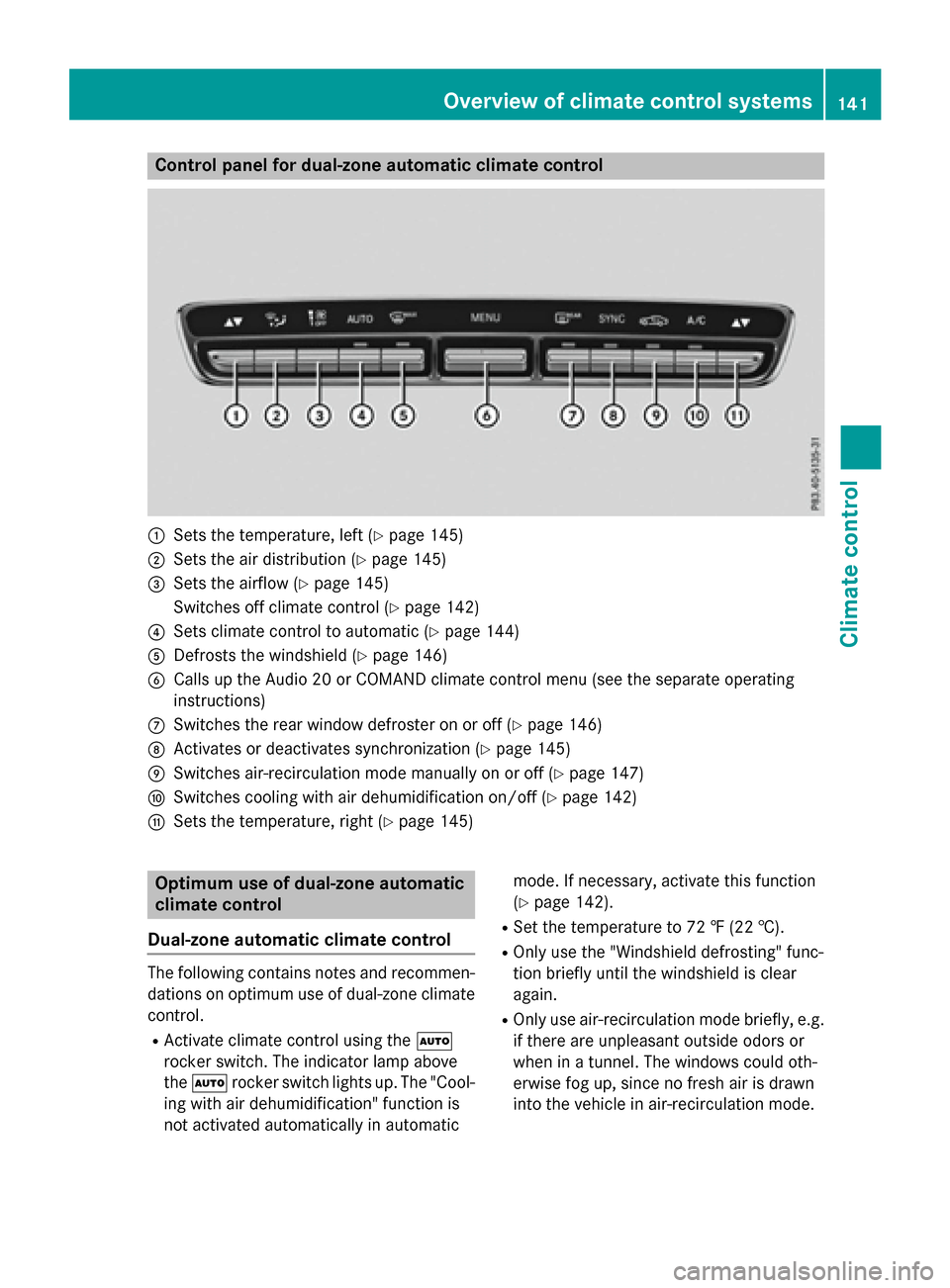
Control panel for dual-zone automatic climate control
:Sets the temperature, left (Ypage 145)
;Sets the air distribution (Ypage 145)
=Sets the airflow (Ypage 145)
Switches off climate control (
Ypage 142)
?Sets climate control to automatic (Ypage 144)
ADefrosts the windshield (Ypage 146)
BCalls up the Audio 20 or COMAND climate control menu (see the separate operating
instructions)
CSwitches the rear window defroster on or off (Ypage 146)
DActivates or deactivates synchronization (Ypage 145)
ESwitches air-recirculation mode manually on or off (Ypage 147)
FSwitches cooling with air dehumidification on/off (Ypage 142)
GSets the temperature, right (Ypage 145)
Optimum use of dual-zone automatic
climate control
Dual-zone automatic climate control
The following contains notes and recommen-
dations on optimum use of dual-zone climate
control.
RActivate climate control using the Ã
rocker switch. The indicator lamp above
the à rocker switch lights up. The "Cool-
ing with air dehumidification" function is
not activated automatically in automatic mode. If necessary, activate this function
(
Ypage 142).
RSet the temperature to 72 ‡ (22 †).
ROnly use the "Windshield defrosting" func-
tion briefly until the windshield is clear
again.
ROnly use air-recirculation mode briefly, e.g.
if there are unpleasant outside odors or
when in a tunnel. The windows could oth-
erwise fog up, since no fresh air is drawn
into the vehicle in air-recirculation mode.
Overview of climate control systems141
Climate control
Page 144 of 418
DYNAMIC SELECT switch
You can choosebetween various drive pro -
grams wit hth eDYNAMI CSELECT switch
(
Ypage 161).
If you hav eselecte ddrive program E:
Rth ecoolin goutput is reduce dwhen coolin g
Rwhen heating, th eelectrical heater booster
is deactivated and heat output is reduce d
as aresult
Rth erea rwindow defroster running time is
reduce d
If you hav eselecte ddrive program C,Sor S+ ,
th ecurren tclimat esetting sare maintained.
ECO start/stop function
Durin gautomatic engin eswitch-off ,th ecli-
mat econtro lsystem only operates at a
reduce dcapacity. If you require th efull cli-
mat econtro loutput ,you can switch of fth e
EC Ostart/sto pfunction by pressing th eEC O
butto n (
Ypage 159).
Operating th eclimat econtro lsys -
tems
Activating/deactivating climat econ-
trol
General notes
Whe nth eclimat econtro lis switched off, th e
air supply and air circulation are also
switched off. The windows could fo gup.
Therefore, switch of fclimat econtro lonly
briefly
Switc hon climat econtro lprimarily usin gth e
à rocker switch (
Ypage 144).
Activating or deactivating
XTurnth eSmartKey to position 2in th eigni-
tion loc k (
Ypage 153).
XTo switch on: press thet or!
rocker switch up or down .
The Audio 20 or COMAN Dclimat econtro l
men uopens .
XSwitchon th eclimat econtro lvia th eair-
conditionin gfunction bar ,see th eseparat e
operatin ginstructions.
or
XSe tth eairflow to level 1or higher usin gth e
H rocker switch .
XTo switch off :press th et or!
rocker switch up or down .
The Audio 20 or COMAN Dclimat econtro l
men uopens .
XSwitchof fth eclimat econtro lvia th eair-
conditionin gfunction bar ,see th eseparat e
operatin ginstructions.
or
XSe tth eairflow to level 0usin gth eH
rocker switch .
Switchingcoolin gwit hair dehumidi-
fication on/of f
General notes
If you deactivat eth e"Coolin gwit hair-dehu-
midification "function ,th eair insid eth evehi-
cl e will no tbe cooled .The air insid eth evehi-
cl e will also no tbe dehumidified. The win -
dows can fo gup more quickly. Therefore,
deactivat eth ecoolin gwit hair-dehumidifica-
tion function only briefly.
The "Coolin gwit hair dehumidification "func-
tion is only available when th eengin eis run -
ning .The air insid eth evehicle is cooled and
dehumidified accordin gto th etemperature
selected.
Condensation may dri pfrom th eunderside of
th evehicle when it is in coolin gmode. Thi sis
normal and no t asignthat there is amalfunc -
tion .
142Operating the climate control systems
Climate control
Page 150 of 418
HEnvironmental note
Full perfume vials must not
be disposed of with house-
hold rubbish. They must be
collected separately and
recycled to protect the envi-
ronment.
Dispose of full perfume vials
in an environmentally
responsible manner and
take them to a special wastecollection point.
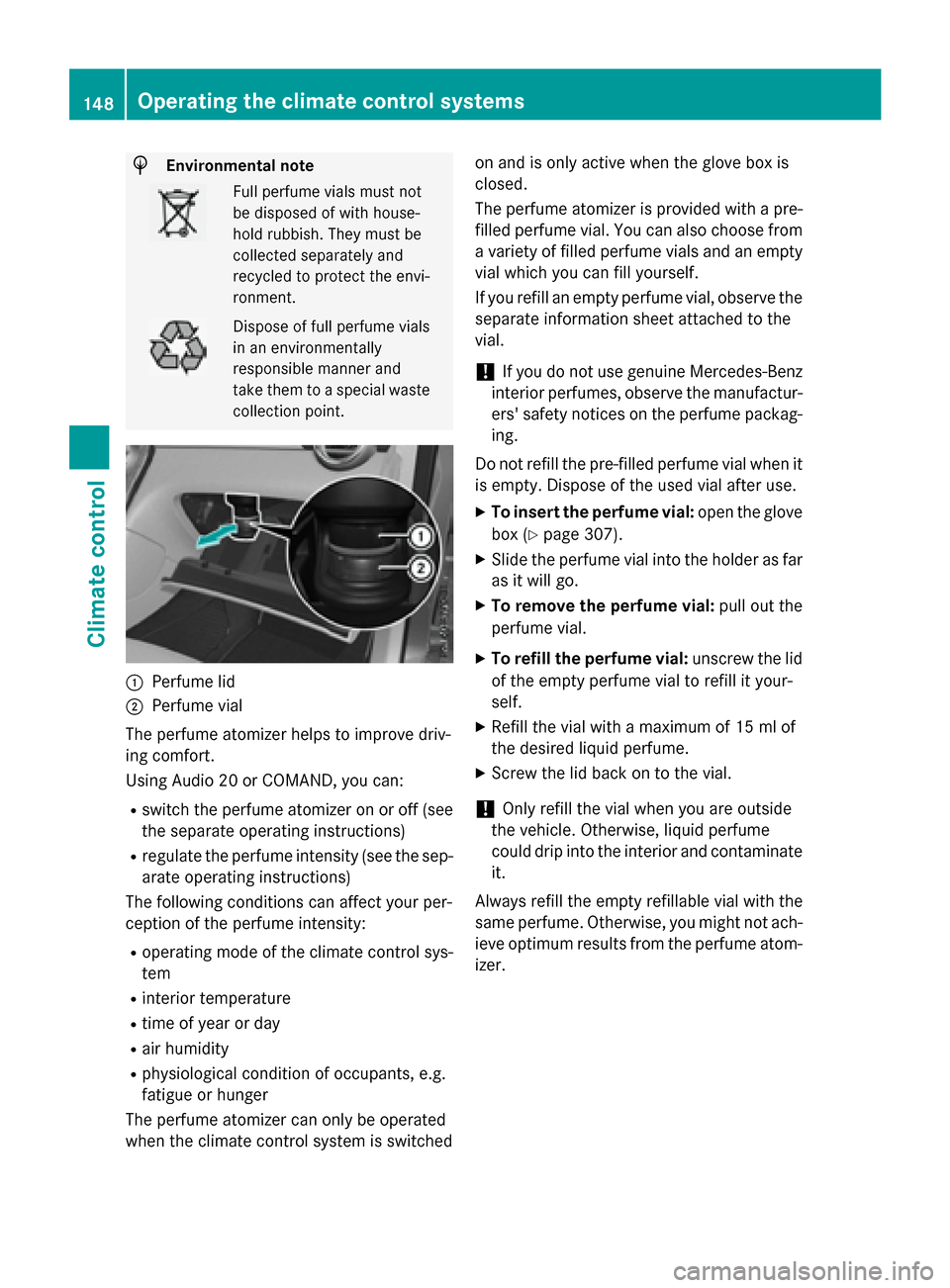
:Perfume lid
;Perfume vial
The perfume atomizer helps to improve driv-
ing comfort.
Using Audio 20 or COMAND, you can:
Rswitch the perfume atomizer on or off (see
the separate operating instructions)
Rregulate the perfume intensity (see the sep-
arate operating instructions)
The following conditions can affect your per-
ception of the perfume intensity:
Roperating mode of the climate control sys-
tem
Rinterior temperature
Rtime of year or day
Rair humidity
Rphysiological condition of occupants, e.g.
fatigue or hunger
The perfume atomizer can only be operated
when the climate control system is switched on and is only active when the glove box is
closed.
The perfume atomizer is provided with a pre-
filled perfume vial. You can also choose from
a variety of filled perfume vials and an empty
vial which you can fill yourself.
If you refill an empty perfume vial, observe the
separate information sheet attached to the
vial.
!If you do not use genuine Mercedes-Benz
interior perfumes, observe the manufactur-
ers' safety notices on the perfume packag-
ing.
Do not refill the pre-filled perfume vial when it
is empty. Dispose of the used vial after use.
XTo insert the perfume vial: open the glove
box (
Ypage 307).
XSlide the perfume vial into the holder as far
as it will go.
XTo remove the perfume vial: pull out the
perfume vial.
XTo refill the perfume vial: unscrew the lid
of the empty perfume vial to refill it your-
self.
XRefill the vial with a maximum of 15 ml of
the desired liquid perfume.
XScrew the lid back on to the vial.
!Only refill the vial when you are outside
the vehicle. Otherwise, liquid perfume
could drip into the interior and contaminate
it.
Always refill the empty refillable vial with the
same perfume. Otherwise, you might not ach-
ieve optimum results from the perfume atom-
izer.
148Operating the climate control systems
Climate control
Page 157 of 418
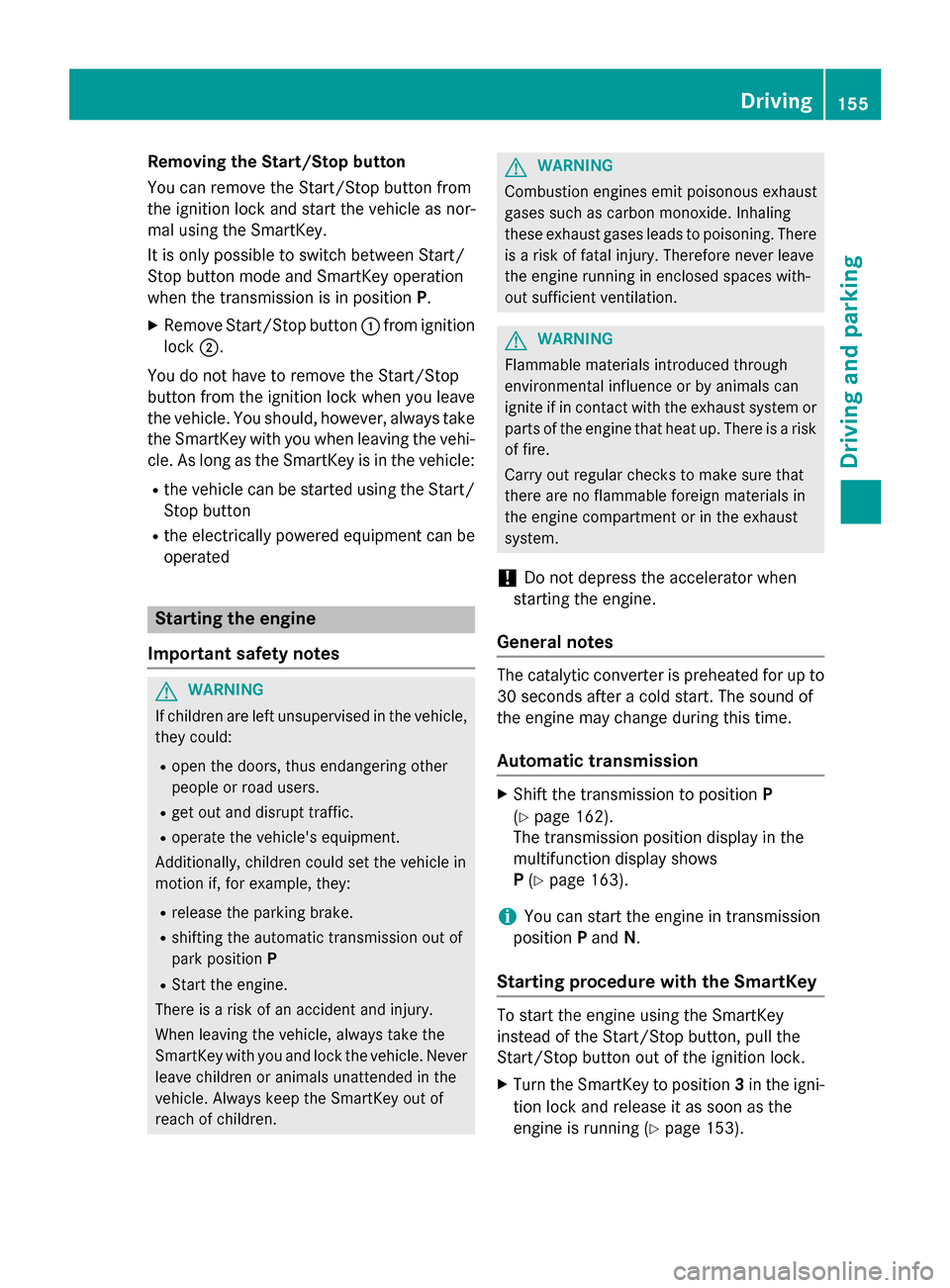
Removing the Start/Stop button
You can remove the Start/Stop button from
the ignition lock and start the vehicle as nor-
mal using the SmartKey.
It is only possible to switch between Start/
Stop button mode and SmartKey operation
when the transmission is in positionP.
XRemove Start/Stop button:from ignition
lock ;.
You do not have to remove the Start/Stop
button from the ignition lock when you leave
the vehicle. You should, however, always take
the SmartKey with you when leaving the vehi-
cle. As long as the SmartKey is in the vehicle:
Rthe vehicle can be started using the Start/
Stop button
Rthe electrically powered equipment can be
operated
Starting the engine
Important safety notes
GWARNING
If children are left unsupervised in the vehicle,
they could:
Ropen the doors, thus endangering other
people or road users.
Rget out and disrupt traffic.
Roperate the vehicle's equipment.
Additionally, children could set the vehicle in
motion if, for example, they:
Rrelease the parking brake.
Rshifting the automatic transmission out of
park position P
RStart the engine.
There is a risk of an accident and injury.
When leaving the vehicle, always take the
SmartKey with you and lock the vehicle. Never
leave children or animals unattended in the
vehicle. Always keep the SmartKey out of
reach of children.
GWARNING
Combustion engines emit poisonous exhaust
gases such as carbon monoxide. Inhaling
these exhaust gases leads to poisoning. There
is a risk of fatal injury. Therefore never leave
the engine running in enclosed spaces with-
out sufficient ventilation.
GWARNING
Flammable materials introduced through
environmental influence or by animals can
ignite if in contact with the exhaust system or
parts of the engine that heat up. There is a risk
of fire.
Carry out regular checks to make sure that
there are no flammable foreign materials in
the engine compartment or in the exhaust
system.
!Do not depress the accelerator when
starting the engine.
General notes
The catalytic converter is preheated for up to
30 seconds after a cold start. The sound of
the engine may change during this time.
Automatic transmission
XShift the transmission to position P
(
Ypage 162).
The transmission position display in the
multifunction display shows
P (
Ypage 163).
iYou can start the engine in transmission
position Pand N.
Starting procedure with the SmartKey
To start the engine using the SmartKey
instead of the Start/Stop button, pull the
Start/Stop button out of the ignition lock.
XTurn the SmartKey to position 3in the igni-
tion lock and release it as soon as the
engine is running (
Ypage 153).
Driving155
Driving and parking
Z