ESP MERCEDES-BENZ GLE 2016 Owner's Guide
[x] Cancel search | Manufacturer: MERCEDES-BENZ, Model Year: 2016, Model line: GLE, Model: MERCEDES-BENZ GLE 2016Pages: 450, PDF Size: 12.92 MB
Page 97 of 450
Problems with the side windows
G WARNING
If you close a side window again immediately after it has been blocked or reset, the side window
closes with increased or maximum force. The reversing feature is then not active. Parts of the
body could be trapped in the closing area in the process. This poses an increased risk of injury or
even fatal injury.
Make sure that no parts of the body are in the closing area. To stop the closing process, release
the switch or push the switch again to reopen the side window.
Problem
Possible causes/consequences and P Solutions
A side window cannot be
closed because it is
blocked by objects, e.g.
leaves in the window
guide. X
Remove the objects. X
Close the side window.
A side window cannot be
closed and you cannot
see the cause. If a side window is obstructed during closing and reopens again
slightly: X
Immediately after the window blocks, pull the corresponding switch
again until the side window has closed.
The side window is closed with increased force.
If a side window is obstructed again during closing and reopens again
slightly: X
Immediately after the window blocks, pull the corresponding switch
again until the side window has closed.
The sliding sunroof is closed without the automatic reversing fea-
ture.
Sliding sunroof
Important safety notes Your vehicle may be equipped with a sliding
sunroof or a panorama roof with power tilt/slid-
ing panel. In the following section, the term
"sliding sunroof" refers to both sliding sunroof
variants.
G WARNING
While opening and closing the sliding sunroof,
body parts in close proximity could become
trapped. There is a risk of injury.
Make sure that no body parts are in close
proximity during the opening and closing pro-
cedures. If somebody becomes trapped: R
release the switch immediately, or R
during automatic operation, push the
switch briefly in any direction
The opening or closing procedure will be stop-
ped.
G WARNING
If children operate the sliding sunroof they
could become trapped, particularly if they are
left unsupervised. There is a risk of injury.
When leaving the vehicle, always take the
SmartKey with you and lock the vehicle. Never
leave children unsupervised in the vehicle.Sliding sunroof 95
Opening and closing Z
Page 98 of 450
! Only open the sliding sunroof if it is free of
snow and ice. Otherwise, malfunctions may
occur.
Do not allow anything to protrude from the
sliding sunroof. Otherwise, the seals could be
damaged.
! The weather can change abruptly. It could
start to rain or snow. Make sure that the slid-
ing sunroof is closed when you leave the vehi-
cle. The vehicle electronics can be damaged if
water enters the vehicle interior.
Resonance noises can occur in addition to the
usual airflow noises when the sliding sunroof is
open. They are caused by minor pressure fluc-
tuations in the vehicle interior. Change the posi-
tion of the sliding sunroof or open a side win-
dow. The noise will be reduced or eliminated.
Sliding sunroof reversing feature Your vehicle may be equipped with a sliding
sunroof or a panorama roof with power tilt/slid-
ing panel. In the following section, the term
"sliding sunroof" refers to both sliding sunroof
variants.
The sliding sunroof is equipped with an auto-
matic reversing feature. If a solid object blocks
or restricts the sliding sunroof during the closing
process, the sliding sunroof opens again auto-
matically. However, the automatic reversing
feature is only an aid and does not relieve you of
the responsibility of paying attention when clos-
ing the sliding sunroof.
G WARNING
The reversing feature does not react: R
to soft, light and thin objects, e.g. small fin-
gers R
over the last 1/6 in (4 mm) of the closing
movement R
during resetting R
when closing the sliding sunroof again man-
ually immediately after automatic reversing
This means that the reversing feature cannot
prevent someone being trapped in these sit-
uations. There is a risk of injury.
Make sure that no body parts are in close
proximity during the closing procedure. If somebody becomes trapped: R
release the switch immediately, or R
press the switch in any direction during the
automatic closing process
The closing process is stopped.
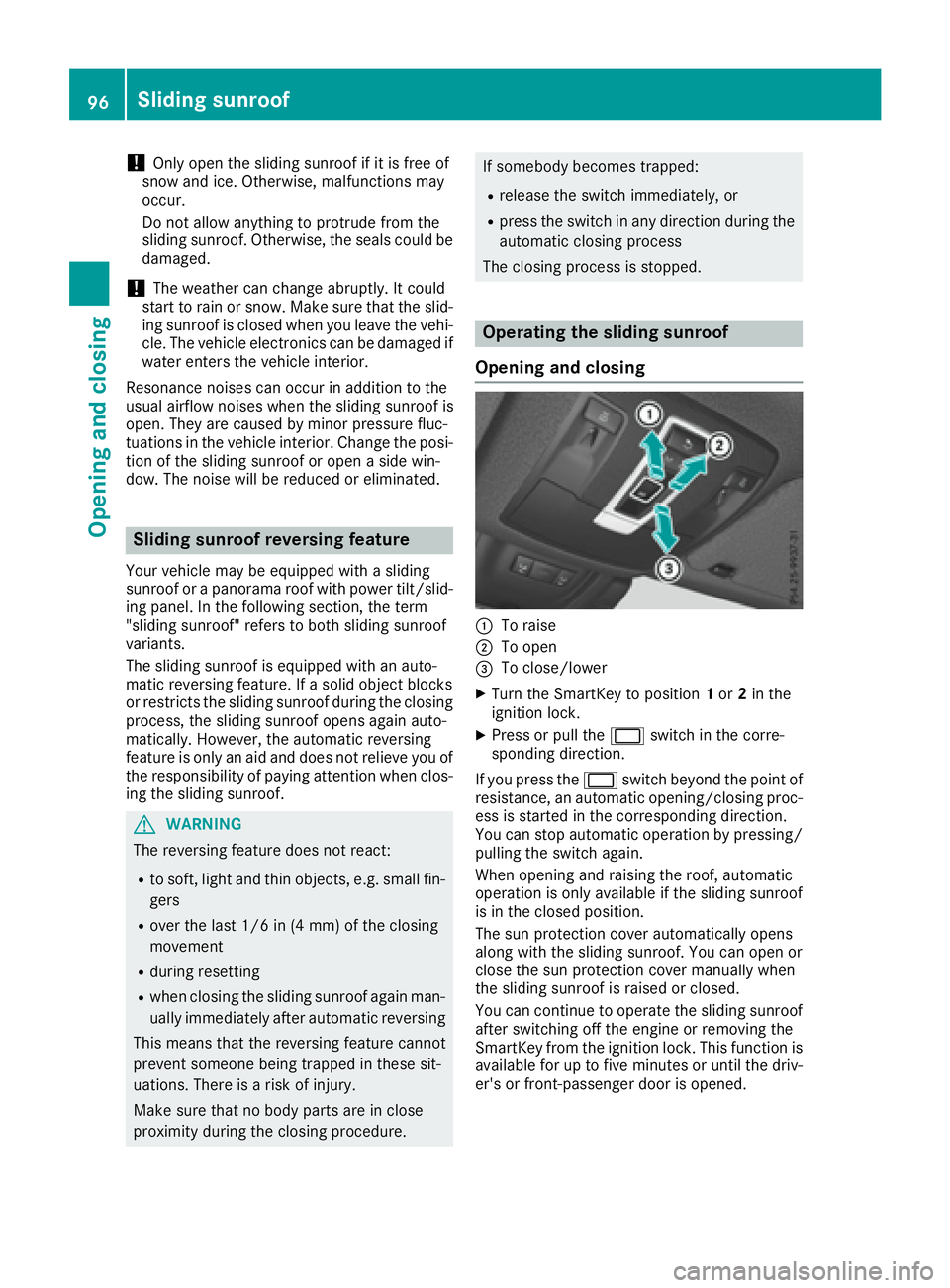
Operating the sliding sunroof
Opening and closing
C
To raise D
To open
Page 112 of 450
Crash-responsive EASY-EXIT feature If the crash-responsive EASY-EXIT feature is trig-
gered in an accident, the steering column will
move upwards when the driver's door is opened.
This occurs irrespective of the position of the
SmartKey in the ignition lock. This makes it eas-
ier to exit the vehicle and rescue the occupants.
The crash-responsive EASY-EXIT feature is only
operational if the EASY-EXIT/ENTRY feature is
activated in the on-board computer
( Y
page 275).
Mirrors
Rear-view mirror
X
Anti-glare mode: flick anti-glare lever C for-
wards or back.
Exterior mirrors
Adjusting the exterior mirrors
G WARNING
You could lose control of your vehicle if you do
the following while driving: R
adjust the driver's seat, head restraint,
steering wheel or mirrors R
fasten the seat belt
There is a risk of an accident.
Adjust the driver's seat, head restraint, steer-
ing wheel and mirror and fasten your seat belt
before starting the engine. G WARNING
The exterior mirror on the front-passenger
side reduces the size of the image. Visible
objects are actually closer than they appear.
This means that you could misjudge the dis-
tance from road users traveling behind, e.g.
when changing lane. There is a risk of an acci-
dent.
For this reason, always make sure of the
actual distance from the road users traveling
behind by glancing over your shoulder.
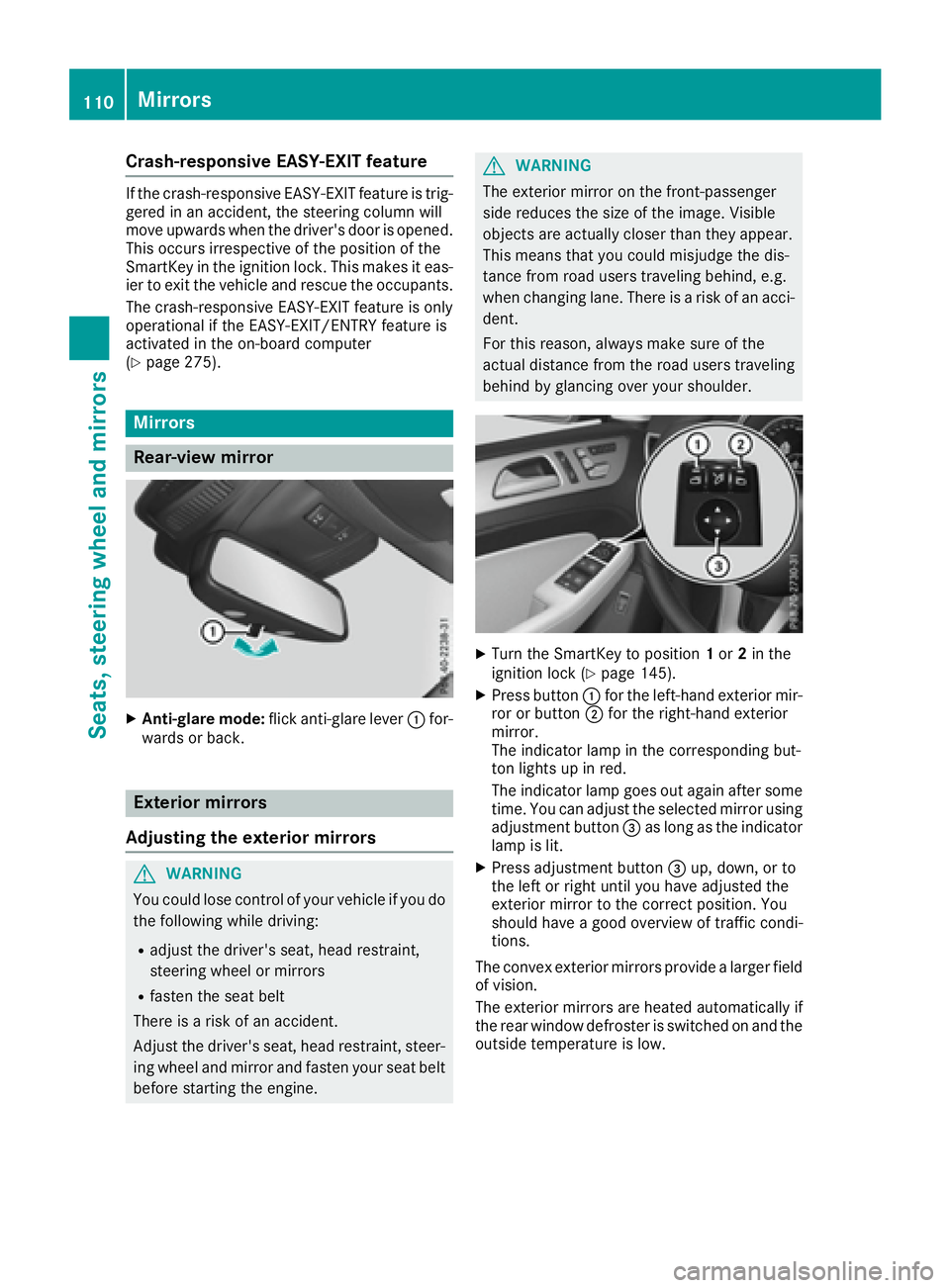
X
Turn the SmartKey to position 1 or 2 in the
ignition lock ( Y
page 145). X
Press button C for the left-hand exterior mir-
ror or button D for the right-hand exterior
mirror.
The indicator lamp in the corresponding but-
ton lights up in red.
The indicator lamp goes out again after some
time. You can adjust the selected mirror using
adjustment button
Page 117 of 450
The daytime running lamps improve the visibility
of your vehicle during the day. The daytime run-
ning lamps function is required by law in Can-
ada. It cannot therefore be deactivated.
When the engine is running and the vehicle is
stationary: if you move the selector lever from a
drive position to P , the daytime running lamps/
low-beam headlamps go out after three
minutes.
When the engine is running, the vehicle is sta-
tionary and in bright ambient light: if you turn the
light switch to ` , the daytime running lamps
and parking lamps switch on.
If the engine is running and you turn the light
switch to X , the manual settings take prec-
edence over the daytime running lamps.
USA only:
The daytime running lamps improve the visibility
of your vehicle during the day. To do this, the
daytime running lamps function must be
switched on using the on-board computer
( Y
page 275).
If the engine is running and you turn the light
switch to ` or X , the manual settings
take precedence over the daytime running
lamps.
Low-beam headlamps Even if the light sensor does not detect that it is
dark, the parking lamps and low-beam head-
lamps switch on when the ignition is switched on
and the light switch is set to the X position.
This is a particularly useful function in the event
of rain and fog. X
To switch on the low-beam headlamps:
turn the SmartKey in the ignition lock to posi-
tion 2 or start the engine.X
Turn the light switch to X .
The green X indicator lamp in the instru-
ment cluster lights up.
Rear fog lamp
The rear fog lamp improves visibility of your
vehicle for the traffic behind in the event of thick
fog. Please take note of the country-specific
regulations for the use of rear fog lamps. X
To switch on the rear fog lamp: turn the
SmartKey in the ignition lock to position 2 or
start the engine. X
Turn the light switch to X or X . X
Press the ^ button.
The yellow ^ indicator lamp in the instru-
ment cluster lights up. X
To switch off the rear fog lamp: press the
^ but ton.
The yellow ^ indicator lamp in the instru-
ment cluster goes out.
Parking lamps
! If the battery has been excessively dis-
charged, the parking lamps or standing lamps
are automatically switched off to enable the
next engine start. Always park your vehicle
safely and sufficiently lit according to legal
standards. Avoid the continuous use of the
` parking lamps for several hours. If pos-
sible, switch on the d right or the c left
standing lamp. X
To switch on: turn the light switch to ` .
The green ` indicator lamp in the instru-
ment cluster lights up.
Standing lamps Switching on the standing lamps ensures the
corresponding side of the vehicle is illuminated. X
To switch on the standing lamps: the
SmartKey should not be in the ignition lock or
it should be in position 0 .X
Turn the light switch to c (left-hand side of
the vehicle) or d (right-hand side of the
vehicle).
Vehicles towing a trailer: both the right-hand
and left-hand standing lamps (tail lamps) are
always illuminated on the trailer.Exterior lighting 115
Lights and windshield wipers Z
Page 120 of 450
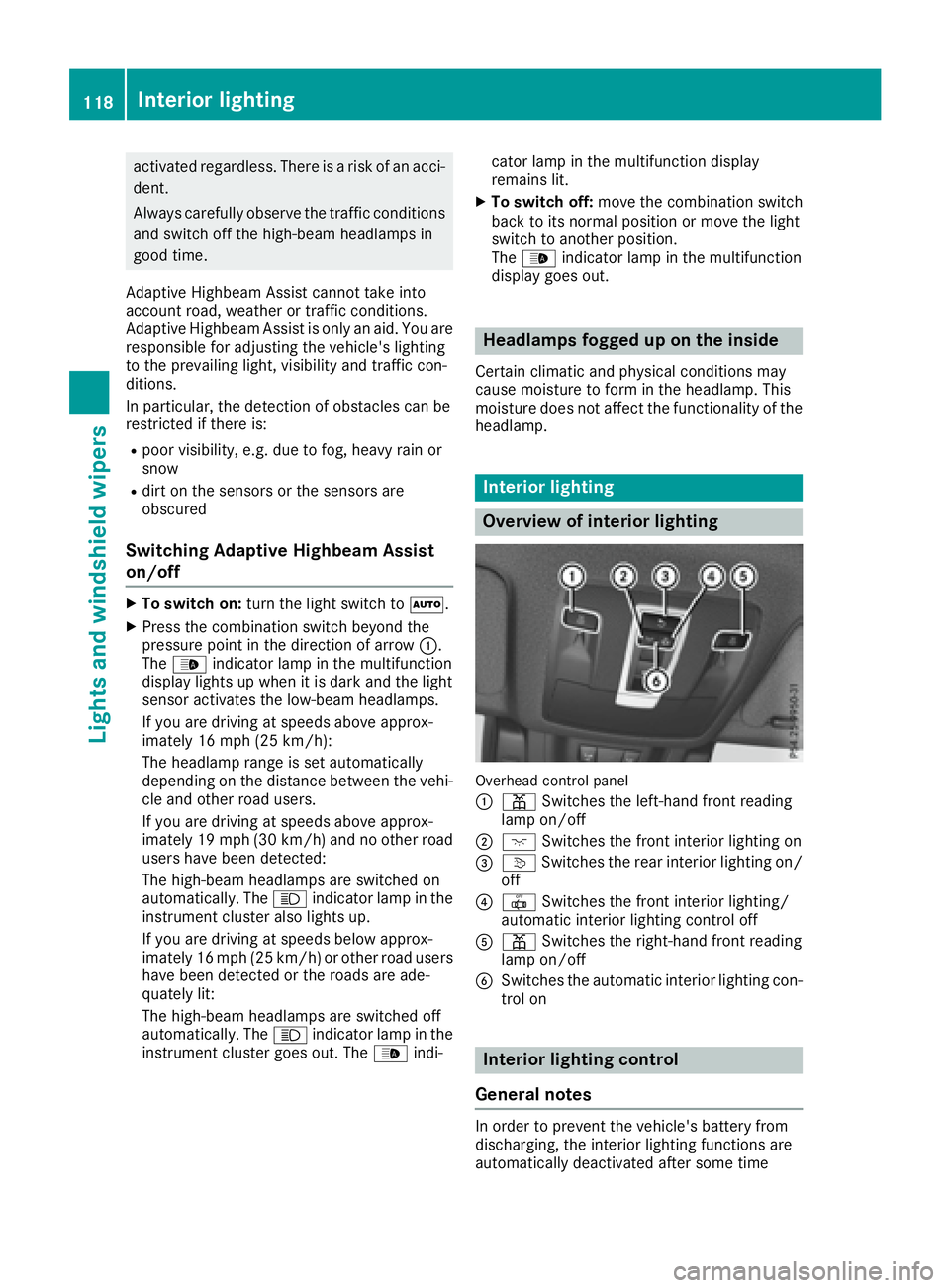
activated regardless. There is a risk of an acci-
dent.
Always carefully observe the traffic conditions
and switch off the high-beam headlamps in
good time.
Adaptive Highbeam Assist cannot take into
account road, weather or traffic conditions.
Adaptive Highbeam Assist is only an aid. You are
responsible for adjusting the vehicle's lighting
to the prevailing light, visibility and traffic con-
ditions.
In particular, the detection of obstacles can be
restricted if there is: R
poor visibility, e.g. due to fog, heavy rain or
snow R
dirt on the sensors or the sensors are
obscured
Switching Adaptive Highbeam Assist
on/off X
To switch on: turn the light switch to X .X
Press the combination switch beyond the
pressure point in the direction of arrow C .
The
Page 148 of 450
KEYLESS- GOGenera l notesVehicles wit h KEYLESS-GO are equipped wit h a
SmartKey featurin g an integrate d KEYLESS-GO
function and a detachable Start/Sto p button.
A chec k whic h periodically establishes a radi o
connection between th e vehicl e and th e Smart -
Key determine s whether a valid SmartKey is in
th e vehicle. This occurs, for example, when
starting th e engine.
Whe n you insert th e Start/Sto p butto n int o th e
ignition lock, th e system needs approximately
two seconds recognition time. You can then use
th e Start/Sto p button.
Pressing th e Start/Sto p butto n several times in
succession corresponds to th e differen t ke y
position s in th e ignition lock. This is only th e
cas e if you are no t depressing th e brak e pedal .
If you depress th e brak e pedal and press th e
Start/Sto p button, th e engin e start s immedi-
ately.
To start th e vehicl e without actively usin g th e
SmartKey: R
th e Start/Sto p butto n mus t be inserted in th e
ignition lock. R
th e SmartKey mus t be in th e vehicle.R
th e vehicl e mus t no t be locke d wit h th e
SmartKey or KEYLESS-GO ( Y
page 79).
Do no t keep th e SmartKey:R
wit h electronic devices, e.g. a mobile phone
or another SmartKey. R
wit h metallic objects , e.g. coins or metal foil.R
inside metallic objects , e.g. a metal case.
This can impair th e functionalit y of th e KEY-
LESS-GO key.
Do no t keep th e KEYLESS-GO ke y in th e tem-
perature-controlled cup holder ( Y
page 340).
Otherwise , th e KEYLESS-GO ke y will no t be rec -
ognized.
If you loc k th e vehicl e wit h th e SmartKey' s
remot e control or wit h KEYLESS-GO , after a
short time: R
you will no t be able to switch on th e ignition
wit h th e Start/Sto p button.R
you will no t be able to start th e engin e wit h th e
Start/Sto p butto n until th e vehicl e is
unlocke d again . If you loc k th e vehicl e centrally usin g th e butto n
on th e fron t door ( Y
page 85) , you can continu e
to start th e engin e wit h th e Start/Sto p button.
The engin e can be switched off while th e vehicl e
is in motion by pressing and holding th e Start /
Stop butto n for three seconds. This function
operate s independentl y of th e ECO start/sto p
automatic engin e switch-off function .
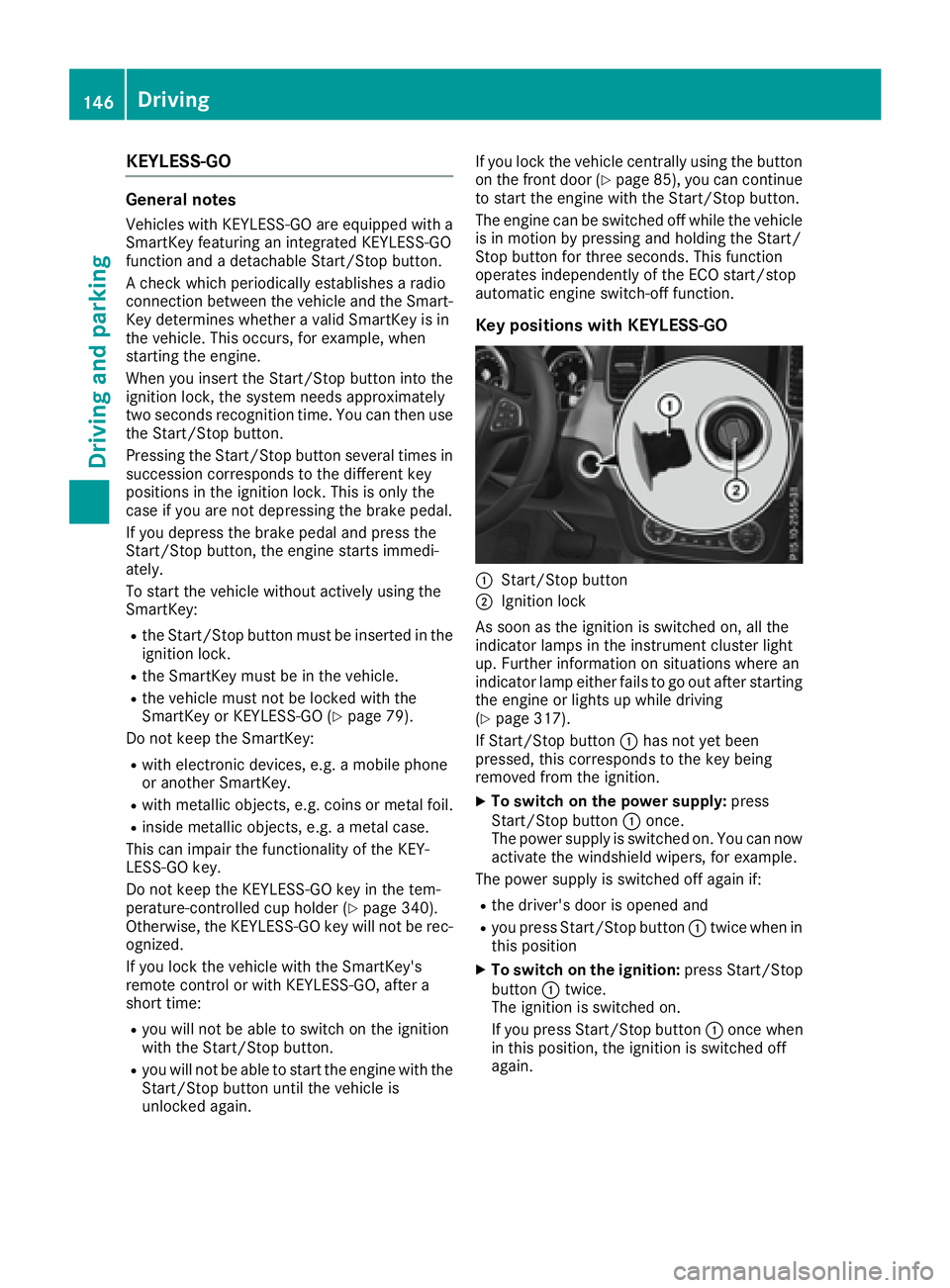
Key positions wit h KEYLESS-G O
C
Start/Sto p butto nD
Ignition loc k
As soo n as th e ignition is switched on , all th e
indicator lamp s in th e instrumen t cluste r ligh t
up. Further information on situation s wher e an
indicator lamp either fail s to go out after starting
th e engin e or lights up while drivin g
( Y
page 317).
If Start/Sto p butto n C has no t yet been
pressed, this corresponds to th e ke y bein g
remove d from th e ignition .X
To switch on th e power supply : press
Start/Sto p butto n C once .
The powe r supply is switched on . You can no w
activat e th e windshield wipers, for example.
The powe r supply is switched off again if: R
th e driver's door is opened and R
you press Start/Sto p butto n C twice when in
this position X
To switch on th e ignition: press Start/Sto p
butto n C twice .
The ignition is switched on .
If you press Start/Sto p butto n C once when
in this position , th e ignition is switched off
again .146
Driving
Driving and parking
Page 151 of 450
It is only possible to shift the transmission from
position P to the desired position if you depress
the brake pedal. Only then is the parking lock
released. If you do not depress the brake pedal,
the DIRECT SELECT lever can still be moved but
the parking lock remains engaged.
i Upshifts take place at higher engine speeds
after a cold start. This helps the catalytic con-
verter to reach its operating temperature
more quickly.
Information on the automatic release of the
electric parking brake ( Y
page 179).
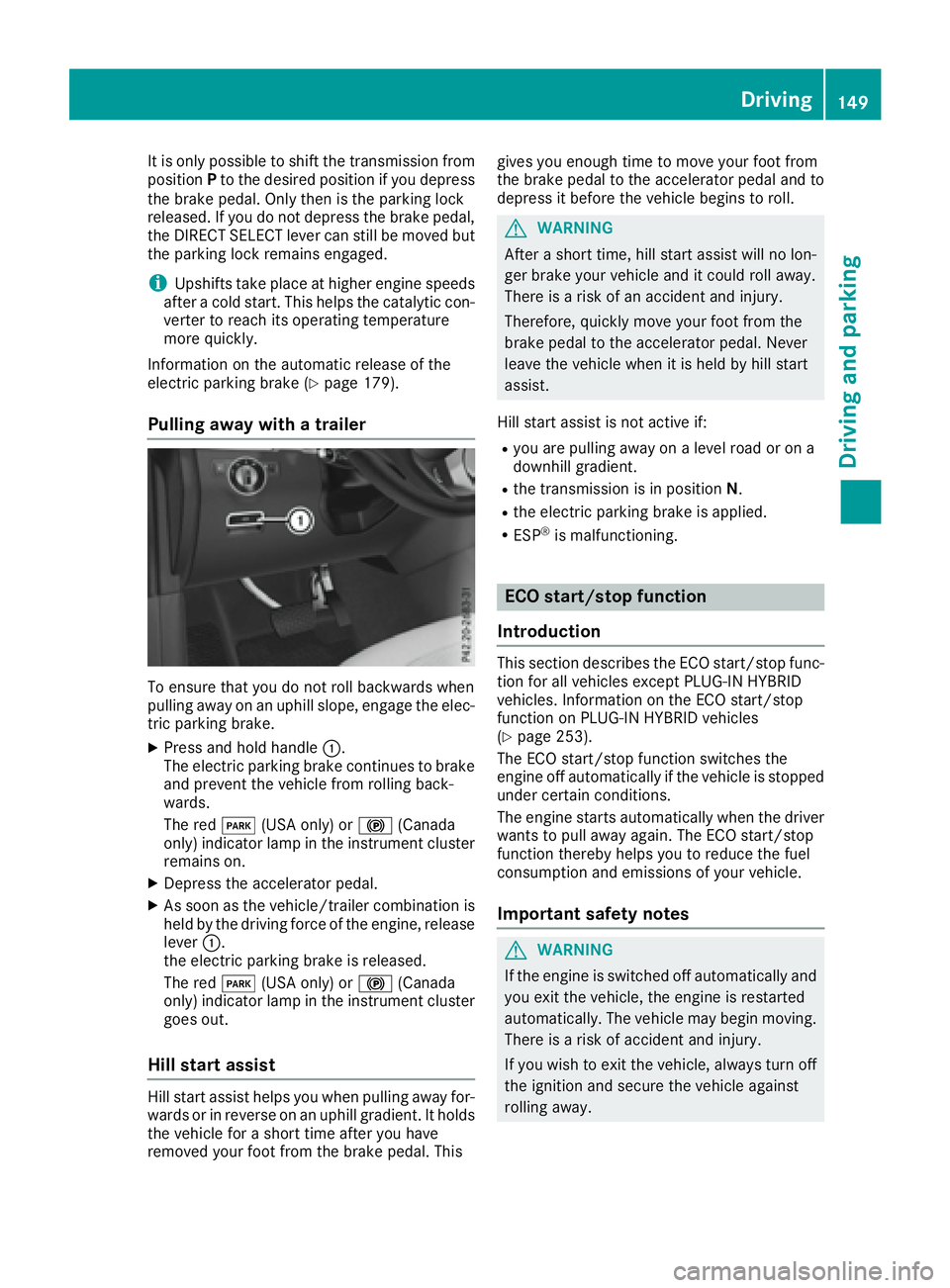
Pulling away with a trailer
To ensure that you do not roll backwards when
pulling away on an uphill slope, engage the elec-
tric parking brake. X
Press and hold handle C .
The electric parking brake continues to brake
and prevent the vehicle from rolling back-
wards.
The red I (USA only) or $ (Canada
only) indicator lamp in the instrument cluster
remains on. X
Depress the accelerator pedal. X
As soon as the vehicle/trailer combination is
held by the driving force of the engine, release
lever C .
the electric parking brake is released.
The red I (USA only) or $ (Canada
only) indicator lamp in the instrument cluster
goes out.
Hill start assist
Hill start assist helps you when pulling away for-
wards or in reverse on an uphill gradient. It holds
the vehicle for a short time after you have
removed your foot from the brake pedal. This gives you enough time to move your foot from
the brake pedal to the accelerator pedal and to
depress it before the vehicle begins to roll.
G WARNING
After a short time, hill start assist will no lon-
ger brake your vehicle and it could roll away.
There is a risk of an accident and injury.
Therefore, quickly move your foot from the
brake pedal to the accelerator pedal. Never
leave the vehicle when it is held by hill start
assist.
Hill start assist is not active if: R
you are pulling away on a level road or on a
downhill gradient. R
the transmission is in position N .R
the electric parking brake is applied. R
ESP ®
is malfunctioning.
ECO start/stop function
Introduction This section describes the ECO start/stop func-
tion for all vehicles except PLUG-IN HYBRID
vehicles. Information on the ECO start/stop
function on PLUG-IN HYBRID vehicles
( Y
page 253).
The ECO start/stop function switches the
engine off automatically if the vehicle is stopped
under certain conditions.
The engine starts automatically when the driver
wants to pull away again. The ECO start/stop
function thereby helps you to reduce the fuel
consumption and emissions of your vehicle.
Important safety notes
G WARNING
If the engine is switched off automatically and
you exit the vehicle, the engine is restarted
automatically. The vehicle may begin moving.
There is a risk of accident and injury.
If you wish to exit the vehicle, always turn off
the ignition and secure the vehicle against
rolling away. Driving 149
Driving and parking Z
Page 154 of 450
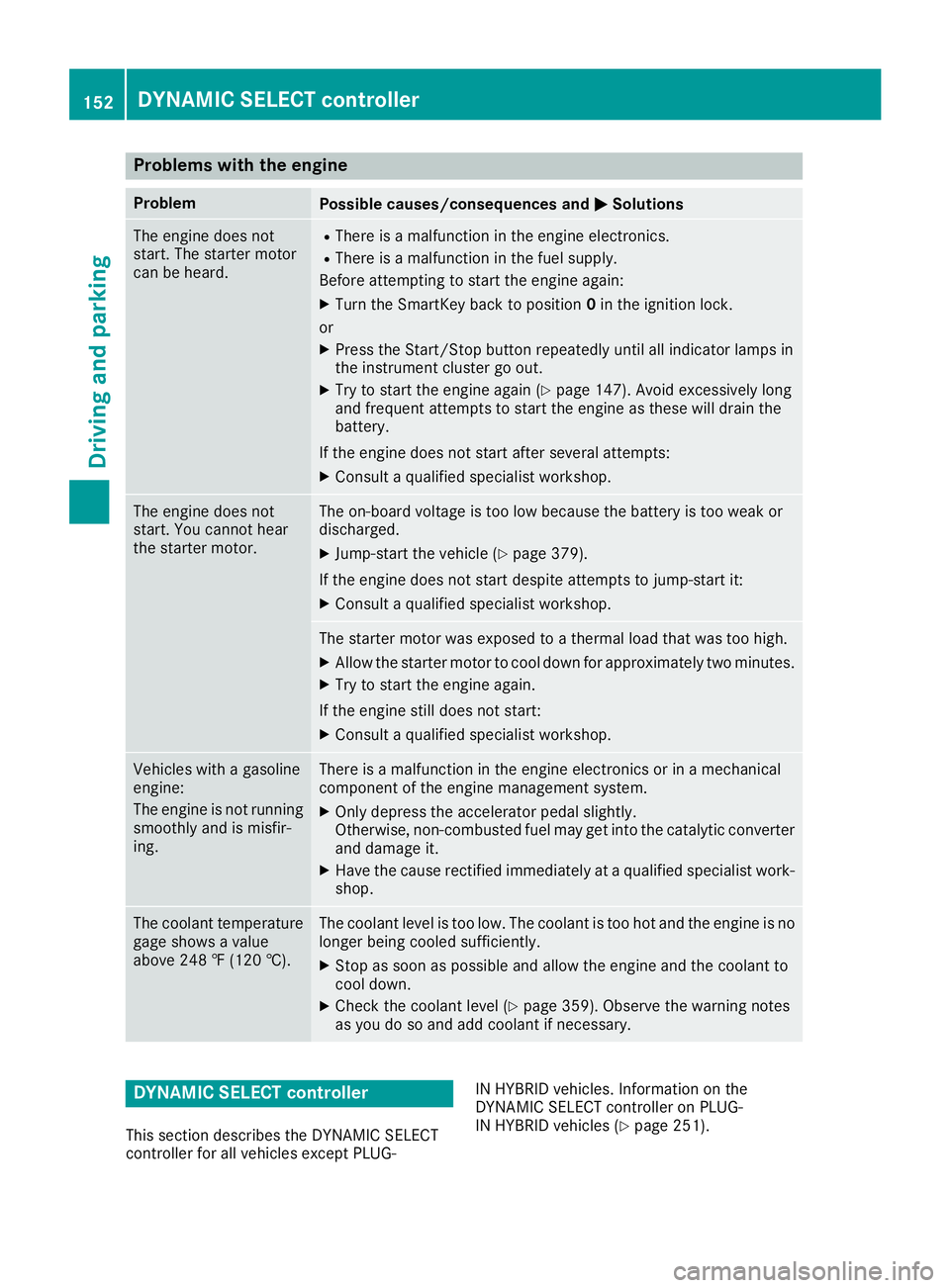
Problems with the engine Problem
Possible causes/consequences and P Solutions
The engine does not
start. The starter motor
can be heard. R
There is a malfunction in the engine electronics. R
There is a malfunction in the fuel supply.
Before attempting to start the engine again: X
Turn the SmartKey back to position 0 in the ignition lock.
or X
Press the Start/Stop button repeatedly until all indicator lamps in
the instrument cluster go out. X
Try to start the engine again ( Y
page 147). Avoid excessively long
and frequent attempts to start the engine as these will drain the
battery.
If the engine does not start after several attempts: X
Consult a qualified specialist workshop.
The engine does not
start. You cannot hear
the starter motor. The on-board voltage is too low because the battery is too weak or
discharged. X
Jump-start the vehicle ( Y
page 379).
If the engine does not start despite attempts to jump-start it: X
Consult a qualified specialist workshop.
The starter motor was exposed to a thermal load that was too high. X
Allow the starter motor to cool down for approximately two minutes. X
Try to start the engine again.
If the engine still does not start: X
Consult a qualified specialist workshop.
Vehicles with a gasoline
engine:
The engine is not running
smoothly and is misfir-
ing. There is a malfunction in the engine electronics or in a mechanical
component of the engine management system. X
Only depress the accelerator pedal slightly.
Otherwise, non-combusted fuel may get into the catalytic converter
and damage it. X
Have the cause rectified immediately at a qualified specialist work-
shop.
The coolant temperature
gage shows a value
above 248 ‡ (120 †). The coolant level is too low. The coolant is too hot and the engine is no
longer being cooled sufficiently. X
Stop as soon as possible and allow the engine and the coolant to
cool down. X
Check the coolant level ( Y
page 359). Observe the warning notes
as you do so and add coolant if necessary.
DYNAMIC SELECT controller
This section describes the DYNAMIC SELECT
controller for all vehicles except PLUG- IN HYBRID vehicles. Information on the
DYNAMIC SELECT controller on PLUG-
IN HYBRID vehicles ( Y
page 251).152
DYNAMIC SELECT controller
Driving and parking
Page 159 of 450
D Neutral
Do not shift the transmission to N
while driving. Otherwise, the auto-
matic transmission could be dam-
aged.
No power is transmitted from the
engine to the drive wheels.
Releasing the brakes will allow you to
move the vehicle freely, e.g. to push
it or tow it.
If ESP ®
is deactivated or faulty: shift
the transmission to position N if the
vehicle is in danger of skidding, e.g.
on icy roads.
If you switch the engine off with the
transmission in position R or D , the
automatic transmission shifts to N
automatically.
! Rolling in neutral N can damage
the drive train.
: Drive
The automatic transmission changes
gear automatically. All forward gears
are available.
Driving tips
Changing gear The automatic transmission shifts to the indi-
vidual gears automatically when it is in trans-
mission position D . This automatic gear shifting
behavior is determined by: R
the selected drive program R
the position of the accelerator pedal R
the road speed
Accelerator pedal position Your style of driving influences how the auto-
matic transmission shifts gear: R
little throttle: early upshifts R
more throttle: late upshifts Kickdown Use kickdown for maximum acceleration. X
Depress the accelerator pedal beyond the
pressure point.
The automatic transmission shifts to a lower
gear depending on the engine speed. X
Ease off the accelerator pedal once the
desired speed is reached.
The automatic transmission shifts back up.
Rocking the vehicle free Shifting the transmission repeatedly between
gears D and R may help to free the vehicle if it
has become stuck in slush or snow. The vehi-
cle's engine management system limits the
speed to a maximum of 5 mph (9 km/h) when
shifting back and forth. To shift back and forth
between transmission positions D and R , move
the DIRECT SELECT lever up and down past the
point of resistance.
Gliding mode
All vehicles (except Mercedes-AMG vehi-
cles) Gliding mode is characterized by the following: R
the combustion engine is disconnected from
the drive train. R
the engine speed corresponds to the idling
speed. R
the gear indicated after the transmission
position D disappears in the multifunction
display ( Y
page 154).
Gliding mode can be activated under the follow-
ing conditions: R
you select the "ECO" setting for the drive sys-
tem within the Individual drive program. You
can find information about this in the Digital
Operator's Manual. R
the speed is within a suitable range. R
the course of the road is suitable, e.g. there
are no steep up or downhill gradients. R
you are no longer depressing the accelerator
pedal.
Gliding mode is deactivated under the following
conditions: R
you depress the accelerator pedal. R
you depress the brake pedal.Automatic transmission 157
Driving an d parking Z
Page 160 of 450
R
you use th e DIRECT SELECT lever to switch
th e transmission position ( Y
page 154).R
use th e DYNAMIC SELECT controller to
chang e th e drive progra m ( Y
page 152).R
you activat e manual gearshiftin g
( Y
page 159).R
you leav e th e suitable speed range.
Mercedes-AMG vehicles Glidin g mod e is characterized by th e following:R
th e combustion engin e is disconnected from
th e drive train .R
th e engin e speed corresponds to th e idlin g
speed. R
in th e multifunction display, th e glidin g sym -
bol appears in th e drive progra m display.
Glidin g mod e can be activated under th e follow-
in g conditions: R
th e Comfor t drive progra m is activated or you
select th e "Comfort" setting for th e drive sys-
te m within th e Individua l drive program. You
can fin d information about this in th e Digital
Operator' s Manual.R
th e ECO start/sto p function is activated.R
you are drivin g carefully wit h low acceleration
of th e vehicle.R
th e engin e is at normal operating tempera-
ture. R
th e speed is within a suitable range.R
th e cours e of th e roa d is suitable, e.g. there
are no steep up or downhill gradients .R
you are no longer depressin g th e accelerato r
pedal .
Glidin g mod e is d eactivated under th e fo
llowin g
conditions: R
you hav e deactivated th e ECO start/sto p
function .R
you depress th e accelerato r pedal .R
you depress th e brak e pedal .R
you use th e DIRECT SELECT lever to switch
th e transmission position ( Y
page 154).R
use th e DYNAMIC SELECT controller to
chang e th e drive progra m ( Y
page 152).R
you activat e manual gearshiftin g
( Y
page 159).R
you leav e th e suitable speed range. Towing a trailer X
Drive in th e middle of th e engin e speed range
on uphil l gradients .X
Dependin g on th e uphil l or downhill gradient,
use left-han d steerin g whee l paddl e shifter
( Y
page 159) to select a lower gear , eve n if
cruise control or DISTRONI C PLU S are acti-
vated.
Drive programs
Slippery drive program The Slipper y drive progra m has th e followin g
characteristics : R
reduce d engin e and transmission setting s for
optimum propulsion on slipper y or snow-cov-
ere d roads. R
optimized ES P ®
stabilit y control on slipper y or
snow-covered roads. R
th e vehicl e has improved drivin g stabilit y on
slipper y or snow-covered roads, for example.
Comfort drive program The Comfor t drive progra m has th e followin g
characteristics : R
comfort-oriented engin e and transmission
settings. R
optimal fuel consumption resultin g from th e
automati c transmission shiftin g up sooner.R
th e vehicl e pullin g away mor e gentl y in
forward and revers e gears, unless th e accel-
erator pedal is depressed fully. R
th e automati c transmission shiftin g up
sooner. This result s in th e vehicl e bein g driven
at lower engin e speeds and th e wheels bein g
less likely to spin .
Sp or t drive program The Sport drive progra m has th e followin g char-
acteristics : R
sport y engin e and transmission settings. R
th e automati c transmission shiftin g up later.
th e fuel consumption possibl y bein g higher as
a result of th e later automati c transmission
shift points . R
th e suspension exhibits sport y dampin g (vehi-
cle s wit h AIRMATIC) .158
Automatic transmission
Driving an d parking