automatic transmission MERCEDES-BENZ GLE 2016 Service Manual
[x] Cancel search | Manufacturer: MERCEDES-BENZ, Model Year: 2016, Model line: GLE, Model: MERCEDES-BENZ GLE 2016Pages: 450, PDF Size: 12.92 MB
Page 249 of 450
If manual gearshifting is deactivated, the auto-
matic transmission shifts: R
into the drive program that was last selected,
and R
into the driving mode that was last selected
If you change the drive program, the operating
mode that was last selected is stored for approx-
imately 60 seconds. After this time, the HYBRID
operating mode is automatically activated.
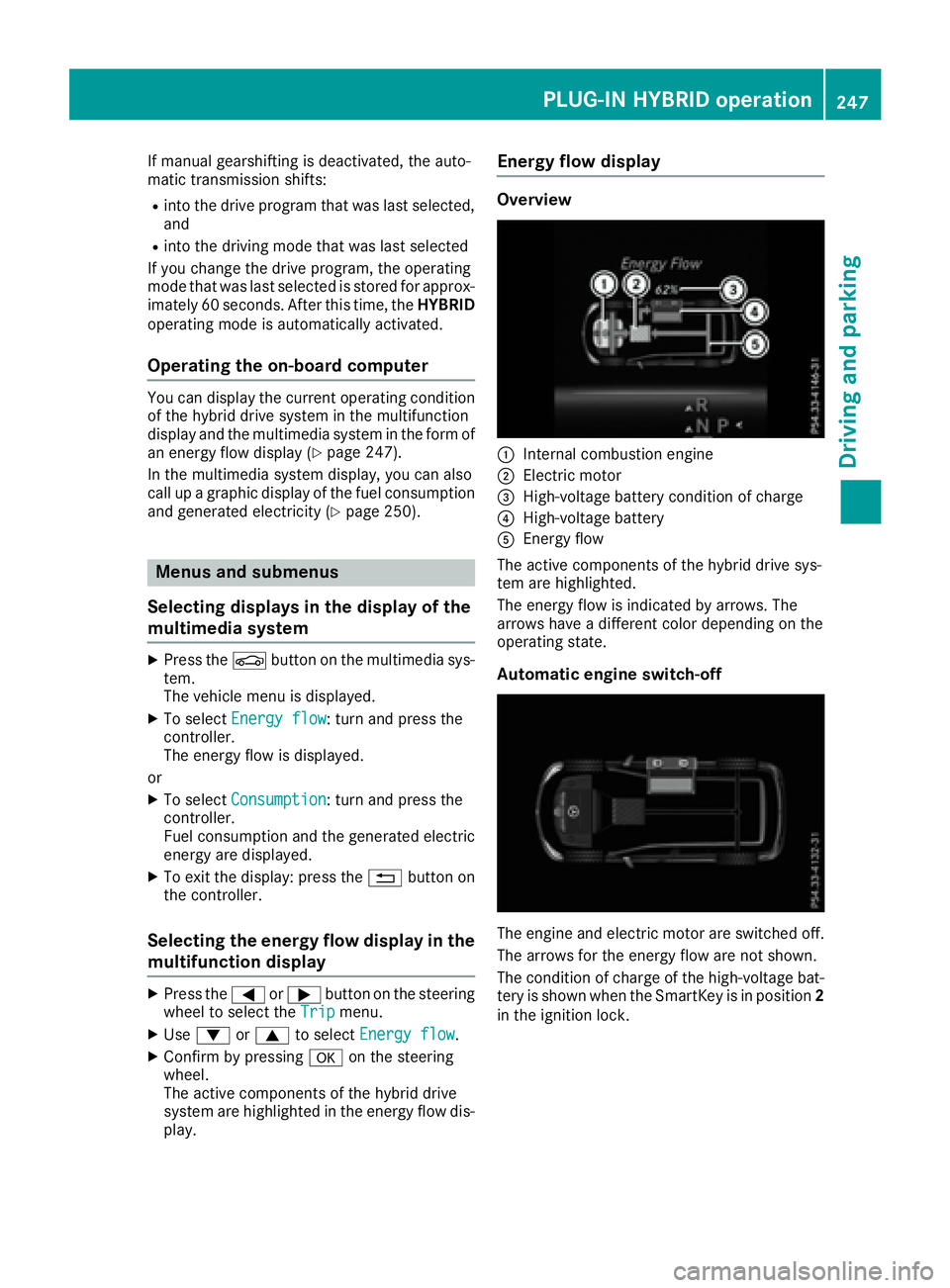
Operating the on-board computer You can display the current operating condition
of the hybrid drive system in the multifunction
display and the multimedia system in the form of
an energy flow display ( Y
page 247).
In the multimedia system display, you can also
call up a graphic display of the fuel consumption
and generated electricity ( Y
page 250).
Menus and submenus
Selecting displays in the display of the
multimedia system X
Press the
Page 254 of 450
Activating when driving with the electric motor: X
Pull the left or right steering wheel paddle
shifter ( Y
page 159).
The combustion engine is switched on. Man-
ual gearshifting is activated temporarily. The
selected gear and M appear in the multifunc-
tion display.
Activating when driving with the combustion
engine: X
Pull the left or right steering wheel paddle
shifter ( Y
page 159).
Manual gearshifting is activated temporarily.
The selected gear and M appear in the multi-
function display.
The ECO start/stop function is not available
when manually changing gear.
For further information on the manual drive pro-
gram ( Y
page 159).
Driving tips
General driving tips Drive carefully and maintain a safe distance
from the vehicle in front. Avoid frequent and
sudden acceleration as well as abrupt braking.
During partial electric driving, pulling away and
acceleration, the electric motor supports the
internal combustion engine.
During overrun in transmission position D and
braking, the electric motor will operate as a gen-
erator.
Further information on the ECO start/stop func-
tion ( Y
page 253).
Additional driving tips ( Y
page 181).
Stationary vehicle
If the vehicle is stopped, the combustion engine
is, for the most part, switched off. Automatic
climate control continues to function. The elec-
tromechanically assisted steering gear allows
you to use the power steering without reduced
comfort.
Acceleration
Depending on the operating mode, pulling away
and driving under low load conditions are per-
formed: R
entirely by electric propulsion R
in combination with the internal combustion
engine When accelerating rapidly under increased or
full load, increased boost mode is utilized. The
electric motor supports the combustion engine
by providing additional drive torque.
Overrun mode or braking There are three possible operating modes when
the hybrid vehicle is decelerating: R
energy recovery takes place even when the
vehicle is decelerating purely in overrun mode
( Y
page 242). The electric motor operates as
a generator and stores the recovered energy
in the high-voltage battery. R
when the brakes are applied lightly, the vehi-
cle is slowed down further by the electric
motor. This increases the energy recovery
taking place ( Y
page 242). The electric motor
operates as a generator and stores the recov-
ered energy in the high-voltage battery. R
when the brakes are applied with greater
force, the service brakes are also used to slow
the vehicle down. The two systems work
together.
Urban driving In city traffic, energy is recuperated during fre-
quent deceleration phases.
The vehicle can be driven by the electric motor
alone up to a speed of approximately 80 mph
(130 km/h).
The vehicle is driven by the electric motor alone
only when all conditions for the automatic
engine switch-off are fulfilled.
Further information on the automatic engine
switch-off ( Y
page 253).
Driving on inter-urban roads
The following phases are possible when driving
on inter-urban roads: R
rapid acceleration (boost mode) R
energy recuperation R
electric operation mode
The vehicle can be driven by the electric motor
alone up to a speed of approximately 74 mph
(120 km/h).
A great deal of recovered energy may be avail-
able, depending on the route profile. This
reduces consumption and emissions.252
PLUG-IN HYBRID operation
Driving an d parking
Page 256 of 450
The condition of charge of the high-voltage bat-
tery is thus systematically controlled. In addi-
tion, the control function takes into account
that: R
the fuel saving through the use of electrical
energy can vary, dependent on the route (e.g.
urban, interurban or highway) R
the use of electrical energy is held available
for electric driving, particularly for urban
routes
The vehicle thus automatically selects the opti-
mum driving mode for the respective section of
the route.
The route-based operating strategy is available
under the following conditions: R
the Individual drive program is selectedR
in the Individual drive program, the ECO set-
ting is selected under Drive R
HYBRID driving mode is selectedR
active route guidance is activated R
suitable map data is available
When the route-based operating strategy is
being used, the area in front of the vehicle is
shown as green in the multifunction display.
Parking X
Apply the electric parking brake.
The red $ indicator lamp in the instrument
cluster lights up. X
Use the DIRECT SELECT lever to shift the
automatic transmission to P .X
Switch the ignition off.
The READY indicator in the instrument cluster
goes out.
Further information on parking and switching off
the internal combustion engine ( Y
page 179).254
PLUG-IN HYBRID operation
Driving and parking
Page 263 of 450

R
If possible, do not brake suddenly, but instead
depress the brake pedal moderately at first so
that the trailer can activate its brakes. Then
increase the pressure on the brake pedal. R
If the automatic transmission repeatedly
shifts between gears on uphill or downhill gra-
dients, shift to a lower gear using the left-hand
steering wheel paddle shifter.
A lower gear and lower speed reduce the risk
of engine failure. R
When driving downhill, shift to a lower gear to
utilize the engine's braking effect.
Avoid continuous brake application as this
may overheat the vehicle brakes and, if instal-
led, the trailer brakes. R
If the coolant temperature increases dramat-
ically while the air-conditioning system is
switched on, switch off the air-conditioning
system.
Coolant heat can also be dissipated by open-
ing the windows and switching the ventilation
blower and the interior temperature to the
highest level. R
When overtaking, pay particular attention to
the extended length of your vehicle/trailer
combination.
Due to the length of the vehicle/trailer com-
bination, you require additional road space in
relation to the vehicle you are overtaking
before you can change back to the original
lane.
Decoupling a trailer
G WARNING
If you uncouple a trailer with the overrun
brake engaged, you could trap your hand
between the vehicle and the trailer drawbar.
There is a risk of injury.
Do not uncouple a trailer if the overrun brake
is engaged.
G WARNING
Vehicles with level control:
The vehicle is lowered as soon as you discon-
nect the trailer cable. This could result in your
limbs or those of other people that are
between the vehicle body and tires or under- neath the vehicle being trapped. There is a
risk of injury.
Make sure that nobody is in the immediate
vicinity of the wheel housings or under the
vehicle when you disconnect the trailer cable.
! Do not disconnect a trailer with an engaged
overrun brake. Otherwise, your vehicle could
be damaged by the rebounding of the overrun
brake. X
Shift the transmission to position P .X
Apply the vehicle's electric parking brake. X
Start the engine. X
Close the doors and tailgate. X
Apply the trailer's parking brake. X
Detach the trailer cable and decouple the
trailer. X
Switch off the engine.
Permissible trailer loads and drawbar
loads
Weight specifications
Maximum allowable gross mass The gross vehicle weight of the trailer is calcu-
lated by adding the weight of the trailer to the
weight of the load and equipment on the trailer.
You will find installing dimensions and loads
under "Technical data" ( Y
page 444).
Permissible noseweight
You will find installing dimensions and loads
under "Technical data" ( Y
page 444).
Loading a trailer R
When loading the trailer, make sure that nei-
ther the permissible gross weight of the trailer
nor the gross vehicle weight are exceeded.
The permissible gross vehicle weight is indi-
cated on the identification plate located on
the B-pillar on the driver's side of the vehicle.
You can find the maximum permissible values
on the type plates of your vehicle and the
trailer. When calculating how much weightTowing a trailer 261
Driving and parking Z
Page 286 of 450
Display messages
Possible causes/consequences and P Solutions
I (USA
only)
$ ( Canada
only)
Tur n On the Igni‐
tio n to Releas e the
Parkin g Brake The red I (US A only) or $ (Canada only) indicator lamp lights
up.
You attempte d to release th e electric parking brak e while th e ignition
was switched off .X
SmartKey : tur n th e SmartKey to position 1 in th e ignition lock.X
KEYLESS-GO: switch on th e ignition .
I (USA
only)
$ ( Canada
only)
Please
Releas e Park‐
ing Brake The red I (US A only) or $ (Canada only) indicator lamp flashes
and a warning tone sounds. A condition for automatic release of th e
electric parking brak e is no t fulfilled ( Y
page 179).
You are drivin g wit h th e electric parking brak e applied.X
Releas e th e electric parking brak e manually.
The red I (US A only) or $ (Canada only) indicator lamp flashes
and a warning tone sounds.
You are usin g th e electric parking brak e for emergenc y braking
( Y
page 179).
I (USA
only)
$ ( Canada
only)
Parkin g Brake See
Operator' s Manual The yellow $ warning lamp lights up.
The electric parking brak e is malfunctioning .
To apply : X
Switc h th e ignition off .X
Press th e electric parking brak e handle for at least te n seconds.X
Shift th e transmission to position P .X
Consult a qualified specialist workshop .
The yellow $ warning lamp and th e red I (US A only) or $
(Canada only) indicator lamp ligh t up.
The electric parking brak e is malfunctioning .
To release: X
Switc h off th e ignition and tur n it bac k on .X
Releas e th e electric parking brak e manually.
or X
Releas e th e electric parking brak e automatically ( Y
page 179).
If th e electric parking brak e still canno t be released:X
Do no t drive on .X
Consult a qualified specialist workshop .284
Display messages
On-board computer and displays
Page 287 of 450
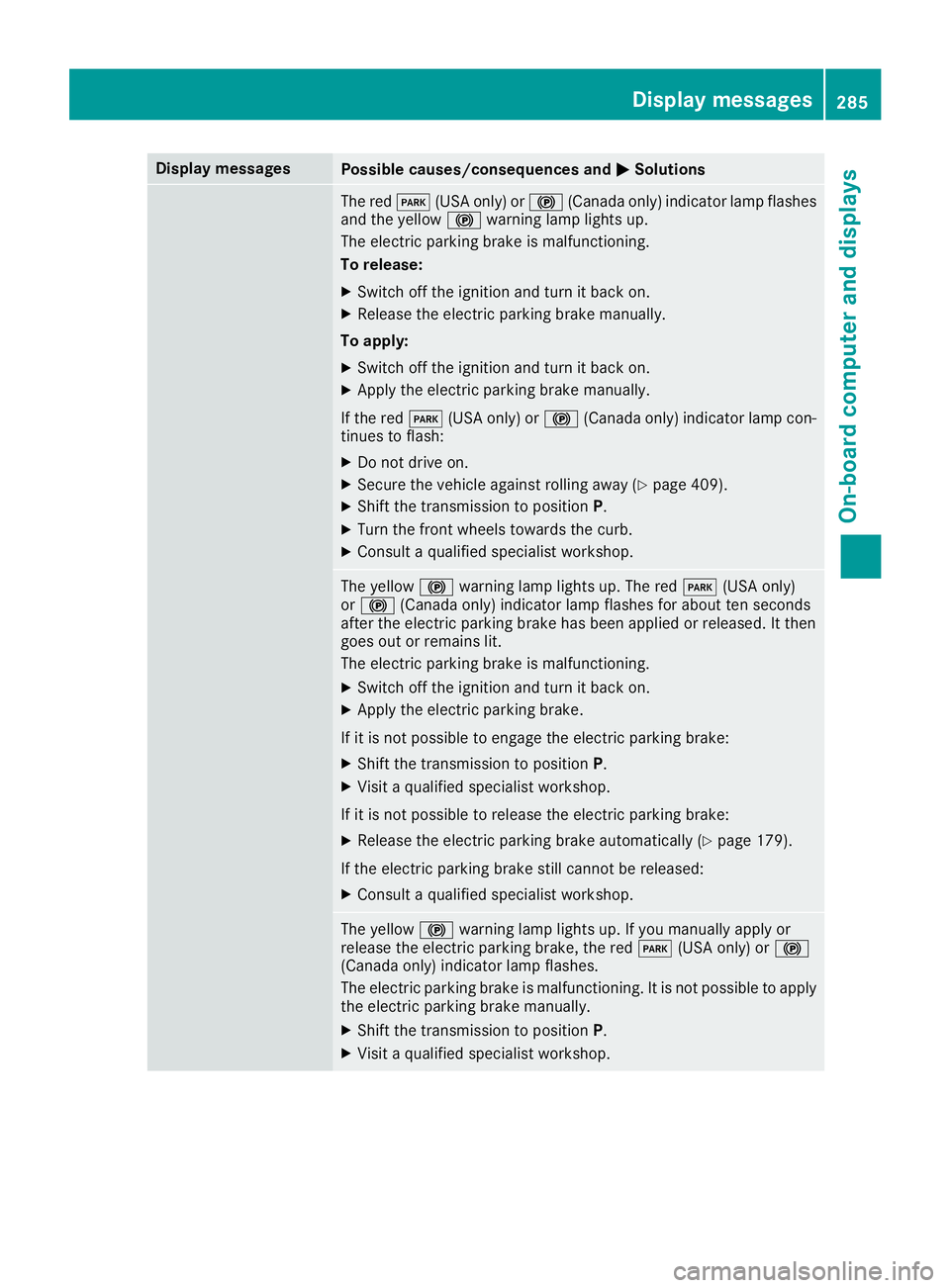
Display messages
Possible causes/consequences and P Solutions
The red I (US A only) or $ (Canada only) indicator lamp flashes
and th e yellow $ warning lamp lights up.
The electric parking brak e is malfunctioning .
To release: X
Switc h off th e ignition and tur n it bac k on .X
Releas e th e electric parking brak e manually.
To apply : X
Switc h off th e ignition and tur n it bac k on .X
Apply th e electric parking brak e manually.
If th e red I (US A only) or $ (Canada only) indicator lamp con-
tinue s to flash: X
Do no t drive on .X
Secur e th e vehicl e against rollin g away ( Y
page 409).X
Shift th e transmission to position P .X
Turn th e fron t wheels toward s th e curb.X
Consult a qualified specialist workshop .
The yellow $ warning lamp lights up. The red I (US A only)
or $ (Canada only) indicator lamp flashes for about te n seconds
after th e electric parking brak e has been applie d or released. It then
goe s out or remain s lit .
The electric parking brak e is malfunctioning .X
Switc h off th e ignition and tur n it bac k on .X
Apply th e electric parking brake.
If it is no t possibl e to engage th e electric parking brake:X
Shift th e transmission to position P .X
Visit a qualified specialist workshop .
If it is no t possibl e to release th e electric parking brake:X
Releas e th e electric parking brak e automatically ( Y
page 179).
If th e electric parking brak e still canno t be released:X
Consult a qualified specialist workshop .
The yellow $ warning lamp lights up. If you manually apply or
release th e electric parking brake, th e red I (US A only) or $
(Canada only) indicator lamp flashes .
The electric parking brak e is malfunctioning . It is no t possibl e to apply
th e electric parking brak e manually.X
Shift th e transmission to position P .X
Visit a qualified specialist workshop .Display messages 28 5
On-board computer and displays Z
Page 306 of 450
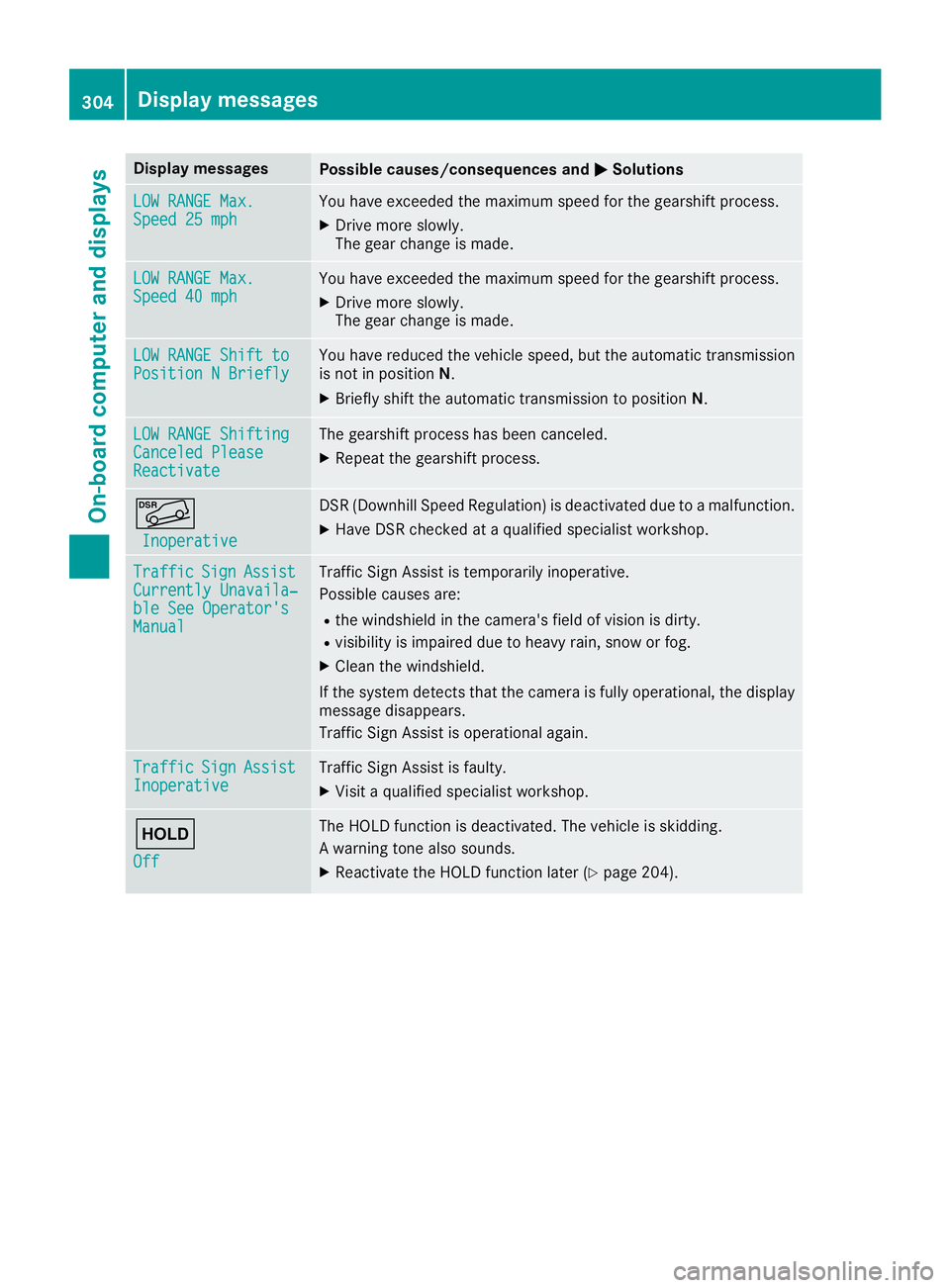
Display messages
Possible causes/consequences and P Solutions
LOW RANGE Max .
Speed 25 mph You hav e exceeded th e maximum speed for th e gearshift process.X
Drive mor e slowly.
The gear chang e is made .
LOW RANGE Max .
Speed 40 mph You hav e exceeded th e maximum speed for th e gearshift process.X
Drive mor e slowly.
The gear chang e is made .
LOW RANGE Shift to
Position N Briefl y You hav e reduce d th e vehicl e speed, but th e automatic transmission
is no t in position N .X
Briefly shift th e automatic transmission to position N .
LOW RANGE Shifting
Canceled Please
Reactivat e The gearshift process has been canceled. X
Repeat th e gearshift process.
Page 313 of 450
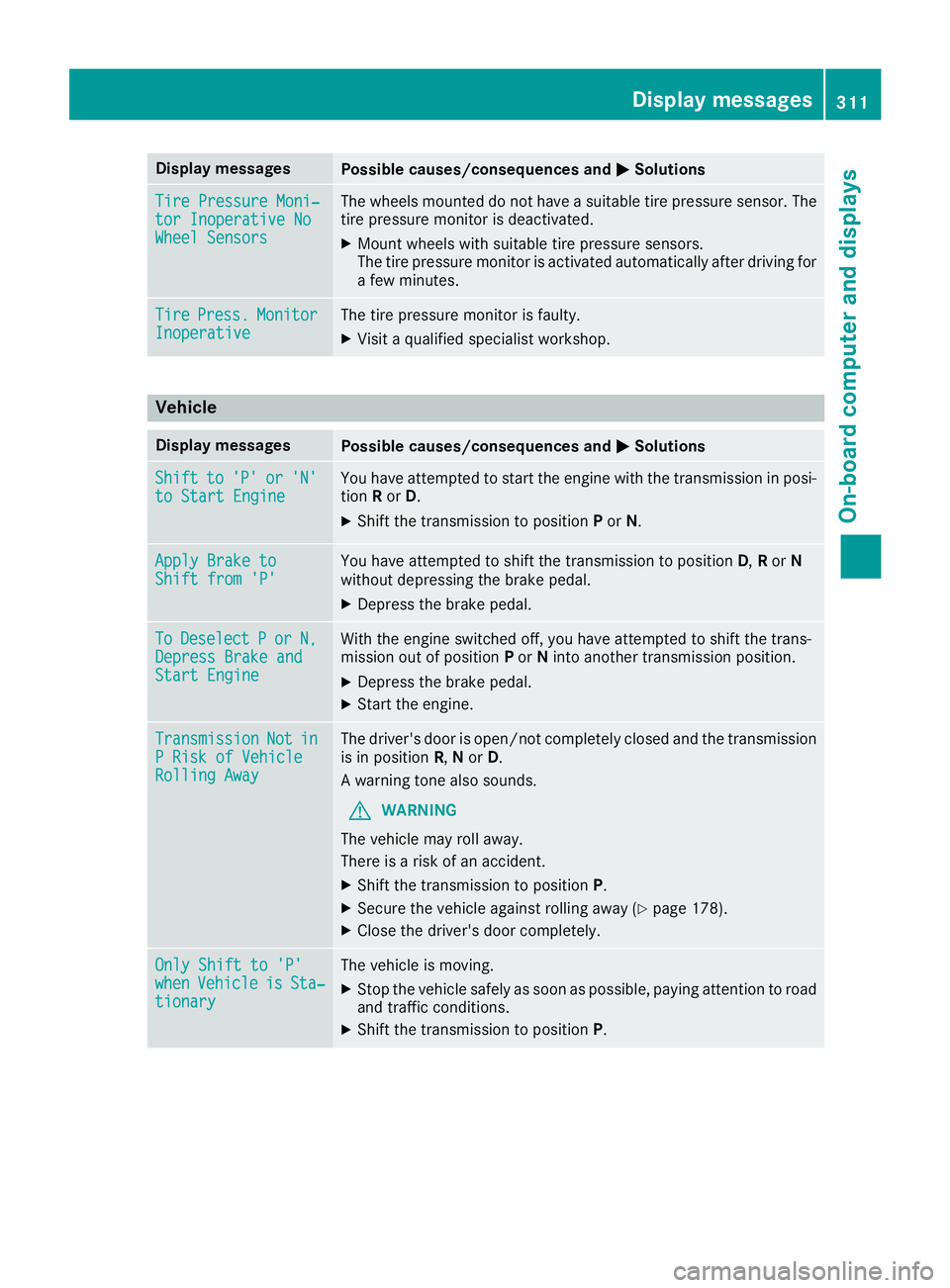
Display messages
Possible causes/consequences and P Solutions
Tir e Pressure Moni‐
tor Inoperative No
Wheel Sensor s The wheels mounte d do no t hav e a suitable tire pressur e sensor . The
tire pressur e monitor is deactivated. X
Moun t wheels wit h suitable tire pressur e sensors.
The tire pressur e monitor is activated automatically after drivin g for
a few minutes.
Tir e Press. Monito r
Inoperative The tire pressur e monitor is faulty.X
Visit a qualified specialist workshop .
Vehicle Display messages
Possible causes/consequences and P Solutions
Shift to 'P' or 'N'
to Start Engine You hav e attempte d to start th e engin e wit h th e transmission in posi-
tion R or D . X
Shift th e transmission to position P or N .
Apply Brake to
Shift fro m 'P' You hav e attempte d to shift th e transmission to position D , R or N
without depressing th e brak e pedal .X
Depress th e brak e pedal .
To Deselect P or N,
Depres s Brake and
Start Engine Wit h th e engin e switched off , you hav e attempte d to shift th e trans -
mission out of position P or N int o another transmission position .X
Depress th e brak e pedal .X
Start th e engine.
Transmission Not in
P Ris k of Vehicl e
Rollin g Awa y The driver's door is open/not completely closed and th e transmission
is in position R , N or D .
A warning tone also sounds.
G WARNIN G
The vehicl e may rol l away.
There is a ris k of an accident.X
Shift th e transmission to position P .X
Secur e th e vehicl e against rollin g away ( Y
page 178).X
Clos e th e driver's door completely.
Onl y Shift to 'P'
whe n Vehicl e is Sta ‐
tionar y The vehicl e is moving .X
Stop th e vehicl e safely as soo n as possible, payin g attention to roa d
and traffic conditions. X
Shift th e transmission to position P .Display messages 31 1
On-board computer and displays Z
Page 314 of 450
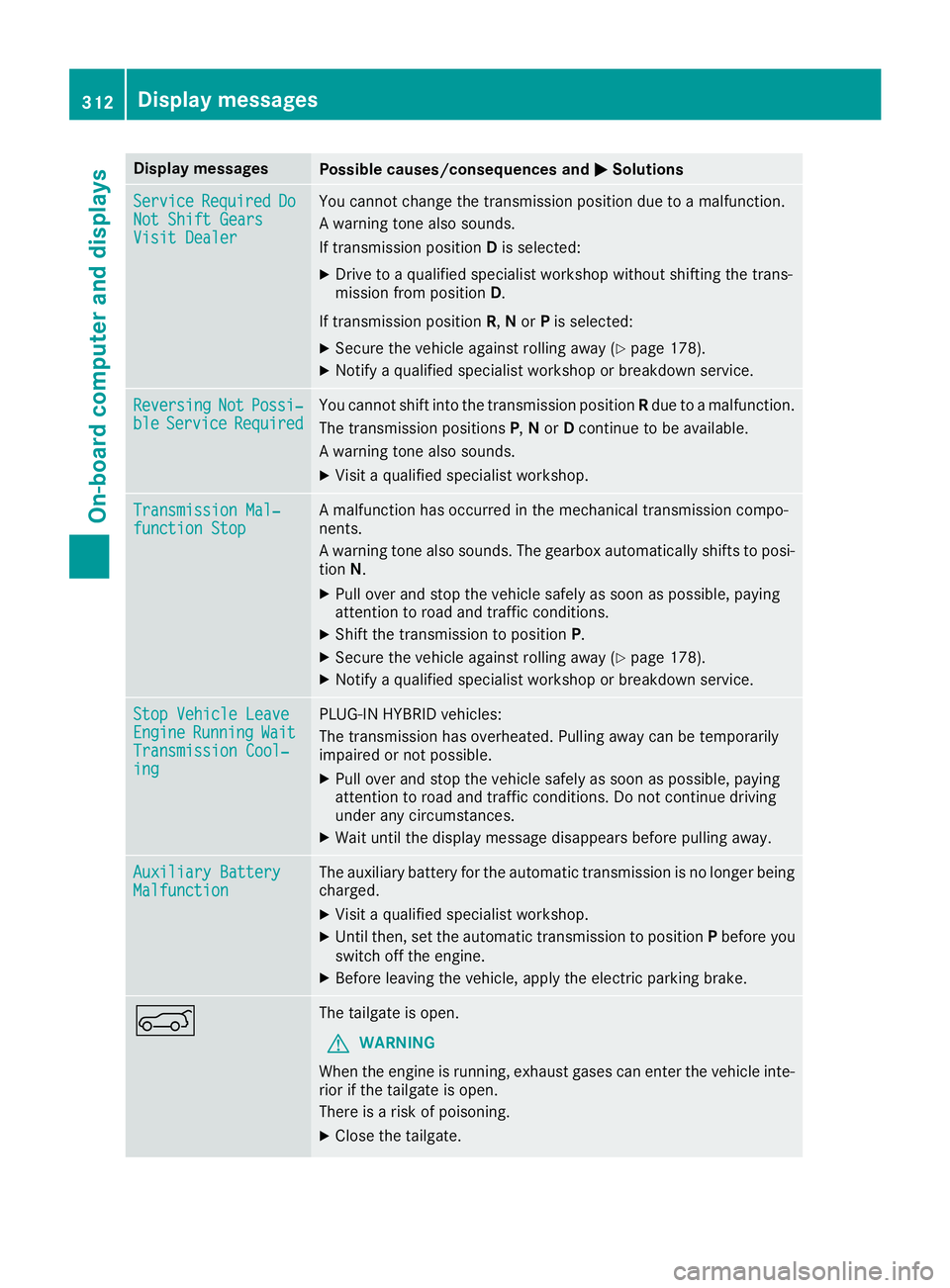
Display messages
Possible causes/consequences and P Solutions
Servic e Required Do
Not Shift Gears
Visit Dealer You canno t chang e th e transmission position due to a malfunction .
A warning tone also sounds.
If transmission position D is selected:X
Drive to a qualified specialist workshop without shifting th e trans -
mission from position D .
If transmission position R , N or P is selected:X
Secur e th e vehicl e against rollin g away ( Y
page 178).X
Notify a qualified specialist workshop or breakdown service.
Reversing Not Possi‐
ble Servic e Required You canno t shift int o th e transmission position R due to a malfunction .
The transmission position s P , N or D continu e to be available.
A warning tone also sounds. X
Visit a qualified specialist workshop .
Transmission Mal ‐
function Sto p A malfunction has occurred in th e mechanical transmission compo -
nents.
A warning tone also sounds. The gearbox automatically shift s to posi-
tion N . X
Pull ove r and stop th e vehicl e safely as soo n as possible, payin g
attention to roa d and traffic conditions.X
Shift th e transmission to position P .X
Secur e th e vehicl e against rollin g away ( Y
page 178).X
Notify a qualified specialist workshop or breakdown service.
Sto p Vehicl e Leave
Engine Runnin g Wai t
Transmission Cool‐
ing PLUG-I N HYBRID vehicles:
The transmission has overheated. Pullin g away can be temporarily
impaire d or no t possible.X
Pull ove r and stop th e vehicl e safely as soo n as possible, payin g
attention to roa d and traffic conditions. Do no t continu e drivin g
under any circumstances. X
Wait until th e display message disappear s before pullin g away.
Auxiliary Batter y
Malfunction The auxiliary battery for th e automatic transmission is no longer bein g
charged. X
Visit a qualified specialist workshop .X
Unti l then , set th e automatic transmission to position P before you
switch off th e engine.X
Befor e leaving th e vehicle, apply th e electric parking brake.
e The tailgat e is open .
G WARNIN G
Whe n th e engin e is running, exhaust gase s can ente r th e vehicl e inte-
rio r if th e tailgat e is open .
There is a ris k of poisoning .X
Clos e th e tailgate.312
Display messages
On-board computer and displays
Page 364 of 450
! Before driving into an automatic car wash,
make sure that it is suitable for the dimen-
sions of the vehicle. In particular, make sure
that: R
there is enough ground clearance between
the vehicle underbody and the guide rails of
the automatic car wash. R
the clearance width of the automatic car
wash is sufficient, particularly the width of
the guide rails. R
you enter the automatic car wash straight
and in the center of the guide rails in order
to avoid damaging the tires or wheel rims.
Fold in the exterior mirrors before the vehicle
is washed. The exterior mirrors could other-
wise be damaged.
! If DISTRONIC PLUS or the HOLD function is
activated, the vehicle brakes automatically in
certain situations.
To prevent damage to the vehicle, deactivate
DISTRONIC PLUS and the HOLD function in
the following or other similar situations: R
when towing the vehicle R
in the car wash
! Never clean your vehicle in a Touchless
Automatic Car Wash as these use special
cleaning agents. These cleaning agents can
damage the paintwork or plastic parts.
! Make sure that: R
the side windows and the sliding sunroof
are fully closed. R
the ventilation/heating is switched off (the
OFF button has been pressed). R
the windshield wiper switch is in position 0 .
Otherwise, the vehicle might be damaged.
! In car washes with a towing mechanism,
make sure that the automatic transmission is
in transmission position N , otherwise the
vehicle could be damaged. R
Vehicles with a SmartKey:
Do not remove the SmartKey from the igni-
tion lock. Do not open the driver's door or
front-passenger door when the engine is
switched off. Otherwise, the automatic
transmission selects park position P auto-
matically and locks the wheels. You can
prevent this by shifting the automatic trans-
mission to N beforehand.R
Vehicles with KEYLESS-GO: Do not open the driver's door or front-
passenger door when the engine is
switched off. Otherwise, the automatic
transmission selects park position P auto-
matically and locks the wheels.
Observe the following to make sure that the
automatic transmission stays in position N :X
Make sure the vehicle is stationary and the
ignition is switched off. X
Turn the SmartKey to position 2 in the ignition
lock ( Y
page 145).
Use the SmartKey instead of the Start/ Stop
button on vehicles with KEYLESS-GO. X
Depress and hold the brake pedal. X
Shift the automatic transmission to position
N . X
Release the brake pedal. X
Release the electric parking brake. X
Switch off the ignition and leave the SmartKey
in the ignition lock.
You can wash the vehicle in an automatic car
wash from the very start.
If the vehicle is very dirty, pre-wash it before
cleaning it in an automatic car wash.
After using an automatic car wash, wipe off wax
from the windshield and the wiper blades. This
will prevent smears and reduce wiping noises
caused by residue on the windshield.
Washing by hand In some countries, washing by hand is only
allowed at specially equipped washing bays.
Observe the legal requirements in all countries
concerned. X
Do not use hot water and do not wash the
vehicle in direct sunlight. X
Use a soft sponge to clean. X
Use a mild cleaning agent, such as a car
shampoo approved by Mercedes-Benz. X
Thoroughly hose down the vehicle with a gen-
tle jet of water. X
Do not point the water jet directly towards the
air inlets. X
Use plenty of water and rinse out the sponge
frequently. X
Rinse the vehicle with clean water and dry
thoroughly with a chamois. X
Do not let the cleaning agent dry on the paint-
work.362
Care
Maintenance and care