height MERCEDES-BENZ GLE 2019 Owner's Manual
[x] Cancel search | Manufacturer: MERCEDES-BENZ, Model Year: 2019, Model line: GLE, Model: MERCEDES-BENZ GLE 2019Pages: 398, PDF Size: 12.25 MB
Page 372 of 398
Speed rating
The speed rating is part of the tire identification. It specifies the speed range for which the tire is
approved.
GTW (Gross Trailer Weight)
The GTW is the weight of a trailer including the
weight of the load, luggage, accessories etc. on
the trailer.
GVW (Gross Vehicle Weight) The gross vehicle weight includes the weight of
the vehicle including fuel, tools, the spare wheel, accessories installed, occupants, luggage and
the drawbar noseweight, if applicable. The gross
vehicle weight must not exceed the gross vehi-
cle weight rating GVWR as specified on the vehi- cle identification plate on the B-pillar on the
driver's side.
GVWR (Gross Vehicle Weight Rating)
The GVWR is the maximum permissible gross
weight of a fully loaded vehicle (the weight of the
vehicle including all accessories, occupants,
fuel, luggage and the drawbar noseweight, if
applicable). The gross vehicle weight rating is
specified on the vehicle identification plate on
the B-pillar on the driver's side.
Maximum loaded vehicle weightThe maximum weight is the sum of:
R the curb weight of the vehicle
R the weight of the accessories
R the load limit
R the weight of the factory installed optional
equipment
Kilopascal (kPa) Metric unit for tire pressure. 6.9 kPa corre-
sponds to 1 psi. Another unit for tire pressure is
bar. 100 kilopascals (kPa) are the equivalent of
1 bar.
Load index
In addition to the load-bearing index, the load
index may also be imprinted on the sidewall of
the tire. This specifies the load-bearing capacity
more precisely.
Curb weight The weight of a vehicle with standard equipment
including the maximum capacity of fuel, oil and
coolant. It also includes the air-conditioning sys- tem and optional equipment if these are instal-
led in the vehicle, but does not include passen-
gers or luggage.
Maximum load rating The maximum tire load is the maximum permis-
sible weight in kilograms or lbs for which a tire is approved.
Maximum permissible tire pressure Maximum permissible tire pressure for one tire.
Maximum load on one tire
Maximum load on one tire. This is calculated by
dividing the maximum axle load of one axle by
two.
PSI (pounds per square inch) A standard unit of measure for tire pressure.
Aspect ratio Relationship between tire height and tire width
in percent.
Tire pressure
This is pressure inside the tire applying an out-
ward force to each square inch of the tire's sur-
face. The tire pressure is specified in pounds per
square inch (psi), in kilopascal (kPa) or in bar.
The tire pressure should only be corrected when the tires are cold.
Cold tire pressure
The tires are cold:
R if the vehicle has been parked with the tires
out of direct sunlight for at least three hours
and
R if the vehicle has not been driven further than
1 mile (1.6 km)
Tread The part of the tire that comes into contact with
the road.
BeadThe tire bead ensures that the tire sits securely
on the wheel. There are several steel wires in the
bead to prevent the tire from coming loose from
the wheel rim. 370
All about wheels and tiresWheels and tires
Page 375 of 398
X
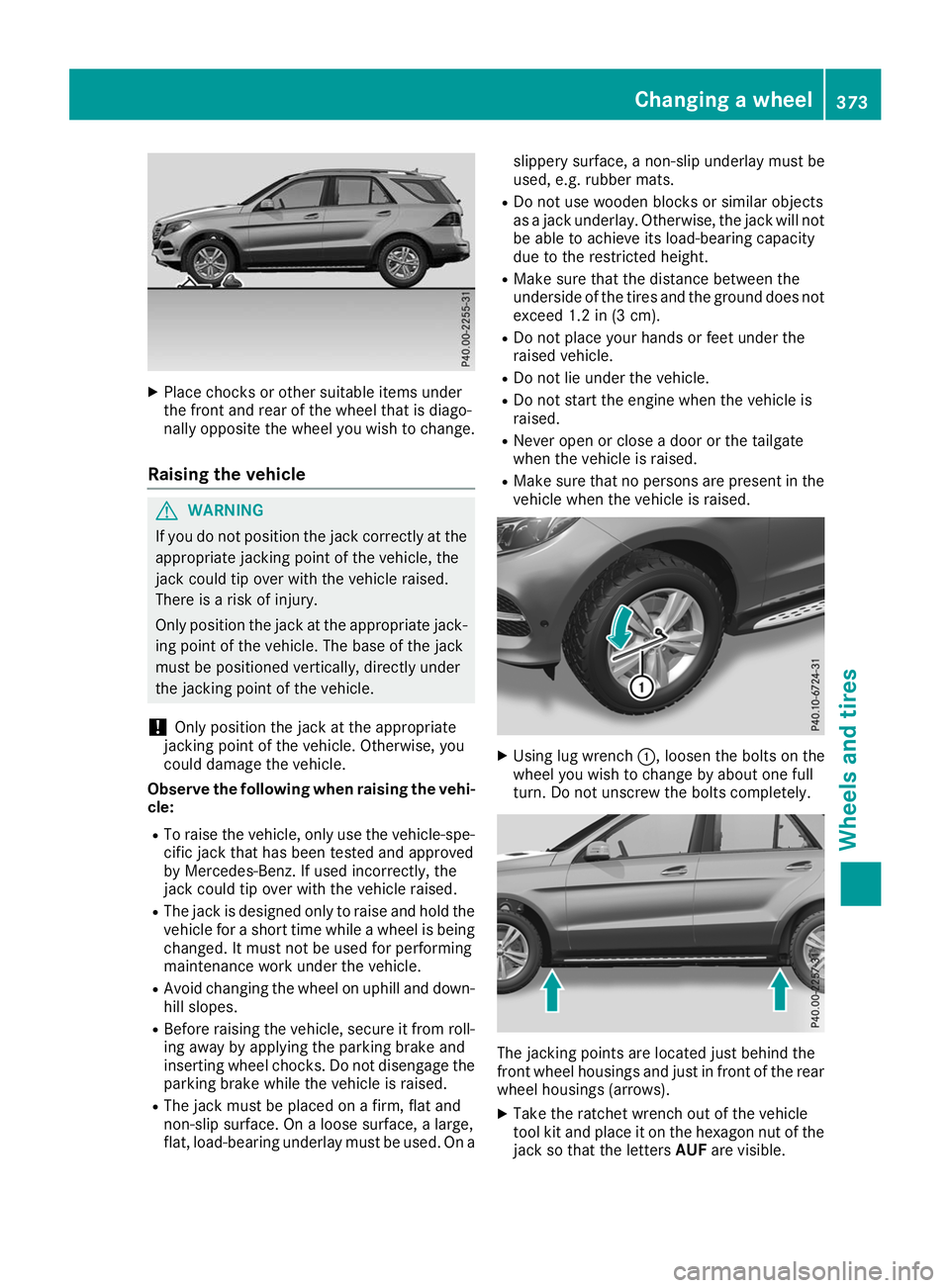
Place chocks or other suitable items under
the front and rear of the wheel that is diago-
nally opposite the wheel you wish to change.
Raising the vehicle G
WARNING
If you do not position the jack correctly at the appropriate jacking point of the vehicle, the
jack could tip over with the vehicle raised.
There is a risk of injury.
Only position the jack at the appropriate jack-
ing point of the vehicle. The base of the jack
must be positioned vertically, directly under
the jacking point of the vehicle.
! Only position the jack at the appropriate
jacking point of the vehicle. Otherwise, you
could damage the vehicle.
Observe the following when raising the vehi- cle:
R To raise the vehicle, only use the vehicle-spe-
cific jack that has been tested and approved
by Mercedes-Benz. If used incorrectly, the
jack could tip over with the vehicle raised.
R The jack is designed only to raise and hold the
vehicle for a short time while a wheel is being
changed. It must not be used for performing
maintenance work under the vehicle.
R Avoid changing the wheel on uphill and down-
hill slopes.
R Before raising the vehicle, secure it from roll-
ing away by applying the parking brake and
inserting wheel chocks. Do not disengage the parking brake while the vehicle is raised.
R The jack must be placed on a firm, flat and
non-slip surface. On a loose surface, a large,
flat, load-bearing underlay must be used. On a slippery surface, a non-slip underlay must be
used, e.g. rubber mats.
R Do not use wooden blocks or similar objects
as a jack underlay. Otherwise, the jack will not
be able to achieve its load-bearing capacity
due to the restricted height.
R Make sure that the distance between the
underside of the tires and the ground does not
exceed 1.2 in (3 cm).
R Do not place your hands or feet under the
raised vehicle.
R Do not lie under the vehicle.
R Do not start the engine when the vehicle is
raised.
R Never open or close a door or the tailgate
when the vehicle is raised.
R Make sure that no persons are present in the
vehicle when the vehicle is raised. X
Using lug wrench 0043, loosen the bolts on the
wheel you wish to change by about one full
turn. Do not unscrew the bolts completely. The jacking points are located just behind the
front wheel housings and just in front of the rear
wheel housings (arrows).
X Take the ratchet wrench out of the vehicle
tool kit and place it on the hexagon nut of the
jack so that the letters AUFare visible. Changing a wheel
373Wheels and tires Z
Page 392 of 398
R-134a refrigerant. Otherwise, the climate
control system may be damaged.
Service work, such as refilling with refrigerant or replacing component parts, may only be carried
out by a qualified specialist workshop. All appli- cable regulations, as well as SAE standard J639,
must be adhered to.
Always have work on the climate control system carried out at a qualified specialist workshop.
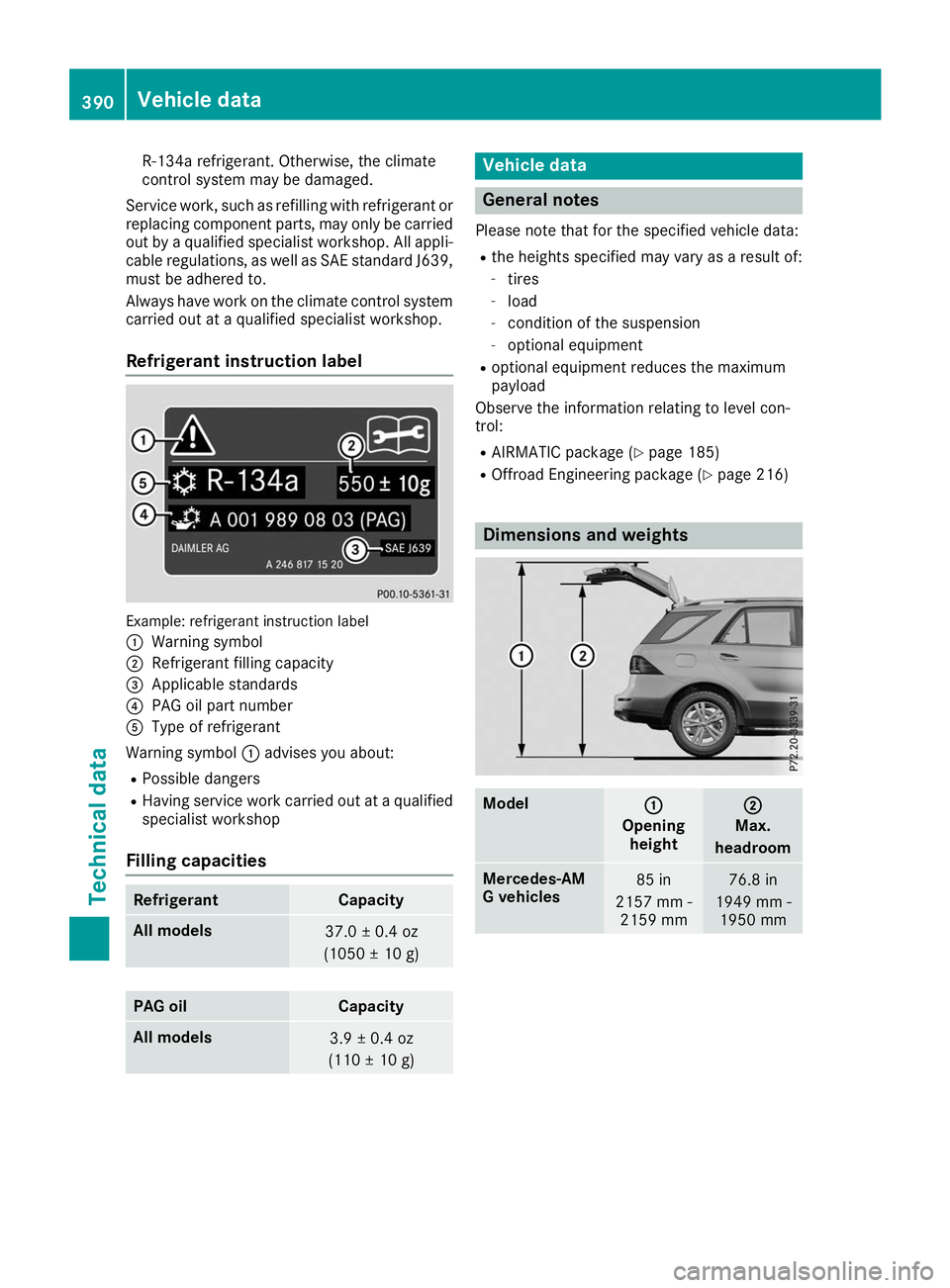
Refrigerant instruction label Example: refrigerant instruction label
0043 Warning symbol
0044 Refrigerant filling capacity
0087 Applicable standards
0085 PAG oil part number
0083 Type of refrigerant
Warning symbol 0043advises you about:
R Possible dangers
R Having service work carried out at a qualified
specialist workshop
Filling capacities Refrigerant Capacity
All models
37.0 ± 0.4 oz
(1050 ± 10 g) PAG oil Capacity
All models
3.9 ± 0.4 oz
(110 ± 10 g) Vehicle data
General notes
Please note that for the specified vehicle data: R the heights specified may vary as a result of:
- tires
- load
- condition of the suspension
- optional equipment
R optional equipment reduces the maximum
payload
Observe the information relating to level con-
trol:
R AIRMATIC package (Y page 185)
R Offroad Engineering package (Y page 216) Dimensions and weights
Model
0043 0043
Opening height 0044
0044
Max.
headroom Mercedes‑AM
G vehicles
85 in
2157 mm - 2159 mm 76.8 in
1949 mm - 1950 mm 390
Vehicle dataTechnical data
Page 393 of 398
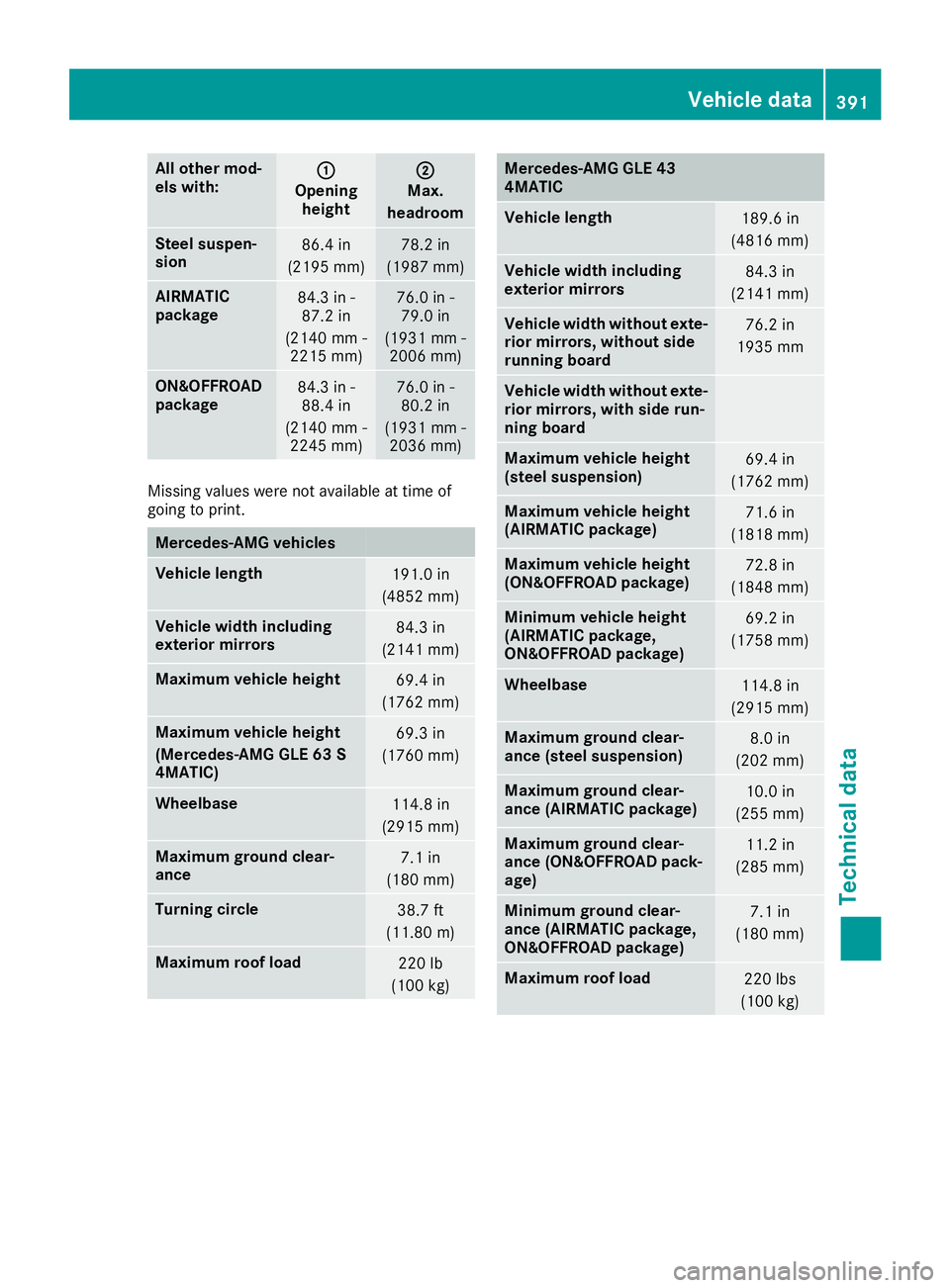
All other mod-
els with:
0043 0043
Opening height 0044
0044
Max.
headroom Steel suspen-
sion
86.4 in
(2195 mm) 78.2 in
(1987 mm) AIRMATIC
package
84.3 in -
87.2 in
(2140 mm - 2215 mm) 76.0 in -
79.0 in
(1931 mm - 2006 mm) ON&O
FFROAD
package 84.3 in -
88.4 in
(2140 mm - 2245 mm) 76.0 in -
80.2 in
(1931 mm - 2036 mm) Missing values
were not available at time of
going to print. Mercedes
‑AMG vehicles Vehicle length
191.0 in
(4852 mm) Vehicle width including
exterior mirrors
84.3 in
(2141 mm) Maximum vehicle height
69.4 in
(1762 mm) Maximum vehicle height
(Mercedes-AMG GLE 63 S
4MATIC)
69.3 in
(1760 mm) Wheelbase
114.8 in
(2915 mm) Maximum ground clear-
ance
7.1 in
(180 mm) Turning circle
38.7 ft
(11.80 m) Maximum roof load
220 lb
(100 kg) Mercedes-AMG GLE 43
4MATIC
Vehicle length
189.6 in
(4816 mm) Vehicle width including
exterior mirrors
84.3 in
(2141 mm) Vehicle width without exte-
rior mirrors, without side
running board 76.2 in
1935 mm Vehicle width without exte-
rior mirrors, with side run-
ning board Maximum vehicle height
(steel suspension)
69.4 in
(1762 mm) Maximum vehicle height
(AIRMATIC package)
71.6 in
(1818 mm) Maximum vehicle height
(ON&OFFROAD package)
72.8 in
(1848 mm) Minimum vehicle height
(AIRMATIC package,
ON&OFFROAD package)
69.2 in
(1758 mm) Wheelbase
114.8 in
(2915 mm) Maximum ground clear-
ance (steel suspension)
8.0 in
(202 mm) Maximum ground clear-
ance (AIRMATIC package)
10.0 in
(255 mm) Maximum ground clear-
ance (ON&OFFROAD pack-
age)
11.2 in
(285 mm) Minimum ground clear-
ance (AIRMATIC package,
ON&OFFROAD package)
7.1 in
(180 mm) Maximum roof load
220 lbs
(100 kg) Vehicle data
391Technical data Z
Page 394 of 398
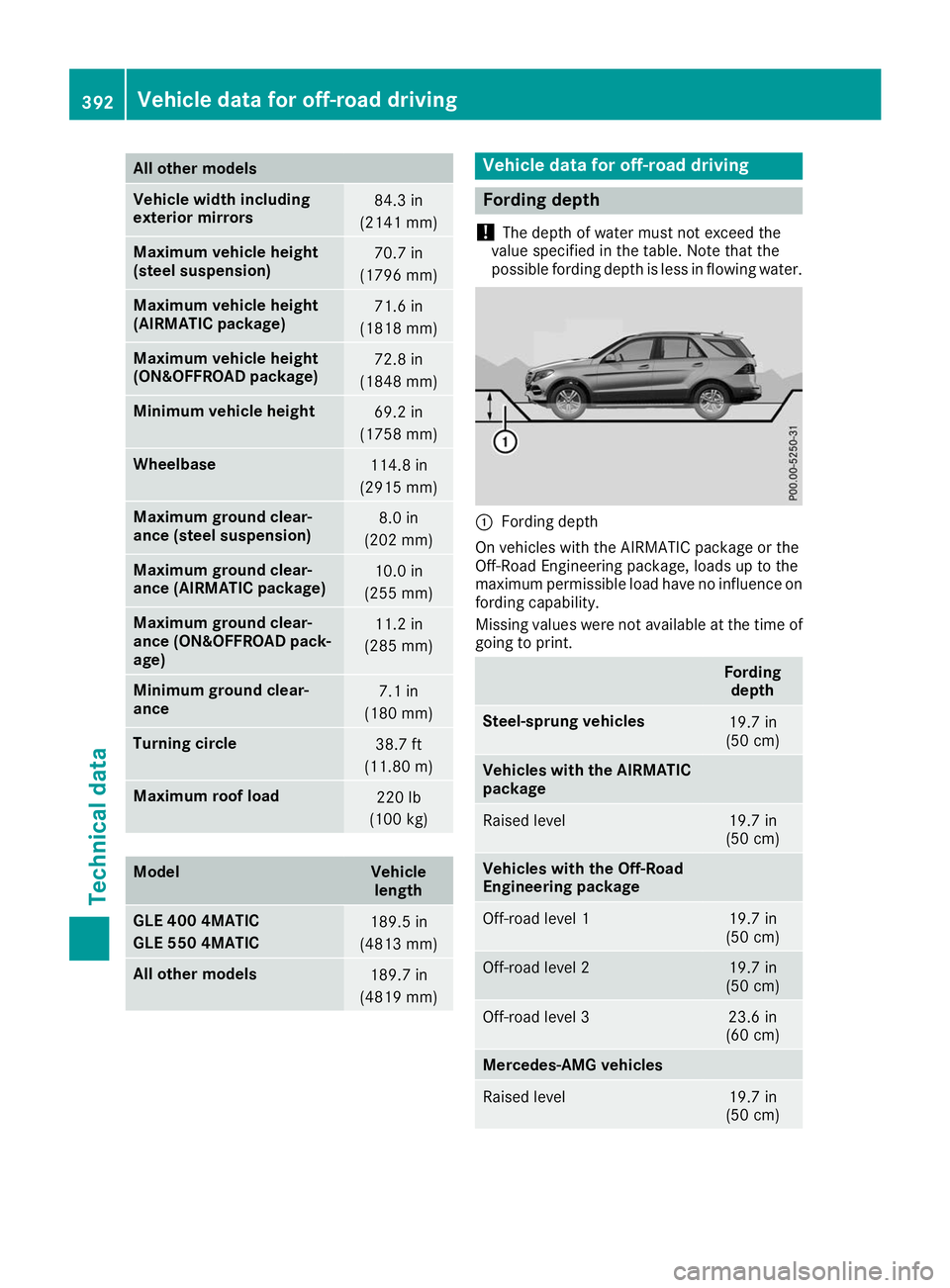
All other models
Vehicle width including
exterior mirrors 84.3 in
(2141 mm) Maximum vehicle height
(steel suspension)
70.7 in
(1796 mm) Maximum vehicle height
(AIRMATIC package)
71.6 in
(1818 mm) Maximum vehicle height
(ON&OFFROAD package)
72.8 in
(1848 mm) Minimum vehicle height
69.2 in
(1758 mm) Wheelbase
114.8 in
(2915 mm) Maximum ground clear-
ance (steel suspension)
8.0 in
(202 mm) Maximum ground clear-
ance (AIRMATIC package)
10.0 in
(255 mm) Maximum ground clear-
ance (ON&OFFROAD pack-
age)
11.2 in
(285 mm) Minimum ground clear-
ance
7.1 in
(180 mm) Turning circle
38.7 ft
(11.80 m) Maximum roof load
220 lb
(100 kg) Model Vehicle
length GLE 400 4MATIC
GLE 550 4MATIC
189.5 in
(4813 mm) All other models
189.7 in
(4819 mm) Vehicle data for off-road driving
Fording depth
! The depth of water must not exceed the
value specified in the table. Note that the
possible fording depth is less in flowing water. 0043
Fording depth
On vehicles with the AIRMATIC package or the
Off-Road Engineering package, loads up to the
maximum permissible load have no influence on fording capability.
Missing values were not available at the time of
going to print. Fording
depth Steel-sprung vehicles
19.7 in
(50 cm) Vehicles with the AIRMATIC
package Raised level 19.7 in
(50 cm) Vehicles with the Off-Road
Engineering package
Off-road level 1 19.7 in
(50 cm) Off-road level 2 19.7 in
(50 cm) Off-road level 3 23.6 in
(60 cm) Mercedes-AMG vehicles
Raised level 19.7 in
(50 cm) 392
Vehicle data for off-road drivingTechnical data