belt MERCEDES-BENZ GLE SUV 2015 Owners Manual
[x] Cancel search | Manufacturer: MERCEDES-BENZ, Model Year: 2015, Model line: GLE SUV, Model: MERCEDES-BENZ GLE SUV 2015Pages: 453, PDF Size: 14.78 MB
Page 8 of 453
Automatic transmission emer-
gency running mode
.........................175
Auxiliary heating
Setting .......................................... .295
Auxiliary heating/ventilation
Display message ............................ 335
Important safety notes .................. 149
Problem (display message) ............ 154
Remote control .............................. 151
Setting the departure time ............. 152
Switching on/off (on the centre
console) ......................................... 150
Axle load, permissible (trailer tow-
ing) ...................................................... 447 B
Bag hook ............................................ 356
Ball coupling
Swinging in ................................... .276
Swinging out .................................. 274
BAS (Brake Assist System) ................. 71
BAS PLUS with Cross-Traffic Assist (Brake Assist PLUS with Cross-
Traffic Assist)
Function/notes ................................ 71
Important safety notes .................... 72
Battery (high-voltage)
see High-voltage battery
Battery (key)
Checking .......................................... 87
Important safety notes .................... 87
Replacing ......................................... 87
Battery (vehicle)
Charging ........................................ 395
Display message ............................ 317
Important safety notes .................. 392
Jump starting ................................. 397
Overview ........................................ 392
Belt
see Seat belts
Belt tensioner
Activation ......................................... 55
Blind Spot Assist
Activating/deactivating ................. 291
Display message ............................ 326
Notes/function .............................. 244
Trailer towing ................................. 246 see Active Blind Spot Assist
BlueTEC
Topping up AdBlue ®
....................... 180
BlueTEC (AdBlue ®
) ............................ .439
Bonnet
Active bonnet (pedestrian protec-tion) ............................................... 373
Closing .......................................... .374
Display message ............................ 334
Important safety notes .................. 373
Opening ......................................... 374
Boot
see Tailgate
Brake Assist
see BAS (Brake Assist System)
Brake fluid
Display message ............................ 306
Notes ............................................. 441
Brake force distribution
see EBD (electronic brake force
distribution)
Brake lamps
Adaptive .......................................... .75
Display message ............................ 314
Brake pedal
Pedal resistance/pedal travel .......... 43
Brakes
ABS .................................................. 70
Adaptive Brake Assist ...................... 74
BAS .................................................. 71
BAS PLUS with Cross-Traffic
Assist ............................................... 71
Brake fluid (notes) ........................ .441
Display message ............................ 301
Driving tips ................................... .196
High-performance brake system .... 197
Important safety notes .................. 196
Parking brake ................................ 192
RBS warning lamp .......................... 340
Recuperative Brake System ............. 43
Warning lamp ................................. 339
Breakdown
Where will I find...? ........................ 386
see Flat tyre
see Towing away
Brightness control (instrument
cluster lighting) ................................... 32 Index
5
Page 9 of 453
C
Calling up a fault see Display messages
Car
see Vehicle
Car wash (care) ................................ .379
Care
360° camera ................................. 383
Automatic car wash ....................... 379
Carpets .......................................... 385
Display .......................................... .384
Exhaust pipe .................................. 383
Exterior lighting ............................ .382
Gear or selector lever .................... 384
High-pressure cleaner .................... 380
Interior .......................................... .384
Matt paintwork .............................. 381
Notes ............................................. 378
Paint .............................................. 380
Plastic trim ................................... .384
Reversing camera .......................... 383
Roof lining ...................................... 385
Seat belt ........................................ 385
Seat cover ..................................... 385
Sensors ......................................... 382
Side running board ........................ 382
Steering wheel ............................... 384
Trim pieces ................................... .384
Washing by hand ........................... 380
Wheels .......................................... .381
Windows ........................................ 381
Wiper blades .................................. 382
Wooden trim .................................. 384
CD player (on-board computer) ........287
Central locking
Automatic locking (on-board com-puter) ............................................. 294
Locking/unlocking (key) .................. 85
Centre console
Lower section .................................. 37
Upper section .................................. 36
Changing bulbs
Dipped-beam headlamps .............. .129
Main-beam headlamps ................... 129
Turn signals (front) ......................... 130 Charging
see Charging the high-voltage bat-
tery (important safety notes)
Charging cable
Connection ................................... .188
Control panel ......................... 185, 186
Disconnecting ................................ 188
Heating up ..................................... 185
Important safety notes .................. 185
Indicator lamps .............................. 187
Storing .......................................... .185
Charging the high-voltage battery
(important safety notes) ................... 182
Child
Restraint system .............................. 59
Child seat
Forward-facing restraint system ...... 63
ISOFIX .............................................. 60
On the front-passenger sea t............ 62
Rearward-facing restraint system .... 63
Recommendations ........................... 67
Suitable positions ............................ 63
Top Tether ....................................... 60
Child-proof locks
Important safety notes .................... 68
Rear doors ....................................... 69
Cigarette lighter ................................ 364
Cleaning
Mirror turn signal ........................... 382
Trailer tow hitch ............................. 383
Climate control
Auxiliary heating/ventilation .......... 149
Controlling automaticall y............... 141
Convenience opening/closing
(air-recirculation mode) ................. 145
Cooling with air dehumidification .. 139
Demisting the windows .................. 143
Demisting the windscreen ............. 143
Immediate pre-entry climate con-
trol ................................................. 149
Indicator lamp ................................ 141
Information about using
THERMATIC automatic climate
control ........................................... 137
Information on using
THERMOTRONIC automatic cli-
mate control .................................. 139
Ionisation ....................................... 146 6
Index
Page 21 of 453
Pulling away
General notes ................................ 161
Trailer ............................................ 161
Pulling away (automatic transmis-
sion) ....................................................1 61Q
QR code Mercedes-Benz Guide App ................. 1
Rescue card ..................................... 28
Qualified specialist workshop ........... 28R
RACETIMER (on-board computer) .... 298
Radiator cover ................................... 374
Radio
Selecting a station ......................... 287
see separate operating instructions
Radio-based vehicle components
Declaration of conformity ................ 27
Rain closing feature
Sliding sunroof ............................... 102
Rain closing feature (panorama
sliding sunroof) ................................. 103
RBS (Recuperative Brake System)
Warning lamp ................................. 340
Reading lamp ..................................... 127
Rear bench seat
Folding the bench seat forwards/back ............................................... 355
Rear compartment
Setting the air vents ..................... .155
Setting the temperature ................ 141
Rear foglamp
Display message ............................ 314
Switching on/off ........................... 122
Rear seat
Adjusting ....................................... 111
Rear window heating
Problem (fault) ............................... 145
Switching on/off ........................... 144
Rear window wiper
Replacing the wiper blade .............. 133
Switching on/off ........................... 131
Rear-compartment seat belt sta-
tus indicator ........................................ 48 Rear-view mirror
Anti-dazzle mode (automatic) ....... .118
Dipping (manual) ........................... 117
Recuperative Brake System
Driving safety systems ..................... 43
Important safety notes .................... 43
Refuelling
Fuel gauge ....................................... 32
Important safety notes .................. 175
Notes for Mercedes‑ AMG vehi-
cles ................................................ 437
Refuelling (PLUG-IN HYBRID vehi-
cles) ............................................... 176
Refuelling process ......................... 176
see Fuel
Remote control
Auxiliary heating/ventilation .......... 151
Changing the batteries (auxiliary
heating) ......................................... 152
Garage door opener ....................... 367
Programming (garage door
opener) .......................................... 367
Replacing bulbs
General notes ................................ 128
Important safety notes .................. 128
Overview of bulb type s.................. 128
Removing/replacing the cover
(front wheel arch) .......................... 129
Replacing the battery (auxiliary
heating remote control) .................... 152
Rescue card ......................................... 28
Reserve (fuel tank)
see Fuel
Reserve fuel
Display message ............................ 318
Warning lamp ................................. 347
Residual heat (climate control) ........ 146
Restraint system
Display message ............................ 309
Introduction ..................................... 43
Warning lamp ................................. 346
Warning lamp (function) ................... 44
Rev counter ........................................ 281
Reversing camera
Cleaning instructions ..................... 383
Display in the multimedia system .. 233
Function/note s............................. 232 18
Index
Page 22 of 453
Switching on/of
f........................... 233
Reversing feature
Panorama sliding sunroof .............. 102
Roller sunblind s............................. 104
Side windows ................................... 98
Sliding sunroof ............................... 102
Tailgate ............................................ 94
Reversing lamp (display message) .. 314
Roller sunblind
Panorama sliding sunroof .............. 103
Roof carrier ........................................ 360
Roof lining and carpets (cleaning
instructions) ...................................... 385
Roof load (maximum) ........................ 442
Route (navigation)
see Route guidance (navigation)
Route guidance (navigation) ............ 286S
Safety Children in the vehicle ..................... 58
Hybrid drive system ......................... 41
see Occupant safety
Safety net
Attaching ....................................... 358
Important safety information ......... 358
Safety notes
Hybrid vehicles ................................ 41
Safety system
see Driving safety systems
SD memory card
Selecting ........................................ 287
Seat belt
Correct usage .................................. 46
Switching belt adjustment on/off
(on-board computer) ...................... 296
Seat belts
Adjusting the driver's and front-
passenger seat belt ......................... 47
Adjusting the height ......................... 47
Cleaning ......................................... 385
Display message ............................ 308
Fastening ......................................... 47
Important safety guidelines ............. 45
Introduction ..................................... 45
Rear seat belt status indicator ......... 48
Releasing ......................................... 47 Warning lamp ................................. 337
Warning lamp (function) ................... 48
Seats
Adjusting (electrically) ................... 109
Adjusting the head restraint .......... 109
Cleaning the cover ......................... 385
Correct driver's seat position ........ 107
Folding the rear bench seat for-
wards/back ................................... 354
Important safety notes .................. 108
Overview ........................................ 108
Seat heating problem .................... 113
Seat ventilation problem ................ 114
Storing settings (memory func-
tion) ............................................... 120
Switching seat heating on/of f....... 112
Switching the seat ventilation on/ off .................................................. 113
Section
Sliding sunroof ............................... 101
Securing hooks .................................. 356
Selector lever
Cleaning ......................................... 384
Sensors (cleaning instructions) ....... 382
Service
see ASSYST PLUS
Service Centre
see Qualified specialist workshop
Service menu (on-board com-
puter) .................................................. 291
Service message
see ASSYST PLUS
Service products
AdBlue ®
special additive s.............. 439
Brake fluid ..................................... 441
Coolant (engine) ............................ 441
Engine oil ....................................... 439
Fuel ................................................ 436
Important safety notes .................. 435
Washer fluid ................................... 442
Setting the air distribution ............... 142
Setting the airflow ............................ 142
Setting the charge current (on-
board computer) ............................... 292
Setting the departure time (on-
board computer) ............................... 292 Index
19
Page 26 of 453
see Flat tyre
U
Unlocking Emergency unlocking ....................... 92
From inside the vehicle (central
unlocking button) ............................. 91
Upshift indicator (on-board com-
puter, Mercedes-AMG vehicles) .......297 V
Vanity mirror (in sun visor) .............. 362
Variable SPEEDTRONIC
see SPEEDTRONIC
Vehicle
Correct use ...................................... 28
Data acquisition ............................... 28
Display message ............................ 332
Electronics ..................................... 433
Equipment ....................................... 26
Implied warranty .............................. 28
Individual settings .......................... 292
Leaving parked up ......................... 194
Locking (in an emergency) .............. .93
Locking (key) ................................... 85
Lowering ........................................ 417
Pulling away ................................... 161
Raising ........................................... 415
Registration ..................................... 28
Securing from rolling away ............ 414
Towing away .................................. 399
Transporting .................................. 401
Unlocking (in an emergency) ........... 92
Unlocking (key) ................................ 85
Vehicle data ................................... 442
Vehicle battery
see Battery (vehicle)
Vehicle data ....................................... 442
Vehicle data (off-road driving)
Approach/departure angle ............ 445
Fording depth ................................ 444
Maximum gradient climbing abil-
ity .................................................. 445
Vehicle dimensions ........................... 442
Vehicle emergency locking ................ 93Vehicle identification number
see VIN
Vehicle identification plate .............. 434
Vehicle level
AIRMATIC ...................................... 222
Vehicle level (display message) ....... 322
Vehicle tool kit .................................. 387
Video
Operating the DVD ......................... 288
VIN ...................................................... 434
Seat ............................................... 435
Type plate ...................................... 434 W
Warning and indicator lamps ABS ................................................ 341
Brakes ........................................... 339
Distance warning signal ................. 349
ESP ®
.............................................. 343
ESP ®
OFF ....................................... 344
Fuel tank ........................................ 347
Hybrid drive system ....................... 340
LIM (cruise control )........................ 203
LIM (DISTRONIC PLUS) .................. 208
LIM (variable SPEEDTRONIC) ......... 205
Overview .......................................... 34
Parking brake ................................ 346
PASSENGER AIR BAG ...................... 44
RBS (Recuperative Brake Sys-
tem) ............................................... 340
Reserve fuel ................................... 347
Seat belt ........................................ 337
Tyre pressure monitor ................... 350
Warning triangle ................................ 386
Warnings
Stickers ........................................... 41
Washer fluid
Display message ............................ 336
Wheel and tyre combinations
Tyres .............................................. 419
Wheel bolt tightening torque ........... 417
Wheel chock ...................................... 414
Wheels
Changing a whee l.......................... 413
Changing/replacing ....................... 413
Checking ........................................ 406
Cleaning ......................................... 381 Index
23
Page 28 of 453
Protection of the environment
General notes
H
Environmental note
Daimler's declared policy is one of compre-
hensive environmental protection.
Our objectives are to use the natural resour-
ces which form the basis of our existence on
this planet sparingly and in a manner which
takes the requirements of both nature and
humanity into consideration.
You too can help to protect the environment
by operating your vehicle in an environmen-
tally-responsible manner.
Fuel consumption and the rate of engine,
transmission, brake and tyre wear depend on
the following factors:
R operating conditions of your vehicle
R your personal driving style
You can influence both factors. Therefore,
please bear the following in mind:
Operating conditions:
R avoid short trips, as these increase fuel
consumption.
R observe the correct tyre pressure.
R do not carry any unnecessary weight in the
vehicle.
R remove the roof rack once you no longer
need it.
R a regularly serviced vehicle will contribute
to environmental protection. You should
therefore adhere to the service intervals.
R all maintenance work should be carried out
at a qualified specialist workshop.
Personal driving style:
R do not depress the accelerator pedal when
starting the engine.
R do not warm up the engine when the vehicle
is stationary.
R drive carefully and maintain a safe distance
from the vehicle in front.
R avoid frequent, sudden acceleration and
braking. R
change gear in good time and use each gear
only up to Ôof its maximum engine speed.
R switch off the engine in stationary traffic.
R monitor the vehicle's fuel consumption. Returning an end-of-life vehicle
EU countries only:
Mercedes-Benz will take back your old vehicle to
dispose of it in an environmentally-responsible
manner in accordance with the European Union (EU) End of Life Vehicles Directive.
There is a network of return points and disas-
sembly plants available. You can return your
vehicle to these plants free of charge. This
makes a valuable contribution to the recycling
process and the conservation of resources.
For further information on recycling old vehi-
cles, recovery and the terms of the policy, visit
the Mercedes-Benz homepage. Genuine Mercedes-Benz parts
H
Environmental note
Daimler AG also supplies reconditioned
assemblies and parts which are of the same
quality as new parts. For these, the same war-
ranty applies as for new parts.
! Airbags and seat belt tensioners, as well as
control units and sensors for these restraint
systems, may be installed in the following
areas of your vehicle:
R doors
R door pillars
R door sills
R seats
R dashboard
R instrument cluster
R centre console
Do not install accessories such as audio sys-
tems in these areas. Do not carry out repairs
or welding. You could impair the operating
efficiency of the restraint systems.
Have accessories retrofitted at a qualified
specialist workshop. Introduction
25 Z
Page 37 of 453
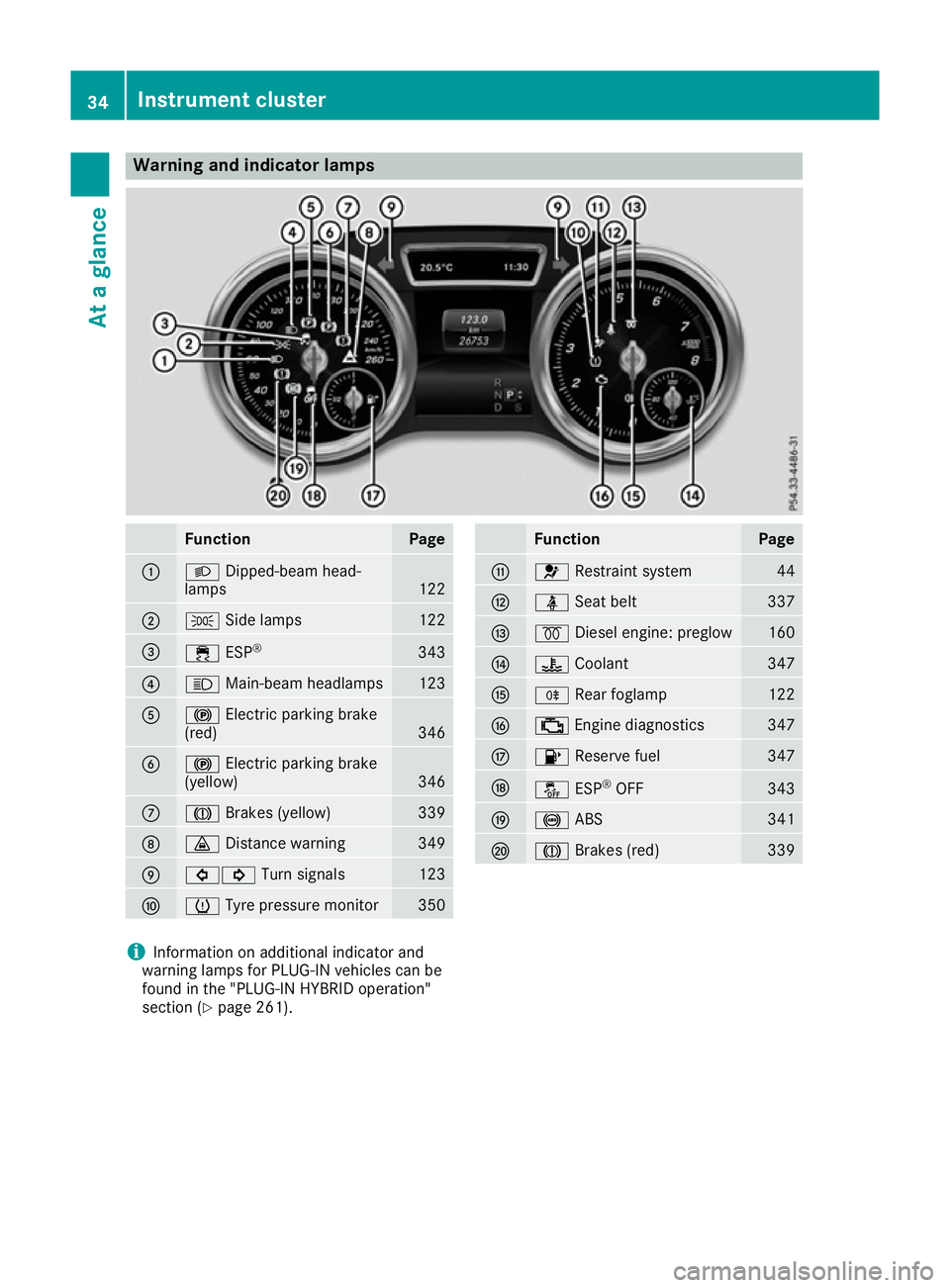
Warning and indicator lamps
Function Page
:
L
Dipped-beam head-
lamps 122
;
T
Side lamps 122
=
÷
ESP® 343
?
K
Main-beam headlamps 123
A
!
Electric parking brake
(red) 346
B
!
Electric parking brake
(yellow) 346
C
J
Brakes (yellow) 339
D
·
Distance warning 349
E
#!
Turn signals 123
F
h
Tyre pressure monitor 350 Function Page
G
6
Restraint system 44
H
ü
Seat belt 337
I
%
Diesel engine: preglow 160
J
?
Coolant 347
K
R
Rear foglamp 122
L
;
Engine diagnostics 347
M
8
Reserve fuel 347
N
å
ESP®
OFF 343
O
!
ABS 341
P
J
Brakes (red) 339
i
Information on additional indicator and
warning lamps for PLUG-IN vehicles can be
found in the "PLUG-IN HYBRID operation"
section (Y page 261). 34
Instrument clusterAt a glance
Page 46 of 453
X
Observe the warning notes on the risk of elec-
tric shock (Y page 41).
X Observe the warning notes about the bonnet
(Y page 374). RBS driving safety system (Recupera-
tive Brake System)
The Recuperative Braking System supports you
when braking with an electronically-controlled
brake boost mode and enables the recovery of
kinetic energy (recuperation).
Further information about the Recuperative
Braking System (Y page 259). Panic alarm
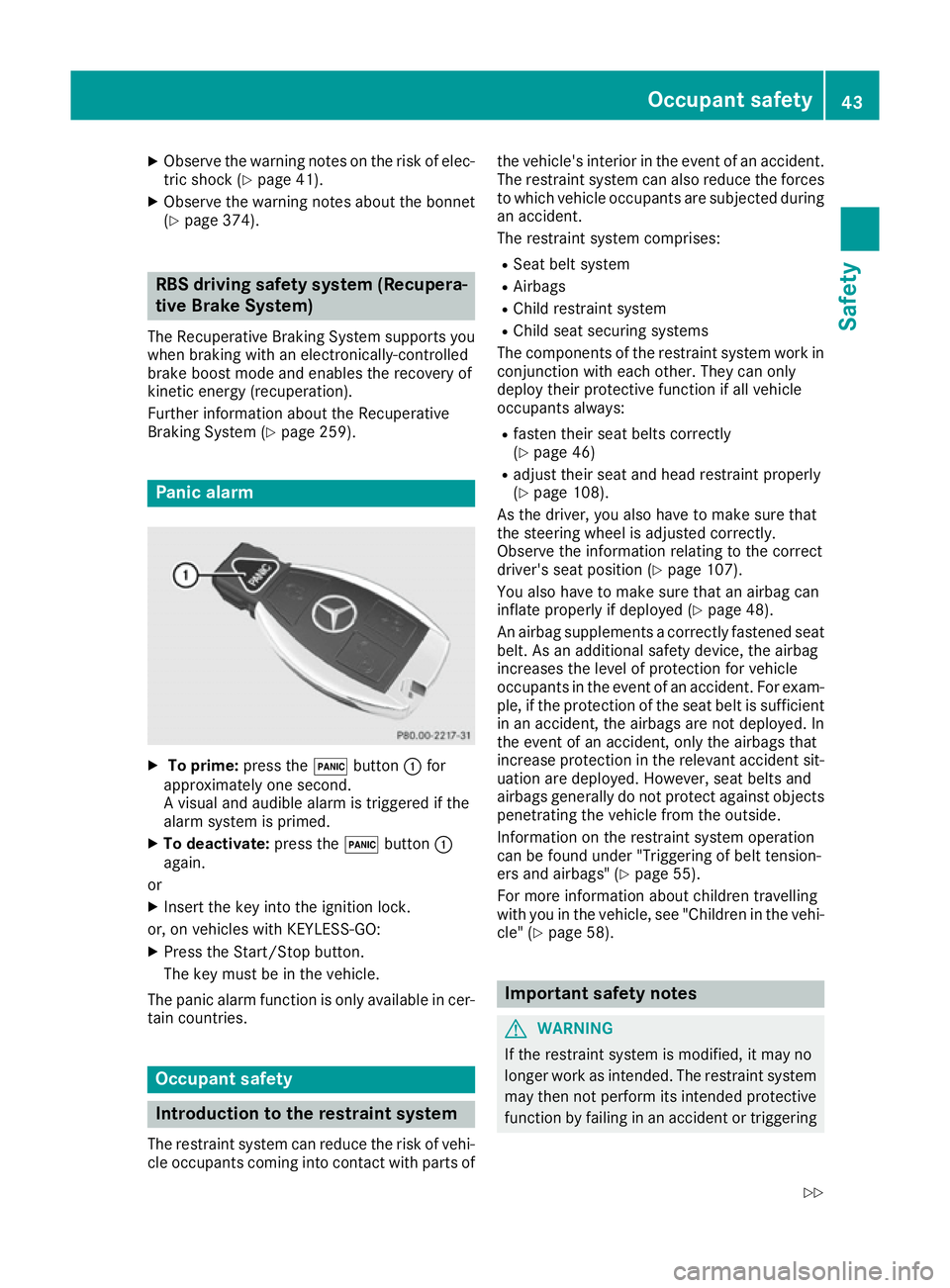
X
To prime: press the!button :for
approximately one second.
A visual and audible alarm is triggered if the
alarm system is primed.
X To deactivate: press the!button :
again.
or
X Insert the key into the ignition lock.
or, on vehicles with KEYLESS‑ GO:
X Press the Start/Stop button.
The key must be in the vehicle.
The panic alarm function is only available in cer- tain countries. Occupant safety
Introduction to the restraint system
The restraint system can reduce the risk of vehi- cle occupants coming into contact with parts of the vehicle's interior in the event of an accident.
The restraint system can also reduce the forces to which vehicle occupants are subjected during
an accident.
The restraint system comprises:
R Seat belt system
R Airbags
R Child restraint system
R Child seat securing systems
The components of the restraint system work in
conjunction with each other. They can only
deploy their protective function if all vehicle
occupants always:
R fasten their seat belts correctly
(Y page 46)
R adjust their seat and head restraint properly
(Y page 108).
As the driver, you also have to make sure that
the steering wheel is adjusted correctly.
Observe the information relating to the correct
driver's seat position (Y page 107).
You also have to make sure that an airbag can
inflate properly if deployed (Y page 48).
An airbag supplements a correctly fastened seat belt. As an additional safety device, the airbag
increases the level of protection for vehicle
occupants in the event of an accident. For exam-
ple, if the protection of the seat belt is sufficient in an accident, the airbags are not deployed. In
the event of an accident, only the airbags that
increase protection in the relevant accident sit- uation are deployed. However, seat belts and
airbags generally do not protect against objects penetrating the vehicle from the outside.
Information on the restraint system operation
can be found under "Triggering of belt tension-
ers and airbags" (Y page 55).
For more information about children travelling
with you in the vehicle, see "Children in the vehi-
cle" (Y page 58). Important safety notes
G
WARNING
If the restraint system is modified, it may no
longer work as intended. The restraint system
may then not perform its intended protective function by failing in an accident or triggering Occupant safety
43Safety
Z
Page 47 of 453
unexpectedly, for example. There is an
increased risk of injury, possibly even fatal.
Never modify parts of the restraint system. Do not attempt to modify the wiring as well as
electronic components or their software.
If it is necessary to modify an airbag system to
accommodate a person with disabilities, con-
tact a Mercedes-Benz Service Centre. Restraint system warning lamp
The functions of the restraint system are
checked after the ignition is switched on and at
regular intervals while the engine is running.
Therefore, malfunctions can be detected in
good time.
The 6 restraint system warning lamp in the
instrument cluster lights up when the ignition is switched on. It goes out no later than a few sec-
onds after the vehicle is started. The compo-
nents of the restraint system are in operational
readiness.
A malfunction has occurred if the 6restraint
system warning lamp:
R does not light up after the ignition is switched
on
R does not go out after a few seconds with the
engine running
R lights up again while the engine is running
All vehicles, except hybrid vehicles: G
WARNING
If the restraint system is malfunctioning,
restraint system components may be trig-
gered unintentionally or might not be trig-
gered at all in the event of an accident with a high rate of vehicle deceleration. This can
effect belt tensioners or airbags, for example. There is an increased risk of serious or even
fatal injuries.
Have the restraint system checked and
repaired immediately at a qualified specialist
workshop.
Hybrid vehicles: G
DANGER
If the restraint system is malfunctioning,
restraint system components may be trig-
gered unintentionally or might not be trig-
gered at all in the event of an accident with a high rate of vehicle deceleration. This can
effect belt tensioners or airbags, for example. In addition, the vehicle's high-voltage electri-
cal system may not be deactivated as inten-
ded in the event of an accident. Touching
damaged components of the vehicle's high-
voltage electrical system could result in an
electric shock. There is an increased risk of
injury, possibly even fatal.
Have the restraint system checked and
repaired immediately at a qualified specialist
workshop. After an accident, immediately
switch the ignition off and remove the key
from the ignition lock. PASSENGER AIR BAG indicator lamp
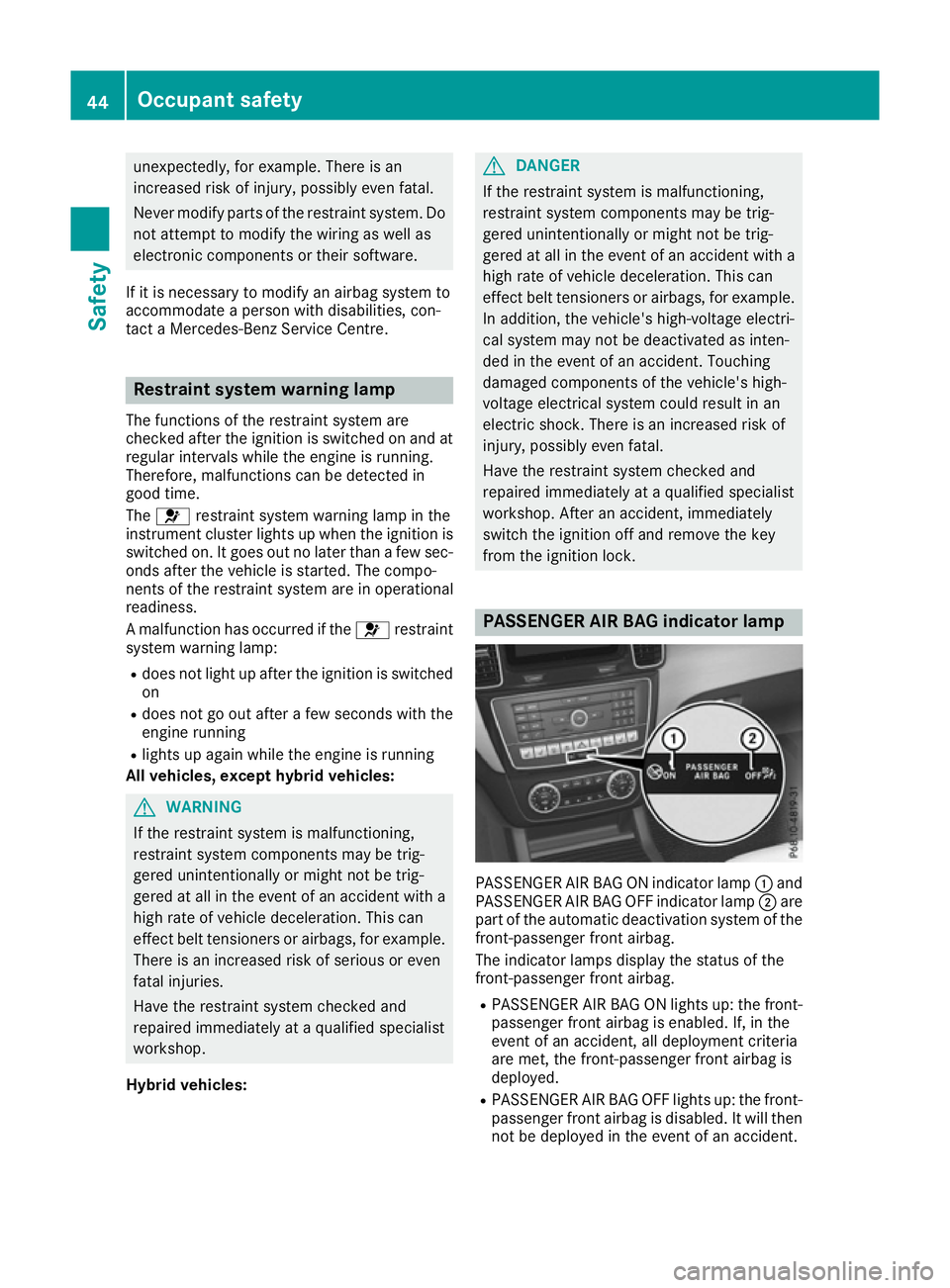
PASSENGER AIR BAG ON indicator lamp
:and
PASSENGER AIR BAG OFF indicator lamp ;are
part of the automatic deactivation system of the front-passenger front airbag.
The indicator lamps display the status of the
front-passenger front airbag.
R PASSENGER AIR BAG ON lights up: the front-
passenger front airbag is enabled. If, in the
event of an accident, all deployment criteria
are met, the front-passenger front airbag is
deployed.
R PASSENGER AIR BAG OFF lights up: the front-
passenger front airbag is disabled. It will then
not be deployed in the event of an accident. 44
Occupant safetySafety
Page 48 of 453
Depending on the person in the front-passenger
seat, the front-passenger front airbag must
either be disabled or enabled; see the following
points. You must make sure of this both before
and during a journey.
R Children in a rearward-facing child
restraint system: the PASSENGER AIR BAG
OFF indicator lamp must be lit. The front-
passenger front airbag is disabled. It is imper- ative to observe the notes on the "Automatic
front-passenger front airbag deactivation sys-
tem" (Y page 51) and on "Children in the
vehicle" (Y page 58).
R Children in a forward-facing child
restraint system: depending on the installed
child restraint system and the age and size of
the child, the front-passenger front airbag is
either disabled or enabled. Therefore, it is
imperative to observe the notes on the "Auto- matic front-passenger front airbag deactiva-
tion system" (Y page 51) and on "Children in
the vehicle" (Y page 58).
R All other persons: the PASSENGER AIR BAG
ON indicator lamp must be lit. The front-
passenger front airbag is enabled. Depending on the build of the person on the front-
passenger seat, the PASSENGER AIR BAG
OFF indicator lamp may light up. The front-
passenger front airbag is disabled. It will then
not be deployed in the event of an accident. In this case, the front-passenger seat should notbe used.
It is imperative to observe the notes on the
"Automatic front-passenger front airbag
deactivation system" (Y page 51) as well as
on "Seat belts" (Y page 45) and "Airbags"
(Y page 48). There you can also find infor-
mation on the correct seat position. Seat belts
Introduction A correctly worn seat belt is the most effective
means of restraining the movement of vehicle
occupants in the event of a collision or if the
vehicle overturns. This reduces the risk of vehi-
cle occupants coming into contact with parts of
the vehicle interior or being ejected from it. The
seat belt also helps to keep the vehicle occu-
pants in the best position in relation to the air-
bag being deployed. The seat belt system consists of:
R seat belts
R belt tensioners for the front seat belts and the
outer seat belts in the rear
R belt force limiters
If the seat belt is pulled quickly or sharply from
the belt outlet, the inertia reel locks. The belt
strap cannot be pulled out any further.
The belt tensioner tightens the seat belt in the
event of a collision so that it fits tightly across
your body. However, it does not pull the vehicle
occupants back in the direction of the seat
backrest.
The belt tensioner does not, however, correct an
incorrect seat position or correct the routing of a seat belt that is worn incorrectly.
If the seat belt is also fitted with a belt force
limiter and this is triggered, the force exerted by
the seat belt on the vehicle occupant is reduced.
The belt force limiters on the front seats are
synchronised with the front airbags, which take
on a part of the deceleration force. This can
reduce the forces to which the vehicle occu-
pants are subjected during an accident.
! If the co-driver's seat is not occupied, do not
engage the seat belt tongue in the buckle on
the co-driver's seat. Otherwise, the belt ten-
sioner could be triggered in the event of an
accident and would have to be replaced.
Important safety notes G
WARNING
The seat belt cannot perform its intended pro- tective function if it is not fastened correctly. Also, an improperly fastened seat belt can
cause additional injuries in the event of an
accident, sudden braking or abrupt changes
of direction. There is an increased risk of
injury, possibly even fatal.
Always make sure that all vehicle occupants
are wearing their seat belt properly and are
seated correctly. G
WARNING
The seat belt does not offer the intended level of protection if you have not moved the back-
rest to an almost vertical position. When brak-
ing or in the event of an accident, you could Occupant safety
45Safety
Z