roof MERCEDES-BENZ GLE SUV 2017 W166 Owner's Guide
[x] Cancel search | Manufacturer: MERCEDES-BENZ, Model Year: 2017, Model line: GLE SUV, Model: MERCEDES-BENZ GLE SUV 2017 W166Pages: 390, PDF Size: 9.43 MB
Page 345 of 390
Observe the notes on the emergency spare
wheel (Ypage 366).
MOExtended tires (tires with run-flat
properties)
With MOExtended tires (tires with run flat char-
acteristics), you can continue to drive your vehi-
cle even if there is a total loss of pressure in one
or more tires.
MOExtended tires may only be used in conjunc-
tion with an active tire pressure loss warning
system or with an active tire pressure monitor
and on wheels specifically tested by Mercedes-
Benz.
Notes on driving with MOExtended tires with a
flat tire (
Ypage 327).
Vehicles equipped with MOExtended tires are
not equipped with a TIREFIT kit at the factory. It
is therefore recommended that you additionally
equip your vehicle with a TIREFIT kit if you mount
tires that do not feature run-flat properties, e.g.
winter tires. A TIREFIT kit can be obtained from
a qualified specialist workshop.
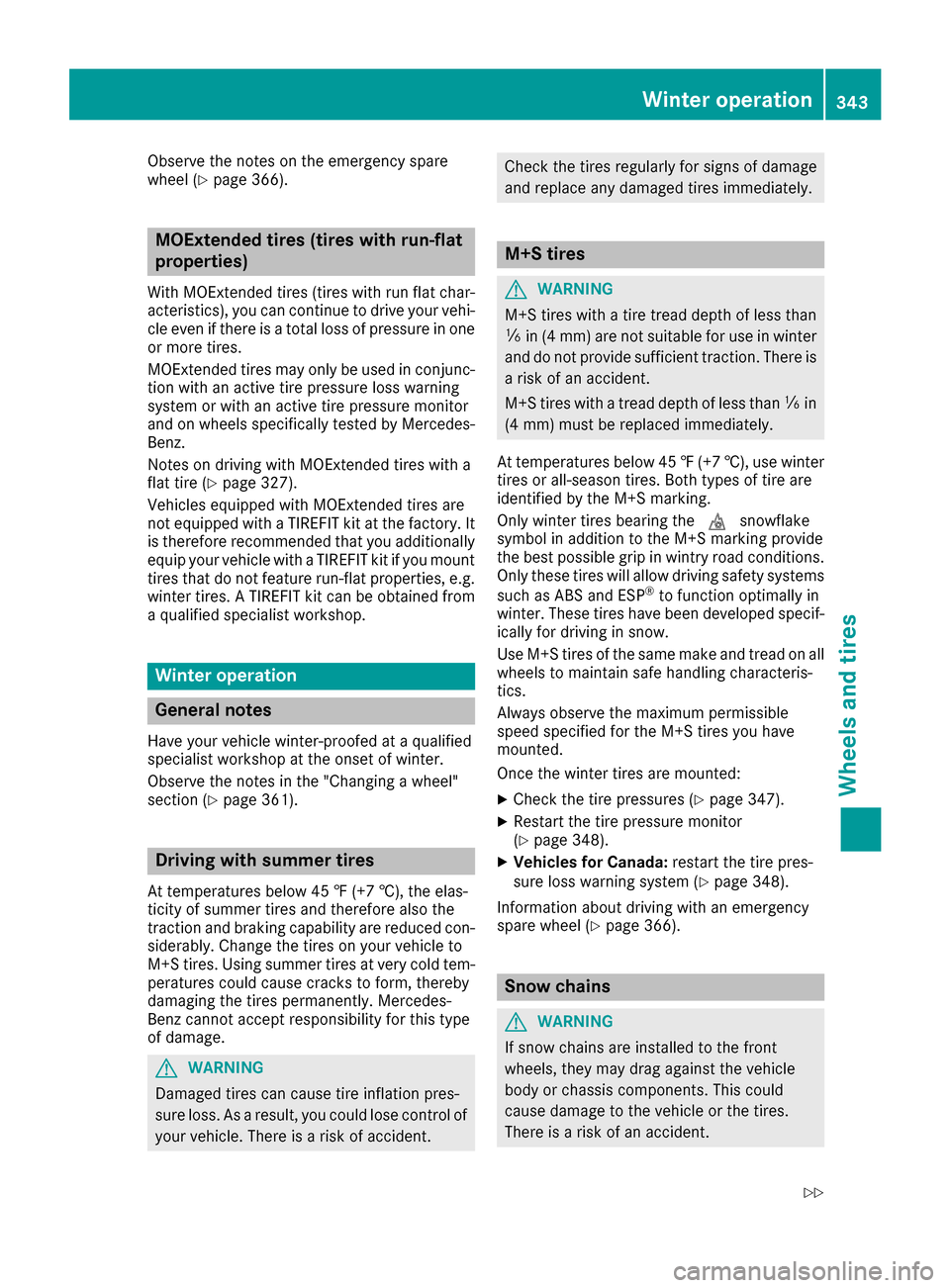
Winter operation
General notes
Have your vehicle winter-proofed at a qualified
specialist workshop at the onset of winter.
Observe the notes in the "Changing a wheel"
section (
Ypage 361).
Driving with summer tires
At temperatures below 45 ‡ (+7 †), the elas-
ticity of summer tires and therefore also the
traction and braking capability are reduced con- siderably. Change the tires on your vehicle to
M+S tires. Using summer tires at very cold tem-
peratures could cause cracks to form, thereby
damaging the tires permanently. Mercedes-
Benz cannot accept responsibility for this type
of damage.
GWARNING
Damaged tires can cause tire inflation pres-
sure loss. As a result, you could lose control of
your vehicle. There is a risk of accident.
Check the tires regularly for signs of damage
and replace any damaged tires immediately.
M+S tires
GWARNING
M+S tires with a tire tread depth of less than
ã in (4 mm) are not suitable for use in winter
and do not provide sufficient traction. There is
a risk of an accident.
M+S tires with a tread depth of less than ãin
(4 mm) must be replaced immediately.
At temperatures below 45 ‡(+7 †), use winter
tires or all-season tires. Both types of tire are
identified by the M+S marking.
Only winter tires bearing the isnowflake
symbol in addition to the M+S marking provide
the best possible grip in wintry road conditions.
Only these tires will allow driving safety systems
such as ABS and ESP
®to function optimally in
winter. These tires have been developed specif-
ically for driving in snow.
Use M+S tires of the same make and tread on all
wheels to maintain safe handling characteris-
tics.
Always observe the maximum permissible
speed specified for the M+S tires you have
mounted.
Once the winter tires are mounted:
XCheck the tire pressures (Ypage 347).
XRestart the tire pressure monitor
(Ypage 348).
XVehicles for Canada: restart the tire pres-
sure loss warning system (Ypage 348).
Information about driving with an emergency
spare wheel (
Ypage 366).
Snow chains
GWARNING
If snow chains are installed to the front
wheels, they may drag against the vehicle
body or chassis components. This could
cause damage to the vehicle or the tires.
There is a risk of an accident.
Winter operation343
Wheels and tires
Z
Page 350 of 390
same time cannot be detected by the tire pres-
sure loss warning system.
The tire pressure monitor is not able to warn you
of a sudden loss of pressure, e.g. if the tire is
penetrated by a foreign object. In the event of a
sudden loss of pressure, bring the vehicle to a
halt by braking carefully. Avoid abrupt steering
movements.
The function of the tire pressure loss warning
system is limited or delayed if:
Rsnow chains are mounted on your vehicle's
tires.
Rroad conditions are wintry.
Ryou are driving on sand or gravel.
Ryou adopt a very sporty driving style (corner-
ing at high speeds or driving with high rates ofacceleration).
Ryou are driving with a heavy load (in the vehi-cle or on the roof).
Restarting the tire pressure loss warn-
ing system
Restart the tire pressure loss warning system if
you have:
Rchanged the tire pressure
Rchanged the wheels or tires
Rmounted new wheels or tires
XBefore restarting, make sure that the tire
pressures are set properly on all four tires for
the respective operating conditions.
The recommended tire pressure can be found
on the Tire and Loading Information placard
on the B-pillar. Additionally, a tire pressure
table is attached to the fuel filler flap. The tire
pressure loss warning system can only give
reliable warnings if you have set the correct
tire pressure. If an incorrect tire pressure is
set, these incorrect values will be monitored.
XAlso observe the notes in the section on tire
pressures (Ypage 344).
XMake sure that the SmartKey is in position 2
in the ignition lock (Ypage 132).
XPress the =or; button on the steering
wheel to select the Servicemenu.
XPress the9or: button to select
Tire Pressure.
XPress the abutton.
The Run Flat Indicator Active Press
'OK' to Restartmessage appears in the
multifunction display. If you wish to confirm the restart:
XPress the
abutton.
The Tire Pressure Now OK?message
appears in the multifunction display.
XPress the 9or: button to select Yes.
XPress theabutton.
The Run Flat Indicator Restartedmes-
sage appears in the multifunction display.
After a teach-in period, the tire pressure loss
warning system will monitor the set tire pres-
sures of all four tires.
If you wish to cancel the restart:
XPress the %button.
or
XWhen the TirePressureNowOK?message
appears, press the 9or: button to
select Cancel
.
XPress the abutton.
The tire pressure values stored at the last
restart will continue to be monitored.
Tire pressure monitor
General notes
If a tire pressure monitor is installed, the vehi-
cle's wheels have sensors that monitor the tire
pressures in all four tires. The tire pressure mon-
itor warns you if the pressure drops in one or
more of the tires. The tire pressure monitor only
functions if the corresponding sensors are
installed in all wheels.
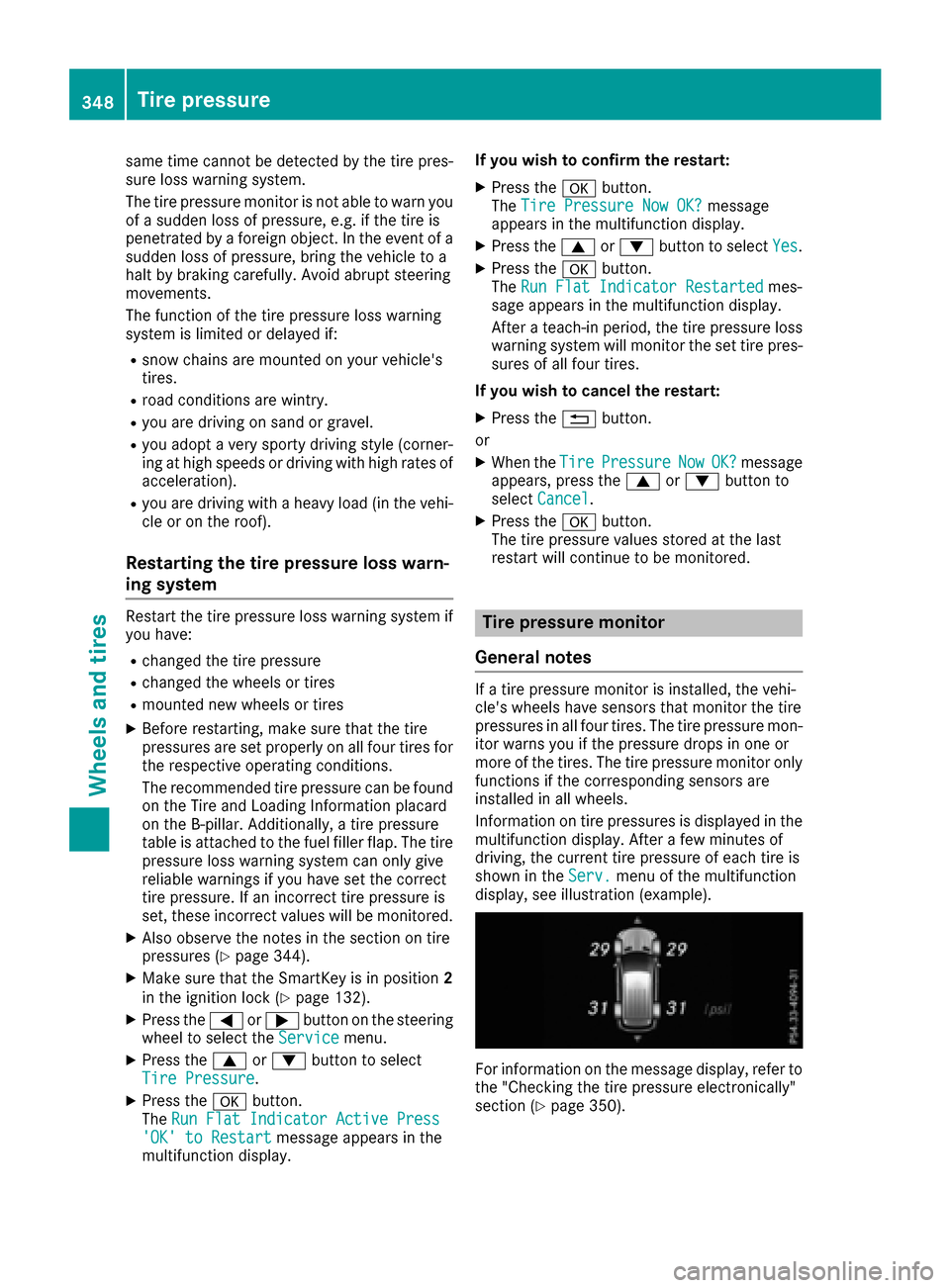
Information on tire pressures is displayed in the
multifunction display. After a few minutes of
driving, the current tire pressure of each tire is
shown in the Serv.
menu of the multifunction
display, see illustration (example).
For information on the message display, refer to
the "Checking the tire pressure electronically"
section (
Ypage 350).
348Tire pressure
Wheels and tires
Page 363 of 390
Sidewall
The part of the tire between the tread and the
bead.
Weight of optional extras
The combined weight of those optional extras
that weigh more than the replaced standard
parts and more than 2.3 kg (5 lbs). These
optional extras, such as high-performance
brakes, level control, a roof rack or a high-per-
formance battery, are not included in the curb
weight and the weight of the accessories.
TIN (Tire Identification Number)
This is a unique identifier which can be used by
a tire manufacturer to identify tires, for example
for a product recall, and thus identify the pur-
chasers. The TIN is made up of the manufactur-
er's identity code, tire size, tire type code and
the manufacturing date.
Load bearing index
The load bearing index (also load index) is a code
that contains the maximum load bearing capa-
city of a tire.
Traction
Traction is the result of friction between the tires
and the road surface.
TWR (Tongue Weight Rating)
The TWR specifies the maximum permissible
weight that the ball coupling of the trailer tow
hitch can support.
Treadwear indicators
Narrow bars (tread wear bars) that are distrib-
uted over the tire tread. If the tire tread is level
with the bars, the wear limit ofáin (1.6 mm)
has been reached.
Occupant distribution
The distribution of occupants in a vehicle at their
designated seating positions.
Total load limit
Nominal load and luggage load plus 68 kg
(150 lbs) multiplied by the number of seats in
the vehicle.
Changing a wheel
Flat tire
The "Breakdown assistance" section
(Ypage 326) contains information and notes on
how to deal with a flat tire. Information on driv-
ing with MOExtended tires in the event of a flat
tire can be found under "MOExtended tires (tires
with run-flat characteristics" (
Ypage 327).
Vehicles with an emergency spare wheel: in
the event of a flat tire, mount the emergency
spare wheel according to the description under "Mounting a wheel" (
Ypage 362).
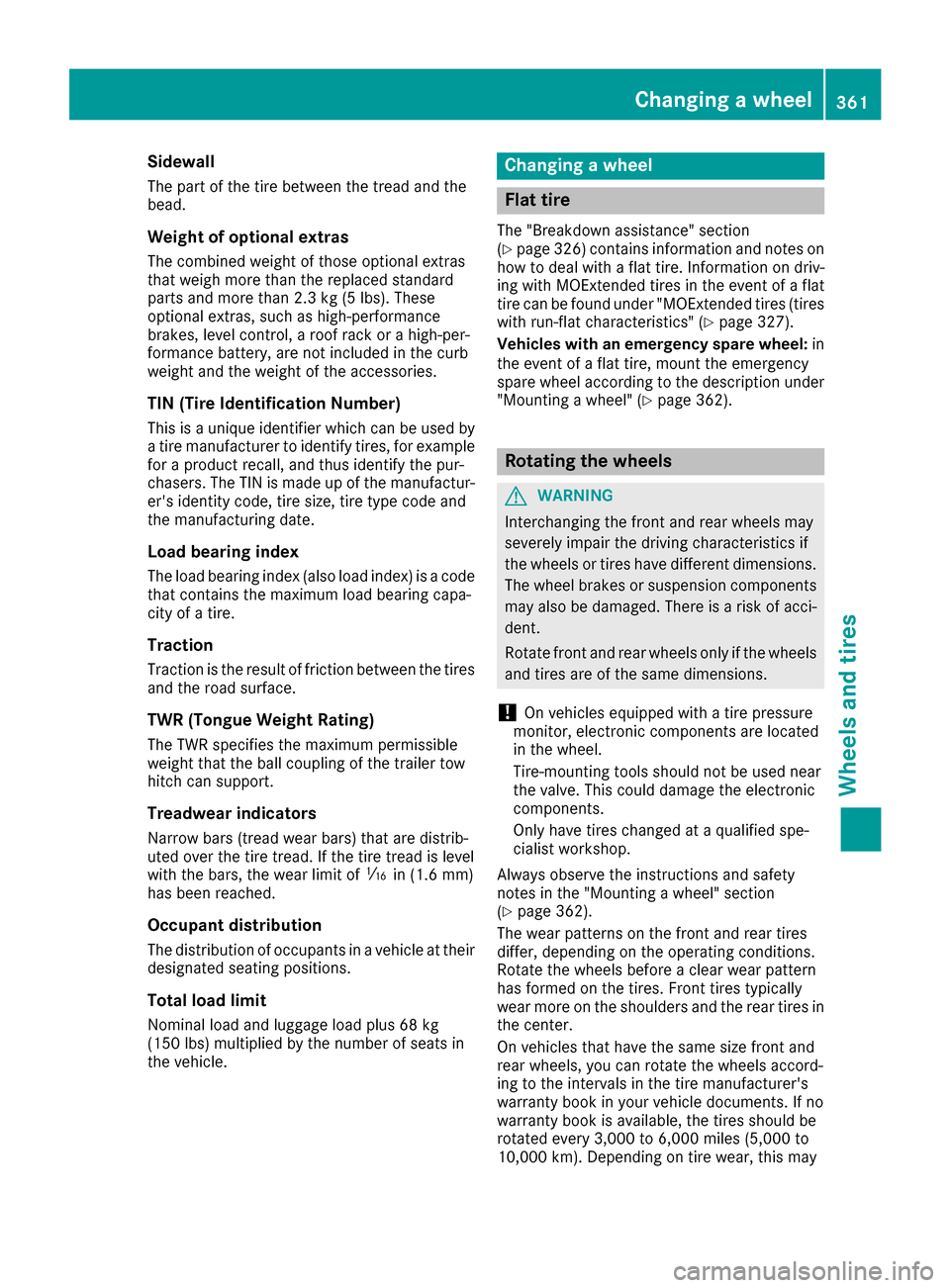
Rotating the wheels
GWARNING
Interchanging the front and rear wheels may
severely impair the driving characteristics if
the wheels or tires have different dimensions. The wheel brakes or suspension components
may also be damaged. There is a risk of acci-
dent.
Rotate front and rear wheels only if the wheels and tires are of the same dimensions.
!On vehicles equipped with a tire pressure
monitor, electronic components are located
in the wheel.
Tire-mounting tools should not be used near
the valve. This could damage the electronic
components.
Only have tires changed at a qualified spe-
cialist workshop.
Always observe the instructions and safety
notes in the "Mounting a wheel" section
(
Ypage 362).
The wear patterns on the front and rear tires
differ, depending on the operating conditions.
Rotate the wheels before a clear wear pattern
has formed on the tires. Front tires typically
wear more on the shoulders and the rear tires in
the center.
On vehicles that have the same size front and
rear wheels, you can rotate the wheels accord-
ing to the intervals in the tire manufacturer's
warranty book in your vehicle documents. If no
warranty book is available, the tires should be
rotated every 3,000 to 6,000 miles (5,000 to
10,000 km). Depending on tire wear, this may
Changing a wheel361
Wheels and tires
Z
Page 383 of 390
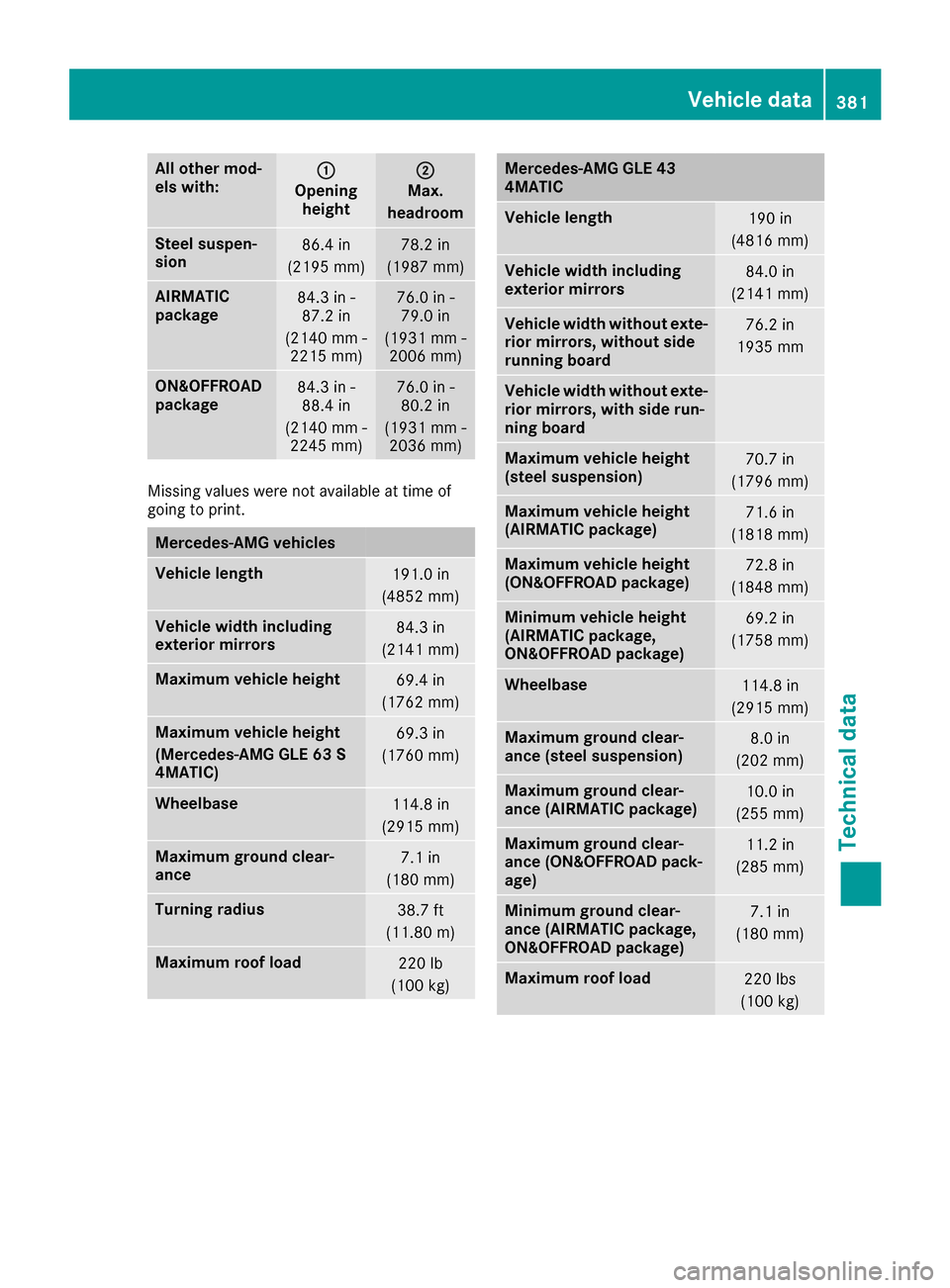
All othermod-
els with::
Opening height
;
Max.
headr oom
Steel suspen-
sion86.4in
(2195 mm )78.2 in
(1987 mm )
AIRMATIC
package84.3in-
87.2 in
(2140 mm -
2215 mm )76.0 in-
79.0 in
(1931 mm -
2006 mm )
ON&OFFROAD
package84.3 in - 88.4 in
(2140 mm -
2245 mm )76.0 in-
80.2 in
(1931 mm -
2036 mm )
Missingvalues were not available at time of
going to print.
Mercedes ‑AMG vehicles
Vehicle length191.0 in
(4852 mm)
Vehicle width including
exterior mirrors84.3 in
(2141 mm)
Maximum vehicle height69.4 in
(1762 mm)
Maximum vehicle height
(Mercedes-AMG GLE 63 S
4MATIC)69.3 in
(1760 mm)
Wheelbase114.8 in
(2915 mm)
Maximum ground clear-
ance7.1 in
(180 mm)
Turning radius38.7 ft
(11.80 m)
Maximum roof load220 lb
(100 kg)
Mercedes-AMG GLE 43
4MATIC
Vehicle length190 in
(4816 mm)
Vehicle width including
exterior mirrors84.0 in
(2141 mm)
Vehicle width without exte-
rior mirrors, without side
running board76.2 in
1935 mm
Vehicle width without exte-
rior mirrors, with side run-
ning board
Maximum vehicle height
(steel suspension)70.7 in
(1796 mm)
Maximum vehicle height
(AIRMATIC package)71.6 in
(1818 mm)
Maximum vehicle height
(ON&OFFROAD package)72.8 in
(1848 mm)
Minimum vehicle height
(AIRMATIC package,
ON&OFFROAD package)69.2 in
(1758 mm)
Wheelbase114.8 in
(2915 mm)
Maximum ground clear-
ance (steel suspension)8.0 in
(202 mm)
Maximum ground clear-
ance (AIRMATIC package)10.0 in
(255 mm)
Maximum ground clear-
ance (ON&OFFROAD pack-
age)11.2 in
(285 mm)
Minimum ground clear-
ance (AIRMATIC package,
ON&OFFROAD package)7.1 in
(180 mm)
Maximum roof load220 lbs
(100 kg)
Vehicle data381
Technical data
Z
Page 384 of 390
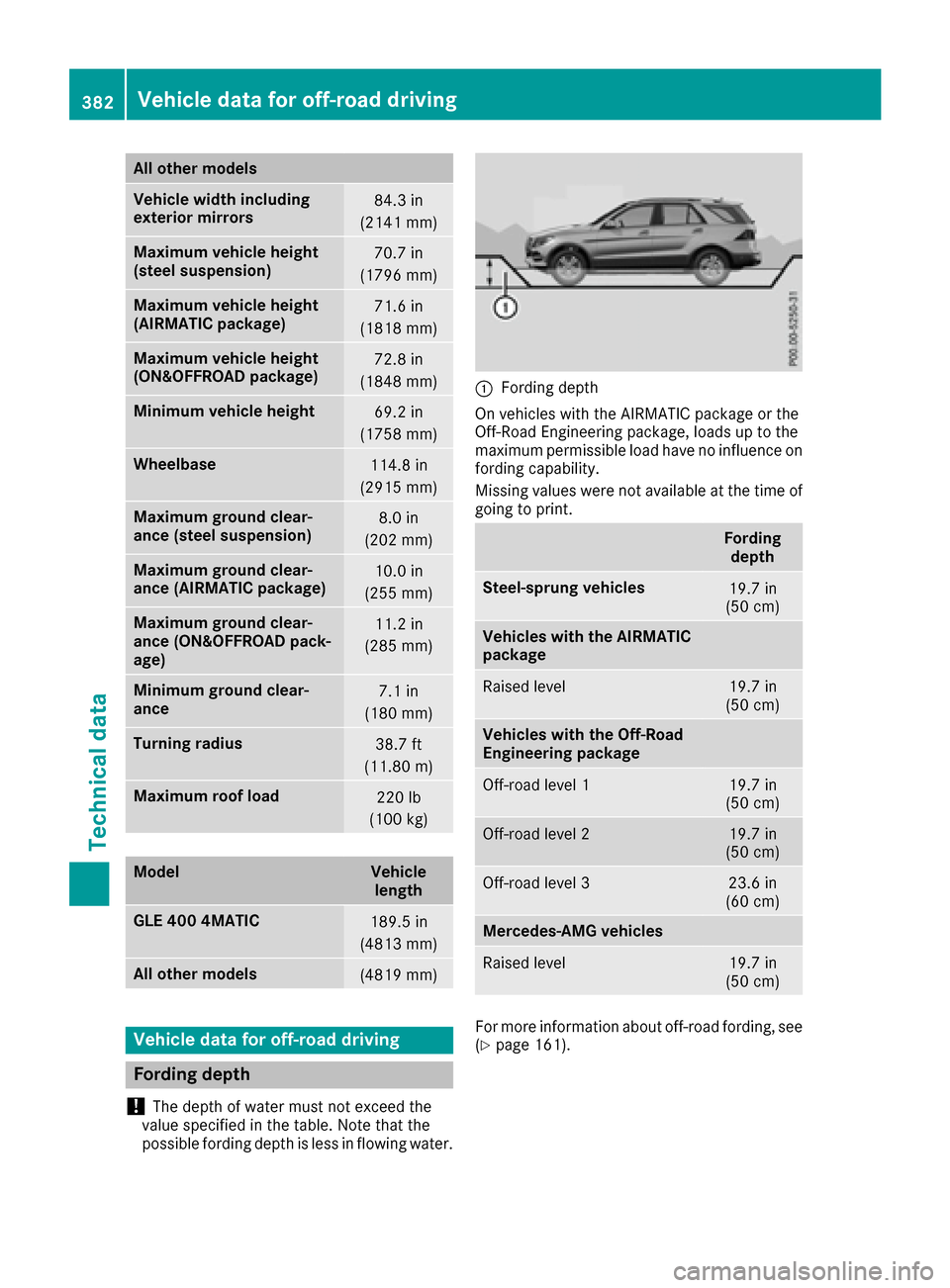
All othermodels
Vehicle width including
exteri ormir rors84.3 in
(2141 mm)
Maximum vehicle height
(steel suspension)70.7 in
(1796 mm)
Maximum vehicle height
(AIRM ATICpackage)71.6in
(1818 mm)
Maximum vehicle height
(ON&OFFROAD package)72.8 in
(1848 mm)
Mini mum vehicle height69.2 in
(1758 mm)
Wh eelbase114.8 in
(2915 mm)
Maximum ground clear-
ance (steel suspension)8.0 in
(202 mm)
Maximum ground clear-
ance (AIRM ATICpackage)10.0in
(255 mm)
Maximum ground clear-
ance (ON&OFFROAD pack-
age)11.2 in
(285 mm)
Mini mum ground clear-
ance7.1 in
(180 mm)
Tu rning radius38.7 ft
(11.80 m)
Maximum roofload220lb
(100 kg)
ModelVehicle length
GLE 400 4MATIC189.5 in
(4813 mm)
All other models(4819 mm)
Vehicle data for off-road driving
Fording depth
!
The dept h of water must not exceed the
value specifie din the table. Note that the
possible fordin gdept his less inflowing water.
:Fording depth
On vehicles with the AIRMATIC package or the
Off-Road Engineering package, loads up to the
maximum permissible load have no influence on
fording capab ility.
Missing values were not availab leat the time of
going to print.
Ford ing
depth
Steel-sprung vehicles19 .7in
(50 cm)
Vehicles with theAIRMATIC
package
Raised level19 .7in
(50 cm)
Vehicles with the Off-Road
Engineeri ngpackage
Off-road level 119.7in
(50 cm)
Off-road level 219 .7in
(50 cm)
Off-road level 323 .6in
(60 cm)
Mercedes-AMG vehicles
Raised level19 .7in
(50 cm)
For more information about off-road fording, see
(Ypage 161).
382Vehicle data for off-road driving
Technical data